• 검색 결과가 없습니다.

The Effects of Instrument-Activities Daily Living Training through Client-Centered Home Visitation on Cognitive Functions, Occupational Performance, and Instrument-Activities Daily Living among Elderly at the Cognitive Support Grade

N/A
N/A
Protected

Academic year: 2021

Share "The Effects of Instrument-Activities Daily Living Training through Client-Centered Home Visitation on Cognitive Functions, Occupational Performance, and Instrument-Activities Daily Living among Elderly at the Cognitive Support Grade"

Copied!
12
0
0

로드 중.... (전체 텍스트 보기)

전체 글

(1)

클라이언트 중심 가정방문 일상생활훈련이 인지지원등급, 노인의 인지기능, 작업수행, 일상생활수행도에 미치는 영향

손보영

1

방요순

1

빛고을전남대학교병원 작업치료사,

광주대학교 작업치료학과 교수

The Effects of Instrument-Activities Daily Living Training through Client-Centered Home Visitation on Cognitive Functions, Occupational Performance, and Instrument-Activities Daily

Living among Elderly at the Cognitive Support Grade

Son Boyoung, OT, Ph.D

1

Bang Yosoon, OT, Ph.D

1

Chnonam National University Bitgoeul Hospital, Occupational Therapist

2ǂ

Dept. of Occupational Therapy, Gwangju University, Professor

Abstract

Purpose : This study aims to investigate the effect of instrument-activities daily living training through client-centered home visitation on the cognitive functions, occupational performance, and instrument-activities daily living of elderly at the cognitive support grade(Grade6).

Methods : The subject of this study was a 66-year-old woman living in G Metropolitan City, who has been diagnosed with Alzheimer's and mild dementia. The study period was from March 17, 2020 through June 12, 2020, and the A-B-A' design, among the individual case experiments, was adopted as the study design. For the data analysis, descriptive statistic and visual analysis using graph were used for the change of cognitive functions, occupational performance, and instrument-activities daily living.

Results : The instrument-activities daily living provided through client-centered home visitation improved the subject's cognitive functions, occupational performance(performance, satisfaction) and instrument-activities daily living.

Conclusion : This study showed that daily life training through client-centered home visitation can help elderly people at the cognitive support grade select for themselves the problems of daily life caused by cognitive decline and practice specific action plans, thereby enabling them to maintain and improve the cognitive functions necessary for the performance of activities, such as comprehension, memory, and thinking skills. In addition, it is thought that the activities based on the subject's preferences, performance, and sense of importance assured the subject of feelings of motivation and the possibility of participation, and had a positive effect on the subject’s performance speed and rate. With the above in mind, Instrument-activities daily living client-centered home visitation is proposed as a potential practical intervention program for individuals. It can help elderly people at cognitive support grade to maintain and improve their functions, thereby delaying the progress of their condition to severe dementia.

Key Words : client-centered home visitation, cognitive function, cognitive support grade, instrument-activities daily living, occupational performance

2)

ǂ

교신저자 : 방요순, [email protected]

논문접수일 : 2020년 10월 12일 | 수정일 : 2020년 11월 3일 | 게재승인일 : 2020년 11월 6일

※ 본 논문은 광주대학교의 2020학년도 학술연구조성비를 지원 받았음.

(2)

Ⅰ . 서 론

치매는 한국인의 10대 사망원인으로 포함될 만큼 빠 르게 증가한다. 치매 유형은 알츠하이머 약 55만, 기타 약 12만, 혈관성 치매 약 6만명 순이었고, 중증도별은 경 도 약 31만, 중등도 약 19만, 최경도 약 13만이었다 (National institute of dementia, 2020). 우리나라는 경도, 최경도 발병률이 증가하는 만큼 초기 대응과 치료로 발 생 원인과 문제행동 대처, 인지기능 유지 및 개선을 위 한 끊임없는 개인적·사회적 개입을 지속해야 한다(Jang, 2019a).

경증치매는 단기 기억력 저하가 특징으로 최근 사건 의 회상 지연, 말과 행동의 반복, 환경 적응능력 저하 (Jang, 2020b), 경미한 인격장애, 의욕 저하, 집중력 감소 및 계산 착오, 우울, 무감동과 같은 감정 변화를 보인다 (Oh, 2019). 일상생활의 변화는 평소 수행 가능하던 개인 위생, 대·소변 조절, 식사, 옷 입기 등의 기본적 일상생활 (Kim, 2014)의 어려움뿐만 아니라, 집안관리, 약 복용, 재 정관리, 대중교통 이용과 같은 수단적 일상생활활동 수 행은 치매 초기부터 민감하게 감퇴기에 초기 치매관리 와 대응을 위해 중요하게 관찰해야 한다(Moon & Park, 2014). 초기 기억력 문제가 점차적으로 사람, 환경, 공간 적응문제를 초래하고, 이전의 생활 유지를 어렵게 한다 (Park, 2017). 이처럼 저하된 인지기능은 수단적 독립적 일상생활 수행을 감소시킬 뿐만 아니라, 간헐적 문제행 동, 정서행동, 더 나아가 기본적 일상생활수행도 저하시 킨다(Kim, 2015). 이에 초기 경증치매 노인의 잔존 인지 기능을 꾸준히 자극하고 개발할 수 있는 실질적인 수단 적 일상생활 프로그램(장보기, 산책하기 등)을 제공하여 생활의 긍정적 만족을 높여야 한다(Back & Jung, 2016).

2008년 노인장기요양보험제도는 중증질환 대상자에게 돌봄과 복지서비스를 도입하였지만, 신체기능의 제약이 없는 대상자들은 서비스의 사각지대에 놓여있었다 (Dementianews, 2018). 2014년 치매특별등급과 인지지원 등급의 추가 신설은 다양한 서비스를 확대 적용하는데 의의가 있었으나, 인지지원등급을 위한 지원서비스는 주·야간 보호, 치매가족휴가제, 복지용구의 지원뿐이었 다(Ministry of Health and Welfare, 2019). 이는 초기 인지

자극 및 일상생활 증진을 위한 프로그램 적용에 많은 제 약을 보였고, 치매안심센터에서는 경증치매를 위한 인지 예방 및 강화프로그램을 공급하였으나 등급별 프로그램 이 아닌 일괄적 시스템(Moon, 2018), 인지지원등급 대상 자들이 인지방문활동형 프로그램에서 제외된다는 점에 서 서비스의 효과성, 효율성에 대해 의문을 제기할 수밖 에 없는 상황이었다(Kwon, 2019).

국내 인지지원등급 관련 연구를 살펴보면, 인지지원등 급 이용자의 주·야간서비스 이용 경험(Kwon, 2019), 노 인복지관 중심의 두뇌/신체/영양, 인지재활 컨텐츠 활용, 정서 , 친구교류 등 집단 프로그램 적용(Editorial department, 2018)이었다. 이처럼 인지지원등급 관련 연 구는 지역사회 내 기관이용 참여 여부, 프로그램 관리 및 실태 파악의 연구일 뿐 인지지원등급 노인의 초기 인 지기능 저하 및 일상생활 증진을 위한 실천적 활동 적용 의 개발 및 효과성 검증에 대한 연구는 미흡하였다. 이 에 본 연구는 클라이언트 중심 자기관리 중재 (client-centered self-care intervention; CCSCI)를 적용하여 인지지원등급 대상자가 스스로 자신의 인지기능 저하의 문제점을 인식하고, 실천할 수 있는 체계적 목표와 계획 을 제공함으로써, 독립적 수행과 만족도의 증진을 가져 오고자 하였다. CCSCI는 치료사와 클라이언트가 자연스 러운 대화로 일상생활 수행의 어려움을 논의하고, 대상 자가 선정한 활동의 목표-계획-실행-확인을 위한 개인 적·전략적·집중적 전략을 세움으로써 만족도 높은 생활 을 제공한다(Guidetti 등, 2010). 따라서 본 연구는 인지지 원등급 노인 스스로 활동의 문제점을 파악하고, 인지적·

환경적 상황을 고려한 개별화 프로그램을 개발 및 적용 함으로써 인지기능의 향상뿐만 아니라 작업의 흥미, 만 족, 독립성 증진을 극대화 시키고자 하였다.

본 연구는 클라이언트 중심 가정방문 일상생활훈련이 인지지원등급 노인의 인지기능, 작업수행, 일상생활수행 도에 미치는 효과를 알아보고자 한다.

Ⅱ . 연구방법

1. 연구대상

(3)

대상자는 G광역시 N구, 66세, 162 ㎝, 55 ㎏의 여성 1 명이다. 2016년 G 광역시 소재 00병원 신경과 전문의로 부터 경증치매 및 알츠하이머 진단을 받았고, G 병원에 서 알츠하이머의 베타 아밀로이드의 축적 확인을 위한 Brain PEC-CT 검사 후, 양성을 확인하여 관련 약을 복용 중이다. 초기 및 재평가 검사에서 한국판 간이 정신상태 검사(MMSE-DS) 20점, 임상치매척도(CDR) 0.5점(치매의 심), 전반적 퇴화척도(GDS) 3단계(경미한 인지장애) 범 위에 해당하였다. 우울증과 인지기능에 영향을 미치는 정신과적 병력은 없다. 노인장기요양등급은 인지지원등 급을 부여받았다. 학력은 초등학교 중퇴, 의사소통에 문 제가 없고 읽고 쓰기가 가능하다. 기본적 독립측정(FIM) 은 125점 만점으로 완전 독립이다. 대상자의 기능적 독 립측정(FIM)을 평가하기 위해 수행한 독립측정(FIM)점 수는 121점이다. 연구 수행에 영향을 미칠 수 있는 시·청 각적 문제는 없으며, 연구 이전 유사한 프로그램의 참여 경험은 없었다. 연구대상자는 본 연구의 목적을 이해하 였으며 연구 참여에 동의하였다.

2. 연구설계

본 연구는 개별대상 실험 연구방법(single-subject experimental research design) 중 반전연구(reversal design) 인 A-B-A´ 설계이다. 개별대상연구는 개별적·객관적·귀 납적 접근의 연구방법으로(Yang, 2015a) 독립변수와 종 속변수 간의 인과관계, 치료 효과의 직접측정이 가능한 실험설계이다(Park 등, 2018). 개별대상연구는 객관적 평 가의 일관성, 중재 효과의 수량화 등의 통계적 분석과 시각적 분석을 병행할 때 중재효과의 결과 입증이 가능 하다(Yang, 2015b).

연구는 2020년 03월 17일부터 06월 12일까지 G광역시 에 거주하는 대상자의 지역사회 내 환경을 이용하여 13 주 동안 기초선(A) 4회기, 중재 기간(B) 30회기, 재기초 선 기간(A´) 3회기, 총 37회기로, 1회당 60분씩 주 3회 (화, 수, 금)를 진행하였다.

1) 기초선(A)

중재 전 대상자의 인지기능, 작업수행, 일상생활수행

도 측정값의 안정성을 파악하기 위한 기간이다. 인지기 능 측정은 한국판 몬트리올 인지평가(Korean Version of the Montreal Cognitive Assessment; K-MoCA)과 한국판 노인용 로웬스타인 작업치료 인지 평가(Lowenstein Occupational Therapy Cognitive Assessment-Geriatric;

LOTCA-G)로 하였다. 한국판 몬트리올 인지평가 (K-MoCA)는 안정된 수치에 도달했을 때까지로 연속 3 회기를 측정하였다. 한국판 노인용 로웬스타인 작업치료 인지평가(LOTCA-G)과 한국판 Instrumental Activities of Daily Living(Korean Version of Instrumental Activities of Daily Living; K-IADL), 캐나다작업수행(Canadian Occupational Performance Measure; COPM)은 중재 전 첫 회기 실시하였다.

2) 중재 기간(B)

클라이언트중심 가정방문 일상생활훈련은 기초선 동 안 인지기능의 측정값이 안정화되는 시점부터 총 30회 기를 진행하였다. 매 회기 클라이언트중심 가정방문 일 상생활훈련 종료 후 , 인지기능(K-MoCA) 측정값은 연속 3회기로 안정된 수준을 보일 때까지였다.

3) 재기초선 기간(A´)

인지기능, 작업수행, 일상생활수행도의 변화를 알아보 기 위한 기간으로, 기초선과 동일한 방법으로 측정하였 다.

3. 연구도구

1) 측정도구

(1) 한국판 몬트리올 인지평가(Korean Version of the Montreal Cognitive Assessment; K-MoCA)

MoCA는 Nasreddine 등(2005)이 개발한 경도인지장애

선별을 위한 도구로, Lee 등(2008)이 한국어로 수정·보완

한 도구를 사용하였다. 항목은 시간공간실행력, 어휘력,

주의력, 문장력, 추상력, 지연회상력, 지남력이다(Lee,

2019). 총 30점 만점, 23점 이상(정상), 22점 이하(경도인

지장애)로 구분한다. 도구의 신뢰도는 Cronbach's α=.84

(4)

이었다(Song, 2013).

(2) 한국판 노인용 로웬스테인 작업치료 인지 평가 (Lowenstein Occupational Therapy Cognitive Assessment- Geriatric Population; LOTCA-G)

LOTCA-G는 Katz 등(1995)이 개발한 도구로, Cha(2008)가 우리나라 실정에 맞게 수정·보완한 도구를 사용하였다. 문항은 지남력, 지각, 실행, 시각운동 조직 력, 사고조직력, 기억력, 주의력과 집중력, 7개 영역, 24 항목이다. 점수는 최소 1점, 최대 4점(지남력 항목 예외:

최소 1점, 최대 8점), 총점은 최소(24점)에서 최대(104점) 으로 점수가 높을수록 인지 기능이 높다(Katz 등, 1995).

도구의 신뢰도는 Cronbach's α=.89이었다(Son, 2013).

(3) 한국판 Instrumental Activities of Daily Living(Korean Version of Instrumental Activities of Daily Living;

K-IADL)

K-IADL은 Lawton과 Brody(1969)가 개발한 도구로, Won 등(2002)이 우리나라 실정에 맞게 수정·보완한 도 구를 사용하였다. 문항은 시장보기, 교통수단이용, 돈 관 리, 집안일 하기, 음식준비, 전화사용, 약복용, 최근기억, 취미생활, 텔레비전 시청, 집안수리로, 11항목이다(Lee, 2018). 점수는 0점 ‘혼자 가능, 정상’, 1점 ‘약간 도움 필 요, 약간 어려움 있음’, 2점 ‘많은 도움 필요, 많은 어려 움 있음’, 3점 ‘불가능’ 이다. 총점은 ‘해당 없음’을 제외 한 항목의 합산 점수를 개수로 나눈 점수로, 0점에 가까 울수록 독립적 일상생활 수행이 가능하다(Ham, 2017).

도구의 신뢰도는 Cronbach's α=.96이었다(Kang 등, 2002).

(4) 캐나다 작업수행 측정(Canadian Occupational Performance Measure; COPM)

COPM은 Law 등(1990)이 개발한 도구로, 영역은 자조 관리(self-care), 생산성(productivity), 여가(leisure) 이다 (Kim, 2018). 방법은 클라이언트가 치료사와의 반구조화 된(semi-structured) 인터뷰로 진행되며 중요도가 가장 높 은 최대 다섯 가지 과제에 우선순위를 두어 수행도, 만 족도를 1점에서 10점 척도로 측정한다(Jeon, 2020). 도구 의 검사-재검사 신뢰도는 r=.84-.92이었다(Kang, 2012).

2) 중재 방법

(1) 클라이언트 중심 가정방문 일상생활활동 훈련 본 연구는 Guidetti 등(2010)과 Baek과 Jung(2016)의 연 구를 수정·보완하여 인지지원등급 대상자의 인지기능 저하 수준, 작업수행, 일상생활활동의 영역을 파악하여 실시하였다.

연구자는 CCSCI와 COPM을 기반으로 대상자와의 면 담 및 활동 선택을 진행하였다. 첫째, 대상자는 캐나다 작업수행 평가(COPM)의 자기관리, 생산적인 활동, 여가 활동 영역 중 ‘하고 싶은 것’, ‘필요한 것’, ‘기대하는 것’

을 생각하였고, 작업의 중요도, 수행도, 만족도를 10점 척도로 점수를 부여하였다. 선정한 활동은 자기관리 영 역의 지역사회 관리에서 대중교통(지하철) 이용, 핸드폰 인터넷 사용, ATM(현금자동입출금기)기기 이용이었고, 생산성 영역의 가정관리에서 요리 배우기, 여가 영역의 정적인 취미영역에서 맞춤법 배우기, 예쁜 글씨 배우기, 활동적인 취미영역의 영화관 가기, 장구, 자전거 배우기 를 선택하였다. 둘째, 연구자는 대상자와 지속성, 효과 성, 주의사항 등을 논의하였고, 최종 활동을 구체화하였 다. 최종 활동은 한글 맞춤법 배우기, ATM기기에서 현 금 인출하기, 지하철 이용하여 시장 다녀오기이었다. 셋 째, 연구자는 대상자의 신체적·심리적 부담을 최소화하 고, 적응속도, 구체적 사고, 환경의 위험성, 타인과의 접 촉 등을 고려하였으며, 세분화된 목표와 방법으로 대상 자의 잠재능력을 촉진시켜 수행의 질과 만족도 등을 달 성하고자 하였다(Table 1).

4. 중재 충실도 및 사회적 타당도

중재 충실도는 중재 목적에 따라 일관성 있는 수행을 평가한다. 진행은 보조 관찰자 작업치료사 1명이 회기 중 30 %를 무작위 관찰 및 측정하였고(Lee, 2017), 전체 문항의 점수 합/전체 문항수*100의 공식에 대입하였다 (Kang 등, 2015). 중재 충실도는 100 %이었다. 사회적 타 당도는 중재의 효과성과 유용성을 측정한다. 진행은 보 조 관찰자 작업치료 1명이 전체 문항의 점수 합/전체 문 항수 *100의 산출 공식을 적용하였다(Son & Bang, 2020).

사회적 타당도는 100 %이었다.

(5)

Session Activities Activities step

1~10 Learning Korean spelling

1. The subject selects a preferred keyword.

2. The researcher finds newspaper clippings related to the keyword.

3. The researcher reads the newspaper slowly and repeatedly to the subject.

4. The subject remembers, recalls, and writes down the contents of the newspaper articles.

5. Together with the subject, the researcher selects the spellings and words that need correction.

6. The researcher and the subject practice the activity together using the selected dictation textbook.

7. The subject practices the dictation contents repeatedly for each session.

8. The researcher reads the newspaper article, and the subject takes the dictation.

9. The researcher checks the subject's writing speed and success rate.

10. The subject expresses her thoughts, feelings, and satisfaction about the process.

11~20 Withdrawing cash from an ATM

1. The researcher asks the subject which bank she uses frequently.

2. The researcher describes the ATM of G bank, near the subject's home.

3. The subject goes to the ATM with the researcher.

4. The researcher observes how the subject uses the ATM.

5. The researcher provides a practice card for learning how to use an ATM.

6. The subject figures out the correct directions of the card for use and practices repeatedly.

7. The subject explains how to withdraw cash from an ATM without the practice card.

8. The subject withdraws cash from the ATM.

9. The researcher checks the subject’s use speed and success rate.

10. The subject expresses her thoughts, feelings, and satisfaction about the process.

21~30

Going to the market by

subway

1. The researcher explains to the subject which is the closest subway station.

2. The subject goes to the subway station with the researcher.

3. The researcher observes how the subject uses the subway.

4. The researcher goes to the market by subway with the subject.

5. The researcher provides a practice card for learning how to use the subway.

6. The subject figures out from the card the correct directions for subway use and practices repeatedly.

7. The subject explains how to use the subway without the practice card.

8. The subjects go to the market by subway.

9. The researcher checks the subject’s use speed and success rate.

10. The subject expresses her thoughts, feelings, and satisfaction about the process Table 1. Home-base activities program

5. 분석방법

본 연구는 클라이언트 중심 가정방문 일상생활훈련이 인지지원등급 노인의 인지기능, 작업수행, 일상생활수행 도에 미치는 효과를 확인하기 위해 기술통계 및 그래프 를 이용한 시각적 분석법을 사용하였다. 기초선, 중재기

간, 재기초선 기간 측정값의 평균은 한국판 회기별 몬트

리올 인지평가(K-MoCA)의 구간 변화율을 시각적 그래

프로 제시하였다. 중재 전·후 한국판 노인용 로웬스테인

작업치료 인지평가(LOTCA-G)와 한국판 Instrumental

Activities of Daily Living(K-IADL), 캐나다작업수행

(COPM)의 측정값 평균은 SPSS Version 20.0의 기술통계

(6)

를 사용하여 비교·분석하였다.

Ⅲ . 결 과

1. 대상자의 중재 전·후 인지기능의 변화

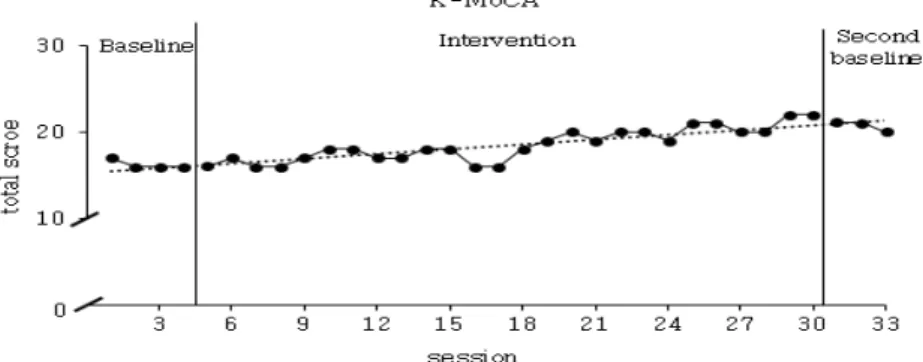
대상자의 K-MoCA의 인지기능 변화는 구간 변화율로 시각적 결과를 제시하였다. 인지기능 평균은 기초선 16 점, 중재기간 19점, 재기초선 21점으로 증가하였다. 표준

편차를 활용한 통계적 분석 결과는 대상자의 기초선 평 균과 중재단계 평균에서 ±2 표준편차의 차이를 나타내 었기에 통계적으로 유의미하며, 중재효과가 있음을 확인 하였다(Fig 1).

대상자의 LOTCA-G의 인지기능 변화를 살펴보면, 인 지기능 총점은 83점에서 93점으로 증가하였다. 하위항목 은 지남력(14점에서 16점), 지각력(26점에서 27점), 운동 실행 (11점에서 12점), 시각운동조직(18점에서 20점), 사 고조직과 기억력(5점에서 7점)으로 증가하여 중재효과 를 나타내었다(Fig 2).

Fig 1. Cognitive function in changes(K-MoCA)

Fig 2. Cognitive function in changes(LOTCA-G)

2. 대상자의 중재 전·후 작업수행의 변화

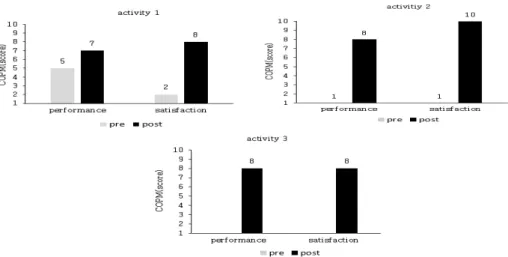
대상자의 작업수행의 변화를 살펴보면, activity 1(한글 맞춤법 배우기)의 수행도는 5점에서 7점, 만족도는 2점 에서 8점으로 증가하였다. activity 2(ATM 기기 이용하여

현금 인출하기)의 수행도는 1점에서 8점, 만족도는 1점

에서 10점으로 증가하였다. activity 3(지하철 이용하여

시장 다녀오기)의 수행도와 만족도는 0점에서 8점으로

증가하여 중재효과를 나타내었다(Fig 3).

(7)

Fig 3. Occupational performance in changes(COPM)

3. 대상자의 중재 전·후 일상생활수행도의 변화

대상자의 일상생활수행도의 변화를 살펴보면, 총점 은 12점에서 8점으로 감소하여 중재효과를 나타내었다 (Fig 4).

Fig 4. Instrument-activities daily living in changes (IADL)

4. 대상자의 중재 전·후 활동 수행속도 및 성공률의 변화

대상자의 활동 수행속도 및 성공률의 변화를 살펴보 면, activity 1의 평균 수행속도는 30분에서 20분으로 감 소하였고, 평균 성공률은 40 %에서 75 %로 증가하였다.

activity 2의 평균 수행속도는 35분에서 17분으로 감소 하였고, 평균 성공률은 10 %에서 95 %로 증가하였다.

activity 3의 평균 수행속도는 60분에서 30분으로 감소 하였고, 평균 성공률은 10 %에서 78 %로 증가하였다 (Fig 5).

Fig 5. Activities time and success in changes (min, %)

(8)

Ⅳ . 고 찰

치매는 광범위한 뇌 기능 손상에 의한 정신기능 감퇴, 의식주를 포함한 일상생활 및 사회생활, 대인관계의 문 제로(Han 등, 2010) 개인과 부양자에게 신체적‧정신적‧경 제적 부담을 초래한다. 국가는 기존 장기노인요양등급 대상자 이외 치매특별등급과 인지지원 등급을 신설하여 다양한 인지기능 개선 프로그램들을 제공하고자 하였지 만, 초기 치매 노인들은 인지프로그램의 비효과성, 환경 의 부적응 등과 같은 시스템에 불만을 호소하였다 (Kwon, 2019). 이에 본 연구는 개인의 인지기능과 일상 생활 수행수준을 파악하고, 계획 및 검증하여 적용 가능 한 프로그램을 제공하고자 하였다. 따라서 본 연구는 클 라이언트 중심 가정방문 일상생활훈련이 인지지원등급 노인의 인지기능, 작업수행, 일상생활 수행도에 미치는 효과를 알아보고자 하였다.

첫째, 클라이언트 중심 가정방문 일상생활훈련은 인지 지원등급 노인의 인지기능과 작업수행을 향상시켰다. 중 재 전 대상자는 최근 사건에 대한 기억력 저하로 반복질 문, 상황판단 미흡, 이해력 저하 등을 보였지만, 우울, 좌 절, 대인관계 기피 반응은 없었다. 중재 기간 첫 번째 활 동은 한글 맞춤법 배우기였다. 대상자는 관심 있는 주제 (운동, 결혼, 코로나)를 선택하였고, ‘글을 제대로 배워보 고 싶었어요’, ‘잘 할 수 있을까요’ 등의 주저함과 설레 는 모습이었다. 초기(1~3회기)에는 ‘잘 안되네요’, ‘틀린 것 같아요’ 등의 소극적 태도를 보였지만, 회기가 진행 될수록 맞춤법 큰소리 읽기, 반복쓰기, 올바른 맞춤법 선 택하기, 음절표 퍼즐 맞추기 등의 반복․연습 과정이 높은 집중력과 몰입을 이끌었다. 이는 단어와 문장에 대한 기 억, 판단, 정확도 등이 향상되면서 작업수행, 만족도, 수 행속도, 성공률의 개선을 보였으나 단어 노출의 양, 겹받 침 이해, 잘못된 표기법 등으로 100 % 목표 달성은 어려 웠다. 두 번째 활동은 ATM (현금자동입출금기)기기에서 현금 인출하기 이었다. 대상자는 ATM 기기 이용 경험이 전무 하였고, 평소 은행직원의 도움을 받아 현금을 인출 하였기에 활동에 대해 ‘재미있을 것 같아요’, ‘혼자서 해 낼 수 있겠죠’ 등의 적극적 태도의 모습이었다. 초기(1~3 회기)에는 ATM 기기 조작카드 이해와 배열에 ‘그냥 하

지 말까요’, ‘쉬워 보였는데 어렵네요’ 등의 난감한 모습 이었지만, 회기가 진행될수록 활동카드의 그림을 대상자 만의 기억방법으로 반복․연습하면서 배열속도, 정확도가 증진되었다. 이는 ‘카드로 연습한 것이 실행에서 많은 도움이 되요’ 라고 표현할 만큼 ATM 기기 이용에 필요 한 기억, 연상, 순서화 등의 인지기능이 향상되면서 작업 수행 , 만족도, 수행속도, 성공률의 개선을 보였으나 타인 과의 접촉, 화면조작 실패 등의 돌발 상황에 즉각적인 대처부족으로 100 % 목표 달성은 어려웠다. 세 번째 활 동은 지하철 이용하여 시장 다녀오기였다. 대상자는 지 하철 이용 경험이 전무하였고, 시간적‧경제적 교통수단 임을 인식하였지만 ‘너무 어려울 것 같아요’, ‘다른 곳에 서 내리면 어떻게 하죠’ 등의 불안, 초조, 두려움의 모습 이었다. 초기 진행(1~3회기)에는 ‘활동 중 가장 어렵네 요’, ‘굉장히 복잡한 것 같아요’ 등의 고민과 막막한 모 습이었지만 회기가 진행될수록 지하철 타기 전 개찰구, 카드 인식하는 곳 등을 실제 현장과 같은 분석카드로 반 복․연습함으로써 거부감을 낮추었다. 이는 ‘사람이 많지 않아서 좋네요’, ‘빨리 배웠으면 좋았을 것 같아요’ 라고 표현할 만큼 자신감 있는 모습이었고, 긴장감을 놓지 않 는 모습이 지하철 이용에 필요한 지남력, 조직화, 기억, 구체화, 시공간 등의 인지기능의 향상과 작업수행, 만족 도, 수행속도, 성공률의 개선을 보였으나 시선 분산, 카 드 충전 등의 돌발 상황에 즉각적인 대처부족으로 100

% 목표 달성은 어려웠다. Ko와 Kim(2018)은 경증치매

노인을 위한 내용 주제 연결하기, 모의 물건 판매하기

등의 동작과 일상을 자극하는 인지활동과 신체 , 회상프

로그램이 인지기능과 일상생활활동을 향상시켰고, 자음

으로 된 글자조합훈련, 위치·모양, 순서 기억하기 등의

과제를 통한 컴퓨터 인지프로그램은 인지기능, 우울, 생

활만족도, 일상생활을 향상(Kim과 Choi, 2019)시켰으며,

Park과 Shin(2019)은 치매노인을 위한 쇼핑목록 기억하

기, 식사 준비를 위한 계획 세우기, 교통수단 이용을 위

한 지도 그리기 등의 도구적 일상생활인지훈련은 주관

적 기억력 감퇴를 감소시켰고, 전반적인 인지기능과 삶

의 질은 유지하여 본 연구의 결과를 지지하였다. 이에

클라이언트 중심 가정방문 훈련은 복잡한 환경과 상호

작용하여 만들어가는 접근을 간결하면서도 단계적으로

제공하여 치매안심센터의 거부감이 있는 경증치매 노인

(9)

의 몰입과 집중, 안정 등의 인지적·심리적 능률을 높여 인지기능과 작업수행도와 만족도에 긍정적 영향을 미쳤 다고 사료된다.

둘째, 클라이언트 중심 가정방문 일상생활훈련은 인지 지원등급 노인의 일상생활수행도를 향상시켰다. 대상자 는 개인위생, 식사하기, 옷 입기, 보행 등과 같은 기본적 일상생활활동을 보호자의 도움 없이 독립적으로 유지하 였지만, 수단적 일상생활활동은 집안일 하기, 취미 생활, 텔레비전 시청은 독립적 수행이 가능하였고, 시장보기, 음식준비, 전화사용은 약간의 도움, 교통수단이용, 돈 관 리, 약 복용, 최근 기억은 많은 도움이 필요로 하였다. 본 연구의 클라이언트 중심 가정방문 일상생활훈련은 대상 자의 기능적 수준과 선호, 수행, 만족도를 고려한 구성으 로 복잡한 환경과의 상호작용 안에서 시각적·청각적 정 보를 연습하고 학습하여 실제 수행으로 연결지어줌으로 써 행동조절, 계획, 인지과정의 향상이 일상생활수행 능 력을 향상시켰다고 사료된다. Joo(2019)는 일상생활활동 훈련은 자기관련 건강상태와 전화사용, 물건 사기, 음식 준비/요리 등의 일상생활활동의 독립적 수행정도의 현재 실행기능을 향상시켰고, 보행, 청소, 계단 오르기, 놀기 등의 신체활동은 에너지 소비를 일으키는 움직임으로 (Kang, 2018) 혈액순환의 개선이 뇌 기능, 신체기능을 증 진시켜 일상생활활동의 독립성을 증진시켰으며(Kim 등, 2015), 상 닦기, 창문 열고 닫기, 차 준비하기, 장보기 등 과 같은 과제지향적 훈련이 가소성 및 학습을 증진시켜 실행기능과 수단적 일상생활을 향상(Moon과 Park, 2014) 시켰다. 또한 시설, 병원, 기관이 아닌 지역사회 환경을 이용한 활동은 클라이언트의 개인적 요소, 의미 있는 작 업 수행을 이끌어낸다고 하여(Baek과 Lee, 2013), 본 연 구의 결과를 지지하였다. 이처럼 일상생활훈련은 인지지 원등급 대상자의 실제 환경, 상황, 수행능력을 기반으로 활동을 구체적·단계적·분석적으로 접근하여 목표를 실 행하고, 성취함으로써 인지적 향상과 수단적 일상생활수 행능력과 만족도에 긍정적 영향을 미쳤다. 이는 클라이 언트 중심 가정방문 일상생활훈련이 기존 아로마·미술·

음악치료, 전산화 인지프로그램 등의 다수가 함께하는 공통의 목표, 인지기능의 특성, 환경적 제약(Jung과 Seo, 2017), 일상생활중심 서비스 제공의 높은 요구(Kim과 Um, 2015) 등을 보완할 수 있는 방문재활서비스의 대안

적 접근방법으로의 의의가 있다고 사료된다.

본 연구의 제한점은 첫째, 인지지원등급 노인 1명으로 한 A-B-A’설계로 중재와 효과성을 전체 인지지원등급 노인의 기능적 연구결과로 일반화하는데 한계가 있다.

둘째 , 사용된 도구의 반복 노출로 자료 분석에 주의가 필요하다 . 셋째, 다양한 연구 설계, 대상자 수, 환경 등을 고려한 반복연구가 필요하다. 추후 치매특별등급과 인지 지원등급의 비교집단을 통한 초기 인지기능을 활성화시 킬 수 있는 맞춤형 프로그램의 임상적 연구의 검증이 필 요하다고 사료 된다.

Ⅴ . 결 론

본 연구는 클라이언트 중심 가정방문 일상생활훈련이 인지지원등급 노인의 인지기능, 작업수행, 일상생활수행 도에 미치는 효과를 알아보기 위해 개별사례실험 연구 중 A-B-A´설계를 적용하였다.

본 연구의 클라이언트 중심 가정방문 일상생활훈련은 인지지원등급 노인 스스로 인지기능 저하에 따른 일생 상활의 문제를 선택하고, 구체적 실행 계획을 실천해봄 으로써 활동수행에 필요한 이해력, 기억력, 사고력 등의 인지기능을 유지 및 향상시켰다. 또한 대상자의 선호도, 수행도, 중요도를 기반으로 한 활동이 참여 동기와 가능 성을 확인함으로써 수행속도와 수행률에 긍정적 영향을 미쳤다고 사료 된다. 이에 클라이언트 중심 가정방문 일 상생활훈련은 인지지원등급 노인의 기능을 유지 및 향 상시킴으로써 중증 치매로의 이환을 지연시킬 수 있는 개별적․실천적 프로그램의 토대를 마련할 수 있는 중재 프로그램으로서 제안하는 바이다.

참고문헌

Baek DR, Jung HR(2016). Effect of client-centered home-based occupational therapy service on activity participation of clients with a special dementia ratings:

a case study. Korean J Occup Ther, 24(2), 83-98.

(10)

https://doi.org/10.14519/jksot.2016.24.2.07.

Baek YR, Lee JS(2013). Occupational performance and leisure activity participation level research according to cognitive level of the elderly with dementia. Korean J of Occup Ther, 21(3), 61-74.

Cha YJ(2008). Reliability and validity of Korean version LOTCA-G. Graduate school of Chungnam National University, Republic of Korea, Master’s thesis.

Editorial Department(2018). Direction of operation of a pilot project for cognitive support service at elderly welfare centers according to the establishment of cognitive support grade. Korean Soc Gerontol Social Welfare Spring Conference, 18(6), 128-137.

Guidetti S, Andersson K, Andersson M, et al(2010).

Client-centered self-care intervention after stroke: a feasibility study. Scand J Occup Ther, 17(4), 276-285.

https://doi.org/10.3109/11038120903281169.

Ham MJ(2017). The effects of a multimodal interventional occupational therapy program on cognitive function, activities of daily living and quality of life in patients with mild Alzheimer's disease. Graduate school of Konyang University, Republic of Korea, Master’s thesis.

Han YR, Song MS, Lim JY(2010). The effects of a cognitive enhancement group training program for community-dwelling elders. J Korean Acad Nurs, 40(5), 724-735. https://doi.org/10.4040/jkan.2010.40.5.724.

Jang HB(2020a). Types of problem behaviors of elderly with mild dementia art education program development.

Graduate school of Sookmyung Women’s University, Republic of Korea, Master’s thesis.

Jang SY(2020b). The effect of group art therapy applying play on helplessness and social behavior of the elderly with mild dementia. Graduate school of Konkuk University, Republic of Korea, Master’s thesis.

Jeon BR(2020). The effects of multiple cognitive intervention training on cognitive function, depression and occupation performance in patients with early onset dementia. Graduate school of Cheongju University, Republic of Korea, Master’s thesis.

Joo AY(2019). The effect of occupation-oriented physical activity on the health status, activities of daily living and cognition in persons with mild dementia. Graduate school of Kaya University, Republic of Korea, Master’s thesis.

Jung MS, Seo YH(2017). The study on the actuality of utilization and satisfaction of the typical Seoul daycare center.-focusing on the day care center Yeongdeungpo-gu, Seoul-. Korean Journal of 21st Century Social Welfare, 14(2), 205-236.

Kang DH(2012). Utility of the Canadian Occupational Performance Measure in evaluating the outcome of rehabilitation services for people with mental disorders.

Korean J Occup Ther, 20(4), 125-136.

Kang DK, Park JY, Jung JH, et al(2015). Development of combined aquatic exercise program to improve functional fitness and cognitive function for elderly with mild dementia. Exerc Sci, 24(4), 415-423.

https://doi.org/10.15857/ksep.2015.24.4.415.

Kang HW(2018). Factors influencing insufficient physical activity in community-dwelling elderly individuals with dementia: using a 2014 survey of living conditions of elderly individuals. Korean Soc Health Service Manag, 12(1), 109-121. https://doi.org/10.12811/kshsm.2018.12.1.109.

Kang SJ, Choi SH, Lee BH, et al(2002). Korean dementia research group, the reliability and validity of the Korean Instrumental Activities of Daily Living (K-IADL). J Korean Neurol Assoc, 20(1), 8-14.

Katz N, Elazer B, Itzkovich M(1995). Construct validity of a geriatric version of the Loewenstein Occupational Therapy Cognitive Assessment (LOTCA) battery. Phys Occup Ther Geriatr, 13(3), 31-46. https://doi.org/

10.1080/j148v13n03_03.

Kim DH, Um KW(2015). A study on care experience of

family members of the elderly with dementia after

policy implementation of dementia special

rating-focusing on difficulty of care and necessary social

services-. Korean Journal of Gerontological Social

Welfare, 70, 349-371.

(11)

Kim EY(2018). Effectiveness of Cognitive Orientation to Daily Occupational Performance (CO-OP) on occupational performance and executive function in children with autism spectrum disorder. Graduate school of Yonsei University, Republic of Korea, Master’s thesis.

Kim JN, Lee CD, Park JH(2015). Effect of exercise program on activity of daily living in patients with dementia: a systematic review. Therapeutic Sci Neurorehabil, 4(2), 7-15. https://doi.org/10.22683/

tsnr.2015.4.2.007.

Kim SY, Choi YI(2019). Effects of a computerized cognitive training on cognitive, depression, life satisfaction and activity of daily living in older adults with mild dementia. J Korea Acad Industr Cooper Soc, 20(4), 311-319. https://doi.org/10.5762/KAIS.2019.

20.4.311.

Kim YN(2015). Factors related to the elderly with mild dementia using of the long-term care class five service.

Graduate school of Kyungpook University, Republic of Korea, Master’s thesis.

Kim YR(2014). The effects of the reminiscence therapy program on the perception, daily living performance abilities and depression of the elderly suffering from dementia. Graduate school of Daegu Haany University, Republic of Korea, Doctoral dissertation.

Ko KA, Kim YE(2018). A study on the effectiveness of cognitive activity integration program designed for the aged with mild dementia. J Digit Converg, 16(2), 431-440. https://doi.org.libproxy.jnu.ac.kr/10.14400/JDC.

2018.16.2.431.

Kwon JH(2019). Experience of cognitive support grade using day and night protection services. Korean Acad Long-Term Care Spring Conference Package Materials, 19(0), 23-34.

Law M, Baptiste S, McColl M, et al(1990). The Canadian Occupational Performance Measure: an outcome measure for occupational therapy. Can J Occup Ther, 57(2), 82-87. https://doi.org/10.1177/000841749005700207.

Lawton MP, Brody EM(1969). Assessment of older people:

self-maintaining and instrumental activities of daily living. Gerontologist, 9(3), 179-186.

Lee AJ(2017). Exploring the effects of phonics intervention through RTI model for students with spelling disabilities. Graduate school of Kookmin University, Republic of Korea, Doctoral dissertation.

Lee JC(2019). A qualitative research on the service experience of cognitive support rating service provider.

Graduate school of Seoul Cyber University, Republic of Korea, Master’s thesis.

Lee JY, Lee DW, Cho SJ, et al(2008). Brief screening for mild cognitive impairment in elderly outpatient clinic:

validation of the Korean Version of the Montreal Cognitive Assessment. J Geriatr Psychiatry Neurol, 21(2), 104-110. https://doi.org/10.1177/0891988708316855.

Lee SH(2018). The effects of the physical activity with cognitive stimulation program on cognitive ability and instrumental activity daily living, quality of life in the mild cognitive impairment. Graduate school of Hallym University, Republic of Korea, Master’s thesis.

Lee YJ(2019). Effect of cognitive programs of arbitration type on cognitive function, self-esteem, and life satisfaction of the elderly with minor dementia.

Graduate school of Dongshin University, Republic of Korea, Master’s thesis.

Moon JH(2018). Verification of effectiveness of acceptance commitment therapy program for improvement of self-integrity in patients with mild dementia. Graduate school of Keimyung University, Republic of Korea, Master’s thesis.

Moon MS, Park JH(2014). The effects of task-oriented training on IADL in dementia : case study. Therapeutic Sci Neurorehabil, 3(1), 67-77. https://doi.org.libproxy.

jnu.ac.kr/10.22683/tsnr.2014.3.1.067.

Nasreddine ZS, Phillips NA, Bédirian V, et al(2005). The

Montreal Cognitive Assessment, MoCA: a brief

screening tool for mild cognitive impairment. J Am

Geriatr Soc, 53(4), 695-699. https://doi.org/10.1111/

(12)

j.1532-5415.2005.53221.x.

Oh JY(2019). A study on the improvement of cognitive function and depression in the integrated cognitive rehabilitation program in the elderly with moderate dementia. Graduate school of Gachon University, Republic of Korea, Master’s thesis.

Park JW(2017). Experience of acceptance of dementia among persons with early dementia. Graduate school of Korea University, Republic of Korea, Doctoral dissertation.

Park KY, Shin SJ(2019). The effects of multimodal cognitive intervention focused on Instrumental Activities of Daily Living (IADL) for the elderly with high-risk of dementia: a Pilot Study. J Converg Inform Technol, 9(5), 210-216. https://doi.org.libproxy.jnu.ac.kr/10.22156/

CS4SMB.2019.9.5.210.

Park EY, Shin MK, Chae SJ(2018). A meta-analysis of single-case research designs on individualized positive behavior supports. J Behav Analysis Support, 5(1), 27-48. https://doi.org/10.22874/kaba.2018.5.1.27.

Son BY, Bang YS(2020). The effect of theratainment Swiss ball exercise on the upper limb function, pain and disability, daily activities of a patient with axillary nerve injury: single subject. J Korea Entertain Industr Assoc, 14(3), 431-442. https://doi.org/10.21184/

jkeia.2020.4.14.3.431.

Son SL(2013). The effect of computerized cognitive rehabilitation (COGPACK) applied to improve cognitive function in patients with brain injury. Graduate school

of Daegu University, Republic of Korea, Master’s thesis.

Song CS(2013). A reliability the Montreal Cognitive Assessment on cognitive impairment following stroke. J Korea Acad Industr Cooper Soc, 14(3), 1228-1233.

https://doi.org/10.5762/KAIS.2013.14.3.1228.

Won CW, Yang KY, Rho YG, et al(2002). The development of Korean Activities of Daily Living (K-ADL) and Korean Instrumental Activities of Daily Living (K-IADL) scale. J Korean Geriatr Soc, 6(2), 107-120.

Yang MH(2015a). 2015 Sing-subject research. 1st ed, Seoul, Hakjisa, pp.57.

Yang MH(2015b). Statistical analysis of single subject research data. J Emot Behav Disord, 31(1), 91-113.

Dementia News. Long-term care insurance for the elderly with mild dementia should be excluded?, 2018.

Available at http://www.dementianews.co.kr/news/

articleView.html?idxno=718 Accessed August 10, 2020.

Ministry of Health and Welfare. Long-term care insurance benefits for the dementia, 2019. Available at https://www.mohw.go.kr/react/al/sal0301ls.jsp?PAR_ME NU_ID=04&MENU_ID=0404&BOARD_ID=145&page=

15 Accessed November 2, 2020.

National Institute of Dementia. Central dementia center

annual report publication, 2020. Available at

https://www.nid.or.kr/notification/activity_view.aspx?BO

ARD_SEQ=1983 Accessed June 18, 2020.

수치

Fig 1. Cognitive function in changes(K-MoCA)
Fig 3. Occupational performance in changes(COPM)

참조

관련 문서

This study aims to examine the impacts of mentoring functions of corporate field teachers on the transfer of training of learning workers through the

In conclusion, applications of combined exercise, which can be easily carried out in one’s daily life for elderly women, would be helpful for their

Puspose: Puspose: Puspose: Puspose: This study is to identify relations between activity of daily living, social support and loneliness of facilities for

Sixth, the analysis of differences in living satisfaction according to the frequency of exercise of participants through living sports showed that there

Objective : This study is to identify factors related to performance of hand washing in daily life for emergency Medical Technology students.. Methods : The study subjects

Among the many educational methods of Waldorf Kindergarten, art activities for infants are centered on the process-oriented emotional color education that

– Organizational support for safety education (e.g. orientation, training, workshops, etc.) for all level of project members – Regular safety meetings and daily toolbox

This study has the following academic suggestions: First, this study focused on the effects of workplace innovation on living quality of rural people with