유비쿼터스 컴퓨팅환경에서 적용 가능한 이동물체 위치 인식을 위한 필터 개발
Development of Filter for Localization of Moving Objects to Apply Ubiquitous Computing
이양원* Yang-Weon Lee*
요 약
본 논문에서는 미지의 환경에서 알려지지 않는 이동 물체를 추적하는 기법을 제안하였다. 이 기법은 기존의
JPDA 방법에 비해서 컴퓨터 계산시간이 매우 단축되는 장점이 있다. 제안된 기법은 컴퓨터 시뮬레이션을 통하
여 추적의 특성을 확인하였다. 본 기법은 파라메터의 선정이 매우 중요한데 본 논문에서는 파라메터 선정을 위 한 relaxation 기법을 함께 제안하여 실제 응용에 문제가 없는 것을 확인하였다.
Abstract
In this paper, I have presented a new approach which can track moving objects in unknown environments.
This scheme is important in providing a computationally feasible alternative to complete enumeration of JPDA which is intractable. I have proved that given an artificial measurement and track's configuration, proposed scheme converges to a proper plot in a finite number of iterations. In this light, even if the performance is enhanced by using the relaxation, I also note that the difficulty in tuning the parameters of the relaxation scheme is critical aspect of this suggestion.
Key words : Tracking, Ubiquitous, Association, Recognition
* 호남대학교 정보통신공학과 ‧ 제1저자 (First Author) : 이양원 ‧ 접수일자 : 2007년 12월 30일
I. Introduction
The purpose of location awareness of moving objects is to provide an accurate position and velocity from the observed data in a desired ubiquitous environment. The performance of this tracking capability is inherently limited by the measurement inaccuracy and source uncertainty caused by the presence of missed detection,
false alarms, emergence of new objects into the observed region and disappearance of existing objects from the observed region. Therefore, it is difficult to determine precisely which object corresponds to each of the closely spaced measured objects. An example of measurement ambiguity is shown in Figure 1.
Measurement uncertainty
그림 1. 불확정상태에서 관측된 물체 Fig. 1. Measurement uncertainty between nearby
observation.
Generally, there are three approaches in data association for location awareness: non-Bayesian approach based on likelihood function [1], Bayesian approach [2], and neural network approach [3]. The major difference of the first two approaches is how to treat the false alarms. The non-Bayesian approach calculates all the likelihood functions of all the possible tracks with given measurements and selects the track which gives the maximum value of the likelihood function. Meanwhile, the tracking filter using Bayesian approach predicts the location of interest using a posteriori probability. The two approaches are inadequate for real time applications such as ubiquitous computing environment because the computational complexity is overwhelming even for relatively large objects and measurements and a computationally efficient substitute based on a careful understanding of its properties is lacking.
The outline of his paper is as follows. In Section Ⅱ, the problem is defined and briefly derived the energy function. Then the relaxation scheme is proposed for the development of tracking filter for the location awareness of moving objects in ubiquitous computing. Finally I present our simulation results in section Ⅳ, and conclusions in sectionⅤ.
Ⅱ. Derivation of Object and Observation Relationship
2-1 Problem Definition
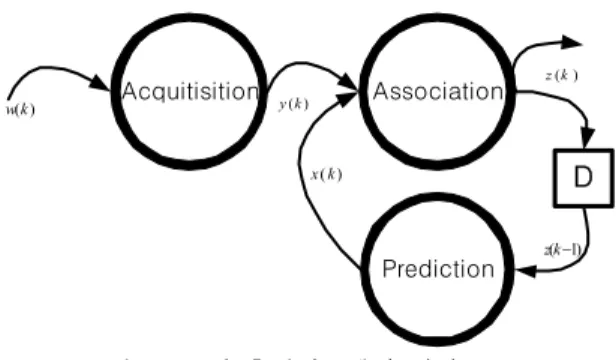
Fig. 2 shows the overall scheme. This system consists of three blocks: acquisition, association, and prediction.
The purpose of the acquisition is to determine the initial starting position of the object tracking. After this stage, the association and prediction interactively determine the tracks. Our primary concern is the association part that must determine the actual measurement and object pairs, given the measurements and the predicted gate centers.
Acquitisition Association
Prediction D
) (k
w y(k)
) ( k x
) (k z
) 1 ( -k z
그림 2. 물체 추적시스템의 전체 구조 Fig. 2. An overall scheme of object tracking
Let m and n be the number of measurements and objects, respectively, in an observed area. Then, the relationships between the objectsand measurements are efficiently represented by the validation matrixw:
(1)
Wherethe first column denotes noise and always
. For the other columns,
, if the validation gate of object t contains the measurement j and , otherwise.
Based on the validation matrix, I must find hypothesis matrix
that must obey the data association hypothesis:
ïî ïí ì
Î
= S
Î
= S
=
=
]) , 1 [ ( ˆ 1
]) , 1 [ ( ˆ 1
0 0
n t for w
m j
for w
jt n t
jt n t
(2)
Here, only if the measurement j is associated with noise (t=0) or object ( ).
Generating all the hypothesis matrices leads to a combinatorial problem, where the number of data association hypothesis increases exponentially with the number of objects and measurements.
2-2 MAP Estimate for Data Association
The ultimate goal of this problem is to find the hypothesis matrix, ∈ ∈
given the observation y and x, which must satisfy (2).
From now on, let's associate the realizations the gate center x, the measurement y, the validation matrix, and to the random processes-X, Y, , and . Next, consider that is a parameter space and ( ) is an observation space. Then, a posteriori can be derived by the Bayes rule:
(3)
Here, I assumed that
since the two variables and (x,y) are separately observed. This assumption makes the problem more tractable as I shall see later. Given the parameter , and are observed. If the conditional probabilities describing the relationships between the parameter space and the observation spaces are available, one can obtain the Relaxation scheme estimator:
(4)
2-3 Representation Constraints by Energy Function
As a system model, I assume that the conditional probabilities are all Gibbs distributions:
(5)
where is called partition function:
(6)
Here, denotes the energy function. Substituting (5) into (3),(4) becomes
(7)
Since the optimization is executed with respect to , the denominator in (3) is independent of and therefore irrelevant for its minimization. The energy functions are realizations of the constraints both for the object trajectories and the measurement-object relationships. For instance, the first term in (7) represents the distance between measurement and object and could be minimized approximately using the constraints. The second term intends to suppress the measurements which are uncorrelated with the valid measurements. The third term denotes constraints of the validation matrix and it can be designed to represent the two restrictions as shown in (2). The energy equations of each term are defined respectively:
(8)
Putting (8) into (7), one gets
(9)
Where and are a coefficient of the weighted distance measure and the matching term respectively.
Using this scheme, the optimal solution is obtained by assigning observations to tracks in order to minimize the weighted total summed distance from all observations to the tracks to which they are assigned. This is thought of as a version of the well-known assignment problem for which optimal solutions have been developed with constraints [12],[16].
Ⅲ. Relaxation Scheme
The optimal solution for (9) is hard to find by any deterministic method. So, I convert the present constrained optimization problem to an unconstrained problem by introducing the Lagrange multipliers and local dual theory [10,11]. In this case, the problem is to
find such that where
(10)
Here, and are the Lagrange multipliers.
Note that (10) includes the effect of the first column of the association matrix, which represents the clutter as well as newly appearing objects. In general setting, I
assume m>n, since most of the multi-object problem is characterized by many confusing measurements that exceed far over the number of original objects. Let's modify (10) so that each term has equal elements:
(11)
Where . I now look for a
dynamical system of ordinary differential equations.
The state of this system is defined by and the energy equation is continuously differentiable with
respect to and . Since
I am dealing with a continuous state problem, it is logical to use the Lagrange multipliers in the differential approach:
(12)
where is a modulation function that ensures that the trajectories of (12) are in a state space contained in Euclidean nm-space. Performing gradient ascent on
and have been shown [16] to be very effective in the resolution of constrained optimization problems.
To find a minimum of this equation by iterative calculations, I can use the gradient descent method:
(13)
where and are initial states, ∆ is the unit step size for each iteration, and ∇∇∇ are gradients. The trajectory of this dynamical equation is chosen in such a way that the energy
decreases steadily along the path. Hence, is
a Lyapunov function for this dynamical equation. Note that this algorithm converges to a minimum point nearest to the initial state. In general, the gradient search method has the property of converging to one of the local minima depending on the initial states. I assume that the energy is analytic and also that the energy is bounded below, i.e., . A complete form of the relaxation equations are given by(14) and its overall computational flow structure is shown in Figure 3.
(14)
그림 3. RA결합을 포함한 전체 흐름도 Fig. 3. Overall flow diagram of RA association
This equation can be computed by an array processor.
A processing element in this array stores and updates the states by using information coming from nearby processors, together with their previous states. To terminate the iteration, I can define in advance either the maximum number of iterations or a lower bound of the change of and in successive steps.
The Relaxation scheme estimate adaptive data association scheme's computational complexities of basic
routine per iteration require computations.
When I assume the average iteration number as , the total data association calculations require
computations. Therefore, even if the tracks and measurements are increased, the required computations are not increasing exponentially. However JPDAF as estimated in [4] requires the computational complexity
, so its computational complexity increases exponentially depending on the number of tracks and measurements.
IV. Experimental Results
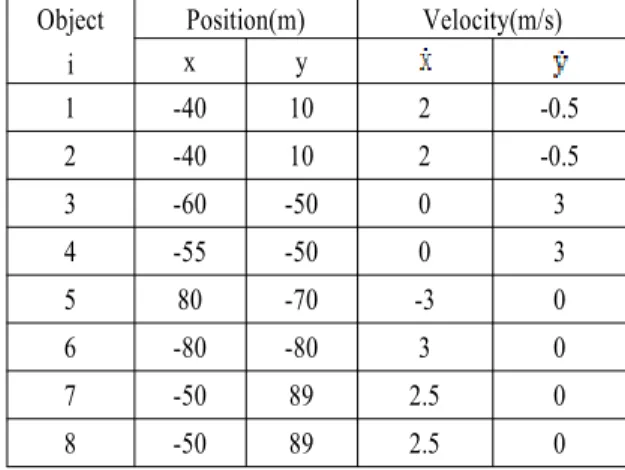
In this section, I present some results of the experiments comparing the performance of the proposed MAP estimate adaptive data association (RA) with that of the JPDA [6]. I just used the standard Kalman filter[15] for the estimation part once feasible matrix is computed. The performance of the RA is tested in two separate cases in the simulation. In the first case, I consider two crossing and parallel objects for testing the track maintenance and accuracy in view of clutter density. In the second case, all the objects as listed in Table 1 are used for testing the multi-object tracking performance. The dynamic models for the objects have been used by the Singer model developed in [14].
표 1. 8개의 물체의 속도 및 초기 위치
Table 1 Initial Position and Velocity of 8 Objects Object
i
Position(m) Velocity(m/s)
x y
1 -40 10 2 -0.5
2 -40 10 2 -0.5
3 -60 -50 0 3
4 -55 -50 0 3
5 80 -70 -3 0
6 -80 -80 3 0
7 -50 89 2.5 0
8 -50 89 2.5 0
The crossing and parallel objects whose initial parameters are taken from object 1,2,3 and 4, respectively in Table 1 are tested. The rms estimation errors and standard deviation value from the filtering based on the crossing and parallel objects are shown in Figure 4. I note that the performance of the RA is better than that of the JPDA in view of both tracking accuracy.
Object Tracking Performance : Location Accuracy
Object Number
0 1 2 3 4 5 6 7 8 9
Error (m)
0.0 0.2 0.4 0.6 0.8 1.0 1.2
1.4 JPDA -Mean/SD
Proposed RA-Mean/SD
그림 4. 물체 추적 성능 Fig. 4. Object Tracking Performance
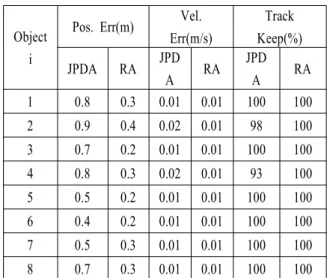
Table 2 summarizes the rms position and velocity errors for each object in the second test. From Table 2, I note that RA's track maintenance capability is higher than JPDA. I also note that the general performance of the RA is almost better than that of JPDA. The RA appears to be an alternative to the JPDA instead of HNPDA. Also, it could replace the sequential computations required for the JPDA with a parallel scheme. But the difficulties in adjusting the parameters still exist.
Ⅴ. Conclusions
The purpose of this paper was to explore an adaptive data association method as a tool for applying location awareness for the ubiquitous environment. It was shown that it always yields consistent data association, in contrast to the JPDA, and that these associated data
measurements are very effective for indoor environment tracking. Although the RA finds the convergence recursively, the RA is a general method for solving the data association problems in data association. A feature of our algorithm is that it requires only storage, where m is the number of candidate measurement associations and n is the number of trajectories, compared to some branch and bound techniques, where the memory requirements grow exponentially with the number of objects. The experimental results show that the RA outperforms the JPDA in terms of both rms errors and track maintenance rate. This algorithm has several applications and can be effectively used in long range object tracking systems using surveillance radar.
표 2. 8개의 물체에 대한 RM 오차 Table 2 RMS errors in 8 objects
Object i
Pos. Err(m) Vel.
Err(m/s)
Track Keep(%) JPDA RA JPD
A RA JPD
A RA
1 0.8 0.3 0.01 0.01 100 100 2 0.9 0.4 0.02 0.01 98 100 3 0.7 0.2 0.01 0.01 100 100 4 0.8 0.3 0.02 0.01 93 100 5 0.5 0.2 0.01 0.01 100 100 6 0.4 0.2 0.01 0.01 100 100 7 0.5 0.3 0.01 0.01 100 100 8 0.7 0.3 0.01 0.01 100 100
Acknowledgement
This work was supported by the Korea Research Foundation Grant funded by the Korean Government"(KRF-2006-D00356(I00068)) in which main calculations were performed by using the supercomputing resource of the Korea Institute of Science and Technology Information(KISTI).
References
[1] Alspach D. L. “A Gaussian sum approach to multi-target identification tracking problem”, Automatica, Vol. 11 (1975) 285-296
[2] Reid D. B., “An algorithm for tracking multiple targets”, IEEE Trans. on Automat. Contr., Vol. 24 (1979) 843-854
[3] Bar-Shalom Y. “Extension of probabilistic data associatiation filter in multitarget tracking”, in Proc.
5th Symp. Nonlinear Estimation Theory and its Application (1974) 16-21
[4] Sengupta, D., and Iltis, R. A. “Neural solution to the multitarget tracking data association problem”, IEEE Trans. on AES, AES-25 (1989) 96-108 [5] Kuczewski R. “Neural network approaches to
multitarget tracking”, In proceedings of the IEEE ICNN conference (1987)
[6] Fortmann T. E., Bar-Shalom Y., and Scheffe M.
“Sonar Tracking of Multiple Targets Using Joint Probabilistic Data Association”, IEEE J. Oceanic Engineering, Vol. OE-8 (1983) 173-184
[7] Fitzgerald R.J. “Development of practical PDA logic for multitarget tracking by microprocessor”, In Proceedings of the American Controls Conference, Seattle, Wash. (1986) 889-898
[8] Fortmann T. E., Bar-Shalom Y. “Tracking and Data Association”, Orland Acdemic Press (1988) [9] Lee Y. W., and Jeong H. “A Neural Network Approach
to the Optimal Data Association in Multi-Target Tracking”, Proc. of WCNN'95, INNS Press
[10] Luenberger D. G. “Linear and Nonlinear Programming”, Addition-wesley Publishing Co.
(1984)
[11] Hiriart-Urruty J. B. and Lemarrecchal C. “Convex Analysis and Minimization Algorithms I”, Springer-Verlag (1993)
[12] Cichocki A., and Unbenhauen R. “Neural networks for optimization and signal processing”, Wiley, New York (1993)
[13] Emile Aarts and Jan Korst “Simulated annealing and Boltzmann Machines”, Wily, New York (1989) [14] Singer, R.A. “Estimating optimal tracking filter
performance for manned maneuvering targets”, IEEE Transactions on Aerospace and Electronic Systems, Vol. 6 (1970) 473-483
[15] Kalman R.E. “A new approach to linear filtering and prediction problems”, Trans. ASME, (J. Basic Eng.,) Vol.82 (1960)
[16] Platt J.C., and Barr A.H. “Constrained Differential Optimization”, Proceedings of the 1987 IEEE NIPS Conf., Denver (1987)
이 양 원(李陽源)
1982년 2월 : 중앙대학교 전자공학과 (공학사)
1991년 8월 : 서울대학교 대학원 제어 계측공학과(공학석사)
1996년 2월 : 포항공과대학교 대학원 전자전기공학과(공학박사)
1996년 3월 ~ 현재 : 호남대학교 정보 통신공학과 교수
관심분야 : 신호처리, 다중표적추적시스템, 닷넷기반 인 터넷응용 임베디드 시스템 개발