• 검색 결과가 없습니다.

Alveoloar Rhabdomyosarcoma of Tongue Base in an Infant : A Case Report

N/A
N/A
Protected

Academic year: 2021

Share "Alveoloar Rhabdomyosarcoma of Tongue Base in an Infant : A Case Report"

Copied!
4
0
0

로드 중.... (전체 텍스트 보기)

전체 글

(1)

- 75 -

Introduction

Certain processes can cause a focal mass within the tongue base. Focal masses of the tongue base in infants are unusual and can be caused by congenital abnormalities such as thyro- glossal duct cyst, lingual thyroid, or vascular or lymphatic mal-

formation. They can also be caused by neoplastic processes such as teratoma or malignancies.

1)

Malignant tumors are ex- tremely uncommon in infants, specifically in the tongue base region.

2)

Rhabdomyosarcoma(RMS) is a highly malignant tu- mor with local tissue invasion and lymphatic and hematoge- nous metastasis, and is third in frequency among the solid ma- lignant tumors of childhood.

3)

RMS potentially may arise in any anatomic location, however, the most common site is the head and neck. Despite this predilection, RMS arising in the tongue base is very rare.

4)

Surgery, radiotherapy and chemo- therapeutic drugs have been used, alone or in combination, in treating this tumor, however, the outcome for patients with metastatic or recurrent disease remains poor.

5)

Here we report

대한 두경부 종양 학회지

제 29 권 제 2 호 2013

Alveoloar Rhabdomyosarcoma of Tongue Base in an Infant : A Case Report

Jisung Kim, MD

1

, Je Yeob Yeon, MD

1

, Jae-Hong Park, MD

1

, Yong-Moon Lee, MD

2

, Dong Wook Lee, MD

1

Department of Otorhinolaryngology-Head and Neck Surgery

1

and Pathology,

2

College of Medicine, Chungbuk National University, Cheogju, Korea

영아의 설근부에 발생한 폐포성 횡문근육종 1예

충북대학교 의과대학 이비인후과학교실,

1

해부병리학교실

2

김지성1·연제엽1·박재홍1·이용문2·이동욱1

= 국 문 초 록 =

영아의 설근부에 발생하는 악성 종양은 매우 드물다. 저자들은 연하곤란과 폐쇄성 수면 무호흡증으로 의뢰된 17 개월 남아의 설근부에 발생한 횡문근육종을 경험하였기에 문헌고찰과 함께 보고하는 바이다. 외래에서 실시한 이학 적 검사 상 설근부 전체가 돌출되어 있었으며 단단한 종괴가 촉지 되었다. 조직검사와 기관절개술을 시행하였으며 컴퓨터단층촬영, 양전자 방출 단층 촬영 그리고 뼈 스캔과 함께 염색체 분석을 실시하였다. 조직검사 결과 폐포성 횡문근육종이 확인되었으며 전이의 증거는 없었다. 염색체 분석상 폐포성 횡문근육종에 상응하는 PAX7-FKHR 유 전자 전좌가 발견되었다. 8 회의 항암화학요법과 방사선 치료 후 촉지되는 설근부의 종괴는 없었으며 환자가 호소하 는 증상도 개선되었다. 추적 관찰 시 시행된 자기공명영상 결과 확연한 종괴 크기의 감소를 확인할 수 있었다. 횡문 근육종은 매우 드문 악성 종양으로 수술과 함께 항암화학요법, 방사선치료 등 여러 치료 방법이 동원되지만 전이나 재발이 있을 시 예후는 매우 불량하다. 그러므로 영아에서 연하곤란, 호흡 곤란 등의 증상이 있을 시에는 설근부를 포함한 상부호흡소화관을 적극적으로 검사하여야 하며 악성 종양의 가능성을 염두에 두어야 하겠다.

중심 단어

:횡문근육종·설근부.

Received : July 17, 2013 / Revised : September 21, 2013 Accepted : September 24, 2013

교신저자 : 이동욱, 361-763 충북 청주시 흥덕구 내수동로 52 충북대학교 의과대학 이비인후과학교실

전화 : (043) 269-6157 · 전송 : (043) 265-6157 E-mail : [email protected]

online©MLComm
(2)

- 76 - a case of RMS of the tongue base in a 17-month-old boy who initially presented with dysphagia and obstructive sleep ap- nea. We summarize the clinical manifestation, treatments and prognosis of RMS of the tongue base in the literature

Case Report

We present a 17- month-old male infant who suffered from sleep apnea and poor oral intake. His general appearance looked slightly drowsy with arousal difficulty. The infant ex- perienced oral bleeding originating from the tongue base without any trauma history and received primary repair from another hospital 1 month ago.

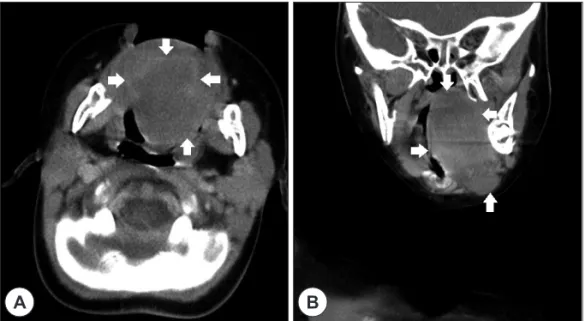
Physical examination showed a diffuse, firm mass occupy- ing the entire tongue base. Mucosa overlying the mass was intact including the 4 cm suture scar. Computed tomography (CT) revealed a maximum 4.5 cm measured irregular heter- ogenous enhancing solid and cystic mass at the tongue base with extension to the left sublingual space(Fig. 1).

Tracheostomy was initially done to maintain the airway.

Biopsy(frozen section) was proven to be malignant. Due to the potential morbidity from surgical resection, mass excision was not performed.

Permanent tissue biopsy revealed alveolar rhabdomyosar- coma (Fig. 2). Staging workup showed no evidence of metas- tasis. According to TNM pretreatment staging classification for Intergroup Rhabdomyosarcoma Study IV, patient was stage I(Table 1). Chromosome analysis showed PAX7-FKHR gene translocation which is compatible to alveolar rhabdo- myosarcoma.

The patient received 8 cycles of chemotherapy(including vincristine, actinomycin-D, cyclophosphamide) and addition- al radiation therapy with a dosage of 4,140 cGy. After chemo- radiation therapy, there was no palpable mass at the tongue base, patient became symptom free and a 3 month follow up magnetic resonance imaging showed a marked decrease of mass size(Fig. 3).

A B

Fig. 1. Enhanced CT images of the mass in axial(A) and coronal(B) cuts. A maximum 4.5 cm irregular heterogenous enhancing solid and cystic mass at tongue base with extension to Lt. sublingual space.

Fig. 2. Nucleus of tumor cells show pleomorphism and mitosis. Fibrous septa separating the lesion and various sized cancer cells with no cohesiveness scattered along the surface of septa, generally mixed multinucleated giant cells are shown. A : Hematoxylin-eosin stain(×400). Multinucleated giant cells stained with desmin which is a differentiation marker between smooth muscle and skeletal muscle cells are shown. B : Desmin stain(×400).

A B

(3)

- 77 -

Discussion

Mass in the tongue base can cause lump sensation in the throat, swallowing or breathing difficulty, abnormal phona- tion, pain if infected, or totally asymptomatic. Patients may also complain of referred otalgia or hemoptysis. Delay in diagno- sis is not uncommon because of the vague nature of initial symptoms and the relative inaccessibility of the tongue base examination. Especially in infants, lack of self-expression makes the early detection of tongue base mass difficult. In the case above, detection of the tongue base mass was delayed until dysphagia and obstructive sleep apnea with arousal dif- ficulty had been exacerbated. Thus, symptoms related to swallowing or breathing should raise the suspicion for the upper aerodigestive tract obstruction including mass in the tongue base. Immediate physical examination with inten- sive history taking, proper imaging or histopathologic stud- ies should be followed, especially in infants. In this case, trau- ma to the mass from sucking or swallowing may explain the bleeding event of unknown cause in his past medical history.

Being extremely rare in infants, malignant tumor should be included in the differential diagnosis of tongue bass mass

and tissue diagnosis should be obtained if the lesion is not proven otherwise. The annual incidence of RMS is about 8/

million children. It is the most common soft tissue sarcoma in infants and children and represents about 5 to 15% of all malignant solid tumors.

6)

Head and neck RMS occurs most commonly in the orbit, nasopharynx, paranasal sinuses, cheek, neck, middle ear and larynx, however, the occurrence of RMS in the base of tongue is very uncommon.

7)

It is known that RMS arises as a consequence of regulatory disruption of skeletal muscle progenitor cell growth and dif- ferentiation

8)

and subdivided into three morphological types, alveolar, pleomorphic, and embryonal.

9)

Among these, alve- olar RMS is highly malignant with a significant incidence of metastatic recurrence and poorly documented to its rari- ty.

9)

Certain genetic conditions are known to increase the risk of RMS, they include, Li-Fraumeni syndrome,

10)

Neuro- fibromatosis type 1,

11)

Costello syndrome,

12)

Beckwoth-Wie- demann syndrome,

13)

and Noonan syndrome.

14)

A specific gene translocation, fusion of PAX3 or PAX7 with the FOXO1 gene(ie, FKHR), by the variant t(1 ; 13)(p36 ; q14) is known to exist in the vast majority of cases of alveolar RMS.

15)

With- in this case, the patient had no involvement with any of the described syndromes, but was proven to be positive for PAX7-

Table 1. TNM pretreatment staging classification for IRS study IV

Stage Sites T* Size Nodes

Metastases

1 Orbit, head and neck(excluding parameningeal), genitour

nary(excluding bladder/prostate) T1 or T2 A or B N0, N1, or Nx M0

2 Bladder/prostate, extremity, cranial parameningeal sites, other

(includes trunk, retroperitoneum) T1 or T2 A N0 or Nx M0

3 Bladder/prostate, extremity, cranial parameningeal T1 or T2 B N0, N1, or Nx M0

4 All T1 or T2 A or B N0 or Nx M1

* : Tumor : T1, confined to anatomic site of origin ; T2, extension or infiltration into surrounding tissues(A ≤5 cm in diameter ; B >5 cm in diameter), † : Nodes : N0, no distant metastases ; Nx, clinical status unknown ; N1, clinically involved, ‡ : Metastases : M0, no distant metastases ; M1, distant metastases present. IRS : Intergroup Rhabdomyosarcoma Study, TNM : tumor-node-metastases

Fig. 3. Pre(A) - and post(B) - treatment enhanced T1- weighted Images. Markedly decreased in extent of enhancing lesion in tong base and sublingual space are shown. The edematous change of subcutaneous fat layer of chin caused by radiation therapy is also noted.

A B

(4)

- 78 - FKHR gene translocation.

Oral and oropharyngeal RMS is commonly treated by radi- cal surgical excision followed by multiagent chemotherapy, usually a combination of vincristine, dactinomycin, and cy- clophosphamide. If complete resection is not possible, post- operative radiotherapy may be employed.

16)

Recently, im- provements in multimodal therapy have resulted in a cure rate of approximately 70% for patients with localized disease

16)

and improved the overall five-year survival rate from less than 10% before the 1960s to 65% nowadays.

17)

However, about 30 % of patients with localized disease are known to experi- ence recurrence or metastasis during the course of treatment.

Metastasis is usually via the bloodstream and less commonly via the lymphatics, usually to cervical lymph nodes, lungs, bones or brain. Five-year survival rate for the patients with recurrence or metastasis remains poor in less than 20%.

5)

In conclusion, RMS is an exceedingly rare, highly malig- nant tumor. Multi-modality treatments have been used in treat- ing this tumor, but the outcome for patients with metastatic or recurrent disease remains poor. Thus symptoms related to swallowing or breathing in infants such as dysphagia, dys- phonia, or obstructive sleep apnea prompt immediate diag- nostic work-ups for the upper aerodigestive tract obstruction including the tongue base mass and malignant tumor should be included.

References

1) Sato M, Tanaka N, Sato T, Amagasa T. Oral and maxillofacial tumours in children: A review. Br J Oral Maxillofac Surg. 1997;

35:92-95.

2) Ferbend P, Crawford SE, Gonzalez-Crussi F. Carcinoma of the tongue in a long-term survivor of clear cell sarcoma of the kidney. Pediatr Pathol Lab Med. 1995;15:327-332.

3) Hicks J, Flaitz C. Rhabdomyosarcoma of the head and neck in children. Oral Oncol. 2002;38:450-459.

4) Gorsky M, Epstein JB. Head and neck and intra-oral soft tissue sarcomas. Oral Oncol. 1998;34:292-296.

5) Pappo AS, Anderson JR, Crist WM, Wharam MD, Breitfeld

PP, Hawkins D, et al. Survival after relapse in children and ad- olescents with rhabdomyosarcoma: A report from the Inter- group Rhabdomyosarcoma Study Group. J Clin Oncol. 1999;

17:3487-3493.

6) Barksdale EM, Wiener ES. Rhabdomyosarcoma.: In Pediatric Surgery. Philadelphia, USA: Saunders Co.; 2000. p.942-954.

7) Doval DC, Kannan V, Acharya RS, Mukherjee G, Shenoy AM, Bapsy PP. Rhabdomyosarcoma of the tongue. Br J Oral Maxil- lofac Surg. 1994;32:183-186.

8) Merlino G, Helman LJ. Rhabdomyosarcoma: working out the pathways. Oncogene. 1999;18:5340-5348.

9) Little DJ, Ballo MT, Zagars GK, Pisters PW, Patel SR, El-Nag- gar AK, et al. Adult rhabdomyosarcoma: Outcome following multimodality treatment. Cancer. 2002;95:377-388.

10) Trahair T, Andrews L, Cohn RJ. Recognition of Li Fraumeni syndrome at diagnosis of a locally advanced extremity rhabdo- myosarcoma. Pediatr Blood Cancer. 2007;48:345-348.

11) Ferrari A, Bisogno G, Macaluso A, Casanova M, D’Angelo P, Pierani P, et al. Soft-tissue sarcomas in children and adolescents with neurofibromatosis type 1. Cancer. 2007;109:1406-1412.

12) Gripp KW, Lin AE, Stabley DL, Nicholson L, Scott Cl Jr, Doyle D, et al. HRAS mutation analysis in Costello syndrome: geno- type and phenotype correlation. Am J Med Genet A. 2006;140:

1-7.

13) Samuel DP, Tsokos M, DeBaun MR. Hemihypertrophy and a poorly differentiated embryonal rhabdomyosarcoma of the pelvis. Med Pediatr Oncol. 1999;32:38-43.

14) Moschovi M, Touliatou V, Papadopoulou A, Mayakou MA, Nikolaidou-Karpathiou P, Kitsiou-Tzeli S. Rhabdomyosarcoma in a patient with Noonan syndrome phenotype and review of the literature. J Pediatr Hematol Oncol. 2007;29:341-344.

15) Davis RJ, D’Cruz CM, Lovell MA, Biegel JA, Barr FG. Fusion of PAX7 to FKHR by the variant t(1;13)(p36;q14) translocation in alveolar rhabdomyosarcoma. Cancer Res. 1994;54:2869- 2872.

16) Crist WM, Anderson JR, Meza JL, Fryer C, Raney RB, Ruy- mann FB, et al. Intergroup rhabdomyosarcoma study-IV: Re- sults for patients with nonmetastatic disease. J Clin Oncol.

2001;19:3091-3102.

17) Gnepp DR. Diagnostic Surgical Pathology of the Head and

Neck. philadelphia, USA: W. B. Sauders Co.; 2001.

수치

Fig. 1. Enhanced CT images of the mass in axial(A) and coronal(B) cuts. A maximum 4.5 cm irregular heterogenous enhancing solid  and cystic mass at tongue base with extension to Lt
Fig. 3. Pre(A) - and post(B) - treatment enhanced T1- weighted Images. Markedly decreased in extent of enhancing lesion in tong  base and sublingual space are shown

참조

관련 문서

After listening to the opinions of firemen in field activities, we confirmed that the firepower can be secured by reducing the loss of firepower caused

 Procedure for creating the equipment failure rate data segment of a CPQRA analysis data base.  Define

The ideal diode is usually taken to be “wide-base” diode, or a diode whose contacts are several minority carrier diffusion lengths or more from the edges of the depletion region.

Module Initialization function block is used in a program with setting of A/D conversion module located base number, slot number of located module on base, specifying a

Zao Wou-Ki generated the best H1 result for the entire Asian continent in Hong Kong; 53% of Zhang Daqian’s turnover was hammered there, and lots of new

The index is calculated with the latest 5-year auction data of 400 selected Classic, Modern, and Contemporary Chinese painting artists from major auction houses..

In case any of the information is found to be false, plagiarized or written by someone else, applicant will be disqualified and acceptance can be canceled

 Lewis acid ~ accepts (a share in) an electron pair Lewis base ~ donates (a share in) an electron pair.  Lewis bases