JDCS Vol. 18, No. 8, pp. 1635-1640, Dec. 2017
싱글 야외 영상에서 계층적 이미지 트리 모델과 k-평균 세분화를 이용한 날씨 분류와 안개 검출
박 기 홍1*
1*
목원대학교 융합컴퓨터미디어학부
Weather Classification and Fog Detection using Hierarchical Image Tree Model and k-mean Segmentation in Single Outdoor Image
Ki-Hong Park
1*1
*Division of Convergence Computer & Media, Mokwon University, Daejeon 35349 Korea
[요 약]
본 논문에서는 싱글 야외 영상에서 날씨 분류를 위한 계층적 이미지 트리 모델을 정의하고, 영상의 밝기와 k-평균 세분화 영상 을 이용한 날씨 분류 알고리즘을 제안하였다. 계층적 이미지 트리 모델의 첫 번째 레벨에서 실내와 야외 영상을 구분하고, 두 번째 레벨에서는 야외 영상이 주간, 야간 또는 일출/일몰 영상인지를 밝기 영상과 k-평균 세분화 영상을 이용하여 판단하였다. 마지막 레벨에서는 두 번째 레벨에서 주간 영상으로 분류된 경우 에지 맵과 안개 율을 기반으로 맑은 영상 또는 안개 영상인지를 최종 추 정하였다. 실험 결과, 날씨 분류가 설계 규격대로 수행됨을 확인할 수 있었으며, 제안하는 방법이 주어진 영상에서 효과적으로 날 씨 특징이 검출됨을 보였다.
[Abstract]
In this paper, a hierarchical image tree model for weather classification is defined in a single outdoor image, and a weather classification algorithm using image intensity and k-mean segmentation image is proposed. In the first level of the hierarchical image tree model, the indoor and outdoor images are distinguished. Whether the outdoor image is daytime, night, or sunrise/sunset image is judged using the intensity and the k-means segmentation image at the second level. In the last level, if it is classified as daytime image at the second level, it is finally estimated whether it is sunny or foggy image based on edge map and fog rate.
Some experiments are conducted so as to verify the weather classification, and as a result, the proposed method shows that weather features are effectively detected in a given image.
색인어 :
날씨 분류, 날씨 특징, k-평균 세분화, 계층적 이미지 트리 모델, 안개 검출
Key word : Weather classification, Weather feature, k-mean segmentation, Hierarchical image tree model, Fog detection
http://dx.doi.org/10.9728/dcs.2017.18.8.1635
This is an Open Access article distributed under the terms of the Creative Commons Attribution Non-CommercialLicense(http://creativecommons .org/licenses/by-nc/3.0/) which permits unrestricted non-commercial
Received 13 December 2017; Revised 24 December 2017 Accepted 25 December 2017
*Corresponding Author; Ki-Hong Park
Tel: +82-42-829-7639
Ⅰ. Introduction
Various systems such as video surveillance, traffic surveillance, and human detection in the field of computer vision are based on weather assumption [1], [2]. Therefore, it is very important to determine whether images obtained from a CCTV are daytime or night images with different weather conditions such as rain, snow, shadow or fog.
In this paper, I propose a weather classification method by defining a hierarchical image tree model for single outdoor images. The hierarchical image tree model is largely classified into three levels: classification of indoor and outdoor; daytime and night; sunny and foggy image. In second level, the intensity and k-mean segmentation image were used for estimating daytime and night. Given daytime image is classified whether it is a sunny or foggy image using the edge map and the fog rate in third level. The proposed weather classification was performed with 45 different outdoor images, and some experimental results show that the proposed weather classification is effective.
The paper was organized as follows: Section 2 was devoted to understanding the various features for weather classification, Section 3 discusses proposed weather classification using the intensity and k-mean segmentation image. Section 4 investigates performance evaluation with experimental results, and discuss the future works. Final section presents paper conclusion.
Ⅱ. Related Technologies
2-1 Weather Understanding and Features
This section describes some of the key elements related to weather classification, which can be regarded as features in scene recognition. Weather classification is very important task to determine whether a given image is sunny or cloudy, and daytime or night. There are many various regional or global features for weather classification [1]. Local features include sky, shadow, rain streak, snowflake, dark channel, and global features have contrast and saturation. Table 1 shows the major features for weather classification that can be estimated on a single image. In Table 1, the movement of cloud in sky, rain streak, snowflakes, etc. is also an important factor for weather pattern and type recognition. Weather classification is also important because some outdoor camera-based monitoring systems must overcome a variety of weather conditions, such as glare effects at night during fog and haze [3], rain [4] and snow on busy roads [5].
Table. 1. Various features for weather classification
Feature Concept or Definition
sky Sky might be the most obvious feature to indicate sunny weather in images
shadow The distance between a boundary and its k-nearest neighbors in sunny boundary
reflection Strong sunlight is another powerful cue.
fog (or haze)
Fog is another visually distinctive weather condition, water-saturated fine particles that act to reduce visibility.
rain streak Some works used HOG feature to remove or detect the rain streaks.
snowflake The histogram of intensity and hue of the snowflake patches
dark channel Most local patches in haze-free outdoor images contain very low intensities in one color channel [6].
contrast The difference in color and brightness saturation One of three coordinates in the HSI color space
2-2 Fog Detection
According to [7], the distinction between the foggy and non-foggy images is due to having many edges and few edges, respectively. Fog detection in single image is partially used by the Sobel filters as shown in (1).
(1) where the horizontal and vertical masks are defined as
(2) These kernels of (2) are designed to respond maximally to edges running vertically and horizontally relative to the pixel coordinates. Then the Sobel pixel value is given by (3).
×
(3)
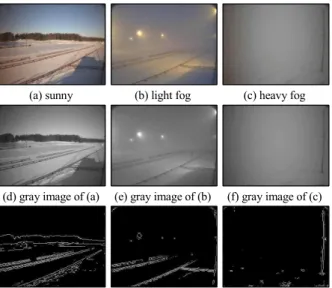
Fig. 1 shows the gray-level images and edge images of the sunny scene, light and heavy fog images. Each color image in Fig.
1 is obtained from [8], and the size of the image is 353 by 256. In
Fig. 1(g), (h) and (i), the number of edge pixels is 4,214, 2,408
and 1,034, respectively. In other words, a high edge count
indicates non-fog image, and a low edge count suggests that the
image contains fog.
(a) sunny (b) light fog (c) heavy fog
(d) gray image of (a) (e) gray image of (b) (f) gray image of (c)
(g) sobel image of (d) (h) sobel image of (e) (i) sobel image of (f) Fig. 1. Edge detection results in various outdoor images
2-3 Fog Removal
The algorithm for removing fog from natural images, including fog, is known to be very effective using the dark channel prior introduced in [6]. The dark channel prior is defined as (4), and is applied for removing fog as shown in Fig. 2.
∈
∈
(4)
where
is a color channel of and is local patch centered at . Here, the minimum intensity in such a patch should has a very low value. In [6], fog removal using the dark channel prior is performed in steps estimating the transmission, soft matting, recovering the scene radiance and estimating the atmospheric light. First, the transmission of the patch simply can be estimated by (5).
∈
∈
(5)
where
is the atmospheric light, and a constant parameter has a value between 0 and 1. Second, the soft matting method has also been applied by [9] to deal with the spatially variant white balance problem. Third, the recovering the scene radiance is defined and recovered by:
(6)
Ⅲ. Proposed Weather Classification
In this paper, I define the hierarchical image tree model, and propose a method for weather classification in single outdoor images. Fig. 2 shows the hierarchical tree model of image database for the weather classification proposed in this paper. The image database is classified into indoor and outdoor class at the first level, and outdoor images can be classified into daytime, night and sunrise/ sunset images. Daytimes images are also divided into sunny and foggy images. Night and sunrise/sunset classes no longer need to classify images. Fig. 3 shows a block diagram for the proposed weather classification, details of which are described in Section 3.1 and 3.2.
Fig. 2. Hierarchical image tree model
Fig. 3. Proposed weather classification algorithm
3-1 Classification of Daytime and Night
This section denotes the second level classification of daytime and night. The intensity image of HSI (hue, saturation, intensity) color model is used to classify daytime and night. The HSI color model was used because a large number of images revealed that the clear sky had a strong correlation with the saturated color [8].
The conversion of the RGB color image to the HSI color image is shown in (7) [10], [11].
≤
(7)
The hue parameters have been widely applied in fields such as traffic and video surveillance, and the saturation parameters is also a global feature of weather classification. The intensity parameters is computed by simply averaging the RGB value as shown in (7), and is used to determine class at second level in Fig.
2. The histogram boundary in the intensity image of Fig. 3 is divided by 100, which is the pixel value of the intensity image.
Threshold value 100 can be applied as an appropriate value depending on characteristics of various fields. Fig. 4 shows the histogram of the intensity image and the results at the second level of Fig. 2 separated by a threshold value of 100. Fig. 5(a) and (b) show the result of segmentation using k-mean clustering algorithm, where is 2 and 3, respectively.
(a) color image (b) intensity image
(c) histogram of (b) (d) classification at the second level Fig. 4. Classification results in the intensity image
(a) k-mean segmentation (k=2) (b) k-mean segmentation (k=3)
(c) histogram of (b) (d) classification at the second level Fig. 5. Classification results in k-mean segmentation image
The k-mean clustering algorithm will find the groups of data that minimize the following objective function [12], [13]:
∈
(8)
where there are clusters
, and
is the mean point of all the points
∈
. In this paper, was applied with a value of 3, and the pixels of the k-mean segmentation image have values 0, 114 and 255 as shown in Fig. 5(b). Therefore, the weather classification of Fig. 4(a) is estimated as daytime in the second level of Fig. 2 because the result is the same as ‘Daytime’
in Fig. 4(d) and Fig. 5(d).
3-2 Classification of Foggy and non-Foggy
This section determines whether fog is included in the daytime image. In other words, if the weather classification in the intensity and the k-mean segmentation image is the same as ‘Daytime’, the fog rate of the image is calculated and classified as foggy and non-foggy image. The fog rate is obtained by (9).
× (9)
where and
are the total number of pixels in the gray-level image and the number of the Sobel edge pixels, respectively. The fog rate calculated by (9) can be distinguished from the given image as foggy and non-foggy image.
(10)
Ⅳ. Experiment and Discussion
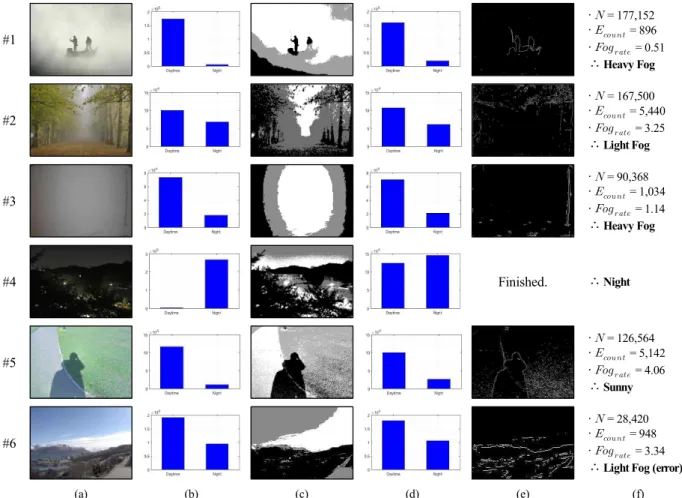
In this paper, the weather classification was performed with 45 different outdoor images, including the images as shown in Fig. 6.
Figure 6(b) and (d) show the classification results of intensity and k-mean segmentation images, respectively. These two results are factors that determine the daytime or night at the second level of the hierarchical image tree model, as described in Section 3.1. If the classification results are the same as 'Daytime', the classification of foggy and non-foggy is performed as in Section 3.2. Otherwise, the classification is finished as shown in outdoor image (#4) of Fig. 6. Then, the daytime images are judged to be foggy or non-foggy images using (10) at the third level of the hierarchical image tree model. The proposed weather classification shows various results in Fig. 6, and some experiments are conducted to verify the proposed method, and the classification is estimated.
The weather classification of the test image (#6) shown in Fig. 6 shows inaccurate results, and it seems necessary to
preprocess the sky feature as shown in Table 1. Also, the threshold value for the fog rate in (10) is not a fixed value and is adjustable to the environmental characteristic.
Ⅴ. Conclusions and Future Works
In this paper, I defined a hierarchical image tree model for single outdoor images, and proposed the weather classification method. First, the intensity and k-segmentation images were used for estimating daytime and night. Next, it is finally estimated whether daytime image is sunny or foggy based on edge map and fog rate. Some experimental results show that the proposed weather classification is effective. In the future, the research objective is to research the fog removal algorithm and the weather features, including the weather conditions such as rain streak, snowflake, shadow, contrast and saturation, and to expand the hierarchical image tree models presented in Table 1.
#1
․ = 177,152
․
= 896
․
= 0.51
∴ Heavy Fog
#2
․ = 167,500
․
= 5,440
․
= 3.25
∴ Light Fog
#3
․ = 90,368
․
= 1,034
․
= 1.14
∴ Heavy Fog
#4 Finished. ∴ Night
#5
․ = 126,564
․
= 5,142
․
= 4.06
∴ Sunny
#6
․ = 28,420
․
= 948
․
= 3.34
∴ Light Fog (error)
(a) (b) (c) (d) (e) (f)
Fig. 6. Experimental results of the weather classification; (a) outdoor image; (b) classification in the intensity image; (c)
the k-mean segmentation image; (d) classification in the k-mean segmentation image; (e) the Sobel edge image;
Acknowledgement
This work was supported by the National Research Foundation of Korea (NRF) grant funded by the Korea government (Ministry of Science, ICT & Future Planning) (No. 2017R1C1B5018143).
References