Copyrightⓒ2009, The Microbiological Society of Korea
69
Micrococcus sp. HJ19
에서 체외분비 단백질 분해효소의 생산조건과 효소특성
차인태1·오용식1·조운동1·임채성1·이제관1·이오석2·노동현1*
1충북대학교 자연과학대학 미생물학과, 2영동대학교 와인발효식품학과
단백질 분해효소는 아미노산 간에 존재하는 공유결합인 펩티드 결합을 절단하는 효소이며, 세계적으로 가장 많 이 판매되는 효소이다. 해양 심층수로부터 분리된 Micrococcus sp. HJ19의 체외분비 단백질 분해효소를 생산하 는 최적의 배지조건을 조사하기 위하여 기본배지로 변형 STY 배지(1% tryptone, 0.15% yeast extract, 0.01%
NaCl, 여과살균한 바닷물)를 사용하였다. 탄소원으로 포도당보다 갈락토오스를 사용하였을 때 1.3배로 높은 활
성을 보여주었으며, 질소원으로는 casamino acid를 사용하였을 때 가장 낮은 활성을 보여준 반면, 맥아추출물을 사용하였을 때 가장 높은 활성을 나타내었다. 생산된 체외단백질 분해효소는 35oC에서 최적의 활성을 나타내었 으며, 최적 pH는 8.5로 판명되었다.
Key words□ extracellular protease, medium compositions, Micrococcus sp. HJ19, optimal temperature & pH
단백질 분해효소는 단백질의 구성성분인 아미노산 사이의 펩 티드 결합을 가수분해하는 효소이며, 세계적인 공업효소 판매량 의 60%를 차지하여 상업적으로 유용한 효소이다(19). 이러한 단 백질 분해효소는 단백질 구조와 기능 예측 등의 기초연구분야 뿐만 아니라, 조미료 제조, 식육의 연화, 주류의 혼탁방지, 치즈 숙성, 제빵 등의 식품산업, 소화제 등의 제약산업, 세제, 피혁, 환 경에 관련된 각종 산업분야에서 그 요구도가 증가하고 있는 실 정이다(5, 19). 현재 산업적으로 사용되는 대부분의 단백질 분해 효소는 생물 공학적 응용에 필요한 모든 특성을 만족시켜주는 미생물 유래의 효소가 많이 사용되며(9) 대부분의 상업적 단백질 분해효소는 Bacillus 속의 세균으로부터 생산되는 중성 또는 알 카리성 효소들이다. Bacillus sp. 외에도 Vibrio (6, 13), Serratia (14), Pseudomonas (8), Pseudoaltermonas (3, 15), Streptomyces (10), Brevibacterium (20), Kocuria sp.의 균주(12)들이 보고되어 있다. 이외에도 치즈류와 심층수에서 체외 단백질 분해효소를 분 비하는 Micrococcus sp. (2, 7, 18)의 균주가 보고 되어있으며, Micrococcus caseolyticus로 부터는 상업적으로 판매되는 단백분 해효소 Rulactine을 생산하여 치즈의 숙성에 사용되어지고 있다 (4, 17).
심층수로부터 분리보고 된 Micrococcus sp. HJ19 균주는 20oC 에서부터 37oC까지의 온도범위에서 생육이 빠르고, 많은 양의 체외분비 단백질 분해효소를 생산한다고 보고되어 있다(2). 따라 서 본 연구는 상업적으로 판매되는 단백질 분해효소의 새로운 공급원의 가능성을 타진하기 위하여 Micrococcus sp. HJ19 균주 의 생육과 효소생산에 대한 최적의 배지조건을 구하고, 효소의 최적 온도와 최적 pH을 조사하였다.
재료 및 방법 사용된 균주, 배지 및 배양조건
실험에 사용된 균주는 동해 심층수에서 순수분리된 Micrococcus sp. HJ19를 사용하였다(2). 이 균주가 생산하는 체외분비 단백질 분해효소의 최적온도와 pH를 알아보기 위해서는 0.5× marine broth (Difco, USA)에 0.01% skim milk (Difco, USA)를 첨가한 MBS 배지를 사용하였으며, 효소생산을 위한 최적의 배지조건을 찾기 위해서는 0.5% yeast extract를 0.15%로 바꾼 변형 STY 배 지(1% tryptone, 0.15% yeast extract, 0.01% NaCl, 여과살균한 바닷물 사용)에 적당한 탄소원 또는 tryptone 대신에 다른 질소 원을 첨가하여 사용하였다. 균주의 배양은 30oC에서 30시간 진 탕배양 하였다.
체외단백분해 효소의 최적온도 및 pH
균주가 생산하는 체외분비 단백질 분해효소의 최적온도와 pH 를 알아보기 위하여 25oC에서 48시간 동안 종배양한 균을 1%가 되도록 MBS 배지에 접종하여, 30oC에서 30시간 배양한 균의 배 양 상등액을 조효소액으로 하였다. 최적온도를 알아보기 위해서 효소의 반응온도를 5oC 간격으로 0oC에서부터 60oC까지 조정하 여 효소활성을 측정하였다. 이때 대조군으로 심층수에서 분리한 균 중에서 체외분비 단백질 분해효소를 분비하지 않는 HJ56의 조효소액도 함께 측정하였다. 효소의 최적 pH를 알아보기 위해서 상기와 같이 조제된 조효소액을 pH 5에서 6까지는 0.1 M citrate 완충용액을 사용하였고, pH 6에서 8까지는 0.1M phosphate, pH 8에서 9까지는 0.2 M Tris-HCl 완충용액을 사용하였고, 이때 사 용한 효소의 반응온도는 30oC이었다.
효소의 활성측정은 배양 상등액을 사용하여 Windler와 Kelleher의 방법(22)에 준하여 다음과 같이 시행하였다. 먼저 상
*To whom correspondence should be addressed.
Tel: 82-43-261-3368, Fax: 82-43-264-9600 E-mail: [email protected]
기에 따라 배양된 균의 배양액을 취해 spectrophotometer (Libra S22, Biochrom, England)로 균의 성장을 흡광도 600 nm에서 측 정하고, 4oC에서 15,000×g로 5분간 원심분리하여 균을 제거한 상등액을 조효소액으로 사용하였다. 표준반응에서 효소의 기질은 0.5% (w/v) azocasein (Sigma, USA)을 50 mM Tris-HCl (pH 8.0)에 녹여 사용하였으며, pH에 따른 활성은 각각의 상응 완충 액에 녹여 사용하였다. 효소반응은 조효소액 100 µl와 동량의 기 질을 잘 혼합하여 30oC에서 1시간 반응시켰으며, 10% (w/v) trichloroacetic acid 400 µl를 첨가하여 반응을 정지시켰다. 반응액 을 2분간 정치한 후 4oC에서 19,000×g로 5분간 원심분리하여 침 전물을 제거한 상등액에 525 mM NaOH 700 µl을 가하여 혼합 한 후 440 nm에서 흡광을 측정하였다. 효소활성의 단위는 30oC 에서 1시간 동안 440 nm에서의 흡광도 0.01 증가를 1 unit으로 정하였으며(21) 효소의 활성은 3회 측정의 평균값과 표준편차로 표시하였다.
탄소원의 종류에 따른 균체생육 및 효소활성 측정
변형 STY 배지에 부가적인 탄소원으로 glucose 또는 maltose, galactose, sucrose, lactose, mannitol, glycerol를 각각 2%로 첨가 하여 30oC에서 30시간 동안 배양한 후 균체생육과 효소활성을 측정하였다.
질소원의 종류에 따른 균체의 생육 및 효소 활성 측정
변형 STY 배지는 기본질소원으로 0.15%의 yeast extract를 소 량함유하고 있으며, 그 외의 질소원으로 1%의 tryptone도 다량 함유하고 있다. 이 배지의 tryptone 대신에 부가적인 질소원으로 동일농도의 peptone 또는 yeast extract, malt extract, NaNO3, (NH4)2SO4, NH4Cl, skim milk로 각각 바꾸고, 1%의 glucose를 첨가하여 30oC에서 30시간 동안 배양한 후 균체 생육과 효소활 성을 측정하였다.
결과 및 고찰 단백질 분해효소의 최적온도
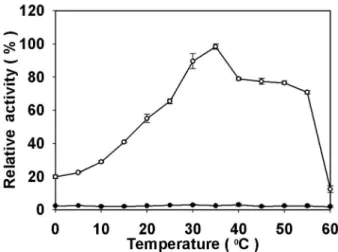
동해의 심층수로부터 분리된 Micrococcus sp. HJ19는 배양초 기에 높은 체외분비 단백질 분해효소를 생산하는 것으로 알려져 있다(2). 최적의 활성을 보여준 30oC에서 배양된 조효소액을 사 용하여 효소의 최적온도를 조사한 결과 Fig. 1과 같았다. 반응온 도에 대한 효소의 활성은 0oC에서부터 비례적으로 증가하여 35oC에서 약 780 unit/ml의 최고 활성을 보여주었다. 그 후, 40oC에서 효소활성이 다소 감소하여 55oC까지는 완만히 유지되 었으나, 이 이상의 온도에서는 단백질의 변성으로 효소의 활성이 급격히 상실되었다. 이러한 반응온도에 대한 효소활성은 차 등 (3)이 보고한 Pseudoalteromonase sp. HJ47와 경향은 유사하였으 나, 효소의 최고활성이 1.5배 이상 높은 결과를 보여주었다.
효소활성에 대한 pH의 영향
Micrococcus sp. HJ19가 생산하는 효소의 최적 pH를 알아보기
위하여 세 가지 완충액에 기질을 녹여 pH를 5에서 9까지 0.5 단 위로 변화시키면서 조효소액과 반응시켜 조사한 결과 Fig. 2와 같았다. pH 5에서는 최대 활성에 대하여 5%만의 낮은 효소활성 만을 나타내었으며, pH의 증가에 따라 효소의 활성이 비례적으 로 증가하여 pH 8.5에 최대에 이른 후 pH 9.0에서는 다소 감소 하는 경향을 나타내었다. 이와 같은 최적 pH는 차 등(3)과 Lee 등(15)이 보고한 Pseudoalteromonase sp.의 균주들과 Secades Fig. 1. Effect of temperature on the activity of the extracellular protease from Micrococcus sp. HJ19.
The cells were cultured at 30oC by shaking at 150 rpm in the medium of 0.5× marine broth supplemented with 0.01% skim milk and enzyme activity was determined at respective temperature for 1 h. Open circle (
○ ) and closed circle ( ● ) represent and enzyme activity of HJ19 and control strain HJ56 that does not have enzyme activity, respectively.
Standard deviations from the mean of three independent assays are indicated by error bars.
Fig. 2. Effect of pH on the extracellular protease activities of Micrococcus sp. HJ19.
All conditions are the same as Fig. 1 except that enzyme activities were determined from pH 5 to pH 9 with different buffers. Standard deviations from the mean of three independent assays are indicated by error bars.
and Guijarro (21)가 보고한 Yersinia 속의 최적 pH가 pH 8.0에 서 pH 8.8 사이인 중성 단백질 분해효소의 특성을 보여주었다.
하지만 Mohedano 등 (16)이 보고한 같은 속의 Micrococcus sp.
INIA 528 균주가 생산한 단백질 분해효소의 최적 pH가 6.25인 것과는 차이가 있었다.
효소생산에 대한 배양배지조성의 효과
일반적으로 배지에 부가적인 영양분의 첨가는 미생물의 성장과 효소활성에 영향을 미친다고 알려져 있다. 분리된 Micrococcus
sp. HJ19에 부가적인 탄소원을 첨가하여 배양하였을 때의 단백질
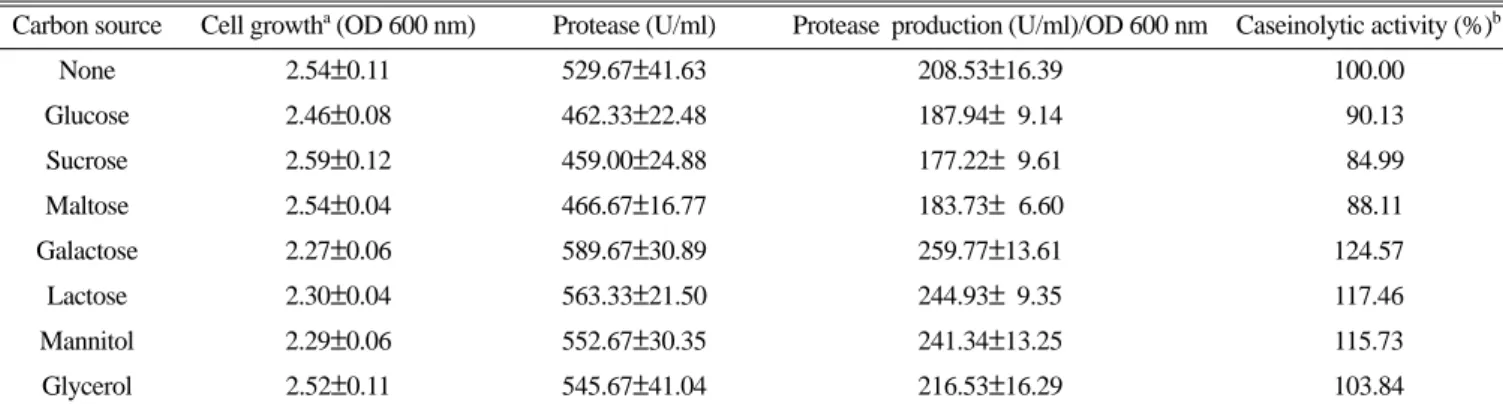
분해효소의 생산결과 Table 1과 같았다. 포도당과, 수크로오스, 맥아당, 글리세롤을 첨가하였을 때는 탄소원의 첨가하지 않았을 때와 유사한 성장을 하였으나 글리세롤을 제외하고는 성장에 대 한 효소의 활성은 약 10% 정도 낮았다. 반면에 갈락토오스와 젖 당, 만니톨을 첨가한 경우에 세포의 성장은 다소 낮았으나, 성장 에 대한 효소활성은 15% 이상 증가하였다. Tryptone 대신에 다 른 질소원을 첨가하였을 때 효소활성은 Table 2와 같았다. 균의 성장은 복합 질소원을 사용하였을 때 좋았다. 효소의 활성은 casamino acid를 넣어준 경우에 50%로 급격히 감소하였으며,
peptone의 경우는 tryptone과 차이가 없었으며 최고의 활성은 맥 아추출물을 첨가하였을 경우로 효소의 활성이 약 35% 증가하였 다. 단백질 분해효소의 생산과 활성에 대한 금속이온의 효과를 알아보기 위해 배지에 50 mM의 Ca2+를 첨가한 결과 균주의 성 장은 약 30% 높아졌으며, 효소의 활성도 약 21% 증가하였다(자 료 미제시).
Yersinia ruckeri (21)에서는 peptone을 가진 기본배지에 젖당을 첨가한 경우에만 기본배지와 유사한 활성을 나타내었고, 다른 당 을 첨가하였을 경우 활성이 뚜렷하게 감소하여, Micrococcus sp.
HJ19와는 다른 양상을 보여주었다. 하지만 두 균 모두 당의 첨 가로 균의 생육이 증가할 경우 단백질 분해효소의 생산이 적은 것을 보아 단백질 분해효소는 탄소원의 상태가 좋지 않은 경우 에 많이 생산되는 것으로 생각되었다. 이러한 경향은 Vibrio
vulnificus 분비하는 엘라스틴분해 단백질 분해효소도 유사하였다
(13). 갈락토오스를 첨가한 경우 최대 활성을 나타낸 다른 균주 는 Bacillus 속이 있었다(1). 질소원으로는 Bacillus 속과 Pseudomonase fluorescens에서 보고된 것과는 달리(1, 11), 암모 니아 형태의 질소원을 사용하였을 때도 양호한 활성의 증가를 보여주었다.
Table 1. Effect of carbon source on the cell growth and protease activity of HJ 19
Carbon source Cell growtha (OD 600 nm) Protease (U/ml) Protease production (U/ml)/OD 600 nm Caseinolytic activity (%)b
None 2.54±0.11 529.67±41.63 208.53±16.39 100.00
Glucose 2.46±0.08 462.33±22.48 187.94± 9.14 090.13
Sucrose 2.59±0.12 459.00±24.88 177.22± 9.61 084.99
Maltose 2.54±0.04 466.67±16.77 183.73± 6.60 088.11
Galactose 2.27±0.06 589.67±30.89 259.77±13.61 124.57
Lactose 2.30±0.04 563.33±21.50 244.93± 9.35 117.46
Mannitol 2.29±0.06 552.67±30.35 241.34±13.25 115.73
Glycerol 2.52±0.11 545.67±41.04 216.53±16.29 103.84
a For nutrient studies cells was grown in modified STY medium supplemented with 2% indicated carbon source at 30oC for 30 h with shaking 180 rpm. Protease activity was determined at 30oC for 1 h. Values are Averages±SD for three independent experiment.
b Percent caseinolytic activity in each medium expressed in relation to the activity in none (100%).
Table 2. Effect of nitrogen source on the cell growth and protease activity of HJ 19
Nitrogen source Cell growtha (OD 600 nm) Protease (U/ml) Protease production (U/ml)/OD 600 nm Caseinolytic activity (%)b
Tryptone 2.54±0.11 529.67±41.63 208.53±16.39 100.04
Yeast Extract 2.55±0.08 553.67±13.28 217.12± 5.21 104.12
Malt Extract 1.69±0.05 475.00± 5.00 281.07± 2.96 134.79
Skim Milk 2.38±0.08 656.33±47.51 275.77±19.96 132.24
Peptone 2.45±0.05 510.67±28.01 208.44±11.43 099.96
NaNO3 1.63±0.04 411.33± 9.50 252.35± 5.83 121.01
(NH4)2SO4 1.69±0.12 431.33±17.21 255.23±10.19 122.39
NH4Cl 1.72±0.04 430.67±15.37 250.39± 8.94 120.07
Casamino acids 2.71±0.15 290.67±20.55 107.26± 7.58 051.44
a All conditions are the same as Table 1 except modified STY medium supplemented with 1% indicated nitrogen source in place of 1% tryptone.
b Percent caseinolytic activity in each medium expressed in relation to the activity in none (100%).
배양초기의 높은 효소 생산능력을 가진 Micrococcus sp. HJ19 (2) 유래의 중성 단백질 분해효소는 낮은 열안정성을 가져 식품 단백질의 가수분해정도를 열로서 쉽게 조절할 수 있어 식품산업 에 유용한 효소가 될 수 있을 것으로 생각된다. 앞으로 최적 배 양조건에 균주를 배양시켜 효소를 정제하고 유전자특성을 밝히 는 연구가 필요할 것으로 생각된다.
감사의 말
이 논문은 2007년도 충북대학교 학술연구지원사업의 연구비 지원에 의하여 연구되었습니다.
참고문헌
1.옥민, 김민석, 서원석, 차재영, 조영수. 2000. 토양으로부터 분리한 Bacillus sp. WRD-1이 생산하는 extracellular protease 의 특성. 한국산업미생물학회지 28, 329-333.
2.차인태, 오용식, 노동현. 2007. 단배질 분해효소를 분비하 는 Micrococcus sp. HJ19의 분리 및 특성. 한국미생물학회 지 43, 222-226.
3.차인태, 임형준, 노동현. 2007. 동해 심층수로부터 Pseudoaltermonas sp. HJ47의 분리 및 체외단백질분해효소 특성. 한국생명과학회지 17, 272-278.
4. Alkhalaf, W., L. Vassal, M.J. Desmazeaud, J.C. Gripon, E. Perrot, G. Pitel, and J. Uro. 1987. Use of Rulactine as ripening agent in semi-hard cheese. Lait 67, 173-185.
5. Cowan, D. 1983. Industrial applications: Proteins, pp. 353-374, In T. Godfrey and S. West (eds.), Industrial enzymology-The appli- cation of enzymes in industry. The Nature Press, New York, USA.
6. Denkin, S.M. and D.R. Nelson. 1999. Induction of protease activ- ity in Vibrio anguillarum by gastrointestinal mucus. Appl. Envi- ron. Microbiol. 65, 3555-3560.
7. Fernsndez, J., A. F. Mohedano, M.J. Polanco, M. Medina, and M.
Nunez 2008. Purification and characterization of an extrcellular cysteine proteinase produced by Micrococcus sp. INIA 528. J.
Appl. Microbiol. 81, 27-34.
8. Fukushima, J., S. Yamamoto, K. Morihara, Y. Atsumi, H. Takeu- chi, S. Kawamoto, and K. Okuda. 1989. Structural gene and com- plete amino acid sequence of Pseudomonas aeruginosa IFO 3455 elastase. J. Bacteriol. 171, 1698-1704.
9. Godfrey, T. and S. West. 1996. Industrial enzymology, 2nd ed.
Macmillan Publisher Inc., New York, USA.
10. Henderson, G., P. Krygsman, C.J. Liu, C.C. Davey, and L.T.
Malek. 1987. Characterization and structure of genes for proteases
A and B from Streptomyces griseus. J. Bacteriol. 169, 3778-3784.
11. Himelbloom, B.H. and H.M. Hassen. 1986. Effect of cysteine on growth, protease production, and catalase activity of Pseudomo- nase fluorescens. Appl. Environ. Microbiol. 51, 418-421.
12. Hinrichsen, L.L., M.C. Montel, and R. Talon. 1994. Proteolytic and lipolytic activities of Micrococcus roseus (65), Halomonas elongata (16) and Vibrio sp. (168) isolated from danish bacon cur- ing brines. Int. J. Food Microbiol. 22, 115-126.
13. Kothary, M.H. and A.S. Kreger. 1985. Production and partial char- acterization of an elastolytic protease of Vibrio vulnificus. Infect.
Immun. 50, 534-540.
14. Kwon, Y.T., H.H. Lee, and H.M. Rho. 1993. Cloning, expression and sequencing of the minor protease encoding gene from Serratia marcescens ATCC 21074. Gene 125, 75-80.
15. Lee, S.O., J. Kato, N. Takiguchi, A. Kuroda, T. Ikeda, A. Mitsu- tani, and H. Ohtake. 2000. Involvement of an extracellular pro- tease in algicidal activity of the marine bacterium Pseudoalteromonas sp. strain A28. Appl. Environ. Microbiol. 66, 4334-4339.
16. Mohedano, A.F., J. Fernndez, P. Gaya, M. Medina, and M. Nunez.
1997. Effect of pH, temperature and culture medium composition on the production of an extracellular cysteine proteinase by Micro- coccus sp. INIA 528. J. Appl. Microbiol. 82, 81-86.
17. Piard, J.C., M. EL Soda, W. Alkhalaf, M. Rousseau, M. Des- mazeaud, L. Vassal, and J.C. Gripon. 1986. Acceleration of cheese ripening with liposome-entrapped proteinase. Biotechem. Lett. 8, 241-246.
18. Prasad, R., R.K. Malik, and D.K. Mathur. 1986. Purification and characterization of an extrcellular caseinolytic enzyme of Micro- coccus sp. MCC-315 isolated from cheddar cheese. J. Dairy Sci.
69, 633-642.
19. Rao, M.B., A.M. Tanksale, M.S. Ghatge, and V.V. Deshpande.
1998. Molecular and biotechnological aspects of microbial pro- teases. Microbiol. Mol. Biol. Rev. 62, 597-635.
20. Rattray, F.P., W. Bockelmann, and P.F. Fox. 1995. Purification and characterization of an extrcellular proteinase from Brevibacterium linens ATCC 9174. Appl. Environ. Microbiol. 61, 3454-3456.
21. Secades, P. and J.A. Guijarro. 1999. Purification and characteriza- tion of an extracellular protease from the fish pathogen Yersinia ruckeri and effect of culture conditions on production. Appl. Envi- ron. Microbiol. 65, 3969-3975.
22. Windle, H.J. and D. Kelleher. 1997. Identification and character- ization of a metalloprotease activity from Helicobacter pylori.
Infect. Immun. 65, 3132-3137.
(Received February 9, 2009/Accepted March 16, 2009)
ABSTRACT : Production Condition and Characterization of Extracellular Protease from Micrococcus sp. HJ-19
In-Tae Cha1, Yong-Sik Oh1, Woon-Dong Cho1, Chae-Sung Lim1, Je-Kwan Lee1, Oh-Seuk Lee2, and Dong-Hyun Roh1* (1Department of Microbiology, Chungbuk National University, Cheongju 361-763, Republic of Korea, 2Department of Food Fermentation Technology, Young- Dong University, Chungbuk 370-701, Republic of Korea)
Proteases are degradative enzymes which hydrolyze a peptide bond between amino acids and they are abun- dantly applied to commercial field. In order to investigate optimal medium compositions of carbon and nitrogen source for enzyme production, modified STY medium containing 0.15% yeast extract were used as basal medium. When galactose was used as carbon source, enzyme activity showed 1.3 higher than that of glucose.
For nitrogen source addition of casamino acids to basal medium in place of tryptone showed lowest activity, whereas addition of malt extract showed maximal activity. The optimum temperature and pH of extracellular protease were found to be 35oC an pH 8.5.