교수자 지지가 대학생의 학업적 지연행동에 미치는 융합적 영향: 학업적 실패내성의 매개효과
송성숙, 함현진*
대진대학교 미래평생학습부 조교수
Converged Influence of Professor Support on Academic Procrastination: Focused on the Mediation Effect of Academic
Failure Tolerance
Seong-Suk Song, Hyun-Jin Ham*
Professor, Dept of Future Lifelong Learning, Daejin University
요 약 본 연구의 목적은 교수자 지지가 대학생의 학업적 지연행동에 미치는 영향에서 학업적 실패내성의 매개효과를 검증하는 것이다. 경기도 D대학교 학생 211명을 대상으로 Google 설문조사를 실시하였고, 수집된 자료는 SPSS 프로 그램을 사용하여 기술통계, 상관분석과 중다회귀분석을 실시하였다. 학업적 실패내성의 매개효과는 Baron과 Kenny의 3단계 회귀분석과 Sobel Test를 통해 검증하였다. 연구결과 첫째, 교수자 지지는 학업적 지연행동과 부적상관이 있었 고, 학업적 실패내성과 정적상관이 있었다. 또한 학업적 실패내성과 학업적 지연행동 간에는 부적상관이 나타났다. 둘 째, 교수자 지지가 학업적 지연행동에 미치는 영향에서 학업적 실패내성은 완전매개효과가 있는 것으로 나타났다. 이는 대학생의 학업적 상황에서 교수자의 지지와 학업적 실패내성의 수준을 높여줄 수 있는 교육환경 조성이 필요함을 시사 한다. 따라서 본 연구에서는 대학생의 학업적 지연행동을 낮추고 학업적 실패내성을 강화할 수 있는 교수자의 지지프로 그램 제공의 필요성을 제언하였다.
주제어 : 대학생, 교수자지지, 학업적 지연행동, 학업적 실패내성, 매개효과
Abstract The purpose of this study is to verify the mediated effect of academic failure tolerance in the influence of professor support on academic procrastination of university students. A Google survey was conducted on 211 students at D University in Gyeonggi-do, and descriptive statistics, correlation analysis, and multiple regression were conducted using the SPSS program with collected data. The mediated effect of academic failure tolerance has been verified through three stages of regression analysis (Baron and Kenny) and Sobel Test. The results of the study are as follows; First, professor support has a negative correlation with academic procrastination, and a positive correlation with academic failure tolerance. In addition, there was a negative correlation between academic failure tolerance and academic procrastination. Second, it showed that academic failure tolerance has a full mediated effect in the influence of professor support on academic procrastination. This implies that it is necessary to create an educational environment that can raise the level of professor support and academic failure tolerance of university students in the academic situation. Therefore, this study suggested the need of providing a program of professor support that can improve academic procrastination problems and strengthen the academic failure tolerance of students.
Key Words : University student, Professor support, Academic procrastination, Academic failure tolerance, Mediation effect
*Corresponding Author : Hyun-Jin Ham([email protected]) Received December 21, 2020
Accepted March 20, 2021 Revised January 26, 2021
Published March 28, 2021
1. 서론
대학생 시기는 사회의 구성원으로 살아가기 위해 필요 한 전문적인 지식과 기술을 습득하기 위해 준비하는 시 기이다. 이 준비과정에서 학교생활의 질을 결정하는 중요 한 요인 중 하나가 학업적응 영역으로[1], 그들은 고등학 교 때와 달라진 학습 환경에 적응해야만 한다[2]. 성공적 인 대학생활을 위해서는 스스로 학습계획을 수립하고 실 천해야하지만, 자기 주도적으로 적응하지 못할 경우 학업 을 지연시키거나 학업실패를 경험하게 된다[3-5].
학업적 지연행동은 초등학생에서 성인에 이르기까지 다양한 연령대에서 나타나는데[6], 이는 학업수행을 저하 시키고 지연행동에 대한 후회와 죄책감 등의 부정적인 정서경험을 유발해 개인의 정신건강에까지 나쁜 영향을 미친다[5,7]. 학업적 지연행동은 국내에서는 지연동기[8], 지연행동 유형[5,9], 학업지연 현상[10], 영향[11]에 대한 연구가 이루어졌으며, 미국과 캐나다에서는 지연동기와 [12,13] 지연행동의 성격적인 특질[14,15] 및 유형 분류 가[16], 독일에서는 지연동기 연구가[17,18] 대학생을 대 상으로 이루어졌다.
이는 대학 시기가 스스로 시간 관리를 조절할 수 있음 에도 불구하고 학업적 지연행동이 많이 이루어지고 있다 는[19] 반증이기에, 학업관련 행동에서 대학생의 인지와 정서에 영향을 미치는 인적 환경인 교수자 지지는 중요 한 변인으로[20-22] 주목할 필요가 있다. 학생과 더불어 교수자는 대학의 교육환경에서 가장 핵심적인 주체라고 할 수 있다. 대학생은 스스로 주체적인 활동을 하지만 교 수자의 지지를 통해 합리적이고 자기주도적인 결정을 할 수 있는 자신감을 확보할 수 있게 된다[23]. 그러므로 교 수자 지지는 대학생의 학교생활 전반에 직접적인 영향을 미치며[23,24], 학업적 상황을 긍정적으로 향상시킬 수 있는 기제로 작용할 수 있다.
더불어 대학생의 학업에 영향을 미치는 요인 중 하나 가 학업적 실패내성이다. 성인초기에 해당되는 대학생에 게 실패란 필수불가결한 요소이다. 대학생 시기의 무한한 가능성에 대한 도전은 다양한 실패 경험으로 이어질 수 있어 실패를 긍정적으로 활용할 수 있는 능력은 필수적 [25]이기 때문이다. 특히 학업적 상황에서 실패 결과에 대해 생산적인 태도로 반응하는 경향성인[26,27] 학업적 실패내성은 학업적 지연행동과 더불어 대학생활적응을 위한 중요한 개인적 특성 중 하나이다.
선행연구들을 살펴보면, 대학생의 실패내성은 종속변 인으로서 대학생의 내적동기, 목표내용, 학교적응유연성
과 학업적 낙관성[28,29] 등에 의해 영향을 받았고, 독립 변인으로서 대학생의 학업소진, 대인관계스트레스, 자기 자비, 그릿과 탄력성[25,30,31] 등에 영향을 주는 것으로 나타났다. 또한 매개변인으로서의 연구는 성장 마인드셋 과 학업참여의 관계, 시험불안과 학업성취도의 영향 [32,33]에 관한 연구가 있다.
이와 같이 교수자 지지와 학업적 지연행동 간에 매개 변인으로서 학업적 실패내성의 기능에 관한 직접적인 연 구는 수행되지 않았으나, 학업적 실패내성과 개념적으로 유사한 측면인 있는 회복탄력성과 리질리언스 등에 관한 선행연구 결과들을 통해 교수자 지지와 학업적 지연행동 간에 학업적 실패내성의 매개역할의 가능성을 유추해 볼 수 있다. 따라서 본 연구에서는 학습지지와 정서지지를 포함하는 교수자 지지와 학습 결과에 대한 긍정적 도전 성인 학업적 실패내성이 학업적 지연행동에 미치는 영향 관계를 검증함으로써 대학생의 학업적 상황의 질을 향상 하기 위한 교수자 지지의 시사점을 제공하고자 한다.
본 연구의 목적을 달성하기 위한 연구문제는 다음과 같다.
연구문제 1. 교수자 지지, 대학생의 학업적 지연행동 과 학업적 실패내성의 수준은 어떠한가?
연구문제 2. 교수자 지지, 대학생의 학업적 지연행동 과 학업적 실패내성 간의 관계는 어떠한 가?
연구문제 3. 교수자 지지가 대학생의 학업적 지연행동 에 미치는 영향에서 학업적 실패내성의 매개효과는 어떠한가?
2. 이론적 배경 2.1 교수자 지지
교수자 지지는 교수자로부터 제공되는 사회적지지의 한 요인으로, 대학생이 교수자가 자신에게 관심을 가지고 도와줄 것이라고 지각하는 긍정적 자원이다[23]. 최근 선 행연구에서 교수자가 대학생이 주체적으로 학습활동에 참여할 수 있도록 상호작용을 할 때, 학습에 긍정적 효과 가 나타난다고 보고하며 조력자(Facilitator)로서의 역할 을 수행하는 교수활동 전략을 강조하였다[34].
또한 교수자로부터 애정과 존중을 받을 때 정서적인 안정감을 느끼며 부정적인 성향을 감소시키고[35] 교수 자와 학습자의 신뢰관계를 통해 학업스트레스를 낮추는 기제로 작용하였다[36]. 그리고 교수자의 지지는 대학생
의 능동적인 학습활동뿐 아니라 진로결정에까지 영향을 [23] 미치는 중요한 요인으로 보고되고 있다.
특히 대학생 시기는 사회에 진출하기 위한 지식과 역 량을 쌓아가며 졸업 후 진로를 고민하는 중요한 시기이 다. 대학생은 졸업 후 직업을 선택하고 사회적인 역량을 함양하기 위해서 대학생활에 잘 적응해야 하며[36] 이는 곧 학업적 성취라는 과제와 밀접한 연관이 있다. 선행연 구에서 대학생들의 사회적지지 수준이 낮을수록 학업적 지연행동 수준이 높아진다고 보고되고 있기에[37], 교수 자의 지지는 대학생의 학업적 상황뿐 아니라 성장과 변 화에 중요한 역할을 한다. 이에 교수자 지지는 4차 산업 혁명 융·복합 시대에 미래를 준비하는 대학생들의 학업 과 관련된 변인의 하나로 연구할 가치가 있다.
2.2 학업적 지연행동
학업적 지연행동은 완성하기를 희망하는 과제나 시험 공부를 마음이 불편할 때까지 미루는 행동이다[38]. 특히 학업적 지연행동은 중·고등학교 때보다 비교적 자율적인 분위기에서 학업을 계획하고 수행하는 대학생에게 나타 날 가능성이 높다[39,40]. 실제로 대학생의 70∼95%가 학업적 지연행동을 경험하고 있을 만큼[41] 학습활동에 중요한 요인으로 작용하고 있기에 대학생의 학업적 지연 행동을 살펴보는 것이 중요함을 시사한다.
이러한 학업적 지연행동은 대학생이 사회가 부과하는 완벽주의와[42] 실패에 대한 공포로[43] 유발되며, 학업 수행을 저조하게 할 뿐만 아니라 심리적인 문제와도 관 련되어 다양한 부적응을 야기한다[5]. 또한 학업적 지연 행동은 심리적인 문제 뿐 아니라 학업수행 및 결과에도 직접적인 영향을 미치기에 대학생에게 많은 어려움을 발 생시킨다[44].
특히 대학생들은 학업적 상황에서 자신의 지연행동이 스스로 문제라고 인식하고 있었으며[6], 이후의 여러 생 활영역에서도 지속적으로 부정적 영향을 미칠 수 있다 [45]. 그러므로 대학생의 학업적 지연행동에 영향을 미치 는 요인을 규명하는 것은 이를 예방하고 감소시키기 위 해 매우 중요한 일이라 할 수 있다.
2.3 학업적 실패내성
학업적 실패내성은 학습과정에서 실패의 결과를 비교 적 빨리 수정하고 실패의 경험을 긍정적으로 활용하여 재학습을 시도하는 노력이다. 이러한 실패내성의 경험은 경우에 따라서는 과제수행을 촉진시키고, 자신의 역량이 도전을 받는다고 생각되면 적극적인 노력을 통해 적절한
효과를 가져 올 수 있다. 그러므로 학업적 실패내성은 학 습의 과정에서 필연적으로 겪게 되는 대학생의 중요한 개인적 자원이다[30].
이는 다양한 상황과 기회에 도전하게 되어 실패를 경 험할 수밖에 없는 대학생들이 실패에 대한 내성을 향상 시켜야 한다는 의미를 내포하고 있기에 이에 대한 방안 을 탐색하는 것이 필요하다. 선행연구에서도 대학생의 학 습과정에서 실패의 경험은 교육적으로 활용할 수 있는 중요한 요인이며[46], 해당 영역에 대한 지식이나 문제해 결력과 창의적 역량을 신장할 수 있는 원동력이 될 수 있 다고 보고되고 있다[47].
또한 실패의 경험을 통해 성장할 수 있다는 격려를 통 해 실패내성을 증진시킬 수 있는데[25], 이를 통해 교수 자의 지지가 학업적 실패내성을 향상시킬 수 있는 기제 임을 유추해 볼 수 있다. 그리고 학업적 실패내성은 경험 회피의 일종인 학업적 지연행동과의 관련성이 유추되는 바[25], 교수자 지지와 학업적 지연행동 간의 영향관계를 더 잘 설명할 수 있는 매개변인으로서의 역할을 할 것으 로 예상된다. 즉, 학업적 실패내성이 교수자 지지와 학업 적 지연행동 간의 영향관계에서 두 변인을 더 잘 설명하 는 논리적 기제로서의 매개역할을 하는지에 대해 검증할 필요가 있다. 따라서 대학생의 학업적 지연행동의 원인을 분석하고 학업적 실패내성을 향상시킬 수 있는 교수자의 실질적이고 구체적인 지지 역할에 대해 살펴보는 것은 의미가 있다.
3. 연구방법 3.1 연구설계 및 모형
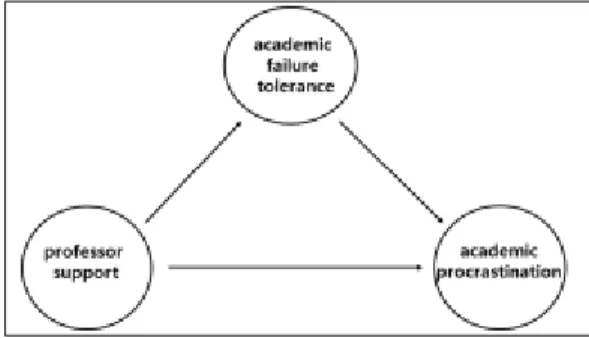
본 연구는 교수자의 지지와 대학생의 학업적 지연행동과 의 관계에서 학업적 실패내성의 매개효과를 검증하고자 하 는 서술적 조사연구이다. 이에 대한 연구모형은 Fig. 1과 같다.
Fig. 1. research model
3.2 연구대상 및 자료수집
본 연구는 경기도 D대학교에 재학 중인 211명의 학생 들을 대상으로 실시되었다. 자료 수집을 위하여 2020년 11월 4일부터 11월 11일까지 8일간 온라인 Google 설 문지를 사용하여 조사를 실시하였다. 설문의 목적과 소요 시간 등에 관하여 기술하여 설문에 관한 이해를 돕고, 이 에 동의한 대상자들은 가능한 시간과 장소에서 조사에 응답하였다.
연구대상자의 성별은 남자 64명(30.3%), 여자 147명 (69.7%)이고, 학년은 1학년 77명(36.5%), 2학년 60명 (28.4%), 3학년 38명(18.0%), 4학년 36명(17.1%)이다.
연구대상자의 일반적 특성은 Table 1과 같다.
Table 1. States of surveyed subject
(N=211)
category n(%)
sex
male 64(30.3)
female 147(69.7)
total 211(100)
grade
1 77(36.5)
2 60(28.4)
3 38(18.0)
4 36(17.1)
total 211(100)
3.3 연구도구 3.3.1 교수자 지지
교수자 지지를 측정하기 위하여 Hektner(1996)의 연 구를 기초로 석임복(2007)이 타당화한 척도를 김미정 (2019)이 수정한 것을 사용하였다[23]. 이 척도는 학습지 지 요인 5문항, 정서지지 요인 5문항의 총 2개 하위요인 과 10문항으로 구성되어 있다. 5점 척도로서 점수가 높 을수록 교수로부터 받는 지지수준이 높은 것을 의미한다.
본 연구에서 분석한 교수자 지지의 전체 신뢰도 Cronbach's α는 .88이고, 하위요인인 학습지지와 정서 지지는 모두 .77로 나타났다. 구체적인 문항의 내용과 신 뢰도는 Appendix 1에 제시하였다.
3.3.2 학업적 지연행동
학업적 지연행동을 측정하기 위하여 허효선, 임선영, 권석만(2015)이 개발한 학업적 착수-완수지연 척도를 사 용하였다[48]. 이 척도는 학업적 착수지연 요인 11문항, 학업적 완수지연 요인 7문항의 총 2개 하위요인과 18문
항으로 구성되어 있다. 5점 척도로서 점수가 높을수록 학 업적 지연행동 수준이 높음을 의미한다. 본 연구에서 분 석한 학업적 지연행동의 전체 신뢰도 Cronbach's α는 .94이고, 하위요인인 착수지연은 .96, 완수지연은 .87로 나타났다. 구체적인 문항의 내용과 신뢰도는 Appendix 1에 제시하였다.
3.3.3 학업적 실패내성
학업적 실패내성을 측정하기 위하여 김아영(2002)의 학업동기검사 중 학업적 실패내성 척도를 사용하였다[27].
이 척도는 감정요인, 행동요인, 과제난이도요인의 총 3개 하위요인과 18문항으로 구성되어 있다. 6점 척도로서 일 부 문항을 역채점하여 점수가 높을수록 학업적 실패내성 이 높음을 의미한다. 본 연구에서 분석한 학업적 실패내 성의 전체 신뢰도 Cronbach's α는 .80이고, 하위요인인 감정 .86, 행동 .71, 과제난이도는 .85로 나타났다. 구체 적인 문항의 내용과 신뢰도는 Appendix 1에 제시하였다.
3.4 자료분석
수집된 자료는 SPSS 프로그램을 사용하여 분석하였으 며, 구체적인 내용은 다음과 같다.
첫째, 연구대상자의 일반적 특성은 빈도분석을 통해 빈도와 백분율을 산출하였다.
둘째, 연구도구의 신뢰도는 Cronbach's α계수를 산 출하였다.
셋째, 각 변인들의 수준은 기술통계를 통해 평균과 표 준편차를 산출하였다.
넷째, 각 변인들 간의 관계는 상관분석을 통해 Pearson 의 적률상관계수를 산출하였다.
다섯째, 연구모형 검증은 회귀분석을 통해 Baron과 Kenny의 3단계 검증절차를 수행하였고, Sobel test를 실시하여 매개효과의 유의성을 검증하였다.
4. 연구결과
4.1 교수자 지지, 학업적 지연행동과 학업적 실패내 성의 수준
교수자 지지, 학업적 지연행동과 학업적 실패내성의 수준은 Table 2와 같다.
전체 평균은 교수자 지지가 3.59(SD=.57)로 가장 높 았고, 학업적 실패내성 3.27(SD=.60), 학업적 지연행동
Table 4. Mediating effect of academic failure tolerance
(N=211)
step independent var. dependent var. B β t R2 F
1 professor support academic
failure tolerance .55 .29 4.42*** .086 19.57***
2 professor support academic procrastination -.41 -.16 -2.35* .021 5.51*
3
professor support
academic procrastination
-.21 -.08 -1.19
.091 10.36***
academic
failure tolerance -.36 -.27 -3.85***
*p<.05 ***p<.001
2.76(SD=.81) 순이었다. 교수자 지지와 학업적 지연행동 은 5점 척도이고, 학업적 실패내성이 6점 척도임을 감안 할 때, 대학생들은 교수자 지지를 보통 이상의 수준으로 인식하고 있었고, 학업적 지연행동은 보통 이하의 수준 으로 인식하고 있었으며, 마지막으로 학업적 실패내성은 보통 이상의 수준으로 인식하고 있음을 알 수 있다.
Table 2. Level of professor support, academic procrastination and academic failure tolerance
(N=211) variables
(sub-variables) M SD
professor support 3.59 .57
academic procrastination 2.76 .81
academic failure tolerance 3.27 .60
4.2 교수자 지지, 학업적 지연행동과 학업적 실패내 성의 관계
교수자 지지, 학업적 지연행동과 학업적 실패내성 간 의 관계를 분석하기 위해 Pearson의 상관계수를 산출한 결과는 Table 3과 같다.
Table 3. Pearson r between professor support, academic procrastination and academic failure tolerance
(N=211) variables professor
support academic
procrastination academic failure tolerance professor
support 1.00 -.16* .29***
academic
procrastination 1.00 -.29***
academic failure
tolerance 1.00
*p<.05 ***p<.001
교수자 지지, 학업적 지연행동과 학업적 실패내성은 -.16∼±.29의 범위에서 유의한 상관을 나타냈다. 구체 적으로 교수자 지지는 학업적 지연행동(r=-.16, p<.05) 과 부적상관이 있었고, 학업적 실패내성(r=.29, p<.001) 과 정적상관이 있었다. 또한 학업적 실패내성과 학업적 지연행동(r=-.29, p<.001)간에는 부적상관이 나타났다.
즉, 교수자 지지 수준이 높을수록 대학생의 학업적 지 연행동 수준은 낮아지고, 학업적 실패내성이 높아지며, 학업적 지연행동 수준이 높을수록 학업적 실패내성의 수 준은 낮아지는 것을 알 수 있다.
4.3 교수자 지지가 학업적 지연행동에 미치는 영향 에서 학업적 실패내성의 매개효과
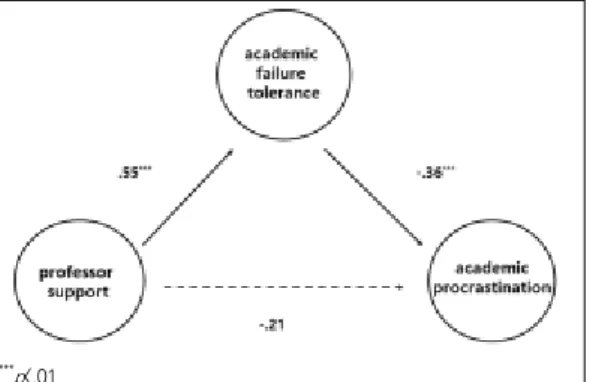
교수자 지지가 학업적 지연행동에 미치는 영향에서 학 업적 실패내성의 매개효과를 검증하기 위하여 Baron과 Kenny(1986)의 3단계 절차를 실시한 결과는 Table 4 와 같다.
1단계에서 독립변인인 교수자 지지는 매개변인인 학 업적 실패내성에 유의미한 정(+)의 영향을 미쳤고(β
=.29, p<.001), 교수자 지지 수준이 높을수록 학업적 실 패내성 수준이 높고 그 설명력은 8.6%인 것으로 나타났 다. 다음 2단계에서 독립변인인 교수자 지지는 종속변인 인 학업적 지연행동에 유의미한 부(-)의 영향을 미쳤고(β
=-.16, p<.05), 교수자 지지 수준이 높을수록 학업적 지 연행동의 수준이 낮고 그 설명력은 2.1%인 것으로 나타 났다. 마지막으로 3단계에서 독립변인인 교수자 지지와 매개변인인 학업적 실패내성을 동시에 투입하였을 때 종 속변인인 학업적 지연행동에 대해 9.1%의 설명력을 나타 냈다. 구체적으로 매개변인인 학업적 실패내성은 종속변 인인 학업적 지연행동에 유의미한 부(-)의 영향을 미쳤고 (β=-.27, p<.001), 반면 독립변인인 교수자 지지는 종속 변인인 학업적 지연행동에 유의미한 영향을 미치지 않은 것으로 나타났다.
따라서 Fig. 2와 같이 교수자 지지가 학업적 지연행동 에 미치는 영향에서 학업적 실패내성은 완전매개효과가 있는 것을 알 수 있다
Table 5와 같이 매개효과의 유의성을 검증하기 위해 Sobel test를 수행한 결과, 간접효과 크기는 -.20(z=-2.90, p<.01)으로 통계적으로 유의하였다.
***p<.01
Fig. 2. Mediation model
Table 5. Result of Sobel test
Pathway of mediated effect indirect effect z professor support
→academic failure tolerance
→academic procrastination -0.20 -2.90**
**p<.01
5. 논의 및 결론
본 연구는 대학생이 지각한 교수자 지지가 학업적 지 연행동에 미치는 영향에서 학업적 실패내성의 매개효과 를 확인함으로써 대학생들의 학교생활 적응 지원을 위한 기초자료를 제공하고자 시도되었다. 본 연구에서 얻어진 결과를 중심으로 다음과 같은 점을 논의할 수 있다.
첫째, 대학생들은 교수자 지지와 학업적 실패내성은 보통 이상 수준으로 인식하고 있었고, 학업적 지연행동은 보통 이하의 수준으로 인식하는 것으로 나타났다. 이러한 결과는 음악전공 대학생의 교수자 지지가 주관적 안녕감 의 부정적인 요소를 낮추고[35], 대학생들의 사회적 지지 수준이 낮을수록 학업적 지연행동 수준이 높아진다는 [37] 연구와 맥락을 같이한다.
이는 대학생의 학업적 지연행동이 개인의 문제에만 국 한되지 않고 현대사회의 성취지향적인 분위기와 맞물려 삶의 만족도를 떨어뜨리고 부적응의 문제로 연결될 위험
이 있다[44]. 그러므로 교수자의 학습적·정서적 지지가 대학생에게 긍정적으로 작용하여 학업적 지연행동을 낮 추고, 학업적 실패내성을 높일 수 있도록 구체적인 전략 을 수립해야 한다는 것을 시사하는 것이다.
둘째, 교수자 지지는 학업적 지연행동과 학업적 실패내 성에 유의미한 상관관계를 보였다. 교수자 지지 수준이 높 을수록 학업적 지연행동 수준이 낮아진다는 연구 결과는 학생들과 의미 있는 관계를 형성하고 있는 교수자 지지가 학생들의 학업적 성취에 긍정적인 영향을 미치는 것으로 나타난 선행연구[49-52] 결과와 일맥상통한다. 이는 그동 안 학업상황에서 학생들에게 학업지연을 하지 못하도록 교육시켰지만[5] 본 연구를 통해 교수자 지지의 수준을 높 여주는 교육환경을 조성할 필요가 있다는 점이 밝혀졌다.
또한 사회적 지지의 하위 요인인 교수자의 지지와[53]
교수자의 변혁적 리더십이 학업적 실패내성에 높은 상관 관계를 보인다는 연구결과와[54] 맥락을 같이한다. 일반 적으로 학교급이 올라갈수록 교수자의 지지가 학업적 상 황에 긍정적 영향을 미치므로[49,55-57], 사회의 구성원 으로서 전문적인 지식과 역량을 함양해야 하는 대학생들 에게 학교 실천 현장에서 중요한 타자인 교수자의 역할 이 중요함을 시사하고 있다.
셋째, 교수자 지지가 학업적 지연행동에 미치는 영향 에서 학업적 실패내성은 완전매개효과가 있는 것으로 나 타났다. 이는 교수-학생의 상호작용이 학업적 지연행동 과[58] 대학생의 학습활동에[59] 직접적인 영향을 미치 며, 교수자의 역할에 따라서 학습자의 지연행동 여부가 달라진다는[60] 연구결과와 맥락을 같이한다.
또한 부모와 대학생 자녀의 관계에서 부모의 학업적 지지 기대가 자녀의 실패내성에 정적으로 유의미한 매개 효과가 나타났고[61], 실패내성이 성장 마인드셋과 학업 참여 관계에서 매개역할을 하는 것으로 확인된[32] 연구 결과를 감안할 때 유의미한 관련이 있을 것으로 유추해 볼 수 있다.
이에 대학생과 상호작용하는 중요한 타자인 교수자가 대학생들의 학업적 지연행동을 낮출 수 있는 요인을 찾 아 개선방안을 모색해야 할 것이다. 또한 학교는 대학생 의 학습적 지연행동을 확인하고, 이를 극복하는 방법으로 실패내성을 강화할 수 있도록 지원하는 프로그램을 제공 할 필요가 있다.
지금까지의 선행연구가 독립적인 변인에 대해 직접적 으로 연구한 결과보다는 개별 변인으로 각각 연구된 것 이 대부분이지만 간접적으로 유추해 볼 때, 학업적 지연 행동에 직접적으로 영향을 미치는 변인으로서 교수자 지
지와 학업적 실패내성에 대한 연구는 의미가 있다고 할 수 있다.
본 연구의 결과 및 논의를 바탕으로 한 학문적 시사점 과 실무적 시사점은 다음과 같다. 첫째, 교수자 지지가 학 업적 지연행동에 미치는 영향에서 학업적 실패내성의 매 개효과를 입증하였다. 이를 통하여 교수자 지지가 대학생 의 학업적 지연행동을 낮추는 변인이며 학업적 실패내성 이 이러한 관계를 더욱 영향력 있게 매개한다는 것을 보 여주었다. 또한 교수자지지, 학업적 지연행동과 실패내성 의 변인을 통합적으로 살펴보았다는 데에도 의의가 있다.
둘째, 기존 연구가 주로 학업적 지연행동의 동기 및 성 격적인 특질등과 관련한 정서적 변인에 편향되어 왔으나 본 연구에서는 대학생의 환경적 변인인 교수자 지지에 초점을 맞춰 학업적 지연행동의 개선 및 학업적 실패내 성의 향상에 대한 근거를 마련하였다.
셋째, 본 연구를 통해서 대학생들이 인식하는 교수자 지지가 학업적 상황에 영향을 미치는 것을 알 수 있었다.
특히 대학은 각 학과를 중심으로 교수자와 학생들이 전 문적인 역량을 높여나가는 일종의 도제관계를 형성하는 교육기관임을 전제할 때, 학업적 상황에서 의미있는 타자 인 교수자의[62] 지지가 대학생들이 사회의 구성원으로 성장할 수 있는 동력으로 작용할 것이라는 점을 시사하 고 있다.
넷째, 본 연구를 통해 교수자 지지의 수준이 높을수록 학업적 지연행동 수준이 낮아지고 학업적 실패내성이 높 아지는 것이 검증되었다. 이는 대면상황뿐 아니라 코로나 19로 인한 비대면 학습 환경에서 교수자의 적절한 지지 가 필요함을 제시하는 것이다. 특히 코로나 19로 인한 대 학 신입생들의 학교적응 및 재학생들의 중도탈락을 방지 하기 위해 교수자는 정서적, 학습적 지지를 내면화하여 효과적인 학생지도와 효율적인 학교운영이 필요하다는 시사점을 제공하고 있다.
본 연구의 제한점 및 향후 연구를 위한 제언은 다음과 같다. 첫째, 본 연구는 D대학교에 재학중인 일부 학생들 로 연구대상을 한정하여 결과를 도출하였기에 결과를 일 반화 하는데 문제점이 제기될 수 있다. 이에 다양한 지역 의 대학생들을 대상으로 후속연구가 필요하다.
둘째, 본 연구는 대학생을 대상으로 교수자지지, 학업 적 지연행동과 실패내성에 대해 양적연구를 수행하였다.
그러나 대학생들의 학업적 지연행동에 대해 효과적으로 개입하기 위해서는, 지연행동을 발생시키고 지속하게 하 는 원인 및 기제를 발견해야 한다. 이에 심층면담을 통한 질적 연구를 수행할 필요가 있다.
REFERENCES
[1] K. H. Kim, M. G. Na. & J. H. Kwon. (2014). Verification of a Relational Model among Professor's Support, Learning Motivation, and Academ ic.
Asian Journal of Education, 15(1),
45-69.[2] I. R. Lim. & I. S. Oh. (2016). Academic Competence, and Environmental/Support Factors Influencing College Students’ Academic Achievements.
Asian journal of education, 17(4),
285-309.DOI : 10.15753/aje.2016.12.17.4.285
[3] I. Arcand. (2012). Creating a relationship: The characteristics of a companioning relationship in the context of academic probation.
International Journal of Humanities and Social Science, 2,
38-49.[4] P. Brady. & P. Allingham. (2007). Help or hindrance The role of secondary schools in a successful transition to university.
Journal of the First-Year Experience, 19,
47-67.DOI : 10.7758/rsf.2020.6.3.03
[5] M. O. Suh. (2014). Exploring Different Types of Undergraduates Academic Procrastination through Cluster Analysis.
The Korea Journal of Youth Counsclig, 22(1),
375-392.[6] S. H. Park. & E. H. Suh. (2005). Women college Students' Academic Procrastination.
Korean journal of educational research. 43(2),
115-134.[7] E. H. Seo. (2007). The Difference of Self-Regulated Learning Among Procrastinators According to Anxiety Levels.
Korean Educational Psychology Association, 21(3),
613-626.[8] J. H. Yoon. (2011).
Procrastination motives in college students : psychometric properties of procrastination motives scale & a path model of procrastination motives to psychological maladjustment.
Doctoral dissertation.The Catholic University of Korea, Bucheon.
[9] E. H. Seo. & E. K. Kim. (2012). The difference in flow experience among active, passive, and non-procrastinators.
Korean Educational Psychology Association, 26(2).
377-390.[10] E. H. Seo. & S. H. Park. (2007). The Relation between Behavioral Manifestations of Procrastination and Academic Achievement.
Korean journal of educational research, 45(2),
105-119.[11] H. I. Kim. & M. K. Song. (2018). The Influence of Socially Prescribed Perfectionism on Academic Procrastination in University Students: The Mediating Effects of Emotional Regulation style.
Journal of Emotional & Behavioral Disorders, 34(4),
317-336.DOI : 10.33770/JEBD.34.4.13
[12] J. R. Ferrari. (1992). Procrastinators and perfect behavior: An exploratory factor analysis of self- presentation, self-awareness, and selfhandicapping components.
Journal of Research in Personality, 26,
75-84.
DOI : 10.1016/0092-6566(92)90060-h
[13] D. C. Watson. (2001). Procrastination and the five-factor model: a facet level analysis.
Personality and Individual Differences, 30,
149-158.DOI : 10.1016/S0191-8869(00)00019-2
[14] W. McCown, J. Johnson, & T. Petzel. (1989).
Procrastination, a principal components analysis.
Personality and Individual Differences, 10,
197-202.DOI : 10.1016/0191-8869(89)90204-3
[15] C. H. Lay. (1987). A modal profile analysis of procrastinators: A search for types.
Personality and Individual Differences, 8,
705-714.DOI : 10.1016/0191-8869(87)90069-9
[16] A. H. Chu. & J. N. Choi. (2005). Rethinking procrastination:
Positive effects of active procrastination behavior on attitudes and performance.
The Journal of Social Psychology, 145,
245-264.DOI : 10.3200/SOCP.145.3.245-264
[17] K. Strunk, Y. Cho, M. Steele,. & S. Bridges. (2013).
Development and validation of a 2×2 model of time-related academic behavior: Procrastination and timely engagement.
Learning and Individual Differences, 25,
35-44.DOI : 10.1016/j.lindif.2013.02.007
[18] C. Grunschel, J. Patrzek. & S. Fries. (2013). Exploring different types of academic delayers: A latent profile analysis.
Learning and Individual Differences, 23,
225.DOI : 10.1016/j.lindif.2012.09.014
[19] J. A. Choi. (2017). Review of Typological Studies of Academic Procrastination.
Journal of Learner- Centered Curriculum and Instruction, 17(20),
65-86.DOI : 10.22251/jlcci.2017.17.20.65
[20] E. I. Jeong. & Y. H. Park. (2008). Relations among faculty trust, learning motivation, and school adjustment of college students.
Asian Journal of Education, 9(1),
73-93.[21] M. Kunter, U. Klusmann, J. Baumert, D. Richter, T.
Voss. & A. Hachfeld. (2013). Professional Competence of Teachers: Effects on Instructional Quality and Student Development.
Journal of Educational Psychology, 105(3),
805-820.DOI : 10.1037/a0032583
[22] J. Allen, A. Gregory, A. Mikami, J. Lun, B. Hamre.
& R. Pianta. (2013). Observations of Effective Teacher-Student Interactions in Secondary School Classrooms: Predicting Student Achievement With the Classroom Assessment Scoring System-Secondary.
School Psychology Review, 42(1),
76-97.[23] M. J. Kim. (2019).
The Relationship between Family Support, Professor Support, and Career Decision Making of University Students - The Mediating Effects of Self-determining Motivation and Self- regulated Learning ability -.
Doctoral dissertation. Mokpo National University, Mokpo.[24] J. U. Kim. & J. H. Kim. (2013). Relationships among parental attachment, social support and adjustment to college life.
The Korea Contents Society, 13(9),
248-259.DOI : 10.5392/JKCA.2013.13.09.248
[25] S. K. Choi. & S. J. Yang. (2020). The Mediating Effects of Positive-reappraisal and Experiential- avoidance in the Relationship between Self- compassion and Failure-tolerance.
Korean Journal of Youth Studies, 27(6),
23-46.DOI : 10.21509/KJYS.2020.06.27.6.23
[26] A. Kim. & M. M. Clifford. (1988). Goal source, goal difficulty, and individual difference variables as predictors of responses to failure.
British Journal of Educational Psychology, 58(1),
28-43.[27] A. Y. Kim. (2002). Development of Standardized Student Motivation Scales.
Journal of Educational Evaluation, 15(1),
157-184.[28] H. Y. Gao. (2012). The Differences in Academic Burnout and Academic Failure Tolerance between Motivation Types.
Asian journal of education, 13(1),
125-147.[29] H. Y. Jeong, S. B. Min, Y. E. Kim. & J. Kim. (2019). The university physical education class participant of School adaptability and academic optimism impact on academic failure tolerance and academic self-efficacy.
Korean Society For The Study Of Physical Education, 24(3),
123-137.DOI : 10.15831/JKSSPE.2019.24.3.123
[30] M. J. Lee & G. H. Kim & J. W. Lee & N. H. Vo & S.
M. Lee. (2020). The Effects of Academic Stress and Academic Failure Tolerance on Academic Burnout Among College Students : Moderated Mediation Effects of Interpersonal Stress.
Journal of the Korea Convergence Society, 11(2),
175-185.DOI : 10.15207/JKCS.2020.11.2.175
[31] H. R. Cho. (2019).
The Effects of Academic Grit and Academic Resilience for Academic Failure Tolerance in Dance Major College Students.
Graduate dissertation. Dankook University, Seoul.[32] E. H. Seo. & E. Y. Kim. (2020). Multiple mediating effects of grit and failure tolerance in the relationship between growth mindset and academic engagement of college student.
Journal of Educational Studies, 41(2),
5-26.DOI : 10.18612/cnujes.2020.41.2.5
[33] C. K. Oh. & H. Y. Chol. (2017). The Influence of Test Anxiety on Academic Achievement : The Mediating Effects of Self-Compassion and Failure Tolerance.
Korean Journal of Youth Studies, 24(10)
, 483-511.DOI: 10.21509/KJYS.2017.10.24.10.483
[34] J. Y. Yang. (2019). The Comparison of Structural Relationships between the Autonomous Motivation and Self-Efficacy of Students According to Social Supports of Teachers in University Physical Education.
The Korean Journal of Sport, 17(4),
233-244.
[35] G. E. Baek. (2020). The Effects of Social Comparison Tendency and Instructor’s Social Support on Subjective Well-being among College Students Majoring in Music.
Korean Journal of Research in Music Education, 4(1),
229-247.DOI : 10.30775/KMES.49.1.229
[36] B. R. Cho. & J. M. Lee. (2019). Effects of Undergraduate Students’ Stress, Social Support, and Resilience on College Life Adjustment.
Journal of Digital Convergence, 17(4),
1-11.DOI: 10.14400/JDC.2019.17.4.001
[37] W. L. Sari. & F. Fakhruddiana. (2019), Internal Locus of Control, Social Support and Academic Procrastination among Students in Completing the Thesis.
International Journal of Evaluation and Research in Education, 8(2),
363-368.[38] L. J. Solomon, & E. D. Rothblum. (1984). Academic procrastination: Frequency and cognitive-behavioral correlates.
Journal of Counseling Psychology, 31,
503-509.[39] J. W. You, M. H. Kang. & E. H. Kim. (2013).
Computer-Aided Education : A relationship among task value, academic self-efficacy, motivation, self-regulated Learning and academic procrastination in a college e-Learning course.
The Journal of Korean association of computer education. 16(1),
81-95.[40] K. B. Klingsieck, S. Fries, C. Horz. & M. Hofer. (2012).
Procrastination in a distance university setting.
Distance Education, 33(3),
295-310.[41] P. Steel. (2007). The nature of procrastination: A meta-analytic and theoretical review of quintessential self-regulatory failure.
Psychological Bulletin, 133,
65-94.[42] M. S. Kim, G. H. Kim. & . Y. Jong. (2020). The Effects of Socially Prescribed Academic Perfectionism on Self-handicapping and Academic Procrastination of Female College Students: The Moderating Role of Growth Mindset
The Journal of Yeolin Education, 28(5),
301-318.DOI : 10.18230/tjye.2020.28.5.301
[43] K. H. Kim. (2020). The Relationship Between Fear of Failure and Academic Procrastination: The Moderating Effect of Social Support.
The Journal of Humanities and Social science, 11(6),
459-474.DOI : 10.22143/HSS21.11.6.34
[44] J. E. Park. (2019). The Relationship Between Socially Prescribed Perfectionism and Academic Procrastination Among Undergraduate Students: The Mediating Effect of Non-Adoptive Cognitive Emotion Regulation Strategies.
Psychological Type and Human Development, 20(1),
49-66.[45] S. G. Kim. & E. Y. Park. (2018). The relationship between Evaluative Concerns Perfectionism and Academic Procrastination of university students: The
Mediating Effect of Shame and Maladaptive Cognitive Emotion Regulation.
The Korean Journal of School Psychology, 15(3),
287-306.DOI : 10.16983/kjsp.2018.15.3.287
[46] M. O. Suh. (2019). The meta-analysis of the relationships between failure tolerance and related variable.
Korean Journal of Educational Research, 57(3),
87-118.DOI : 10.30916/KERA.57.3.87
[47] J. B. Kim. (2017). Creative failure for learner’s intellectual growth.
Korean Journal of Educational Psychology, 31(4),
745-766.DOI : 10.17286/KJEP.2017.31.4.07
[48] H. S. Huh, S. Y. Lim. & S. M. Kwon. (2015). The Effect of Perfectionism and Impulsiveness on Academic Initiation- and Completion-Procrastination.
The Korean Psychological Association, 34(1),
147-171.[49] W. Ahmed, A. Minnaert, G. Werf. & H. Kuyper. (2010).
Pereived social support and early adolescents achievement: The mediational roles of motivational beliefs and emotions.
Journal of Youth and Adolescence, 39(1),
36-46.[50] J. L. Chen, (2005). Relation of academic support from parents, teacher, and peer to Hong Kong adolescent's academic achievement: The mediating role of academic engagement.
Genetic, Social, and General Psychology Monographs, 131(2),
77-127.[51] G. M. Ghaith. (2002). The relationship between cooperative learning,
perception of social support, and academic achievement. System, 30(3),
263-273.[52] E. J. Lopez, S. Ehly. & E. Garcia-Vazquez. (2002).
Acculturation, social support and academic achievement of Mexican and Mexican American high school students: An exploratory study.
Psychology in the Schools, 39(3),
245-257.[53] M. Y. Cho. (2012).
The Mediating Effect of Academic Failure-Tolerance on the Relationship between School Adjustment and Perceived Social Support in Elementary School Students.
Graduate dissertation.Konkuk University, Seoul.
[54] H. J. Jong. & D. T. Kwon. (2011). The Relationships Between Transformational Leadership of Elementary School Teachers, Academic Self Efficacy and Academic Failure Tolerance.
Journal of elementary education studies, 18(2),
289-310.[55] J. M. Dennis, J. S. Phinney. & L. I. Chuateco. (2005).
The role of motivation, parental support, and peer support in the academic success of ethnic minority first-generation college students.
Journal of College Student Development, 46(3),
223-236.[56] S. R. Harper. (2006). Peer support for African American male college achievement: Beyond internalized racism and the burden of action white.
The Journal of Men's Studies, 14(3),
337-358.[57] I. K. Seo. & Y. S. Lee. (2017). Effects of Adolescents'
Stress on Academic Achievement and the Control Effect of Social Support: A Comparative Study of Middle and High School Students.
Journal of Youth Welfare, 19(3),
23-51.DOI : 10.19034/KAYW.2017.19.3.02
[58] H. H., Kim. (2019).
The Influence of Fear of Failure Perceived by Local College Student Majoring in Hospitality on Academic Procrastination and Academic Achievement: The Moderating Effect of Teacher-Student Interactions.
Graduate dissertation.Honam University, GwangJu.
[59] M. J. Kim.. (2020). The Relationship Between Family Support,Professor Support, and Career Decision Making of University Students,
The Journal of Humanities and Social science, 11(5),
1159-1174.DOI : 10.22143/HSS21.11.5.84
[60] A. Onwuegbuzie. (2004). Academic procrastination and statistics anxiety.
Assessment & Evaluation in Higher Education, 29,
3-19.[61] T. Y. An, S. D. Park. & S. J. Yang. (2020). How Does Grit Develop? A Focus on the Relationship between Perceived Parents Failure Mindset, Parental Academic Expectation and Failure Tolerance among University Students.
The Korean Journal of Developmental Psychology, 33(2),
103-121.DOI : 10.35574/KJDP.2020.6.33.2.103
[62] M. Kunter, U. Klusmann, J. Baumert, D. Richter, T.
Voss. & A. Hachfeld. (2013). Professional Competence of Teachers: Effects on Instructional Quality and Student Development.
Journal of Educational Psychology, 105(3),
805-820.송 성 숙(Seong-Suk Song) [정회원]
․ 2006년 2월 : 한국방송통신대학교 교육학과(교육학사)
․ 2009년 2월 : 한국방송통신대학교 평생교육학과(교육학석사)
․ 2013년 2월 : 아주대학교 교육학과 (교육학박사)
․ 2015년 2월 ~ 현재 : 대진대학교 미래평생학습부 조교수
․ 관심분야 : 평생교육, 일터학습
․ E-Mail : [email protected]
함 현 진(Hyun-jin Ham) [정회원]
․ 2006년 2월 : 대진대학교 아동학과 (문학사)
․ 2008년 2월 : 대진대학교 아동학과 (문학석사)
․ 2015년 2월 : 대진대학교 교육학과 (교육학박사)
․ 2015년 3월 ~ 현재 : 대진대학교 미래평생학습부 조교수
․ 관심분야 : 행동심리, 심리측정
․ E-Mail : [email protected]
Appendix 1. Scale contents of items and reliability scale(subfactor) number of
items contents of items Cronbach's α
professor support 10 .88
(learning) 5
2. If I don't understand something in class, I get help from the professor.
4. The professor is interested in broadening and deepening relationships with students.
5. The professor provided appropriate feedback regarding questions and evaluation.
8. The professor is faithful to the content of the class and teaches in a fun way.
9. I was able to develop my knowledge and ability in the field through class.
.77
(emotional) 5
1. I am close to the professor.
3. The professor effectively communicates the content of the class.
6. The professor usually listens carefully to what I say.
7. The professor encourages me when I try to do something.
10. I want to keep a good relationship with the professor.
.77
academic
procrastination 18 .94
(initiation) 11
1. I tend to procrastinate with my assignments. Then, I struggles to finish them in a hurry when a deadline is nearing.
2. Even if I know I have to start working on a report, I often cannot start right away.
3. I try to fix my procrastination problem, but it doesn't work well.
4. I start searching for data when a deadline for a report is close.
5. I procrastinate on doing important things.
6. I make up my mind not to procrastinate with an assignment every time, but I always put it 7. When a report assignment is given, I think 'I should start later'.off.
8. I waste my time doing unimportant things and eventually start my assignments late.
9. It takes a lot of time to start working on a report.
10. Procrastination is my big concern.
11. I procrastinate with easy tasks that can be finished quickly, which leads to the delay in submission.
.96
(completion) 7
12. Start right away even if I'm given a simple task that can be finished quickly. However, strangely, the completion is sometimes delayed.
13. I start my work early and continue the job consistently, but nevertheless, I seldom finish my work on time.
14. Even if I start writing my report early, I stay up all night the day before a deadline.
15. Even if I start work early, the completion is delayed because I sometimes don't know what to do anymore.
16. Even if I start working on a report early, I spend too much time on collecting data and then hurry to complete it when a deadline is near.
17. No matter how early I start my assignment, I never complete it on time.
18. No matter how early I start my assignment, I lack time, so I hope the professor to delay the .87
scale(subfactor) number of
items contents of items Cronbach's α
academic failure
tolerance 18 .80
(emotion) 6
1. I feel very bad when I make a mistake at school.●
2. Whenever I get bad grades, I want to hide somewhere.●
6. When I fall behind in class, I become very sad.●
7. If I answer incorrectly to a professor's question, I feel very bad.●
11. When I make a lot of mistakes at school, I get very depressed or angry.●
15. When I study, I worry a lot about being wrong.●
.86
(behavior) 6
4. If I get a low grade on a school exam, I study what I got wrong and try again.
5. I try to study again what I didn't understand in class even if it is not necessary.
9. If I don't completely understand something, I ask a professor to explain.
10. If I get wrong while studying at school, I try over and over again.
14. If I don't succeed in doing a new school assignment, I quickly give up.●
18. If I get a bad grade, I control my mind and decide to study hard.
.71
(task difficulty) 6
3. I like doing difficult things in my school work.
8. It's better for me to study difficult subjects than very easy subjects.
12. It's fun to try to solve a difficult or challenging problem.
13. Studying that requires a lot of thoughts is fun.
16. I like to do difficult things even if I might get wrong.
17. It's better to solve problems that can be done quickly, rather than problems that take a lot of time and thoughts.
.85
● reversed scored