Evaluation of the Anti-thrombosis Activities of the Aerial Parts of Sageretia thea
Su-Jin Pyo1, Yun-Jin Lee1, Seong-Ik Park2, Chang-Il Lee2, Jong-Yi Park3 and Ho-Yong Sohn1*
1Department of Food and Nutrition, Andong National University, Andong 36729, Korea
2Gyeongsangbuk-do Institute of Health & Environment, Yeongcheon 38874, Korea
3Gyeongbuk Institute For Bio-Industry, Andong 36728, Korea
Received January 18, 2020 /Revised February 26, 2020 /Accepted February 28, 2020
Recently, thrombotic diseases have become rapidly more prevalent due to Westernized lifestyles and high-fat diets. In this study, the anti-thrombosis activities of the aerial parts of Sageretia thea were eval- uated using ethanol extracts of the leaf (ST-L), branch (ST-B), and fruit (ST-F), and their anti-coagu- lation, platelet aggregation inhibition, and hemolytic toxicity were assessed. In comparison to the ST-F extract, the ST-B exhibited 6.7 times more polyphenol content, and the ST-L had 2.7 times more total flavonoid content. The ST-L and ST-B extracts showed stronger inhibitions of thrombin, prothrombin, and blood coagulation factors than aspirin, berry extracts, or commercial oriental herbs. Furthermore, ST-L and ST-B showed superior platelet aggregation-inhibitory activities than aspirin. The ST-F extract demonstrated only minor anti-thrombosis effects, and none of the extracts showed hemolysis against red blood cells up to 1 mg/ml. Phenolic acid and flavonoid analysis of the ST-L and ST-B extracts showed abundant rutin, isoquercitrin, and astragalin as the major active compounds. Further research on the anti-thrombotic activity of isoquercitrin, a rare flavonoid from quercetin, is necessary. This is the first report of isoquercitrin in Sageretia thea, and our results suggest that ST-L and ST-B extracts could therefore developed as anti-thrombosis agents.
Key words : Anti-thrombosis, isoquercitrin, Sageretia thea, UPLC/MS/MS
*Corresponding author
*Tel : +82-54-820-5491, Fax : +82-54-820-6281
*E-mail : [email protected]
This is an Open-Access article distributed under the terms of the Creative Commons Attribution Non-Commercial License (http://creativecommons.org/licenses/by-nc/3.0) which permits unrestricted non-commercial use, distribution, and reproduction in any medium, provided the original work is properly cited.
Journal of Life Science 2020 Vol. 30. No. 5. 443~451 DOI : https://doi.org/10.5352/JLS.2020.30.5.443
서 론
인간의 혈액은 12만 Km의 혈관을 따라 흐르면서 산소, 영 양분, 노폐물의 운반 기능, 체온, 삼투압, 수분 및 액성 조절 기능 및 생체방어 기능을 수행하는 생명현상의 필수적 인자이 다[19]. 정상적인 혈액 순환은 체내에서의 출혈시 지혈을 위한 혈액응고 반응계와, 생성된 혈전을 용해하는 혈전용해 반응계 가 상호 보완적으로 작용하여야 한다. 혈액응고 반응계는 혈 관내피세포의 노출된 collagen에 혈소판이 점착·응집하여 혈 소판 혈전(primary hemostatic plug)을 형성한 후[38], 트롬빈, 프로트롬빈 및 다양한 혈액응고인자들의 cascade반응에 의해 비가역적인 피브린 혈전이 형성되며, 피브린 단량체들은 칼슘 에 의해 중합되어, 혈소판과 내피세포에 결합하게 되며, XIII 인자에 의해 교차 결합된 피브린 폴리머를 형성하면서 영구적 인 혈전을 생성하게 된다[3, 19]. 그러나 정상적인 지혈을 위한 혈전 생성 이외의 고지방의 서구화된 식사, 과도한 스트레스
등에 의한 비정상적인 혈액응고 및 과다한 혈소판 응집이 나 타나는 경우, 다양한 혈전성 질환 위험성이 증가하게 된다[3, 33]. 현재 혈전성 질환의 예방과 치료에 aspirin, heparin, war- farin, coumarin, urokinase 등의 다양한 항응고제, 항혈소판 제, 혈전용해제 등이 임상적으로 사용되고 있으나, 기존 항혈 전제들은 가격이 매우 높으며, 출혈성 부작용, 위장장애, 과민 반응 및 경구투여의 한계가 알려지면서 안정성이 확보된 천연 약용, 식용식물의 항혈전 활성에 관심이 증가되고 있다 [15-21].
한편, 상동나무(Sageretia thea)는 갈매나무과(Rhamnaceae) 상동나무속(Sageretia)에 속하는 반상록성 활엽관목으로서 우 리나라를 포함한 아시아와 북아메리카에 분포하며, 우리나라 에서는 주로 제주도와 남해안 지역에 일부 분포한다[5]. 상동 나무는 잎이 작고 가시가 있어 매발톱 나무라고도 불리며, 블 루베리 열매와 색상은 비슷하나 크기는 작은 편이다. 민간에 서는 상동나무의 잎을 감기, 발열, 간염, 피부병 치료 등에 사 용하여 왔으며, 상동나무 열매는 식용으로 이용되어 왔다[14].
상동나무에 대한 연구로는, 상동나무 열매의 종자발아 특성 [36, 37], 자생지의 생육환경 조사[35] 등의 재배학적 연구가 과거 주로 이루어졌으나, 최근에는 열매 추출물의 항산화 활 성 연구[2, 14, 22, 24], 미백활성[23], 암세포 생장억제 활성[10, 22]이 알려져 있으며, 특히 상동나무 잎의 경우, 플라보노이드 농축 성분의 항산화 활성[1], 잎의 플라보노이드 성분 분석을
위한 가수분해 조건 검토[32], 잎 추출물의 HIV-1 protease 활 성억제 활성[31], 잎 추출물의 암세포 성장억제 활성[11, 12]
및 항염증 활성[13] 등이 알려져 있다. 상동나무 줄기에 대한 연구는 상대적으로 미미한 바, 상동나무 잔가지 추출물의 신 경세포 사멸 보호효과[8] 및 줄기 추출물의 암세포 성장억제 및 항염증 활성[12, 13]이 알려져 있을 뿐, 현재까지 상동나무 추출물의 항혈전 활성에 대한 보고는 알려진 바 없다.
따라서 본 연구에서는 제주 특산식물인 상동나무의 지상부 (잎, 줄기, 열매) 추출물을 대상으로 혈액응고, 혈소판 응집, 적혈구 용혈에 미치는 활성을 평가하고, 추출물의 flavonoids 및 phenolic acids를 분석하여, 상동나무 지상부 추출물이 혈 전성 질환 개선 및 예방을 위한 식의약품 및 화장품 소재로 개발 가능함을 제시하고자 하였다.
재료 및 방법 실험재료 및 시약
본 실험에 사용된 상동나무 잎, 줄기, 열매는 국립산림과학 원 산림약용자원연구소로부터 제공받았으며, 확증표본(FM. J.
S. 20180510-01)은 산림약용자원연구소에 보관하고 있다. 음 건, 세절한 상동나무 시료들을 각각 20배의 70% ethanol (Dae- jung Chemicals & Metals Co., Ltd. Korea)을 가한 후 상온에 서 7일 동안 침지하여 추출하였으며, 추출액을 filter paper (Whatsman No. 2)로 거른 후 감압 농축(Eyela Rotary evapo- rator N-1110S, Tokyo Rikakikai Co., Ltd. Japan) 후 동결건조 하였다. 상동나무 잎(ST-L), 줄기(ST-B) 및 열매(ST-F) 추출물 들은 DMSO에 적당한 농도로 녹여, 성분 분석 및 항혈전 활성 평가에 사용하였다. 항혈전 활성평가에 사용한 혈장은 시판 control plasma (MD Pacific Technology Co., Ltd, Huayuan Industrial Area, China)를 사용하였으며, PT reagent와 aPTT reagent는 MD Pacific Hemostasis (MD Pacific Technology Co., Ltd, Huayuan Industrial Area, China)의 분석시약을 사 용하여 측정하였다[19]. 기타 시약은 Sigma Co. (St. Louis, MO, USA)의 시약급 이상의 제품을 구입하여 사용하였다.
항응고 활성
ST-L, ST-B 및 ST-F 추출물의 항응고 활성은 thrombin time (TT), prothrombin time (PT) 및 activated partial thrombo- plastin time (aPTT)을 각각 측정하여 평가하였다[17, 21]. TT 는 37℃에서 thrombin (0.5 U, Sigma Co., St. Louis, MO, USA) 50 μl와 CaCl₂(20 mM) 50 μl, 다양한 농도의 ST-L, ST-B 및 ST-F 추출물 10 μl를 Amelung coagulometer (Amelung, Lemgo, Germany) 튜브에 혼합하여 2분간 반응시킨 후, 혈장 100 μl를 첨가한 후 혈장이 응고될 때까지의 시간을 측정하였 다. PT 측정은 혈장 70 μl와 다양한 농도의 ST-L, ST-B 및 ST-F 추출물 10 μl를 coagulometer 튜브에 첨가하여 37℃에서 3분
간 가온 후, 130 μl의 PT reagent를 첨가하고 혈장이 응고될 때까지의 시간을 측정하였다. 내인성 혈전 생성의 지표인 aPTT는, 표준혈장 70 μl와 다양한 농도의 ST-L, ST-B 및 ST-F 추출물 10 μl를 coagulometer 튜브에 첨가하여 37℃에서 3분 간 가온 후, 65 μl의 aPTT reagent를 첨가하고 다시 37℃에서 3분간 반응하였다. 이후 65 μl CaCl2 (35 mM)을 첨가한 후 혈장이 응고될 때까지의 시간을 측정하였다. 모든 실험은 3회 반복하여 평균치로 나타내었으며, 각각의 항응고 활성은 시료 첨가시의 응고 시간의 평균치를 무첨가시의 응고시간의 평균 치의 비로 나타내었다[16, 19].
혈소판 응집 저해 활성
ST-L, ST-B 및 ST-F 추출물의 혈소판 응집저해 활성은 Whole Blood Aggregometer (Chrono-log, PA, U.S.A)를 사용 하여 impedance 법으로 평가하였다[38]. 먼저 인간 농축 혈소 판(platelet rich plasma: PRP, 대구·경북혈액원)을 전처리 및 수세한 후 최종 혈소판 농도가 5×10⁸/ml이 되도록 조정하여 사용하였으며, 응집유도제로 collagen (1 mg/ml)을 사용하였 다. 혈소판 응집반응은 collagen 첨가 후 12분간 측정하였으며 amplitude, slope, area under를 측정하여 평가하였다[38]. 이 때, amplitude (ohm)는 혈소판에 응집유도제를 첨가하였을 때 일어나는 최대 응집정도를 나타내며, slope는 응집유도제 를 첨가한 직후부터 1분 동안의 응집곡선의 기울기를 나타내 며, area under는 전체적인 혈소판 응집 정도를 표시하는 것으 로 전기저항 증가에 따른 slope 곡선의 하강면적을 의미한다 [21, 38]. 혈소판 응집 저해 활성은 시료 첨가시의 area under값 과 DMSO를 첨가한 대조구의 area under값의 비로 나타내었 다[19, 38].
인간 적혈구 용혈활성
ST-L, ST-B 및 ST-F 추출물의 인간 적혈구 용혈 활성은 PBS 로 3회 수세한 인간 적혈구 100 μl를 96-well microplate에 가 하고 다양한 농도의 추출물 100 μl를 가한 다음 37℃에서 30분 간 반응시켰으며, 이후, 반응액을 10분간 원심분리(1,500 rpm) 하여 상등액 100 μl를 새로운 microtiter plate로 옮긴 후 용혈 에 따른 헤모글로빈 유출 정도를 414 nm에서 측정하였다. 시 료의 용매 대조구로는 DMSO (2%)를 사용하였으며, 적혈구 용혈을 위한 실험 대조구로는 Triton X-100 (1 mg/ml)및 am- photericin B를 사용하였다. 용혈 활성은 다음의 수식을 이용 하여 계산하였다[18, 21].
(%)Hemolysis=[(Abs. S - Abs. C)/(Abs. T - Abs. C)]×100 Abs. S : 시료 첨가구의 흡광도, Abs. C : DMSO 첨가구의
흡광도,
Abs. T : Triton X-100 첨가구의 흡광도.
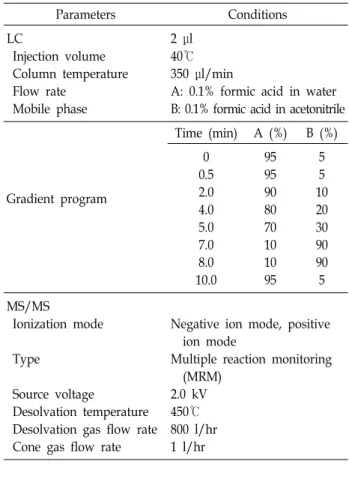
Table 1. Conditions of UPLC/MS/MS analysis for ST-L and ST-B extracts
Parameters Conditions
LC
Injection volume Column temperature Flow rate
Mobile phase
2 μl 40℃
350 μl/min
A: 0.1% formic acid in water B: 0.1% formic acid in acetonitrile
Gradient program
Time (min) A (%) B (%) 0
0.5 2.0 4.0 5.0 7.0 8.0 10.0
95 95 90 80 70 10 10 95
5 5 10 20 30 90 90 5 MS/MS
Ionization mode Type
Source voltage
Desolvation temperature Desolvation gas flow rate Cone gas flow rate
Negative ion mode, positive ion mode
Multiple reaction monitoring (MRM)
2.0 kV 450℃
800 l/hr 1 l/hr 추출물의 총 폴리페놀 및 기타 분석
Total polyphenol (TP) 및 Total flavonoid 함량 측정은 기존 의 보고된 방법[34]에 따라 측정하였으며, 각각 rutin과 tannic acid를 표준시약으로 사용하였다. 총당 정량은 phenol-sulfu- ric acid법을 사용하였으며, 시료 100 μl에 5% phenol 300 μl와 진한 황산 1.5 ml를 가하고 30℃에서 30분간 반응시켰으며, 이후, 반응액을 490 nm에서 측정하였다. 시료의 흡광도는 su- crose로 표준곡선을 작성하여 SE (sucrose equivalent)로 나타 내었다. 환원당 정량의 경우에는 DNS 변법을 이용하였으며, 시료 100 μl에 DNS 시약 300 μl를 첨가하고 3분간 방치한 후, 100℃에서 5분간 반응시켰으며, 이후 실온에서 방냉한 후, 반 응액을 540 nm에서 측정하였다. 시료의 흡광도는 glucose로 표준곡선을 작성하여 GE (glucose equivalent)로 나타내었다 [20].
UPLC/MS/MS에 의한 flavonoids 및 phenolic acids 분석
상동나무 추출물의 flavonoids 및 phenolic acids 분석은 UPLC (Acquity i class, Waters, Milford, USA)/MS/MS(TSQ Quantum ULTRA, Thermo Fisher, Waltham, USA)를 사용하 였으며, 분석 표품은 상업적으로 판매하고 있는 Sigma Co. (St.
Louis, MO, USA)의 caffeic acid, cinnamic acid, ρ-coumaric acid, m-coumaric acid, ferulic acid, gallic acid, gentisic acid, 4-hydroxybenzoic acid, protocatechuic acid, salicylic acid, si- napic acid, syringic acid, vanillic acid의 13종의 페놀산과 apiin, astragalin, cosmosiin, fisetin, hyperoside, isoquercitrin, kaempferol, luteolin, myricetin, orientin, quercetin, querci- trin, rutin, vitexin의 총 14종의 플라보노이드 성분을 사용하 였다. UPLC 분석 조건은 ACQUITY UPLC® BEH C18 1.7 μm 컬럼, 컬럼온도 40℃, 유량 350 μl/min, 주입량 2 μl, 이동상 용매는 0.1% formic acid가 포함된 증류수와 0.1% formic acid 가 포함된 acetonitrile 기울기 용리를 수행하였다(Table 1).
MS/MS 분석조건은 분석의 선택성과 검출감도 향상을 위해 multiple reaction monitoring (MRM) 방식으로, negative ion- ization mode로 수소화 된 분자이온((M-H)-)을 만들어 각 성 분별 precursor ion을 선정하여 tune 작업을 통해 최적의 colli- sion energy 및 product ion을 선택하여 spray voltage 2.0 kV, desolvation gas flow rate 800 l/hr와 cone gas flow rate 1 l/hr, desolvation temperature 450℃로 분석하였다. Orientin 는 positive ionization mode로 분석하였으며, 이동상 용매는 HPLC/MS/MS용 등급을 사용하였다.
통계분석
모든 분석결과는 3회 반복한 실험의 평균과 편차로 나타내 었다. 실험 결과는 SPSS 23.0 버전을 사용하여 mean ± SD 로 나타내었으며, 각 군간의 차이는 ANOVA로 분석하였으며,
유의수준은 p<0.05로 하였다.
결과 및 고찰
ST-L, ST-B 및 ST-F의 총 폴리페놀, 총 플라보노이드, 총당 및 환원당 분석
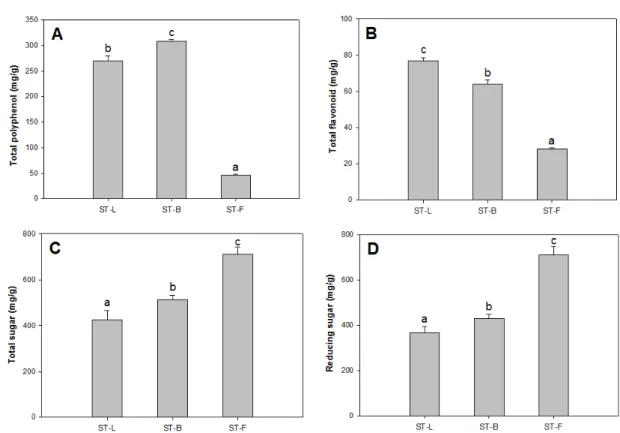
상동나무 지상부의 ethanol 추출물을 제조한 후 이의 유용 성분을 분석하였으며, 그 결과는 Fig. 1에 나타내었다. 상동나 무 에탄올 추출효율은 열매 > 잎 > 줄기의 순으로 나타났으며, 15.5~20.0%의 수율을 나타내었다. 부위별 추출물의 유용성분 분석 결과, 총 폴리페놀 함량은 줄기 추출물에서 가장 높은 307.5 mg/g의 함량을 보였으며, 잎 추출물(270.0 mg/g), 열매 추출물(45.8 mg/g) 순으로 나타났다. 반면, 플라보노이드 함 량 측정 결과는 잎 추출물(77.0 mg/g) > 줄기 추출물(63.9 mg/g) > 열매 추출물(28.2 mg/g) 순으로 나타났다. 총당 및 환원당 함량은 유사하게 열매 > 줄기 >잎의 순으로 나타났다.
따라서, 기존의 많은 연구가 이루어진 상동나무 열매보다 잎 및 줄기 추출물이 보다 높은 폴리페놀 및 플라보노이드 함량 을 나타내어 더욱 우수한 생리 활성을 나타내리라 예상되었다 [25, 30].
Fig. 1. Component analysis of the ethanol extracts of aerial parts of Sageretia thea. Symbols: ST-L: leaf extract of Sageretia thea, ST-B:
branch extract of Sageretia thea, ST-F: fruit extract of Sageretia thea. Different superscripts within a column differ significantly (p<0.05).
Table 2. Platelet aggregation inhibitory activities of the ethanol extracts of aerial parts of Sageretia thea Chemicals/
Samples
Conc.
(mg/ml)
Amplitude (Ω)
Slope (Ω/min)
Lag time (sec)
Area under
PAR1 (%)
DMSO 22 6 34 167.6 100
Aspirin 0.25
0.125
10 18
1 3
91 36
54.5 120.9
32.5 68.6
ST-L
0.25 0.125 0.063
3 9 21
1 2 4
21 14 5
24.4 71.3 171.2
14.6 42.5 102.1
ST-B
0.25 0.125 0.063 0.025
2 8 18 22
1 2 2 4
22 62 8 12
14.8 58.3 135.4 173.6
8.8 34.8 80.8 103.6
ST-F 0.25 28 6 34 226.9 135.4
1PAR: Platelet Aggregation Ratio. Data are presented as representative result relative of independent three determinations. Amplitude is expressed as ohms by maximum extent of platelet aggregation, and slope (rate of reaction) is determined by drawing a tangent through the steepest part of curve. Area under is a calculated area in descent drawing during platelet aggregation. 2RAAE: Residue after adult emerge.
ST-L, ST-B 및 ST-F 추출물의 혈액응고저해 활성 상동나무 지상부 ethanol 추출물의 항응고 활성을 TT, PT, aPTT를 각각 측정하여 평가하였다. 활성대조구로는 throm- bin 및 혈액응고인자 저해를 통해 혈전 생성을 억제하는 aspir- in [39]을 사용하였으며, aspirin은 1.5 mg/ml 농도에서 용매
대조구에 비해 TT, PT, aPTT를 각각 1.82, 1.57 및 1.69배 증가 시켜 우수한 항응고 활성을 확인하였다. ST-L 및 ST-B 추출물 은 2.5 mg/ml에서 용매대조구보다 15배 이상 연장된 혈액응 고시간을 나타내었으며, 특히 ST-B 추출물은 1.25 mg/ml 농 도에서 TT 및 aPTT를 대조구에 비해 15배 이상 연장하였으며,
Table 3. Hemolytic of the ethanol extracts of aerial parts of Sageretia thea against human red blood cells Chemicals/Samples (mg/ml) Hemolysis (%)
DMSO Triton X 100(1.0)
1.5±1.2 100.0±0.1
Amphotericin
95.8±0.3 80.7±7.3 59.5±6.3 48.2±5.9 38.0±0.7 26.5±9.6 0.0±1.7 ST-L
ST-B ST-F
-5.8±1.5 -7.2±3.2 -0.5±3.5 Fig. 2. Effect of the ethanol extracts of aerial parts of Sageretia
thea on blood coagulation. Anti-coagulation activity was calculated on the clotting time of sample divided by the clotting time of solvent control in blood coagulation assay. The thrombin time (TT), prothrombin time (PT) and activated partial thromboplastin time (aPTT) of sol- vent control (dimethylsulfoximide) were 31.5 sec, 20.5 sec and 80.9 sec, respectively. Data are means ± SD of triplicate determinations.
PT의 경우에도 1.55배 연장하여 ST-L 추출물보다 강력한 활성 을 나타내었다(Fig. 2). ST-B 추출물의 강력한 트롬빈 저해는 0.95 mg/ml 농도에서도 확인되어, elastase와 같은 serine계 단백질 분해효소에도 유사한 저해활성[42]을 나타내어 피부탄 력개선 화장품 소재로도 이용가능하리라 판단된다. 한편 ST-F 추출물은 2.5 mg/ml 농도에서 aPTT만 1.5배 연장시켰으며, TT 및 PT는 각각 무첨가구에 비해 0.87배 및 0.92배 연장하여 항응고 활성이 인정되지 않았다. ST-L 및 ST-B 추출물은, 최근 항혈전 활성이 우수하다고 알려진 블랙커런트[17], 복분자
[19], 오미자[21], 흑마늘[7], 패모[33], 수태[28], 우엉뿌리[18], 모링가[26], 눈개승마[15] 및 마가목 열매[20] 등의 약용식물보 다도 강력한 항응고 활성을 나타내었으며, 상기 결과는 상동 나무 잎과 줄기 추출물을 이용한 경제성 있는 항응고제 개발 이 가능함을 제시하고 있다.
ST-L, ST-B 및 ST-F 추출물의 혈소판 응집저해 활성 상동나무 지상부 ethanol 추출물의 혈소판 응집저해 활성 을 impedance 법으로 측정한 Table 2 및 Fig. 3에 나타내었다.
활성대조구로는 COX-1을 비가역적으로 저해하여 혈소판 응 집에 중요한 역할을 수행하는 thromboxane A2 합성을 억제하 는 aspirin [40]을 사용하였으며, aspirin은 0.25 및 0.125 mg/ml 농도에서 각각 무첨가구에 비해 각각 32.5 및 68.6%의 혈소판 응집율을 나타내어 농도 의존적인 강력한 혈소판 응집 저해 활성을 나타내었다. 한편, ST-L 추출물은 0.25 mg/ml에 서 14.6%, 0.125 mg/ml에서 42.5%, 0.063 mg/ml에서 102.1%
의 응집도를 나타내어 aspirin보다 강력한 응집저해 활성을 나타내었다. ST-B 추출물 역시 0.25 mg/ml에서 8.8%, 0.125 mg/ml에서 34.8%, 0.063 mg/ml에서 80.8%의 응집도를 나타 내어 aspirin에 비해 2~4배 강력한 응집저해 활성을 나타내었 다. 이는 기존 혈소판 응집저해능이 우수하다고 알려진 천연 한방약재보다 강력한 저해 활성이었다[18-21, 33]. 반면, ST-F 추출물은 0.25 mg/ml 농도에서 인간 혈소판 응집을 오히려 촉진하여 무첨가구에 비해 135.4%의 응집도를 나타내었다 (Fig. 3). 따라서, ST-L 및 ST-B 추출물은 강력한 혈소판 응집저 해 활성으로 항혈전제로 사용가능함을 확인하였다.
ST-L, ST-B 및 ST-F 추출물의 인간 적혈구 용혈 활성 상동나무 지상부 ethanol 추출물의 인간 적혈구 용혈활성 을 평가하였으며, 그 결과는 Table 3에 나타내었다. 먼저, 대조 구로 사용된 DMSO와 물은 용혈 활성이 없었으며, Triton X-100은 1 mg/ml 농도에서 적혈구를 100% 용혈시킴을 확인
Table 4. Flavonoids and phenolic acids identified in the ethanol extracts of aerial parts of Sageretia thea
Flavonoid and phenolic acid
Concentration (μg/g)
ST-L ST-B
Apigenin Luteolin Vitexin Astragalin Isoquercitrin Kaempferol Quercetin Orientin Qurercitrin Hyperoside Rutin
4-Hydroxybenzoic acid Protocatechuic acid p-Coumaric acid Vanillic acid Caffeic acid Ferulic acid Syringic acid
- 0.135±0.04 0.175±0.03 3.663±0.07 58.863±1.34
- 0.004±0.001
- - 0.662±0.002 664.627±7.251 0.046±0.002
- 0.005±0.001 0.032±0.002 0.004±0.001 0.011±0.001
-
- 0.257±0.007 0.004±0.001 0.827±0.014 13.42±0.065
- 0.032±0.001
- - 0.138±0.002 174.802±5.331 0.164±0.001
- 0.005±0.001 0.086±0.006 0.001±0.001 0.002±0.001 0.024±0.001 -: below detection limit (0.001 μg/g)
A B C D E F G H I J K
Fig. 3. Diagram of impedance changes during platelet aggregation after addition of aspirin and the ethanol extracts of aerial parts of Sageretia thea in whole blood aggregometer. Symbols: (A) DMSO, (B) aspirin (0.25 mg/ml), (C) aspirin (0.125 mg/ml), (D) ST-L (0.25 mg/ml), (E) ST-L (0.125 mg/ml), (F) ST-L (0.063 mg/ml), (G) ST-B (0.25 mg/ml), (H) ST-B (0.125 mg/ml), (I) ST-B (0.063 mg/ml), (J) ST-B (0.025 mg/ml) and (K) ST-F (0.25 mg/ml). Aggregation was induced by addition of 2.5 μl of collagen (1 mg/ml) into cuvette containing 50 μl of washed PRP and measured the impedance change for 12 min.
The sample concentrations used were 0.25 mg/ml, respectively.
하였다. 또한, 항암제, 항진균제로 사용되고 있는 amphoter- icin B의 경우 0.025mg/ml 농도에서 50% 이상 적혈구를 용혈 시킴을 확인하였다. 반면 ST-L, ST-B, ST-F 추출물 모두에서 1 mg/ml 농도까지 전혀 용혈활성이 나타나지 않았다. 상동나 무 열매가 식용으로 사용되고 있으며, 잎을 차로 음용하고 있 음을 고려할 때, 상동나무 잎 및 줄기도 특별한 독성은 나타내 지 않으리라 판단된다[5].
ST-L 및 ST-B 의 flavonoids 및 phenolic acids 분석 혈액응고 및 혈소판 응집 저해 활성이 우수한 ST-L 및 ST-B 추출물을 대상으로 flavonoids 및 phenolic acids 성분을 분석 한 결과는 Table 4에 나타내었다. ST-L 추출물에서는 rutin이 가장 높은 함량(664.6 μg/g)을 나타내었으며, isoquercitrin (58.8 μg/g), astragalin (3.66 μg/g)이 검출되었다. ST-B 추출물 의 경우에도 rutin (174.8 μg/g), isoquercitrin (13.4 μg/g), as- tragalin (0.8 μg/g)이 주요 성분으로 확인되었다. 특히 iso- quercitrin (quercetin 3-glucoside)은 quercetin보다 우수한 생 리활성을 나타내는 것으로 알려져 있으나 자연계에서 매우 희귀한 flavonoid 성분이며[29], 현재까지 상동나무에서는 보 고된 바 없다. Isoquercitrin은 상동나무와 유사한 갈매나무과 대추잎[27] 및 나포마 잎[9] 등에서 보고되어 있으며, 심장기능 장애 완화[4], 혈소판 응집저해[9], 폐고혈압 완화[41] 등의 활 성이 알려져 있다. 또한 rutin, astragalin의 경우 이미 항혈전 활성이 보고된 바 있다[19, 25]. 따라서 ST-L 및 ST-B 추출물의 강력한 항응고 및 혈소판 응집저해 활성은 rutin, isoquercitrin, astragalin 등의 flavonoids 성분에 의한 것으로 추측된다. 한 편 isoquercitrin (quercetin 3-glucoside)은 quercetin으로부터
생성되는 것으로 알려져 있으나, 상동나무 잎과 줄기 추출물 에서는 quercetin, quercitrin (quercetin-3-rhamnoside) 및 hy- peroside (quercetin-3-glalctoside)는 거의 검출되지 않으면서, 상대적으로 희귀한 isoquercitrin (quercetin 3-glucoside)을 고 농도로 함유하고 있는 점은 매우 흥미로우며, 이는 β-glucosi- dase inhibitor가 강력한 대추잎[6]에서 isoquercitrin이 고농도
로 검출되는 현상과 관련이 있을 것으로 판단된다. 향후 상동 나무 잎의 quercetin 대사 과정 및 생태적 특성 연구와 iso- quercitrin 생합성의 상관관계 연구가 필요하다고 판단된다.
이상의 결과는, 제주 특산식물인 상동나무 잎과 줄기가 새로 운 항혈전제 개발 소재로 이용 가능하며, serine계 효소저해에 의한 다양한 식의약품, 화장품 소재로 개발이 필요함을 제시 하고 있다.
감사의 글
본 연구는 2019년도 산업통산자원부 바이오테라피 산업기 반구축사업(과제번호 N0001805)에 의해 수행되었으며, 이에 감사드립니다.
The Conflict of Interest Statement The authors declare that they have no conflicts of interest with the contents of this article.
References
1. Chung, S. K., Chen, C. Y. O. and Blumberg, J. B. 2009.
Flavonoid-rich fraction from Sageretia theezans leaves scav- enges reactive oxygen radical species and increases the re- sistance of low-density lipoprotein to oxidation. J. Med. Food.
12, 1310-1315.
2. Chung, S. K., Kim, Y. C., Takaya, Y., Terashima, K. and Niwa, M. 2004. Novel flavonol glycoside, 7-O-methyl mearn- sitrin, from Sageretia theezans and its antioxidant effect. J.
Agric. Food Chem. 52, 4664-4668.
3. Eikelboom, J. W., Zelenkofske, S. L. and Rusconi, C. P. 2010.
Coagulation factor IXa as a target for treatment and prophy- laxis of venous thromboembolism. Arterioscler. Thromb. Vasc.
Biol. 30, 382-387.
4. Huang, S. H., Xu, M., Wu, H. M.,Wan, C. X., Wang, H.
B., Wu, Q. Q.,Liao, H. H., Deng, W. and Tang, Q. Z. 2018.
Isoquercitrin attenuated cardiac dysfunction via AMPKα- dependent pathways in LPS-treated mice. Mol. Nutr. Food Res. 62, e1800955.
5. Hyun, T. K., Song, S. C., Song, C. K. and Kim, J. S. 2015.
Nutritional and nutraceutical characteristics of Sageretia thee- zans fruit. J. Food Drug Analy. 23, 742-749.
6. Jo, Y., Lim, S., Chang, P. S. and Choi, Y. J. 2016. The possible presence of natural β-D-glucosidase inhibitors in jujube leaf extract. Food Chem. 194, 212-217.
7. Jung, I. C. and Sohn, H. Y. 2014. Antioxidation, antimicrobial and antithrombosis activities of aged black garlic (Allium sativum L.). Kor. J. Microbiol. Biotechnol. 42, 285-292.
8. Kang, K. B., Park, E. J., Silva, D. R. R., Kim, H. W., Dorrestein, P. C. and Sung, S. H. 2018. Targeted isolation of neuro- protective dicoumaroyl neolignans and lignans from Sageretia theezans using in silico molecular network annota-
tion propagation-based dereplication. J. Nat. Prod. 24, 1819- 1828.
9. Kasimu, R., Fan, Z., Wang, X., Hu, J., Wang, P. and Wang, J. 2015. Anti-platelet aggregation activities of different frac- tions in leaves of Apocynum venetum L. J. Ethnopharmacol.
168, 116-121.
10. Khalil, A. T., Ovais, M., Ullah, I., Ali, M., Shinwari, Z. K., Hassan, D. and Maaza, M. 2018. Sageretia thea (Osbeck.) modulated biosynthesis of NiO nanoparticles and their in vitro pharmacognostic, antioxidant and cytotoxic potential.
Art. Cells Nanomed. Biotechnol. 46, 838-852.
11. Kim, H. N., Park, G. H., Kim, J. D., Park, S. B., Eo, H. J.
and Jeong, J. B. 2019. Effect of the extracts from the leaves and branches of Sageretia thea on β-catenin proteasomal deg- radation in human colorectal and lung cancer cells. Kor. J.
Plant Res. 32, 153-159.
12. Kim, H. N., Park, G. H., Park, S. B., Kim, J. D., Eo, H. J., Son, H. J., Song, J. H. and Jeong, J. B. 2019. Extracts from Sageretia thea reduce cell viability through inducing cyclin D1 proteasomal degradation and HO-1 expression in human colorectal cancer cells. BMC Complement. Altern. Med. 19, 43.
13. Kim, H. N., Park, G. H., Park, S. B., Kim, J. D., Eo, H. J., Son, H. J., Song, J. H. and Jeong, J. B. 2019. Sageretia thea inhibits inflammation through suppression of NF-κB and MAPK and activation of Nrf2/HO-1 signaling pathways in RAW264.7 cells Am. J. Chin. Med. 47, 385-403.
14. Kim, J. S. and Hyun, T. K. 2015. Nutrients and antioxidative activities of Sageretia theezans fruit. Kor. Soc. Med. Crop Sci.
5, 225-226.
15. Kim, M. S. and Sohn, H. Y. 2014. Anti-thrombosis Activity of the aerial part of Aruncus dioicus var kamtschaticus. J. Life Sci. 24, 515-521.
16. Kim, M. S. and Sohn, H. Y. 2015. Anti-coagulation and an- ti-platelet aggregation activity of the mature fruit of Sorbus commixta. Microbiol. Biotechnol. Lett. 43, 373-377.
17. Kim, M. S. and Sohn, H. Y. 2016. Anti-oxidant, anti-coagu- lation, and anti-platelet aggregation activities of black cur- rant (Ribes nigrum L.). J. Life Sci. 26, 1400-1408.
18. Kim, M. S., Lee, Y. S. and Sohn, H. Y. 2014. Anti-thrombosis and anti-oxidative activity of the root of Arctium lappa L.
Kor. J Food Preserv. 21, 727-734.
19. Kim, M. S., Shin, W. C., Kang, D. K. and Sohn, H. Y. 2016.
Anti-thrombosis activity of sinapic acid isolated from the lees of bokbunja wine. J. Microbiol. Biotechnol. 26, 61-65.
20. Kim, M. S., Sung, H. J. and Sohn, H. Y. 2016. In-vitro anti- thrombosis activity of different parts of Sorbus commixta from Ulleung island. J. Life Sci. 26, 289-295.
21. Kim, M. S., Sung, H. J., Park, J. Y. and Sohn, H. Y. 2017.
Evaluation of anti-oxidant, anti-microbial and anti-thrombo- sis activities of fruit, seed and pomace of Schizandra chinensis Baillon. J. Life Sci. 27, 131-138
22. Ko, G. A., Koh, S. Y., Ryu, J. Y. and Kim, S. M. 2017.
Comparison of proximate compositions, antioxidant, and antiproliferative activities between blueberry and Sageretia thea (Osbeck) M.C. Johnst fruit produced in Jeju Island. J.
Appl. Biol. Chem. 60, 161-171.
23. Ko, G. A., Shrestha, S. and Kim, C. S. 2018. Sageretia thea fruit extracts rich in methyl linoleate and methyl linolenate downregulate melanogenesis via the Akt/GSK3beta signal- ing pathway. Nutr. Res. Pract. 12, 3-12.
24. Ko, G. A., Son, M. and Cho, S. K. 2016. Comparative evalua- tion of free radical scavenging activities and cytotoxicity of various solvent fractions of Sandong Sageretia thea (Osbeck) M.C. Johnst branches. Food Sci. Biotechnol. 25, 1683-1691.
25. Kumar, S., Prahalathan, P. and Raja, B. 2011. Antihyperten- sive and antioxidant potential of vanillic acid, a phenolic compound in L-NAME-induced hypertensive rats: a dose- dependence study. Redox Rep. 16, 208-215.
26. Kwon, C. S., Sung, H. J. and Sohn, H. Y. 2019. Anti-thrombo- sis activities of the root extract of Moringa oleifera Lam.
Microbiol. Biotechnol. Lett. 47, 20-24.
27. Lee, M. K., Kim, H. W., Kim, Y. J., Lee, S. H., Jang, H. H., Jung, H. A., Kim, S. B., Lee, S. H., Choe, J. S. and Kim, J. B. 2016. Profiling of flavonoid glycosides in fruits and leaves of jujube (Zizyphus jujuba var. inermis (Bunge) Rehder) using UPLC-DAD-QTOF/MS. Kor. J. Food Preserv.
23, 1004-1011.
28. Lee, Y. S., Jung, S. J., Kim, M. S., Sohn, H. Y. and Jung, I. C. 2014. In-vitro anti-thrombosis activity of Sphagnum palustre. Kor. J. Microbiol. Biotechnol. 42, 417-421
29. Michalcova, K., Roychoudhury, S., Halenar, M., Tvrda, E., Kovacikova, E., Vasicek, J., Chrenek, P., Baldovska, S., Sanislo, L., Kren, V. and Kolesarova, A. 2019. In vitro re- sponse of human ovarian cancer cells to dietary bio- flavonoid isoquercitrin. J. Environ. Sci. Health B. 54, 752-757.
30. Nanjo, F., Goto, K., Seto, R., Suzuki, M., Sakai, M. and Hara, Y. 1996. Scavenging effects of tea catechins and their de- rivatives on 1, 1-diphenyl-2-picrylhydrazyl radical. Free Radic. Biol. Med. 21, 895-902.
31. Park, J. C., Hur, J. M., Park, J. G., Hatano, T., Yoshida, T., Miyashiro, H., Min, B. S. and Hattori, M. 2002. Inhibitory effects of Korean medicinal plants and camelliatannin H from Camellia japonica on human immunodeficiency virus type 1 protease. Phytother. Res. 16, 422-426.
32. Park, J. S., Hwang, I. W., Zheng, H. Z., Kim, S. K. and Chung, S. K. 2010. Determination of optimum hydrolysis conditions
for flavonoid analysis in plant leaves. Kor. J. Food Preserv.
17, 261-266.
33. Shin, Y. K., Jang, H. S., Kim, J. I. and Sohn, H. Y. 2009.
Evaluation of antimicrobial, antithrombin, and antioxidant, activity of Fritillaria thunbergii Miquel. J. Life Sci. 19, 1245- 1250.
34. Singleton, V. L., Orthofer, R. and Lamuela-Raventos, R. M.
1999. Analysis of total phenols and other oxidation sub- strates and antioxidants by means of folin-ciocalteu reagent.
Methods Enzymol. 299, 152-178.
35. Song, S. C., Song, C. K. and Kim, J. S. 2014, Vegetation and habitat environment of Sageretia thea in Jeju Island. Kor. J.
Med. Crop Sci. 22, 301-305.
36. Song, S. C., Song, C. K. and Kim, J. S. 2015. Characteristics of seed-germination and fruit for Sageretia thea in Jeju region.
Kor. J. Med. Crop Sci. 23, 8-12.
37. Song, S. C., Song, C. K. and Kim, J. S. 2015. Effect of plant growth regulators on fruit enlargement and optimal harvest time in Sageretia thea (Osback) M. C. Johnst. Kor. J. Med. Crop Sci. 23, 311-318.
38. Sweeney, J. D., Hoerning, L. A., Behrens, A. N., Novak, E.
and Swank, R. T. 1990. Thrombocytopenia after desmo- pressin but absence of in-vitro hypersensitivity to ristocetin.
Am. J. Clin. Pathol. 93, 522-525.
39. Szczeklik A, Musial, J., Undas, A., Swadzba, J., Gora, P. F., Piwowarska, W. and Duplaqa, M. 1996. Inhibition of throm- bin generation by aspirin is blunted in hypercholesterolemia.
Arterioscler Thromb Vasc Biol. 16, 948-954.
40. Wang, J., Xiong, X. and Feng, B. 2014. Aspirin resistance and promoting blood circulation and removing blood stasis:
Current situation and prospectives. Evid. Complement. Alter.
Med. 2014, 1-11. http://dx.doi.org/10.1155/2014/954863 41. Zhang, Y., Cui, Y., Deng, W., Wang, H., Qin, W., Huang,
C., Li, C., Zhang, J., Guo, Y., Wu, D. and Guo, H. 2017.
Isoquercitrin protects against pulmonary hypertension via inhibiting PASMCs proliferation. Clin. Exp. Pharmacol. Phys- iol. 44, 362-370.
42. Zhang, Y., Wang, M. and Wei, S. 2010. Isolation and charac- terization of a trypsin inhibitor from the skin secretions of Kanoula pulchra hainana. Toxicon 56, 502-507.
초록:상동나무 지상부의 항혈전 활성
표수진1․이윤진1․박성익2․이창일2․박종이3․손호용1*
(1안동대학교 식품영양학과, 2경상북도 보건환경연구원, 3경북바이오산업연구원)
현대사회는 고지방의 서구화된 식사, 과도한 스트레스 등으로 비정상적인 혈액응고 및 과다한 혈소판 응집이 증가되고 있으며, 이로 인한 다양한 혈전성 질환 위험성도 증가되고 있다. 본 연구에서는 제주 특용식물인 상동나 무(Sageretia thea) 지상부의 항혈전 활성을 평가하기 위해 잎(ST-L), 줄기(ST-B), 열매(ST-F) 에탄올 추출물을 조제 하고 이의 항혈전 활성, 인간 적혈구 용혈활성 및 flavonoids·phenolic acids 조성을 검토하였다. ST-B 추출물은 식용으로 이용되고 있는 ST-F 추출물보다 6.7배의 총 폴리페놀 함량을 보였으며, ST-L 추출물은 ST-F 추출물보다 2.7배 높은 총 플라보노이드 함량을 보였다. 혈액응고 저해활성 평가 결과, ST-F 추출물은 aPTT에서만 혈액응고시 간 연장이 미약하게 나타났으나, ST-L 및 ST-B 추출물은 기존 항혈전제인 aspirin 및 베리류 및 한방 약재 추출물 보다 트롬빈, 프로트롬빈, 응고인자들에 대해 강력한 저해활성을 나타내었다. 혈소판 응집저해 역시 ST-L 및 ST-B 추출물은 aspirin보다 우수한 응집저해 활성을 나타내었으며, 인간 적혈구에 대한 용혈활성은 1 mg/ml 농도까지 전혀 나타나지 않았다. ST-L 및 ST-B 추출물의 phenolic acid 및 flavonoids 분석결과, rutin, isoquercitrin 및 as- tragalin이 주요 활성물질로 확인되었다. 본 연구결과는 상동나무 잎과 줄기의 강력한 항혈전 활성의 최초 보고이 며, 상동나무를 이용한 항혈전제 개발이 가능함을 제시하고 있다. 향후 상동나무에서 처음으로 확인된 isoquercitrin 의 항혈전 기전에 대한 연구가 필요하다.