ISSN 2288-1069 (Online)
http://dx.doi.org/10.12925/jkocs.2021.38.3.824
Mass spectrometry와 NMR Spectroscopy를 이용한 1, 2-Octanediol Galactoside의 효소합성 확인
이향렬1․진홍종2․안승혜3․이혜원3․정경환1,✝
1한국교통대학교 생명공학전공, 교수
2㈜케이피티 연구소, 소장
3한국교통대학교 생명공학전공, 학생
(2021년 4월 12일 접수: 2021년 6월 29일 수정: 2021년 6월 29일 채택)
Confirmation of Enzymatic Synthesis of 1, 2-Octanediol Galactoside using Mass Spectrometry and NMR Spectroscopy
Hyang-Yeol Lee1․Hong-Jong Jin2․Seung Hye An3․Hye Won Lee3․Kyung-Hwan Jung1,✝
1,3Department of Biotechnology, Korea National University of Transportation, Jeungpyung, Chungbuk 27909, Republic of Korea
2KPT Co., LTD, Osong-Eup, Heungdeok-Gu, Cheongju Chungbuk 28162, Republic of Korea
(Received April 12, 2021; Revised June 29, 2021; Accepted June 29, 2021)
요 약 : 안전한 화장품용 방부제에 대한 연구를 위하여 1, 2-octanediol (OD)에 galactose 한 분자 가 결합된 1, 2-octanediol galactoside (OD-gal)의 합성을 시도하였다. 이를 위하여, 재조합 대장균의 β-galactosidase (β-gal)를 이용하여 transgalactosylation 반응을 수행하였으며, OD-gal 합성을 확인 하기 위하여 mass spectrometry 분석과 NMR (1H- and 13C-) spectroscopy 분석을 실시하였다. 합성 반응물에서 m/z=331.1732의 sodium adduct ion 형태로 OD-gal 분자의 합성을 확인하였고, 정제된 OD-gal의 NMR 분석을 통하여 OD-gal의 1H NMR 스펙트럼에서 OD에 갈락토실화가 되었음을 보 여주는 다양한 피크를 확인하였다. 1H NMR 스펙트럼의 다운필드인 δH 4.39 ppm과 δH 3.98~3.55 ppm에서 나타나는 다양한 피크들은 이들이 OD에 갈락토실화가 되었다는 것을 잘 암시하고 있으며, 또 한 1H NMR 스펙트럼의 업필드에서 나타나는 δH 1.52~1.26 ppm과 0.89 ppm의 피크는 OD의 CH2 와 CH3 작용기로 부터 나타나는 피크로써 OD가 본 물질에 존재함을 알 수 있었다. 13C NMR 스펙트 럼에서는 OD-gal의 알파-아노머와 베타-아노머의 구조에서 기인하는 총 24개의 탄소피크가 나타났고, 각 아노머 마다 14개의 탄소가 존재하는데 이중 δc 31.4, 29.0, 22.3 그리고 13.7 ppm에 보이는 OD 4개의 탄소는 지방족 사슬의 끝부분에 해당하며 화학적 구조의 유사성으로 인하여 탄소 피크가 겹쳐서 나타난 것으로 보인다. 따라서 총 28개의 탄소 피크 중 24개가 나타났다. 마지막으로, 합성된 OD-gal 의 β-gal을 이용한 가수분해 반응을 통하여 OD-gal에 gal이 결합되어 있다는 것을 확인하였다. 이러
✝Corresponding author (E-mail: [email protected])
한 결과를 바탕으로 세포독성이 감소된 첨가물 개발을 기대하고 있으며, 추가적인 후속연구를 진행할 예 정이다.
주제어 : 1, 2-옥탄디올 갈락토사이드, 베타-갈락토시데이즈, 핵자기공명분석, 질량분석, 화장품용 방부제
Abstract : 1, 2-Octanediol galactoside (OD-gal) has been synthesized from 1, 2-octanediol (OD), as a safer cosmetic preservative, using recombinant Escherichia coli β-galactosidase (β-gal).
To confirm the molecular structure of synthesized OD-gal, mass spectrometry and NMR (1H- and
13C-) spectroscopy of OD-gal were carried out. In the reaction mixture, a sodium adduct ion of OD-gal (m/z=331.1732) was identified using mass spectrometry analysis. In addition, 1H NMR spectrum of OD-gal showed multiple peaks corresponding to the galactosyl group, which is evidence of galactosylation on OD. Downfield proton peaks at δH 4.39 ppm and multiple peaks from δH 3.98~3.55 ppm were indicative of galactosylation on OD. Up field proton peaks at δH 1.52~1.26 ppm and 0.89 ppm showed the presence of CH2 and CH3 protons of OD. 13C NMR spectrum revealed the presence of 24 carbons suggestive of α- and β-anomers of OD-gal.
Among 14 carbon peaks from each anomer, the 4 peaks at δC 31.4, 29.0, 22.3, and 13.7 ppm were assigned to be overlapped showing only 24 peaks out of a total of 28 peaks. The mass value from mass spectrometry analysis of OD-gal, and 1H and 13C NMR spectral data were in good agreement with the expecting structure of OD-gal. Finally, we identified a galactose molecule from the hydrolysate of OD-gal using β-gal. We are expecting that through future study it will eventually be able to develop a safe cosmetic preservative.
Keywords : 1, 2-Octanediol galactoside, β-Galactosidase, NMR spectroscopy, Mass spectrometry, Cosmetic preservative
1. 서 론
1, 2-Octanediol (Molecular formula: C8H18O2, CAS number: 1117-86-8, 일명 Caprylyl glycol, Fig. 1)은 항균력과 보습력을 가지고 있는 물질로서, 화장품에 0.5에서 1.0%의 농도로 사용 되고 있다. 그 동안 1, 2-Octanediol (OD)는 비 교적 안전한 성분으로 평가되어 왔으나[1], 몇몇 연구에서는 피부에 문제를 유발시킬 수 있을 가 능성 있다는 결과를 제시하고 있다[2,3,4]. 따라 서, 본 연구에서는 그 동안 본 연구팀이 몇 가지 화장품용 방부제에 적용하였던 피부독성 감소를 위한 galactoside 유도체 합성과 응용 전략이 OD 의 문제점을 해결하기 위한 방안으로서 가능한지 를 살펴보았다.
본 연구팀에서는 lactose 농도가 30~40(%)인 조건에서 대장균의 β-galactosidase (β-gal)를 이용한 transgalactosylation (혹은 reverse
hydrolysis) 반응에 관한 연구를 그 동안 수행하 여 왔다[7,8,9,10,11,12]. 이러한 연구 결과를 바 탕으로 chlorphenesin (CPN) [5,6], phenoxyethanol (PE) [7,8], 1, 2-hexanediol (HD) [9,10], 그리고 phenylethanol (PhE) [11,12]과 같은 화장품 방부제로 쓰이는 물질의 galactoside 유도체를 합성했던 방법으로 대장균 의 β-gal를 이용하여 transgalactosylation 반응 으로 OD로부터 1, 2-octanediol galactoside (OD-gal)의 합성 가능성을 확인하는 연구를 수 행하였다. 선행연구에서 이미 화장품용 방부제의 galactoside 유도체가 인간 피부세포에 대한 독성 을 감소시킨다는 실험결과를 확인하였기 때문에 [5,7,13], OD에서 OD-gal이 합성될 수 있다면, 보다 안전한 화장품용 방부제를 확보할 수 있게 되며, 이를 이용한 산업화 응용 연구도 가능할 것으로 생각하고, OD-gal 합성 연구를 수행하였 다.
이번 연구에서는 OD-gal 분자의 합성을 확인 하기 위하여, OD-gal 합성 반응액의 thin-layer chromatography (TLC)와 mass spectrometry 분 석, 정제된 OD-gal의 NMR spectroscopy 분석, 그리고 합성된 OD-gal의 가수분해를 통한 galactose 분자 확인 연구 등을 수행하였다. 앞으 로 OD-gal 분자의 항균력 실험과 인간 피부세포 에 대한 독성연구 등을 수행할 예정이며, 이를 근거로 보다 안전한 OD-gal의 화장품 방부제로 서의 산업화 가능성에 도전해볼 계획을 수립하고 있다.
Fig. 1. Chemical structure of 1, 2-octanediol.
2. 실험방법
2.1. 시약
1, 2-Octanediol은 Sigma-Aldrich (St Louis, MO, USA)에서 구입하였고, TLC (thin-layer chromatography) plate는 MACHEREY- NAGEL GmbH & Co. KG (Düren, Germany) 의 precoated plates SIL HD UV254
(MN809222)를 사용하였다. OD-gal 정제를 위 한 Silica gel은 Zeochem (Uetikon am See, Switzerland)의 ZEOprep 60 (60-200 μm)을 사용하였고, 기타 본 연구에 사용한 시약들은 reagent-grade를 사용하였다.
2.2. 재조합 β-Gal을 발현하는 대장균 대장균의 araBAD 프로모터 시스템에 의하여 발현이 조절되는 pBAD/Myc-His/lacZ vector (7.2 kb) (Invitrogen, Carlsbad, CA, USA)를 사 용하여 E. coil MC 1061를 발 현 숙주로 하여 β-gal을 발현하였다. β-gal 유전자는 pBAD/
Myc-His expression kit의 유전자를 사용하였고, 재조합 E. coil 제작과 재조합 β-gal을 함유한 E. coil의 배양방법 등에 대하여서도 선행연구에 서 자세히 기록하였다[14].
2.3. β-Gal 함유 대장균을 이용한 OD-gal 합성 및 정제
OD-gal 합성은 50 mM phosphate buffer
(pH 7.0)를 이용하여, 50 ml conical tube에 1%
OD, 4.5 U/ml β-gal, 300 g/l lactose를 녹인 후, 전체 반응 부피를 10 ml 되게 하고, shaking incubator (37℃, 100 rpm) 에서 48 시간 동안 수행하였다. 이 때, 반응액의 일부는 mass spectrometry 분석에 사용하였다. 그리고, OD-gal 정제는 silica gel chromatography (이동 상, ethyl acetate: methanol: distilled water = 17:2:1)를 이용하였으며, OD-gal로 추정되는 물 질이 포함된 분획을 모은 후, rotary vacuum evaporator를 이용하여 농축하였다. 기타 정제에 관한 자세한 조건과 방법은 선행연구에 상세히 기술하였다[15,16]. 그리고 이렇게 정제된 OD-gal을 사용하여 NMR spectroscopy 분석과 대장균 β-gal을 이용한 OD-gal 가수분해를 실 시하였다.
2.4. TLC 분석
20 × 10 cm TLC plate에 1.0 μl 시료를 loading하고 이동상 (Ethyl acetate: Methanol:
Distilled water = 17:2:1 (v/v))으로 전개하였다.
그리고 staining solution (1.5 g KMnO4, 10 g K2CO3, 1.25 ml 10% NaOH in 200 ml water) 를 TLC plate에 뿌린 후, 80℃ oven에서 15 분 간 말려서 spot을 확인하였다.
2.5. Mass spectrometry
질량 분석은 High Resolution ESI-Mass spectrometer (SYNAPT G2, Waters, U.K.)를 사 용하여 실시하였다. Ionization source는 ESI (electrospray ionization), analyze type은 time of flight (TOF)이며, 스펙트럼은 positive-ion mode에서 m/z (mass to charge ratio)로 확인하 였다.
2.6. 1H- and 13C-NMR spectroscopy 400 MHz NMR Spectrometer (Bruker Ascend 400, Bruker, Germany)를 이용한
1H-NMR과 13C-NMR 분석을 하였다. 이 때, 사용한 solvent는 D2O이며, 정제된 OD-gal을 약 20 mg 1000 μl D2O에 녹여 NMR 시료로 사 용하였다.
2.7. OD-gal의 가수분해
OD-gal을 가수분해하기 위하여 대장균 β-gal (Sigma-Aldrich) 용액 (2 U/ml) 100 ml와 정제
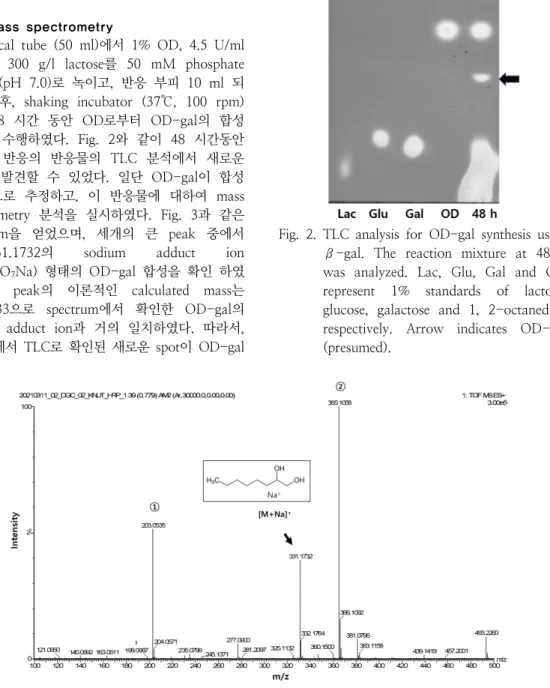
Fig. 3. High resolution ESI mass spectrometry of OD-gal in the reaction mixture.
[M+Na]+ indicates a sodium adduct ion of OD-gal. The preferred structure of OD-gal is shown in the mass spectrum. ① and ② indicate sodium adduct ions of monosaccharide and disaccharide, respectively.
된 OD-gal (0.03 mM) 100 ml를 50 mM phosphate buffer (pH 7.5)에 혼합한 후, 37℃에 서 12 시간 반응시켰다.
3. 결과 및 고찰
3.1. Mass spectrometry
Conical tube (50 ml)에서 1% OD, 4.5 U/ml β-gal, 300 g/l lactose를 50 mM phosphate buffer (pH 7.0)로 녹이고, 반응 부피 10 ml 되 게 한 후, shaking incubator (37℃, 100 rpm) 에서 48 시간 동안 OD로부터 OD-gal의 합성 실험을 수행하였다. Fig. 2와 같이 48 시간동안 수행한 반응의 반응물의 TLC 분석에서 새로운 spot을 발견할 수 있었다. 일단 OD-gal이 합성 된 것으로 추정하고, 이 반응물에 대하여 mass spectrometry 분석을 실시하였다. Fig. 3과 같은 spectrum을 얻었으며, 세개의 큰 peak 중에서 m/z=331.1732의 sodium adduct ion (C14H28O7Na) 형태의 OD-gal 합성을 확인 하였 다. 이 peak의 이론적인 calculated mass는 331.1733으로 spectrum에서 확인한 OD-gal의 sodium adduct ion과 거의 일치하였다. 따라서, 반응물에서 TLC로 확인된 새로운 spot이 OD-gal
일 것이라는 추정에 대한 확실한 근거를 한 가지 찾을 수 있었다. 그 이외에 spectrum에서 단당류의 sodium adduct ion (m/z=230.0523, C6H12O6Na) 과 이당류의 sodium adduct ion (m/z=365.1058, C12H22H11Na)도 확인할 수 있었다.
Fig. 2. TLC analysis for OD-gal synthesis using β-gal. The reaction mixture at 48 h was analyzed. Lac, Glu, Gal and OD represent 1% standards of lactose, glucose, galactose and 1, 2-octanediol, respectively. Arrow indicates OD-gal (presumed).
Fig. 4. 1H-NMR spectrum of OD-gal.
* : artifact(CH3CN) 3.2. 1H- and 13C-NMR spectroscopy
새롭게 합성된 물질의 분자구조를 확인하기 위 하여 OD-gal로 추정되는 물질을 정제하여 1H- and 13C-NMR spectroscopy 분석을 수행하였다.
1H-NMR 스펙트럼은 OD에 galactosylation이 되었음을 보여주는 다양한 피크가 나타나 있다 (Fig. 4). 1H-NMR 스펙트럼의 다운필드인 δH 4.39 ppm과 3.98~3.55 ppm에서 나타나는 다양 한 피크들은 OD에 galactosylation이 되었다는 것을 잘 암시하고 있다(#1 peaks in Fig. 4). 또 한 1H-NMR 스펙트럼의 업필드에서 나타나는 δH 1.52~1.26 ppm과 0.89 ppm의 피크는 OD 의 CH2와 CH3 작용기로부터 나타나는 피크로써 OD가 본 물질에 존재함을 알 수 있다(#2 peaks in Fig. 4). 1H NMR (400MHz, D2O) 4.39 (d, 2H, J=7.6 Hz), 3.98~3.95 (m, 4H), 3.90~3.82 (m, 2H), 3.81~3.77 (m, 6H), 3.71~3.66 (m, 6H), 3.60~3.55 (m, 2H), 1.52~1.42 (m, 4H), 1.36~1.26 (m, 16H), 0.89 (t, 6H, J=6.0 Hz).
13C-NMR 스펙트럼은 OD-gal의 α-anomer
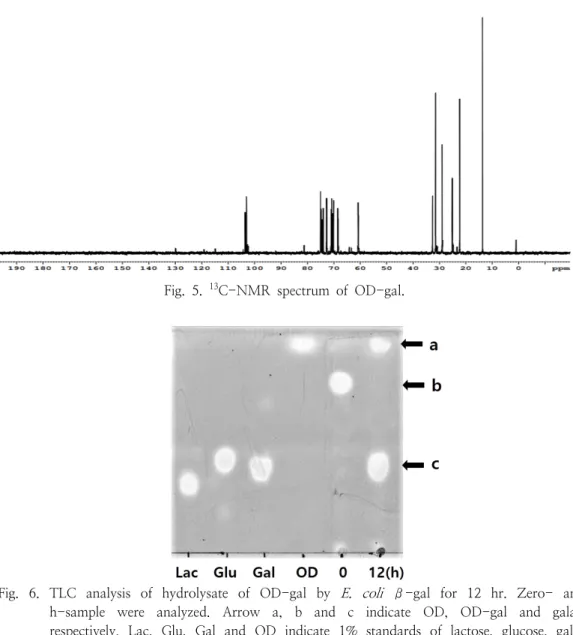
와 β-anomer의 구조에서 기인하는 총 24개의 탄소 피크가 나타났다. 각 anomer 마다 14 개의 탄소가 존재하는데 이중 δC 31.4, 29.0, 22.3 그 리고 13.7 ppm에 보이는 OD 4개의 탄소는 지 방족 사슬의 끝부분에 해당하며 따라서 NMR에 서 탄소의 화학적이동(chemical shift)이 유사하여 겹쳐서 나타났다. 결국 두 anomer로부터 총 28 개의 탄소 피크가 나타나야 하나 이 중 24개만 나타난 것으로 보인다 (black dots in Fig. 5). 이
로써, 본 물질에 OD-gal이 존재하고 있고, OD 에 galactosylation이 되었다는 것을 확인 할 수 있었다 (Fig. 5). 13C NMR (100 MHz, D2O) 103.6, 103.0, 75.0, 74.9, 74.4, 74.0, 72.71, 72.66, 70.9, 70.8, 70.5, 70.1, 68.5, 68.4, 60.8, 60.6, 32.64, 32.58, 31.4, 29.0, 25.1, 25.0, 22.3, 13.6.
그러나, 1H-, 13C-NMR 스펙트럼 결과로는 OD 분자의 두 개 중 어느 hydroxyl group (-OH)에 galactose가 결합했는지는 알 수 없었 다. 다만 선행연구 결과에서는 β-gal에 의하여 CPN, HD의 primary alcohol group에 galactose 가 결합된다고 밝혀져 있다[5,10]. 따라서, OD-gal도 primary alcohol group에 galactose가 결합했을 것으로 추측된다.
3.3. OD-gal의 가수분해
OD로부터 합성된 OD-gal에 galactose가 결합 되어 있다는 것을 확인하기 위하여, 합성된 OD-gal을 β-gal로 가수분해하여, 결합된 galactose가 다시 분리되는지를 확인하였다.
OD-gal을 12 시간 동안 가수분해한 후, TLC로 분석한 결과 OD-gal에서 galactose가 분리되어 나오는 것을 확인하였다(Fig. 6). 분리된 galactose는 TLC에서 Rf=0.38의 spot으로 확인 되었으며, 이 때, standard인 lactose, glucose, galactose의 Rf 값은 각각 0.29, 0.413, 0.373 이 었고, OD의 Rf 값은 0.97, OD-gal의 Rf 값은 0.733이었다. Standard galactose의 Rf 값 0.373
Fig. 5. 13C-NMR spectrum of OD-gal.
Fig. 6. TLC analysis of hydrolysate of OD-gal by E. coli β-gal for 12 hr. Zero- and 12 h-sample were analyzed. Arrow a, b and c indicate OD, OD-gal and galactose, respectively. Lac, Glu, Gal and OD indicate 1% standards of lactose, glucose, galactose and 1, 2-oactanediol, respectively.
과 OD-gal에서 가수분해 반응에서 분리된 spot 의 Rf 값 0.38은 매우 유사하며, 이러한 결과는 OD-gal에 galactose 한 분자가 결합되어 있었다 는 또 다른 증거라고 할 수 있다.
4. 결 론
Mass spectrometry 분석과 NMR (1H- and
13C-) spectroscopy 분석을 통하여, 재조합 대장 균 β-gal을 이용하여 OD의 hydroxyl group (-OH)에 galactose 한 분자를 결합된 OD-gal이 합성된다는 것을 확인하였다. 그리고, 합성된 OD-gal의 가수분해 반응을 이용하여 OD-gal로 부터 galactose 분자가 유리된다는 것을 확인함으 로서, OD-gal 분자에 galactose가 결합되어 합성 되었다는 것을 증명하였다. 따라서, 대장균 β -gal을 이용한 OD-gal로의 transgalactosylation
Fig. 7. Enzymatic synthesis of OD-gal using β-gal.
반응을 Fig. 7과 같이 추론할 수 있었으며, 본 연 구를 통하여, 항균력은 유지하면서, 피부세포에 대한 독성이 감소된 화장품용 방부제 개발을 기 대하고 있으며, 후속연구를 통하여 OD-gal의 항 균력과 피부세포에 대한 독성연구를 수행할 예정 이다.
감사의 글
본 연구는 2020년도 교육부의 재원으로 한국 연구재단의 지원을 받아 수행된 지자체-대학 협 력기반 지역혁신 사업의 결과입니다. 한국교통대 학교 생명공학전공 신재혁, 오승준, 이재혁 학생 이 본 연구에 도움을 주었습니다.
References
1. W. Johnson Jr., W. F. Bergfeld, D. V.
Belsito, R. A. Hill, C. D. Klaassen, D.
Liebler, J. G. Marks Jr., R. C. Shank, T.
J. Slaga, P. W. Snyder, F. A. Andersen,
“Safety assessment of 1, 2-glycols as used in cosmetics”, International Journal of Toxicology, Vol.31(Supplement 2), pp.147S-168S, (2012).
2. E. Q. Coelho, S. L. C. Wu, R. S. Nunes, V. M. S. Reis, “Contact urticaria following the use of a cosmetic containing caprylyl glycol: A case report”, Contact Dermatitis, Vol.81, No.4, pp. 308-309, (2019).
3. F. C. Kreeshan, J. D. L. Williams,
“Allergic contact dermatitis to caprylyl glycol: A novel para-preservative allergen”,
Contact Dermatitis, Vol.83, No.5, pp.
418-419, (2020).
4. E. Lee, S. An, S. A. Cho, Y. Yun, J. Han, Y. K. Hwang, H. K. Kim, T. R. Lee,
“The influence of alkane chain length on the skin irritation potential of 1,2- alkanediols”, International Journal of Cosmetic Science, Vol.33, Vol.5, pp.
421-425, (2011).
5. S. E. Lee, T. M. Jo, H. -Y. Lee, J. Lee, K. -H. Jung, “β-Galactosidase-catalyzed synthesis of galactosyl chlorphenesin and its characterization”, Applied Biochemistry and Biotechnology, Vol.171, No.6, pp.
1299-1312, (2013).
6. S. E. Lee, H. -Y. Lee, K. -H. Jung,
“Production of chlorphenesin galactoside by whole cells of β-galactosidase- containing Escherichia coli”, Journal of Microbiology and Biotechnology, Vol.23, No.6, pp. 826-832, (2013).
7. K. -H. Jung, H. -Y. Lee, “Escherichia coli β-galactosidase-catalyzed synthesis of 2-phenoxyethanol galactoside and its characterization”, Bioprocess and Biosystems Engineering, Vol.38, No.2, pp.
365-372, (2015).
8. H. -Y. Lee, K. -H. Jung, “Enzymatic synthesis of 2-phenoxyethanol galactoside by whole cells of β-galactosidase- containing Escherichia coli”, Journal of Microbiology and Biotechnology, Vol.24, No.9, pp. 1254-1259, (2014).
9. Y. O. Kim, K. -H. Jung, “Enzymatic synthesis of 1, 2-hexandiol galactoside by whole cells of β-galactosidase-containing
recombinant Escherichia coli”, Journal of Life Science, Vol.26, No.5, pp. 608-613, (2016).
10. Y. O. Kim, H. -Y. Lee, K. -H. Jung,
“NMR spectroscopy and mass spectrometry of 1, 2-hexanediol galactoside synthesized using Escherichia coli β-galactosidase”, J. Korean Oil Chemists’ Society”, Vol.33, No.2, pp.
286-292, (2016).
11. H. -Y. Lee, K. -H. Jung, “NMR Spectroscopy and mass spectrometry of phenylethanol galactoside synthesized using Escherichia coli β-galactosidase”, Journal of the Korean Applied Science and Technology, Vol.37, No.5, pp. 1323-1329, (2020).
12. K. -H. Jung, “Optimal conditions for phenylethanol galactoside synthesis using Escherichia coli β-galactosidase”, Journal of the Korean Applied Science and Technology, Vol.38, No.1, pp. 99-106, (2021).
13. J. -S. Kim, K. -H. Jung, “Cytotoxic effects of 1, 2-hexanediol and 1, 2-hexanediol galactoside on HaCaT cell”, Journal of the Society of Cosmetic Scientists of Korea, Vol.44, No.3, pp.
343-347, (2018).
14. K. -H. Jung, “Enhanced enzyme activities of inclusion bodies of recombinant β -galactosidase via the addition of inducer analog after L-arabinose induction in the araBAD promoter system of Escherichia coli”, Journal of Microbiology and Biotechnology, Vol.18, No.3, pp. 434-442, (2008).
15. K. -H. Jung, “Purifications of phenoxyethanol galactoside and chlorphenesin galactoside using solvent extraction followed by gel chromatography”, Journal of Oil and Applied Science, Vol.34, No.4, pp.
954-961, (2017).
16. Y. O. Kim, K. -H. Jung, “β- Galactosidase-catalyzed synthesis of 1, 2-hexanediol galactoside and its purification using ethyl acetate extraction followed by silica gel chromatography”, Journal of Korean Oil Chemists’ Society, Vol.33 No.3, pp. 498-506, (2016).