Safety and Effectiveness of Indacaterol in Chronic Obstructive Pulmonary Disease Patients in South Korea
Ho-Kee Yum, M.D.
1, Hak-Ryul Kim, M.D.
2, Yoon Soo Chang, M.D.
3, Kyeong-Cheol Shin, M.D.
4, Song Kim, M.D.
5and Yeon-Mok Oh, M.D.
61
Department of Internal Medicine, Inje University Seoul Paik Hospital, Inje University College of Medicine, Seoul,
2Department of Internal Medicine, Wonkwang University School of Medicine, Iksan,
3Department of Internal Medicine, Yonsei University College of Medicine, Seoul,
4Division of Pulmonology and Allergy, Department of Internal Medicine, Regional Center for Respiratory Disease, Yeungnam University College of Medicine, Daegu,
5Novartis Korea Ltd., Seoul,
6Department of Pulmonary and Critical Care Medicine, Asan Medical Center, University of Ulsan College of Medicine, Seoul, Korea
Background: Inhaled indacaterol (Onbrez Breezhaler), a long-acting β
2-agonist, is approved in over 100 countries, including South Korea, as a once-daily bronchodilator for maintenance and treatment of chronic obstructive pulmonary disease (COPD). Here, we present an interim analysis of a post-marketing surveillance study conducted to evaluate the real-world safety and effectiveness of indacaterol in the Korean population.
Methods: This was an open-label, observational, prospective study in which COPD patients, who were newly prescribed with indacaterol (150 or 300 μg), were evaluated for 12 or 24 weeks. Safety was assessed based on the incidence rates of adverse events (AEs) and serious adverse events (SAEs). Effectiveness was evaluated based on physician’s assessment by considering changes in symptoms and lung function, if the values of forced expiratory volume in 1 second were available.
Results: Safety data were analyzed in 1,016 patients of the 1,043 enrolled COPD patients receiving indacaterol, and 784 patients were included for the effectiveness analysis. AEs were reported in 228 (22.44%) patients, while 98 (9.65%) patients reported SAEs. The COPD condition improved in 348 patients (44.4%), while the condition was maintained in 396 patients (50.5%), and only 40 patients (5.1%) exhibited worsening of ailment as compared with baseline. During the treatment period, 90 patients were hospitalized while nine patients died. All deaths were assessed to be not related to the study drug by the investigator.
Conclusion: In real-life clinical practice in South Korea, indacaterol was well tolerated in COPD patients, and can be regarded as an effective option for their maintenance treatment.
Keywords: Indacaterol; Pulmonary Disease, Chronic Obstructive; Safety; Bronchodilator Agents; Therapeutics;
South Korea
Address for correspondence: Yeon-Mok Oh, M.D.
Department of Pulmonary and Critical Care Medicine, Asan Medical Center, University of Ulsan College of Medicine, 88 Olympic-ro 43-gil, Songpa-gu, Seoul 05505, Korea
Phone: 82-2-3010-3136, Fax: 82-2-3010-6968, E-mail: [email protected] Received: Feb. 23, 2016, Revised: Apr. 12, 2016, Accepted: Jun. 22, 2016
cc It is identical to the Creative Commons Attribution Non-Commercial License (http://creativecommons.org/licenses/by-nc/4.0/).
Copyright © 2017
The Korean Academy of Tuberculosis and Respiratory Diseases.
All rights reserved.
Introduction
Chronic obstructive pulmonary disease (COPD) is a pro- gressive lung disease characterized by persistent airflow limitation which is associated with an enhanced chronic inflammatory response to noxious particles or gases
1. Ac- cording to the Global Burden of Disease Study reports, COPD is projected to become the third leading cause of mortality worldwide by 2020
1. In South Korea, the prevalence of COPD has been reported as 12.2%–15.5% in 2012, as per the 5th Korean National Health and Nutrition Examination Survey (KNHNES)
2. Bronchodilators remain the cornerstone of pharmacological management of COPD patients. The current Global Initiative for Chronic Obstructive lung Disease (GOLD) guidelines recommend inhaled long-acting bronchodila- tors such as long-acting β
2-agonists (LABAs) and long-acting muscarinic antagonists (LAMAs) for management of patients with moderate-to-severe COPD
1. Once-daily indacaterol is the first approved LABA, inhaled using the Breezhaler device (Onbrez Breezhaler; Novartis, Basel, Switzerland) for main- tenance bronchodilator treatment of COPD patients
3. It was first approved in the European Union in 2009 as a once-daily treatment at doses of 150 and 300 μg
4; since then, it has been approved in over 100 countries worldwide for the mainte- nance treatment of COPD
5. Indacaterol received approval for maintenance bronchodilator treatment of COPD patients in South Korea in 2010.
In clinical studies, once-daily indacaterol showed statistical- ly significant and clinically meaningful improvements in lung function, improved dyspnoea, reduced rescue medication use and improved quality of life (QoL) in patients with moderate- to-severe COPD
4,6. In a 12-week study conducted in Asian pa- tients with moderate-to-severe COPD, including patients from Korea, indacaterol (150 and 300 μg) showed effective bron- chodilation and improvements in patient-reported outcomes.
Moreover, indacaterol had a good safety profile and tolerabil- ity in this population
7. Furthermore, in a 12-week post-hoc analysis conducted in an Asian COPD population, indacaterol treatment demonstrated clinically important improvements in lung function, dyspnoea, and health status
8.
This post-marketing surveillance (PMS) was conducted to meet the local Health Authority regulatory requirements in South Korea, in order to identify unexpected adverse events (AE), if any, and their frequency as well as to understand the factors that may influence the safety and effectiveness of in- dacaterol in COPD patients. The report presented here is an interim analysis of this PMS conducted in COPD patients in South Korea.
Materials and Methods
1. Study design
This was an open-label, observational, prospective study in which the eligible patients were newly treated with inda- caterol (150 or 300 μg) in its approved indication according to the routine medical practice, over a 12- or 24-week treatment period, as applicable. In this PMS study; recruitment of more than 3,000 patients is planned until 2016 according to the Korean Health Authority regulatory guidelines. The study was designed and conducted in accordance with the guidelines for Good Pharmaco-epidemiology Practices and is in compli- ance with the ethical principles stated in the Declaration of Helsinki. The study protocol was approved by the institutional review board of each study center.
2. Study population
The inclusion criteria of subjects were physician-diagnosed COPD patients aged 18 and over, prescribed with indacaterol either 150 or 300 μg for the maintenance treatment. The exclusion criteria were patients with hypersensitivity to inda- caterol capsule or any of the ingredients of the capsule, or with lactose intolerance, or with asthma. The written informed consent of patients for participation in this study was directly taken by each investigator. Patients with hypersensitivity to indacaterol capsule or any of the ingredients of the capsule, or with lactose intolerance, or with asthma, were not included in the study.
3. Assessments
Safety evaluation was based on the incidence of AEs and serious adverse events (SAEs) during routine drug use. An AE was defined as any unfavourable and unintended sign (in- cluding an abnormal laboratory finding), symptom or disease (new disease or worsening of existing disease) occurring after the start of the study medication. Data were collected and recorded, whether volunteered by the subject, discovered by investigator questioning or detected through physical exami- nation, laboratory test or by any other means. Any event was regarded as an SAE, if any one of the following occurred: (1) AE resulting in death/life-threatening condition, (2) required hospitalisation or prolongation of hospitalization, (3) resulted in persistent or significant disability/inability, (4) resulted in a congenital anomaly or a birth defect, and (5) important medi- cal event that jeopardized the subject or may require medical or surgical intervention to prevent one of the outcomes listed above.
Classification of AEs for this study was based on the Medical
Dictionary for Regulatory Activities (MedDRA) 16.0 Classifi-
cation Criteria. Incidences of AEs and SAEs, unexpected AEs
and SAEs which were defined as events not listed in the local label were also assessed. During recording of AEs, following information was included type of AE; onset and stop date;
severity (mild, moderate, or severe); any SAE occurrence;
outcome of AEs; relationship to the study drug; or any con- comitant medications, disease, action taken, and treatment given. The severity of AEs was determined as follows: mild, symptom(s) not interfering with the patient’s daily activities and continuous treatment with same dose of indacaterol is possible; moderate, symptom(s) were interfering with the pa- tient’s daily activities so that the dose decrease of indacaterol or any treatment is needed; and severe, symptom(s) resulting in the patient’s inability to undertake daily activities or dis- continuation of indacaterol due to AEs. Several factors were considered to check whether there was any relationship with the safety variables. These factors were gender, age, disease duration, history of COPD exacerbation, smoking history, treatment duration, average daily dose of indacaterol, comor- bidities, and concomitant drugs or concomitant therapies used.
Effectiveness was evaluated by interviewing the patients by trained and certified physicians and also based on change from baseline in forced expiratory volume in 1 second (FEV
1) when the pulmonary function test results were available at site. Change in COPD condition at week 12 or 24 (whichever applicable) was assessed in terms of ‘improved’ (improvement of symptoms) or ‘maintained’ (little change shown from base- line) or ‘worsening’ (symptoms worsened from baseline) or
‘not assessable’ (assessment is not possible because of loss to follow-up or other reasons). Since indacaterol was approved as a maintenance treatment for COPD patients, both ‘im- proved’ and ‘maintained’ were assessed as being ‘effective.’
4. Statistical analysis
For AEs, the number of the subjects and the number of cases of AEs were calculated. The incidence rates and their 95% confidence intervals (CIs) were estimated and analyzed using the chi-square test or Fisher exact test. The number of cases and the percentage of AEs were calculated according to severity, SAEs, outcome, causality with the study drug, actions
232 Excluded 784 Effectiveness analysis set 3 Enrolled before the contract date
23 Violated exclusion/inclusion criteria 1 Lost to follow-up
1,043 CRFs retrieved
1,016 Safety analysis set 27 Excluded
Figure 1. Selection of study patients (patient disposition). CRF: case report forms.
Table 1. Patient demographics and baseline characteristics
Variable No. (%)
Age, yr
Mean±SD 69.1±9.2
≥65 731 (72)
Gender
Male 891 (87.7)
Treatment type*
Outpatient 984 (97.2)
Hospitalization 28 (2.8)
Duration of COPD, mo
Mean±SD 32.9±47.3
History of COPD exacerbation
Yes 244 (24.0)
No 772 (76.0)
Smoking history
†Non-smoker 188 (18.8)
Current smoker 211 (21.1)
Ex-smoker 603 (60.2)
Medication for COPD treatment
LABA/ICS 133 (13.1)
LAMA 363 (35.7)
ICS use 148 (14.6)
Theophylline 29 (2.9)
Rescue medication 64 (6.3)
Baseline FEV
1, L
Mean±SD 1.46±0.5
*Data for four patients were not recorded.
†Data for 14 patients were not recorded.
SD: standard deviation; COPD: chronic obstructive pulmonary disease; LABA: long-acting β
2-agonist; ICS: inhaled corticosteroid;
LAMA: long-acting muscarinic antagonist; FEV
1: forced expiratory
volume in 1 second.
taken with regard to the study drug, and treatment for AEs.
AEs/SAEs whose causality was related to the study drug were referred to as ‘adverse drug reactions.’ Patients excluded from the safety analysis set were those who ‘did not take the study drug’ and those ‘who was lost to follow-up.’
FEV
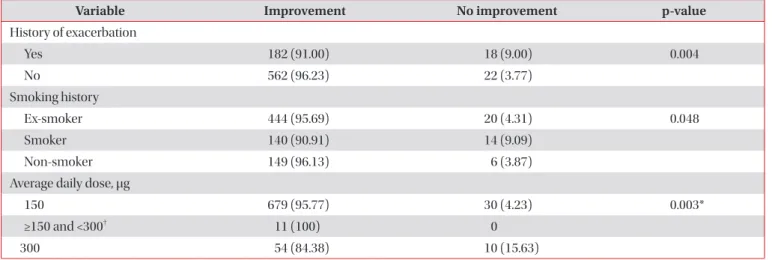
1values at week 12 or 24 (as applicable) from baseline (before administration) were recorded (if the patients under- went a spirometry test) and the changes before and after study drug administration were analyzed using the paired t test. The effectiveness rate was assessed according to demographic data including key factors such as age, gender, duration of dis- ease, exacerbation history, smoking history, total duration of treatment, total dosage, treatment discontinuation and its rea- son, concomitant medication use and its type, concomitant treatment and its type. The effectiveness rate and its 95% CIs were then estimated and analyzed using the chi-square test or Fisher exact test. Multivariate logistic regression analysis was performed to find factors affecting effectiveness rate and inci- dence rate of AEs. All statistical analysis was performed using SAS release version 9.4 (SAS Institute Inc., Cary, NC, USA).
Results
1. Patient disposition
Of the 1,043 enrolled patients, 1,016 patients (97.4%) were included in the safety analysis set. Of these, 784 patients (77.2%) were part of the effectiveness analysis set while 232 patients (22.8%) were excluded due to inability to assess their final effectiveness (i.e., those who did not visit at week 12 and week 24) (Figure 1).
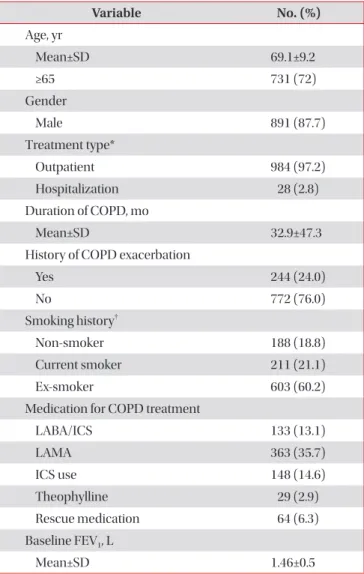
2. Patient demographics and baseline characteristics Patient demographics and baseline characteristics are presented in Table 1. The average patient age was 69.1±9.2 years and 87.7% of patients were male. Most patients were fol- lowed up at outpatient clinic (97.2%) and 76% of patients had no history of exacerbation in the previous 12 months. Prior to study enrolment, 13.1% and 35.7% of patients were using inhaled corticosteroids (ICS)/LABA and LAMA, respectively.
ICS use including ICS/LABA at baseline was 14.6% of patients.
Spirometry was available for 476 patients with the mean FEV
1as 1.46±0.47 L. On an average, patients were treated with indacaterol for 150.3±66.1 days. Majority of patients (91.2%) received the daily treatment dose of 150 μg while only 7.6% of the patients received 300 μg.
Table 2. AEs and SAEs (safety set)
Incidence rate, n (%) 95% CI
Any AEs 228 (22.44) 19.91–25.13
Most frequent AEs by preferred term
Cough 41 (4.04) 2.91–5.43
Dyspnoea 30 (2.95) 2.00–4.19
COPD worsening 18 (1.77) 1.05–2.79
Pneumonia 18 (1.77) 1.05–2.79
Adverse drug reactions* 50 (4.92) 3.67–6.44
Most frequent adverse drug reactions
Cough 28 (2.76) 1.84–3.96
Drug ineffective 9 (0.89) 0.41–1.67
Dyspnoea 4 (0.39) 0.11–1.00
Any SAEs 98 (9.65) 7.9–11.63
Most frequent SAEs by preferred term
Dyspnoea 19 (1.87) 1.13–2.91
Pneumonia 17 (1.67) 0.98–2.67
COPD 14 (1.38) 0.76–2.30
Adverse drug reactions* 1 (0.10) 0.00–0.55
*Defined as AEs/SAEs whose causality was related to the study drug.
AEs: adverse events; SAEs: serious adverse events; CI: confidence intervals; COPD: chronic obstructive pulmonary disease.
3. Safety assessments
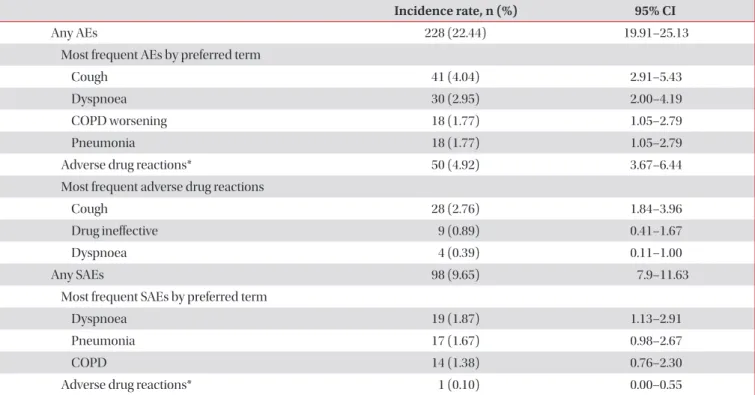
Overall, 228 patients (22.44%) reported at least one AE with a total of 313 cases of AEs, during this interim analysis. The most common AEs were cough (4.04%) followed by dyspnoea (2.95%), COPD worsening (1.77%), and pneumonia (1.77%).
‘Adverse drug reactions’ occurred in 50 patients (4.92%).
Cough (2.76%), drug ineffective (0.89%), and dyspnoea (0.39%) were the most frequent adverse drug reactions in these patients (Table 2).
SAEs were reported by 98 patients (9.65%) with a total of 131 cases during this interim analysis. Of 1,016 patients the most frequent SAEs were dyspnoea (1.87%, 19) followed by pneumonia (1.67%, 17), and COPD worsening (1.38%, 14) (Table 2).
Some of the cases of the reported AEs and SAEs were unexpected, which are defined in the protocol as the events not listed on the local label of the study drug; 13% of patients reported 169 AEs while 8.2% of patients reported 105 SAEs without expectation. SAE suspected to be related to the study medication was orthostatic hypotension, which was reported by one patient. Ninety patients in this study population were hospitalized and nine patients died during the treatment pe- riod. All death was assessed to be not related to study medica- tion as determined by the investigator.
Among 313 reported AEs, majority of them were ‘mild’
(61.3%) while the proportion of ‘moderate’ and ‘severe’ cases was lower (27.8% and 10.9%, respectively) (Figure 2). The AEs could either be resolved completely (67.1%), or on recovery (20.1%) while some of them were not resolved (10.5%), re- solved with sequela (0.7%) or remained worsened (1.6%). For the management of AEs, the most common action taken with the study drug was no change (77.6%) followed by perma- nently discontinued (20.8%), temporarily discontinued (1.3%), and dosage increased (0.3%).
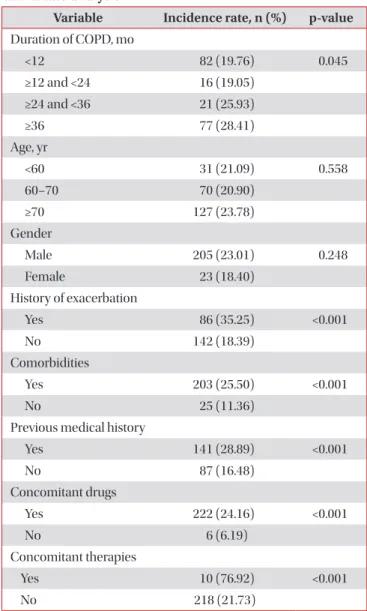
There were no differences in the incidence rate of AEs either by gender or age. However, a statistically significant difference in the incidence rate was observed for patients who suffered from COPD for more than 3 years as compared with patients who had the disease for less than 1 year (28.41% vs. 19.76%, respectively; p=0.045). In addition, an analysis of the incidence of AEs based on the presence and absence of COPD exac- erbations revealed that 35.25% (86/244) of the patients with AEs had experienced a COPD exacerbation, while 18.39%
(142/772) had not (p<0.001) (Table 3). Multivariable analysis showed that COPD exacerbation history (relative ratio [RR], 1.88; p=0.001), previous medical history (RR, 2.05; p<0.001), comorbidities (RR, 2.19; p=0.002), concomitant drugs (RR,
250
200
150
100
50
No.ofAEs*
0
Mild Moderate Severe
Severity
Figure 2. Severity of AE (safety set). *For 313 AEs reported by 228 patients. AEs: adverse events.
Table 3. Factors associated with incidence rate of AEs:
univariate analysis
Variable Incidence rate, n (%) p-value Duration of COPD, mo
<12 82 (19.76) 0.045
≥12 and <24 16 (19.05) ≥24 and <36 21 (25.93)
≥36 77 (28.41)
Age, yr
<60 31 (21.09) 0.558
60–70 70 (20.90)
≥70 127 (23.78)
Gender
Male 205 (23.01) 0.248
Female 23 (18.40)
History of exacerbation
Yes 86 (35.25) <0.001
No 142 (18.39)
Comorbidities
Yes 203 (25.50) <0.001
No 25 (11.36)
Previous medical history
Yes 141 (28.89) <0.001
No 87 (16.48)
Concomitant drugs
Yes 222 (24.16) <0.001
No 6 (6.19)
Concomitant therapies
Yes 10 (76.92) <0.001
No 218 (21.73)
p-value by chi-square test.
AE: adverse event; COPD: chronic obstructive pulmonary disease.
3.45; p=0.01), and concomitant therapies used (RR, 7.91;
p=0.003) were the factors that affects the incidence rate of AEs (Table 4).
4. Effectiveness assessments
Physicians subjectively assessed the patient’s overall status based on the changes in FEV
1and symptom improvement at week 12 or 24, through proportions of ‘improved’, ‘maintained’
Table 4. Multivariate logistic regression analysis of factors associated with incidence rate of AEs and effectiveness rate
Variable OR 95% CI p-value
Incidence rate of AEs
COPD exacerbation history 1.88 1.28–2.77 0.001 Previous medical history 2.05 1.45–2.88 <0.001
Comorbidities 2.19 1.34–3.58 0.002
Concomitant drugs 3.45 1.35–8.83 0.01 Concomitant therapies 7.91 2.06–30.32 0.003 Effectiveness rate
COPD exacerbation history 0.43 0.22–0.83 0.011 Average daily dose 0.99 0.99–1.00 0.003 AEs: adverse events; OR: odds ratio; CI: confidence interval; COPD:
chronic obstructive pulmonary disease.
60
50
40
30
20
10
No.ofpatients(%)
0
Improved No change Worsening
Overall condition of patients 44.4
50.5
5.1 n=348
n=348 n=396n=396 n=40n=40