1. 서론
1.1. 연구의 배경 및 목적
2010년 LUTRON Lighting Control System Seminar의 건물에 서의 에너지 소비형태 자료에 의하면 미국과 한국은 각각 조명에 너지 사용량은 건물부분 에너지 소비량의 28%, 22%로 높게 나타 나고 있으며, 조명에너지 사용량은 점차 증가할 것이라고 보고하 고 있다. 이러한 조명에너지 문제에 대한 해결책을 제시하기 위하 여 다양한 연구가 진행되고 있으며, 이러한 다양한 연구 중 자연 채광시스템은 외부 자연광을 실내로 끌어들여 질적으로 우수한 빛환경을 조성하는 시스템으로 그 효율을 인정받고 있다. 자연채 광시스템의 하나인 광선반은 반사를 통하여 외부 자연광을 실내 깊숙이 유입하여 에너지 저감 및 쾌적한 빛환경을 제공한다는 측
pISSN 2288-968X, eISSN 2288-9698 http://dx.doi.org/10.12813/kieae.2015.15.3.049
면에서 그 유효성을 인정받아서 다양한 연구와 적용이 이루어지 고 있다. 그러나 광선반 관련 기존 연구 및 설계 시 광선반의 채광 성능을 높이기 위하여 고휘도의 반사재질을 광선반 반사판으로 적용하고 있으며, 이는 현휘 및 조도 불균형을 야기하고 있다 1) . 이러한 요소는 광선반 관련 분야의 연구 발전에 걸림돌이 되고 있 다고 판단한다. 광선반 반사율에 따른 성능 및 적정안 도출은 선 행되어함에도 불구하고 연구가 부재한 상태이다.
이에 본 연구는 광선반의 반사판의 반사율에 따른 성능평가를 실시하여 광선반의 적정 반사율 및 특성을 도출, 분석하여 광선반 설계 시 기초자료로 활용을 목적으로 한다.
1.2. 연구의 방법 및 절차
본 연구는 광선반 반사율에 따른 성능평가 및 적정안 도출을 위
1) 김정태, 신현구, 김곤, “광반사를 이용한 광선반 채광시스템의 기본형상 설계 및 성능 평가에 관한 연구”, 대한건축학회논문집 19(3), 2003
KIEAE Journal
Korea Institute of Ecological Architecture and Environment 73
1)
반사율에 따른 광선반 채광 성능평가 연구
- 주거공간을 중심으로 -Daylighting Performance Evaluation of Light-shelf according to the Reflectivity
- Focused on the Residing space -
허도연
*
⋅이행우**
⋅서장후***
⋅김용성****
Doyeon Heo
*
⋅Heangwoo Lee**
⋅Janghoo Seo***
⋅Yongseong Kim****
* Dept. of Architectural Design, Graduate School of Techno Design, Kookmin University., South Korea ([email protected])
** Dept. of Architectural Design, Graduate School of Techno Design, Kookmin University., South Korea ([email protected])
*** Dept. of Architectural Design, Graduate School of Techno Design, Kookmin University., South Korea ( [email protected])
**** Corresponding author, Dept. of Architectural Design, Graduate School of Techno Design, Kookmin University., South Korea ([email protected])
A B S T R A C T K E Y W O R D
Purpose: Due to recent increase on energy consumption for light in building, many studies to mitigate this issue have been conducted. Various researches have been carried out to suggest light shelf as one of the solutions, but researches for its reflectivity is very few. In fact, existing research on light shelf shows that utilizing more than 90% of high-illumination materials causes imbalance of glare and illuminance. Method: Therefore this research aimed to evaluate the performance of light shelves depending on reflectivity and to identify proper solution through test-bed.
Result: The results are following: 1) Increased reflectivity generally contributed to increase of indoor illuminance but degrade uniformity factor related with indoor comfort of light environment. 2) The 0˚fixed light shelf with 75% of reflectivity and width of 300mm and 40mm appeared to consume more energy than other shelves. Therefore, it is analyzed as unsuitable. 3) This research was conducted by calculating appropriate angle of light shelf around winter and summer solstices and vernal/autumnal equinox. Based on this, performance evaluation was undertaken depending on reflectivity of movable light shelf, which is activated by external sources and can be applied with lower reflectivity than fixed shelf. However, one exception was a movable shelf with width of 600mm that increased light energy consumption when 75% of reflectivity was applied. 4) Performance evaluation of fixed and movable light shelf showed that the shelf with 80% of reflectivity came up with suitable results, but 75% of reflectivity may be applied depending on the width and angle of the shelf. This research is meaningful in that estimation of appropriate reflectivity of light shelf can resolve the glare problem and improve light environment, and further research would be desirable under more diverse conditions to identify proper solution.
ⓒ 2015 KIEAE Journal
광선반 반사율 성능평가 적정규격
Light-shelf Reflectivity
Performance Evaluation Appropriate Dimension
A C C E P TA N C E IN F O Received April 14, 2015
Final revision received June 20, 2015
Accepted June 22, 2015
하여 <그림1>에서 나타나듯이 다음과 같은 절차에 의거하여 진 행하였다.
첫 번째, 광선반의 개념 및 광선반 관련 연구에서 다루고 있는 반사율을 검토하였으며, 이후 성능평가 간 조명제어를 위한 실내 조도 기준을 고찰하였다. 두 번째, 고찰된 내용을 근거로 광선반 반사율 설정 및 성능평가를 위한 테스트베드 및 환경 설정을 하였 다. 세 번째, 0˚ 고정의 광선반과 가동형 광선반의 반사율에 따른 성능평가를 실시하며, 그에 따른 광선반의 적정 반사율 도출과 분 석을 진행하였다.
본 연구는 광선반 성능평가를 위한 방법으로 실제 조명과 연동 하여 조명 에너지 사용량을 산출하였으며, 이는 광선반 성능평가 를 위한 중요한 지표라고 사료된다.
Literature review
⦁ Concept of Light-shelf
⦁ Trend research of Light-shelf ⦁Recommended levels of illumination
Setting of Light-shelf and test-bed for Performance Evaluation
⦁Reflectivity setting of Light-shelf ⦁Setting of test-bed
Performance Evaluation for Light-shelf according to the Reflectivity
⦁Fixed type (0˚ fixed) ⦁Movable type (-30˚~30˚)
Conclusion Fig. 1 Flowchart of study
2. 광선반 연구 동향 및 조도기준 고찰
2.1. 광선반 개념 및 연구 고찰
광선반은 <그림2>에서 나타나듯이 외부 자연광을 반사를 통 하여 실내 깊숙이 유입시키는 채광시스템이며, 광선반에 의한 빛 의 유입은 광선반의 반사판, 실내공간의 천장 순에 의거하여 반사 가 이루어진다. 이에 광선반 반사판의 반사율은 광선반 성능을 좌 우하는 중요한 지표이다. 또한, 광선반의 종류는 고정된 타입의 재래형 광선반과 태양의 고도 및 방위각에 대응하기 위한 가동형 광선반으로 분류 2) 된다.
Light-shelf -Ⓐ
+Ⓐ
Ⓗ
Ⓦ
ⓗ height ⓦ width + ⓐ + angle - ⓐ - angle
Fig. 2. Concept and variable of light shelf
2) 김기철, 경사형 광선반 채광시스템의 개발 및 채광성능평가에 관한 연구, 경희대학교 석사학위논문, 2004
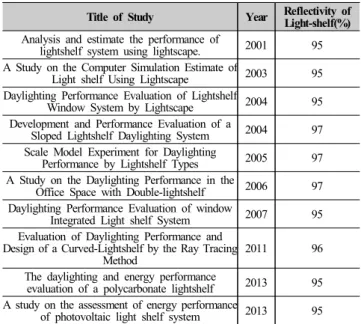
광선반 성능평가에 관련한 기존 연구의 고찰결과 <표1>에서 나타나듯이 95~97%의 높은 고휘도 재질을 적용하고 있으며, 이 러한 고휘도 재질을 적용시 채광성능 개선에는 유리할 수 있으나 현휘가 발생하여 쾌적한 빛환경을 저해할 수 있다 3) .
Title of Study Year Reflectivity of Light-shelf(%) Analysis and estimate the performance of
lightshelf system using lightscape. 2001 95 A Study on the Computer Simulation Estimate of
Light shelf Using Lightscape 2003 95 Daylighting Performance Evaluation of Lightshelf
Window System by Lightscape 2004 95 Development and Performance Evaluation of a
Sloped Lightshelf Daylighting System 2004 97 Scale Model Experiment for Daylighting
Performance by Lightshelf Types 2005 97 A Study on the Daylighting Performance in the
Office Space with Double-lightshelf 2006 97 Daylighting Performance Evaluation of window
Integrated Light shelf System 2007 95 Evaluation of Daylighting Performance and
Design of a Curved-Lightshelf by the Ray Tracing
Method 2011 96
The daylighting and energy performance
evaluation of a polycarbonate lightshelf 2013 95 A study on the assessment of energy performance
of photovoltaic light shelf system 2013 95 Table 1. Advance research of Light-shelf
2.2. 주거공간 내 조도기준 고찰
본 연구는 광선반의 반사율에 따른 성능평가를 위하여 실제 조 명과 연동하여 성능평가를 진행하였으며, 조명의 제어를 위하여 주거공간 내 조도기준을 고찰하였다. 한국의 경우 주거공간내 조 도기준으로 <표2>에서 나타나듯이 KS A 3011 4) 으로 명시하고 있으며, 본 연구는 거실 및 안방의 작업시 표준조도인 400lx를 조 명제어를 위한 조도기준으로 설정하였다. 또한 성능평가를 위한 조도 측정 높이는 작업면 기준을 근거하여 바닥으로부터 750mm 지점에 대하여 진행하였다.
Separation Measurement location
Range of illumination[lx]
Min Standard Max
Living room
General Above the floor 40
±5(cm)
150 200 300
Work 300 400 600
Inner room
General Above the floor 80
±5(cm)
60 100 150
Work 300 400 600
Bedroom
General Above the floor 40
±5(cm)
60 100 150
Work 150 200 300
Work 600 1000 1500
Kitchen
General Above the floor 80
±5(cm)
60 100 150
Work 300 400 600
Work 150 200 300
Bathroom General Above the floor 80
±5(cm)
60 100 150
Work 150 200 300
Table 2. Standard illuminance of KS A 3011
3) 김정태, 신현구, 김곤,“광반사를 이용한 광선반 채광시스템의 기본형상 설계 및 성능평 가에 관한 연구”, 대한건축학회논문집 계획계 19(3), 2003
4) 국가표준인증종합정보센터 www.standard.go.kr
3. 광선반 반사율 설정 및 성능평가 환경 설정
3.1. 광선반 성능평가를 위한 반사율 및 변인 설정
본 연구의 광선반의 반사율 설정은 75%에서 100%로 5%단위 로 설정하였으며, 반사율 설정에 있어서 제조업체의 제품 정보 5) 및 실내면반사율계수를 근거하여 <표3>에서 나타나듯이 75%, 80%, 85%, 90%, 97%, 99%로 조정하여 진행하였다. 또한 본 연구 는 성능이 우수하게 평가되고 있는 외부형 광선반 6) 으로 국한하 였으며, 광선반의 높이는 재실자의 눈높이 및 성능이 우수하다고 평가되고 있는 1,800mm 7) 으로 제한하여 연구를 진행하였다.
Reflectivity setting of Light-shelf(%)
75 80 85 90 97 99
Table 3. Reflectivity setting of Light-shelves for Performance Evaluation
Width external type : 0.3m, 0.4m, 0.5m, 0.6m
Height 1800mm(from flat)
Angle range -30˚ ~ 30˚ (10˚ intervals) Table 4. Variables of light shelf
3.2. 광선반 성능평가를 위한 환경 설정
광선반의 반사율에 따른 광선반 성능평가를 진행한 테스트베 드는 <표4>와 같이 구축하였으며, 테스트베드의 크기는 폭 4.9m, 깊이 6.6m 높이 2.5m이다. 또한 광선반이 설치되는 채광창의 크 기는 폭1.9m, 높이 1.7m이며, 테스트베드의 인공태양광은 정남 향에 위치시켰다.
Room Size 4.9m(W) × 6.6m(D) × 2.5m(H)
Windows Size 1.9m(W) × 1.7m(H)
Directions South aspect
Lighting Dimming Control(8 level)
Panoramic] view of Test-bed
Table 4. Overview of Test-bed
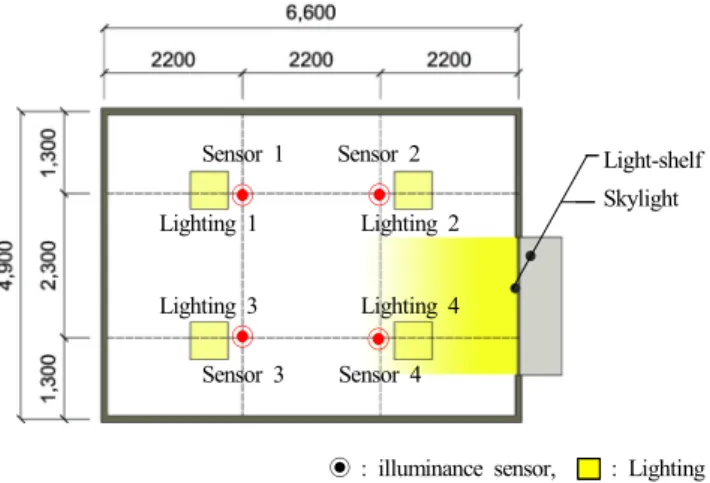
<그림3> 및 <그림4>는 본 연구의 성능평가를 위한 테스트베드 의 평면 및 단면이며, 테스트베드의 외부에는 인공태양광조사장 치를 구축하였다. 인공태양광조사장치는 램프의 광량 및 높이와 각도조절을 통해서 태양의고도에 따른 계절 및 외부환경을 조성 하였다. 성능평가를 위한 조도측정 위치는 4개소이며, 각 센서는 각각의 조명과 연동하여 표준조도 400lx를 기준으로 디밍 조명제 어가 이루어지도록 하였다.
5) 3M, Construction Markets, Product Information
6) 이현우, 이시내, “사무소 건물에서 수평형 광선반을 이용한 빛환경 개선”, 한국생활환 경학회지 18(1), 2011
7) 정유근, “창호일체형 광선반 시스템 채광성능 평가”, 한국생태환경건축학회 논문집 7(5), 2007
Light-shelf Skylight
◉
◉
◉
◉ Lighting 1
Sensor 3
Sensor 1 Sensor 2
Sensor 4 Lighting 2
Lighting 3 Lighting 4
◉ : illuminance sensor, : Lighting Fig. 3. Plane of Test-bed, Location of illuminance sensor
Light-shelf Skylight Lighting
◉ ◉
◉ : illuminance sensor
Fig. 4. Section of Test-bed, Height of illuminance sensor
4. 반사율에 따른 광선반 성능평가 방법 및 결과
4.1. 반사율에 따른 광선반 성능평가 방법
본 연구는 반사율에 따른 광선반 성능평가를 위하여 다음의 방 법에 의거하여 성능평가를 진행하였다.
첫 번째, 고정형 광선반의 반사율에 따른 성능평가를 진행하였 으며, 광선반의 각도는 0˚로 설정하였다.
두 번째, 광선반 폭, 반사율, 각도에 따른 성능평가를 진행하였 으며, 광선반 폭과 반사율에 따른 적정 각도를 도출하였다. 이후 적정 각도는 가동형 광선반의 반사율에 따른 성능평가를 위한 근 거 자료로 활용하였다.
세 번째, 고정형과 가동형 광선반의 반사율에 따른 실내조도 측 정값을 근거로 조명에너지 사용량을 산출하였으며, 조명제어는 조도측정값이 가장 낮은 지점에 근접한 조명부터 순차적으로 제 어 하였다. 각 조명의 제어는 8단계 조절이 가능한 디밍 조명제어 가 가능하도록 하였다. 또한, 조명에너지 산출 방법은 <표5>와 같 이 정남향의 하루 1시간, 절기당 약 15일을 기준으로 하였다.
Energy consumption(kWh)
Lighting energy consumption × Time(1h) × Solar term(15days)
Table 5. Energy consumption calculation for Performance Evaluation
4.2. 고정형 광선반의 반사율에 따른 성능평가 결과
본 절에서는 <표6>에서 나타나듯이 0˚ 고정형 광선반의 폭과 반사율에 따른 성능평가를 진행하였으며, 성능평가의 결과는 지 면의 한계로 인하로 동지의 결과는 제시하지 않았다. 단, 동지는 낮은 태양고도로 인하여 본 연구에서 설정한 변인에 상관없이 400lx를 만족하기에 조명에너지 소비는 발생하지 않는다. 다음에 이에 대한 분석 내용이다.
첫 번째, 광선반에 의하여 외부 자연광이 직접적으로 유입되는 지점인 3번 조도센서와 평균조도는 반사율에 증가에 따라서 증가 하는 경향을 보인다. 이는 광선반 반사율 증가에 따른 실내로 유 입되는 광량이 증가하기 때문이다.
두 번째, 광선반 반사율의 증가에 따른 조도 균제도는 광선반 폭에 따라서 상이한 결과를 보이고 있으나 90%이상 반사율의 광 선반을 사용시 균제도가 저하되는 경향을 보인다.
세 번째, 실제 조명과 연동하여 조명에너지 전력사용량을 산출 한 결과 광선반의 폭 300mm, 반사율 75%와 광선반의 폭 400mm, 반사율 75%인 경우에는 에너지 소비량이 증가하고 있으며, 광선 반 폭 300mm, 400mm의 반사율 80%이상의 경우와 광선반 폭 500mm 이상, 반사율 75%의 경우는 동일한 에너지 소비량이 도 출되었다. 이는 에너지 저감의 측면에서 반사율 80%이상의 광선 반을 사용시 유효하다는 결과이며, 반사율 90%가 넘는 고휘도 재 질의 광선반을 적용 시 현휘 및 균제도 저하 등의 실내 빛환경 개 선에 부적합하여 광선반 설계 시 고려해야 할 요소이다. 단, 광선 반의 반사율 증가는 실내로 유입되는 광량이 증가하기에 광선반 적용 대상의 성격에 따라서 적절한 광선반의 반사율의 조절이 필 요하다.
4.3. 가동형 광선반의 반사율에 따른 성능평가 결과
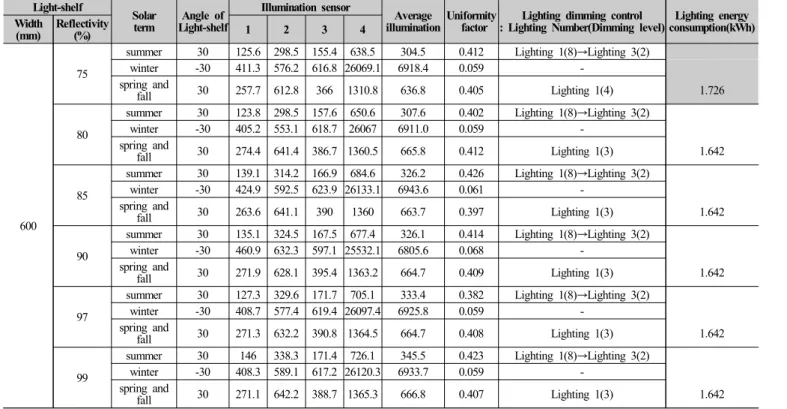
본 연구는 에너지 저감 측면에서 가동형 광선반의 하지, 동지, 춘추분에 따른 적정 각도를 <표7>과 같이 도출하였으며, 가동형 광선반을 위한 적정 각도의 도출 방법은 다음과 같다. 첫 번째, 동 지의 경우와 같이 측정되는 조도의 값이 400lx를 넘어 갈 경우에 는 최소 조도가 400lx에 근접한 각도를 광선반의 적정 각도로 산 출하였다. 두 번째, 측정되는 실내 조도의 값 중 400lx 이하의 값이 있는 경우에는 최소 조도 값이 400lx에 근접하는 각도를 광선반 의 적정 각도로 도출하였다.
가동형 광선반의 반사율에 따른 성능평가 결과는 다음과 같다.
첫 번째, 광선반 반사율에 따른 광선반의 정적각도는 상이하게 나타나고 있으며, 반사율에 따라서 유입되는 광량의 차이에 기인 한 것으로 판단된다. 또한, 하지의 적정 각도는 (+) 각도이며, 동지 의 정적각도는 (-)각도로 도출된 근거는 하지시는 태양의 높은 고 도로 인하여 빛의 유입시키기 위함이며, 동지시는 낮은 태양의 고 도로 인해 실내로 유입되는 자연광을 차양하기 위함이다.
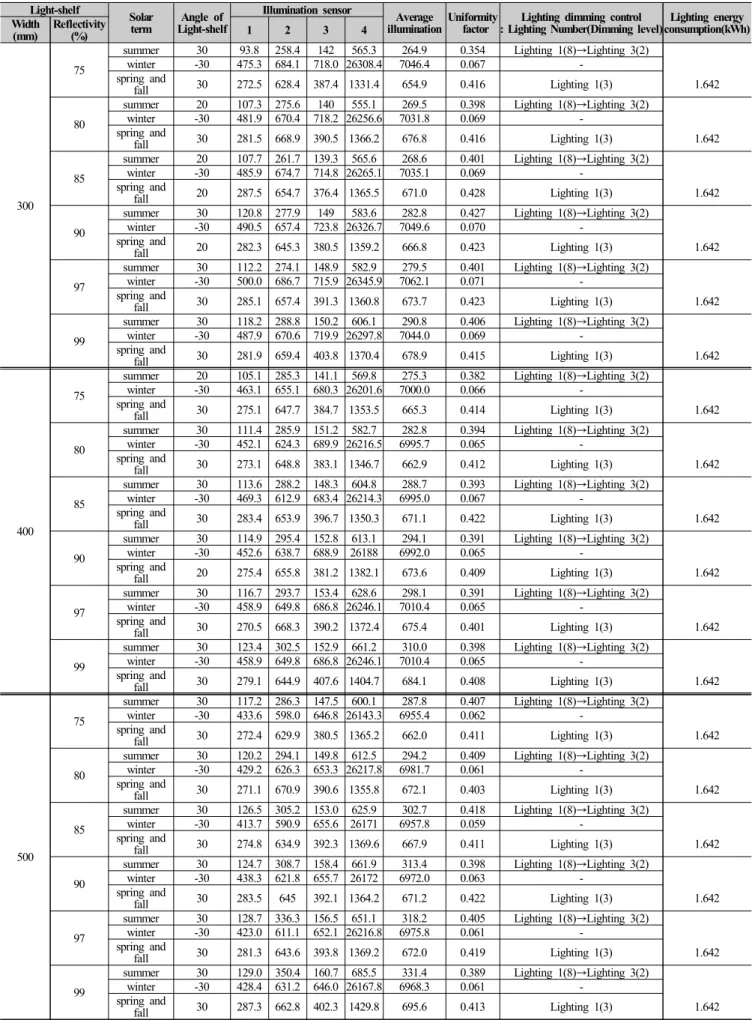
두 번째, 가동형 광선반의 경우 0˚고정형 광선반에 대비하여 조명에너지 저감이 이루어지고 있으며, 이에 따라서 폭 300mm 및 400mm의 반사율 75%인 0˚고정형 광선반의 조명에너지 사
용량도 개선되고 있음을 알 수 있다. 이는 외부 환경에 대응하여 광선반을 가동한 결과로 고정형 타입의 광선반에 대비하여 낮은 반사율의 재질을 광선반에 적용하여 현휘를 줄일 수 있다.
세 번째, <표9>에서 나타나듯이 폭 600mm, 반사율 75%인 가 동형 광선반은 조명에너지 사용량이 증가하고 있으며, 이는 반사 율 증가로 조명에너지 저감률을 증가시킬 수 있으나 현휘를 고려 시 광선반의 폭을 400mm으로 줄여서 광선반 설계에 반영하는 것 이 바람직하다고 판단된다.
4.4. 광선반의 반사율에 따른 성능평가 논의
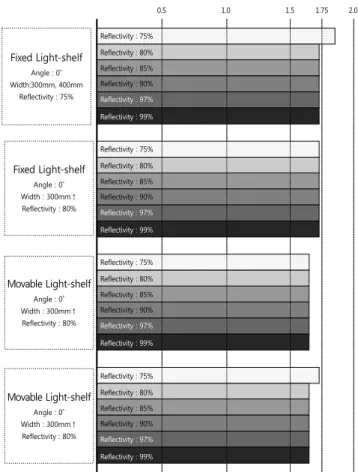
본 연구는 테스트베드를 통한 광선반 반사율에 따른 성능평가 를 진행하였으며, 실제 조명과 연동하여 조명에너지 사용량을 산 출하였다. 그 결과 고정형 광선반의 경우에는 광선반의 폭에 따른 적정반사율은 80%이며, 광선반의 폭이 증가함에 따라서 75%의 반사율을 적용할 수 있다. 가동형 광선반의 경우에는 외부환경에 대응하여 적절한 가동을 통하여 채광성능 개선이 가능하며, 이에 따라서 75%의 반사율을 적용하여 에너지 저감을 유도할 수 있으 나 폭 600mm의 가동형 광선반의 경우 75%의 반사율을 적용시 조 명에너지 사용량이 증가하여 부적합 하다. 이에 고정형 및 가동형 광선반의 경우 적정 반사율은 80%이나 광선반설계시 광선반의 가동 여부와 폭에 따른 반사율 조정은 필요하다고 판단된다.
Fixed Light-shelf
Angle : 0˚
Width:300mm, 400mm Reflectivity : 75%
Fixed Light-shelf
Angle : 0˚
Width : 300mm↑
Reflectivity : 80%
Movable Light-shelf
Angle : 0˚
Width : 300mm↑
Reflectivity : 80%
Movable Light-shelf
Angle : 0˚
Width : 300mm↑
Reflectivity : 80%
Reflectivity : 75%
Reflectivity : 80%
Reflectivity : 85%
Reflectivity : 90%
Reflectivity : 97%
Reflectivity : 99%
Reflectivity : 75%
Reflectivity : 80%
Reflectivity : 85%
Reflectivity : 90%
Reflectivity : 97%
Reflectivity : 99%
Reflectivity : 75%
Reflectivity : 80%
Reflectivity : 85%
Reflectivity : 90%
Reflectivity : 97%
Reflectivity : 99%
Reflectivity : 75%
Reflectivity : 80%
Reflectivity : 85%
Reflectivity : 90%
Reflectivity : 97%
Reflectivity : 99%
(kHw)
0.5 1.0 1.5 1.75 2.0
Fig. 5. Lighting energy consumption according to the Reflectivity
Light-shelf
Solar term Illumination sensor Average
illumination Uniformity
factor Lighting dimming control
: Lighting Number(Dimming level) Lighting energy consumption(kWh)
width(mm) reflectivity(%) 1 2 3 4
300
75 summer 91.7 255.2 126.9 521.9 248.9 0.368 Lighting 1(8)→Lighting 3(3)
spring and fall 240.6 608.6 346.0 1295.6 622.7 0.386 Lighting 1(4) 1.848 80 summer 103.8 256.0 130.7 540.1 257.7 0.403 Lighting 1(8)→Lighting 3(2)
spring and fall 244.5 611.1 358.8 1293.3 626.9 0.390 Lighting 1(4) 1.726 85 summer 103.0 255.7 129.1 545.9 258.4 0.399 Lighting 1(8)→Lighting 3(2)
spring and fall 246.7 616.5 362.6 1310.8 634.2 0.389 Lighting 1(4) 1.726 90 summer 99.5 266.2 131.3 547.1 261.0 0.381 Lighting 1(8)→Lighting 3(2)
spring and fall 247.7 620.2 356.1 1338.3 640.6 0.387 Lighting 1(4) 1.726 97 summer 97.3 270.2 134.5 571.4 268.4 0.363 Lighting 1(8)→Lighting 3(2)
spring and fall 251.1 614.6 363.8 1345.3 643.7 0.390 Lighting 1(4) 1.726 99 summer 101.1 264.4 131.0 553.8 262.6 0.385 Lighting 1(8)→Lighting 3(3)
spring and fall 257.3 615.0 359.2 1343.6 643.8 0.400 Lighting 1(4) 1.848
400
75 summer 100.8 262.1 128.6 541.8 258.3 0.390 Lighting 1(8)→Lighting 3(2)
spring and fall 238.3 584.0 336.3 1254.8 603.4 0.395 Lighting 1(4) 1.848 80 summer 100.6 267.6 133.5 556.8 264.6 0.380 Lighting 1(8)→Lighting 3(2)
spring and fall 229.9 584.9 330.9 1262.9 602.2 0.382 Lighting 1(4) 1.726 85 summer 98.4 271.9 132.1 575.2 269.4 0.365 Lighting 1(8)→Lighting 3(2)
spring and fall 237.5 586.6 342.6 1309 618.9 0.384 Lighting 1(4) 1.726 90 summer 100.1 268.2 134.6 583.7 271.7 0.368 Lighting 1(8)→Lighting 3(2)
spring and fall 251.1 600.2 343.1 1299.6 623.5 0.403 Lighting 1(4) 1.726 97 summer 105.4 281.3 135.1 597.1 279.7 0.377 Lighting 1(8)→Lighting 3(2)
spring and fall 244.8 610.7 345.6 1351.2 638.1 0.384 Lighting 1(4) 1.726 99 summer 104 293.3 137.9 593.0 282.1 0.369 Lighting 1(8)→Lighting 3(2)
spring and fall 247.2 615.4 349.0 1342.1 638.4 0.387 Lighting 1(4) 1.726
500
75 summer 103.2 281.3 135.0 574.6 273.5 0.377 Lighting 1(8)→Lighting 3(2)
spring and fall 227.2 567.6 320.9 1240.5 589.1 0.386 Lighting 1(4) 1.726 80 summer 101.4 291.4 138.7 594.6 281.5 0.360 Lighting 1(8)→Lighting 3(2)
spring and fall 229.6 555.1 325.1 1265.1 593.7 0.387 Lighting 1(4) 1.726 85 summer 104.9 282.2 136.6 610.8 283.6 0.370 Lighting 1(8)→Lighting 3(2)
spring and fall 228.5 584.6 327.1 1273.4 603.4 0.379 Lighting 1(4) 1.726 90 summer 108.3 290.7 138.0 604.7 285.4 0.379 Lighting 1(8)→Lighting 3(2)
spring and fall 230.1 587.4 330.8 1306.5 613.7 0.375 Lighting 1(4) 1.726 97 summer 106.4 300.8 141.4 621.7 292.6 0.364 Lighting 1(8)→Lighting 3(2)
spring and fall 225.5 591.3 327.2 1295.4 609.9 0.370 Lighting 1(4) 1.726 99 summer 109.2 289.6 143.8 623.0 291.4 0.375 Lighting 1(8)→Lighting 3(2)
spring and fall 232.4 578.2 327.3 1305.4 610.8 0.380 Lighting 1(4) 1.726
600
75 summer 104.8 276.7 136.1 591.1 277.2 0.378 Lighting 1(8)→Lighting 3(2)
spring and fall 217.7 532.4 299.5 1187.5 559.3 0.389 Lighting 1(4) 1.726 80 summer 110.3 295.0 139.7 605.6 287.7 0.383 Lighting 1(8)→Lighting 3(2)
spring and fall 225.8 554.1 308.8 1229.5 579.6 0.390 Lighting 1(4) 1.726 85 summer 106.7 296.7 136.8 608.5 287.2 0.372 Lighting 1(8)→Lighting 3(2)
spring and fall 226.1 558.4 308.4 1257.5 587.6 0.385 Lighting 1(4) 1.726 90 summer 105.7 306.1 143.5 632.8 297.0 0.356 Lighting 1(8)→Lighting 3(2)
spring and fall 235.0 565.7 321.0 1313.4 608.8 0.386 Lighting 1(4) 1.726 97 summer 117.9 307.1 145.9 643.5 303.6 0.388 Lighting 1(8)→Lighting 3(2)
spring and fall 225.8 580.3 315.1 1309.5 607.7 0.372 Lighting 1(4) 1.726 99 summer 106.6 301.0 146.4 663.8 304.5 0.350 Lighting 1(8)→Lighting 3(2)
spring and fall 225.9 599.3 320.1 1313.8 614.8 0.367 Lighting 1(4) 1.726 Table 6. Performance evaluation result of fixed type Light-shelf according to the Reflectivity
Light-shelf Appropriate angle Light-shelf Appropriate angle Light-shelf Appropriate angle Light-shelf Appropriate angle
W(mm) R(%) Ⓢ Ⓦ Ⓕ W(mm) R(%) Ⓢ Ⓦ Ⓕ W(mm) R(%) Ⓢ Ⓦ Ⓕ W(mm) R(%) Ⓢ Ⓦ Ⓕ
300
75 30 -30 30
400
75 20 -30 30
500
75 30 -30 30
600
75 30 -30 30
80 20 -30 30 80 30 -30 30 80 30 -30 30 80 30 -30 30
85 20 -30 20 85 30 -30 30 85 30 -30 30 85 30 -30 30
90 30 -30 20 90 30 -30 20 90 30 -30 30 90 30 -30 30
97 30 -30 30 97 30 -30 30 97 30 -30 30 97 30 -30 30
99 30 -30 30 99 30 -30 30 99 30 -30 30 99 30 -30 30
W : width, R : reflectivity, Ⓢ : summer, Ⓦ : Winter, Ⓕ : spring and fall
Table 7. Appropriate angle according to the reflectivity
Light-shelf Solar
term Angle of Light-shelf
Illumination sensor Average
illumination Uniformity
factor Lighting dimming control
: Lighting Number(Dimming level) Lighting energy consumption(kWh) Width
(mm) Reflectivity
(%) 1 2 3 4
300
75
summer 30 93.8 258.4 142 565.3 264.9 0.354 Lighting 1(8)→Lighting 3(2)
winter -30 475.3 684.1 718.0 26308.4 7046.4 0.067 -
spring and
fall 30 272.5 628.4 387.4 1331.4 654.9 0.416 Lighting 1(3) 1.642
80
summer 20 107.3 275.6 140 555.1 269.5 0.398 Lighting 1(8)→Lighting 3(2)
winter -30 481.9 670.4 718.2 26256.6 7031.8 0.069 -
spring and
fall 30 281.5 668.9 390.5 1366.2 676.8 0.416 Lighting 1(3) 1.642
85
summer 20 107.7 261.7 139.3 565.6 268.6 0.401 Lighting 1(8)→Lighting 3(2)
winter -30 485.9 674.7 714.8 26265.1 7035.1 0.069 -
spring and
fall 20 287.5 654.7 376.4 1365.5 671.0 0.428 Lighting 1(3) 1.642
90
summer 30 120.8 277.9 149 583.6 282.8 0.427 Lighting 1(8)→Lighting 3(2)
winter -30 490.5 657.4 723.8 26326.7 7049.6 0.070 -
spring and
fall 20 282.3 645.3 380.5 1359.2 666.8 0.423 Lighting 1(3) 1.642
97
summer 30 112.2 274.1 148.9 582.9 279.5 0.401 Lighting 1(8)→Lighting 3(2)
winter -30 500.0 686.7 715.9 26345.9 7062.1 0.071 -
spring and
fall 30 285.1 657.4 391.3 1360.8 673.7 0.423 Lighting 1(3) 1.642
99
summer 30 118.2 288.8 150.2 606.1 290.8 0.406 Lighting 1(8)→Lighting 3(2)
winter -30 487.9 670.6 719.9 26297.8 7044.0 0.069 -
spring and
fall 30 281.9 659.4 403.8 1370.4 678.9 0.415 Lighting 1(3) 1.642
400
75
summer 20 105.1 285.3 141.1 569.8 275.3 0.382 Lighting 1(8)→Lighting 3(2)
winter -30 463.1 655.1 680.3 26201.6 7000.0 0.066 -
spring and
fall 30 275.1 647.7 384.7 1353.5 665.3 0.414 Lighting 1(3) 1.642
80
summer 30 111.4 285.9 151.2 582.7 282.8 0.394 Lighting 1(8)→Lighting 3(2)
winter -30 452.1 624.3 689.9 26216.5 6995.7 0.065 -
spring and
fall 30 273.1 648.8 383.1 1346.7 662.9 0.412 Lighting 1(3) 1.642
85
summer 30 113.6 288.2 148.3 604.8 288.7 0.393 Lighting 1(8)→Lighting 3(2)
winter -30 469.3 612.9 683.4 26214.3 6995.0 0.067 -
spring and
fall 30 283.4 653.9 396.7 1350.3 671.1 0.422 Lighting 1(3) 1.642
90
summer 30 114.9 295.4 152.8 613.1 294.1 0.391 Lighting 1(8)→Lighting 3(2)
winter -30 452.6 638.7 688.9 26188 6992.0 0.065 -
spring and
fall 20 275.4 655.8 381.2 1382.1 673.6 0.409 Lighting 1(3) 1.642
97
summer 30 116.7 293.7 153.4 628.6 298.1 0.391 Lighting 1(8)→Lighting 3(2)
winter -30 458.9 649.8 686.8 26246.1 7010.4 0.065 -
spring and
fall 30 270.5 668.3 390.2 1372.4 675.4 0.401 Lighting 1(3) 1.642
99
summer 30 123.4 302.5 152.9 661.2 310.0 0.398 Lighting 1(8)→Lighting 3(2)
winter -30 458.9 649.8 686.8 26246.1 7010.4 0.065 -
spring and
fall 30 279.1 644.9 407.6 1404.7 684.1 0.408 Lighting 1(3) 1.642
500
75
summer 30 117.2 286.3 147.5 600.1 287.8 0.407 Lighting 1(8)→Lighting 3(2)
winter -30 433.6 598.0 646.8 26143.3 6955.4 0.062 -
spring and
fall 30 272.4 629.9 380.5 1365.2 662.0 0.411 Lighting 1(3) 1.642
80
summer 30 120.2 294.1 149.8 612.5 294.2 0.409 Lighting 1(8)→Lighting 3(2)
winter -30 429.2 626.3 653.3 26217.8 6981.7 0.061 -
spring and
fall 30 271.1 670.9 390.6 1355.8 672.1 0.403 Lighting 1(3) 1.642
85
summer 30 126.5 305.2 153.0 625.9 302.7 0.418 Lighting 1(8)→Lighting 3(2)
winter -30 413.7 590.9 655.6 26171 6957.8 0.059 -
spring and
fall 30 274.8 634.9 392.3 1369.6 667.9 0.411 Lighting 1(3) 1.642
90
summer 30 124.7 308.7 158.4 661.9 313.4 0.398 Lighting 1(8)→Lighting 3(2)
winter -30 438.3 621.8 655.7 26172 6972.0 0.063 -
spring and
fall 30 283.5 645 392.1 1364.2 671.2 0.422 Lighting 1(3) 1.642
97
summer 30 128.7 336.3 156.5 651.1 318.2 0.405 Lighting 1(8)→Lighting 3(2)
winter -30 423.0 611.1 652.1 26216.8 6975.8 0.061 -
spring and
fall 30 281.3 643.6 393.8 1369.2 672.0 0.419 Lighting 1(3) 1.642
99
summer 30 129.0 350.4 160.7 685.5 331.4 0.389 Lighting 1(8)→Lighting 3(2)
winter -30 428.4 631.2 646.0 26167.8 6968.3 0.061 -
spring and
fall 30 287.3 662.8 402.3 1429.8 695.6 0.413 Lighting 1(3) 1.642
Table 8. Performance evaluation result of Movable type Light-shelf according to the Reflectivity(Width : 300mm, 400mm, 500mm)
5. 결론