Does the Mean Arterial Pressure Influence Mortality Rate in Patients with Acute
Hypoxemic Respiratory Failure under Mechanical Ventilation?
Juarda Gjonbrataj, M.D.
1,2*, Hyun Jung Kim, M.D.
1*, Hye In Jung, M.D.
1and Won-Il Choi, M.D., Ph.D.
11
Department of Internal Medicine, Keimyung University School of Medicine, Daegu, Korea, ²Department of Internal Medicine, Mother Thereza University Hospital, Tirana, Albania
Background: In sepsis patients, target mean arterial pressures (MAPs) greater than 65 mm Hg are recommended.
However, there is no such recommendation for patients receiving mechanical ventilation. We aimed to evaluate the influence of MAP over the first 24 hours after intensive care unit (ICU) admission on the mortality rate at 60 days post- admission in patients showing acute hypoxemic respiratory failure under mechanical ventilation.
Methods: This prospective, multicenter study included 22 ICUs and compared the mortality and clinical outcomes in patients showing acute hypoxemic respiratory failure with high (75–90 mm Hg) and low (65–74.9 mm Hg) MAPs over the first 24 hours of admission to the ICU.
Results: Of the 844 patients with acute hypoxemic respiratory failure, 338 had a sustained MAP of 65–90 mm Hg over the first 24 hours of admission to the ICU. At 60 days, the mortality rates in the low (26.2%) and high (24.5%) MAP groups were not significantly different. The ICU days, hospital days, and 60-day mortality rate did not differ between the groups.
Conclusion: In the first 24 hours of ICU admission, MAP range between 65 and 90 mm Hg in patients with acute hypoxemic respiratory failure under mechanical ventilation may not cause significantly differences in 60-day mortality.
Keywords: Arterial Pressure; Respiratory Insufficiency; Respiration, Artificial
Introduction
Acute hypoxemic respiratory failure (AHRF) is a common disease in the intensive care unit (ICU), and frequently re- quires mechanical ventilation. The condition may be caused by left ventricular failure, increased alveolar capillary perme- ability as observed in acute respiratory distress syndrome (ARDS), diffuse alveolar haemorrhage, or inflammatory exu- dates such as those observed in pneumonia or other inflam- matory lung conditions
1. AHRF in mechanically ventilated patients can present in an ARDS or non-ARDS form. Acute respiratory failure occurs in 56% of all patients in the ICU and the mortality rate is 34%
2. In other cohort studies, the mortality rates in AHRF patients were found to be higher than 40%
3,4.
The role of arterial blood pressure on outcomes and mor- tality is well studied in shock patients
5,6. However, there is paucity of data about the role of mean arterial pressure (MAP) in AHRF patients under mechanical ventilation. One study Copyright © 2015
The Korean Academy of Tuberculosis and Respiratory Diseases.
All rights reserved.
Address for correspondence: Won-Il Choi, M.D., Ph.D.
Department of Internal Medicine, Keimyung University School of Medicine, 56 Dalseong-ro, Jung-gu, Daegu 700-712, Korea
Phone: 82-53-250-7572, Fax: 82-53-250-8379E-mail: [email protected] Received: Sep. 11, 2014 Revised: Oct. 7, 2014 Accepted: Dec. 10, 2014
*Juarda Gjonbrataj and Hyun Jung Kim contributed equally to this work.
cc
It is identical to the Creative Commons Attribution Non-Commercial
License (http://creativecommons.org/licenses/by-nc/3.0/).
found that impaired perfusion of small vessels caused altera- tions in microcirculation and had an important effect on out- comes and survival in patients with septic shock
7. Additional studies conducted on patients with septic shock found that in- creases in MAP from 65 mm Hg to 85 mm Hg were not related to tissue perfusion or mortality
8,9. However, both the effect of MAP on mortality rate and the maintenance of a blood pres- sure target in shock patients remain controversial.
Mechanical ventilation is critical for the survival of most ICU patients with AHRF. However, over-inflation of the lung, which frequently occurs with mechanical ventilation, raises the stresses in the capillary walls to high levels. This leads to ultra- structural changes in the barrier, a condition known as stress failure
10. As a result, mechanical ventilation itself may cause additional lung injury, affecting survival in ICU patients
11-13.
The Surviving Sepsis Campaign has suggested maintaining a target MAP higher than 65 mm Hg in cases of septic shock
14. However, there is no such recommendation for mechanically ventilated patients. We hypothesized that MAP may influence survival in mechanically ventilated patients with AHRF. We divided mechanically ventilated patients with AHRF into two groups depending on their MAP over the first 24 hours after ICU admission: the first low MAP group consisted of individu- als with MAP ranging from 65 to 74.9 mm Hg and the second high MAP group consisted of individuals with MAP from 75 to 90 mm Hg.
Materials and Methods
1. Subjects and study design
This study is a subgroup analysis of a prospective cohort study that consisted of patients from 22 ICUs in Korea, and data from the “Validation of Simplified Acute Physiology Score 3 in Korean ICUs (VSKI)” study. Participating hospital units were enrolled voluntarily. The VSKI study included 22 ICUs (14 medical, 6 surgical, and 2 multidisciplinary) in 15 tertiary-level hospitals. Approval from the respective ethics committees was obtained at each hospital. All adult patients with AHRF admitted to the participating ICUs were screened regardless of ARDS status starting on July 1, 2010, through to January 31, 2011. The patients with a Pa O
2/FI O
2ratio less than 300 mm Hg at ICU admission during the study period formed the study cohort. The patients were classified into two groups according to MAP over the first 24 hours: the low MAP group (65–74.9 mm Hg) and the high MAP group (75–90 mm Hg).
2. Data collection
Demographic information including age, gender, MAP, body mass index, co-morbid conditions, acute lung injury (ALI) risk factors, vital signs, and laboratory features were recorded. The
disease severity was assessed based on the Simplified Acute Physiology Score III (SAPS III)
15and the Sequential Organ Failure Assessment (SOFA) score
16at ICU admission. The duration of hospitalization and duration in the ICU was also measured for each patient. Patients were followed up for 60 days following hospital admission.
3. Outcomes
The primary outcome of this study was the 60-day mortal- ity rate for AHRF with high (75–90 mm Hg) and low (65–74.9 mm Hg) MAP over the first 24 hours of ICU admission. Sec- ondary outcomes included the durations of hospital and ICU stay in both groups.
4. Statistical analysis
Data were presented as mean (standard deviation) for continuous variables and the number of subjects (%) for cat- egorical variables. Categorical variables were compared using the Fisher exact test or Pearson χ
2test as appropriate, and continuous variables were compared by the Mann-Whitney U test or Student t test, after determining normality using the Kolmogorov-Smirnov test. All tests for significance were two- tailed, and a p-value of less than 0.5 was considered signifi- cant. Multivariate linear (for continuous variables) and logistic (for categorical variables) regressions were used to evaluate the association between MAP in the first 24 hours of admis- sion and survival. Survival curves for both study groups were compared using the log-rank test. Results were analyzed with SPSS version 20.0 for Windows (SPSS Inc., Chicago, IL, USA).
Results
Of the 844 patients diagnosed with AHRF, 338 individu-
als fulfilled the required criteria for our study (Figure 1). The
population demographics for patients with low MAP over the
first 24 hours as compared to the patients with high MAP over
the first 24 hours is summarized in Table 1. The mean patient
age in both groups was 60 years, and 65% of all patients were
men. Sepsis was the most probable cause of AHRF in 26% of
patients, while cancer and diabetes were the most common
co-morbidities, affecting 89 (26%) and 79 (23%) patients,
respectively. Chronic obstructive pulmonary disease as a
co-morbidity occurred in a significantly higher number of
patients with high MAP than in patients with low MAP. Mean-
while sepsis affected higher percentage of patients with low
MAP than those with high MAP. The high MAP group had
a significantly higher Pa O
2/FI O
2ratio and C-reactive protein
than the low MAP group. ARDS was present in 20% of the
patients with low MAP, and in 22.4% of the patients with high
MAP. The duration of ICU stay, hospital stay, and 60-day mor-
tality rate did not differ between the two groups.
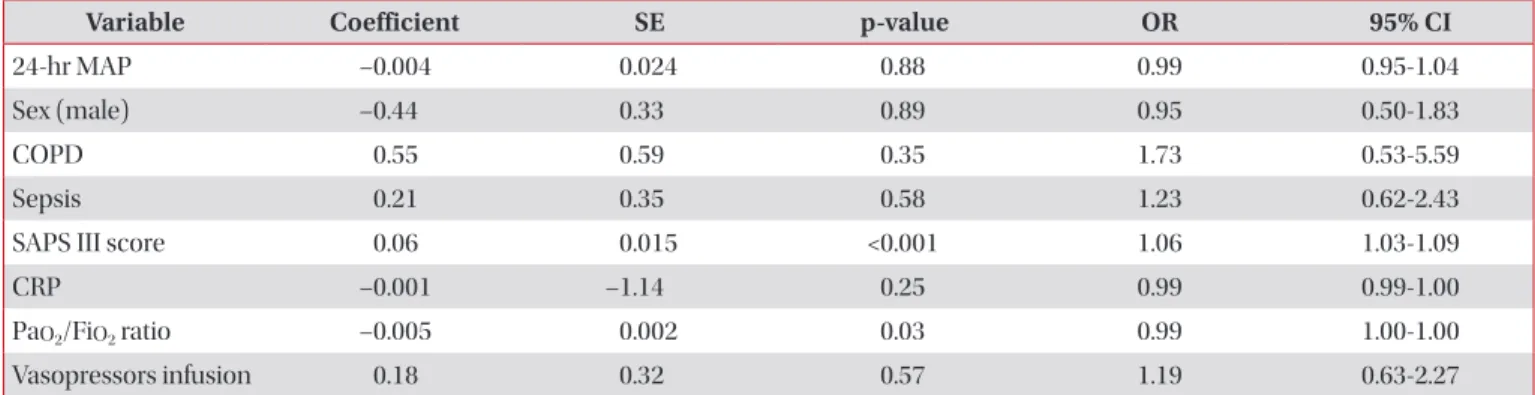
A multivariate analysis was performed to evaluate the inde- pendent factors affecting the 60-day mortality rate in mechan- ically ventilated AHRF patients. The MAP in the first 24 hours is not an independent factor associated with 60-day mortality rate. We found that the SAPS III score and the Pa O
2/Fi O
2ratio
Figure 1. Flow chart of patients who sustained mean arterial pres- sure (MAP) of 65 to 90 mm Hg over the first 24 hours of the intensive care unit (ICU) admission among hypoxemic respiratory failure.
A total of 4,617 patients admitted to
ICU
844 patients had PaO /FiO <300
mm Hg
2 2
837 patients with invasivemechanical
ventilation
7 patients excluded due to no ventilatory
support
338 patients hada MAP of 65-90 during
the first 24 hours
191 patients with MAP 65-90 mm Hg
147 patients with MAP 75-90 mm Hg
Figure 2. Kaplan-Meier survival curves: patients with low mean arterial pressure (MAP) (65–74.9 mm Hg) (solid line) compared to patients with high MAP (75–89.9 mm Hg) (dotted line).
0 10 20 30 40 50
1.0
0.8
0.6
0.4
0.2
60
Probabilityofsurvival
Days from the intensive care unit admission 0.0
Log-rank test p=0.93