전파관리방식의 변화에 대비한 제도 개선 방안에 대한 조사
최우진
*
․석경휴**
Domestic Radio Waves Propagate Management and Control Systems Investigate the System Status
Woo-Jin Choi
*ㆍGyeong-Hyu Seok
**요 약
주파수의 혼신·간섭 방지를 위해 실제 공중에 방사되는 복사전력 중심으로 규제기준 전환이 요구된다. 복사 전력 규제는 기술기준, 허가, 검사 등 전파관리 전반에 관련되는 사항이므로 적용 용이성, 시급성 등을 고려해 점진적으로 도입하고, 주요국의 복사전력 관련 법제도 현황 조사를 통해 국내 환경에 적합한 복사전력 방식에 따른 측정, 검사, 인증 등의 무선설비 출력관리 방식을 마련한다. 국내는 현재 안테나 공급 전력의 비중이 높 고, 유럽의 경우는 복사전력의 비중이 높음. 향후 무선국의 수가 점점 증가하고 다양해지므로 공간 관리인 복 사전력 기반을 병행하여 측정이 가능하도록 제도개선 마련 필요하고, 복사전력 관리체계로 전환하기 위해서는 관련 전파 제도(기술기준, 인증, 무선국 검사, 사후 관리 등)에 대한 제도개선 필요하다.
ABSTRACT
In order to prevent interference and interference of the frequency, it is required to convert the regulatory standard into the center of the radiation power radiated to the actual public. Since the radiation power regulation is related to general radio management such as technical standards, permits, and inspections, it is gradually introduced in consideration of applicability and urgency, and the radiation power related laws of major countries And a method of controlling the output of the radio equipment such as measurement, inspection, and authentication. In Korea, the proportion of antenna power supply is high, and in Europe, radiation power is high. Since the number of radio stations will increase and diversify in the future, institutional improvement should be made so that it can be measured in parallel with the radiocommunication infrastructure of the space manager. In order to convert to the radiative power management system, the system for the related radio system needs(Technical standards, certification, inspection of radio stations, post-management, etc.) to be improved.
키워드
ERP, EIRP, Radiation Power, Antenna Power Supply, Radio Wave Rule, Radio Wave Management, Radio Station ERP, EIRP, 복사 전력, 안테나 공급 전력, 전파 규칙, 전파 관리, 무선국
* 청암대학교([email protected])
** 교신저자 : 동강대학교 ㆍ접 수 일 : 2018. 07. 03 ㆍ수정완료일 : 2018. 09. 23
ㆍReceived : Jul. 03, 2018, Revised : Sep. 23, 2018, Accepted : Dec. 15, 2018 ㆍCorresponding Author : Gyeong-Hyu Seok
Donggang University, Email : [email protected]
http://dx.doi.org/10.13067/JKIECS.2018.13.6.1145
Ⅰ. 서 론
전파산업은 더욱 무궁무진하게 발전할 것으로 예상 된다. 모든 기기가 무선으로 연결되고 이용자들은 장 소와 시간에 관계없이 원하는 정보 및 서비스를 자유 롭게 이용할 수 있는 환경이 구축될 것이다. 특히 빅 데이터, IoT 등 새로운 개념의 데이터 이용환경과 맞 물려 전파를 이용한 무선산업은 우리가 상상할 수 없 는 모습으로 진화해 나갈 것이다. 따라서, 정부는 이 러한 무궁무진한 미래가치가 잠재되어 있는 전파산업 을 정부주도로 기획하고 범국가적으로 추진해나갈 수 있도록 재원마련 및 역량확보에 더욱 힘써야 한다 [1-2].
5G, IoT 등의 높은 주파수 사용에 대한 효율적으 로 운용 할 수 있는, 전파관리와 연구개발의 대안이 마련되어야 하고, 국내 전파관리 순수 업무인 인증, 검사 관련의 인력 보강으로 해상, 육상 등에서 전파 를 공평하면서도 효율적인 이용을 확보함으로써 공공 의 복지를 증진해야 한다[3-5].
주요선진국가의 전파이용환경과 국내의 환경을 비 교분석해보면 국가주도에서 무선국의 허가, 감독, 검 사 등의 모든 업무가 시장기반로 이관하는 정책이 확대되어가므로, 이를 고려한 정책 방향 필요하다.
통신기술의 발달로 이용자가 급증으로, 안테나공 급전력, 옥내서비스용기기, 안테나설치, 전자파의 장 해와 많은 전자통신 측정기기 사용으로 안전사고가 빈번히 발생하고 있어 여기에 대한 대책이 필요하다 [6-10].
전파산업의 진흥을 통해 우리나라의 경제가 재도약 하고 국민의 편익 증진 및 복지사회 실현까지 달성할 수 있도록 최선의 노력을 다 하여야만 할 것이다.
Ⅱ. 무선설비 출력 관리 제도
2.1 무선설비 출력관리 현황
우리나라의 경우 2007년부터 전파간섭 방지 및 출 력관리의 정확성 제고를 위해 복사전력 중심의 무선 설비 출력관리하고 있다. 소출력 무선기기의 기술기 준을 복사전력으로 전환하였으나 시험방법 등은 크 게 변동 없다. 무선설비에 대한 출력관리 방식은 안
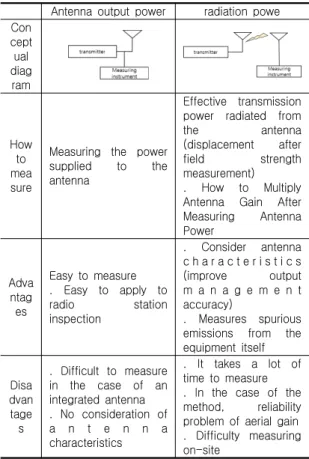
테나공급전력 방식과 복사전력(ERP/EIRP) 방식으 로 구분해서 사용한다[11]. 안테나공급전력은 송신기 로부터 공중선(안테나)의 급전선에 공급되는 전기신 호의 전력으로 전파를 발사하기 전 단계의 출력이고, 복사전력은 안테나에서 실제로 방사되는 유효 송신 출력으로 통상 공중선으로 공급되는 전력과 공중선 이득의 곱으로 계산한다[12-13].
안테나공급전력은 측정이 용이한 반면, 안테나 일체형 기기에 대한 시험이나 설비자체에서 방사 되는 불요파 측정은 곤란하고, 복사전력은 안테나 특성에 대한 고려가 가능하나, 시험에 시간이 소요되 고 현장 측정이 곤란하다.
2.2 무선설비 출력관리 단계
Antenna output power radiation powe Con
cept ual diag ram
How to mea sure
Measuring the power supplied to the antenna
Effective transmission power radiated from
the antenna
(displacement after field strength measurement)
. How to Multiply Antenna Gain After Measuring Antenna Power
Adva ntag es
Easy to measure . Easy to apply to radio station inspection
. Consider antenna c h a r a c t e r i s t i c s (improve output m a n a g e m e n t accuracy)
. Measures spurious emissions from the equipment itself
Disa dvan tage s
. Difficult to measure in the case of an integrated antenna . No consideration of
a n t e n n a
characteristics
. It takes a lot of time to measure . In the case of the method, reliability problem of aerial gain . Difficulty measuring on-site
표 1. 안테나공급 전력과 복사전력 방식 비교 Table 1. Comparison of antenna supply power and
radiated power scheme
2.3 국내외 출력관리 제도 현황 1) 기술기준상 출력규제
방송업무용은 동일채널 및 인접채널 보호를 위해 ITU 규정에 따라 복사전력으로 규제하고, 전기통신 사업용은 미국의 경우 지역간․사업자간 간섭보호 를 위해 복사전력으로 규제하고 있으며 설치 높이 에 따라 허용출력이 상이하나, 일본, 유럽, 우리나라 는 안테나공급전력으로 규제한다.
해상․항공용은 IMO 및 ICAO 협약에 따라 통일된 출력규정을 적용하고, 대부분 안테나공급전력으로 관 리하고 있으나 일부 해상 조난통신 설비는 복사전력 으로 관리한다. 소출력의 경우 미국, 유럽은 무선랜 을 제외하고는 대부분 복사전력으로 규제하지만 우리 나라도 433㎒ RFID, 중계용 특정소출력, 무선랜 등 일부기기를 제외하고는 2008년부터 복사전력으로 전 환하고 있다. 무전기 등 기타기기의 경우 미국은 복 사전력으로 규정, 유럽은 안테나공급전력과 복사전력 으로 동시에 규정하고 있는 반면, 우리나라는 아직 대 부분 안테나공급전력으로 규정한다[14-15].
2) 시험방법상 출력규제
방송업무용의 경우 동일채널 및 인접채널 보호를 위해 ITU 규정에 따라 복사전력을 사용한다. 전기 통신사업용은 미국, 유럽의 경우 무선국 출력은 안 테나공급전력으로 시험하되 스퓨리어스는 안테나공 급전력과 복사전력으로 모두 시험한다. 단말기 출력 은 미국의 경우 안테나공급전력과 복사전력으로 모 두 시험하나 유럽은 안테나 분리 여부에 따라 안테 나공급/복사 전력으로 시험하고, 우리나라의 경우 기지국, 단말기 출력과 스퓨리어스를 모두 안테나공 급전력으로만 시험한다.
해상․항공용의 미국, 유럽, 우리나라 모두 복사전 력으로 규정된 설비는 복사전력으로 시험하고, 안테 나공급전력으로 규정된 설비는 안테나공급전력으로 시험하고, 우리나라의 경우 민간시험기관이 시험하지 못하는 선박레이더, 복사전력 항목 등은 전파연구원 에서 시험한다.
소출력의 경우 미국은 복사전력으로 규정된 경우 복사전력으로 시험하되, 스퓨리어스는 안테나공급전 력과 복사전력으로 모두 시험하고, 유럽은 안테나 포
트가 없는 일체형은 복사전력으로, 안테나 포트가 있는 경우에는 안테나공급전력으로 시험한다.
division USA Europe Korea
Base station, repeate
r
outpu t
Antenna output power
Antenna output power
Antenna output power
Spuri ous
Antenna output power, radiation
power
Antenna output power,
radiation power
Antenna output power
termina l
outpu t
Antenna output power, radiation
power
Integrated antenna ->
Radiant power, Separate type
-> Antenna supply power
Antenna output power
Spuri ous
Antenna output power, radiation
power
Antenna output power,
radiation power
Antenna output power
표 2. 이동통신 관련 시험방법 비교 Table 2. Comparing test methods related to mobile
communication
우리나라의 경우 복사전력 시험이 강제사항이 아니 며 시험시설 미비 및 시험의 용이성을 이유로 대부분 안테나공급전력으로 시험하고, 미약전계강도 기기, 전계강도 기준으로 되어 있는 소출력 기기 등 일부 기기는 복사전력으로 시험한다. 미국에서 무전기 등 기타기기는 안테나공급전력으로 시험하나 스퓨리어스 는 안테나공급전력과 복사전력으로 모두 시험한다. 유 럽은 안테나 분리 여부에 따라 안테나공급전력/복사 전력으로 시험하고, 우리나라는 출력, 스퓨리어스를 안테나공급전력으로 시험한다.
Ⅲ. 국내 ERP/EIRP 측정 및 제도 개선
3.1 국내 ERP/EIRP 측정 및 제도 현황
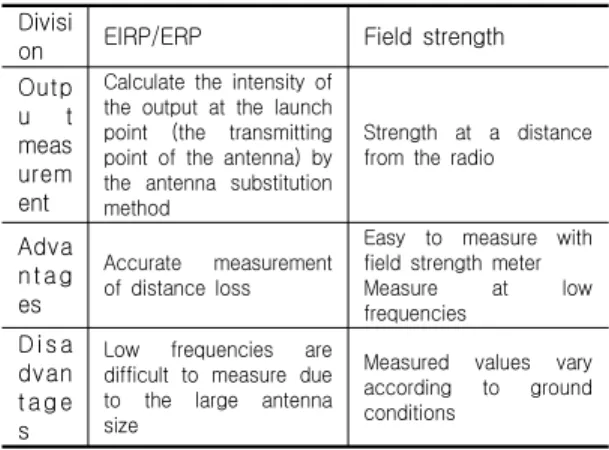
안테나 기술 발전으로 다양한 고 이득 안테나가 등 장함에 따라 안테나 특성을 고려한 새로운 무선설비 출력 관리가 필요하게 되어 현재까지의 진행사항 및 개선 필요사항에 대해 검토하고 있다.
국내는 이동통신 등 대부분의 무선설비에 대해
Divisi
on EIRP/ERP Field strength
Outp u t meas urem ent
Calculate the intensity of the output at the launch point (the transmitting point of the antenna) by the antenna substitution method
Strength at a distance from the radio
Adva n t a g es
Accurate measurement of distance loss
Easy to measure with field strength meter Measure at low frequencies
D i s a dvan t a g e s
Low frequencies are difficult to measure due to the large antenna size
Measured values vary according to ground conditions
표 3. EIRP/ERP와 전계강도 비교 Table 3. Comparison of EIRP / ERP and field
strength 공중선 전력 기준으로 출력을 관리하며 일부 무선설
비에 한하여 복사전력으로 규제, 현재 보유하고 있는 국가 측정 인프라의 효율적인 활용이 필요하다.
1) ERP/EIRP(복사전력) 측정 표준
ERP/EIRP 측정법 관련 국제 표준화 미흡으로 국 가마다 달리 운용 중이나 이를 통일화하는 것이 바람 직하고, 소출력 무선기기에 관한 ERP/EIRP 관련 측 정은 미국과 유럽 모두 안테나 치환법으로 측정하고 있으나 피 시험기기의 측정거리, 높이, 측정 장 조건 이 서로 상이하다.
미국 FCC, 유럽 ETSI에서는 모든 무선기기에 대 해 ERP/EIRP 관리를 위한 측정방법 및 레벨을 규정 하고, 관련 표준 및 규격은 미국(FCC CFR 47, ANSI/TIA-603-C), 유럽(ETSI TR 102 273, ETSI TR 300 328), 국제(ITU HandbookSpectrum Monitoring)이다.
2) 복사전력 측정 방법
송신기로부터 공중선에 공급되는 전력과 공중선 이득을 포함해서 발사되는 유효 송신출력을 측정한 다.
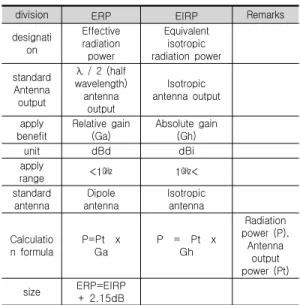
- ERP(: Effective Radiated Power, 실효복사전 력)의 경우 공중선에 공급되는 송신기의 전력과 주어진 방향에서의 반파장 다이폴 안테나에 대한 상대이득의 곱으로 대부분 1㎓이하에서 적용하여 측정한다.
※ ERP가 EIRP보다 1.64배(2.15db) 더 큼 - EIRP(: Effective Isotropic Radiated Power, 실효등
방성복사전력)의 경우공중선에 공급되는 송신기의 전력과 등방성 안테나에 대한 절대이득의 곱으로 1㎓이상에 적용하여 측정한다.
그림 1. 복사전력 측정 Fig. 1 Radiation power measurement
- 전계강도 : 송신기로부터 일정거리 이격된 거리에
서의 전파의 세기
division
Number of businesses
company name Remarks
1. Fully Anechonic Chamber (FAC, antenna measurement)
40
National Institute of Radiological Science, Ace Antenna, KMW, High Gain Antenna, etc.
Most small chamber- oriented
2. Semi Anechonic Chamber
(SAC, EMC
measurement)
17
National Radio Research Institute, Chungbuk Techno Park, HCT, etc.
Most 3m measuring chambers
3. Near Field Measurement System (NFMS, fortenna measurement)
9
Samsung Thales, Agency for Defense Development, Institute of Standards and Science, etc
Appointed researchers and large corporations
4. Open Site
(OS, EMC
measurement)
9
Standard Science Research Institute, Industrial Technology Research Institute, National Radio Research Institute, etc.
The majority of test validation companies 5. Outdoor Range
(OR, antenna measurement)
4
Central radio station, high gain antenna, aaltech, etc.
Mid-sized a n t e n n a supplier
표 6. 국내 ERP/EIRP 측정 활용가능 인프라 현황 Table 6. Status of ERP / EIRP measurement
infrastructure available in Korea
division USA Europe, Korea
Related
Standards ANSI/TIA-603-C ETSI EN 300 220 등
Type of chamber
Outdoor test site, fully anechoic
Outdoor test center, semi-anechoic
chamber, A complete anarchy Bottom
surface and sample
height
0.8m 1.5m
Distance between sample and
receiving antenna
3m or more
Below 1GHz: 3m or more 1 ㎓ or higher:
Applicable distance Receive
antenna height change
Change from 1 to
6m Change from 1 to 4
How to measure
Antenna substitution method
Antenna substitution method
Use antenna
1 GHz or less:
half-wave dipole 1 ㎓ or higher:
Standard horn
1 GHz or less:
half-wave dipole 1 ㎓ or higher:
Standard horn
표 5. 복사전력 시험장 비교
Table 5. Comparison of Radiation Power Test
division ERP EIRP Remarks Site
designati on
Effective radiation power
Equivalent isotropic radiation power standard
Antenna output
λ / 2 (half wavelength) antenna
output
Isotropic antenna output
apply benefit
Relative gain (Ga)
Absolute gain (Gh)
unit dBd dBi
apply
range <1㎓ 1㎓<
standard antenna
Dipole antenna
Isotropic antenna
Calculatio n formula
P=Pt x Ga
P = Pt x Gh
Radiation power (P), Antenna output power (Pt) size ERP=EIRP
+ 2.15dB
표 4. ERP/EIRP 비교 Table 4. ERP / EIRP comparison
Ⅳ. 국내외 주요 무선 설비 출력관리 현황
4.1 복사전력 시험방법 및 시험장 조건
복사전력 측정을 위한 공통조건으로 안테나치환법 측정절차는 특정 측정조건을 제외하고 미국, 일본, 우 리나라 모두 동일하다. 야외 시험장의 경우 주변의 간섭신호가 측정신호보다 6dB 미만이여야 하며 정규 화된 시험장 감쇠 조건에 따라 1㎓ 이하에서만 시험 한다. 미국은 야외시험장이나 완전무반사실에서 시험 가능한 반면, 유럽이나 우리나라의 경우 반무반사실에 서도 시험가능하고, 측정기와 수신 안테나 사이의 거 리는 3m 이상이어야 한다[16].
그림 2. 복사전력 시험방법
Fig. 2 Radiation power test method
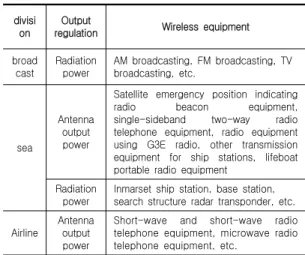
divisi on
Output
regulation Wireless equipment
broad cast
Radiation power
AM broadcasting, FM broadcasting, TV broadcasting, etc.
sea
Antenna output power
Satellite emergency position indicating
radio beacon equipment,
single-sideband two-way radio telephone equipment, radio equipment using G3E radio, other transmission equipment for ship stations, lifeboat portable radio equipment
Radiation power
Inmarset ship station, base station, search structure radar transponder, etc.
Airline
Antenna output power
Short-wave and short-wave radio telephone equipment, microwave radio telephone equipment, etc.
표 7. 무선설비별 출력관리 – 미국
Table 7. Output management by wireless facility – USA
Telec omm unicat
ions
Radiation power
All transmitters (base stations, mobile phones) using the allowed frequency band,
Non notific ation
Antenna output power
2.4GHz, 5GHz WiFi for data communication (maximum antenna gain regulation)
Radiation power
RFID, personal alarm transmitter, underwater animal tracking transmitter, medical implantable communication system transmitter, frequency hopping transmitter, etc.
Etc
Antenna output power
Amateur radio station, radio coordination
Radiation power
Industrial communication radio (stationary, mobile), air-to-ground wireless telephone (ground station)
Division Output
regulation Wireless equipment Teleco
mmunic ations
Antenna
output power GSM, TETRA, 3G, LTE
Non notificat
ion
Antenna
output power 2.4㎓, 5㎓ Wi-Fi Radiation
power
UWB, WBDTS (RLANs), fixed wireless terminals, vehicle collision avoidance radar (77GHz), etc.
Etc
Antenna
output power Antenna detachable radio Radiation
power Antenna Integrated Radio
표 8. 무선설비별 출력관리 – 유럽
Table 8. Output Management by Wireless Facility – Europe
Divisio n
Output
regulation Wireless equipment
broadc ast
Antenna output power
AM broadcasting, digital TV broadcasting
Radiation power
AM broadcasting, FM broadcasting, digital TV broadcasting, etc.
sea
Antenna output power
Digital selective calling device, radio buoy, ship automatic identification device, radar for ship station, satellite emergency position indicator
Radiation Location information transmitting device for
표 9. 무선설비별 출력관리 – 국내 Table 9. Output Management by Wireless Facilities
– Domestic 4.2 국내외 주요 무선설비별 출력관리 현황
미국의 경우 안테나 공급 전력 방식과 복사전력 방 식을 병행하여 무선설비의 출력을 관리한다. FM 방 송, TV 방송, 이동통신, 소출력, 무선설비 등은 복사 전력 방식을 적용하여 출력 규제하고, AM 방송, 해 상, 항공무선국 등 복사전력 기준 측정이 용이하지 않 을 경우에 안테나 공급 전력으로 출력 규제한다.
유럽의 경우 소출력 무선기기에 대해서는 복사전력 을 적용하고 있으나 그 밖의 무선기기는 회원국마다 상이하다. 다만, 핸드폰의 경우 안테나 공급 전력으로 출력을 관리하나 수입제품은 복사전력 방식을 적용한 다. 영국의 경우 OFCOM은 IoT 시대에 대응한 스펙 트럼 이용량 측정, 간섭신호 분석 등의 기술을 개발하 고 필드 시험을 진행 중이고, 호주의 경우 무선설비마 다 전력 최대치와 측정방법을 개별적으로 규제하고 있으며, 해상·항공용을 제외한 대다수 무선국에서는 복사전력에 의해 규제하고, AM 방송, TV 방송, 소출 력, 전기통신용 등은 복사전력 방식을 적용하여 출력 규제한다. 국내의 경우 전수 검사를 하는 반면, 외국 의 경우 민원 발생 시나 꼭 필요한 경우에만 실시하 므로 두 방식(안테나공급전력, 복사전력)을 모두 적용 사용한다[17].
- 출력 기준
power
search structure, Inmarsat ship earth station, microwave radio equipment for two-way communication
Airline
Antenna output power
Wireless telephony and data link equipment, mobile radio equipment for aircraft, surveillance radar, radio equipment using the VHF maritime mobile service band
Radiation power
Emergency position indicating radio beacon, satellite navigation system
Teleco mmuni cations
Antenna output power
Wireless paging, wireless data communication, subscriber line, mobile communication, portable internet, wireless for location-based services
Radiation
power Satellite radio communication equipment
Non notifica
tion
Antenna output power
Radio access system (5 GHz), mobile object identification, wireless data system (2.4 / 5.8 GHz), relay)
Radiation power
Weak electric field intensity, magnetic field induction type, specific low power radio station (for radio control, data transmission, voice sound signal transmission, vehicle collision avoidance radar), etc
Etc
Antenna output power
Radio stations using radio waves such as simple radio station, space station and earth station, radio detection, radio coordination station, F1D, weather station, radio call, etc.
Radiation power
Fixed point-to-point communications, broadcast production and performance support
Ⅴ. ERP/EIRP 측정 및 개선 제도
5.1 ITU의 복사전력 측정 기준(ITU-R의 권고, SF.1004 1) )
고정된 서비스 내의 주파수 대역을 공유하는 정지 -위성 서비스의 지구국에 의한 수평 방향으로 전송된 이방적으로 방사된 전력의 최대 등가하고, ITU무선 어셈블리가 고려하는 것은 아래와 같다.
① FSS(고정 위성 서비스)에서의 시스템과 고정 서 비스 공유는 주파수 대역을 포함
② 고정 서비스에서 중요한 간섭을 회피하기 위하 여 수평을 향한 FSS에서 지국구의 EIRP(:
Equivalent Isotropically Radiated Power, 등가 이방성 방사 전력)에 대한 최대 허용값을 정의 하는 것이 필요하다.
③ 방사 전력의 최대 허용값은 FSS의 각 국의 설계 상에서 지나친 제한을 하는 장소가 되지 말아야 한다.
ITU-R의 권고안에서 EIRP는 측정 방법은 ①-④ 과 같다.
① 1-15GHz 사이의 주파수 대역에서 FSS와 고정 서비스 사이의 공유에서, EIRP는 FSS의 지구국 에 의해 수평방향으로 향한 임의의 방향에 전송 된 것은 다음과 같은 제한을 넘지 말아야 한다.
- ≤ °에 대하여 임의의 4kHz 대역에서 +40 dBW
- ° ≤ ≤ °에 대하여 임의의 4kHz 대역에서 +40+3 dBW
여기서 는 지구국 안테나의 방사 중심으로부터 보여진 수평의 앙각(올려본 각)이며 수평면 위의 양 의 값과 수평면 아래의 음의 값으로서 각도로 측정된 값이다.
② 15GHz 이상의 주파수 대역에서, FSS와 고정 서 비스 사이의 공유에서, EIRP는 FSS의 지구국에 의해 수평방향으로 향한 임의의 방향에 전송된 것은 다음과 같은 제한을 넘지 말아야 한다.
- ≤ °에 대하여 임의의 1MHz 대역에서 +64 dBW
- ° ≤ ≤ °에 대하여 임의의 1MHz 대역에서 +64+3 dBW
③ 5°보다 큰 수평 앙각에 대하여 수평 방향 지구국 에 의해 전송된 EIRP에 대하여는 제한이 없다.
④ ①과 ②에서 주어진 제한은 10dB 넘지 않는 범 위에 대해 초과되어 질 수 있지만 좌표 면적이 다른 국가의 영토 속으로 확대되는 결과일 때 국 가의 관리에 의한 동의(협정)의 주제가 늘어난다.
5.2. 국내외 출력관리 제도 시사점
국제적으로 복사전력(EIRP/ERP)으로 측정․규제 하고 있는 분야는 안테나 일체형 소출력 기기, 이동 통신 단말기 등 소형으로 시험장 측정이 용이한 기기 이다. 이동통신 등 중․대출력 무선설비의 복사전 력 규제는 간섭분석 시뮬레이션에 한정되어 있고 시험․검사에 도입하는 것은 현행 기술과 시험장 여건상 현실적으로 어려움있다. 국내․외 표준 상
1) Radiocommunication Study Groups 4 and 9 made editorial amendments to this Recommendation in 2000 in accordance
복사전력 측정시 대상기기와 수신안테나간 거리 원 역장 이상의 거리 이격을 요구한다. 스퓨리어스의 경우 더미 안테나를 이용하여 측정하므로 10m이내 의 챔버에서 측정이 가능하나, 출력을 복사전력으로 측정하기 위해서는 30m 이상의 대형 시험장이 필요 하다. 특히, 우리나라처럼 무선국 검사가 일반화되어 있는 경우 복사전력을 현장에서 측정하는 것은 어렵 기 때문에 증폭기와 안테나 일체형 무전기 또는 기 운용중인 무전기에 대하여 증폭기와 안테나를 분리하 여 EIRP를 측정하는 것이 불합리한 경우, 자유공간 에서 EIRP를 산출하는데 필요한 복사전력을 측정할 수 있는 경우 등을 제외하고는 안테나공급전력과 안 테나이득의 각각에 의하여 EIRP를 규제하는 것이 현실적이다.
미국의 경우에도 일부 중․대출력 무선국에 대해 기술기준과 허가 단계에서는 복사전력으로 규제하 고 있지만 시험과 검사단계에서는 안테나공급전력 을 적용하고 복사전력 시험은 스퓨리어스에 한정하 고, 팸토셀 등 무선설비의 소형화 추세에 맞추어 비 신고 소출력 기기가 아니더라도 복사전력으로 시험하는 방안을 지속적으로 연구하고 있다.
Ⅵ. 결론
ERP나 EIRP가 안테나 이득과 고전력증폭기의 출 력 즉, 안테나에 인입되는 전력을 기준으로 한다.
송신기의 ERP/EIRP값을 규제하는 이유는 주파수 를 효율적으로 사용하고자 하는 것이다. 즉, 한정된 천연자원인 주파수를 효율적으로 사용하기 위해서는 동일한 주파수를 사용하는 무선국간의 신호에 상호간 섭을 일으키지 않도록 해야 한다.
ERP/EIRP는 송신기의 전력증폭기 출력과 송신안 테나의 이득값에 의하여 각 무선국의 유형에 따라 송 신안테나로 부터 복사되는 전력값을 제한 하는 것이 다. 그러나 송신기의 증폭기와 안테나가 일체형으로 제조되는 경우 등 송신기 전력증폭기와 안테나를 분 리하여 EIRP값을 측정할 수 없는 경우에는 무반사실 에서의 복사전력측정, 무전기의 제조과정에서 전력증 폭단의 출력과 안테나이득에 대하여 표본 측정 등의 방법으로 EIRP/ERP값을 검사할 수 있다.
다음의 경우는 자유공간에서 측정되는 복사 전력값 에 의하여 EIRP값을 검사하여야 하는 경우에 대한 것이다. 기 운용중인 무전기로서 출력단과 안테나를 분리하기가 곤란한 경우, 자유공간에서 EIRP를 검사 하는데 필요한 복사전력을 측정하는 것이 가능한 경 우, ERP/EIRP값을 자유공간을 이용하여 측정이 가능 할 경우에 무반사실의 구축 및 운용에 필요한 비용의 절감, 완전한 제품상태에서 EIRP값을 측정하므로서 안테나로 부터 정확한 규정값에 의한 전력의 송신으 로 주파수 자원 사용에 대한 효율제고, 및 기타 개별 측정된 증폭기 출력값과 안테나이득값이 그 구성요소 가 하나로 조합되었을때 나타날 수 있는 상이한 EIRP값의 오차의 방지, 무선국을 방문하지 않고 원하 는 때에 수시로 무선국의 EIRP를 측정하므로서 전파 환경의 건전성을 제고하는 등, 효과가 있을 것으로 기 대된다. 다만 정확한 ERP/EIRP값을 측정하는데 필 요한 자유공간에서의 복사전력 전계강도의 측정을 위 한 만족할 만한 자유공간전파환경장소가 많지 않아 서 이러한 전파환경하에서 정확한 EIRP값을 산출하 기 위한 실용성있고 실효성있는 전계강도 측정방법이 도입되어야 할 것이다.
References
[1] Wireless Management, “Administrative prices charged for radio resource research institutions,”
Korea Communication Agency, 2004. 5.
[2] Propagation salons Inspection Agency, “2013 Review Report Management System using radio waves,” Korea Communication Agency, 2013. 12.
[3] Propagation salons Inspection Agency, “2014 Review Report Management System using radio waves,” Korea Communication Agency, 2014. 12.
[4] Propagation salons Inspection Agency,
“Licensing & Inspection System for use at home and abroad propagation,” Korea Communication Agency, 2012. 12.
[5] Propagation salons Inspection Agency, “Studies
measuring the communication quality of the
digital communication system,” Korea
Communication Agency, 2013. 12.
[6] Propagation salons Inspection Agency, “Study on improving radio station established procedures,”
Korea Communication Agency, 2012. 12.
[7] Propagation salons Inspection Agency, “Licensed radio stations. Radio Waves Study on the test system,” Korea Communication Agency, 2014. 12.
[8] Propagation salons Inspection Agency,
“Anti-social dysfunction study of the propagation environment according to pre-deregulation,” Korea Communication Agency, 2010. 12.
[9] Y. Yeom, “Radio Broadcasting Act. System maintenance study,” Korea Communication Agency, 2003. 7
[10] H. Lee, “Using radio waves resources development Management Study,” Korea Information Society Development Institute (KISDI), 2002. 2.
[11] K. Cheo, “Study on the direction of the radio wave revised convergence era tongbang,”
Wireless Management, 2005. 5.
[12] D. Park, “Recent Trends and Policy Implications of the radio control system,” Korea Information Society Development Institute (KISDI), 2003. 9.
[13] C. Kin, “Frequency reallocation foreign policy case study,” Korea Information Society Development Institute (KISDI), 2004. 5.
[14] H. Sin, “A study on The Role of Communication at Disaster Managing in Modern Societies,” J. of the Korea Institute of Electronic Communication Sciences, vol. 3, no. 1, 2008, pp.
31-38.
[15] H. Yeon and H. Sin, “A study on new radio wave law of system reorganization for korea,” J. of the Korea Institute of Electronic Communication Sciences, vol. 4, no. 1, 2009, pp. 1-6.
[16] H. Sin, “A Study on Radio Wave Law Revision Content for Korea,” J. of the Korea Institute of Electronic Communication Sciences, vol. 4, no. 3, 2009, pp. 176-182.
[17] H. Sin, “A study on South Korea's disaster safety of wireless communication,” J. of the Korea
Institute of Electronic Communication Sciences, vol.
6, no. 1, 2011, pp. 1-5.
[18] H. Kim, K. Seok, and H. Sin, “Domestic radio waves propagate management and control systems investigate the system status,” J. of the Korea Institute of Electronic Communication Sciences, vol. 11, no. 5, 2016, pp. 441-450.
[19] H. Kim and K. Seok, “Domestic radio waves propagate management and control systems investigate the system status,” J. of the Korea Institute of Electronic Communication Sciences, vol.
12, no. 1, 2017, pp. 1-8.
저자 소개
최우진(Woo-Jin Choi)
2003년 2월 조선대학교 대학원 컴퓨터공학과 졸업(공학 박사) 1997년 3월~ 현재 청암대학교 컴퓨터정보과 교수
2007년 웹디자인 (지방) 관리 위원
※ 관심분야 : 데이터베이스, 인터넷 정보 보안&
보호, 광통신
석경휴(Gyeong-Hyu Seok)