DOI: https://doi.org/10.3339/jkspn.2017.21.2.69
ISSN 2384-0250 (online)Experience with Pediatric Kidney Transplantation, 1985-2016: A Single Regional Center Study
Purpose: Kidney transplantation (KT) is an ideal treatment for pediatric patients with end-stage renal disease (ESRD). We report the clinical outcomes of pediatric ESRD patients who underwent KT in a single regional center.
Methods: We retrospectively investigated the medical records of 60 pediatric pa- tients who were diagnosed with ESRD and underwent KT in our hospital between January 1985 and June 2016.
Results: A total of 60 children and adolescents (40 male, 20 female; mean age, 13.86±4.26 years) were included in this study. Six patients (10.0%) underwent KT immediately after receiving the diagnosis of ESRD, while the others underwent KT after dialysis treatment (mean period of dialysis, 368.7±4,41.8 days). The mean donor age (50 living-related [83.3%], 10 deceased [16.7%]) was 40.0±12.85 years and the male:female ratio was 1.07:1. The most common cause of ESRD was chronic glomerulonephritis. The overall survival rates at 1, 3, and 5 years after KT were 98%, 98%, and 96%, respectively, while the graft survival rates at 1, 3, and 5 years were 93%, 86%, and 68%, respectively. Children who underwent KT before 10 years of age had better monthly growth rates than those who underwent KT later than 10 years of age.
Conclusions: KT is performed less frequently in children than in adults, but causes of ESRD vary and clinical outcomes after KT greatly affect the growth and develop- ment of pediatric patients. Therefore, further analysis and monitoring of clinical progression after KT in pediatric ESRD patients are necessary.
Key words: Kidney transplantation, Children, End-stage renal disease, Survival rate
So Yoon Min, M.D.
1Tae Kyoung Jo, M.D.
1Hee Sun Baek, M.D.
1Sook-Hyun Park, M.D.
1Hyung-Kee Kim, M.D.
2Seung Huh, M.D.
2Min Hyun Cho, M.D.
1Department of Pediatrics
1and Surgery
2, Kyungpook National University School of Medicine, Daegu, Korea
Corresponding author: Min Hyun Cho, M.D.
Department of Pediatrics, Kyungpook National University Medical Center 807 Hogukno, Buk-gu, Daegu 41404, Korea Tel: +82-53-200-2741
Fax: +82-53-200-2039 E-mail: [email protected] Received: 29 July 2017 Revised: 16 August 2017 Accepted: 14 September 2017
This is an open-access article distributed under the terms of the Creative Commons Attribu tion Non-Commercial License (http://
crea tivecom mons.org/licenses/by-nc/4.0/) which permits unrestricted non-commercial use, distribution, and reproduction in any medium, provided the original work is properly cited.
Copyright © 2017 The Korean Society of Pediatric Nephrology
Introduction
Over the past three decades, despite many advances in renal replacement therapies, kidney transplantation (KT) remains one of the most ideal treat
ments for pediatric patients with endstage renal disease (ESRD)
13). KT pro
vides freedom from dialysis and is costeffective for providing great opport
unities for normal growth and development in pediatric patients with ESRD
36)
. In addition, the risk of death is more than four times higher with dialysis
than with KT
1). The first KT in Korean children was performed in 1973
7, 8).
Poorer graft survival in KT during childhood was reported due to the nature
of pediatric KT in terms of inconsistent adherence to medication regimens,
worse side effects of medications, higher rates of graft rejection due to recur
rent disease, and the more intense immunoreactivity of children
9). However, improvements in immunosuppressive management, sur gical techniques, and longterm suppor
tive care have had a favorable impact on pediatric KT re
sults
8). The 5year survival rate of pediatric KT has recently been similar to that of adults, but there is an important dif
ference between pediatric and adult KT in that the result of the former greatly affects pediatric growth and develop
ment
8, 9). How ever, the clinical data of pediatric KT versus adult KT in Korea has not been systematically established yet. There fore, here we report the clinical outcomes of pe
diatric KT performed in a single regional center.
Material and methods
We retrospectively reviewed the medical records of 60 pediatric patients <20 years of age who were diagnosed with ESRD and underwent KT at Kyungpook National Univer
sity Hospital between January 1985 and June 2016. The data included information about the recipients and donors:
recipient age, sex, underlying renal disease, dialysis type, dialysis duration, and immunosuppressants used for in
duction therapy; donor age and sex; and the relationship of the recipient and donor. The survival analysis of graft failure (graft survival analysis) and mortality (patient sur
vival analysis) were performed using the KaplanMeier method, while the statistically significant differences bet
ween the two groups were assessed by the logrank test (using R software version 3.3.1).
Results
Between January 1985 and June 2016, 60 children and adolescents <20 years of age were diagnosed with ESRD and underwent KT in our hospital. Of them, 40 were male (66.7%) and 20 were female (33.3%) with a mean age of 13.86±4.26 years (range, 1.7619.97 years). The youngest patient at the time of KT was a 1.76yearold girl whose body weight was 9 kg. Six patients (10.0%) underwent KT immediately after receiving the diagnosis of ESRD, while the others underwent KT after dialysis (mean dialysis du
ration, 368.7±441.8 days; 23 for peritoneal dialysis and 31
for hemodialysis) (Table 1).
The causes of ESRD were as follows: 20 with chronic glo
merulonephritis (33.3%; seven focal segmental glomerulo
sclerosis, four with immunoglobulin A nephropathy, four with membranoproliferative glomerulonephritis, three with HenochSchönlein nephritis, two with interstitial nephritis), seven with reflux nephropathy (11.7%), four with hereditary kidney disease (6.7%), three with polycystic kidney disease (5.0%), one with kidney dysplasia (1.7%), four with others (6.7%), and 21 unknown (35.0%) (Table 2).
Table 1. General Characteristics of KT Recipients and Donors Recipients (n=60)
Age (years) 13.86±4.26*
(range, 1.76-19.97)
Sex (M:F) 40:20
Body weight (kg) 38.03±14.37*
(range, 9-69) Duration from Diagnosis of ESRD to KT (days) 368.74±441.84*
(range, 7-1723) Type of RRT before KT (n; pre-emptive/PD/HD) 5 (8.3%)/23 (38.0%)/
31 (51.7%) Donor (n=60)
Age (years) 40.10±12.85*
(range, 5.37-64.42) Relation to recipient (n)
Deceased 10 (16.7%)
Living-related (mother/father/sibling) 50 (83.3%) (25/22/3)
*Some values are expressed as mean±standard deviation.
Abbreviations: KT, kidney transplantation; ESRD, end-stage renal disease;
RRT, renal replacement therapy; PD, peritoneal dialysis; HD, hemodialysis.
Table 2. Causes of End-stage Renal Disease
Causes Number of patients (%)
Focal segmental glomerulosclerosis 7 (11.7)
Reflux nephropathy 7 (11.7)
Alport syndrome 4 (6.6)
Immunoglobulin A nephropathy 4 (6.6)
Membranoproliferative glomerulonephritis 4 (6.6)
Henoch-Schönlein nephritis 3 (5.0)
Polycystic kidney 3 (5.0)
Interstitial nephritis 2 (3.3)
C1q nephropathy 1 (1.7)
Dysplasia 1 (1.7)
Hemolytic uremic syndrome 1 (1.7)
Hypertensive nephropathy 1 (1.7)
Other systemic immunologic disease 1 (1.7)
Unknown 21 (35.0)
Total 60 (100.0)
The mean donor age was 40.10±12.85 years (range, 5.37
64.42 years), while the male: female ratio was 1.07:1. Ten donors (16.7%) were deceased and 50 donors (83.3%) were livingrelated (including 25 mothers, 22 fathers, and three siblings) (Table 1).
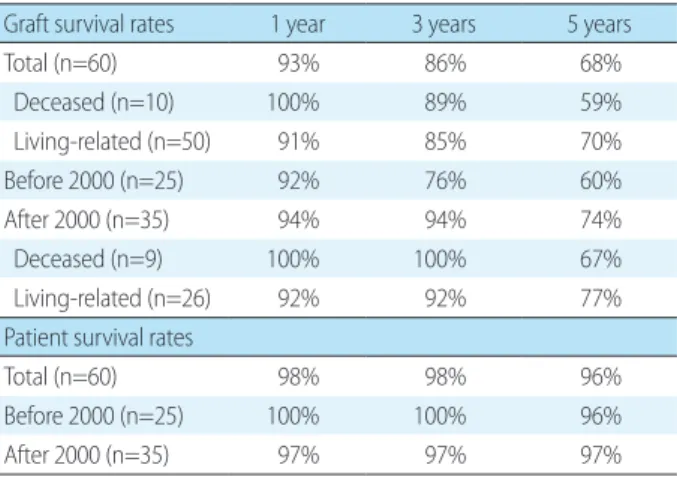
The graft survival rates of 60 patients at 1, 3, and 5 years after KT were 93%, 86%, and 68%, respectively, while the patient survival rates of them at 1, 3, and 5 years after KT were 98%, 98%, and 96%, respectively (Table 3). The graft survival rates of deceased donor recipients at 1, 3 and 5 years after KT were 100%, 89%, and 59% and those of living donor recipients were 91%, 85%, and 70%. The most common cause of graft failure was chronic rejection (n=12; 50%), while the second most common cause was recurrence of the original renal disease (n=3; 12.5%) (Table 4). A total of five patients died, and the known causes of death were bac
terial infection and hemorrhage. 26 patients (44.1%) had acute rejection after KT and one of them had graft failure.
Since 2000, tacrolimus has been used as an initial major immunosuppressant therapy instead of cyclosporine and basiliximab (Simulect
Ⓡ) has been used as the induction therapy for grafts from deceased donors in our center.
However, there was no significant difference in patient and graft survival rates between patients who received KT before and patients who received KT after 2000. Similarly, there was no significant difference between the deceased donor recipients group and living donor recipients group in patient or graft survival analysis (Table 3). Estimated graft survival probabilities were 91%, 85%, and 73% at 1, 3, and 5 years, respectively, for cyclosporine therapy. Corre
sponding estimates for tacrolimus therapy were 95%, 95%,
and 64%. No significant differences were seen between the two distinctive therapy groups in graft or patient survival analysis.
There reported 2% of posttransplantation lymphopro
liferative disorder (PTLD) (n=1) after KT. The most com
mon posttransplant infection was cytomegalovirus (CMV) infection. There were 4 CMV infected patients. 3 of them (5.2%) had symptoms and culture proven viremia, 1 patient (1.7%) had viremia only. No patient had EpsteinBarr virus (EBV) infection and 2 patients had BK virus infection.
The height percentage change per month differed signi
ficantly according to KT timing. The children who under
went KT before 10 years of age showed a 0.15±0.2% increase in growth rate, whereas the children who underwent KT after 10 years of age showed a 0.05±0.17% growth rate change ( P=0.02) (Fig. 1).
Table 3. Graft and Patient Survival Rates
Graft survival rates 1 year 3 years 5 years
Total (n=60) 93% 86% 68%
Deceased (n=10) 100% 89% 59%
Living-related (n=50) 91% 85% 70%
Before 2000 (n=25) 92% 76% 60%
After 2000 (n=35) 94% 94% 74%
Deceased (n=9) 100% 100% 67%
Living-related (n=26) 92% 92% 77%
Patient survival rates
Total (n=60) 98% 98% 96%
Before 2000 (n=25) 100% 100% 96%
After 2000 (n=35) 97% 97% 97%
Table 4. Causes of Graft Failure
Cause Number of patients (%)
Accelerated acute rejection 1 (4.2) Acute rejection <1 year 1 (4.2)
Bacterial/viral infection 1 (4.2)
Chronic rejection 12 (50.0)
Late acute rejection >1 year 1 (4.2) Recurrence of original disease 3 (12.5)
Other/unknown 5 (20.8)
Total 24 (100.0)
B. KT performed after 10 years of age A. KT performed prior
to 10 years of age -0.4
-0.2 0.0 0.2 0.4
Fig 1. Height percentage change per month ( P=0.02). KT, kidney
transplantation.
Discussion
ESRD occurs in 510 children per million each year
6). ESRD is very rare but an important risk factor for pediatric mortality and morbidity. According to a study performed in Australia and New Zealand, agespecific mortality of pediatric ESRD patients was about 30 times higher than that of children without ESRD
6). Either dialysis or KT as renal replacement therapy is required for survival of ESRD patients. Peritoneal dialysis is widely used as a renal replace
ment therapy for pediatric ESRD patients because the ca
theter is easy to install and maintain and has no technical problems regarding patient size
1012). In contrast, hemodi
alysis is hemodynamically more unstable than peritoneal dialysis in pediatric ESRD patients, and it is difficult to se
cure adequate blood vessels and blood volume in pediatric patients compared with adults
13,14). Most pediatric ESRD patients using peritoneal dialysis or hemodialysis can sur
vive, but the ideal treatment is KT because it is the best way to ensure a normal life and normal physical and mental development
3,4,6). As previously reported, dialysis is asso
ciated with a risk of death that is four times higher than the risk associated with KT
6).
Growth failure is a crucial problem for pediatric ERSD patients and the largest concern compared with adult ESRD patients. One study noted that growth failure is associated with a more complicated clinical course and increased risk of death for pediatric ESRD patients
15). Malnutrition, salt wasting, acidosis, secondary hyperparathyroidism, osteo
dystrophy, anemia, and resistance to growth hormones have been shown to be significant determinants of growth failure in pediatric ESRD patients
10,11,16). Therefore, current clinical recommendations to achieve normal growth velo
city in pediatric ESRD patients include adequate nutrition;
control of renal osteodystrophy, anemia, and acid base and sodium balance; use of recombinant human growth hor
mone; and optimization of dialysis
11,15,17). Our study showed that children who underwent KT before 10 years of age have significantly better growth rate changes per month than children who underwent KT after 10 years of age (0.15±
0.2% vs 0.05±0.17%, P=0.02). This result suggests that KT should be performed earlier to ensure better growth in pediatric ESRD patients, similarly to the report of the North American Pediatric Renal Transplant Cooperative Study
(NAPRTCS)
3). There were no patients who were treated with recombinant human growth hormone in our study.
In conclusion, early KT can overcome growth delays in and return pediatric ESRD patients to a normal life.
In our study, there were 50 livingrelated donors (83.3%) and 10 deceased donors (16.7%) (Table 1). Among the living
related donors, 47 were the parents and three were others.
No significant difference was noted between the two groups in the patient or graft survival analysis (Table 3). There are more living donors than deceased donors in Korea, and the living donors in cases of pediatric KT are mostly their family members
8,18). This is different from other countries, including the Unites States, in which there are more de
ceased donors than living donors
1921). In 2015, the number of KT performed involving deceased donors in the United States was 38.5 per million population compared to 17.91 per million population in Korea. This shows that Korea has not only fewer total donors but also significantly fewer de
ceased donors, leading to a chronic organ shortage in Korea.
According to the report of NAPRTCS from 1987 to 2010
3)