Print ISSN: 2288-4637 / Online ISSN 2288-4645 doi:10.13106/jafeb.2021.vol8.no5.0485
Conceptualizing the Role of Work Engagement: A Case Study of the Hotel Sector in Surabaya during the COVID-19
Nahda Nur FABIYANI1, Achmad SUDIRO2, Wahdiyat MOKO3, Mochamad SOELTON4
Received: January 15, 2021 Revised: March 21, 2021 Accepted: April 01, 2021
Abstract
With increased competition in various industries comes increased organizational pressure to develop. Human resources are the most important assets in an organization because it is a source capable of directing, maintaining, and developing organizations to meet various demands of society and times. This study aims to analyze the effect of workload on turnover intention mediated by work stress and work engagement at four-star hotels in Surabaya Indonesia. In this study, data collection was obtained using questionnaires and saturated sample methods. The sample in this study is all employees at four-star hotels in Surabaya Indonesia, totaling 60 respondents. Partial Least Square approach was used for model analysis. The results showed that workload has a significant effect on turnover intention. Workload also has a significant effect on work stress and work engagement, and work stress and work engagement have a significant effect on turnover intention.
The findings of this study suggest that four-star hotels in Surabaya Indonesia need to pay more attention to the tasks that are allocated to employees according to their abilities so that employees do not feel overwhelmed and can complete these tasks optimally, on time, and they need to create a strategy to relieve employee stress during work.
Keywords: Workload, Turnover Intention, Work Stress, Work Engagement JEL Classification Code: J24, J63, N35
manage all his resources properly in order for his organization to survive. The company will find it difficult to maintain its operations in the absence of skilled and loyal human resources. Human resources is the most important asset in an organization because it is a resource capable of directing, maintaining, and developing organizations to meet various demands of society and times (Soelton & Nugrahati, 2018;
Islam et al., 2016; Susiawan & Muhid, 2015). The importance of skilled human resources requires organizations to look at various ways to maintain the workforce and ensure it has no desire to move to other organizations.
An individual’s desire to leave an organization is called turnover intention. Turnover intention is the desire of employees to leave/move jobs from one company to another (Chen et al., 2014). Turnover intention is also one of the critical issues of management in recent years (Chen et al., 2011). This can be seen from the research of the Survey Hay Group (2014) that, out of 700 million employees in 19 different countries, the number of employees who changed jobs (turnover) is as many as 192 million people in 2018 and the trend of turnover globally increased annually in 2010–2018 (Wonowijoyo, 2018;
Soelton et al., 2020).
1 First Author. Faculty of Economics and Business, University of Brawijaya, Malang, Indonesia.
2 Faculty of Economics and Business, University of Brawijaya, Malang, Indonesia.
3 Faculty of Economics and Business, University of Brawijaya, Malang, Indonesia.
4 Corresponding Author. Lecturer, Faculty of Economic and Business, Universitas Mercu Buana, Jakarta, Indonesia [Postal Address: Jalan Meruya Selatan No. 1, Kel. Meruya Selatan, Kembangan, Jakarta Barat, DKI Jakarta, 11650, Indonesia]
Email: [email protected]; [email protected]
© Copyright: The Author(s)
This is an Open Access article distributed under the terms of the Creative Commons Attribution Non-Commercial License (https://creativecommons.org/licenses/by-nc/4.0/) which permits unrestricted non-commercial use, distribution, and reproduction in any medium, provided the original work is properly cited.
1. Introduction
In the era of globalization there is an increase in com- petitive pressures on various industries. With increased competition comes increased organizational pressure to develop, such as to lower costs, make workers more productive, and to do things better with cost efficiency (Dessler, 2013). This condition requires the manager to
Turnover intention is one of the problems in an organization management, especially in Indonesia. Indonesia has a turnover intention rate of 15.8% and is ranked in the top four in the world (Gutmann, 2016). The Michael Page Indonesia Report (2015) stated that 72% of respondents in Indonesia in 2015 had a desire to change jobs within the next 12 months (Wonowijoyo, 2018).
Employees’ desire to move jobs can decrease employee performance, company productivity, consumer satisfaction, and damage cooperation relationships with partners. In addition, high turnover intention rates can also lower consumer confidence in the organization (Hurley & Estelami, 2007), and can increase costs (Amir & Mangundjaya, 2021; Zhang, 2016). Therefore, the high ratio and risk due to turnover intention is one of the problems for every organization that must be resolved properly. To solve it, it would be good for an organization to know the factors that can influence the occurrence of turnover intention. Workload is one of the strong factors that influence a person’s intention to change jobs (Truong et al., 2021; Altahtooh, 2018). Workload is a condition where an employee does too difficult a job or too much work compared to the time available (Schultz &
Schultz, 2006).
Therefore, it is important for an organization to manage employee workloads fairly and rationally so as not to decrease employee satisfaction in work and be able to lower or prevent the desire to move jobs (turnover intention).
Knowing the turnover intention itself is bad for most organizations because it can increase/increase costs for the organization. There is a significant relationship between workload and turnover intention (McEntee et al., 2020;
Ratnasari & Lestari, 2020). The higher the workload felt by employees, the higher the turnover intention. This finding underlines the importance for organizations to pay attention to employee workload to reduce turnover intention.
Hospitality is one of the sectors that has a high turnover rate compared to other sectors (McGinley et al., 2017).
Employee turnover intention in the hospitality industry is the most serious problem because of the highest turnover rate compared to employee turnover in other industries (Mohsin et al., 2013). Turnover costs in the hospitality industry according to Woods and Macaulay (1989) are about $3,000 and $10,000 for each employee who leaves his or her job.
Surabaya is the second largest city in Indonesia and one of the tourist and business destinations in Indonesia. The number of tourists coming to Surabaya increased every year from 22,713,892 in 2017 to 27,575,125 tourists in 2018 (Badan Pusat Statistika Kota Surabaya, 2018). This also affects the increase in the number of foreign and domestic guests in hotels, especially four-star hotels, because four-star hotels have luxurious facilities at a lower price than five- star hotels. And almost all four-star hotels are strategically located in the middle of Surabaya City. The location is
close to shopping centers, office complexes, and tourist attractions. One of the four-star hotels with the best reviews in Surabaya Indonesia according to Tripadvisor (2019) is a
“Business Hotel” type hotel, which is a type of hotel that provides special services and facilities to support guests’
business activities. Besides tourists, many business people come. This reason makes many tourists and business people decide to stay overnight at this hotel.
Achieving the best level of reviews in a hotel cannot be separated from the role of employees who work hard to provide the best service to customers and form a good image of the hotel. The hospitality industry itself, according to Lee (2018), is known for its solid service jobs, long working hours, and high workload because employees have to provide the best service, so the hotel gets good reviews from customers as well. This also causes the turnover rate in the hospitality industry to be quite high. Table 1 shows the turnover percentage at four-star hotels in Surabaya, Indonesia.
Based on Table, it appears that the percentage of employee turnover in hotel is quite high, which exceeds the standard turnover rate according to Harris and Cameron (2005), which is 10% annually. Thus, the research is conducted at four-star hotels in Surabaya, Indonesia, because of the turnover phenomenon that occurred in both hotels will be further researched and to find out the relationship between the variables studied, namely, workload, work stress, work engagement, and turnover intention.
2. Literature Review 2.1. Turnover Intention
Turnover intention is the intention of leaving the company voluntarily, which can affect the status of the company and will certainly affect employee productivity (Issa et al., 2013). Turnover intention is the intention to resign from his or her job and the tendency to seek employment in other organization of an employee (Mappamiring et al., 2020;
Emiroğlu et al., 2015). There are several factors that can influence the occurrence of turnover intentions, namely, Table 1: Percentage Turnover of Employees at Four-star Hotel in Surabaya Indonesia (2016–2019)
Year Labor Turnover (%)
2016 23
2017 35
2018 29
2019 42
Source : HRD of Four-star Hotel in Surabaya Indonesia (2019).
leadership style, demographics, organizational commitment, organizational justice, organizational climate, promotion opportunities, organizational culture, and work stress (Ak, 2018). One of the biggest factors in turnover intention is due to dissatisfaction or low levels of employee satisfaction (Ronra & Chaisawat, 2009; Tracey & Hinkin, 2008).
Therefore, the high workload results in increased employee dissatisfaction so that it can make employees have the desire to leave their jobs (Saputra et al., 2019).
2.2. Workload
Workload is basically a job that must be completed in a certain time, but exceeds the limits of human ability, so that the body of an individual feel unable to bear the burden of the work (Ippolito Morrill et al., 2010). The number of assignments given to employees should be adjusted to the abilities of employees, both in terms of physical and cognitive abilities (Tentama et al., 2019). Workload causes an individual to feel stressed, nervous, restless, frustrated, even depressed (Xiaoming et al., 2014). Employee workload is a critical point at the workplace because if their workload is below the standard workload, it will evoke laziness and provide opportunity for them to be idle. On the other hand, if the workload is above the standard workload, there is a tendency that the employee will be overwhelmed (Inegbedion et al., 2020). There are possible sources of perceived workload divided into two categories; the first category concerns the demands placed on the individual (mental, physical and temporal), while the second category focuses on the interaction of the task with the individual (effort, frustration, and performance) (Hart & Staveland, 1988).
2.3. Work Stress
Stress is a condition or feeling overworked when a person considers that the demands exceed the social and personal resources that a person is able to deploy. If the individual is slightly able to face the existing conditions and demands, then the level of stress is low. But if it is felt that the individual is unable to deal with a certain condition, eating stress levels will increase (Manktelow, 2007). Work stress is an individual’s reaction to the characteristics of an emotionally and physically visible work environment (Jamal, 2005).
Work stress is a psychological condition felt by individuals when faced with important, but uncertain demands, obstacles, and opportunities (Yozgat et al., 2013). Work stress can be caused by an imbalance between the personality characteristics of employees and the characteristics of their work (Soelton et al., 2020; Kurniawati et al., 2018). Unstable work, an uncomfortable work environment, and inadequate financial problems caused employees to feel stressed and uncomfortable so decided to switch jobs (Firth et al., 2004).
Work stress causes job satisfaction to decline and makes employees unproductive in work so they decide to quit their jobs (Applebaum et al., 2010; Côté & Morgan, 2002).
2.4. Work Engagement
Engagement to work results in a positive experience when there is complacency with a job and this can correlate with the emergence of energy and positive thinking. The existence of this positive energy and experience makes employees more eager to show the best results of their work, getting an award from the manager can reduce the possibility of turnover intention (Schaufeli & Bakker, 2004; Sonnentag, 2003). This is in accordance with the assertion that there is a negative relationship between work engagement and turnover intention (Du Plooy & Roodt, 2010; Harter et al., 2002). Work engagement has a positive relationship with job satisfaction, work motivation, employee welfare, which can reduce the likelihood of turnover intention (Schaufeli &
Bakker, 2004; Van den Berg et al., 2013).
2.5. Hypotheses
Turnover intention is one of the problems that need to be addressed by an organization, because it can have negative consequences for an organization. According to Ratnasari and Lestari (2020) workload is one of the strong factors that influence a person’s intention to change jobs (turnover intention). From the explanation above, there seems to be a relationship between workload and turnover intention. In order to control employee workload to minimize or decrease turnover intention rate, there are two important variables that can be used as mediation of the relationship of the two variables, namely, work stress and work engagement.
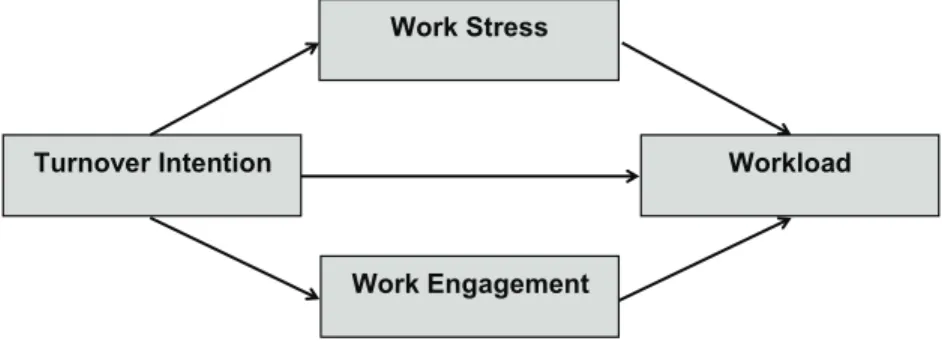
Hence, this study examined the role of work stress and work engagement in mediating the effect of workload on turnover intention. The investigation is based on the following hypotheses (see Figure 1):
H1: High workload can increase turnover intention, so that workload positively affects turnover intention.
H2: High workload can increase work stress, so that the workload positively affects work stress.
H3: High work stress can increase turnover intention, so work stress has a positive effect on turnover intention.
H4: High workload can decrease employees’ engagement to work, so that workload is negatively affected.
H5: Low work engagement can increase turnover intention so that work engagement negatively affects turnover intention.
H6: Work stress can mediate the effect of workload on turnover intention.
H7: Work engagement can mediate the effect of workload on turnover intention.
Workload Turnover Intention
Work Stress
Work Engagement Figure 1: Research Framework
3. Research Methods
The approach used in this research is quantitative and explanatory in nature. Total population is 60 employees of four-star hotels in Surabaya, Indonesia. The population is small because of layoffs due to the Covid-19 pandemic.
Because the population in this study is small, it uses saturated samples where the size of population and sample is the same, which are 60 people. Data measurement techniques used in this study is 5-point Likert scale. The inference analysis model used was PLS (Partial Least Square) approach. There are four stages of analysis in conducting PLS (Partial Least Square) approach, namely, Measurement Model Analysis (Outer Model), Structural Model Analysis (Inner Model), Hypothesis Testing, and Mediation Testing. This study also used the Sobel test to examine the role of variable in mediating the relationship between the independent variable and the dependent variable.
4. Results and Discussion 4.1. Results
4.1.1. Outer Model Evaluations
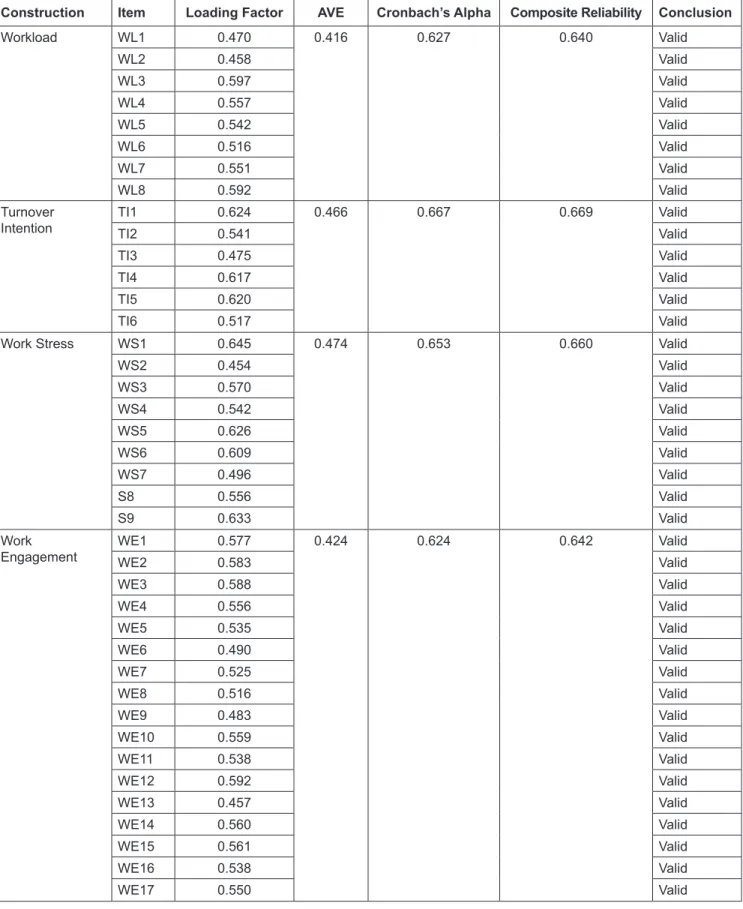
Table 2 shows that the AVE values of all variables have qualified validity. All items have a loading factor value of more than 0.5. The AVE values of each construct have been more than 0.5. This indicates that all items on each construct can be declared valid. All construct variables have Cronbach’s Alpha value and composite reliability of more than 0.6. The conclusion is that all the variable constructs used in this study have passed the reliability tests or can be said to be reliable.
Table 3 shows that the AVE root value of each construct has a value greater than the correlation of latent variables between constructs. The conclusion is that all constructs have met the parameters of the discriminant validity test so that it is declared valid.
4.1.2. Inner Model Evaluations
Inner Model testing shows the relationship between variables in accordance with theoretical studies as well as the results of previous research. Inner model analysis can be seen from three indicators, namely, R-Square (R2), Q-Square Predictive Relevance (Q2), and Goodness of Fit (GoF).
Regarding determinant coefficient (R2) value of 0.75 (strong), 0.50 (moderate), and 0.25 (weak) (Ghozali & Latan, 2012). The R2 values of work engagement variable is 0.282 (weak), this means that exogenous variables have a weak ability to explain the work engagement variable. The R2 values of work stress variable is 0.341 (weak to moderate), this means that exogenous variables have a weak to moderate ability to explain the work stress variable. And the R2 values of turnover intention variable is 0.738 (strong), this means that exogenous variables have a strong ability to explain the turnover intention variable.
Regarding Q-Square Predictive Relevance (Q2) value of 0.35 (strong), 0.15 (moderate), and 0,02 (weak) (Ghozali
& Latan, 2012). Q2 in this study was 0.63 or 63%. This research model is categorized into strong models, meaning that turnover intention variables can be predicted by variable workload, work engagement, work stress, and the rest (100% – 63% = 37%) is a contribution from other variables not described in this research model. The result of the calculation above gets a GoF value of 0.545. In conclusion, the structural model of this research generally has good predictive properties (GoF large) meaning that the model has a high ability to explain empirical data.
Table 2: Convergent Validity and Reliability Values
Construction Item Loading Factor AVE Cronbach’s Alpha Composite Reliability Conclusion
Workload WL1 0.470 0.416 0.627 0.640 Valid
WL2 0.458 Valid
WL3 0.597 Valid
WL4 0.557 Valid
WL5 0.542 Valid
WL6 0.516 Valid
WL7 0.551 Valid
WL8 0.592 Valid
Turnover
Intention TI1 0.624 0.466 0.667 0.669 Valid
TI2 0.541 Valid
TI3 0.475 Valid
TI4 0.617 Valid
TI5 0.620 Valid
TI6 0.517 Valid
Work Stress WS1 0.645 0.474 0.653 0.660 Valid
WS2 0.454 Valid
WS3 0.570 Valid
WS4 0.542 Valid
WS5 0.626 Valid
WS6 0.609 Valid
WS7 0.496 Valid
S8 0.556 Valid
S9 0.633 Valid
Work
Engagement WE1 0.577 0.424 0.624 0.642 Valid
WE2 0.583 Valid
WE3 0.588 Valid
WE4 0.556 Valid
WE5 0.535 Valid
WE6 0.490 Valid
WE7 0.525 Valid
WE8 0.516 Valid
WE9 0.483 Valid
WE10 0.559 Valid
WE11 0.538 Valid
WE12 0.592 Valid
WE13 0.457 Valid
WE14 0.560 Valid
WE15 0.561 Valid
WE16 0.538 Valid
WE17 0.550 Valid
4.1.3. Direct Effect Testing and Indirect/
Mediation Effects Testing 4.2. Discussion
The influence of workload on turnover intention
Based on Hypothesis 1 stating the influence of workload on turnover intention, the value obtained from path coefficient is 0.714 and value obtained from t-statistics is 9.607. The value of the path coefficient shows the value is positive and the value of the t-statistic is more substantial than the value of the t-table, which is 1.96. This means that workload directly has a positive and significant effect on turnover intention. Positive values in the path coefficient indicate the direction of a positive relationship between workload and turnover intention of employees at four-star hotels in Surabaya, Indonesia. This study shows that, if an
employee receives a workload that exceeds their ability limits, it can increase the employee’s desire to leave work.
The results showed the workload felt by the employees of four-star hotels in Surabaya, Indonesia, is that employees feel very busy during work, and employees find it difficult to complete the demands of the work of the manager so that it requires a high concentration in order for the task to be completed. However, employees still feel quite comfortable working at four-star hotels in Surabaya, Indonesia, despite getting a heavy workload. Nevertheless, employees still want to keep working at four-star hotels in Surabaya, Indonesia, even though sometimes they also think about leaving their job in the next 12 months.
The influence of workload on work stress
Based on Hypothesis 2 stating the influence of workload on work stress, the value obtained from path coefficient is 0.306 and value obtained from t-statistics is 6.372. The value Table 5: The Result of Indirect Effect/Mediation Testing
Variable Inter-Variable
Relationship Path
Coefficient Z-Values Description
Workload → Turnover Intention (c) Direct effect 0.301 Significant
Workload → Work Stress → Turnover Intention (c″) Indirect effect 0.184 3.121 Significant
Workload → Work Engagement → Turnover Intention (c″) 0.237 3.967 Significant
Table 3: AVE Root Value and Latent Variable Correlation
Workload Work Engagement Work Stress Turnover Intention
Workload 0.774
Work Engagement –0.530 0.782
Work Stress 0.584 –0.410 0.826
Turnover Intention 0.714 –0.727 0.663 0.819
Table 4: The Result of Direct Effect Testing
Hypothesis Relationships Between Variables Path
Coefficient T-Statistics Description Independent Variables Dependent Variables
H1 Workload Turnover Intention 0.714 9.607 Positive - Significant
H2 Workload Work Stress 0.584 6.372 Positive - Significant
H3 Work Stress Turnover Intention 0.306 3.479 Positive - Significant
H4 Workload Work Engagement –0.530 4.982 Negative - Significant
H5 Work
Engagement Turnover Intention –0.442 6.524 Negative - Significant
of the path coefficient shows the value is positive and the value of the t-statistic is more substantial than the value of the t-table, which is 1.96. This means that workload directly has a positive and significant effect on work stress. Positive values in the path coefficient indicate the direction of a positive relationship between workload and work stress of employees at four-star hotels in Surabaya, Indonesia. High workloads have higher impacts on employees’ emotional state than employees’ physical condition during work. This is evidenced that the employees of four-star hotels in Surabaya, Indonesia, feel very busy in completing the demands of difficult work. The demands of work are also a big burden for employees, because employees feel stressed anxious if the task cannot be completed to the maximum and on time.
The influence of work stress on turnover intention
Based on Hypothesis 3 stating the influence of work stress on turnover intention, the value obtained from path coefficient is 0.584 and value obtained from t-statistics is 3.479. The value of the path coefficient shows the value is positive and t-statistic value is greater than the t-table value, which is 1.96. This means that work stress directly has a positive and significant effect on turnover intention.
Positive values in the path coefficient indicate the direction of a positive relationship between work stress and turnover intention of employees in four-star hotels in Surabaya, Indonesia. Work stress can cause employees to decide to leave their jobs. The feeling of stress felt by the employees of four-star hotels in Surabaya, Indonesia, in completing tasks that are considered too difficult, makes employees feel no confidence in completing the task. In addition, the amount of work that must be completed compared to the time available, leaves employees with no opportunity to achieve their goals at work. This condition is enough to make employees have the intention to move their jobs to other hotels.
The influence of workload on work engagement
Based on Hypothesis 4 stating the influence of workload on work engagement, the value obtained from path coefficient is –0.530 and value obtained from t-statistics is 4.982. The value of the path coefficient shows the value is negative and t-statistic value is greater than the t-table value, which is 1.96. This means that workload directly give negative and significant effect on work engagement.
Negative values in the path coefficient indicate the direction of a negative relationship between workload on work engagement of employees at four-star hotels in Surabaya, Indonesia. Busy employees in completing their work, making employees more focused on their work until too late in their work (absorption). But employees do not feel proud and enthusiastic about the work done now (dedication) because they finish their work just because of the demands,
not because they love the job. Employees also argue that the work done is less challenging.
The influence of work engagement on turnover intention Based on Hypothesis 5 stating the influence of work engagement on turnover intention, the value obtained from path coefficient is –0.442 and value obtained from t-statistics is 6.524. The value of the path coefficient shows the value is negative and the value of the t-statistic is more substantial than the value of the t-table, which is 1.96. This means that work engagement directly give negative and significant effect on turnover intention. Negative values in the path coefficient indicate the direction of a negative relationship between work engagement on turnover intention of employees in four-star hotels in Surabaya, Indonesia. This study showed that employees always focus on completing work until late at work and forget about time. In addition, employees also have a high enthusiasm for work (vigor). However, employees do not feel proud and enthusiastic at work because they complete their work only because of demands, not because they love their work (dedication). Employees only complete their work, but are not in accordance with company goals.
Employees also feel that the work done is less challenging and quite boring. Based on the explanation above, it can be seen that the dedication indicator has the greatest influence, which affects the occurrence of turnover intention.
The influence of workload on turnover intention mediated by work stress
The results of mediation test analysis showed that work stress is able to mediate the influence of workload on turnover intention (Hypothesis 6 is accepted), proven from the coefficient value of the indirect effect path, which is less than the direct effect path (0.184 < 0.301). Sobel test results also support that the workload has a significant effect on turnover intention through work stress with a z-values value of 3.121. That means work stress has the role of mediating the influence of workload on turnover intention. According to Baron and Kenny (1986), the role was found to be only partial mediation.
The influence of workload on turnover intention mediated by work engagement
The results of mediation test analysis showed that work engagement is able to mediate the influence of workload on turnover intention (Hypothesis 7 is accepted), proven from the coefficient value of the indirect effect path, which is less than the direct effect path (0.237 < 0.301). Sobel test results also support that the workload has a significant effect on turnover intention through work engagement with a z-values value of 3.967. The nature of mediation is categorized as partial mediation, meaning that the workload is still able to
influence turnover intention without the mediation of work engagement. According to Baron and Kenny (1986), the role was found to be only partial mediation.
5. Conclusion and Limitation
Based on the data analysis and the discussion, several research conclusions can be put forward:
Workload has a positive and significant effect on turnover intention of employees of four-star hotels in Surabaya, Indonesia. This means when the level of workload is increasingly high, then it can also increase the level of turnover intention. So that, if an employee receives a workload to exceed their ability limits, it can increase the level of turnover intention. Workload has a positive and significant effect on work stress of employees of four-star hotels in Surabaya, Indonesia. This means when the level of workload is increasingly high, then the level of work stress is also increasingly high. The employees feel very busy in completing the demands of difficult work. Work stress has a positive and significant effect on turnover intention of employees at four-star hotels in Surabaya, Indonesia. That means when the level of work stress is increasingly high, then it can also increase the level of turnover intention.
There is stressed anxious about work, which can increase the level of turnover intention. Workload has a negative and significant effect on work engagement of employees of four-star hotels in Surabaya, Indonesia. That means when the level of workload is increasingly high the level of work engagement is decreasing. Work engagement has a negative and significant effect on turnover intention of employees of four-star hotels in Surabaya, Indonesia. That means when the level of work engagement is decreasing, then it can increase the level of turnover intention. Work stress can mediate the influence of workload on employee turnover intention of four-star hotels in Surabaya, Indonesia. Work engagement can mediate the influence of workload on employee turnover intention of four-star hotels in Surabaya, Indonesia.
The study has generated several theoretical and practical implications:
Four-star hotels in Surabaya, Indonesia, need to pay more attention to the tasks distributed to employees according to their abilities so that employees do not feel too overwhelmed and can complete these tasks optimally and on time. Four- star hotels in Surabaya, Indonesia, need to provide more opportunities for employees to achieve their goals in the workplace, such as promotion of positions, assigning job responsibilities in accordance with the capacity of employees’ abilities. Four-star hotels in Surabaya, Indonesia, need to create a strategy to relieve employee stress during work. Four-star hotels in Surabaya, Indonesia, need to increase employees’ sense of dedication to their work so that employees feel more enthusiastic and proud of their work.
Some limitations faced in the implementation of research include the following:
The object of research is still limited to employees of four-star hotels in Surabaya, Indonesia, which limits the generalization of the findings in hotel employees nationally.
Because the research was conducted during the Covid-19 pandemic, four-star hotels in Surabaya, Indonesia, ceased operations for five months, and laid off most of its employees.
Although the population is small and research took a long time, the analysis can still be done.
References
Altahtooh, A. U. (2018). The Effect of Job Satisfaction and Workload on IT Project Employee Turnover Intention in the Madinah Government of Saudi Arabia. International Journal of Business and Social Science, 9(8), 107–115. https://doi.
org/10.30845/ijbss.v9n8p12
Ak, B. (2018). Turnover Intention Influencing Factors of Employees: An Empirical Work Review. Journal of Entrepreneurship & Organization Management, 7(03), 3–7.
https://doi.org/10.4172/2169-026x.1000253
Amir, M., & Mangundjaya, W. L. (2021). How Resilience Affects Employee Engagement? A Case Study in Indonesia. Journal of Asian Finance, Economics and Business, 8(2), 1147–1156.
https://doi.org/10.13106/jafeb.2021.vol8.no2.1147
Applebaum, D., Fowler, S., Fiedler, N., Osinubi, O., & Robson, M.
(2010). The Impact of Environmental Factors on Nursing Stress, Job Satisfaction, and Turnover Intention. Journal of Nursing Administration, 40(7–8), 323–328. https://doi.
org/10.1097/NNA.0b013e3181e9393b
Badan Pusat Statistika Kota Surabaya. (2018). Domestic and International Tourist Data Visiting the City of Surabaya, East Java in 2017 and 2018. Retrieved January 20 2021, from surabayakota.bps.go.id
Barkhuizen, N., & Rothmann, S. (2006). Work Engagement of Academic Staff in South African Higher Education Institutions.
Management Dynamics, 15(1), 38–46.
Baron, R.M., & Kenny, D. (1986). The Moderator-Mediator Variable Distinction in Social Psychological Research:
Conceptual, Strategic, and Statistical Considerations. Journal of Personality and Social Psychology, 51(6), 1173–1182.
https://doi.org/10.1037/0022-3514.51.6.1173
Chen, M. F., Lin, C. P., & Lien, G. Y. (2011). Modelling Job Stress as a Mediating Role in Predicting Turnover Intention.
Service Industries Journal, 31(8), 1327–1345. https://doi.
org/10.1080/02642060903437543
Chen, M. L., Su, Z. Y., Lo, C. L., Chiu, C. H., Hu, Y. H., & Shieh, T. Y. (2014). An Empirical Study on the Factors Influencing the Turnover Intention of Dentists in Hospitals in Taiwan. Journal of Dental Sciences, 9(4), 332–344. https://doi.org/10.1016/j.
jds.2013.01.003
Côté, S., & Morgan, L. M. (2002). A Longitudinal Analysis of the Association Between Emotion Regulation, Job Satisfaction,
and Intentions to Quit. Journal of Organizational Behavior, 23(8), 947–962. https://doi.org/10.1002/job.174
Dessler, G. (2013). Human Resource Management (13th ed). Upper Saddle River, NJ: Prentice Hall.
Du Plooy, J., & Roodt, G. (2010). Work Engagement, Burnout and Related Constructs as Predictors of Turnover Intentions.
SA Journal of Industrial Psychology, 36(1), 1–14. https://doi.
org/10.4102/sajip.v36i1.910
Emiroğlu, B. D., Akova, O., & Tanrıverdi, H. (2015). The Relationship Between Turnover Intention and Demographic Factors in Hotel Businesses: A Study at Five Star Hotels in Istanbul. Procedia - Social and Behavioral Sciences, 207, 385–397. https://doi.org/10.1016/j.sbspro.2015.10.108 Firth, L., Mellor, D. J., Moore, K. A., & Loquet, C. (2004). How
Can Managers Reduce Employee Intention to Quit? Journal of Managerial Psychology, 19(2), 170–187. https://doi.
org/10.1108/02683940410526127
Ghozali, I., & Latan, H. (2012). Partial Least Square: Concepts, Techniques and Applications Using the Smart PLS 2.0 M3 Program. Universitas Diponegoro.
Gutmann, P. (2016). Workforce Turnover Around the World. Mercer Global Edition Report.
Harris, G. E., & Cameron, J. E. (2005). Multiple Dimensions of Organizational Identification and Commitment as Predictors of Turnover Intentions and Psychological Well-Being. Canadian Journal of Behavioural Science, 37(3), 159–169. https://doi.
org/10.1037/h0087253
Hart, S.G., & Staveland, L. (1988). Development of NASA- TLX (Task Load Index): Result of Empirical and Theoretical Research. In: P. A. Hancock & N. Meshkati (Eds.), Human Mental Workload. Amsterdam: North-Holland.
Harter, J. K., Schmidt, F. L., & Hayes, T. L. (2002). Business-Unit- Level Relationship Between Employee Satisfaction, Employee Engagement, and Business Outcomes: A Meta-Analysis.
Journal of Applied Psychology, 87(2), 268–279. https://doi.
org/10.1037/0021-9010.87.2.268
Hurley, R. F., & Estelami, H. (2007). An exploratory Study of Employee Turnover Indicators as Predictors of Customer Satisfaction. Journal of Services Marketing, 21(3), 186–199.
https://doi.org/10.1108/08876040710746543
Inegbedion, H., Inegbedion, E., Peter, A., & Harry, L. (2020).
Perception of Workload Balance and Employee Job Satisfaction in Work Organisations. Heliyon, 6(1). https://doi.org/10.1016/j.
heliyon.2020.e03160
Ippolito Morrill, M., Hines, D. A., Mahmood, S., & Córdova, J. V.
(2010). Pathways Between Marriage and Parenting for Wives and Husbands: The Role of coparenting. Family Process, 49(1), 59–73. https://doi.org/10.1111/j.1545-5300.2010.01308.x Islam, Z. ul., Bangish, S. B., Muhammad, H., & Jehan, A. S.
(2016). The Impact of HR Practices on Job satisfaction: A Case Study of Hotel Industry in Pakistan. Journal of Asian Finance, Economics and Business, 3(1), 43–48. https://doi.org/10.13106/
jafeb.2016.vol3.no1.43
Issa, D. A. R. M., Ahmad, F., & Gelaidan, H. M. (2013). Job Satisfaction and Turnover Intention Based on Sales Person Standpoint. Middle East Journal of Scientific Research, 14(4), 525–531. https://doi.org/10.5829/idosi.mejsr.2013.14.4.11172 Jamal, M. (2005). Employees: A Cross-Cultural Study. European
Management Review, 2, 224–230.
Kurniawati, N. I., Werdani, R. E., & Pinem, R. J. (2018). Analysis of the Effect of Work Family Conflict and Workload on Work Stress in Influencing Turnover Intention (Study on Employees of PT. Bank Negara Indonesia (Persero), Tbk, Semarang Region). Jurnal Administrasi Bisnis, 7(2), 95. https://doi.
org/10.14710/jab.v7i2.22694
Lee, Y. H. (2018). An Overview of Meta-Analysis for Clinicians.
The Korean Journal of Internal Medicine, 33(2), 277–283.
https://doi.org/10.3904/kjim.2016.195
Manktelow, J. (2007). Manage Stress. Jakarta: Erlangga.
Mappamiring, M., Akob, M., & Putra, A. H. P. K. (2020). What Mille nnial Workers Want? Turnover or intention to Stay in Company. Journal of Asian Finance, Economics and Business, 7(5), 237–248. https://doi.org/10.13106/JAFEB.2020.VOL7.
NO5.237
McEntee, A., Roche, A. M., Kostadinov, V., Hodge, S., &
Chapman, J. (2020). Predictors of Turnover Intention in the Non-Government Alcohol and Other Drug Sector. Drugs:
Education, Prevention and Policy, 0(0), 1–9. https://doi.org/1 0.1080/09687637.2020.1759508
McGinley, S. P., Hanks, L., & Line, N. D. (2017). Constraints to Attracting New Hotel Workers: A Study on Industrial Recruitment. International Journal of Hospitality Management, 60, 114–122. https://doi.org/10.1016/j.ijhm.2016.10.010 Mohsin, A., Lengler, J., & Kumar, B. (2013). Exploring the
Antecedents of Intentions to Leave the Job: The Case of Luxury Hotel Staff. International Journal of Hospitality Management, 35, 48–58. https://doi.org/10.1016/j.ijhm.2013.05.002
Ratnasari, S. L., & Lestari, L. (2020). Effect of Leadership Style, Workload and Job Insecurity on Turnover Intention. International Journal of Innovation, Creativity and Change, 11(12), 299–313.
Ronra, B., & Chaisawat, M. (2009). Factors Affecting Employee Turnover and Job Satisfaction: A Case Study of Amari Hotels and Resorts. 1–14. Retrieved January 18 2021, from http://
www.conference.phuket.psu.ac.th/proceedings/PSU_OPEN_
WEEK_2009/data/Hospltality/Paper1.pdf
Saputra, P. M. A., Yuesti, A., & Sudja, I. (2019). The Effect of Work Satisfaction, Organizational Commitment and Workload on Turnover Intention on PT. Bank Rakyat Indonesia (Persero) Tbk Unit Sekanca Denpasar Gajah Mada. 2(1). https://doi.
org/10.1234/ijsegce.v2i1.54
Schaufeli, W. B., & Bakker, A. B. (2004). Job Demands, Job Resources, and Their Relationship with Burnout and Engagement: A Multi-Sample Study. Journal of Organizational Behavior, 25(3), 293–315. https://doi.org/10.1002/job.248 Schultz, D., & Schultz, S. E. (2006). Psychology & Work Today
(9th ed). London: Pearson Education. Inc.
Soelton, M., & Nugrahati, T. (2018). How Complaining Behaviors Effect on Coping Stress and Anxiety. International Journal of Saudi Journal of Business and Management Studies (SJBMS), 3(6), 623–628.
Soelton, M., Nugrahati, T., Setiawan, M., Rohman, F., & Pratama, A. (2019). Gender: Stress Levels On Performance In Modern Industry. Archives of Business Research, 7(2).
Soelton, M., Visano, N. A., Noermijati, N., Ramli. Y., Syah. T. Y.
R., & Sari, Y. J. (2020). The Implication of Job Satisfaction That Influence Workers to Practice Organizational Citizenship Behavior (OCB) in the Workplace. Archives of Business Research, 8(5), 33–48. https://doi.org/10.14738/abr.85.8139 Sonnentag, S. (2003). Recovery, Work Engagement, and Proactive
Behavior: A New Look at the Interface Between Nonwork and Work. Journal of Applied Psychology, 88(3), 518–528. https://
doi.org/10.1037/0021-9010.88.3.518
Susiawan, S., & Muhid, A. (2015). Transformational Leadership, Job Satisfaction, and Organizational Commitment. Jurnal Psikologi Indonesia, 4(3), 304–313.
Tentama, F., Rahmawati, P. A., & Muhopilah, P. (2019). The Effect and Implications of Work Stress and Workload on Job Satisfaction. International Journal of Scientific and Technology Research, 8(11), 2498–2502.
Tracey, B. J., & Hinkin, T. R. (2008). Contextual Factors and Cost Profiles Associated with Employee Turnover.
Cornell Hospitality Quarterly, 49(1), 12–27. https://doi.
org/10.1177/0010880407310191
Tripadvisor. (2019). Star Hotel in Surabaya. Retrieved January 20 2021, from https://www.tripadvisor.co.id/Hotels-g297715-zfc4 Surabaya_East_Java_Java-Hotels.html.
Truong, T. V. T., Nguyen, H. V., & Phan, M. C. T. (2021). Influences of Job Demands, Job Resources, Personal Resources, and Coworkers Support on Work Engagement and Creativity.
Journal of Asian Finance, Economics and Business, 8(1), 1041–1050. https://doi.org/10.13106/jafeb.2021.vol8.no1.1041 Van den Berg, B. A. M., Bakker, A. B., & ten Cate, T. J. (2013). Key
Factors in Work Engagement and Job Motivation of Teaching Faculty at A University Medical Centre. Perspectives on Medical Education, 2(5–6), 264–275. https://doi.org/10.1007/
s40037-013-0080-1
Wonowijoyo, S. (2018). Effect of Organizational Commitment and Job Satisfaction on Turnover Intention at Pt. Kediri Matahari Corn Mills. Agora, 6(1).
Woods, R. H., & Macaulay, J. F. (1989). R for Turnover:
Retention Programs That Work. Cornell Hotel and Restaurant Administration Quarterly, 30(1), 78–90. https://doi.
org/10.1177/001088048903000119
Xiaoming, Y., Ma, B. J., Chang, C. L., & Shieh, C. J. (2014). Effects of Workload on Burnout and Turnover Intention of Medical Staff: A Study. Studies on Ethno-Medicine, 8(3), 229–237.
https://doi.org/10.31901/24566772.2014/08.03.04
Yozgat, U., Yurtkoru, S., & Bilginoğlu, E. (2013). Job Stress and Job Performance Among Employees in Public Sector in Istanbul: Examining the Moderating Role of Emotional Intelligence. Procedia - Social and Behavioral Sciences, 75, 518–524. https://doi.org/10.1016/j.sbspro.2013.04.056
Zhang, Y. (2016). A Review of Employee Turnover Influence Factor and Countermeasure. Journal of Human Resource and Sustainability Studies, 4(2), 85–91. https://doi.org/10.4236/
jhrss.2016.42010