Korean J. Environ. Biol. 36(3) : 329~335(2018) https://doi.org/10.11626/KJEB.2018.36.3.329
INTRODUCTION
The filamentous brown algal genus Acinetospora is de- scribed as plants that possess sparsely branched uniseriate filaments forming entangled tufts, plurilocular sporangia (acinetosporangia) which produce acinetospores, monospo- rangia, scattered meristematic zones, and crampons (Bornet 1892; Sauvageau 1899). Currently, four Acinetospora spe- cies are recognized: A. crinita (Carmichael in Harvey) Sau- vageau (1899), A. nicholsoniae Hollenberg (1971), A. fila
mentosa (Noda) Yaegashi, Uwai et Kogame (2015), and A.
asiatica Yaegashi, Yamagishi et Kogame (2015). Of them, only A. crinita has been reported in Korea (Kim 2010).
The genus Botrytella is characterized by heterotrichous thallus organization arising from a basal disc, the erect fila- ments with sympodial branching, diffuse intercalary meri- stem, and sub-globular to irregular larger plurilocular spo- rangia arising terminally or serially on the adaxial side of the laterals (Womersley 1987; Kim 1996; Guiry and Guiry 2018).
Currently, four Botrytella species are recognized around the world; Botrytella micromora Bory (1822), B. parva (Taka- matsu) H. S. Kim (1996), B. pacifica (Hollenberg) G. I. Han- sen (1997) and B. reinboldii (Reinke) Kornmann & Sahling (1988). Of them, the three species have been reported in Korea except B. reinboldii (Kim 2010).
We collected two filamentous brown algae from coast of Korea that fit the description of Acinetospora asiatica and Botrytella reinboldii. We observed their detailed morphology and analysed molecular data based on rbcL gene for their phylogenetic relationships with others in their respective genera and a few selected species within the Ectocarpales.
In this study, we add Acinetospora asiatica and Botrytella reinboldii to the Korean marine algal inventory.
MATERIALS AND METHODS 1. Morphology
Plants were collected from coasts of Korea and sorted into voucher herbarium specimens, silica gel samples for molec-
* Corresponding author: Tae Oh Cho, Tel. 062-230-7161, Fax. 062-230-7161, E-mail. [email protected]
ⓒ2018. Korean Society of Environmental Biology.
New Records of Two Filamentous Brown Algae, Acinetospora asiatica and Botrytella reinboldii from Korea
Antony Otinga Oteng’o, Jose Avila-Peltroche, So Young Jeong, Boo Yeon Won and Tae Oh Cho*
Department of Life Science, Chosun University, Gwangju 61452, Republic of Korea
Abstract - Acinetospora asiatica and Botrytella reinboldii are reported as two new records from S.
Korea based on morphological studies and molecular analyses. A. asiatica is mainly characterized by the presence of sparsely branched uniseriate filaments with diffused meristematic zones, the formation of crampons at right angles, and the formation of plurilocular sporangia on both pros- trate and erect filaments. B. reinboldii is characterized by the presence of irregularly alternating branched uniseriate filaments attached by rhizoids, and single or clustered plurilocular sporangia with a single opening. Molecular analyses of rbcL gene revealed that A. asiatica and B. reinboldii are placed within each clade of Acinetospora and Botrytella, respectively.
Keywords : Acinetospora asiatica, Botrytella reinboldii, Ectocarpales, Phaeophyceae
<Original article>
Antony Otinga Oteng’o, Jose Avila-Peltroche, So Young Jeong, Boo Yeon Won and Tae Oh Cho 330
ular analysis, and formalin samples for morphological analy- sis. Formalin samples were preserved in 4-5% formalin/sea- water. Photomicrographs taken using an Olympus BX51TRF microscope (Olympus, Tokyo, Japan) and an Olympus DP71 camera. Permanent slides were mounted in 70% karo syrup.
Representative specimens examined in this study were depo- sited in the herbarium of Chosun University (CUK) and Na- tional Institute of Biological Resources (NIBR), Korea.
2. Molecular study
Genomic DNA was manually extracted from silica-gel samples using a NucleoSpin Plant II Kit (Macherey-Nagel, Düren, Germany). The extracted DNA was stored at -20°C and used to amplify rbcL. Polymerase chain reaction (PCR) was conducted in 30 μL reactions that contained 3.2 μL ge- nomic DNA or 3.2 μL diluted genomic DNA (1 : 10), 1 μL 10 pmols forward and reverse primers, and 15 μL HelixAmp Ready-2x-Go Series (NanoHelix Co., Ltd., Daejeon, Korea).
The rbcL gene was amplified using the primer combinations NDrbcL2-DRL1R and DRL2F-R3A (Kogame et al. 1999;
Hwang et al. 2005). The PCR product was purified with PCR quick-spin
TMPCR product purification kit (iNtRON Biotech- nology, Inc. Seongnam, Korea). Determination of the nucle- otide sequence or sequencing performed by Macrogen Inc., Seoul, South Korea.
RbcL sequence data were compiled by the present study and obtained from GenBank and aligned with ClustalW (Thompson et al. 1994). New rbcL sequences obtained from Acinetospora asiatica have been deposited in EMBL/Gen- Bank under the accession numbers MH727658, MH727659, MH727660, and MH727661. Also Botrytella reinboldii sequ- ence data are deposited in EMBL/GenBank under accession number MH727662 for rbcL. Phylogenetic analyses were conducted using MEGA version 6.06 (Tamura et al. 2013).
Maximum likelihood analyses were conducted using the GTR+G model, with 1,000 bootstrap replicates. A bayesian inference was performed using MrBayes 3.2.6 (Huelsenbeck and Ronguist 2001; Ronguist and Huelsenbeck 2003). Mar- kov chain Monte Carlo runs were conducted for 2 million generations, each with one cold chain and three heated chains using the GTR+Γ+I evolutionary model and sampling and printing every 1,000 generations. Summary trees were gen- erated using a burn-in value of 800.
RESULTS AND DISCUSSION 1. Morphological observations
Acinetospora asiatica Yaegashi, Yamagishi et Kogame,
2015
아시아솜말
(
신칭) (Figs. 1-2)
Type locality: Oshoro, Otaru, Hokkaido, Japan.
Material examined: MBRB0063TC13380 (voucher speci- mens deposited in the National Marine Biodiversity Insti- tute of Korea for MH727658 GenBank accession number), Byeonsan-myeon, Buan-gun, Jeollabuk-do, Korea (35°37ʹ 41.87ʺN, 126°28ʹ04.60ʺE), January 09, 2015, T. O. Cho and B. Y. Won, at 1 m depth by hand; MBRB0063TC14114 (vou- cher specimens deposited in the National Marine Biodiver- sity Institute of Korea for MH727659 GenBank accession number), Hupo-hang, Hupo-myeon, Uljin-gun, Gyeongsang- buk-do, Korea (36°40ʹ42.90ʺN, 129°27ʹ02.96ʺE), January 23, 2015, T. O. Cho, S. Y. Jeong, J. G. Lee, S. Y. Park, J. B. Chai and H. U. Jany, at 1 m depth by hand; MBRB0063TC17307 (voucher specimens deposited in the National Marine Bio- diversity Institute of Korea for MH727660 GenBank acces- sion number), Hongdo-hang, Hongdo-ri, Heuksan-myeon, Sinan-gun, Jellanam-do, Korea (34°41ʹ02.15ʺN, 125°11ʹ 35.50ʺE), May 21, 2016, T. O. Cho, S. Y. Jeong, D. B. Mosta- jo and A. Jose, at 1 m depth by hand; NIBROR0000001359 (deposited in the National Institute of Biological Resources), MBRB0063TC18922 (voucher specimens deposited in the National Marine Biodiversity Institute of Korea for MH727 661 GenBank accession number), Jaranman-ro, Hai-myeon, Goseong-gun, Gyoungsangnam-do, Korea (34°54ʹ19.08ʺN, 128°09ʹ08.43ʺE), May 05, 2018, T. O. Cho and B. Y. Won, at 1 m depth by hand.
Description: Plants forming entangled tufts (Fig. 1A) on rocks and other seaweeds (e.g. Sargassum spp.), sparsely branched uniseriate filaments (Fig. 1B), and up to 30 cm high.
Erect filaments have meristematic zones composed of small
sized cells (Fig. 1C) and crampons formed on erect filaments
at right angles (Fig. 1D). Cells of erect filaments 20-77 μm in
length, 18-30 μm in width, and contain many discoid chlo-
roplasts (Fig. 1E). Erect filaments produced from prostrate
filaments (Fig. 1F), and tapered slightly in upper part to form
pseudohairs (Fig. 1G). Plurilocular zoidangia produced on
both prostrate and erect filaments, ectocarpoid, 90-135 μm in length, 25-40 μm in width, with one- or two-celled pedi- cels (Fig. 1H) or sessile (Fig. 1I). Unilocular sporangia were
not found.
Habitat: Epiphytic and saxicolous at the tide pool in inter- tidal zone.
Fig. 1. Acinetospora asiatica Yaegashi, Yamagishi et Kogame. A. Specimen with filamentous entangled tufts; B. Thallus with Sparsely branched uniseriate filaments; C. Meristematic zones(arrow heads) composed of small cells; D. Formation of crampon(arrow) on erect filaments at right angles; E. Cells with discoid chloroplasts; F. Erect filaments(arrows), prostrate filaments(arrowhead); G.
Pseudohair(arrows) in the upper part of erect filaments; H. Pedicellate plurilocular zoidangia(arrow); I. Sessile plurilocular zoidangia (arrow). Scale bars: A=2.0cm; B=500μm; C, D, F, H=50μm; E=20μm; G=200μm; I=100μm.
A B C
D E F
G H I
Antony Otinga Oteng’o, Jose Avila-Peltroche, So Young Jeong, Boo Yeon Won and Tae Oh Cho 332
World distribution: Korea, Japan.
Identifier: Tae Oh Cho.
Phylogenetic analyses: The 1326-nucleotide portion of rbcL was aligned for Acinetosproa asiatica. The phylogenetic trees were obtained from the alignment of the rbcL sequences newly generated and downloaded from GenBank. Asterocla
don rhodochortonoides and A. interjectum were selected as outgroup. Phylogenetic analyses revealed that Acinetosproa collected from South Korea was placed within a clade of Acinetospora asiatica (Fig. 2). In addition, Acinetospora asi
atica collected from South Korea differs from A. crinita by 4.2-5.2% and from A. filamentosa by 4.7-4.9% gene sequ- ence divergence respectively. However, there was only 0-
0.02% gene sequence divergence between Genbank and our collection of Acinetospora asiatica.
Remarks: Acinetospora asiatica was recently described as
a new species from Japan (Yaegashi et al. 2015). Our collec- tions match the diagnosis of Acinetospora asiatica as describ- ed from the type locality. Molecular data based on rbcL gene match with the Japanese samples. In this study, we report A.
asiatica as a new record from Korea and add this species in the list of Korean macroalgal flora.
Botrytella reinboldii
(Reinke) Kornmann & Sahling, 1988
가지바다오디
(
신칭) (Figs. 3-4) Type locality: Helgoland, Germany.
Material examined: MBRB0061TC10574, Beakpo village, Dolsan-eup, Yeosu-si, Jeollanam-do, Korea (34°37ʹ15.03ʺN, 127°47ʹ25.70ʺE), January 18, 2014, T. O. Cho, at 1 m depth by hand; NIBROR0000001360 (deposited in the National
Fig. 2. Phylogenetic tree of Acinetospora species based on Bayesian and ML analysis with rbcL sequences. Value above the branches=Bayes-ian posterior probabilities>0.75/Maximum likelihood bootstrap values in %>50. Values lower than BPP 0.75 or BS 50 are indicated by hyphens(-). Values of BPP 1.00 or BS 100 are indicated by asterisks(*).
Institute of Biological Resources), MBRB0061TC18903 (voucher specimens deposited in the National Marine Bio- diversity Institute of Korea for MH727662 GenBank acces-
sion number), Aninjin hang, Gangdong-myeon, Gangneung- si, Gangwon-do, Korea (37°44ʹ15.81ʺN, 128°59ʹ19.55ʺE), January 05, 2018, T. O. Cho and B. Y. Won, at 1 m depth by
Fig. 3. Botrytella reinboldii(Reinke) Kornmann & Sahling. A. Specimen with filamentous entangled tufts; B. A uniseriate filament showing irregular alternative branching pattern; C. Rhizoids(arrows) near the base; D. Cells with discoid chloroplasts; E. Meristematic zones (arrowheads) composed of small cells; F. Sessile plurilocular zoidangia of various sizes(asterisks); G. Empty plurilocular sporangium with an anterior opening(arrow) after the release of spores. Scale bars: A=0.5cm; B=0.5mm; C, E=100μm; D=20μm; F, G=20μm.A B C
D E
F G
Antony Otinga Oteng’o, Jose Avila-Peltroche, So Young Jeong, Boo Yeon Won and Tae Oh Cho 334
hand.
Description: Plant yellowish brown, epiphytic (e.g. on Sar
gassum spp.), forming tufts (Fig. 3A), up to 10 cm in length, 8 μm in diameter, irregularly alternating branched uniseriate filaments (Fig. 3B), and attached by rhizoids (Fig. 3C). Cells cylindrical, slightly constricted at the septum, and with nu- merous discoid chloroplasts (Fig. 3D). Filaments 30 μm in diameter, tapered slightly in upper part, and bear diffuse mer- istem (Fig. 3E). Plurilocular sporangia sessile or stalked with various shapes and sizes, single on the lower thalli, grape- like clusters on laterals of upper thalli (Fig. 3F), release spores through one opening located anteriorly on the plurilocular sporangium (Fig. 3G). Unilocular sporangia not observed.
Habitat: Epiphytic on other seaweeds (e.g. on Sargassum spp.) at the tide pool in intertidal zone.
World distribution: Korea, Japan (Guiry and Guiry 2018).
Identifier: Tae Oh Cho and So Young Jeong.
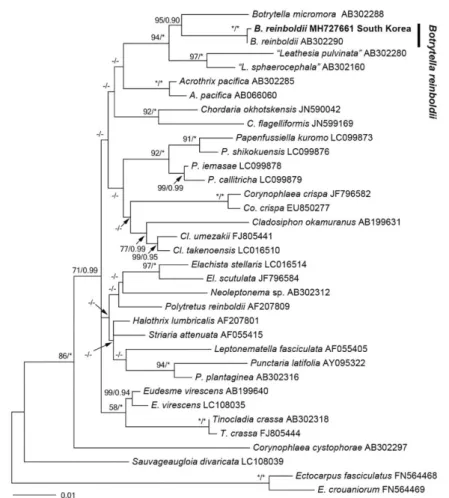
Phylogenetic analyses: The 1122-bp portion of rbcL was aligned for Botrytella reinboldii. Ectocarpus fasciculatus and E. crouaniorum were selected as outgroup. Phylogenet- ic analyses revealed that Botrytella reinboldii from South Korea was nested in a clade of Botrytella reinboldii (Fig. 4).
The gene sequence divergence between Botrytella reinboldii and B. micromora is 3% and there is no difference within Botrytella reinboldii.
Remarks: Morphologically, our samples closely match the description of B. reinboldii described by Kornmann and Sah- ling (1988). Also, molecular data based on rbcL gene reveal- ed that our samples are placed within the clade of the Botry
tella and specifically very close to the Japanese B. reinboldii (GenBank accession number: AB302290). In this study, we report B. reinboldii as a new record from Korea and add this species to the list of Korean macroalgal flora.
Fig. 4. Phylogenetic tree of Botrytella species based on ML and Bayesian analysis with rbcL sequences. Value above the branches=Maximum likelihood bootstrap values in %>50/Bayesian posterior probabilities>0.75. Values lower than BS 50 or BPP 0.75 are indicated by hyphens(-). Values of BS 100 or BPP 1.00 are indicated by asterisks(*).
ACKNOWLEDGEMENTS
This study was supported by a grant from the National Institute of Biological Resources (NIBR), funded by the Min- istry of Environment (MOE) of the Republic of Korea (NIBR 201801205). This research was also supported by Basic Sci- ence Research Program through the National Research Foun- dation of Korea (NRF) funded by the Ministry of Education, Science and Technology (2015R1D1A1A01058359) and a grant from Marine Biotechnology Program (PJT200669 and 20170431) funded by Ministry of Oceans and Fisheries of Korean Government to Tae Oh Cho.
REFERENCES
Bornet E. 1892. Note sur quelques Ectocarpus. B. Soc. Bot. Fr.
38:353-372.
Bory de Saint Vincent JBM. 1822. Dictionnaire classique d’His- toire Naturelle. Paris.
Guiry MD and GM Guiry. 2018. AlgaeBase. World-wide elec- tronic publication, National University of Ireland, Galway.
http://www.algaebase.org; searched on 15 August 2018.
Hansen GI. 1997. A revised checklist and preliminary assess- ment of the macrobenthic marine algae and seagrasses of Oregon. pp. 175-200. In Conservation and Management of Native Flora and Fungi(Kaye TN, A Liston, RM Love, DL Luoma, RJ Meinke and MV Wilson eds.). Native Plant Society of Oregon.
Hollenberg GJ. 1971. Phycological notes. V. New species of marine algae from California. Phycologia 10:11-16.
Hwang IK, HS Kim and WJ Lee. 2005. Polymorphism in the brown alga Dictyota dichotoma(Dictyotales, Phaeophyce- ae) from Korea. Mar. Biol. 147:999-1015.
Hyuelsenbeck JP and F Ronquist. 2001. MrBayes: Bayesian inference of phylogeny. Bioinformatics 17:754-755.
Kim HS. 1996. Morphotaxonomic studies on the Korean Ecto-
carpaceae(Phaeophyta). IV. Botrytella parvus(Takamatsu) comb. nov., life history and morphogenesis based on light- temperature gradient culture. Algae 11:45-57.
Kim HS. 2010. Ectocarpaceae, Acinetopsoraceae, Chordariace- ae. pp. 3-137. In Algal Flora of Korea. Volume 2, Number 1. Heterokontophyta: Phaeophyceae: Ectocarpales. Marine Brown Algae I(Kim HS and SM Boo eds.). National Insti- tute of Biological Resources, Incheon.
Kogame K, T Horiguchi and M Masuda. 1999. Phylogeny of the order Scytosiphonales(Phaeophyceae) based on DNA sequences of rbcL, partial rbcS, and partial LSU nrDNA.
Phycologia 38:496-502.
Kornmann P and PH Sahling. 1988. The disentanglement of the Botrytella(Sorocarpus) complex(Ectocarpaceae, Phaeophy- ta). Helgoland. wiss. Meer. 42:1-12.
Ronquist F and JP Huelsenbeck. 2003. MrBayes 3: Bayesian phylogenetic inference under mixed models. Bioinformat- ics 19:1572-1574.
Sauvageau C. 1899. Les Acinetospora et la Sexualité des Tilop- teridacées. Jour. De Bot. 13:107-127.
Tamura K, G Stecher, D Peterson, A Filipski and S Kumar. 2013.
MEGA6: Molecular Evolutionary Genetics Analysis Version 6.0. Mol. Biol. Evol. 30:2725-2729.
Thompson JD, DG Higgins and TJ Gibson. 1994. Clustal W:
improving the sensitivity of progressive multiple sequence alignment through sequence weighting, position-specific gap penalties and weight matrix choice. Nucleic Acids Res.
22:4673-4680.
Womersley HBS. 1987. The Marine Benthic Flora of Southern Australia. Part II. South Australian Government Printing Division, Adelaide.
Yaegashi K, Y Yamagishi, S Uwai, T Abe, WJE Santiañez and K Kogame. 2015. Two species of the genus Acinetospora (Ectocarpales, Phaeophyceae) from Japan: A. filamentosa comb. nov. and A. asiatica sp. nov. Bot. Mar. 58:331-343.
Received: 21 August 2018 Revised: 3 September 2018 Revision accepted: 4 September 2018