• 검색 결과가 없습니다.

IEG 환경지질연구정보센터

N/A
N/A
Protected

Academic year: 2021

Share "IEG 환경지질연구정보센터"

Copied!
2
0
0

로드 중.... (전체 텍스트 보기)

전체 글

(1)

한국지하수토양환경학회 춘계학술발표회 2013년 4월 11일-12일 한화리조트 제주

Solar Cell-Based Electrokinetic Remediation of Heavy metals-Contaminated Soil

정지민․백기태

*

Department of Environmental Engineering, Chonbuk National University, 567 Baekje-daero, Deokjin, Jeonju, Jeollabuk 561-756, Republic of Korea

*e-mail: : [email protected]

Abstract

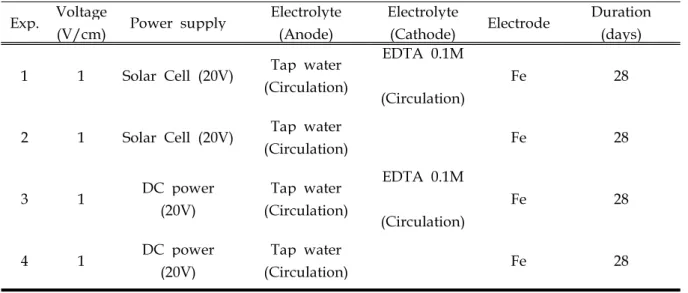
Soil contamination has been magnified due to industrial development. Especially, soil pollution is serious caused by heavy metals contaminated soil. Electrokinetic can be applied to the remediation of most metal contaminated sites. Electrokinetic techniques are currently being explored as a means of extracting or removing contaminants from soils, sediments, and sludge [1]. Electrokinetic techniques have been used to extract radionuclide, certain organic compounds or mixed organic/inorganic species, and some organic wastes from soils. However, energy costs account for 25% of total operation costs [2]. The experimental conditions were summarized in Table 1. We designed four experiments to evaluate the effect of solar-cell based electrokinetic and to improve the metal removal using electrolyte circulation. After 28 days, the soil samples were sliced into 10 equal sections. Each section was extracted by Korean Standard Test Method, and were analyzed using ICP-OES(720-ES, VARIAN, INC). In this study, we investigated the efficiency of conventional electrokinetic and solar-cell used electrokinetic systems for the removal of metal from heavy metal contaminated soils.

Exp. Voltage

(V/cm) Power supply Electrolyte (Anode)

Electrolyte

(Cathode) Electrode Duration (days) 1 1 Solar Cell (20V) Tap water

(Circulation)

EDTA 0.1M (Circulation)

Fe 28

2 1 Solar Cell (20V) Tap water

(Circulation) Fe 28

3 1 DC power

(20V)

Tap water (Circulation)

EDTA 0.1M (Circulation)

Fe 28

4 1 DC power

(20V)

Tap water

(Circulation) Fe 28

Table 1. Experimental condition of Electrokinetic process

key words : Solar Cell, Photovoltaic, Electrokinetic, heavy metal

(2)

사사 This work was supported Korea Environment Industry and Technology Institute (KEITI) through GAIA project.

참고문헌

[1] Acar, Y.B. and Alshawabkeh, A. N., Principles of electrokinetic remediation , Environ. Sci. Technol. 27, 2638-2647, 1993.

[2] Kim, D-H., Jung, J.-M., Jo, S.-W., Kim, W.-S., Bajargal, T., Beak, K., Photovoltaic Powered Electrokinetic Restoration of Saline Soil. Separation Science and Technology. 47:14-15, 2235-2240, 2012.

[3] Ryu, B.-G.; Yang, J.-S.; Kim, D.-H.; Baek, K., Pulsed electrokinetic removal of Cd and Zn from

fine-grained soil. J. Appl. Electrochem., 40, 1039, 2010.

수치

Table 1. Experimental condition of Electrokinetic process

참조

관련 문서

In this study, thermal efficiency of a flat-plate solar collector and a U-tube solar collector using a CuO nanofluid and water as a working fluid was investigated according to

In this study, the RESRAD-RECYCLE 3.10 computer code was used to evaluate individual and collective doses due to the recycling of radioactive metal waste

The metal biopsy test of both specimens did not show any microscopic cracks in the heat affected zone and the base metal, and both samples were free from

For this, this study analyzed the ethnic and national identity of Korean Chinese by approaching the context of political, cultural and ideological systems

Advancement of Clay and Clay-based Materials in the Remediation of Aquatic Environments Contaminated with Heavy Metal Toxic Ions and Micro-pollutants..

Objective: The purpose of this study was to analyze recent trend in incidence of basal cell carcinoma and squamous cell carcinoma in patients from the Gwangju City

Studies on the stabilization mechanism of metal(loid)s in contaminated soil with different calcareous wastes Waste..

Recently, metal-assisted chemical etching (MACE) has been widely used for the synthesis of SiNWs, because this technique has advantages such as simplicity, low operating