≪ Research Paper ≫
Stabilization of Metals-contaminated Farmland Soil using Limestone and Steel Refining Slag
Jeong-Muk Lim
1· Youngnam You
1· Seralathan Kamala-Kannan
1· Sae-Gang Oh
2· Byung-Taek Oh
1*
1
Division of Biotechnology, Advanced Institute of Environment and Bioscience, College of Environmental and Bioresource Sciences, Chonbuk National University
2
Mine Reclamation Corp.
ABSTRACT
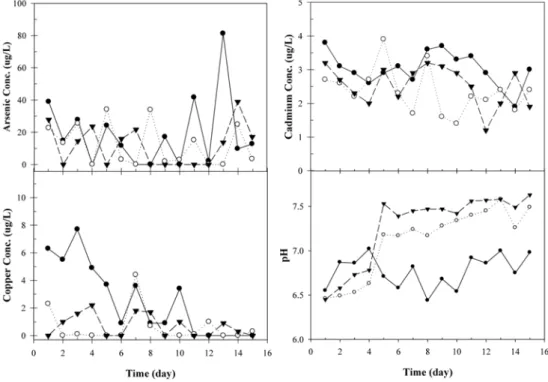
The metals contamination of farmland soil nearby abandoned metal mine was serious problem in Korea. Stabilization of contaminated soil was reported using various stabilizers. Application of limestone and steel refining slag was reported as effective stabilizers in the stabilization of metals. The batch studies confirmed that the mixture of limestone and steel refining slag was suitable for stabilization of metals in contaminated soil. The limestone and steel refining slag mixture (2 : 1 and 3 : 2) were used in column studies and it was confirmed that the stabilizers effectively stabilized heavy metals in contaminated soil. The pH of the soil was increased with the addition of stabilizers. Total leached concentration of metals from the column study was reduced 44, 17, and 93% in comparison to the control at arsenic, cadmium and copper, respectively. The sequential extraction studies showed that the exchangeable fraction was changed into carbonate bound fraction (Cd and Cu) and Fe-Mn oxide bound fraction (As). Based on the results we confirmed that 2:1 ratio of limestone and steel refining slag effectively stabilizes the heavy metals. The mixed treatment of lime stone with steel refining slag would be an effective and feasible method for controlling metals leaching in contaminated soil.
Key words : Abandoned mine, Stabilization, Sequential extraction, Limestone, Steel refining slag
1. Introduction
The contamination of metals in Korean farmlands was caused by various anthropogenic factors. During the past few decades, environmental problems caused by metal pol- lution from mining activities have received increasing atten- tion. Metals contamination of farmland soil nearby aban- doned metal mines was very serious in Korea (MOE, 2009a). According to Mine Reclamation Corporation in Korea, 6037 mines are located in Korea which includes 391 coal mines, 3538 nonmetallic mines and 2108 metallic mines (Mireco, 2009). More than 80% of these mines are now closed and these mines cause several environmental pollution during long times. Furthermore mining and refin- ing installation of abandoned metal mines were neglected in ruin. Also mine tailing and ore rock waste were scattered without control (Kim et al., 2002). Mine tailings and waste-
water are the major sources of metal pollution into the envi- ronment. The high concentrations of metals in the environ- ment have detrimental effects on chemical and biological properties of soil (Lothenbach et al., 1999). These toxic metals can eventually harm to plants and health of human through the food chain (Ok et al., 2007). Most tailings and mine wastes are remained on slopes and contaminate nearby agriculture soil and streams (Yang et al., 2006).
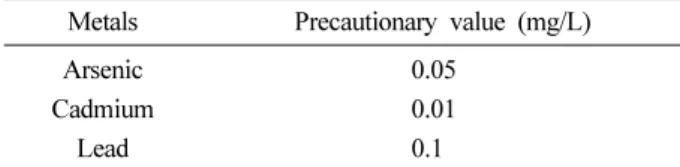
According to the Korean Soil Environmental Conservation Act (KSECA), metals concentration of farmland soils was restricted with arsenic, cadmium, copper, lead, and zinc at a concentration of 25, 200, 4, 150 and 300 mg/kg, respec- tively. Thus, it should be monitored continuously and restricted from agricultural usage.
Solidification and stabilization used for treatment of metal contaminated soil. These process are applicable to both in-situ and ex-situ remediation. It has low cost and
*Corresponding author : [email protected]
Received : 2014. 4. 7 Reviewed : 2014. 5. 7 Accepted : 2014. 5. 8
Discussion until : 2014. 12. 31
short treatment period. Thus solidification or stabilization have been considered as available and effective option for treatment of metal contaminated farmland soils nearby abandoned metals mines (Lee, 2007). Solidification is reduc- ing the mobility of contaminants using solidifying agents and stabilization is reducing the toxicity, solubility and mobility by changing the state of contaminants. In treat- ment of farmland soils nearby abandoned metal mines, sta- bilization is more widely used than solidification (Kim, 2010). Numerous studies reported the application of vari- ous stabilizers to treat different contaminants. Also many stabilizers were used for assessment of stabilization of arsenic and heavy metals (Kumpiene et al., 2008). The mechanisms of stabilization of heavy metals in contami- nated soil are absorption, precipitation, ion exchange (Park et al., 2010). It has been established that various factors such as pH, diameter, moisture content, concentration and form of heavy metals and transmissibility highly influence the metals stabilization in soil, but the most important fac- tor is types of stabilizer on various contaminants in soil (Kumpiene et al., 2008). The mobility and leachability of cation heavy metals in contaminated soil was reduced through precipitation and insolubilization via increasing of pH (Kaasalainen and Yli-Halla, 2003). The various limes are typical material to reduce of leachability of heavy met- als through increase in soil pH (Lee et al., 2007). However the high pH causes the increasing of mobility and toxicity of arsenic. Thus, arsenic treatment is difficult in high pH value (Hartley et al., 2004). In previously study, iron oxides
was used as effective materials for reducing of mobility of arsenics in high pH value. Iron oxides made complex with arsenic in soil, such as FeAsO
4·H
2O or Fe
3(AsO
4)
2(Kim et al., 2003).
The objectives of this study were to (i) assess the possi- bility of stabilization of contaminated farmland soil nearby abandoned metals with limestone and steel refining slag, and (ii) provide optimum ratio of stabilizers for stabiliza- tion of contaminated soil. This study is important because the soil site of this study used to farming now, it will cause the problem in various organisms include human and animals.
2. Materials and Methods
2.1. Soil sample collection and analysis
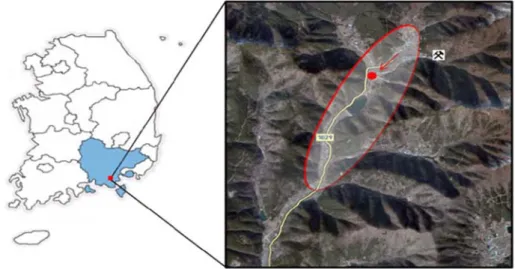
Soil was collected from paddy farmlands around the mine sites located in Masan of Gyeong-nam province in South Korea. The geographical information of the sampling site is shown in Fig. 1. This mine was a major source and supply of Cu on 1970s. The soil was collected from both top (15 cm from the ground surface) and sub (50 cm from the ground surface) regions. After air-drying at room tempera- ture for 1 week, samples were disaggregated and sieved into a 10 mesh (less than 2 mm). Physicochemical properties of the soil were analyzed according to Korean standard analy- sis for soils (MOE, 2009b). The concentration of heavy metals in soil was analyzed using sequential extraction method (Tessier et al., 1979). Sequential extraction studies reported the availability, mobilization, and transport of trace
Fig. 1. Location of sampling site in South Korea (Latitude; 35
o11 ' 22", Longitude; 126
o23 ' 16").
of metals and metalloids. Sequential extraction procedure reveals five types of metal binding mechanisms in soil such as, 1) species associated with the exchangeable phase, 2) species associated with the acid soluble phase such as car- bonate and acid rain, 3) species adsorbed onto solid parti- cles such as iron and manganese oxides, 4) species associated with oxidizable organic matter, 5) residual faction with min- eral matter. The first and second factions were considered to easily leach through change of natural conditions.
2.2. Characterization of lime stone and steel refining slag
In this study, limestone (LS) was used to increase the soil pH and to reduce the mobility and leachability of metals in the soil. Steel refining slag (SRS) was used to remove arsenic in the soil. The iron oxide present in SRS seems to be effective in arsenic treatment. The LS and SRS were provided from Deaseong MDI and Ecomaister in the Korea, respectively. The composition of the stabilizers was ana- lyzed by using X-ray fluorescence spectrometer (XRF;
Axios minerals, PANalytical, Netherlands). The stabilizers were sieved into a 10 mesh (less than 2 mm) and used for further experiments.
2.3. The batch test for collection of stabilizer ratio Batch studies were conducted to optimize the effective ratio of stabilizers. The addition ratio of LS (1, 3 and 5%), SRS (1, 3 and 5%) and LS : SRS (1 : 1, 2 : 1, 2 : 3 and 3 : 2) was used for the studies. The ratio of stabilizers was calcu- lated as a percentage of the total soil (20 g). Briefly, 20 g of soil with calculated stabilizers was dispensed in 250 mL Erlenmeyer flask containing 100 mL of distilled water. The flasks were incubated at room temperature for 36 h. Sam- ples were collected at predetermined time intervals (0.5, 1, 2, 4, 6, 12 and 36 h) and centrifuged at 13,000 rpm for 20 min. The supernatant was used for metal analysis using inductively coupled plasma-atomic emission spectropho- tometry (ICP-AES; Leeman Labs, Inc., Hudson, NH, USA).
Commercially available stock solutions were used to pre- pare appropriate elemental calibration standards for the ICP-AES. Analysis of sample and standard solutions was based on the mean of three readings. Solutions of HNO
3were used as reagent blanks. To check analytical quality, a
rigorous quality control program was implemented, which included reagent blanks, triplicate samples and certified international materials (BCR-701) (Ramsey et al, 1987).
The precision and bias of the chemical analysis was less than 10%.
2.4. Continuous column experiment for comparison of leaching concentration from soil
A glass column including capping plates, valves and tube
was used (30 cm length × 3.0 cm in diameter). The bottom
part of the column (2 cm) was filled with sand, later it was
filled with soil and stabilizers (20 cm), and again filled with
sand (2 cm) (Fig. 2). The ratio of stabilizer in each column
was selected from the results of batch tests. Thus two type
of ratio (LS : SRS; 2 : 1 and 3 : 2) was selected for the sta-
bilization of contaminated soils. The pH of the used water
was adjusted 5.6 for the same as the pH of acid rains using
NaOH and H
2SO
4solution. A flow speed of water in col-
umn was adjusted into 1 pore volume/day. The soil has
1.52, 1.56 and 1.62 g/cm
3of dry unit weight at control, 2 : 1
and 3 : 2 columns. The pore volume has 0.35, 0.31 and
0.3 L at control, 2 : 1 and 3 : 2 columns. The direction of
flow was upward from the bottom of column (Fig. 2). Sam-
ples were collected every 24 h of the cycle and centrifuged
Fig. 2. The diagram of the used column in this study.
at 13,000 rpm for 20 min. The supernatant was used for analysis of metals. The samples were collected a total of 15 times and metal distribution in the soil was measured using sequential extraction methods.
3. Results and discussion
3.1. Characteristics of contaminated soil and stabilizers
The physicochemical characteristics of contaminated soil are represented in Table 1. The pH of the soil was 6.2, this pH value is slightly higher than pH 5.6 which is an average of Korean soil pH value (Jung et al., 2001). The EC, CEC, organic carbon and total organic matter of the soil were 8.83 µs/cm, 2.66 cmol
+/kg, 1.47%, and 2.53%, respectively.
However, the concentrations of arsenic and other heavy metals were exceeded the criteria set by The Korean Soil Environment Conservation Act (SECA) (Table 2). Arsenic, cadmium and copper were higher than Anxiety Criterion level. Especially, copper was exceeded the Countermeasure criterion, it shows the soil was significantly contaminated
with copper. Based on the XRF analysis we found that the chemical compound present in LS was CaO (53.24%), CO
2(40.28%) and SiO
2(2.38%). Also SRS was CaO (30.6%), SiO
2(12.4%), and F
2O
3(28.1%) (Table 3).
3.2. Batch studies for the selection of stabilizers ratio The effective ratios of LS and SRS for the stabilization of metal were determined using batch studies. The control soil without LS and SRS showed pH 6.21. However, the addi- tion of LS (1, 3 and 5%) significantly increased the pH to 7.08, 7.51 and 7.67, respectively. The leaching of arsenic was increased according to LS concentration. Maximum arsenic leaching 1026 µg/L was observed at 5% LS. How- ever, leaching of other metals decreased according to
Table 1. Physical and chemical properties of contaminated soils Environmental variable Soil sample
pH 6.21
Electric conductivity ( µs/cm) 8.83 Cation exchange capacity (cmol
+/kg) 2.66
Organic carbon (%) 1.47
Total organic Matter (%) 2.53
Table 2. Total metal concentrations in contaminated soils
As Cd Cu Pb Zn
SECA
1)AC
2)25 4 150 200 300
CC
3)75 12 450 600 900
Concentration (mg/kg) 37.9 5.97 604.4 21.9 116.0
1)
Korean Soil Environmental Conservation Act. (SECA)
2)
Anxiety Criterion
3)