
IEG 환경지질연구정보센터
10
0
0
전체 글
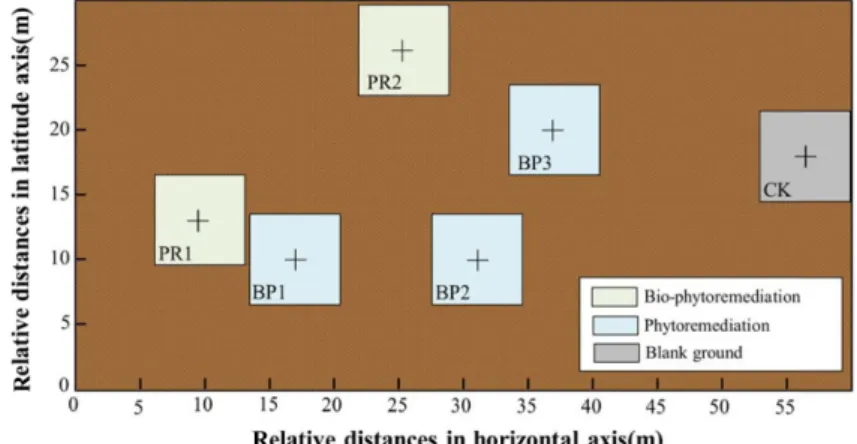
(2) 36. Wen-Liang Lai·Fang-Yin Lee·Colin S. Chen·Zeng-Yei Hseu·Yau-Lun Kuo. contamination. For extremely contaminated sites, other. 2. Materials and Methods. approaches must be applied (Lasat, 2002). Before the application of the remedial technologies on. 2.1. On-site description. contaminated soil, the disadvantages existed in physical or. The contaminated site is located at Pintung County with. chemical technoloies resulting the destruction of soil prop-. an area of 1,800 m2. In this study field, two remedial tech-. erty, secondary pollutant induced and high cost, must take. noligies were applied, bio-phytoremediation (BP) and phy-. into consideration. For decreasing pollutants as well as. toremediation (PR), to remove the pollution. The detailed. responsive to maintaining the soil environment, integrated. procedure was described as the following paragraphs. With. remediation such as phytoremediation, was regardes as an. regard to area tested, two plots were selected for using BP. better technology to remove heavy metal by phytoextrac-. process, classified as BP1 and BP2. However, three plots. tion from plants like Poplar (Populus bonatii Levl.) and Sun. were treated by PR process, assigned as PR1, PR2, and. Hemp (Crotalaria juncea L.) (Etim, 2012; Lorestani, 2011;. PR3. The control plot, regarded as the uncontaminated area,. Pulford and Watson, 2003; Baker et al., 2000; Raskin and. was represented as CK region. All plots conducted in this. Ensley, 2000; Carman et al., 1998; Critcchley, 1998;. study were positioned by Global Positioning System (GPS). Watanabe, 1997; Cunningham and Ow, 1996). In the litera-. shown in Fig. 1. Two soil samples in each plot were sam-. tures, green remediation technology shows having an abil-. pled for the measurements of pollutant concentrations. All. ity to remove pollutants that the related exercise on-site. data collected was calcualted by duplicate trials. During the. field to remove TPH and heavy metal was absent in Tai-. remediation, the following tasks, including maintaining water. wan. As a result, in this study the research team had tried to. content, weeding, fertilizing and preventing insect were reg-. testify the elimination ability of coexisted pollutants in con-. ularly performed. For the control of watering, six sprin-. taminated soil by phytoremediation with Poplar and Sun. klers were used to evenly spray in all testing plots. Also,. Hemp and bio-phytoremediation with extra earthworm (E.. field operator could operate sprinklers dependent on the. fetida) and petroleum-degrading bacteria (Pseudomonos sp.. ambient temperature and condition of plant growth. Weed-. NKNU0) added. The contours of pollutant concentration,. ing was done by labor. The composition of fertilizer was. including TPH and the dominant heavy metals of Zn and Cr. consisted of 4.6 % of TN, 4.8% of TP, 3.2% of TK and. at varied soil depths were examinated in long-term opeart-. 50% of OM. Agricultural insecticide was applied to control. ion from May, 2012 to Dec., 2013. Meanwhile, not only the. the insect.. amount of heavy metal removal by Poplar but also the growth of Poplar and Sun Hemp were well discussed using. 2.2. Remedial technologies. photosynthesis rate (PR) and maximal photochemical yield. In this research, the high amounts of TPH and heavy met-. (MPY).. als coexisted in contaminated area, the bioremediation with. Fig. 1. Sampling locations with different remedial technologies in contaminated area. J. Soil Groundw. Environ. Vol. 19(5), p. 35~44, 2014.
(3) The Removal Efficacy of Heavy Metals and Total Petroleum Hydrocarbons from Contaminated Soils by Integrated Bio-phytoremediation. 37. earthworm and petroleum-degrading bacteria was used as. including plant leaves and root, the mixed acid solution. biological processes to remove TPH (Parrish et al., 2006).. from HNO3 and HClO4 with a ratio of 5 was used to digest-. Each bioremedial plot had applied with 5.4 kilograms of. ing the whole samples pretreated by roasting and crum-. earthworm and 20 L of petroleum-degrading bacteria. The. bling. The digested solutions were filtered by using Whatman. region for use of earthworm to treat pollutants was sur-. No. 42 filter paper and diluted to adequate volume with. rounded and laid an impermeable plastic sheet with botton. deionized water. The heavey metal analysis was completed. layer of 60 cm and depth of 40 cm. Liquid form of petro-. with a flame atomic absorption spectrophotometr (FAAS). leum-degrading bacteria was sprayed on contaminated soil. (Hitachi Z-8100, Japan) in accordance with NIEA S361.63. by hand sprayer. On the study of phytoremediation, several. method of EPA of Taiwan.. researchers proved that Poplar and Sun Hemp had an excellent tolerance with high TPH and heavy metal coexisted in. 2.3.3. Physiological investigation. contaminated soil (Euliss et al., 2008; Collins, 2007; Huang. Net photosynthetic rate and maximal photochemical yield. et al., 2005). In Taiwan, due to the lack of imfomation to. (Fv/Fm) of chlorophyll fluorescence in dark-adapted sam-. remove coexisted pollutants by plant, the Populus bonatii. ples of Poplar were measured. During the study period,. Levl. and Crotalaria juncea L. were selected to establish an. duplicate measurements in each sample were collected. As. operational procedure in on-site phytoremediation study.. well known, photosynthesis is an important physiological. The distance of Poplar planted was 2.5 m apart. Sun Hemp. activity of plants. Its efficiency reveals the physiological. was planted in between Poplars planted.. condition of a plant. Four samples from each plant of the 6 treatment plots were randomly selected. Two leaves from. 2.3. Parameters analysis. each sample were collected and measured. The measure-. 2.3.1. Total petroleum hydrocarbons (TPH). ments were taken between 7 : 30 to 10 : 30 am, using a por-. Contaminated soils either prepared in the laboratory or. table photosynthesis system (LI-6400, LI-COR, USA).. collected in situ were used in this study. Soil samples col-. Microenvironment in the leaf chamber was set at 1,500. lected from surrounding region were sieved by a 2-mm. µmol photon m−2 s−1 of light, 400 µL L−1 of CO2 concentra-. mesh sieve to remove large particles, and then the sample. tion, 60-80% of relative humidity, and 28oC of leaf temper-. was homogenized in a stainless steel container by a mixer.. ature. Net photosynthetic rates obtained under these fixed. Soil sample from 60 cm depth in PR1 plot could not be col-. conditions can be used to compare the physiological status. lected due to the previous existed underground cement. of Poplar planted in different treatment plots.. layer. The target pollutants of spiked soils were added with. Since chloroplast is the part for photosynthesis, measur-. a 1 : 1 (v/v) n-hexane/acetone solution and placed in a fume. ing maximal photochemical yield (Fv/Fm) of chlorophyll. hood to eliminate solvents. The TPH analysis was accord-. fluorescence in a dark-adapted leaf can indicate the health. ing to standard method of NIEA S70361B by Environmen-. condition of a plant. A portable chlorophyll fluorescence. tal Protection Adminstration (EPA) of Taiwan. The TPH. analyzer (Mini-PAM, Walz, Germany) were used for this. concentration was mesured by GC-FID (HP-6890 series,. measurement. The process of dark adaptation was preceded. USA) with the calibration curve produced from spiked CK. by covering the leaf with a dark leaf clip (DLC-8) for 30. plot soil sample with various concentration of TPH stan-. minutes. Then we measured the minimum (Fo) and the. dards.. maximum (Fm) fluorescence values of this dark-adapted leaf, and calculated its Fv/Fm value (where Fv = Fm − Fo). In. 2.3.2. Heavy metal. plant physiology, Fv/Fm represents the maximal photochem-. Before the analysis of heavy metals in soil samples, the. ical potential of photo-systems II. It can be used as an index. same procedure of pretreatment with TPH was applied and. for indicating whether the plant is under stress, therefore, it. digested by concentrated HNO3 and HCl (1 : 3, v/v) (aqua. was used to evaluate a plant’s health condition.. regia). As the plant biomass heavey metal measurement, J. Soil Groundw. Environ. Vol. 19(5), p. 35~44, 2014.
(4) 38. Wen-Liang Lai·Fang-Yin Lee·Colin S. Chen·Zeng-Yei Hseu·Yau-Lun Kuo. Table 1. Water content and organic matter in different depths of studied soils Water contents (%) in different depths (cm). Organic matter (%) in different depths (cm). Regions. 30. 60. 100. 30. 60. 100. BP1 BP2 BP3 PR1 PR2 CK. 24 ± 1.4 20 ± 2.1 27 ± 2.1 35 ± 0.7 23 ± 1.4 20 ± 0. 26 ± 2.8 27 ± 2.8 27 ± 0.7 38 ± 0.7 24 ± 2.1 23 ± 0.7. 36 ± 2.8 27 ± 2.8 32 ± 0 ND 26 ± 0.7 25 ± 0.7. 68 ± 1.0 65 ± 1.2 10 ± 1.5 13 ± 3.0 10 ± 5.7 63 ± 1.4. 11 ± 3.86 66 ± 3.76 69 ± 0.66 14 ± 5.46 12 ± 12.2 63 ± 0.26. 24 ± 0.1 66 ± 3.7 64 ± 0.3 ND 64 ± 0.1 62 ± 0.2. 3. Results and Discussion 3.1. Contents of TPH in various soil depths Table 1 shows the contents of water and organic matter in contaminated soil in earlier remediation. Based on Table 1, it showed that most of treated regions using different remedial strategies had higher water content than control region at different depths. The water contents in tested region were ranged from 20 ± 0 % to 38 ± 0.7% by the controlled irrigation schedule. Regarding the amount of organic matter, the values in CK plot value at different depths were less than those in remedial treated regions. High organic matter in remedial region than agricultural soils may be contributed to the use of organic fertilizer and TPH pollutant. Hence, low organic matter in CK region may be related with less TPH concentration. Fig. 2 shows that the variations of TPH contour at varied depths in contaminated soil using different remedial technologies during long-term study. Observed TPH contours on May, 2012 represent early stage in the on-site area with pollutant (Fig. 2 A) the highest contaminated locations were appeared in BP1 and BP3 in 60 cm of soil depth similar to those in 120 cm of soil depth. The peak location at 30 cm of soil depth had a minor difference from BP1 and PR2 to BP1 and BP3. Actually, both plots of PR2 and BP3 were adjacent zone, indicating that source TPH in early stage was located among these plots. After ten months remediation (Feb., 2013), BP1 and BP2 plots with bio-phytoremediation at 30 cm of soil depth showed higher TPH removal rate than PR1 and PR2 with phytoremediation. Three plots treated with bio-phytoremediation, only BP3 showed a weaker TPH removal than two plots with phytoremediation. In summary, TPH removal by J. Soil Groundw. Environ. Vol. 19(5), p. 35~44, 2014. Fig. 2. Variation of TPH contents at various depths (A) 30 cm (B) 60 cm (C) 100 cm..
(5) The Removal Efficacy of Heavy Metals and Total Petroleum Hydrocarbons from Contaminated Soils by Integrated Bio-phytoremediation. 39. bio-phytoremediation was higher than that by phytoremediation. The exceptional plot of BP3 may be contributed from the heterogeneous sample, the slope of topography, and the adaptability of earthworm, petroleum-degrading bacteria, Poplar, and Sun Hemp. On Dec., 2013 after twenty months operation, part of plots showed the decrease of TPH removal efficiency compared with those on Feb., 2013, but the total trend for TPH removal by bio-phytoremediation was higher than that by phytoremediation. Only BP3 out of three plots treated by bio-phytoremediation on Dec., 2013 had a value close to that of PR2 by phytoremediation. This phenomenon was also found as TPH removal at BP3 by bio-phytoremediation compared with PR on Feb. 2013. For 60 cm of soil depth, TPH removal at different remedial technologies in the middle stage on Feb. 2013 (Fig. 2B), high removals were found at four plots including PR1, BP1, BP2 and BP3 except for PR2 plot with TPH increase. Bio-phytoremediation revealed it’s more consistent on TPH removal than phytoremediation, even though, on Dec., 2013, similar trend was observed. With regard to the soil depth of 100 cm after twenty months operation (Fig. 2C), the whole TPH removals were less than 90%; however, the ineffective removal was happened in PR1 because samples could not be collected in underground cement layer of this depth. At soil depths of both 60 cm and 100 cm, the highest TPH concentration in early stage had same region located at the BP3 plot. Summarized from above statements, the high TPH removal in bio-phytoremedaition treatment may be attributed with simultaneous effects not only by microbial activity (Cassidy et al., 2001; Cavalca et al., 2000) and earthworm (Parrish et al., 2006) but also by polar (Euliss et al., 2008;. Fig. 3. Variations of Zn contents at various depths (A) 30 cm (B) 60 cm (C) 100 cm.. Collins, 2007). as shown in Fig. 3 and Fig. 4. 3.2. Contents of heavy metals in various soil depths. Zn contours at varied depths in contaminated soil by on-. TPH removal in the polluted soil by bio-phytoremedia-. site remediation during long-term operation are shown in. tion and phytoremediation was well discussed in the above. Fig. 3. In early remedial stage on May, 2012, only one peak. paragraph. In fact, the contaminated soil conducted in this. location was observed at PR1, PR2, and BP1 for 30 cm, 60. research was not only infected by oil but also by heavy met-. cm and 100 cm of soil depths. The concentration of Zn was. als. According to the investigation in this research (not. decreased with soil depth. The plot of main peak was so. shown), both zinc (Zn) and chromium (Cr) elements were. close in this contaminated area, indicating that high metal. main heavy metals. Hence, the following discussion was. concentration was existed in these areas owing to inhomo-. focused on both metals removals in long-term remediation,. geneous distribution of soil sampling. Zn removal in 30 cm J. Soil Groundw. Environ. Vol. 19(5), p. 35~44, 2014.
(6) 40. Wen-Liang Lai·Fang-Yin Lee·Colin S. Chen·Zeng-Yei Hseu·Yau-Lun Kuo. increasing concentration of Zn element. This phenomenon was also happened in the soil depth of 60 cm. At soil depth of 100 cm, plots with bio-phytoremediation, including BP1 and BP2, eliminated 13-44% of Zn element in contrast with the increase of 64% at BP3 plot. The plot of PR2 by phytoremediation showed the insignificant variation owing to the existence of cement floor. As for Cr contours at varied depths in contaminated soil by on-site remediation during long-term operation, its variation was shown in Fig. 4. In early remedial stage on May, 2012, peak locations for different soil depths were located PR1 plot for 30 cm, PR1 and BP3 plots for 60 cm, and BP1 and BP3 plots for 100 cm, respectively. The Cr concentration of peak location was at 30 cm and 60 cm of soil depths which are higher than that in 100 cm of soil depth. The penetration of Cr element in contaminated soil reaches 60 cm at early stage in this study. After ten and twenty months’ operation at 30 cm of soil depth, Cr removal changing from 61% to 37% was found in PR1 plot by phytoremediation. Only one-fifths tested plots showed the ability to decrease the heavy metal Cr. For Cr removal at 60 cm of soil depth after twenty months’ operation, PR1 plot with phytoremediation reached 41% and BP2 plot by bio-phytoremediation had lowest efficiency of 2%. Only two-fifths of remedial plot was able to remove Cr element. For Cr removal at 100 cm of soil depth after twenty months’ operation, BP1 and BP2 plots by bio-phytoremediation were 15% and 21%, respectively. Generally, the mobility for Zn is higher than Cr in subsurface could affect evapotranspiration of plant to absorb and migrate heavy metal from soil water to plant leaves via plant root system (ITRC, 2009). Actually, Kabata-Pendias Fig. 4. Variations of Cr contents at various depths (A) 30 cm (B) 60 cm (C) 100 cm.. (2010) proved that the removal ability of heavy metal by. of soil depth on Feb. 2013, two out of three plots by bio-. Zn, Hg, Cu, Pb, As, Ni and Cr. Apparently, experiments. phytoremediation showed the value from 9% to 53%; how-. conducted in this research show its rationality.. most of plants is from large to small was in the order Cd,. ever, BP3 and other two plots with phytoremediation showed the inability to eliminate the heavy metal. Longterm operation till Oct. 2013, the same plots by bio-phytore-. 3.3. Characteristics of plant growth and physiology during remediation. mediation on Zn removal was changed from 4% to 26%. The heights of Poplar and Sun Hemp grwon in different. and the PR2 plot with phytoremediation had 46% of Zn. remedial plots were measured on Apr. and Aug. in 2013,. removal. PR1 and BP3 plots have continue to show an inef-. respectively, as shown in Fig. 5. Figure 5A revealed that the. ficient to eliminate heavy metal, especially for PR1 with the. heights of Poplar grown in contaminated plot compared. J. Soil Groundw. Environ. Vol. 19(5), p. 35~44, 2014.
(7) The Removal Efficacy of Heavy Metals and Total Petroleum Hydrocarbons from Contaminated Soils by Integrated Bio-phytoremediation. 41. Fig. 5. Growth heights of (A) Poplar (B) Sun Hemp on Apr. and Aug., 2013 at different plots with various remediations.. Fig. 6. Variations of (A) Photosynthesis rate (B) chlorophyll fluorescence of Poplar grown in remedial regions on Apr. and Aug. in 2013.. with control plot were similar at duplicate sampling, indi-. sured on Aprl. 2013 was higher than that on Aug. 2013, it. cating that Poplar had high tolerance with high amount of. may be attributed with the variation of season. As for the. TPH and heavy metal. Observed from Fig. 5B, the growh. duplicate measurments of Fv/Fm on Apr., 2013 and Aug.,. of Sun Hemp showed an different trend relative to that of. 2013, those values revealed insignificant difference with. Poplar. Apparently, high amounts of TPH and heavy metal. larger than 0.75, indicating that Poplar grown in high pol-. could affect the growh of Sun Hemp.. luted region had better physiological performance.. According to above discussion, Poplar was proved to have high tolerance with high coexisted pollutants. More. 3.4. Beneficial evaluation of remediation. evidence was shown based on physiological investigation. According to previous discussion, TPH removal was. including net photosynthetic rate and maximal photochem-. higher than heavy metal removal after remediation. Fig. 7. ical yield, as shown in Fig. 6. Observed from Fig. 6A, most. shows the amounts of both heavy metals removals by Pop-. of net photosynthetic rates of Poplar on different remedial. lar and Sun Hemp. The leavies of Poplar had higher removal. plots compared with control plot at same date were ranged. efficacy on Zn element than Cr element. Poplar grown in. from 28.1 µmole CO2 m−2 S−1 (CK) to 30.1 µmole CO2 m−2. control plot had the lowest amount of metal removal than. −1. −2. −1. S (BP3) excluding the 23.7 µmole CO2 m S (PR2) on. other remedial plots (Fig. 7 A-1 and Fig. 7 B-1). Similar. Apr. 2013. In the literature, Critcchley (1998) showed that. trend for the amounts of Zn and Cr removal was happened. less than 0.75 of Fv/Fm represented the phenomenon of. in the root and shoot fractions for Poplar, as shown in Fig. 7. inhibition on plant resulted from adverse circumstance. At. A-2, Fig 7 A-3, Fig. 7 B-2 and Fig. 7 B-3. In consideration. the same remedial plot, the net photosynthetic rate mea-. of plant biomass with dried weight, the amount of heavy J. Soil Groundw. Environ. Vol. 19(5), p. 35~44, 2014.
(8) 42. Wen-Liang Lai·Fang-Yin Lee·Colin S. Chen·Zeng-Yei Hseu·Yau-Lun Kuo. Fig. 7. Amounts of (A) Zn (B) Cr removal by (1) the leaf of Poplar (2) the root fraction of Sun Hemp (3) the shoot fraction of Sun Hemp on Apr. and Aug., 2013.. metal removal by Poplar, calculated from Fig. 7, was. be collected and treated according to the regulation of local. respectively 33.2 g for Zn and 0.048 g for Cr during the. government.. remediation, as shown in Fig. 8A. Figure 8B shows the amount of Zn and Cr removal by Sun Hemp was respectvi-. Conclusions. ley 50.8 g and 0.331 g. Summing up of heavy metals removal by Poplar and Sun Hemp, the amounts of elimina-. Several objectives were completed in this research and. tion for Zn and Cr were 84 g and 0.38 g, respectivley, far. summarized as the followings. In conclusion, the removal. less than the original amounts of Zn with 1,084 kg and Cr. efficiency of TPH by both remedial technologies was higher. with 47.0 kg. For promoting the benefit of remediation, the. than that of both investigated heavy metals Zn and Cr.. frequency of sowing Sun Hemp could be considered in this. Based on tested physiological results, Poplar shows a higher. field. Evidently, the growth of Poplar will gradually increase. tolerance in adverse growth condition. The bio-phytoreme-. the amounts of the pollutant removals. Of course, the deriv-. diation and phytoremediation on metal removal efficacy. ative issue, high metal concentration of leaves of polar must. was low in the case of high concentration heavey metal con-. J. Soil Groundw. Environ. Vol. 19(5), p. 35~44, 2014.
(9) The Removal Efficacy of Heavy Metals and Total Petroleum Hydrocarbons from Contaminated Soils by Integrated Bio-phytoremediation. 43. 2000, Metal hyperaccumulator plants: A review of the ecology and physiology of a biological resource for phytoremediation of metal-polluted soils, In: Phytoremediation of contaminated soil and water, Lewis Publishers, New York. Baker, A.J.M., McGrath, S.P., Reeves, R.S., and Smith, J.A.C., 1998, Metal hyperaccumulator plant: a review of the ecology and physiology of a biological resource for phytoremediation of metal-polluted soils, in: N. Terry, and G.N. Bannelos (Eds.), Phytoremediation of Contaminated Soil and Water, Lewis Publ., FL, USA, p. 85-107. Blaylock, M.J., Salt, D.E., Dushenkov, S., Zakharova, O., Gussman, C., Kapulnik, Y., Ensley, B.D., and Raskin, I., 1997, Enhanced accumulation of Pb in Indian mustard by soil-applied chelating agents, Environ. Sci. Technol., 31, 860-865. Cassidy, D.P. and Hudak, A.J., 2001, Microorganism selection and biosurfactant production in a continuously and periodically operated bioslurry reactor, 84(2-3), 253-264. Cavalca, L., Di Gennaro, P., Colombo, M., Andreoni, A., Bernasconi, S., and Bestetti, G., 2000, Distribution of catabolic pathways in some degrading bacteria of a subsurface polluted soil, Research Microbiology, 151, 877-887.. Fig. 8. Removals of heavy metals by (A) Poplar (B) Sun Hemp during remediation period.. tainminated soil. For example, the amount of Zn removal by Poplar and Sun Hemp was respectively measured in 84 g and 0.38 g after remedial treatment. In comparison with the estimated total containminated Zn amount of 1,084 kg, apparently, a long remediation period to eliminate Zn must be invested. In order to obtain the benefit from bio-phytoremediation on the elimination of heavy metals, higher frequency of Sun Hemp planted and larger biomass of Poplar continuously grown in long-term operation will significantly shorten the time of remeidation.. Acknowledgments Financial support for this study was provided by the Taiwan Environmental Protection Administration (IN 0038).. References Baker, A.J.M., McGrath, S.P., Reeves, R.D., and Smith, J.A.C.,. Carman, E.P., Crossman, T.L., and Gatliff, E.G., 1998, Phytoremediation of No. 2 fuel oil-contaminated soil, Journal of Soil Contamination, 7(4), 455-466. Collins, C.D., 2007, Implementing Phytoremediation of Petroleum Hydrocarbons, Methods in Biotechnology, 23(1), 99-108. Critcchley, C., 1998, Photoinhibition. In: Photosynthesis, A.S. Raghavendra(ed.), Cambridge University Press, Cambridge, p. 264-272. Cunningham, S.D. and Ow, D.W., 1996, Promises and prospect of phytoremediation, Plant Physiol., 110, 715-719. Etim, E.E., 2012, Phytoremediation and Its Mechanisms: A Review, International Journal of Environment and Bioenergy, 2(3), 120-136. Euliss, K., Ho, C.H., Schwab, A.P., Rock, S., and Banks, M.K., 2008, Green house and field assessment of phytoremediation for petroleum contaminants in riparian zone, Bioresource Technology, 99, 1961-1971. Huang, X.D., El-Alawi Y., Gurska, J., Glick, B.R., and Greenberg, B.M., 2005, A multi-process phytoremediation system for decontamination of persistent total petroleum hydrocarbons (TPHs) from soils, Microchemical Journal, 81, 139-147. ITRC, 2009, Phytotechnology technical and regulatory guidance and decision trees, The interstate Technology & Regulatory Council. Kabata-Pendias, A., 2010,Trace elements in soils and plants (4th ed.). CRC Press, Florida. J. Soil Groundw. Environ. Vol. 19(5), p. 35~44, 2014.
(10) 44. Wen-Liang Lai·Fang-Yin Lee·Colin S. Chen·Zeng-Yei Hseu·Yau-Lun Kuo. Lasat, M.M., 2002, Phytoextraction of toxic metals: a review of biological mechanisms, J. Environ. Qual., 31, 109-120. Lorestani, B., Cheraghi, M., and Yousefi, N., 2011, Accumulation of Pb, Fe, Mn, Cu and Zn in plants and choice of hyperaccumulator in the industrial town of Vian, Iran, Arch. Biol. Sci., Belgrade, 63(3), 739-745 Parrish, Z.D., White , J.C., Isleyen, M., Gent, M.P., IannucciBerger, W., Eitzer, B.D., Kelsey, J.W., and Mattina, M.I., 2006, Accumulation of weathered polycyclic aromatic hydrocarbons (PAHs) by plant earthworm species, Chemosphere, 64 (4), 609618.. J. Soil Groundw. Environ. Vol. 19(5), p. 35~44, 2014. Pulford, I.D. and Watson, C., 2003, Phytoremediation of heavy metal-contaminated land by tree-A review, Environ. Int., 29, 529-540. Raskin, I. and Ensley, B.D., 2000, Recent developments for in situ treatment of metal contaminated soils, in: Phytoremediation of toxic metals: using plants to clean up the environment, John Wiley & Sons Inc., New York. Watanabe, M.E., 1997, Phytoremediation on the brink of commercialization, Environmental Science & Technology, 31(4), 182-186..
(11)
수치


관련 문서
In this context, this study compared and analyzed a variety of soil decontamination methods used to evaluate the wide-area soil contaminated with Cs:
이 방법은 토양 내에 존재하 는 중금속 이온들을 시멘트 혼합물에 의해 수산화물(hydroxide)이나 탄 산염(carbonates), 실리케이트(silicates)형태로 전환하여
Therefore, gravity concentration treatment followed by citric acid leaching could remove successfully heavy metals contaminants from the contaminated soil.. KEY
The purpose of this study was to explore research trends in child assessment system, to examine problems that were arose in process of child assessment, and
→ To use wastes in cement industry, it is necessary to research on the behavior of heavy metals and alkali chlorine, and influence on the cement properties. Emerging
All things considered, the ability of gasification technologies to extract useful products from secondary oil-bearing materials and listed refinery wastes is analogous
This study was conducted to clarify the optimum nutrient solution concentration for Phalaenopsis and the plants were cultivated in the closed ebb and
□ The least-upper-bound property (sometimes called completeness or supremum property) is a fundamental property of the real number system. The least-upper-bound
