수중 운동 시 손관절 부위의 유동 및 압력변동 특성에 대한 해석적
연구
최지현1, 박성영2*
1공주대학교 일반대학원 기계공학과, 2공주대학교 기계자동차공학부
Numerical Study on the Characteristics of Fluid Flow and Pressure
Fluctuation around Human Knuckle in Hydrogymnastics
Ji-Hyun Choi1, Sung-Young Park2*
1Department of Mechanical Engineering, Graduate School, Kongju National University
2Div. of Mechanical & Automative Engineering, Kongju National University
요 약 수중운동치료는 물의 저항을 이용하여 충분한 운동 효과를 낼 수 있어서 관절염이나 재활치료를 받아야하는 환자들에게 긍정적인 효과를 가진다. 하지만 효과에 대한 국내 연구는 미비한 실정이고, 그 효과에 대한 근본적인 원인 규명은 아직까지 확실하지 않다. 따라서 본 연구에서는 수중운동 효과의 근본적인 원인을 파악하기 위해 실제 환경과 비슷한 조건으로 Unsteady fluid flow simulation을 진행했다. 해석 모델은 실제 손을 모델링하였고, 손가락 마디에 가해지는 압력변동을 the methods of computational fluid로 분석했다. 손의 수중운동 시, 피부 표면속도와 유동 저 항에 의하여 손가락 사이에 다양한 크기의 와류가 발생한다. 와류에 의해 약 –500Pa부터 +500Pa 정도의 압력이 가해 지고, 방향을 전환하는 부분에서는 최소 –2000Pa에서 최대 +2000Pa까지의 양압과 음압이 지속적으로 반복됐다. 또한 손가락 마디마다 20Hz ~ 70Hz의 진동수를 가진 압력 변동이 지속적으로 가해졌다. 이러한 지속적인 압력 변동은 손가 락 마디에 직접적인 마사지 효과를 제공하고, 관련 부위의 혈액순환에 긍정적인 영향을 미친다고 판단된다.
Abstract Hydrogymnastics so that sufficient exercise effect can be obtained using the resistance of water has a positive effect on patients who have to receive arthritis or rehabilitation treatment. However, the studies on the effect are insufficient, and the main cause of their effects has not been unclear yet. In this study, in order to identify the main cause of the effects of Hydrogymnastics, conducted Unsteady fluid flow simulation under the same conditions as the actual environment. The analysis model based on real hands, and the pressure fluctuation applied to the knuckle was analyzed by the computational fluid method. During the underwater movement of the hands, Various sizes of vortices were generated between fingers due to skin surface velocity and flow resistance. Pressure of about -500 Pa to +500 Pa is applied by the vortex flow. Also It was confirmed that the positive pressure and the negative pressure were continuously repeated up to maximum + 2000 Pa at the minimum of -2000 Pa at the portion where the direction was changed. Pressure fluctuations with a frequency of 20 Hz to 70 Hz were added continuously for each knuckle. These continuous pressure fluctuations provide a direct massage effect on the knuckles, an It is judged that the blood circulation at the relevant part is positively affected.
Keywords : Hydragymnastics, Unsteady, Computational Fluid Dynamics, Pressure Fluctuation, Frequency
*Corresponding Author : Sung-Young Park(Kongju Univ.) Tel: +82-41-521-9275 email: [email protected]
Received March 27, 2019 Revised April 29, 2019 Accepted June 7, 2019 Published June 30, 2019
1. 서론
최근 전 세계적으로 인구수가 증가하고 있는 추세이 다. 노인 인구가 전체 인구에서 차지하는 비율이 증가함 으로써, 고령화 사회에 도달할 것으로 전망하고 있다[1].
이에 따라 포괄적인 재활을 필요로 하는 관절염 및 뇌졸 증 환자의 수도 현저히 증가되었다[2]. 관절염 환자들은 통증 및 여러 가지 질병들로 인하여 일상생활에 지장을 받는다. 이 환자들은 지속적인 마사지로 통증을 완화시킬 수 있는데, 수중운동 치료는 최근에 개발된 재활치료 중 하나이다.
수중에서 하는 운동은 특별한 보조 기구 없이 물에 의 한 부력과 저항, 와류의 흐름에 의한 효과가 환자와 환자 의 피부에 직접 작용한다[3]. 수중운동은 관절의 부담을 주지 않으면서 유희적인 요소가 포함되어있는 장점이 있 어, 재활 프로그램에 용이하게 적용될 수 있다[3-5]. 하 지만 관절염의 원인은 최근 들어 면역학적 이상 반응으 로 알려져 있으며, 더욱 정확한 원인과 발병기전은 확실 치 않다[6]. 수중운동의 효과에 대한 국내연구는 미비한 실정이고, 관절염 환자들의 수중운동 효과에 대한 연구는 더욱 더 부족한 상태이다[7-9].
따라서 본 연구에서는 실제 수중운동 환경과 유사하게 비정상 유동해석[10-14]을 수행하여, 근본적인 수중운동 효과를 규명하는데 그 목적을 두고 있다. 이러한 분석 방 법은 향후 수중운동을 과학적으로 발전시키는데 유용한 툴로서 도움이 될 것이라고 판단된다.
2. 연구방법
2.1 3D 모델수중 운동 시, 각 손가락의 피부 표면에 가해지는 압력 변동을 확인하기 위해, 실제 팔을 모델링하였다. 3D 스 캐너인 EinScan Pro 장비를 이용, 상지를 스캔하여 역 설계하였다. 상지 모델은 만 28세, 키 170cm, 67 kg 체 격을 가진 남성의 상지를 이용하였다. Fig. 1은 3D 스캔 을 통해 제작한 3차원 팔의 모델을 보여주고 있다[15].
Fig. 1. 3D-model of upper limb
2.2 해석 방법 2.2.1 계산 격자
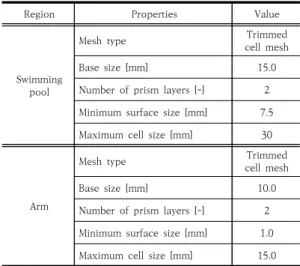
상용 소프트웨워인 Star-CCM+내의 mesher를 사용 하여 손의 수중운동 해석을 하였다. 본 모델은 Overset mesh를 이용하였는데, 이 기법은 Chimera 또는 Overlap mesh라고도 불리며, 중첩되는 격자 간의 유동 정보 교환을 통해 유동을 계산하는 방법이다[15]. 이 기 법을 적용하기 위하여, 손 외부의 유동영역과 수영장(가 로×세로×높이 = 2 m×1 m×1 m)의 영역을 나누어 생 성하였다. 수중운동 시, 필요한 손의 계산격자 설정 조건 은 Table 1과 같다. 계산격자 수는 수영장 약 15만개, 손 약11만개로 총 26만개로 생성되었다.
Table 1. Mesh setting for Arm aquatic excercis
Region Properties Value
Swimming pool
Mesh type Trimmed
cell mesh
Base size [mm] 15.0
Number of prism layers [-] 2 Minimum surface size [mm] 7.5
Maximum cell size [mm] 30
Arm
Mesh type Trimmed
cell mesh
Base size [mm] 10.0
Number of prism layers [-] 2 Minimum surface size [mm] 1.0 Maximum cell size [mm] 15.0
2.2.2 해석 조건
손의 수중운동 조건은 비정상상태의 난류 유동으로 가 정하였으며, 난류에 대한 계산을 위해 K-Epsilon Turbulence 모델을 사용하였다. 해석에 사용된 유체는 물을 사용하였다. 수영장 영역의 측면과 하면은 정지유체 로 정의하고, 상면은 대기압 조건으로 설정하였다[16].
Time step은 손의 유동 흐름을 정확하게 보기 위해
손의 움직임을 고려하여 총 3750 Time step으로 설정 하였다. 손의 움직임은 Fig. 2과 같이 어깨 축을 기준으 로 0 ~ 0.75sec에는 40°의 움직임을 설정하였으며, 1.0
~ 2.25sec와 2.5 ~ 3.75sec에는 80°의 움직임으로 설 정하였다. 손의 움직임의 속도는 0.93rad/s로 설정하였 다. 손의 압력측정 위치는 엄지, 검지, 중지, 약지, 소지의 중심 부분을 양옆으로 총 10곳을 설정하였고, Fig. 3는 손의 압력측정 위치를 나타낸 그림이다.
(a) (b) (c)
Fig. 2. moving profile depends on position (a) 0 ~ 0.75s (b) 1.0 ~ 2.25s (c) 2.5 ~ 3.75s
(a) (b)
Fig. 3. Pressure measurement position (a) view A (b) View B
3. 연구결과 및 고찰
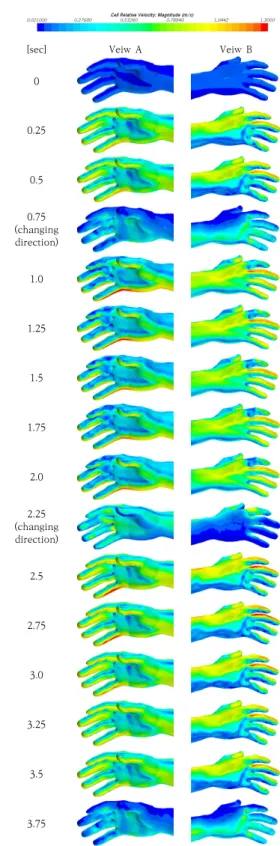
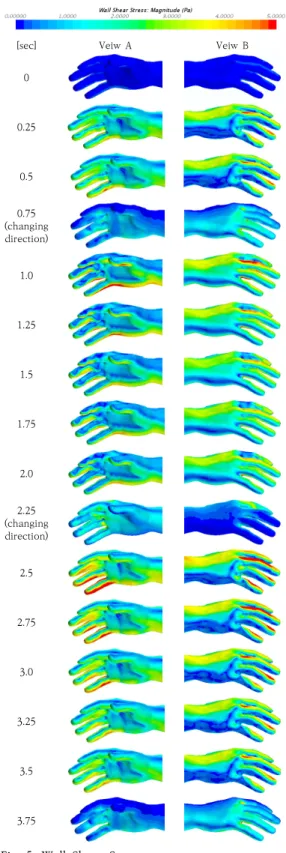
3.1 손의 압력변동 특성수중운동 시, 각 손가락의 표면속도와 전단응력을 확 인하기 위하여, 각 시간별 손 주위의 압력 및 응력분포를 Fig. 4와 Fig. 5에 나타내었다. Fig. 4에서 View A의 소 지와 View B의 중지의 표면 속도가 가장 높았다. 이때의 속도는 약 1.3m/sec 였다. 또한 손의 진행방향이 바뀌는 시간인 0.75sec와 2.25sec 이후에 점진적으로 표면속도 가 증가하였다.
Fig. 5는 손 표면의 전단응력을 나타낸 그림이다.
View A와 view B 모두에서, 중지와 소지부분에 표면 전 단 응력이 높게 나타났다. 특히 2.25sec 이후에, 손가락 사이에서 높은 전단응력이 발생하였다. 이는 기존에 손이 지나간 궤적으로 손이 지나가면서 유동이 좀 더 복잡해 졌기 때문으로 판단된다.
[sec] Veiw A Veiw B
0
0.25
0.5
(changing 0.75 direction)
1.0
1.25
1.5
1.75
2.0
(changing 2.25 direction)
2.5
2.75
3.0
3.25
3.5
3.75
Fig. 4. Velocity Magnitude field
[sec] Veiw A Veiw B 0
0.25
0.5
(changing 0.75 direction)
1.0
1.25
1.5
1.75
2.0
(changing 2.25 direction)
2.5
2.75
3.0
3.25
3.5
3.75
Fig. 5. Wall Shear Stress
손이 지나간 궤적을 다시 지나갈 때 손주위의 복잡한 유동은 압력변동으로 나타날 수 있을 것이다. Fig. 6은 각 손가락 마디별 압력변동치를 나타낸 그림이다. 정확한 위치는 Fig. 3에 표시하였다. Fig. 6에서 보이는바와 같 이, 전체적으로 약 -500Pa 부터 +500Pa의 압력변동이 발생하고 있다. 특히, 방향이 전환되는 부분에서는 최소 –2000Pa ~ 최대 +2000Pa의 압력변동이 발생하였다.
각 손가락 마디의 진동수에서를 분석하면 약 20 ~ 70Hz 의 진동수가 발생하였다.
(a)
(b)
Fig. 6. Frequency position for each finger (a) View A (b) View B
다양한 진동수를 가진 음압과 양압이 손의 전면부와 후면부 피부에 작용하였다. 이는 손의 방향 전환 시, 이전 에 손의 움직임에 의해 발생되었던 물의 와류와 유동이, 손의 진행방향과 교차하면서 음압과 양압의 압력변동이 발생하였다고 판단된다. 따라서 지속적인 압력변동이 손 관절부에 가해지므로, 마사지 효과가 있다고 판단된다.
이러한 효과는 혈액순환에 긍정적인 영향이 있을 것이다.
4. 결론
수중운동의 효과는 다수의 임상보고에서 긍정적인 효 과가 있다고 보고하고 있지만, 그 효과의 원리에 대한 연 구는 미비한 실정이다. 따라서 본 연구에서는 재활치료를 받는 환자들이 수중운동 시, 마사지 효과의 원인을 규명 하는데 목적을 두었다. 수중운동 시, 실제 손과 손가락 마 디에 작용하는 압력변동과 유동 특성을 분석하여 다음과 같은 결론을 얻었다.
1) 손의 표면속도는 전면부에는 소지에, 후면부에는 중지가 가장 높았고, 전단응력은 중지와 소지에서 높게 발생하였다. 특히, 전면부에는 약지에서, 후면 부에는 중지부분에서 강하게 발생하였다. 또한 손 의 진행방향이 바뀌는 시간인 0.75sec와 2.25sec 이후에 점진적으로 표면속도가 증가하였다.
2) 전체적으로 약 -500Pa 부터 +500Pa의 압력변동 이 지속적으로 발생하였다. 특히, 방향이 전환되는 부분에서는 최소 –2000Pa ~ 최대 +2000Pa의 압 력변동이 발생하였다.
3) 각 손가락 마디에 약 20 ~ 70Hz의 진동수가 발생 하였다. 다양한 진동수를 가진 음압과 양압이 손의 전면부와 후면부 피부에 작용하였다. 이는 손의 방 향 전환 시, 이전에 손의 움직임에 의해 발생되었던 물의 와류와 유동이, 손의 진행방향과 교차하면서 음압과 양압의 압력변동으로 발생한 것이라 판단된 다. 따라서 수중운동시에 지속적인 압력변동이 손 관절부에 가해지므로, 손 관절과 마디주위에 마사 지 효과가 있을 것으로 판단된다. 이러한 효과는 혈 액순환에 긍정적인 영향이 있을 것이다.
References
[1] D. W. Han, Effects of Aqua Exercise Program on the Improvement of Physical Function, Body Compositions and Blood Components in the Older Adults, Ph.D dissertation, Daegu University, Daegu, Korea, 2002.
[2] S. M. Nam, (The)effects of underwater activity utilizing buoyancy aids on the foot sole pressure of the patients with hemiplegia, Master’s thesis, Yongin University, Gyeonggi Province, Korea, 2010.
[3] T. Y. Kim, G. Y. Kim, J. Lambeck, “Hydrotherapy in Rheumatoid Arthritis”, The Journal of Korean Society of Physical Therapy, Vol.12, No.3, pp.407-414, 2000.
[4] J. A. Adsett, A. M. Mudge, N. Morris, S. Kuys, J. D.
Paratz, “Aquatic exercise training and stable heart failure: A systematic review and meta-analysis”, International Journal of Cardiology, Vol.186, No.1, PP.22-28, May. 2015.
DOI: http://dx.doi.org/10.1016/j.ijcard.2015.03.095 [5] L. Costa, V. R. Mantha, A. J. Silva, R. J. Fernandes, D.
A. Marinho, et al, “Computational fluid dynamics vs.
inverse dynamics methods to determine passive drag in two breaststroke glide positions”, journal of Biomechanics, Vol.48, No.10, pp.2221-2226, July.
2015.
DOI: https://doi.org/10.1016/j.jbiomech.2015.03.005 [6] K. S. Hyun, The effects of rehabilitation exercise
programs on muscular function and body composition of anterior cruciate ligament reconstruction surgery patients, Ph.D dissertation, Korea University, Seoul, Korea, 2000.
[7] J. I. Kim, K. S. Cho, H. S. Sim, E. N. Lee, I. O. Lee, Y.
Eun, D. S. Lee, H. S. Kang, W. S. Bak, J. H. Lee,
“Analysis of Studies on the Effect of Aquatic Exercise Program”, The Journal of Muscle and Joint Health, Vol.18, No.2, pp.257-269, November, 2011.
DOI: https://doi.org/10.5953/JMJH.2011.18.2.257 [8] G. Caminiti, M. Volterrani, G. Marazzi, A. Cerrito, R.
Massaro, et al., “Hydrotherapy added to endurance training versus endurance training alone in elderly patients with chronic heart failure: a randomized pilot study”, Internation Journal of Cardiology, Vol.148, No.2, pp.199-203, April.. 2011.
DOI: https://doi.org/10.1016/j.ijcard.2009.09.565 [9] M. G. Neto, C. S. Conição, F. L. Arcanjo de jesus, V. O.
Carvalho, “Hydrotherapy on exercise capacity, muscle strength and quality of life in patients with heart failure: A meta-analysis”, International Journal of Cardiology, Vol.198, No.1, pp.216-219, November.
2015.
DOI: http://dx.doi.org/10.1016/j.ijcard.2014.10.132 [10] S. I. Lee, S. Y. Park, “Numerical analysis of internnal
flow characteristics of urea injectors for SCR dosing system”, Fuel, Vol.129, No.1, pp.54-60, August. 2014.
DOI: https://doi.org/10.1016/j.fuel.2014.03.031 [11] C. S. Kim, S. Y. Park, “COMPUTATIONAL STUDY ON
THE CHARACTERISTICS OF THE MASS FLOW RATE OF A UREA-SCR INJECTOR WITH VARIOUS NEEDLE PROFILES”, Advances and Application in Fluid Mechanics, Vol.19, No.4, pp.867-877, October. 2016.
DOI: http://dx.doi.org/10.17654/FM019040867 [12] C. S. Kim, S. Y. Park, “COMPUTATIONAL ANALYSIS OF
THE TRANSIENT INTERNAL FLOW CHARACTERISTICS OF A THREE-HOLE UREA-SCR INJECTOR FOR COMMERCIAL VEHICLES”, Advances and Application in Fluid Mechanics, Vol.19, No.4, pp.903-912, October. 2016.
DOI: http://dx.doi.org/10.17654/FM019040903 [13] C. S. Kim, S. Y. Park, “A Design-Variable-Based
Computational Study on the Unsteady Internal-Flow Characteristics of the Urea-SCR Injector for Commercial Vehicles”, Defect and Diffusion Forumm, Vol.379, pp.64-72, Nobemver. 2017.
DOI: https://doi.org/10.4028/www.scientific.net/DDF.379.64 [14] E. J. Gwak, S. Y. Park, “Study on the flow
Characteristics of the Urea-SCR Swirl injector Using the Unsteady CFD Technique”, Journal of Engineering and Applied Sciences, Vol.13, No.2, pp.2978-2985, 2018.
[15] CD-Adapco, Star-CCM+ ver. 11.04 User Guide, 2016.
[16] J. I. Kim, K. H. Choi, S. Y. Park, “Computation Fluid Flow Study on the pressure Fluctuation Caused by the Vortex Flow Arising From Underwater Exercises of Arthritis Patient”, Defect and Diffusion Forum, Vol.
390, pp.8-22, 2019.
DOI: https://doi.org/10.4028/www.scientific.net/DDF.390.8
최 지 현(Ji-Hyun Choi) [준회원]
• 2019년 2월 : 공주대학교 기계자 동차공학부 (공학사)
• 2019년 3월 ~ 현재 : 공주대학교 기계공학과 석사과정
<관심분야>
열유체 해석, 내연기관 성능개발
박 성 영(Sung-Young Park) [정회원]
• 1993년 2월 : 충남대학교 기계공 학과 (공학사)
• 1995년 2월 : 충남대학교 기계공 학과 (공학석사)
• 2002년 5월 : Texas A&M Univ.
기계공학과 (공학박사)
• 2006년 4월 ~ 현재 : 공주대학교 기계자동차공학부, 정교수
<관심분야>
열유체 해석, 내연기관 성능개발