음곡에 시행한 적소두약침이 LPS로 유도된 흰쥐의 급성 신장염에 미치는 영향
곽규인, 강재희, 이현*
대전대학교 한의과대학 침구의학교실
[Abstract]
The Effect of Phaseoli Semen Herbal-acupuncture at KI10 in Lipopolysaccharide Induced Acute Nephritis in Rats
Kyu In Kwak, Jae Hui Kang and Hyun Lee*
Department of Acupuncture & Moxibustion Medicine, College of Oriental Medicine, Daejeon University
Objectives : This study was designed to evaluate the effects of Phaseoli Semen Herbal- acupuncture(PS-HA) at KI10 in acute nephritis induced by lipopolysaccharide(LPS) in rat.
Methods : The rats were divided into 5 groups, which were control, LPS, PS-HA, NP and saline group. LPS, PS-HA, NP and saline groups were given LPS to induce acute nephritis and control group did not receive LPS. LPS group did not receive any treatment after the onset of acute nephritis. PS-HA, NP and saline group received PS-HA, normal acupuncture, and saline injection at KI10 three times per week, respectively. To evaluate the effect of PS-HA at KI10, the complete blood count, BUN, creatinine, TNF-α, and CINC-1 in serum were measured. To show its effect on renal function, creatinine, and total protein in urine was measured as well as urine output. The level of myeloperoxidase in renal tissue was quantified and complete histology was done in kidney samples obtained from the rats.
Results : PS-HA group showed a significant reduction in the proportion of WBC and neutrophil, serum BUN, TNF-a, and CINC-1 compared to LPS group. Furthermore, a significant increase in urine output and a decrease in urinary creatinine level, MPO in renal tissue, and number of neutrophils at glomerulus was observed in PS-HA group compared to LPS group
Conclusions : PS-HA at KI10 was shown to have a significantly effect on treating LPS induced acute nephrits. Therefore, future study is needed to further evaluate the clinical usefulness of PS-HA at KI10 in treating acute nephritis.
Key words :
Acute nephritis;
Phaseoli Semen; Herbal-acupuncture;
KI10; LPS
Received : 2013. 05. 09.
Revised : 2013. 06. 01.
Accepted : 2013. 06. 03.
On-line : 2013. 06. 20.
✱ Corresponding author : Department of Korean Acupuncture & Moxibustion Medicine, Cheonan Oriental Hospital of Daejeon University, 621, Dujeong-dong, Cheonan-si, Chungcheongnam-do, 331-958, Republic of Korea
Tel : +82-41-521-7578 E-mail : [email protected]
This is an Open-Access article distributed under the terms of the Creative Commons Attribution Non-Commercial License (http://creativecommons.org/licenses/by-nc/3.0) which permits unrestricted non-commercial use, distribution, and reproduction in any medium, provided the original work is properly cited.
The Acupuncture is the Journal of Korean Acupuncture & Moxibustion Medicine Society. (http://www.TheAcupuncture.or.kr) Copyright © 2013 KAMMS. Korean Acupuncture & Moxibustion Medicine Society. All rights reserved.
Ⅰ. 서 론
신장은 혈장, 즉 세포 외액의 구성과 양을 조절한다. 또 한 모든 세포막에서 이루어지는 물과 용질의 지속적인 교 환을 통해 세포 내액의 조성에도 영향을 주며 여과와 재흡 수 작용을 하기 위해 얇은 막 구조를 형성하고 있어 독성 물질에 의한 손상에 취약하다1,2).
급성 신장염은 neutrophil이 모여들어 염증 반응을 일으 키고 모세혈관 내강의 폐색을 일으키며 혈뇨, 단백뇨, 핍뇨 등 의 증상이 나타난다. 이로 인해 신사구체 여과율(glomerular filteration rate, GFR) 저하, 혈청 creatinine이나 blood urea nitrogen(BUN)의 상승, 소변 감소증, 무뇨가 일어나 며 체내 순환혈액량의 증가로 인하여 고혈압, 부종 등 전신 증상이 동반된다3).
적소두(Phaseoli Semen, 이하 PS)는 콩과에 속한 일년 생 초본인 팥, 덩굴팥의 성숙한 종자로 性은 平하고 味는 甘 酸하다. 歸經은 心 ․ 小腸經이며 利水消腫, 解毒排膿하는 효능 이 있어 전신이 붓는 증상이나 간경화로 인한 복수, 각기 등에 사용되는 약재이다4,5).
음곡(KI10)은 足少陰腎經의 合水穴로서 足少陰經ㆍ衝脈ㆍ陰 維脈의 交會穴로서, 補腎培元 調經利水하여 陽痿, 月經不調, 崩 漏, 小便難을 치료하는 데 이용된다6,7).
2005년 자료에 의하면 신장염 소견을 보이는 단백뇨, 혈 뇨, 혹은 혈청 크레아티닌 1.5 ㎎/㎗ 이상인 환자가 2000년 에 비하여 2004년에 2배 이상 증가하였다고 보고하였고8), 국민건강보험공단 질병소분류별 다빈도 상병 급여현황을 비교해보았을 때 신장염에 지급된 진료비가 2004년에 비 해 2008년에 47 % 가량 증가하였다9). 이처럼 증가 추세에 있는 신장염 치료로 사구체 염증의 자연 관해가 일어날 때 까지 항생제와 대증 요법으로 감염을 억제하는 것에 초점 을 맞추고 있으나, 항생제에 대한 내성이 생기는 등 여러 부작용이 발생하며, 근본적인 치료법은 아직 확립되지 않 은 실정이다. 급성 신장염 및 신장 독성에 관한 기존 한의 학적 연구로 Choi et al10), Hwang et al11), Yoon et al12)의 약물을 이용한 연구와 Kim et al13), Park et al14), Lee et al15), Yoon et al16), Cho et al17)이 여러 약침을 음곡에 자 침하여 유효한 효과를 나타낸 연구가 보고된 바 있어 한의 학적 접근이 보다 효과가 있을 것으로 생각된다. 적소두에 대한 연구로는 적소두와 한인진 추출물로 비만에 유의한 효과를 보인 Cho et al18)의 연구가 있었으나 신장염에 대 한 연구는 아직 접하지 못하였다.
이에 저자는 lipoopolysaccharide(이하 LPS)로 유도된 신장염 병태모델 흰쥐로 음곡에 상응하는 부위에 적소두의
利水消腫, 解毒排膿의 효능이 신장염에 효과가 있을 것으로 사료되어 적소두약침을 시술하고 혈액과 소변, 신장 내 염 증 활성평가, 조직학적 분석 등을 통하여 유의한 결과를 얻 었기에 보고하는 바이다.
Ⅱ. 실 험
1. 재료
1) 동물
실험은 동물실험 윤리위원회의 승인을 얻어 시행하였으며, 동물은 6주령의 웅성 Sprague Dawley(SD) rat을 (주)대한 바이오링크(경기도, 한국)에서 공급받아 1주일간 실험실 환 경에 적응시킨 후 실험에 사용하였다. 실험에 사용된 동물은 실험 당일까지 고형사료(삼양사료, 한국)와 물을 충분히 공급 하고, 실험실은 실온(22±2 ℃)과 습도 50~60 %를 유지하였다.
2) 약재
본 실험에 사용된 적소두(PS)는 대전대학교 한방병원에 서 구입하여 실온에서 보관하였으며, 사용하기 전 초음파 세척을 실시하였다.
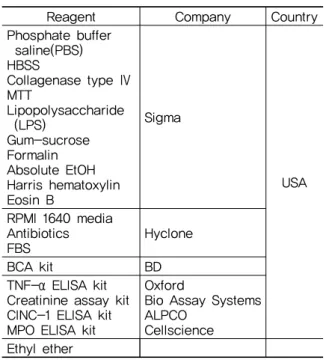
3) 시약 및 기기 (1) 시약(Table 1)
Reagent Company Country
Phosphate buffer saline(PBS) HBSSCollagenase type Ⅳ MTT
Lipopolysaccharide (LPS)
Gum-sucrose Formalin Absolute EtOH Harris hematoxylin Eosin B
Sigma
USA RPMI 1640 media
Antibiotics FBS
Hyclone
BCA kit BD
TNF-α ELISA kit Creatinine assay kit CINC-1 ELISA kit MPO ELISA kit
Oxford
Bio Assay Systems ALPCO
Cellscience Ethyl ether
Table 1. Reagents
(2) 기기(Table 2)
Equipment Company Country
Bio-freezer Sanyo
Japan Rotary evaporator Eyela
ELISA reader TARAN Canada
Sonicate Fisher USA
Ice maker Vision science Korea Metabolic cage B&P
Cytological centrifuge Hanil Micro centrifuge
Cryotome Shandon UK
Table 2. Instruments
2. 방법
1) 약침액의 제조
분쇄기를 이용해서 적소두 55 g을 분쇄하여 분말로 만들 어, 삼각 flask에 넣고 증류수 500 ㎖를 가하여 3시간 동안 shaking water bath에서 유출한 후, 유출액을 여과하였 다. 여과액을 여과지로 3회 여과한 후, rotary evaporator 에 감압농축 하였다. 농축액에 90 % ethyl alcohol 30 ㎖ 를 가하여, 실온에서 교반한 후 방치하여, 침전물이 생성되 게 한 후 여과하였다. 이 여과액을 rotary evaporator로 감압농축한 후, 농축액을 다시 여과하였다. 이 여과액에 80 % ethyl alcohol 30 ㎖를 가하여 잠시 교반 후 방치하 여, 침전물이 생성되게 한 후 여과하였다. 여과액에 70 % ethyl alcohol 30 ㎖를 가하고 교반한 후 방치하였다가 다 시 여과하는 조작을 2회 반복하였다. 여과액중의 ethyl alcohol 성분을 rotary evaporator로 감압제거하고, 남은 농축액이 20 ㎖가 되게 하였다. 적소두 55 g에서 얻은 약 침액을 감압 농축하여 수분을 모두 날렸을 때 건조분말은 1.035 g이었다(수율 1.88 %). 1N NaOH를 이용하여 농축 액을 pH 6.8이 되도록 조절하고, 4 ℃에서 12시간 방치한 후, 침전물을 제거하기 위해 syringe filtering을 실시하였 다. 여과된 농축액에 PBS를 첨가하여 5%로 희석하여 약침 액으로 사용하였다(Scheme 1).
2) 세포독성 (1) 간세포 분리
본 실험모델과 동일한 6주령 수컷 SD rat의 간 조직을 사용하였다. Rat을 ethyl ether를 이용하여 마취시킨 후,
Phaseoli Semen(55 g)
- Extracted with DW 500 ㎖ for 3 hr Filtrated and evaporated three times
Residue
discarded Extracts(DW)
- Suspended in DW Residue
discarded Filtrate
- Precipitated in 90 % EtOH and standing at cooling
temperature - Filtration
Precipitated Filtrate
- Vacuum concentration and cooling it off to room temperature
- Precipitated in 80 % EtOH and standing at cooling
temperature - Filtration
Precipitated Filtrate
- Vacuum concentration and cooling it off to room temperature - Precipitated in 70 % EtOH and
standing at cooling temperature (repeated twice)
- Filtration
Precipitated Filtrate
- Evaporated 2.5 ㎖ and add PBS 47.5 ㎖
Phaseoli Semen herbal-acupuncture solution (PS-HAS)
Scheme 1. Manufacturing procedure of Phaseoli Semen herbal acupuncture solution
대동맥 혈관에 Hank's balanced salt solution(HBSS) (Ca2+, Mg2+ free)를 투여하며 복부 쪽 혈관을 절단하여 동물의 혈액을 모두 배출하였다. 조직을 잘게 잘라서 Rosewell Park Memorial Institue(RPMI) 1640 media (with 10 % FHO)와 collagenase type Ⅳ(300 u/㎖)를 넣 고 실온에서 90분간 incubation하였다. 이때 20분에 한 번 씩 흔들어 줌으로써 간세포가 잘 분리되도록 하였으며 얻 어진 간세포는 RPMI 1640 media에 세척한 후, 세포를 계
수하였다.
(2) Methyl thiazol trazolium(MTT) assay 분리된 간 실질세포의 viability를 trypan blue를 이용 하여 확인한 뒤, 96 well plate에 세포를 1×10⁵ cells/well 로 분주하고, FBS 10 %와 antibiotics를 첨가한 RPMI 1640 media에 적소두 전탕액을 농도별로 처리하고, 72시 간동안 세포 배양을 실시하였다. 72시간 후에, MTT solution(5 ㎎/㎖, Cat No. 135038, Sigma, USA)을 각 well에 20 ㎕씩 분주하고 5시간 동안 37℃에서 incubation 을 실시하였다. 5시간 후, 각 well에 있는 medium을 100
㎕씩 버리고, solubilizing solution을 100 ㎕씩 분주한 뒤 pipetting을 강하게 하여 well에 dark blue crystals가 침 전하는 정도를 ELISA reader를 이용하여 570 ㎚에서 optical densities로 확인하였다.
3) 신장염 동물 모델
6주령 수컷 SD rat에 LPS(2 ㎎/kg)를 복강에 투여하여 신장염을 유도하였다. 각 실험군에는 실험동물을 8마리씩 배정하였다. LPS 투여 1시간 뒤, 각 실험군에서 5마리의 혈액 sample을 채취하였으며, LPS 투여 3시간 후에는 혈 액을 채취했던 동물 5 마리를 sacrifice하여 신장을 적출하 였다. 각 실험군의 나머지 3마리로부터 LPS 투여 후 12시 간 동안 소변 sample을 채취하였다. (Scheme 2.)
Scheme 2. Experimental procedure
4) 실험군 분류 및 처치
실험동물은 정상군(normal) ․ LPS군 ․ NP군(needle prick) ․ saline군 ․ PS-HA군(적소두약침, Phaseoli Semen herbal- acupuncture)의 5군으로 나누었으며, 각 실험군에는 실험 동물을 8마리씩 배정하였다. 정상군을 제외한 LPS군ㆍNP 군ㆍsaline군ㆍPS-HA군은 각각 2 ㎎/kg의 LPS를 복강에 투여하였다. NP군과 saline군ㆍPS-HA군은 LPS 투여 1주 일 전에 좌우 교대로 음곡(KI10) 상응 부위에 NP자극, saline 주입, 적소두 약침처치를 주 3회 실시하였다. 각 실 험군에 대한 처치는 다음과 같다.
① 정상군 : 아무 처치하지 않은 정상 SD rat
② LPS군 : 실험 당일 LPS를 2 ㎎/kg으로 복강 투여한 군
③ NP군 : 실험 전 1 주일간 주 3회 음곡(KI10) 상응부위 에 26 gauge 주사기로 0.5 cm 정도 깊이로 자입한 후 즉시 제거하고, 실험 당일 LPS 2 ㎎/kg을 복강에 투여한 군
④ Saline군 : 실험 전 1 주일간 saline 0.2 ㎖를 주 3회 음곡(KI10) 상응부위에 주입하고, 실험 당일 LPS 2 ㎎/ kg을 복강에 투여한 군
⑤ PS-HA군 : 실험 전 1주일간 10 %의 적소두 약침액 0.2 ㎖를 주 3회 음곡(KI10) 상응부위에 주입하고, 실험 당일 LPS 2 ㎎/kg을 복강에 투여한 군
5) 신장염 평가 (1) 혈액 분석
LPS 처리 1시간 뒤, ethyl ether를 이용하여 rat를 마취 하고 심장채혈법으로 각 동물에서 4 ㎖의 혈액을 채취하였 다. (주) 이원임상검사센터(대전, 한국)에 의뢰하여 혈중 red blood cell(RBC), white blood cell(WBC), neutrophils의 비율을 측정하였으며, 혈청 BUN의 농도를 확인하였다. 혈청 TNF-α, cytokine- induced neutrophil chemoattractant-1 (CINC-1), creatinine의 농도는 ELISA kit으로 확인하였다.
(2) 소변분석
Metabolic cage에서 12시간동안 소변을 채취하여, 배뇨 량을 측정하고, 요 중 total protein과 creatinine 농도를 kit으로 측정하였다.
(3) 신장 내 염증 활성평가
LPS 처리 3시간 후, ethyl ether를 이용하여 rat를 마취 하고 대동맥 혈관에 HBSS(Ca2+, Mg2+ free)를 투여하여 방혈한 후 신장을 적출하였다. 적출된 신장조직은 0.010 % sodium azide가 첨가된 0.1 M phosphate buffer(pH 7.4) 를 넣고 sonicate(Fisher, USA)하여 잘게 간 후, 2,000 × g 에서 10분간 원심분리하였다. 분리된 supernatant는 -80 ℃ 에서 보관하였다가 ELISA kit으로 myeloperoxidase (MPO)의 농도를 측정하였다.
(4) 조직학적 분석
LPS 처리 3시간 후, 각 군의 실험동물 신장을 적취하여, 각각 50 ml tube에 10 % formalin에 담아 침수 고정하였 다. 이것을 (주) 바이오톡스텍(충북 청원군, 한국)에 의뢰 하였다. 염색은 H&E stain을 하였고, 현미경은 Nikon eclipse 80i(Nicon Co, Japan)으로 관찰한 후, Olympus DP70(Olympus Optical Co, Japan)으로 사진을 촬영하
Fig. 1. Cytotoxicity of PS-HAS on rat liver cells
Liver cells from normal SD rat were cultured in RPMI 1640 with 10 % FBS medium for 72h with or without various concentrations of PS-HAS (Phaseoli Semen herbal acupuncture solution).
The cell viability were measured by MTT assay.
Values represent the means ± SD of 3 independent experiments.
Control : culture medium without PS-HAS.
10%, 5%, 2.5%, 1% PS-HAS : culture medium with 10%, 5%, 2.5%, 1% PS-HAS respectively
였다.
6) 통계분석
본 실험에서 얻은 결과값은 평균 ± 표준편차로 나타내 었다. Fig. 2, 3에서는 t-test를 이용하여 LPS 처리군과 비처리군의 평균을 비교하였다. 그 외에는 SPSS 통계프로 그램(14.0 KO)의 일원배치 분산분석(one-way ANOVA)을 사용하여 군간 비교를 하였으며, 사후검정은 Scheffe‘s test를 이용하였다. 각 실험군의 결과값을 비교하여 신뢰 도 95 % 이상(p<0.05) 일 때 유의성이 있는 것으로 판정하 였다.
Ⅲ. 성 적
1. 적소두 약침액의 세포독성
적소두 약침액을 1 %, 2.5 %, 5 %, 10 %로 희석하여 정 상 rat의 간세포에 대한 세포독성을 확인하였다(Fig. 1).
2. LPS투여 따른 TNF-α의 농도 변화
1) Serum TNF-α
Rat에 LPS를 복강투여 하여 신장염을 유도하고, 1시간 후와 3시간 후에 serum TNF-α의 농도를 관찰하였다.
LPS 투여 1시간 후에 serum TNF-α의 농도가 크게 증가 하여 LPS를 투여하지 않은 군에 비하여 유의하게 높았으 며, LPS 투여 3시간 후에는 1시간 후에 비하여 serum
TNF-α가 감소하여 no-treatment군과 유의한 차이를 나 타내지 않았다(Fig. 2).
2) Renal TNF-α
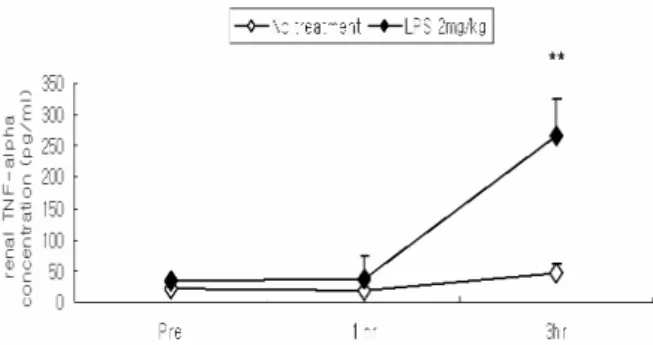
Rat에 LPS를 복강투여 하여 신장염을 유도하고, 1시간 후 와 3시간 후에 각각 신장을 적출하여 renal TNF-α의 농 도를 관찰하였다. LPS 복강투여 1시간 후에 renal TNF-α의 농도는 LPS를 투여하지 않은 군에 비하여 차이를 보이지 않 았으며, LPS 투여 3시간 후 renal TNF-α의 농도는 LPS를 투여하지 않은 군에 비하여 유의하게 증가하였다(Fig. 3).
Fig. 2. Effect of LPS on serum TNF-α level in SD rats
The male SD rats were injected intra-peritoneally with LPS(lipopolysaccharide; 2 ㎎/㎏). Blood samples were taken from rat heart at 1 hr or 3 hr after the LPS injection, and serum TNF-α level was analysed by ELISA.
Data were expressed as mean ± SD(n=3).
No treatment : normal SD rat.
LPS 2 ㎎/kg : SD rat with LPS (2 ㎎/㎏) challenge.
* : p<0.05, compared to no-treatment group by t-test.
Fig. 3. Effect of LPS on renal TNF-α level in SD rats
The male SD rats were injected intra-peritoneally with LPS(2 ㎎/㎏).
Rat kidney was removed at 1 hr or 3 hr after the LPS injection, and renal TNF-α level was analysed by ELISA.
Data were expressed as mean ± SD(n=3).
No treatment : normal SD rat without LPS challenge.
LPS 2 ㎎/kg : SD rat with LPS(2 ㎎/㎏) challenge.
** : p<0.001, compared to no-treatment group by t-test.
3. 음곡 적소두 약침이 LPS에 의한 rat의 신장염에 미치는 영향
1) 혈액학적 분석
Rat에 LPS로 신장염을 유도하고, 1시간 후에 rat의 혈 액을 채취하여 RBC, WBC의 수와 WBC 중 neutrophil의 비율을 측정하였다.
(1) RBC
Rat에 LPS로 신장염을 유도하고, 1시간 후에 rat의 혈 중 RBC 수를 측정하였다. 약물투여에 의해 혈중 RBC 수에 유의한 차이가 나타나지 않았다(Fig. 4).
(2) WBC
Rat에 LPS로 신장염을 유도하고, 1시간 후에 rat의 혈 중 WBC 수를 측정하였다. LPS군의 혈중 WBC는 정상군에 비하여 유의하게 증가하였다. NP군과 saline군ㆍPS-HA 군은 LPS군에 비하여 혈중 WBC 수가 유의하게 감소하였 다(Fig. 5).
(3) Neutrophil
Rat에 LPS로 신장염을 유도하고, 1시간 후에 rat의 혈 액을 채취하여 WBC 중 neutrophil 비율을 측정하였다. 정 상군에 비하여 LPS군의 WBC 중 neutrophil 비율이 증가 하였으나 유의성은 나타나지 않았다. PS-HA군에서는 정 상군ㆍLPS군ㆍNP군ㆍsaline군에 비하여 neutrophil 비율 이 유의하게 감소하였다(Fig. 6).
Fig. 4. Effects of PS-HA on RBC count in blood of LPS-stimulated rats
The male SD rats were treated as described in the materials and method and injected intra-peritoneally with LPS(2 ㎎/㎏).
Blood samples were taken from rat hearts 1 hr after the LPS injection and RBC count was analysed.
Data were expressed as mean ± SD(n=5).
Normal : normal SD rat.
LPS : LPS(2 ㎎/㎏) challenge.
NP : LPS(2 ㎎/㎏) challenge and a needle prick at KI10. Saline : LPS(2 ㎎/㎏) challenge and saline(200 ㎕/rat) injection
at KI10.
PS-HA : LPS(2 ㎎/㎏) challenge and PS-HA(5 %, 200 ㎕/rat) at KI10.
Fig. 5. Effect of PS-HA on WBC count in blood of LPS-stimulated rats
The male SD rats were treated as described in the materials and method and injected intra-peritoneally with LPS(2 ㎎/㎏).
Blood samples were taken from rat hearts 1 hr after the LPS injection and WBC count was analysed.
Data were expressed as mean ± SD(n=5).
Normal : normal SD rat.
LPS : LPS(2 ㎎/㎏) challenge.
NP : LPS(2 ㎎/㎏) challenge and a needle prick at KI10. Saline : LPS(2 ㎎/㎏) challenge and saline(200 ㎕/rat)
injection at KI10.
PS-HA : LPS(2 ㎎/㎏) challenge and PS-HA(5 %, 200 ㎕/rat) at KI10.
*** : p<0.001 compared to normal group by ANOVA test.
††† : p<0.01, † : p<0.05 compared to LPS group by ANOVA test.
Fig. 6. Effect of PS-HA on neutrophil count in blood of LPS-stimulated rats
The male SD rats were treated as described in the materials and method and injected intra-peritoneally with LPS(2 ㎎/㎏).
Blood samples were taken from rat hearts 1 hr after the LPS injection and the percentage of neutrophil out of WBC count was analysed.
Data were expressed as mean ± SD(n=5).
Normal : normal SD rat.
LPS : LPS(2 ㎎/㎏) challenge.
NP : LPS(2 ㎎/㎏) challenge and a needle prick at KI10. Saline : LPS(2 ㎎/㎏) challenge and saline(200 ㎕/rat)
injection at KI10.
PS-HA : LPS(2 ㎎/㎏) challenge and PS-HA(5 %, 200 ㎕/rat) at KI10.
*** : p<0.001 compared to normal group by ANOVA test.
††† : p<0.001 compared to LPS group by ANOVA test.
‡‡‡ : p<0.001 compared to NP group by ANOVA test.
### : p<0.001 compared to saline group by ANOVA test.
2) Blood chemistry
Rat에 LPS로 신장염을 유도하고, 1시간 후에 rat의 혈
액을 채취하여 혈청을 분리한 후, 혈청 BUN, creatinine, TNF-α 그리고 CINC-1의 농도를 측정하였다.
(1) BUN
Rat에 LPS로 신장염을 유도하고 1시간 후에 rat의 혈청 BUN 농도를 확인하였다. LPS군에서는 정상군에 비하여 혈청 BUN 농도가 유의하게 증가하였다. NP군ㆍsaline군ㆍ PS-HA군에서는 LPS군에 비하여 혈청 BUN 농도가 유의 하게 감소하였다(Fig. 7).
(2) Creatinine
Rat에 LPS로 신장염을 유도하고 1시간 후에 rat의 혈청 creatinine 농도를 확인하였다. LPS군ㆍ NP군ㆍsaline군 은 정상군에 비하여 creatinine 농도가 유의하게 증가하였 다. PS-HA군에서는 LPS군에 비하여 혈청 creatinine 농 도가 감소하였으나 유의성은 나타나지 않았고, saline대조 군에 비하여 혈청 creatinine 농도가 유의하게 감소하였다 (Fig. 8).
(3) TNF-α
Rat에 LPS로 신장염을 유도하고 1시간 후에 rat의 혈청 TNF-α 농도를 확인하였다. 정상군에 비하여 모든 군에서 혈청 TNF-α가 현저하게 증가하였다. Saline군과 PS-HA 군에서는 LPS군과 NP군에 비하여 혈청 TNF-α가 유의하 게 감소하였다(Fig. 9).
Fig. 7. Effects of PS-HA on serum BUN level in LPS-stimulated rats
The male SD rats were treated as described in the materials and method and injected intra-peritoneally with LPS(2 ㎎/㎏).
Blood samples were taken from rat hearts 1 hr after the LPS injection and serum BUN level was analysed.
Data were expressed as mean ± SD(n=5).
Normal : normal SD rat.
LPS : LPS(2 ㎎/㎏) challenge.
NP : LPS(2 ㎎/㎏) challenge and a needle prick at KI10. Saline : LPS(2 ㎎/㎏) challenge and saline(200 ㎕/rat)
injection at KI10.
PS-HA : LPS(2 ㎎/㎏) challenge and PS-HA(5 %, 200 ㎕/rat) at KI10.
*** : p<0.001 compared to normal group by ANOVA test.
††† : p<0.001 compared to LPS group by ANOVA test.
(4) CINC-1
Rat에 LPS로 신장염을 유도하고 1시간 후에 rat의 혈청 CINC-1 농도를 확인하였다. LPS군에서는 정상군에 비하 여 혈청 CINC-1이 유의하게 증가하였다. NP군과 PS-HA 군에서는 LPS군에 비하여 혈청 CINC-1이 유의하게 감소 하였다(Fig. 10).
Fig. 8. Effects of PS-HA on serum creatinine level in LPS-stimulated rats
The male SD rats were treated as described in the materials and method and injected intra-peritoneally with LPS(2 ㎎/㎏).
Blood samples were taken from rat hearts 1 hr after the LPS injection and serum creatinine level was analysed.
Data were expressed as mean ± SD(n=5).
Normal : normal SD rat.
LPS : LPS(2 ㎎/㎏) challenge.
NP : LPS(2 ㎎/㎏) challenge and a needle prick at KI10. Saline : LPS(2 ㎎/㎏) challenge and saline(200 ㎕/rat)
injection at KI10.
PS-HA : LPS(2 ㎎/㎏) challenge and PS-HA(5 %, 200 ㎕/rat) at KI10.
** : p<0.01, * : p<0.05compared to normal group by ANOVA test.
# : p<0.05 compared to saline group by ANOVA test.
Fig. 9. Effects of PS-HA on serum TNF-alpha level in LPS-stimulated rats
The male SD rats were treated as described in the materials and method and injected intra-peritoneally with LPS(2 ㎎/㎏).
Blood samples were taken from rat hearts 1 hr after the LPS injection and serum TNF-alpha level was analysed.
Data were expressed as mean ± SD(n=5).
Normal : normal SD rat.
LPS : LPS(2 ㎎/㎏) challenge.
NP : LPS(2 ㎎/㎏) challenge and a needle prick at KI10. Saline : LPS(2 ㎎/㎏) challenge and saline(200 ㎕/rat)
injection at KI10.
PS-HA : LPS(2 ㎎/㎏) challenge and PS-HA(5 %, 200 ㎕/rat) at KI10.
*** : p<0.001, * : p<0.05 compared to normal group by ANOVA test.
† : p<0.05 compared to LPS group by ANOVA test.
‡ : p<0.05 compared to NP group by ANOVA test.
Fig. 10. Effects of PS-HA on serum CINC-1 level in LPS-stimulated rats
The male SD rats were treated as described in the materials and method and injected intra-peritoneally with LPS(2 ㎎/㎏).
Blood samples were taken from rat hearts 1 hr after the LPS injection and serum CINC-1 level was analysed.
Data were expressed as mean ± SD(n=5).
Normal : normal SD rat.
LPS : LPS(2 ㎎/㎏) challenge.
NP : LPS(2 ㎎/㎏) challenge and a needle prick at KI10. Saline : LPS(2 ㎎/㎏) challenge and saline(200 ㎕/rat)
injection at KI10.
PS-HA : LPS(2 ㎎/㎏) challenge and PS-HA(5 %, 200 ㎕/rat) at KI10.
** : p<0.01 compared to normal group by ANOVA test.
†† : p<0.01, † : p<0.05 compared to LPS group by ANOVA test.
3) 소변 분석
Rat에 LPS로 신장염을 유도하고 12시간 동안 소변을 채 취하여 소변 양과 요 중 creatinine과 total protein의 양 을 측정하였다.
(1) 이뇨 활성
Rat에 LPS로 신장염을 유도한 후 metabolic cage에 한
Fig. 11. Effect of PS-HA on urinary volume in LPS-stimulated rats
The male SD rats were treated as described in the materials and method and injected intra-peritoneally with LPS(2 ㎎/㎏).
The rats were kept in metabolic cages and the urine was collected for 12 hours.
Data were expressed as mean ± SD(n=3).
Normal : normal SD rat.
LPS : LPS(2 ㎎/㎏) challenge.
NP: LPS(2 ㎎/㎏) challenge and a needle prick at KI10. Saline : LPS(2 ㎎/㎏) challenge and saline(200 ㎕/rat)
injection at KI10.
PS-HA : LPS(2 ㎎/㎏) challenge and PS-HA(5 %, 200 ㎕/rat) at KI10.
** : p<0.01, * : p<0.05 compared to normal group by ANOVA test.
# : p<0.05 compared to saline group by ANOVA test.
마리씩 수용하고 12시간동안 소변을 채취하여 배뇨량을 측 정하였다. LPS군과 saline군은 정상군에 비하여 배뇨량이 유의하게 감소하였다. PS-HA군에서는 saline군에 비하여 배뇨량이 유의하게 증가하였다(Fig. 11).
(2) Creatinine
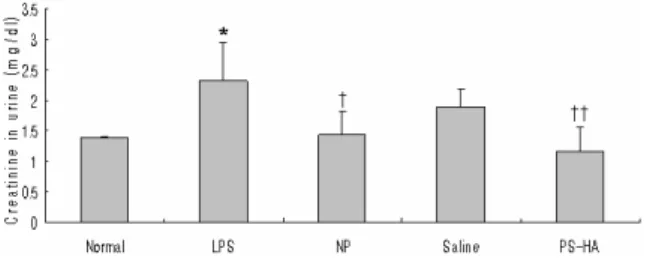
Rat에 LPS로 신장염을 유도하고 12시간 동안 소변을 채 취하여 요 중 creatinine 양을 측정하였다. LPS군의 요 중 creatinine 농도는 정상군에 비하여 유의하게 증가하였다.
NP군과 PS-HA군에서는 LPS군에 비하여 요 중 creatinine 농도가 유의하게 감소하였다(Fig. 12).
(3) Total protein
Rat에 LPS로 신장염을 유도하고 12시간 동안 소변을 채 취하여 요 중 total protein 양을 측정하였다. LPS군에서 는 정상군에 비하여 요 중 total protein이 유의하게 증가 하였다. PS-HA군에서는 LPS군에 비하여 요 중 total proteain 양이 감소하였으나 유의성은 없었다(Fig. 13).
4) 신장 내 염증 활성
Rat에 LPS로 신장염을 유도하고 3시간 후에 신장을 적 출하여 신장조직을 분획한 후 MPO의 농도를 측정하였다.
(1) MPO
Rat에 LPS로 신장염을 유도하고 3시간 후에 신장을 적
Fig. 12. Effects of PS-HA on urinary creatinine level in LPS-stimulated rats
The male SD rats were treated as described in the materials and method and injected intra-peritoneally with LPS(2 ㎎/㎏).
The rats were kept in the metabolic cages and the urine was collected for 12 hours. And the urinary creatinine level was analysed. Data were expressed as mean ± SD(n=3).
Normal : normal SD rat.
LPS : LPS(2 ㎎/㎏) challenge
NP : LPS(2 ㎎/㎏) challenge and a needle prick at KI10. Saline : LPS(2 ㎎/㎏) challenge and saline(200 ㎕/rat)
injection at KI10.
PS-HA : LPS(2 ㎎/㎏) challenge and PS-HA(5 %, 200 ㎕/rat) at KI10.
* : p<0.05 compared to normal group by ANOVA test.
†† : p<0.01, † : p<0.05 compared to LPS group by ANOVA test.
Fig. 13. Effects of PS-HA on total protein level in urine of LPS-stimulated rats
The male SD rats were treated as described in the materials and method and injected intra-peritoneally with LPS(2 ㎎/㎏).
The rats were kept in the metabolic cages and the urine was collected for 12 hours.
And, total protein level in urine was analysed.
Data were expressed as mean ± SD(n=3).
Normal : normal SD rat.
LPS : LPS (2 ㎎/㎏) challenge.
NP : LPS (2 ㎎/㎏) challenge and a needle prick at KI10. Saline : LPS (2 ㎎/㎏) challenge and saline(200 ㎕/rat)
injection at KI10.
PS-HA : LPS (2 ㎎/㎏) challenge and PS-HA(5 %, 200 ㎕/rat) at KI10.
* : p<0.05 compared to normal group by ANOVA test.
Fig. 14. Effects of PS-HA on renal MPO level in LPS-stimulated rats
The male SD rats were treated as described in the materials and method and injected intra-peritoneally with LPS(2 ㎎/㎏).
Three hours after the LPS stimulation, rat kidney was removed and renal MPO level was analysed by ELISA.
Data were expressed as mean ± SD(n=5).
Normal : normal SD rat.
LPS : LPS(2 ㎎/㎏) challenge.
NP : LPS(2 ㎎/㎏) challenge and a needle prick at KI10. Saline : LPS(2 ㎎/㎏) challenge and saline(200 ㎕/rat)
injection at KI10.
PS-HA : LPS(2 ㎎/㎏) challenge and PS-HA(5%, 200 ㎕/rat) at KI10.
*** : p<0.001 compared to normal group by ANOVA test.
† : p<0.05 compared to LPS group by ANOVA test.
출하여 renal MPO 농도를 측정하였다. LPS군ㆍ NP군ㆍ saline군ㆍ PS-HA군은 정상군에 비하여 renal MPO가 현 저하게 증가하였다. PS-HA군의 renal MPO는 LPS군에 비하여 유의하게 감소하였다(Fig. 14).
5) 조직학적 분석
Rat에 LPS로 신장염을 유도하고 3시간 후에 신장을 적
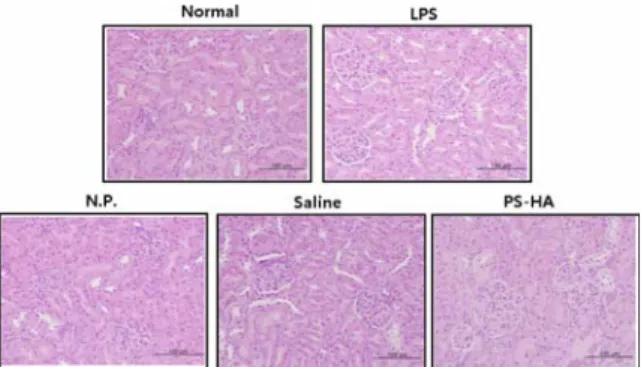
Fig. 15. Histological analysis of renal tissue in LPS-stimulated rats(H&E stain)
The male SD rats were treated as described in the materials and method and injected intra-peritoneally with LPS(2 ㎎/㎏).
Three hours after the LPS stimulation, rat kidney was removed.
The renal tissue was sliced and embedded in OCT compound, and 8 ㎛ sections were stained with hematoxilin and eosin.
Normal : normal SD rat.
LPS : LPS(2 ㎎/㎏) challenge.
NP : LPS(2 ㎎/㎏) challenge and a needle prick at KI10. Saline : LPS(2 ㎎/㎏) challenge and saline(200 ㎕/rat)
injection at KI10.
PS-HA : LPS(2 ㎎/㎏) challenge and PS-HA(5 %, 200 ㎕/rat) at KI10.
출하여 hematoxilin and eosin(H&E) 염색법으로 조직을 염색한 후 광학현미경으로 관찰하였다. LPS군의 신장조직 은 정상군에 비하여 사구체에 netrophil의 집중과 조직의 조밀도 저하가 나타났다. PS-HA군의 신장 조직에서는 LPS군에 비하여 neutrophil의 집중이 감소하였다(Fig. 15).
Ⅳ. 고 찰
신장은 복강 후벽의 윗부분 척주 양쪽의 약간 패인 자리 에 위치하는 완두콩 모양의 장기로서2,19), 그 무게는 어른 을 기준으로 했을 때 한 개가 약 150 g이고 대략 주먹만 한 크기이다. 각 신장의 안쪽에 신문이라 불리는 함몰 부위가 있는데 이곳을 통해 신동맥과 정맥, 림프관, 신경, 수뇨관 등이 지난다20). 신장은 혈장, 즉 세포 외액의 구성과 양을 조절하며 모든 세포막에서 이루어지는 물과 용질의 지속적 인 교환을 통해 세포 내액의 조성에도 영향을 주며 요소, 크레아티닌 같은 질소 대사의 비휘발성 부산물뿐만 아니라 음식에 포함된 과잉의 물과 대사 되지 않은 용질의 배출을 위한 기능을 수행하는데1) 다양한 물질의 교환을 위해서 신 장은 얇은 막 구조를 형성하고 있다. 이는 신장의 기능을 수행하는 데 필수적이지만 그 구조가 외부의 침입에 취약 하여 독성 물질에 의한 손상 가능성이 높다.
급성 신장염은 다양한 원인으로 인해 발생하는데, 대부 분 감염 후에 발생하며 피부 감염 및 상기도 감염도 원인 중의 하나이며 혈뇨, 단백뇨, 고혈압, 부종 등을 유발하고 만성으로 이행될 경우 신부전으로 발전할 수 있다3).
신장염은 한의학적으로 尿不利, 癃閉, 淋證 등의 범주에 속하며 환자는 欲尿不暢하고 심하면 點滴難出, 小便澁痛, 痛 引腰腹하며 시일이 오래 지나면 尿毒이 內攻하여 頭暈, 心悸, 浮腫, 惡心嘔吐 등의 증상과 심하면 昏迷抽搐 증상을 동반할 수 있다고 하였다. 病機는 주로 熱鬱膀胱이고 肝鬱氣滯의 경 우가 간혹 있지만 腎虛寒濕에 속하는 경우는 없으며 病位는 腎과 膀胱이다. 치료는 標本을 함께 살펴 補腎健脾를 위주로 하면서 淸利濕熱이나 淸熱解毒의 방법을 병용한다2,21).
음곡(KI10)은 足少陰腎經의 合水穴로서 무릎 뒤쪽의 오목 하게 들어간 부분인 반힘줄모양근 힘줄의 가쪽 모서리에 위치하며 祛濕通溲, 滋腎淸熱, 疏泄厥氣, 利導下焦의 성질로 尿道炎, 陰道炎, 子宮出血, 小便難 등 신장과 관련된 다양한 질환에 사용된다7).
적소두는 콩과(leguminous)에 속한 一年生 草本인 팥 또 는 덩굴팥의 성숙한 종자로 性은 平하고 味는 甘酸하다. 下 行하는 효능이 있으며, 內로 水道를 通利하며 水濕을 泄하므 로 利水하고 小腸火를 淸하여 濕熱을 小便으로 내보내므로 濕 熱黃疸과 熱淋에 응용한다4).
염증반응은 물리적 손상, 자외선, 미생물 침입, 그리고 면역반응 등 다양한 자극에 의해 유발되며22) 조직의 손상 에 대한 면역세포의 국소적인 방어 및 회복반응으로 세균, 바이러스 등 이물질을 인식한 면역체계가 활성화되어 cytokine을 분비시키는데 cytokine이 염증반응을 유발시 키게 된다. cytokine은 감염 또는 염증 자극에 대한 숙주반 응을 매개하는 물질로23) 사구체 신염의 발병과 진행에 매 우 중요한 역할을 하는 것으로 알려져 있다.
LPS는 포도상 구균이나 연쇄상 구균과 같은 그람 음성 균의 세포벽에 위치하는 지질 다당체의 일종으로서 내독소 (endotoxin)라 불리며, 면역세포 특히 대식세포로 하여금 염증 촉발 물질의 급격한 생성증가를 유발한다24-26). 이렇 게 면역세포를 활성화시켜 NO, PGE2, TNF-α, IL-1β 및 IL-6, IL-10과 같은 염증 매개 물질이 생성되게 한다27,28).
오늘날 염증 질환의 치료는 염증 매개체의 합성이나 작 용을 방해하는 것과 관련되며 특히 신장염과 같은 경우 적 절한 항생제의 투여와 대증 요법을 통해 염증을 억제하는 방법을 사용하는데 자주 재발하며 항생제에 대한 내성이 생기는 등, 근본적인 치료에 한계점이 있는 것으로 알려져 있다.
한의학에서는 주로 淸熱法을 사용하여 염증 질환에 응용 하여 왔고 신장염과 같은 경우 利水滲濕藥인 구맥13)ㆍ차전
자14)ㆍ동과인15) 약침을 응용하여 유의한 효과를 나타낸 연 구가 있었으나 적소두약침을 시술하여 신장염에 효과를 보 인 연구는 아직 보고된 바가 없었다.
이에 저자는 음곡에 시술한 적소두약침이 신장염에 미치 는 영향을 알아보기 위해 적소두약침액을 시료로 정상 흰 쥐의 간세포에 대한 세포독성을 확인하고 LPS 투여 후 혈 청과 신장 내 TNF-α의 농도를 측정하였고, 음곡에 적소 두약침 투여 후 혈액 및 혈청분석, 소변분석, 신장 내 염증 활성의 조직학적 분석을 시행하여 다음과 같은 결과를 얻 었다.
적소두약침액을 1 %, 2.5 %, 5 %, 10 %로 희석하여 정 상 rat의 간세포에 투여한 후 세포독성을 확인한 결과 농도 가 높을수록 세포의 viability가 높아졌으나 유의성 있는 차이는 없었다(Fig. 1). 이에 중간 농도인 5%로 희석한 적 소두 약침액을 사용하였다.
사구체 신염에서 사구체 손상을 매개하는 것으로 알려진 여러 인자 중 하나인 TNF-α는 proinflammatory cytokine으로서 강력한 염증 조절 기능이 있는 물질29)이고 다양한 면역반응에 중심적 역할을 하는 강력한 면역조절인 자로 각종 자가면역 질환과의 관련성이 보고되어 있다30). 염증반응이 일어나는 정도를 알아보고자 LPS 투여에 따른 시간당 혈청과 신장조직에서 TNF-α의 농도 변화를 측정 하였다. 혈청검사에서는 LPS 투여 후 1시간과 3시간 후 모 두 TNF-α가 증가하였으나, 1시간 후에 LPS를 투여하지 않은 군과 비교하여 유의한 차이를 보였고 3시간 후는 유 의한 차이를 나타내지 않았다. 또한 신장 조직 검사에서는 1시간 후 TNF-α가 LPS를 투여하지 않은 군과 거의 차이 가 없었으나 3시간 후에는 유의한 증가를 보였다(Fig. 2, 3). 따라서 LPS 투여에 따른 효과를 정확하기 측정하기 위 해 혈청검사는 1시간 후, 신장 조직 검사는 3시간 후에 시 행하였다.
WBC는 대부분 감염과 염증 부위로 이동하는 것으로 염 증의 경과에 따라 종류가 변한다. 염증 초기에는 neutro- phil이 주로 반응하고 후기에는 림프구, 형질세포와 대식 구가 주로 작용한다. neutrophil은 골수에서 유래하며 이 물질, 특히 세균 등의 병원체를 처리함으로써 생체의 방어 체계에 중요한 역할을 한다. 실험에서 WBC 수치가 LPS투 여군에 비해 PS-HA군이 유의성 있는 차이로 감소하였고 NP군과 saline군에서도 유의성 있게 감소하였다. 그리고 WBC 중 특히 염증과 관련이 있는 neutrophil 비율을 살펴 보았을 때 정상군에 비해 LPS군에서 비율이 증가하였으나 유의성 있는 차이는 없었고, PS-HA군에서는 유의성 있게 감소한 결과를 나타냈다. 이는 음곡(KI10)의 淸熱하는 효과 뿐만 아니라 적소두의 利水하여 淸熱하는 효능으로 신장염
모델에서 염증반응을 억제한 것으로 사료된다.
BUN은 혈중에 존재하는 요소 내 질소를 표현하는 것으 로 신장질환과 관계가 깊은 질소대사 산물이다. 혈중 요소 는 거의 모두가 사구체에서 여과되어 배설되지만, 그 일부 는 세뇨관 및 유두부에서 수동적으로 재흡수되어 혈류로 유입된다. 재흡수량은 생체 내 수분량에 따라 규제를 받는 데 사구체 여과치가 50 % 이하로 떨어지면 혈중 요소가 기 준 범위 이상으로 증가하여 혈중 creatinine의 증가와 더 불어 증가하게 된다31). BUN이 상승하는 것은 대부분의 경 우 신장질환 또는 요도에 폐색이 있어 배설이 잘 안 되는 경우이다23).
Creatine의 무수물인 creatinine은 creatine phosphate 에서 직접 또는 creatine에서 1분자의 H2O가 제거되어 생 성된다. Creatinine은 신장질환과의 상관성이 커서 간단한 신장기능의 지표로서 중요시되고 있다31).
CINC-1은 IL-8계통으로 내피세포에서 분비되어 neutrophil을 유도하며 활성화시켜 흰쥐의 염증반응 모델 연구에서 수치가 사용되어왔다32).
본 실험의 혈청 검사에서 BUN, creatinine, TNF-α, CINC-1의 농도를 측정한 결과, BUN은 음곡에 시술한 모 든 군에서 농도가 유의하게 감소하였고, creatinine은 정 상군에 비하여 LPS군ㆍ NP군ㆍ Saline군에서 유의하게 증 가하였고 PS-HA군은 LPS군에 비해서 농도가 감소하였으 나 유의성 있는 차이는 나타나지 않았고 saline군에 비하여 농도가 유의하게 감소하였다. TNF-α는 saline군과 PS-HA군에서 LPS군에 비하여 유의하게 감소하였으며 CINC-1은 LPS군에 비해 NP군과 PS-HA군이 유의하게 감소하였다(Fig. 7~10). 적소두약침이 신장염과 관련된 혈 청 검사 항목에서 모두 유의하게 감소한 것으로 보아 적소 두의 淸熱하여 解毒排膿하는 효능으로 인한 결과로 보인다.
또한 음곡(KI10)에 침자극만 가한 NP군과 음곡(KI10)에 Saline을 투여한 군에서도 특정 항목들은 유의하게 감소된 결과를 나타냈다. 이러한 결과는 음곡의 祛濕通溲, 滋腎淸 熱, 疏泄厥氣, 利導下焦하는 경혈적 특성과 연관된 것으로 생 각된다.
신장은 체액의 용량, 삼투압 및 세포 내액, 세포 외액량 등의 분포를 포함한 내부 환경의 구성을 일정하게 유지하 기 위해 섭취량에 따라 적당한 양을 소변으로 배설하는 역 할을 한다. 소변의 생성은 혈액 여과, 세뇨관에서의 재흡 수, 분비의 과정을 통해 이루어지는데 소변에는 적혈구, 백 혈구, 단백질 등이 일반적으로 배출되지 않거나 극소량 발 견되지만, 사구체 손상 등으로 사구체 여과에 이상이 생기 면 소변에서 단백질이 발견된다33). 본 실험에서는 소변을 채취하여 소변의 양과 요 중 creatinine과 total protein을
측정하였다. LPS군과 saline군에서 소변양이 정상군에 비 하여 유의하게 감소하였고 PS-HA군에서는 saline군에 비 하여 배뇨량이 유의하게 증가하였다. 요 중 creatinine도 LPS군에 비하여 유의하게 감소하였으나 요 중 total protein은 LPS군에 감소하였으나 유의성은 나타나지 않았 다(Fig. 11~13). 이는 적소두 전탕액의 신장 기능 중 특히 배뇨량에 미치는 영향을 보여준 Kim et al34)의 연구 결과 와 상통한다고 사료되며 利水滲濕藥 중 利水退腫藥인 적소두 약침의 利水消腫하는 효과로 신장의 기능을 개선시키는 것 으로 생각된다.
MPO는 neutrophil이 탐식한 세균에 대하여 free radical을 생산하여 면역작용을 보이며 신장에서 MPO가 증가한다는 것은 neutrophil 침입의 지표가 되고 MPO는 사구체 모양을 변화시키며 사구체 신염과 같은 endothelial cell과 mesangial cell 손상을 유발한다. 또한 염증의 지표로서 조직 속의 neutrophil의 수를 측량할 때 사용 된다31,35). 본 실험에서 신장 조직 내 MPO 농도를 측 정한 결과 PS-HA군이 LPS군에 비하여 유의하게 감소하 였다(Fig. 14). 앞서 혈청검사 결과상 PS-HA군에서 WBC, neutrophil 두 부분에서 유의하게 감소하였고 신장 조직 검사상 neutrophil 지표가 되는 MPO의 유의한 감소를 고 려해볼 때 음곡 적소두약침의 효과로 淸熱, 解毒排膿하여 염 증반응 초기에 주로 활동하는 neutrophil을 감소시켜 초기 염증반응에 유효한 효과가 있을 것으로 생각해 볼 수 있고 추후 이와 관련한 연구가 필요할 것으로 사료된다.
LPS로 신장염을 유도한 후 신장을 적출하여 손상을 관 찰한 결과 LPS군의 신장조직은 정상군에 비하여 사구체에 neutrophil의 집중과 조직의 조밀도 저하가 나타났다. 이 에 비해 PS-HA군에서는 LPS군에 비하여 neutrophil의 집중이 감소한 것으로 관찰되었다(Fig. 15). 이로 미루어 보아 PS-HA군에서 LPS와 같은 독성 물질로 유발된 신장 염의 조직 손상을 막는 데 효과가 있을 것으로 생각된다.
이상의 결과를 종합해볼 때 음곡에 시술한 적소두약침은 LPS로 유도된 흰쥐의 급성 신장염에 대하여 혈중 WBC, neutrophil의 증가를 억제하며 혈청 BUN, creatinine, TNF-α, CINC-1을 유의하게 감소시켰다. 또한 소변 양을 증가시키고 creatinine농도를 감소시켰다. 또한, 음곡에 saline을 투여한 군에서는 혈중 WBC, 혈청 BUN, TNF-α 가 유의하게 감소하였고 NP군에서는 혈중 WBC, 혈청 BUN, CINC-1이 유의하게 감소하였다. 이는 음곡의 祛濕 通溲, 滋腎淸熱, 疏泄厥氣, 利導下焦하는 효능과 적소두의 효 과가 더불어 작용한 것으로 보인다. 따라서 음곡에 시술한 적소두약침은 신장의 염증을 억제하는데 효과가 있는 것으 로 생각되며 향후 지속적인 연구가 필요할 것으로 사료된다.
Ⅴ. 결 론
음곡(KI10)에 시술한 적소두약침이 LPS로 유도된 신장염 모델 흰쥐에 미치는 영향을 알아보고자 혈액 및 혈청분석, 소변분석, 신장 내 염증활성, 조직학적 분석을 시행하여 다 음과 같은 결론을 얻었다.
1. PS-HA군에서 혈중 WBC, neutrophil의 비율, 혈청 BUN, TNF-α, CINC-1의 농도가 유의하게 감소하 였다.
2. PS-HA군에서 배뇨량이 유의하게 증가하였고, 요 중 creatinine 농도가 LPS군에 비하여 유의하게 감소하 였으며 신장조직의 MPO가 유의하게 감소하였다.
3. 조직학적 분석에서 PS-HA군에서 사구체의 neutrophil 집중이 LPS군에 비해 감소하는 경향을 보였다.
Ⅵ. References
1. E Braunwakd, A Fauci, D Kasper, S Hauser, D Longo, J Jameson. Harrison’s Principles of Internal Medicine, 15/e. Seoul : MIP. 2003 : 1583-89.
2. Du HK. Oriental Kidney System Internal Medicine.
Seoul : Sungbosa. 2003 : 225-301.
3. Choi KH. Steps to Internal Medicine(5). Seoul : Jungdam. 2008 : 116-45.
4. Committee of Korean Textbook Publisher. Herbology.
Seoul : Yeonglimsa. 2005 : 355-56.
5. Ahn DK. Illustrated Book of Korean Medicinal Herbs. Seoul : Kyohaksa. 2002 : 393.
6. Yim YK, Kim JP, Kim TH. Korean Meridian &
Acupoint(Kakron). Daejeon : Obikihoek. 2006 : 676-8.
7. Committee of Korean Acupuncture & Moxi- bustion Textbook Publisher. Acupuncture &
Moxibustion(Sang). Paju : Jipmundang. 2008 : 175-6.
8. The Korean Society of Nephrology Restration Board. Renal Replacement Therapy in Korea - Insan Memorial Dialysis Registry 2004-. The Korean Journal of Nephrology. 2005 ; 24(2) :
425-57.
9. National Health Insurance Service. 2008, Benefits by Frequency of Disease(2004).
10. Choi JB, Lee KH, Kim YS. Beneficial Effect of Liuwei Dihuang Tang Jia Renshen ․ Huangqi Extract on Cisplatin Induced Kidney Toxicity in Rats. Journal of Korean Oriental Internal Medicine. 2003 ; 24(3) : 579-87.
11. Hwang YG, Jeong JC. Effect of Salviae Radix on renal tubular reabsorption in rabbits with mercury-induced acute renal failure. Journal of Korean Oriental Internal Medicine. 2000 ; 21(2) : 227-34.
12. Yoon CH, Jeong JC, Shin US. Effects of Cervus elaphus Acua-Acupuncture’s solution on damage of Rat's Kidney induced by Ischemia and Reflow. Journal of Korean Oriental Internal Medicine. 1999 ; 20(1) : 111-21.
13. Kim KM, Lee H, Kang HJ, Lee YH, Yim YK.
Anti-inflammatory Effect of Dianthi Semen Herbal-acupuncture at KI10 on nephritis in rats. Journal of Meridian & Acupoint. 2009 ; 26(1) : 61-77.
14. Park BM, Hur B, Yim YK. Anti-inflammatory Effect of Plantaginis Semen Herbal-acupuncture at KI10 on LPS-induced nephritis in rats.
Journal of Meridian & Acupoint. 2009 ; 26(2) : 127-43.
15. Lee JH, Kim JH, Kim YI. Anti-inflammatory Effect of Benincasae Semen Herbal-acupuncture at KI10 on nephritis in rats. Journal of Pharmacopuncture. 2010 ; 13(2) : 51-65.
16. Yoon KS, Kang JH, Lee H. Anti-inflammatory Effect on Desmodii Herba Pharmacopuncture at KI10 on Nephritis in Rats. The Journal of Korean Acupuncture & Moxibustion Society.
2011 ; 28(3) : 43-54.
17. Cho E, Kang JH, Lee H. Anti-inflammatory Effect of Akebiae Lignum Parmacopuncture at KI10 on LPS-induced Acute Nephritis in Rats.
The Journal of Korean Acupuncture & Moxi- bustion Society. 2012 ; 29(3) : 41-53.
18. Cho KH, Shin SS, Lee ES, Byun BH, Byun SE, Seo BI. The Effects of Phaseoli Angularis
Semen and Artemisiae Iwayomogi Herba on Biochemical and Histological Changes of Rats Fed High Fat Diet. The 35th International Symposium of Korean Society of Life Science.
2002 ; 35 : 65.
19. Lee WT, Lee JE, Park SH, Lee KL, Park KA, Hong SG. Hole’s human anatomy & physiology.
Seoul : Jungdam. 2004 : 821-3.
20. 27 Medical Professors Joint Translation. Textbook of Medical Physiology. Seoul : Jungdam. 2002 : 318-33.
21. Committee of Korean Renal Internal Medicine Textbook Publisher. Renal Internal Medicine.
Seoul : Koonjachulpansa. 2011 : 40-45.
22. Lee MH. Immunology. Seoul : Shinilbooks. 2008 : 50.
23. Lee SY, Jeong YS, Kwon OH, Song KS. Clinical Laboratory Medicine 7th ed. Seoul : Yonsei University Press. 2000 : 234-7, 617-9.
24. Anzai M, Maezawai R, Ohara T, Kodama K, Fukuda T, Kurasawa K. Systemic lupus erythematosus associated with facial edema. overproduction of interleukin-5. and eosinophilia. J Clin Rheumatol.
2008 ; 14(6) : 361-2.
25. Trowbridge HO, Emling RC. Inflammation: a review of the process. 5th Ed. Chicago : Quintessence Pub Co. 1997 : 219-45.
26. Cho HY, Noh KH, Cho MK et al. Anti-oxidative and Anti-inflammatory Effects of Genistein in BALB/c Mice Injected with LPS. Journal of Korean food science and nutrition. 2008 ; 37(9) : 1126-35.
27. Park SJ, Song HJ. Anti-inflammatory effect of
extract of Pulsatilla koreana NAKAI. in LPS- stimulated Murine peritoneal macrophage. Korean Journal of Herbology. 2007 ; 22(1) : 111-7.
28. Bae GS, Park HJ, Kim DY et al. Inhibitory Effect of Extract of Teucrium veronicoides on the Production of Inflammatory Cytokines.
Korean Journal of Herbology. 2008 ; 23(3) : 119-25.
29. Beutler B and Cerami A. The biology of cachetin TNR-R primary mediator of the host response.
Annu ReV Immunol. 1989 ; 7 : 625-55.
30. Abboud HE. Growth factors in glomerulone- phritis. Kidney Int. 1993 ; 43(1) : 252-67.
31. Yi KN, Kwon OH. Clinical Pathology File(Third Edition). Seoul : Eui-Hak Publishing &
Printing Co. 2000 : 95-8, 102-5, 1436-39.
32. Ha JY, Kim YK, Lee KS, Min KR, Kim YS.
Inhibitory effects of herbal extracts on CINC-1 induction in LPS-stimulated rat kidney epitheloid NRK-52E cells. Natural Product Science. 1997 : 59-70.
33. Song KY, Ji JG, Ham EG. Core Pathology. Seoul : Korea Medical Books Pub. 1998 : 573-620.
34. Kim SB, Park JS, Seo JY, Kwon GB, Lee HS, Ryu DG. Effects of Semen Phaseoli Water Extract on the Renal Fuction in Rats. Journal of Oriental Physiology. 1999 ; 14(1) : 123-8.
35. Sela S, Shurtz-Swirski R, Cohen-Mazor M et al.
Primed peripheral polymorphonuclear leukocyte: a culprit underlying chronic low-grade inflammation and systemic oxidative stress in chronic kidney disease. Journal of the American Society of Nephrology. 2011 ; 30(7) : 603-15.