A Study on Synthesis and Properties of Polyurethane Dispersion Adhesives
Dong Kyu Park † , Chung Gi Kim * , and Chan Young Park **,†
Dept. of Chemistry, Kyungsung University, Busan 48434, Republic of Korea
*
Dept. of Advanced Materials Eng., Kyungsung University, Busan 48434, Republic of Korea
**
Dept. of Polymer Engineering, Pukyong National University, Busan 48547, Republic of Korea (Received November 27, 2017, Revised December 4, 2017, Accepted December 11, 2017)
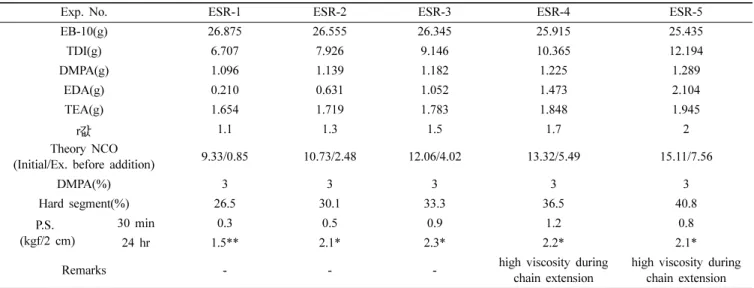
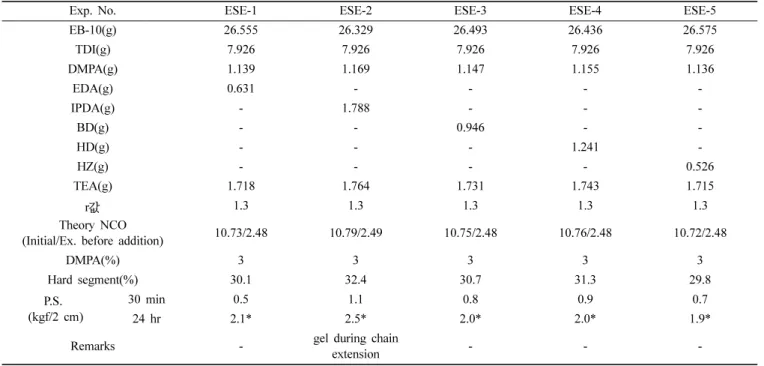
Abstract: Polyurethane dispersion (PUD) polymers were synthesized by using polyether and polyester polyol. The effect of ionomeric centers, r(NCO / OH) values, chain extender process, and chain extender types on the adhesion properties was investigated. In the case of polyether-based PUD, the ionic center, r value, chain extension process and chain extender types were not adjusted even after adjustment. In the case of polyester-based PUD, when the ionic center content was more than 2.5%, the state of adhesive strength was 2.0 kgf/cm
2or more. On the other hand, the initial adhesive strength was excellent at about 1 kgf/cm
2when the ionic center content was over 3.5%. When the r value was 1.3 or more, it was found that the initial bonding strength and the state of bonding strength were excellent at about 1 kgf/cm
2and 2.1 kgf/cm
2or higher, respectively. An IR spectrum analysis of the synthesized PUD confirmed that PUD was composed of urethane based on the N-H characteristic peak at 3340 cm
−1and the urethane characteristic peak at 1730 cm
−1. Moreover, the characteristic peaks of the isocyanate (2260 cm
−1) used in the preparation of the prepolymer were not observed. As a result, the residual -NCO was not observed, and urethane was completely synthesized.
Keywords: polyurethane, water soluble, adhesive, bond strength, prepolymer
Introduction
접착제는 가정에서 첨단 산업 분야까지 그 적용 범위가 매 우 넓으며, 또한 피착재도 유기재료, 금속재료, 무기재료 등 광 범위하다. 다양한 종류의 폴리올과 이소시아네이트기의 중합 반응으로부터 광범위한 폴리우레탄이 합성되며 이를 이용하 여 폴리우레탄 접착제가 얻어진다. 한편 고분자량을 갖는 폴 리우레탄 접착제는 분자당 2~3개의 반응기를 갖는 poly- isocyanate 및 polyol을 사용하여 얻을 수 있다.
1-3각종 산업용 제품이나 구조물의 결합에 중요한 역할을 담당하고 있는 접 착제에 대한 요구 사항으로는 사용 조건별 접착 내구성 확립, 접착 시간 단축과 전처리 공정의 간소화에 의한 생산성 향상 이외에도 환경 친화성이 새롭게 추가되었다.
4-6접착제의 환경 친화성을 확보하기 위한 노력으로는 환경친화성 무독성 피착 면 전처리 공정, 재활용 용이성을 갖는 접착제 및 공정 도입, 유독성 용제형 접착제의 대체 조성 개발 등 환경 부하저감을 위한 다양한 연구가 전 세계적으로 활발히 진행되고 있다. 또 한 수용자의 요구가 점점 더 다양해지고 복잡해짐에 따라 이 에 대응하는 고성능 제품을 재빠르게 개발할 필요성이 높아 지고 있다. 접착제는 수지, 용매, 촉매, 경화제, 첨가제 등 구
성 요소의 일부 또는 전부를 배합하여 제조되는데, 생산 및 적 용 공정 시 용매와 화학원료에서 휘발성 유기화합물(VOCs) 이 주로 발생되고 있으며, 폐기 후 매립 시 미 반응물 또는 유 출물의 독성이 문제시 되고 있다.
7-9VOCs 는 접착제의 상온 건 조 및 가열 경화 공정 중에 대기 중으로 쉽게 증발되고 대기 중에서 질소화합물과 광화학 반응을 일으켜 황화물 스모그 유 발, 광화학산화물인 전구물질 생성, 오존층 파괴, 지구 온난화 및 발암물질 생성 등 지구 환경 및 인체에 미치는 부정적인 영향으로 인하여 각종 환경 규제의 대상이 되어 왔다. 따라서, 환경문제의 심각성에 대한 인식의 확산으로 용제형의 접착제 는 점차 줄어들고 에멀젼, 수성 등의 비용제형 및 핫멜트형 접 착제가 점차 증가하고 있는 추세이다.
10-15따라서 수성 폴리 우레탄 에멀젼형 접착제는 유기 용제를 사용하지 않기 때문 에 작업장 환경 문제를 개선시킬수 있어 환경 친화적인 수성 접착제라 할 수 있다. 한편 환경친화적인 수성 폴리우레탄 접 착제는 물에 분산이 가능한 염 형성에 의한 폴리우레탄 이오 노머로부터 제조될 수 있다.
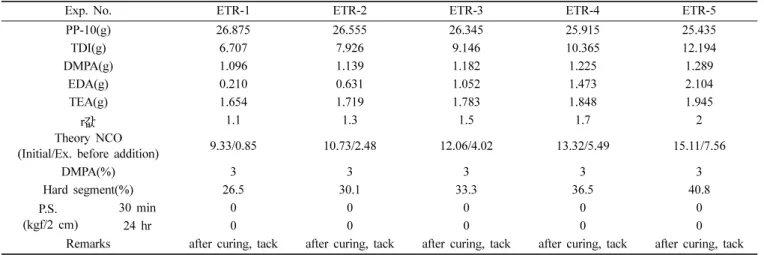
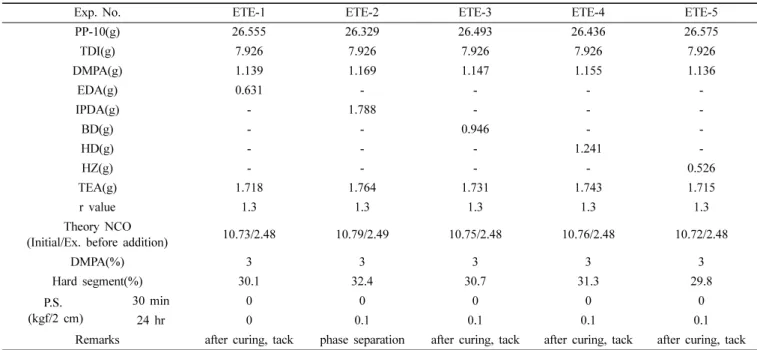
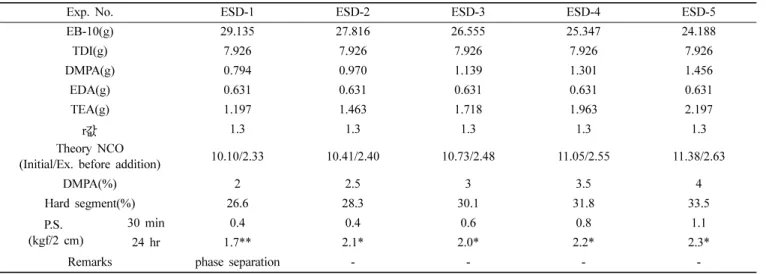
따라서 본 실험에서는 무용제화, 접착공정의 자동화 및 자 원절약 등 산업계의 요구에 따라 부품소재공정의 친환경화를 통한 선진화를 이루기 위하여 환경친화적인 수성 폴리우레탄 접착제를 합성하는 데 있어서 monomer 조성의 비, DMPA 함 량, r(NCO/OH)값, 쇄연장 process 및 쇄연장제의 종류에 따
†
Corresponding author E-mail: [email protected], [email protected]
라서 미치는 영향을 검토하였다.
16-20Experimental
1. 실험재료
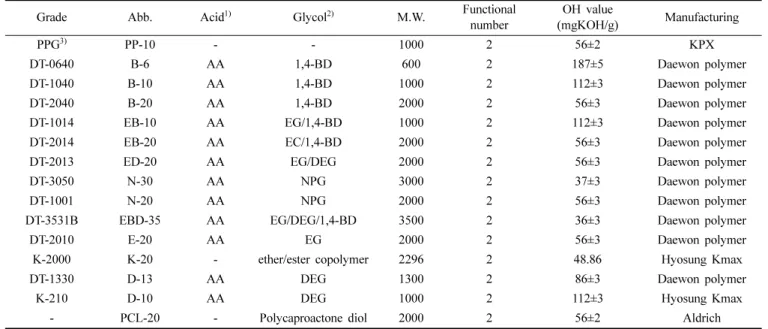
PUD 합성에 사용한 polyol류는 대원포리머 등에서 구입하 였으며, 100
oC 에서 기포가 완전히 제거될 때까지 진공 건조
하여 사용하였다. Polyol 류의 특성을 Table 1에 나타내었다. 실 험에 사용한 isocyanate는 isophorone diisocyanate (IPDI, Junsei), diphenylmethane diisocyanate (MDI, BASF), hexa- methylene diisocyanate (HDI, Aldrich), toluene diisocyanate (TDI, Junsei) 를 정제 없이 사용하였으며 monomeric diol 및 diamine 류는 1,4-butanediol (BD, Yakuri), 1,6-hexanediol (HD, Junsei), ethylene diamine (EDA, Junsei), hydrazine (HZ, Aldrich), ionic center 및 neutralizer를 dimethylol propionic Table 1. Properties of Polyol used in PU Prepolymer Synthesis.
Grade Abb. Acid
1)Glycol
2)M.W. Functional
number
OH value
(mgKOH/g) Manufacturing
PPG
3)PP-10 - - 1000 2 56±2 KPX
DT-0640 B-6 AA 1,4-BD 600 2 187±5 Daewon polymer
DT-1040 B-10 AA 1,4-BD 1000 2 112±3 Daewon polymer
DT-2040 B-20 AA 1,4-BD 2000 2 56±3 Daewon polymer
DT-1014 EB-10 AA EG/1,4-BD 1000 2 112±3 Daewon polymer
DT-2014 EB-20 AA EC/1,4-BD 2000 2 56±3 Daewon polymer
DT-2013 ED-20 AA EG/DEG 2000 2 56±3 Daewon polymer
DT-3050 N-30 AA NPG 3000 2 37±3 Daewon polymer
DT-1001 N-20 AA NPG 2000 2 56±3 Daewon polymer
DT-3531B EBD-35 AA EG/DEG/1,4-BD 3500 2 36±3 Daewon polymer
DT-2010 E-20 AA EG 2000 2 56±3 Daewon polymer
K-2000 K-20 - ether/ester copolymer 2296 2 48.86 Hyosung Kmax
DT-1330 D-13 AA DEG 1300 2 86±3 Daewon polymer
K-210 D-10 AA DEG 1000 2 112±3 Hyosung Kmax
- PCL-20 - Polycaproactone diol 2000 2 56±2 Aldrich
1)