• 검색 결과가 없습니다.

국민건강보험 일산병원 재활의학과

N/A
N/A
Protected

Academic year: 2021

Share "국민건강보험 일산병원 재활의학과"

Copied!
5
0
0

로드 중.... (전체 텍스트 보기)

전체 글

(1)

접수일 : 2016 년 12 월 5 일 , 게재승인일 : 2017 년 3 월 22 일 책임저자 : 김형섭 , 경기도 고양시 일산동구 일산로 100

10444, 국민건강보험 일산병원 재활의학과

Tel: 031-900-0137, Fax: 031-900-0343 E-mail: [email protected]

외상성 뇌손상 환자에서 성인 척수견인증후군에 의한 요천추 신경근병증

증례 보고

국민건강보험 일산병원 재활의학과

장찬웅ㆍ김종문ㆍ김형섭

Lumbosacral Radiculopathy Caused by Adult Tethered Cord Syndrome with Underlying Traumatic Brain Injury

A Case Report

Chan Woong Jang, M.D., Jong Moon Kim, M.D.

and Hyoung Seop Kim, M.D.

Department of Physical Medicine and Rehabilitation, National Health Insurance Service Ilsan Hospital, Goyang, Korea Adult tethered cord syndrome (ATCS) is a rare entity and which symptoms mimic a wide spectrum of pathologies, making diagnosis of ATCS a truly demanding task. We present a 24-year-old man with ATCS who had suffered a traumatic brain injury (TBI). In order to provide relief on the hydrocephalus, ventriculoperitoneal shunts (VP shunt) were inserted at both sides with pressure adjusted several times throughout the day. He complained of persistent gait disturbance, lower extremities weakness and newly devel- oped, lower back pain. Mini mental status examination showed no significant change and laboratory tests were within normal limits. Computed tomography (CT) scan did not reveal any signs of aggravation of the hydrocephalus and shunt malfunction. Electrodiagnostic test revealed lum- bosacral radiculopathy, mainly at L5 or S1. However, a lum- bar spine magnetic resonance imaging (MRI) showed a tethered cord at the level of S1. We, therefore, recom- mended him to have detethering surgery. This is a compli- cated case report on combined ATCS and TBI. (Clinical Pain 2017;16:31-35)

Key Words: Tethered cord syndrome, Radiculopathy, Traumatic brain injury

INTRODUCTION

Tethered cord syndrome (TCS) is a clinical condition of various spinal abnormalities that presents itself as the lower position of the conus medullaris than L2 vertebrae or below the L1-2 disc space. These abnormalities are usually dis- covered at birth or during childhood through is better than neurological, urological, musculoskeletal, or gastrointes- tinal symptoms. It is often easier to diagnose cases where patients have cutaneous manifestations such as subcuta- neous mass, hemangioma, hair patches, and bony defects like spina bifida or tumors.

1

Adult tethered cord syndrome (ATCS), however, is a rare entity that encompass a wide range cases. It is most often presented with pain, static motor or sensory deficits, gait difficulty and sphincter disturbances.

1

As many of these symptoms are also seen in patients with lumbosacral radiculopathy or brain lesion, such as hydrocephalus as se- quelae of stroke or TBI, the final diagnosis may often be delayed.

We describe a 24-year-old man who was given ven- triculo-peritoneal (VP) shunt for hydrocephalus after TBI.

He presented aggravated gait disturbances, lower back pain and both urinary and stool incontinence, newly diagnosed with ATCS through neurological examination, radiologic and electrodiagnostic test.

CASE REPORT

A 24-year-old man who had been being suffered from

traumatic brain injury (TBI) by a motor vehicle accident

and sequelae of hydrocephalus in 2009, visited the out-

patient clinic with aggravation of gait disturbance, espe-

cially limping gait with right recurvatum, lower extremity

(2)

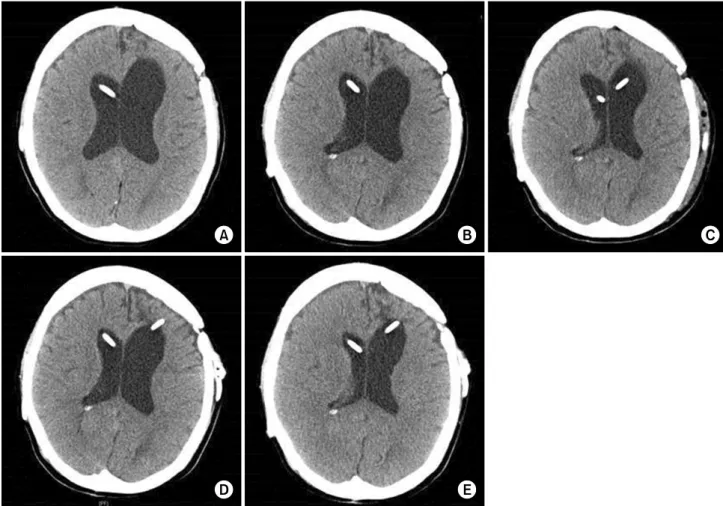
Fig. 1. Serial coronal brain CTs of the hydrocephalus from March 2

nd

, 2014 to April 20

th

, 2016. (A) Coronal brain CT, taken on March 2

nd

, 2014 shows the progression of the hydrocephalus. (B) Coronal brain CT, taken on August 14

th

, 2014 shows no interval change of ventricular size. (C) Coronal brain CT, taken on September 12

th

, 2014 shows VP shunt inserted status into left lateral ventricle with decreased in ventricular size. (D) Coronal brain CT, taken on January 14

th

, 2015 shows no significant interval change.

(E) Coronal brain CT, taken on April 20

th

, 2016 shows no progression of hydrocephalus. 

weakness, and persistent stool incontinence.

He had VP shunt insertion surgery to the right side on 2009. Nevertheless, after discharge, the follow-up brain CT did not show a decrease in ventricular size although the pa- tient’s gait disturbance was aggravated further (Fig. 1B).

On September 8

th

, 2014, he had a second VP shunt in- sertion surgery to the left side to relieve hydrocephalus and other symptoms. The follow-up brain CT showed de- creased ventricle size and a significant improvement in gait disturbance which was far worse than before (Fig. 1C). He also had been diagnosed with panhypopituitarism by TBI and was being treated through cocktail hormone treatment with regular follow up from the department of physical medicine and rehabilitation.

On April 19

th

2016, the patient was hospitalized for fur-

ther evaluation and proper management of his newly devel-

oped lower back pain with radiating pain to the right lower

extremity, aggravated gait disturbance and stool incon-

tinence, without sensory change, worsening of urinary in-

continence, cutaneous findings. His lower limb physical ex-

amination at admission showed poor grade of manual mus-

cle power, checked at the ankle dorsiflexor, plantar flexor

and great toe extensor. The results were significantly lower

than those of the previous examination, having shown good

grade but mini–mental state examination, checked to 24

points, was higher than that of year 2014, 19 points, show-

ing improvement after second VP shunt insertion. Deep

tendon reflexes were normo-reflexive and pathologic re-

(3)

Table 2. Results of Needle Electromyography

Muscles I.A PSW/Fib MUAP I.P

Rt. Paraspinalis (L3-4) NMU

Rt. Paraspinalis (L4-5) Increased + NMU

Rt. Paraspinalis (L5-S1) Increased + NMU

Lt. Paraspinalis (L3-4) Lt. Paraspinalis (L4-5) Lt. Paraspinalis (L5-S1)

Rt. Tensor fascia latae Increased + NMU Complete

Rt. Vastus medialis NMU Complete

Rt. Tibialis anterior Increased ++ NMU Single-Polyphasic

Rt. Gastrocnemius Increased +++ NMU Single-Polyphasic

Rt. Extensor hallucis longus Increased ++ NMU Single-Polyphasic

Rt. Adductor hallucis Increased +++ No MU Zero

Lt. Tensor fascia latae NMU

Lt. Vastus medialis NMU

Lt. Gastrocnemius NMU

Lt. Tibialis anterior NMU

Lt. Extensor halluces longus NMU

I.A: Insertional activity, PSW: Positive sharp wave, Fib: Fibrillation, MUAP: Motor unit action potential, I.P: Interference pattern, NMU: Normal motor unit, MU: Motor unit.

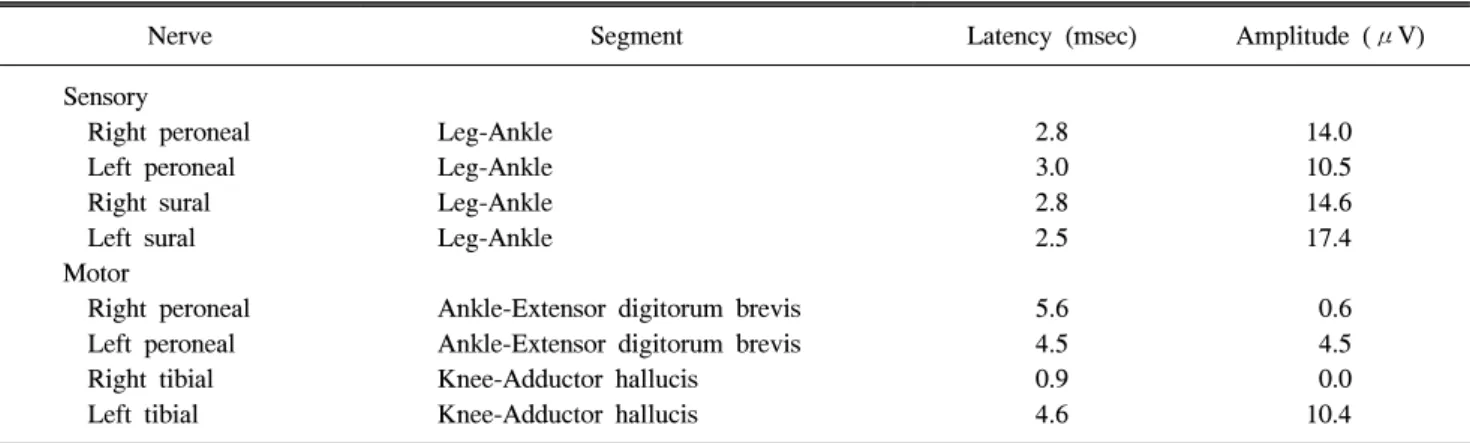
Table 1. Results of Sensory and Motor Nerve Conduction Studies

Nerve Segment Latency (msec) Amplitude (μV)

Sensory

Right peroneal Leg-Ankle 2.8 14.0

Left peroneal Leg-Ankle 3.0 10.5

Right sural Leg-Ankle 2.8 14.6

Left sural Leg-Ankle 2.5 17.4

Motor

Right peroneal Ankle-Extensor digitorum brevis 5.6 0.6

Left peroneal Ankle-Extensor digitorum brevis 4.5 4.5

Right tibial Knee-Adductor hallucis 0.9 0.0

Left tibial Knee-Adductor hallucis 4.6 10.4

flexes were not showed. Laboratory tests were carried out to rule out electrolyte imbalance by pan-hypopituitarism.

The results were within normal limits, with serum sodium level was 135 mmol/L, serum potassium level at 4 mmol/L, and serum chloride at 98 mmol/L. We performed brain CTs and consulted the department of neurosurgery to rule out aggravation of hydrocephalus as it showed no evidence of progression of hydrocephalus (Fig. 1E). The adjustment of VP shunts was carried out alongside consultation. Nonethe- less, symptoms did no improved and remained unchanged.

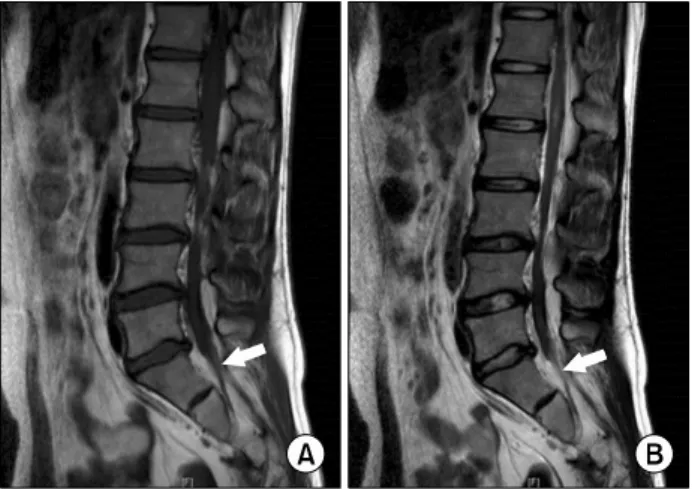
To rule out lumbosacral radiculopathy, an electrodiagnostic test was carried out. As the results suggested lumbosacral radiculopathy, mainly at L5 or S1, further imaging studies were recommended (Table 1, 2). Further investigation through lumbar spine MRI showed a tethered cord at S1 with signal change (Fig. 2).

The patient was then recommended to undergo detether-

ing surgery. His surgery was done successfully and there

was significant improvement to his lower back pain with

radiating pain, gait abnormalities and stool incontinence. At

(4)

Fig. 2. Sagittal MRI in T1-weighted (A) and T2-weighted im- ages (B) showed that the caudal end of the spinal cord is anch- ored around the sacral area (arrow).

6 months follow up, he did not feel pain and could control the stool, but continued to show limping gait with genu recurvatum.

DISCUSSION

TCS is a clinical entity defined by its broad spectrum of abnormalities due to a longitudinal traction of the conus medullaris. It has been discovered through several studies that tethering of the filum terminale disturbs blood flow to the spinal cord, resulting in hypoxia and cellular dysfunc- tion or death.

2

In most cases, TCS presents itself at birth or during childhood through relevant spinal anomalies such as spina bifida, meningomyelocele, lipomeningomyelocele etc. The above abnormalities are often accompanied by cu- taneous manifestations that include lipomas, lumps, he- mangiomas, nevi, etc., suggesting that inspection and pal- pation of the spine is essential. However, most ATCS cases show different presentations to those with childhood TCS.

3,4

In adults, lower back and leg pain were predom- inant features rather than cutaneous stigmata. The pain is often described as insidiously arising, burning and sharp that may diffuse over one or both lower extremities. As demonstrated by our case, it is easy to confuse ATCS as pure lumbosacral radiculopathy. But the true radicular pain that might be misconstructed as discogenic is rare.

4

Other symptoms that should be kept in mind are motor weakness, sensory change, sphincter dysfunction. Presenting symp- toms of upper trunk pain was only reported in a small num-

ber of cases.

5

With regards to the above, the difference in symptoma- tologies suggest that the underlying pathology of the two syndromes might be different.

2

During gestational period, the growth rate of a vertebral column is faster than that of the spinal cord. For this reason, a higher location of the conus medullaris than the L2 vertebrae is considered normal. However, due to various pathologies relating to cell division or fusion at any time of embryology, a low positioning of the conus medullaris below the L2 vertebrae may occur which may lead to childhood TCS. On the other hand, patients with less severely attracted spinal cord can remain asymptomatic during childhood. The degree of trac- tion correlates with the degree of the cellular dysfunction and the capability of recovery.

2

When several factors such as growth spurt, worsening of spinal stenosis and increase in physical activity, which all aggravate the stretching ef- fect of the cord, develop, the symptoms occur later.

5

Due to its rarity, the diagnosis of ATCS is a difficult task to clinicians.

1

In adults, TCS most often presents with nonspecific pain, static motor or sensory deficits, gait diffi- culty, and sphincter disturbances. Except for these rela- tively common symptoms, particular attention should be paid to any skin abnormalities, scoliosis, and muscle weakness. One study reported that it takes on averages 8 years from symptom development the the final diagnosis.

6

It is identified that the severity of the traction is related to the time taken to be diagnosed.

The natural history of ATCS has not been well known until today. Several factors were identified by Yamada et al., that contributed towards the delayed onset of symptoms in patients with less severe traction. These include 1) in- creasing fibrosis of the filum leading to a progressive in- crease in lumbosacral cord traction; 2) a growth spurt caus- ing an increase in spinal cord tension; 3) an increase in physical activity and 4) development of spinal stenosis that can restrict movement and may accentuate tension.

4

MRI, due to its ability to show a low-lying conus me-

dullaris and a thickened filum terminale, is the diagnostic

modality of choice.

5

A conus medullaris positioned above

L2 is considered a normal finding and filum terminale low-

er than 2 mm is considered abnormal, especially in

children. Physical examination including neurological ex-

amination should be done and urodynamic studies could be

helpful.

1

Additionally, the electrodiagnostic test can mimic

(5)

the degenerative lumbar disease.

In our case, newly developed lower back pain that radi- ated to the right lower extremity was found to be the lead- ing symptom. The absence of any congenital abnormalities and the status of VP shunt insertion due to hydrocephalus caused by TBI confused and delayed final diagnosis.

The treatment of choice is an early surgical approach to relieve tethering of the cord in symptomatic patients, but still considered controversial for asymptomatic patients.

According to one report, the operation has a 90 percent success rate in improving symptoms.

7

A delay in diagnosis and dismissed symptoms over 5 years, however, are asso- ciated with a less favorable prognosis.

1

Overall, early diag- nosis and detethering surgery of symptomatic ATCS pa- tients are very important. Through this case, the point to be considered is that lower back pain and gait disturbance can be chief complaints of ATCS, especially in TBI pa- tients, and that earlier and more accurate diagnosis could be made by close physical examination and electro- diagnostic test.

REFERENCES

1. Hertzler DA, DePowell JJ, Stevenson CB, Mangano FT.

Tethered cord syndrome: a review of the literature from embryology to adult presentation. Neurosurg Focus. 2010;

29: E1

2. Stetler Jr WR, Park P, Sullivan S. Pathophysiology of adult tethered cord syndrome: a review of the literature.

Neurosurg Focus. 2010; 29: E2

3. Yamada S, Siddiqi J, Won DJ, Kido DK, Hadden A, Spitalieri J, et al. Symptomatic protocols for adult tethered cord syndrome. Neurol Res. 2004; 26: 741-744

4. Yamada S, Lonser RR. Adult tethered cord syndrome. J Spinal Disord. 2000; 13: 319-323

5. Pang D, Wilberger Jr JE. Tethered cord syndrome in adults.

J Neurosurg. 1982; 57: 32-47

6. Hüttmann S, Krauss J, Collmann H, Sörensen N, Roosen K. Surgical management of tethered spinal cord in adults:

report of 54 cases. J Neurosurg. 2001; 95: 173-178 7. Lee GY, Paradiso G, Tator CH, Gentili F, Massicotte EM,

Fehlings MG. Surgical management of tethered cord syn-

drome in adults: indications, techniques, and long-term out-

comes in 60 patients. J Neurosurg Spine. 2006; 4: 123-131

수치

Fig.  1.  Serial  coronal  brain  CTs  of  the  hydrocephalus  from  March  2 nd ,  2014  to  April  20 th ,  2016
Table  2.  Results  of  Needle  Electromyography
Fig.  2.  Sagittal  MRI  in  T1-weighted  (A)  and  T2-weighted  im- im-ages  (B)  showed  that  the  caudal  end  of  the  spinal  cord  is   anch-ored  around  the  sacral  area  (arrow).

참조

관련 문서

GDP impact of COVID-19 spread, public health response, and economic policies. Virus spread and public

(1.1 points) According to the passage, which of the following is NOT mentioned as the nature of pain.. ① Pain is not tied to any referent in

W You’re going to have back and neck pain, if you sit like that for a long time4. When you’re sitting, it’s very important to keep the back straight, knees bent, and head

In conclusion, the sling stabilization exercise program for middle-aged women with non-specific low back pain was found to be effective in improving

Abstract: This study was aimed to investigate the adhesion control standards of pain relieving patch (PRP) drugs and to survey it′s adverse effects on the skin of patients

Depending on Tennis Forehand Stroke with elbow pain and without elbow pain Kinematic Analysis of

Comparison of pain scale between the conventional and 2-step needle insertion technique according to the injection area ··· 11... The combination of pain scale and

Sports Massage Using Thumb Pressure on the Effects on Subjective Neck