574 Korean Chem. Eng. Res., 55(4), 574-577 (2017)
https://doi.org/10.9713/kcer.2017.55.4.574 PISSN 0304-128X, EISSN 2233-9558
단 신
Preliminary Study: Comparison of Kinetic Models of Oil Extraction from Vetiver (Vetiveria Zizanioides) by Microwave Hydrodistillation
Heri Septya Kusuma†, Taufik Imam Rohadi, Edwin Fatah Daniswara, Ali Altway and Mahfud Mahfud† Department of Chemical Engineering, Institut Teknologi Sepuluh Nopember, Surabaya, Indonesia 60111
(Received 20 January 2017; Received in revised form 8 April 2017; accepted 25 April 2017)
Abstract − In Indonesia, vetiver oil is one commodity that plays an important role in the country's foreign exchange earnings. Currently, the extraction of essential oil from vetiver still uses conventional methods. Therefore, the aim of this study was to know and verify the kinetics and mechanism of microwave hydrodistillation of vetiver based on two mod- els. In this study, microwave hydrodistillation was used to extract essential oils from vetiver. The extraction was carried out in nine extraction cycles of 20 min to 3 hours. The rate constant, the equilibrium extraction capacity, and the initial extraction rate were calculated using the two models. Kinetics of oil extraction from vetiver by microwave hydrodistil- lation proved that the extraction process was based on the second-order extraction model. The second-order model was satisfactorily applied, with high coefficients of correlation (R2 = 0.9427), showing that it well described the process.
Key words: Extraction, Kinetic model, Microwave hydrodistillation, Vetiver oil, Vetiveria zizanioides
1. Introduction
Vetiver, included in the family of Graminae, whose plants are found in soil composed of a number of fine roots, has pale yellow or gray to dark red color. From the fine roots leaf stalks stick out of about 1.5 to 2 meters in length. The leaves are slightly rigid, green to gray, length is about 75~100 cm and does not contain essential oil. Vetiver comes from India, Burma and Sri Lanka. In Indonesia, vetiver is cultivated in Garut, West Java. Until now vetiver has been a plant that has been relied upon by Garut residents as a source of income.
Vetiver oil for Indonesia is a commodity that plays an important role in the country's foreign exchange earnings. In international trade, Indonesia is a major producer of vetiver oil, which is the third rank after Haiti and Bourbon [1]. Every year there is a fluctuation of the volume of exports for vetiver oil from Indonesia. Fluctuations in export volumes are mainly due to the quality of vetiver oil which is not in accordance with market demand [2]. The foreign markets for prod- ucts of vetiver oil from Indonesia include, among others, Japan, China, Singapore, India, Hong Kong, USA, UK, France, Germany, Belgium, Switzerland, and Italy [3].
Essential oils that come from vetiver play an important role as an export commodity in many countries and have been widely used in the cosmetics, perfume, and food industries [4]. The use of vetiver oil as fixative in several fragrances with an odor contributor in bases, such as rose and chypre, is highly appreciated by the perfume industry.
Additionally, vetiver oil is also used in the pharmaceutical industry,
because it has some biological properties, such as being antifungal [5], anticancer [6], antioxidant [7], and anti-inflammatory [8].
The main methods to obtain essential oils from the plant materials are hydrodistillation, steam distillation, solvent extraction, and supercrit- ical fluid extraction (SC-CO2) [9]. Supercritical fluid extraction (SC- CO2) has been used to obtain the volatile oil from vetiver [4,9]. Among these methods, hydrodistillation has been the most common approach to extract the essential oils from the medicinal herbs and plants [10,11,12]. Alternative methods, employing microwaves, have been developed to shorten extraction time, improve the extraction yield, and reduce the operational costs. Microwave-assisted procedures for isolating essential oils have become attractive for use in laboratories and industry. The advantages of using microwave energy for oil extraction include effective heating, fast energy transfer, fast response to process heating control, fast start-up, with increased production and elimination of some process steps.
However, to the best of the authors’ knowledge, no work has been published on the extraction of essential oil from vetiver species using microwaves for heating. Therefore, the objective of this study was to investigate the potential of microwave hydrodistillation for the extraction of essential oils from vetiver. In this study, we also com- pared the suitability of two models in order to describe the kinetics of microwave hydrodistillation of the vetiver. Thus, the efficiency of each model was checked by comparing experimental data with calcu- lated parameters such as the rate constant, the equilibrium extraction capacity, and the initial extraction rate.
2. Materials and Methods
2-1. Raw materials
The main raw material used in this study was vetiver (Vetiveria
†To whom correspondence should be addressed.
E-mail: [email protected]; [email protected] This is an Open-Access article distributed under the terms of the Creative Com- mons Attribution Non-Commercial License (http://creativecommons.org/licenses/by- nc/3.0) which permits unrestricted non-commercial use, distribution, and reproduc- tion in any medium, provided the original work is properly cited.
Preliminary Study: Comparison of Kinetic Models of Oil Extraction from Vetiver (Vetiveria Zizanioides) by Microwave Hydrodistillation 575
Korean Chem. Eng. Res., Vol. 55, No. 4, August, 2017 zizanioides) that comes from Garut, West Java, Indonesia. All other
chemicals and solvents used were of analytical grade.
2-2. Microwave hydrodistillation of vetiver oil
A domestic microwave oven (EMM2308X, Electrolux, 23 L, 800 W;
variable in 200 W increments, 2.45 GHz) was modified for micro- wave hydrodistillation operation. The dimensions of the PTFE-coated cavity of microwave oven were 48.5 cm × 37.0 cm × 29.25 cm. Eighty grams of vetiver samples were placed in a 1 L flask containing deion- ized water (200 mL). The flask was set up within a microwave oven cavity, and a condenser was used on the top (outside the oven) to col- lect the extracted essential oils (Fig. 1). The microwave oven was operated at 450 W power level for a period of 3 h. This period was sufficient to extract all the essential oils from the sample. The extraction was carried out in nine extraction cycles of 20 min to 3 hours. To remove water, the extracted essential oils were then dried over anhy- drous sodium sulfate, weighed and stored in amber vials at 4oC until they were used for analysis. The yield of vetiver oil was found by the following equation:
(1) where y is the vetiver oil yield (%, w/w), V is the weight of extracted vetiver oil (g) and W is the weight of vetiver (g).
2-3. Kinetic model
2-3-1. First-order extraction model
The pseudo first-order equation of Lagergren [13-15] can be rewrit- ten in its differential form as follows:
(2) where k1 is the first-order extraction rate constant (min-1), and t (min) the time.
Equation (2) was integrated with application of the boundary con- ditions Ct = 0 at t = 0 and Ct = Ct at t = t:
(3)
Equation (3) can be rearranged to obtain the linear form:
log(CS− Ct) = log(CS) - t (4)
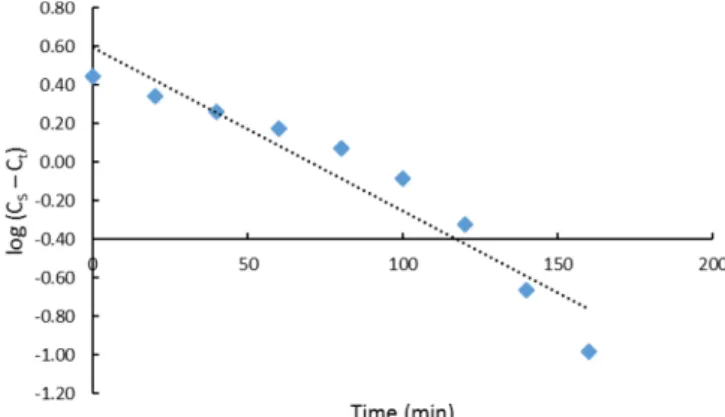
The plots of log(CS− Ct) against t for different experimental con- ditions were analyzed to allow a calculation of the constant k1 from the slope and the equilibrium extraction capacity CS (concentration obtained at saturation) from the intercept.
2-3-2. Second-Order Extraction Model [16]
The second-order kinetic equation for the extraction rate can be written as follows:
(5) where k2 is the second-order extraction rate constant (L g-1 min-1), CS the extraction capacity (concentration of essential oil at saturation in g L-1) and Ct is the concentration of vetiver oil at any time t (min).
By considering the initial and boundary conditions, t = 0 to t and Ct
= 0 to Ct, the integrated rate law for a second-order extraction was obtained:
(6)
By transforming Eq. (6), a linear form shown in Eq. (7) can be obtained and the extraction rate can be written as Eq. (8):
(7)
(8)
The initial extraction rate, h, as Ct/t when t approaches 0, can be defined as:
(9) and, the concentration of essential oil at any time can be expressed after rearrangement as:
(10)
The initial extraction rate, h, the extraction capacity, CS, and the second-order extraction rate constant, k, can be determined exper- imentally from the slope and intercept by plotting t/Ct versus t.
3. Results and Discussion
When the vetiver was extracted with water as a solvent, the increase in concentration of the essential oil was rapid at the beginning of the process, then slowed with time (Fig. 2). The evolution of the quan- tity of essential oil extracted from vetiver is displayed in Fig. 2 in the plots of concentration versus time. In Fig. 2, the rate of extraction was increased as the time of extraction increased until it reached a
y V
W--- 100×
=
dCt
---dt =k1(CS–Ct)
CS CS–Ct ---
⎝ ⎠
⎛ ⎞
ln =k1t
k1 2.303 ---
dCt
---dt =k2(CS–Ct)2
Ct CS2k2t 1 C+ Sk2t ---
=
t Ct --- 1
k2CS2 --- t
CS --- +
= Ct
---t 1
1/k2CS2 ( ) t/C+( S) ---
=
h=k2CS2
Ct t
(1/h) t/C+( S) ---
= Fig. 1. Schematic representation of microwave hydrodistillation appara-
tus used in this study.
576 Heri Septya Kusuma, Taufik Imam Rohadi, Edwin Fatah Daniswara, Ali Altway and Mahfud Mahfud
Korean Chem. Eng. Res., Vol. 55, No. 4, August, 2017
plateau or was constant after 140 min of extraction. 0.67% extract- able essential oil was obtained in 140 min of extraction until it became a plateau (0.68%). These experimental results were used to check two kinetic models.
According to Fig. 2, the rate of extraction was fast at the begin- ning and slow until the end of the extraction process. The extraction process takes place in three different steps: an equilibrium phase where the phenomena of solubilization and partition intervene, in which the substrate is removed from the outer surface of the particle at an approximately constant velocity. Then, this stage is followed by an intermediary transition phase to diffusion. The resistance to mass transfer begins to appear in the solid-liquid interface; in this period the mass transfer by convection and diffusion prevails. In the last phase, the solute must overcome the interactions that bind it to the matrix and diffuse into the extracting solvent. The extraction rate in this period is low, characterized by the removal of the extract through the diffusion mechanism. This point is an irreversible step of the extraction process; it is often regarded as the limiting step of the pro- cess [17]. Diffusion rate decreased as the time of extraction increased due to the high solute concentration in liquid at the third stage. Even though the extraction time increased after the maximum vetiver oil was extracted, it did not show any changes or significant in amount of essential oil extracted. The trend of vetiver oil recovery was mea- sured at extraction time of 100 min (71.27%), 140 min (26.77%) and 180 min (1.96%).
3-1. First-order extraction model
The plot of log (CS- Ct) versus t (Fig. 3) shows that the extraction of essential oil of vetiver can be represented in a linear form accord- ing to the first-order model. From the slope and the intercept of the plot, k1, CS, and the coefficient of determination, R2, were calculated (Table 1). These results presented generally low coefficients of deter- mination. Furthermore, as shown in Fig. 3, the linearization is better at the beginning of the process than at a later stage. Thus, the process does not seem to follow the evolution of a first-order kinetic model of extraction, although the beginning of the extraction agrees with this order.
3-2. Second-order extraction model
The same data were analyzed by using a second-order kinetic model of extraction. The initial extraction rate, h, the extraction capacity, CS, the second-order extraction rate constant, k, and coefficient of determination, R2, were calculated experimentally by referring to the linear curve in Fig. 4. From graph t/Ct versus time, slope is equal to 1/CS, and intercept is equal to 1/h. The data are shown in Table 2.
Compared with the first-order extraction model, the second-order model presents higher coefficients of determination and may be used to explain the microwave hydrodistillation process. However, two phenomena globally occur during microwave hydrodistillation of veti- ver in which maximum extraction takes place: an intense dissolution during the initial first stage, and a strong scrubbing of the most soluble molecules (normal extraction) in the second stage. The second stage is much slower because of the problems of transfer of other molecules and of the modification of the solid structure. This stage corresponds Fig. 2. The concentration of vetiver oil in the solution at any time,
Ct (g L-1) versus time (min).
Fig. 3. First-order extraction kinetics of vetiver.
Table 1. Extraction data fit to the first-order kinetic model of microwave hydrodistillation of vetiver
CS (g L-1) k1 (L g-1 min-1) R2
3.9102 0.0196 0.9180
Fig. 4. Second-order extraction kinetics of vetiver.
Table 2. Extraction data fit to the second-order kinetic model of microwave hydrodistillation of vetiver
CS (g L-1) k2 (L g-1 min-1) h (g L-1 min-1) R2
6.2189 0.0007 0.0290 0.9427
Preliminary Study: Comparison of Kinetic Models of Oil Extraction from Vetiver (Vetiveria Zizanioides) by Microwave Hydrodistillation 577
Korean Chem. Eng. Res., Vol. 55, No. 4, August, 2017 essentially to an external diffusion that is concerned with the remain-
der of the soluble matter.
For this study, the maximum yield of oil extracted by microwave hydrodistillation was higher compared to conventional hydrodistilla- tion. Danh et al. (2009) observed that vetiver oil yield extracted by conventional hydrodistillation for 12 hours was 0.31 0.01%. The fundamentals of microwave hydrodistillation process are different from those of conventional methods because the extraction occurs as the result of changes in the cell structure caused by electromagnetic waves. In microwave hydrodistillation, the process acceleration and high extraction yield may be the result of a synergistic combination of two transport phenomena: heat and mass gradients working in the same direction [18]. On the other hand, the mass transfer occurs from inside to the outside in conventional extractions, although the heat transfer occurs from the outside to the inside of the substrate (Fig. 5).
In addition, although the heat is transferred from the heating medium to the interior of the sample in conventional extraction, the heat is dissipated volumetrically inside the irradiated medium in microwave hydrodistillation.
4. Conclusions
The kinetics of microwave hydrodistillation of vetiver was explored experimentally, and the results were checked by using two models.
The established theoretical equations were used to correlate the experi- mental data to the kinetic model for the extraction. The results proved that the extraction of essential oil from vetiver followed a second- order model. Compared with conventional hydrodistillation, micro- wave hydrodistillation for the extraction of essential oils from veti- ver is a better method. The time used in microwave hydrodistillation
is much shorter than that of conventional hydrodistillation, while higher extraction yield is obtained in microwave hydrodistillation than in conventional hydrodistillation.
References
1. Wakindiki, I. C. and Ben-Hur, M., Soil Sci. Soc. Am. J., 66, 897 (2002).
2. Heyne, K., Useful Plants of Indonesia Volume 1 (in Bahasa Indonesia). Research and Development Centers, Ministry of Forestry, Jakarta(1987).
3. Indrawanto, C., The Financial Analysis of Agro-industry of Vetiver Extraction in Garut, West Java (in Bahasa Indonesia), Research Institute for Medicinal and Aromatic Plants, Bogor(2006).
4. Talansier, E., Braga, M. E. M., Rosa, P. T. V., Paolucci-Jeanjean, D.
and Meireles, M. A. A., J. Supercrit. Fluids, 47, 200(2008).
5. Sridhar, S. R., Rajagopal, R. V., Rajavel, R., Masilamani, S. and Narasimhan, S., J. Agric. Food Chem., 51, 7596(2003).
6. Chen, F., Wang, X. and Kim, H. J., Antioxidant, anticarcinogenic and termiticidal activities of vetiver oil, Proceeding of Third Interna- tional Vetiver Conference, October 2003, Guangzhou, China(2003).
7. Kim, H. J., Chen, F., Wang, X., Chung, H. Y. and Jin, Z., J. Agric.
Food Chem., 53, 7691(2005).
8. Jagtap, A. G., Shirke, S. S. and Phadke, A. S., J. Ethnopharmacol., 90, 195(2004).
9. Danh, L. T., Mammucari, R., Truong P. and Foster, N., Chem.
Eng. J., 155(3), 617(2009).
10. Kusuma, H. S. and Mahfud, M., RSC Adv., 7, 1336(2017).
11. Kusuma, H. S. and Mahfud, M., J. Appl. Res. Med. Aromat. Plants, 4, 46(2017).
12. Kusuma, H. S. and Mahfud, M., J. Appl. Res. Med. Aromat.
Plants, 4, 55(2017).
13. Lagergren, S., K. Sven. Vetenskapsakad. Handl., 24(4), 1(1898).
14. Reddad, Z., Gerente, C., Andres, Y. and Le Cloirec, P., Environ.
Sci. Technol., 36, 2067(2002).
15. Ho, Y.-S., Scientometrics, 59(1), 171(2004).
16. Ho, Y. -S., Adamou, H. -O. H., Fauduet, H. and Porte, C., Sep.
Purif. Technol., 45, 169(2005).
17. Raynie, D. E., Extraction. In: Wilson ID, Adlard ER, Cooke M, Poolie CF (eds) Encyclopedia of separation science, Academic Press, San Diego(2000).
18. Chemat, F. and Cravotto, G., Microwave-assisted extraction for bioactives compounds: theory and practices, Springer, New York (2013).
Fig. 5. Heat and mass transfer mechanisms in microwave hydro- distillation and conventional hydrodistillation of vetiver oil.