699
돌파요로감염에 미치는 영향
The Effect of Renal Scarring on Spontaneous
Resolution and Breakthrough Infection in Children with Vesicoureteral Reflux
Jong Ho Jeon, Kyung Hun Lee1, Jae Shin Park
From the Departments of Urology and 1Pediatrics, College of Medicine, Daegu Catholic University, Daegu, Korea
Purpose: Primary treatment of children with vesicoureteral reflux (VUR) is antibiotic prophylaxis until the reflux resolves. But, it is not easy to determine in which patients the reflux resolves. We sought to determine whether renal scarring could help to predict the prognosis of reflux regarding reflux resolution and breakthrough infection.
Materials and Methods: A total of 90 children, 54 boys and 36 girls, mean age 15.1 (range: 1-98) months, with VUR were analyzed retrospectively.
Eighty-six presented with febrile urinary tract infection (UTI) and 4 with prenatal hydronephrosis. Technetium Tc 99m dimercaptosuccinic acid (DMSA) scans were performed at 4 months after resolution of a febrile UTI. All children were initially treated with antibiotic prophylaxis (BactrimⓇ; TMX-SMX 2 mg/kg/day) and 40 underwent antireflux surgery. Median follow-up was 26.1 (range: 6-52) months. Reflux grade was defined by use of the International Classification System. We analyzed the incidence of renal scarring according to reflux grade, reflux resolution, and reason for antireflux surgery.
Results: Normal DMSA scans were documented in 63 (70%) children and renal scarring in 27 (30%). Children with renal scarring presented high grade (III-V) VUR. VUR with renal scarring was not resolved sponta- neously and increased the risk for breakthrough UTI. Renal scarring could help to predict the prognosis of reflux regarding reflux resolution and breakthrough infection. VUR grade, however, did not help to predict the prognosis of reflux.
Conclusions: We conclude that VUR with renal scarring has a low spontaneous resolution rate and a high risk for breakthrough UTI. This information would be helpful when counseling the families of patients with VUR. (Korean J Urol 2009;50:699-703)
Key Words: Vesico-ureteral reflux, Technetium Tc 99m dimercaptosuccinic acid, Urinary tract infections
Korean Journal of Urology Vol. 50 No. 7: 699-703, July 2009
DOI: 10.4111/kju.2009.50.7.699
대구가톨릭대학교 의과대학 비뇨기과학교실,
1소아청소년과학교실
전종호ㆍ이경훈1ㆍ박재신
Received:February 23, 2009 Accepted:June 3, 2009
Correspondence to: Jae Shin Park Department of Urology, College of Medicine, Daegu Catholic University, 3056-6, Daemyeong4- dong, Nam-gu, Daegu 705-718, Korea
TEL: 053-650-4662 FAX: 053-623-4660 E-mail: [email protected]
Ⓒ The Korean Urological Association, 2009
서 론
방광요관역류의 치료에서 우선적으로 고려되는 것은 예 방적인 약물 치료이다. 이러한 치료방침은 환아가 성장하 면서 역류가 자연 소실될 수 있고, 감염이 동반되지 않은
저압의 역류는 신장에 악영향을 미치지 않는다는 여러 임 상적 관찰 결과에 근거하고 있다.1-4
일반적으로 방광요관역류 1급과 2급은 자연 소실될 가능 성이 매우 높아 약물 요법을 시행하면서 기다리는 것이 바 람직하며, 반면에 5급과 같은 고도역류인 경우에는 역류의 자연 소실 가능성이 극히 낮아 대체로 수술적 교정이 필요
하다는데 큰 이견이 없다.
그러나 3급과 4급 역류의 경우에는 논란이 있으며 이를 평가하기 위한 International Reflux Study5에서도 이 경우 약 물 요법이나 수술적 교정 모두 신반흔의 진행을 효과적으 로 억제할 수 있다는 결론만 보고하고 있다.
이러한 기존의 보고와는 달리, 최근에는 방광요관역류의 임상적 의의에 관한 새로운 관점의 연구들이 보고되고 있 다. 그것은 방광요관역류 자체보다도 돌파요로감염을 쉽게 일으키는 숙주인자의 중요성에 관한 연구이다. Preda 등6은 저등급의 방광요관 역류는 돌파요로감염의 가능성이 거의 없다고 주장하였고 Garin 등7은 저등급의 방광요관 역류에 서는 예방적인 약물요법이 필요 없다고 하였다. 특히 Gerald 등은 방광요관역류를 가진 환아에서 DMSA 신주사 소견의 중요성을 강조하면서 비정상적인 DMSA 신주사소 견은 돌파요로감염의 가능성을 높인다고 하였다.8 이러한 연구들은 요로감염 및 방광요관역류의 예후에 관한 연구의 필요성을 야기한다. 만약 환아의 향후 경과를 예측할 수 있 는 정확한 인자가 있다면 임상의사가 약물치료 없이 관찰 만 할 것인지, 장기간의 약물요법 혹은 수술적 교정을 선택 할 것인지 판단하는 데 도움을 줄 수 있을 것이다.
이에 저자들은 열성 요로감염 및 선천성 수신증으로 내 원하여 원발성 방광요관역류로 진단받고 일정 기간 약물요 법을 시행하면서 추적관찰한 환아들을 대상으로, 처음 내 원 시 DMSA 신동위원소 검사로 시행한 환아의 신반흔 유 무가 역류의 자연 소실 및 환아의 예후를 예측하는데 도움 이 되는지 알아보고자 하였다.
대상 및 방법 1. 대상 및 진단
2002년 1월부터 2007년 12월까지 본원에서 원발성 방광 요관역류로 진단된 환아 중 DMSA 신동위원소 검사를 시행 한 90명을 대상으로 후향적으로 분석하였다. 86명은 열성 요로감염으로 4명은 선천적 수신증으로 방광요관역류가 진단되었다.
열성 요로감염으로 내원한 환아는 최초 진단 시 요검사, 요 배양 검사와 함께, 복부 초음파 및 DMSA 신동위원소검 사를 검사를 하였고 요로감염 치료 후 1개월 경에 배뇨중방 광요도조영술을 시행하여 역류를 확인하였다. 선천성 수신 증으로 내원한 환자는 생후 1개월 경에 배뇨중방광요도조 영술 및 DMSA 신동위원소검사를 시행하여 역류를 확인하 였다. 문진이 가능한 환자에서 배뇨장애의 병력을 조사하 였다.
남아가 54명, 여아가 36명이었으며 진단 시 평균나이는
15.1개월 (1-98)이었다.
2. 치료
모든 환아에서 저용량의 BactrimⓇ (TMX-SMX 2 mg/kg/
day)으로 내과적 치료를 시작하였으며 매년 배뇨중방광요 도조영술 혹은 동위원소 방광조영술을 시행하였다. 배뇨장 애의 병력이 있는 경우는 저용량의 항생제와 함께 항콜린 약물을 투여하였다. 이 중 40명은 내과적 치료 후 여러 가지 이유로 역류교정수술을 하였다.
추적관찰기간은 평균 26.1개월 (6-52)이었고 내과적 치료 만 한 경우는 최소 2년 이상 관찰하였다. 역류교정 수술을 한 경우 내과적 치료 기간은 평균 11.7개월 (1-52)이었다.
3. 역류와 신반흔의 분석
방광요관역류의 정도는 국제 소아역류연구회의 방광요 관역류 등급 분류에 따라 5단계로 분류하였으며, 양측성인 경우는 심한 쪽의 등급으로 표시하였다.
신반흔은 열성요로감염 후 최소 4개월 이상 경과한 후 DMSA 신동위원소검사에서 섭취결손을 보이는 경우로 정 의하였고, 선천성 수신증으로 내원한 경우는 생후 1개월에 시행한 DMSA 신동위원소검사 소견을 따랐다.
진단 당시 대상 환아에서 역류 정도는 1급이 7명, 2급이 16명, 3급이 34명, 4급이 23명, 5급이 10명이었다.
4. 분석 방법
대상 환아의 신반흔 유무, 역류의 정도, 수술적 교정 및 역류의 자연소실 유무 등을 조사하여 비교분석하였다. 통 계프로그램은 SPSS ver 12.0을 사용하였다.
통계학적 유의성은 Fisher's exact test를 이용하여 검정하 였고 p값이 0.05 미만인 경우를 유의한 것으로 판정하였다.
결 과
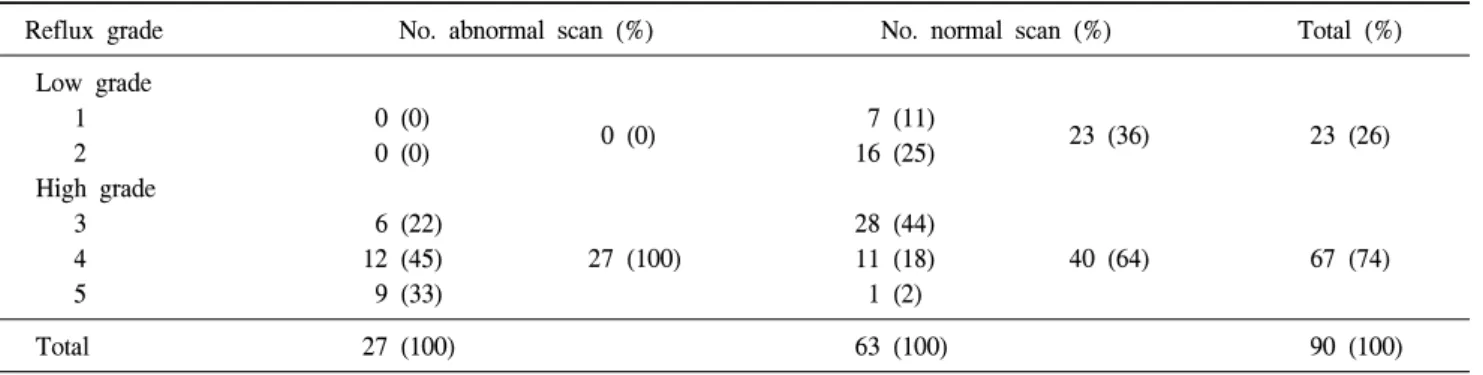
전체 90명 중 63명 (70%)은 DMSA 신동위원소검사에서 정상소견이었고 27명 (30%)은 신반흔이 관찰되었다. 환아 역류의 정도를 신반흔 유무와 비교하였을 때 방광요관역류 3급 이상의 고등급 역류를 보인 67명의 환아 중에서 신반흔 이 있는 경우는 27명이었고, 신반흔이 없는 경우는 40명이 었다. 1급 및 2급의 저등급 방광요관역류를 보인 23명 중에 서는 신반흔은 한 명도 관찰되지 않았다 (Table 1).
내과적 치료만 시행한 환아는 50명이었는데 이 중 4명이 신반흔이 있었다. 신반흔이 없는 46명에서는 32명이 방광 요관역류가 자연소실 되었고, 7명에서 호전되었으며 7명은 방광요관역류의 정도가 변화 없었다. 신반흔이 있는 4명에
Table 3. Correlation between VUR grade and prognosis of reflux (p=0.249)
Reflux grade Persistent Improved Resolution 1
2 3 4 5
1 1 5 1 0
0 3 3 3 1
6 10 13 3 0 VUR: vesicoureteral reflux
Table 1. Correlation between reflux grade and renal scarring (p<0.0001)
Reflux grade No. abnormal scan (%) No. normal scan (%) Total (%)
Low grade 1 2 High grade 3 4 5
0 (0) 0 (0)
6 (22) 12 (45) 9 (33)
0 (0)
27 (100)
7 (11) 16 (25)
28 (44) 11 (18) 1 (2)
23 (36)
40 (64)
23 (26)
67 (74)
Total 27 (100) 63 (100) 90 (100)
Table 4. Correlation between VUR grade and breakthrough UTI (Spearman's correlation coefficient=0.219)
Grade Breakthrough UTI
I II III IV V
0 2 8 8 7 VUR: vesicoureteral reflux, UTI: urinary tract infection Table 2. DMSA scan results in children with reflux under
observation or reflux repair
No. abnormal scan (%)
No. normal
scan (%) p-value Observation: n=50
Reflux resolution Reflux improvement No change in reflux Surgery: n=40 Breakthrough UTI No resolution Noncompliance
0 (0) 3 (6) 1 (2)
18 (45) 2 (5) 3 (7)
32 (64) 7 (14) 7 (14)
7 (18) 10 (25) 0 (0)
0.008
0.001
Total 27 63
DMSA: technetium Tc 99m dimercaptosuccinic acid, UTI: urinary tract infection
서는 방광요관역류가 자연소실된 경우는 없었고 3명은 호 전되었고 1명은 방광요관역류의 정도가 변화 없었고, 이는 통계학적으로 유의하였다 (Table 2).
내과적 치료를 시행한 환아 50명에서 방광요관역류의 등 급을 역류의 호전 양상과 분석하였을 때, 방광요관역류의 등급은 방광요관역류의 호전과는 유의한 연관관계가 없었 다 (p=0.249) (Table 3).
수술적 교정은 40명에서 시행하였는데 25명은 돌파요로 감염으로, 12명은 자연소실이 되지 않아서, 3명은 예방적 항생제 치료에 순응이 잘 되지 않아서 시행하였다 (Table 2).
돌파요로감염을 신반흔 유무로 분석하면 신반흔이 있는 경우가 18명으로 45%였고, 신반흔이 없는 경우가 7명으로 18%였으며, 이는 통계학적으로 유의한 차이를 보였다 (p=
0.001) (Table 2).
돌파요로감염을 방광요관역류 등급으로 분석하였을 때 2급에서 2명, 3급에서 8명, 4급에서 8명, 5급에서 7명이 있 었다. 방광요관역류 등급과 돌파요로감염 사이의 연관성을 알아보기 위하여 Spearman's correlation coefficient를 구해보
면, 그 값은 0.219로 상관관계가 있었다 (Table 4).
고 찰
방광요관역류는 전체 소아의 1% 정도에서 발견되며 열 성요로감염을 가진 환아의 25-40%에서 발견된다.9-12 방광 요관역류의 치료는 기본적으로 역류의 자연 소실 가능성에 근거하고 있다. 일반적으로 1급과 2급 저등급 방광요관역 류는 자연소실 가능성이 높아 초기 치료가 예방적 항생제 를 투여하면서 기다리는 것이고, 5급의 고등급 방광요관역 류는 역류의 자연소실 가능성이 극히 낮아 대체로 수술적 교정이 필요하다는 데에 큰 이견이 없다.3,13
한편 방광요관역류를 가진 환자의 30-40%는 역류의 첫
진단 시 신반흔을 가지는 것으로 보고된다.14,15 특히 역류와 신반흔을 가진 역류성 신병변환자의 10-15%는 고혈압으로 발전하며 3-5%는 말기 신병변으로 진행한다고 알려져 있
다.16,17 이러한 좋지 않은 경과로 빠질 가능성이 있는 환아
를 구별하는 것은 매우 중요하다. 만약 이를 예측할 수 있는 정확한 인자가 있다면 임상의사가 장기간의 약물요법을 선 택할 것인지 혹은 수술적 교정을 선택할 것인지 판단하는 데 도움을 줄 수 있을 것이다. 지금까지 알려진 연구결과를 살펴보면 환아의 성별, 역류의 정도, 나이, 배뇨장애 및 이 미 존재하는 신반흔 등이 어느 정도 환아의 향후 임상적인 경과를 판단하는데 도움을 준다고 알려져 있다.18-20 하지만 어떤 환아에서 역류로 인한 해가 없는지 밝히기에는 그 한 계점이 분명히 있다고 하겠다.
과거의 이러한 보고들의 많은 부분은 고등급 역류를 가 지면서 배설성요로조영술에 나타난 신모양의 이상을 신반 흔이라고 판단하고 이를 기초로 한 것이다. 근래에는 신피 질의 영상을 잘 보여주는 DMSA 신주사에 근거한 보고들이 많다. DMSA 신주사는 신우신염과 같은 급성기 요로감염의 진단에도 사용되지만 급성기 수개월 후에 시행하면 볼 수 있는 신반흔을 위한 조사에서도 사용된다.21 이 때 신반흔은 신 외연의 결손으로 나타나거나 신의 부분적인 방사선 섭 취감소로 나타난다.22 저자들은 DMSA 신주사에서 나타난 신반흔 소견을 방광요관역류의 자연소실과 추적관찰 중 일 어나는 돌파감염 위험성과의 상관관계를 조사하였다.
저자들의 연구에서 환아 역류의 정도를 신반흔 유무와 비교하였을 때 신반흔은 방광요관역류 3급 이상의 고등급 역류에서 많았다 (Table 1). 또한 신반흔을 가진 경우 방광 요관역류의 자연소실은 없었고 6%에서만 역류정도의 개선 이 있었다. 반면 신반흔이 없는 경우 64%에서 역류의 자연 소실이 있었고 14%에서 개선이 있었다 (Table 2). 또한 신반 흔을 가진 경우의 27명 중 18명 (67%)에서 돌파요로감염이 있었고 반면 신반흔이 없는 경우의 63명 중 단지 7명 (11%) 에서 돌파요로감염을 보였다 (Table 2).
역류의 정도와 신반흔 유무를 비교한 저자들의 연구결과 는 방광요관역류의 등급이 높으면 DMSA 신주사에서 나타 나는 신반흔의 빈도가 증가한다는 다른 연구자들의 보고와 일치하였다.22-26
또한 신반흔과 방광요관역류의 호전 사이에서도 연관성 이 있는 것으로 나타났다 (p=0.008) (Table 2). 한편 방광요 관역류의 등급은 방광요관역류의 호전과의 연관성이 없는 것으로 나타났는데 (p=0.249) (Table 3), 이는 수술을 하지 않고 추적 관찰한 고등급 역류 환아 대상수가 적어서 통계 분석에 영향을 미쳤기 때문으로 생각된다. 이러한 저자들 의 결과의 한계를 감안하더라도 신반흔이 역류의 자연소실
에 영향을 가진다는 점은 분명하다고 하겠다.
신반흔 유무와 돌파요로감염의 발생과의 관계를 비교한 저자들의 연구는 Gerald 등8의 연구에서와 같이 연관성이 있는 것으로 나타났다 (p=0.001). 저자들은 역류의 정도가 돌파요로감염에 영향을 미칠 수 있다는 가정 하에 그 연관 성을 알아보기 위하여 Spearman's correlation coefficient를 구하였으며, 그 값은 0.219로 상관관계가 있었다. 이는 신반 흔 뿐만이 아니라 역류도 돌파요로감염에 영향을 비친다는 결과이다. Mingin 등8의 보고를 살펴 보면 역류의 정도보다 신반흔이 돌파요로감염에 영향을 미친다고 하였고, 열성요 로감염이 반복되면 신반흔이 점점 더 진행되는 것과 같이, 신반흔은 재발되는 돌파요로감염의 지표로 활용될 수 있다 고 하였다. 한편 Goldman 등27의 보고에서는 역류의 등급이 낮은 경우에는 신우신염은 신반흔과 관련이 없다고 하면서 신 실질의 손상은 재발성 요로감염과 상관관계가 없다고 하였다. 이러한 신반흔이 재발되는 돌파감염에 미치는 생 물학적인 기전은 환아의 숙주요소와 더불어 향후 더 연구 되어야 할 분야로 생각한다.
방광요관역류의 치료방침은 지금까지 잘 알려져 있다.3,5 특히 신반흔을 가진 역류 환아는 신반흔이 향후 더 악화될 가능성이 있고 콩팥기능이 나빠질 가능성이 있기 때문에 더 적극적으로 치료를 한다.13,28-30
저자들은 이러한 기존의 치료 방침을 신반흔을 가진 방 광요관역류 환아에서 후향적으로 분석하여 구체적으로 확 인하였다. 저자들 및 다른 연구자들이 보고한 바와 같이 신 반흔은 향후 재발하는 돌파요로감염과 역류 지속의 한 가 지 원인으로 생각된다. 향후 이에 관한 전향적인 연구가 필 요할 것으로 생각한다. 이러한 정보는 환아의 가족과 돌파 요로감염과 역류지속의 가능성에 대하여 상담하는데 도움 이 될 것으로 생각한다.
결 론
원발성 방광요관역류를 가진 90명의 환아에서 DMSA 신 동위원소 검사를 시행하여 신반흔 유무를 검사한 후 이들 을 추적 조사하였다. 첫 내원 시 신반흔이 있는 방광요관역 류 환아는 역류의 자연소실 가능성이 떨어지고 돌파요로감 염의 위험이 높았다. 이러한 정보는 방광요관역류를 가진 환아의 가족과 상담할 때 도움이 될 것으로 생각한다.
REFERENCES
1. Lenaghan D, Whitaker JG, Jensen F, Stephens FD. The natural history of reflux and long-term effects of reflux on the kidney.
J Urol 1976;115:728-30
2. Skoog SJ, Belman AB, Majd M. A nonsurgical approach to the management of primary vesicoureteral reflux. J Urol 1987;
138:941-6
3. Scholtmeijer RJ. Treatment of vesicoureteric reflux. Results of a prospective study. Br J Urol 1993;71:346-9
4. Smellie JM, Poulton A, Prescod NP. Retrospective study of children with renal scarring associated with reflux and urinary infection. BMJ 1994;308:1193-6
5. Weiss R, Duckett J, Spitzer A. Results of a randomized clinical trial of medical versus surgical management of infants and children with grades III and IV primary vesicoureteral reflux (United States). The International Reflux Study in Children. J Urol 1992;148:1667-73
6. Preda I, Jodal U, Sixt R, Stokland E, Hansson S. Normal dimercaptosuccinic acid scintigraphy makes voiding cystoure- thrography unnecessary after urinary tract infection. J Pediatr 2007;151:581-4
7. Garin EH, Olavarria F, Garcia Neito V, Valenciano B, Compos A, Young L. Clinical significance of primary vesicoureteral reflux and urinary antibiotic prophylaxis after acute pyelonephritis: a multicenter, randomized, controlled study. Pediatrics 2006;117:626-32
8. Mingin GC, Nguyen HT, Baski LS, Harlen S. Abnormal dimercapto-succinic scans predict an increased risk of break- through infection in children with vesicoureteral reflux. J Urol 2004;172:1075-7
9. Woodward A. Vesico ureteric reflux and urinary tract infec- tions in children. Aust Fam Physician 1998;27:1095-7 10. Yang SK, Choi SK. Validity of 99m Tc-dimercaptosuccinic
acid scan for detection of renal scarring. Korean J Urol 1991;
32:61-8
11. Kim KS, Chung KH, Kim KM, Kim IW, Yeon KM, Choi H.
The urologic abnormalities of urinary tract infection in children and their detection. Korean J Urol 1989;30:350-4 12. Yeom MH, Chung SK, Lee KS, Kim KS, Park JS, Ryu DS,
et al. Incidence of vesicoureteral reflux for prepuberty patients in Daegu city and Gyeongbuk area according to the clinical indications, gender and age. Korean J Urol 2005;46:1284-9 13. Elder JS. Guidelines for consideration for surgical repair of
vesicoureteral reflux. Curr Opin Urol 2000;10:579-85 14. Smellie JM, Ransley PG, Normand IC, Prescod N, Edwards
D. Development of new renal scars: a collaborative study. Br Med J 1985;290:1957-60
15. Bellinger MF, Duckett JW. Vesicoureteral reflux: a com- parison of non-surgical and surgical management. Contrib Nephrol 1984;39:81-93
16. Noe HN. The long-term results of prospective sibling reflux screening. J Urol 1992;148:1739-42
17. Walker RD. Renal functional changes associated with vesi-
coureteral reflux. Urol Clin North Am 1990;17:307-16 18. Knudson MJ, Austin JC, McMillan ZM, Hawtrey CE, Cooper
CS. Predictive factors of early spontaneous resolution in children with primary vesicoureteral reflux. J Urol 2007;178:
1684-8
19. Papachristou F, Printza N, Kavaki D, Koliakos G. The characteristics and outcome of primary vesicoureteric reflux diagnosed in the first year of life. Int J Clin Pract 2006;
60:829-34
20. Park SY, Park HY, Woo YN. The factors affecting the outcome after medical management of vesicoureteral reflux.
Korean J Urol 2006;47:994-1000
21. Sweeney B, Cascio S, Velayudham M, Puri P. Reflux nephropathy in infancy: a comparison of infants presenting with and without urinary tract infection. J Urol 2001;166:
648-50
22. Merguerian PA, Jamal MA, Agarwal SK, McLorie GA, Bagli DJ, Shuckett B, et al. Utility of SPECT DMSA renal scanning in the evaluation of children with primary vesicoureteral reflux. Urology 1999;53:1024-8
23. Stokland E, Hellstrom M, Jacobsson B, Jodal U, Sixt R. Renal damage one year after first urinary tract infection: role of dimercaptosuccinic acid scintigraphy. J Pediatr 1996;129:815- 20
24. Scherz HC, Downs TM, Caesar R. The selective use of dimercaptosuccinic acid renal scans in children with vesicoure- teral reflux. J Urol 1994;152:628-31
25. Rushton HG, Majd M, Jantausch B, Wiedermann BL, Belman AB. Renal scarring following reflux and nonreflux pyelo- nephritis in children: evaluation with 99mtechnetium-dimercap- tosuccinic acid scintigraphy. J Urol 1992;147:1327-32 26. Ash JM, McLorie GA. Can DMSA detect early renal injury
in children with vesicoureteral reflux? J Nucl Med 1994;35:
449-50
27. Goldman M, Bistritzer T, Horne T, Zoareft I, Aladjem M. The etiology of renal scars in infants with pyelonephritis and vesicoureteral reflux. Pediatr Nephrol 2000;14:385-8 28. Levit SB, Duckett J, Spitzer A, Walker D, Weiss R, Lebowitz
R, et al. Medical versus surgical treatment of primary vesi- coureteral reflux: a prospective international reflux study in children. J Urol 1981;67:392-400
29. Choi H, Oh SJ, So Y, Lee DS, Lee A, Kim KM. No further development of renal scarring after antireflux surgery in children with primary vesicoureteral reflux: review of the results of 99mtechnetium dimercapto-succinic acid renal scan.
J Urol 1999;162:1189-92
30. Elder JS, Peters CA, Arant BS Jr, Ewalt DH, Hawtrey CE, Hurwitz RS, et al. Pediatric vesicoureteral reflux guidelines panel summary report on the management of primary vesi- coureteral reflux in children. J Urol 1997;157:1846-51