THE KOREAN JOURNAL OF HEMATOLOGY O R I G I N A L A R T I C L E
Additional rituximab-CHOP (R-CHOP) versus involved-field radiotherapy after a brief course of R-CHOP in limited, non-bulky diffuse large B-cell lymphoma: a retrospective analysis
Junshik Hong
1, Ae Jin Kim
1, Jin Sun Park
1, Seok Ho Lee
2, Kyu Chan Lee
2, Jinny Park
1, Sun Jin Sym
1, Eun Kyung Cho
1, Dong Bok Shin
1, Jae Hoon Lee
1Departments of 1Internal Medicine and 2Therapeutic Radiology & Oncology, Gachon University Gil Hospital, Gachon University of Medicine and Science, Graduate School of Medicine, Incheon, Korea
p-ISSN 1738-7949 / e-ISSN 2092-9129 DOI: 10.5045/kjh.2010.45.4.253 Korean J Hematol 2010;45:253-9.
Received on August 5, 2010 Revised on November 8, 2010 Accepted on November 18, 2010
Background
Standard treatment for stage I or non-bulky stage II diffuse large B-cell lymphoma (DLBCL) has been either a brief course of chemotherapy plus involved-field radiotherapy (IFRT) or prolonged cycles of chemotherapy. The introduction of rituximab has necessitated re-evaluation of the treatment for limited disease (LD) DLBCL.
Methods
Thirty-nine LD DLBCL patients (median age, 52 years; range, 24-85) treated with ritux- imab, cyclophosphamide, doxorubicin, vincristine, and prednisolone (R-CHOP) were retrospectively analyzed. Treatment outcomes were evaluated, and toxicity, event-free survival (EFS), and overall survival (OS) were compared according to the treatment and risk factors.
Results
The median follow-up duration was 34.6 months (range, 9.1-65.4). The 3-year EFS and OS were 76.0% and 86.0%, respectively. Among the 36 patients who underwent either 3-4 cycles of R-CHOP followed by IFRT (N=22) or 6-8 cycles of R-CHOP (N=14), there was no difference in the 3-year EFS (79.4% vs. 71.6%, P=0.638) and 3-year OS (85.7%
vs. 92.9%, P=0.732). Severe neutropenia and neutropenic fever were more frequent in patients treated with R-CHOP alone, with 1 treatment-related mortality. Among the IFRT patients, 1 required hospital admission for IFRT-related complications. No events or deaths were reported among patients without adverse risk factors.
Conclusion
The difference in outcomes between the 2 treatment options was not significant. Analysis of treatment outcomes suggested that baseline characteristics and expected toxicities should be considered in LD DLBCL treatment. Further studies are needed to define the optimal treatment in the rituximab era.
Key Words Diffuse large B-cell lymphoma, Radiotherapy, Rituximab
Correspondence to Jinny Park, M.D., Ph.D.
Department of Internal Medicine, Gachon University Gil Hospital, 1198, Guwol-dong, Namdong-gu, Incheon 405-760, Korea Tel: +82-32-460-8209
Fax: +82-32-460-3233 E-mail: [email protected]
Ⓒ 2010 Korean Society of Hematology
INTRODUCTION
Treatment options for diffuse large B-cell lymphoma (DLBCL), the most common type of non-Hodgkin’s lympho- ma [1], differ for patients with limited disease compared to those with advanced disease [2]. Therefore, a clear defi- nition of “limited disease” is required. In previously published studies, limited disease has also been referred to as “localized
disease” [3, 4], and the terms “early-stage” or “low-stage”
have been used. This category of disease is defined as non-Hodgkin’s lymphoma (NHL) of Ann Arbor stage I and non-bulky stage II. Bulky disease is defined as any mass with a maximum diameter greater than 10 cm or any media- stinal mass exceeding 1/3 of the maximum transthoracic diameter [2]. Because patients with bulky stage II lymphoma have a prognosis similar to those with stage III or IV disease, they usually are regarded as having advanced disease [2].
The stage-modified International Prognostic Index (IPI) has proven useful for studies of limited disease in patients with NHL [3, 5]. Adverse risk factors of stage-modified IPI include the following 4 clinical parameters: Eastern Cooperative Oncology Group Performance Status 2 to 4, non-bulky stage II, age >60 years, and elevated level of serum lactose dehydrogenase. Patients with no adverse risk factors have been reported to have an excellent prognosis when treated with 3 cycles of doxorubicin-containing combi- nation chemotherapy plus involved-field radiation therapy (IFRT) [6]. In a study reported by the British Columbia Cancer Agency, the 5-year and 10-year overall survival (OS) rates were 97% and 90%, respectively [5]. Excellent prognosis was achieved regardless of the treatment strategy, including a brief course of combination chemotherapy with cyclo- phosphamide, doxorubicin, vincristine, and prednisolone (CHOP) plus IFRT, in addition to 8 cycles of CHOP [3], or an aggressive combination regimen containing doxor- ubicin [7].
For patients with limited disease NHL and any adverse risk factor, both chemotherapy followed by radiotherapy and chemotherapy alone have been used. These treatment options were based on the results of numerous previous studies [8-11]. In the early 1980s, chemotherapy followed by subsequent radiotherapy was found to be superior to radiotherapy alone, which was the standard treatment at that time [11]. During the same period, chemotherapy alone was also accepted as an effective treatment option for limited disease NHL [8], and a brief course of chemotherapy followed by IFRT was further tested and confirmed to be effective [9, 10].
The emergence of rituximab, a monoclonal antibody to CD20, for clinical treatment has substantially improved the EFS and OS in both elderly [12] and young [13] patients with DLBCL. Addition of rituximab to 3 cycles of CHOP chemotherapy with subsequent IFRT has been evaluated and was shown to be effective in a phase II study [14].
Although the current National Comprehensive Cancer Network Clinical Practice Guidelines for NHL recommends both 3 cycles of rituximab with CHOP (R-CHOP) plus IFRT, and 6-8 cycles of R-CHOP with or without subsequent IFRT [15], the recommendations are based on data and practices of the pre-rituximab era. No study has re-evaluated the 2 treatment options in patients with limited disease DLBCL.
In this study, the efficacy and tolerability of the 2 treatment options in limited disease DLBCL patients treated with R-CHOP were compared.
MATERIALS AND METHODS
Data were collected and reviewed from DLBCL patients treated with R-CHOP at a single institution, Gachon Univer- sity Gil Hospital (GUGH), between June 2004 and September 2009. Patients with Ann Arbor stage I or non-bulky stage II were selected for this study, and were retrospectively analyzed. Patients were included in the study if they had
histological confirmation of DLBCL according to the World Health Organization (WHO) criteria without any previous treatment for the lymphoma. Patients with DLBCL originat- ing from transformation of an indolent lymphoma, with primary involvement of the central nervous system or with human immunodeficiency virus-associated lymphoma were excluded from the analysis. The institutional review board at GUGH granted permission for this retrospective study.
A cycle of R-CHOP consisted of 375 mg/m2 of rituximab, on day 1 of each cycle and a combination of 750 mg/m2 of cyclophosphamide, 50 mg/m2 of doxorubicin and 1.4 mg/m2 of vincristine (maximal dose of 2 mg), all on day 1. Patients also received 100 mg/day of prednisolone PO for 5 days. The immunochemotherapy cycle was repeated every 21 days. Granulocyte colony stimulating factor support was limited to secondary neutropenia prophylaxis.
IFRT consisted of 30-36 Gy for patients achieving a com- plete response (CR), with a boost volume to a maximum of 50-55 Gy for patients failing to achieve a CR, in daily fractions of 1.8 Gy (5 days a week) in predetermined standard ports involving only the lymph node region(s) or organs affected by overt disease and calculated at the midplane of the target volume or at 3-cm depth for the supraclavicular regions. Most IFRT treatments were completed in 4-5 weeks.
The duration of treatment depended on the dose delivered.
Response evaluation for patients with DLBCL was per- formed 3 months after treatment completion by spiral com- puted tomography (CT) of the lymphoma-involved area.
Positron emission tomography-CT could also be used to con- firm the final response status. Responses were evaluated ac- cording to the International Workshop criteria [16]. Follow- up physical examinations and laboratory screenings were performed every 3 months for the first 2 years, then every 6 months for 3 years, and annually thereafter.
EFS was defined as survival free of progression, relapse, or death from lymphoma or treatment-related toxicity. OS was defined as survival free of death from any cause. Survival was calculated using the Kaplan-Meier method and compared by log rank test. Probability values of less than 0.05 were considered statistically significant. Fisher’s exact test was used to compare baseline characteristics between patients treated with subsequent IRFT and those treated with addi- tional R-CHOP. SPSS software version 15.0 (SPSS Inc., Chicago, IL, USA) was used for all statistical analyses.
RESULTS
1. Patients
Among 87 patients treated with R-CHOP therapy, 43 pa- tients had Ann Arbor stage I or II DLBCL (49.4%). Because 4 of the 43 patients had a bulky mass at initial presentation, 39 patients (44.8%) were classified as limited disease DLBCL.
The 4 patients with bulky stage II disease received 6-8 cycles of R-CHOP with (1 patient) or without (3 patients) IFRT.
The median age of the patients with limited disease was 52 years (range, 24-85). Thirty-six of the 39 patients with
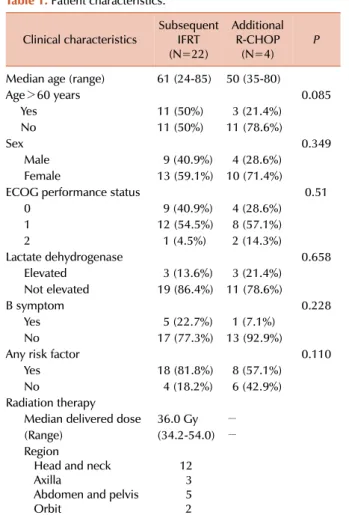
Table 1. Patient characteristics.
Clinical characteristics Subsequent IFRT (N=22)
Additional R-CHOP
(N=4) P
Median age (range) 61 (24-85) 50 (35-80)
Age>60 years 0.085
Yes 11 (50%) 3 (21.4%)
No 11 (50%) 11 (78.6%)
Sex 0.349
Male 9 (40.9%) 4 (28.6%)
Female 13 (59.1%) 10 (71.4%)
ECOG performance status 0.51
0 9 (40.9%) 4 (28.6%)
1 12 (54.5%) 8 (57.1%)
2 1 (4.5%) 2 (14.3%)
Lactate dehydrogenase 0.658
Elevated 3 (13.6%) 3 (21.4%)
Not elevated 19 (86.4%) 11 (78.6%)
B symptom 0.228
Yes 5 (22.7%) 1 (7.1%)
No 17 (77.3%) 13 (92.9%)
Any risk factor 0.110
Yes 18 (81.8%) 8 (57.1%)
No 4 (18.2%) 6 (42.9%)
Radiation therapy
Median delivered dose 36.0 Gy −
(Range) (34.2-54.0) −
Region
Head and neck Axilla
Abdomen and pelvis Orbit
12 35 2
Abbreviations: IFRT, involved-field radiation therapy; R-CHOP, combination immunochemotherapy consisting of rituximab, cyclo- phosphamide, doxorubicin, vincristine, and prednisolone; ECOG, Eastern Cooperative Oncology Group.
stage I or non-bulky stage II disease underwent either 3-4 cycles of R-CHOP followed by IFRT (N=22) or 6-8 cycles of R-CHOP alone (N=14). Three patients belonged to neither treatment group. A male patient with stage I disease and without any adverse factors initially presented with isolated left inguinal lymph node enlargement. He was diagnosed with DLBCL on the basis of an excision biopsy of the lymph node, and after 4 cycles of R-CHOP, he had no lesion that required IRFT because of complete excision. A second 73 year-old male patient with no adverse risk factors, except for age, died of treatment-related mortality (TRM) after the third cycle of R-CHOP. A third patient with non-bulky stage II DLBCL refused further treatment after the third cycle of R-CHOP immunochemotherapy.
There was 1 TRM in the 6-8 R-CHOP cycle group. A 74-year-old female patient who had all 4 adverse risk factors died of severe pneumonia after the sixth cycle of R-CHOP.
The baseline characteristics of both groups were similar (Table 1).
2. Treatment outcomes
During the median follow-up period of 34.6 months (range, 9.1-65.4) for patients with limited disease DLBCL, 8 patients (20.5%) experienced an event and 5 of them (12.8%) even- tually died. Among these 8 patients, the reported events were relapse or progression of the lymphoma (5 patients), TRM (2 patients), 1 death that was not related to treatment or lymphoma, and sudden cardiac arrest due to acute my- ocardial infarction (1 patient).
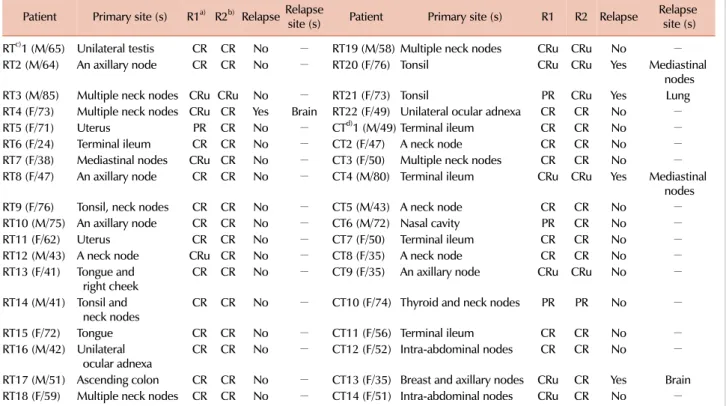
Table 2 shows the disease presentation and treatment out- comes of 36 patients who underwent either subsequent IFRT or additional R-CHOP. Most patients achieved complete re- sponse (CR) or CR unconfirmed (CRu) irrespective of the treatment option. Only 2 patients in each group showed partial response (PR) in the interim analysis performed after the initial 3-4 cycles of R-CHOP and only 1 patient, with thyroid lymphoma, had a PR after additional R-CHOP.
Three patients treated with IFRT and 2 patients treated with additional R-CHOP relapsed. All 3 patients treated with IFRT had relapsed because the lesion was outside the previous radiation field.
The 3-year EFS and OS were 76.0% and 86.0%, respec- tively. The median EFS and OS have not yet been reached (Fig. 1).
3. Comparison of treatment-related toxicities
Patients who underwent 6-8 cycles of R-CHOP alone showed more frequent grade 3 or 4 neutropenia, probably due to the additional cycles of R-CHOP therapy. Among the 36 patients who underwent either treatment option, 8 patients (22.2%) reported neutropenic fever and required admission for intravenous (IV) antibiotic administration (3 of the 22 patients treated with IFRT and 5 of the 14 patients treated with further R-CHOP) during their first 3-4 cycles of R-CHOP. After completion of the initial R-CHOP, 6 of the 14 patients treated with additional immunochemo- therapy reported neutropenic fever that required hospital
admission and IV antibiotics. Four of the 6 patients experi- enced recurrent neutropenic fever after their first 3-4 cycles of R-CHOP, even though they all had a 25% dose reduction of cyclophosphamide and doxorubicin after the previous oc- currence of neutropenic fever. In contrast, among the pa- tients treated with subsequent IFRT, no patient had recurrent neutropenic fever. However, 1 of the 22 patients treated with subsequent IFRT required admission for grade 3 mucosi- tis after radiation (Table 3). There was no TRM in the IFRT group, and there was 1 TRM in the continued immunochem- otherapy group.
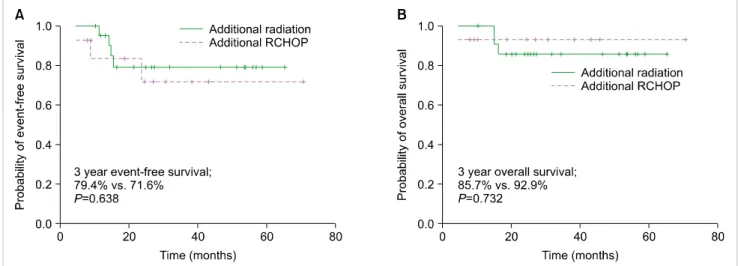
4. Comparison of survival according to treatment option The 3-year EFS among patients who underwent 3-4 cycles of R-CHOP followed by IFRT and the long course of R-CHOP alone was 79.4% and 71.6%, respectively. Therefore, there was no difference in EFS. In addition, the 3-year OS of patients treated with R-CHOP followed by IFRT and the long course of R-CHOP alone was 85.7% and 92.9% re- spectively, and the difference was not significant by log-rank test (Fig. 2).
Table 2. Profile of patients’ tumor response and pattern of relapse.
Patient Primary site (s) R1a) R2b) Relapse Relapsesite (s) Patient Primary site (s) R1 R2 Relapse Relapse site (s) RTc)1 (M/65) Unilateral testis CR CR No − RT19 (M/58) Multiple neck nodes CRu CRu No −
RT2 (M/64) An axillary node CR CR No − RT20 (F/76) Tonsil CRu CRu Yes Mediastinal
nodes
RT3 (M/85) Multiple neck nodes CRu CRu No − RT21 (F/73) Tonsil PR CRu Yes Lung
RT4 (F/73) Multiple neck nodes CRu CR Yes Brain RT22 (F/49) Unilateral ocular adnexa CR CR No −
RT5 (F/71) Uterus PR CR No − CTd)1 (M/49) Terminal ileum CR CR No −
RT6 (F/24) Terminal ileum CR CR No − CT2 (F/47) A neck node CR CR No −
RT7 (F/38) Mediastinal nodes CRu CR No − CT3 (F/50) Multiple neck nodes CR CR No − RT8 (F/47) An axillary node CR CR No − CT4 (M/80) Terminal ileum CRu CRu Yes Mediastinal
nodes
RT9 (F/76) Tonsil, neck nodes CR CR No − CT5 (M/43) A neck node CR CR No −
RT10 (M/75) An axillary node CR CR No − CT6 (M/72) Nasal cavity PR CR No −
RT11 (F/62) Uterus CR CR No − CT7 (F/50) Terminal ileum CR CR No −
RT12 (M/43) A neck node CRu CR No − CT8 (F/35) A neck node CR CR No −
RT13 (F/41) Tongue and
right cheek CR CR No − CT9 (F/35) An axillary node CRu CRu No −
RT14 (M/41) Tonsil and
neck nodes CR CR No − CT10 (F/74) Thyroid and neck nodes PR PR No −
RT15 (F/72) Tongue CR CR No − CT11 (F/56) Terminal ileum CR CR No −
RT16 (M/42) Unilateral
ocular adnexa CR CR No − CT12 (F/52) Intra-abdominal nodes CR CR No −
RT17 (M/51) Ascending colon CR CR No − CT13 (F/35) Breast and axillary nodes CRu CR Yes Brain RT18 (F/59) Multiple neck nodes CR CR No − CT14 (F/51) Intra-abdominal nodes CRu CR No −
a)R1 denotes tumor response after initial 3-4 cycles of immunochemotherapy, b)R2 denotes response after completion of additional immunochemotherapy or radiotherapy, c)RT denotes patient treated with subsequent radiotherapy, d)CT denotes patient treated with additional immunochemotherapy.
Abbreviations: CR, complete response; CRu, CR-unconfirmed; PR, partial response.
Fig. 1. Kaplan-Meier curves of (A) event-free survival and (B) overall survival in all 36 patients with stage I or non-bulky stage II diffuse large B-cell lymphoma.
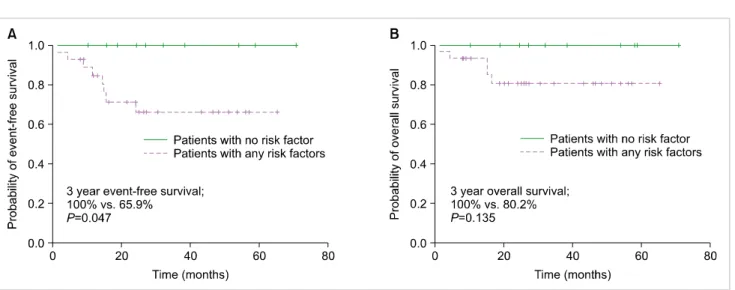
5. Comparison of survival according to adverse risk factors Among limited disease DLBCL patients, 11 had no adverse risk factors. They did not experience any events, and they were all alive at the time of analysis. In contrast, patients with any of the adverse risk factor had a 3-year EFS of 65.9% (P=0.047) and a 3-year OS of 80.2% (P=0.135) (Fig.
3). Further detailed comparisons of survival according to stage-modified IPI score (e.g., 0 vs. 1, 2 vs. 3, 4 or 0-2
vs. 3, 4, etc.) were not possible because of the limited number of events and deaths.
DISCUSSION
The results of this study showed no significant difference in survival between the 2 commonly used treatment options
Table 3. Profile of adverse events during treatment.
Reported adverse event Subsequent
IFRT (N=22) Additional R-CHOP (N=14) Cumulative hematologic
toxicity By CTCAE v.3.0 N (%)a) Hemoglobin
Grade 1 Grade 2 Grade 3 Grade 4
13 (59.1) 7 (31.8) 1 (4.5) 1 (4.5)
10 (71.4) 2 (14.3) 2 (14.3) 0 White blood cell count
Grade 1 Grade 2 Grade 3 Grade 4
5 (22.7) 6 (27.3) 5 (22.7) 4 (18.2)
1 (7.1) 1 (7.1) 2 (14.3) 5 (35.7) Absolute neutrophil count
Grade 1 Grade 2 Grade 3 Grade 4
12 (54.5) 2 (9.1) 4 (18.2) 4 (18.2)
2 (14.3) 1 (7.1) 0 11 (78.6) Platelet
Grade 1 Grade 2 Grade 3 Grade 4
17 (77.3) 4 (18.2) 1 (4.5) 0
9 (64.3) 4 (28.6) 1 (7.1) 0 NF during initial 3 to 4
cycles of R-CHOP 3 (13.6) 5 (35.7) Admission due to NF
during additional therapy
0 6 (42.9) 3 patients had already suffered from NF during initial R-CHOP) Admission due to
other cause during additional therapy
1 (4.5); due to IFRT- induced mucositis
0
Treatment related mortality 0 1 (7.1)
a)The sum of the percentages may not be 100 because of rounding.
Abbreviations: IFRT, involved-field radiation therapy; R-CHOP, combination immunochemotherapy consisting of rituximab, cyclo- phosphamide, doxorubicin, vincristine, and prednisolone; CTCAE v.3.0, Common Terminology Criteria for Adverse Events Version 3.0; NF, neutropenic fever.
Fig. 2. Kaplan-Meier survival analysis of (A) event-free survival and (B) overall survival according to treatment options.
for DLBCL. Because the prognosis of patients with limited disease DLBCL is generally good, neither treatment group has yet reached the median EFS or OS in our study. Although the patients in both groups showed tolerable toxicities, com- pared to the patients who underwent IFRT, the patients treated with 6-8 cycles of R-CHOP had more frequent epi- sodes of grade 4 neutropenia and neutropenic fever, which resulted in more hospital admissions for antibiotic treatment.
However, there was no significant difference in TRM.
Previous randomized trials that compared a brief course of CHOP followed by IFRT to CHOP alone have reported conflicting data. Miller et al. reported that 3 cycles of CHOP followed by IFRT was superior to 8 cycles of CHOP alone [3]. In their study, which included 401 patients, the 5-year progression-free survival among patients undergoing CHOP plus IFRT (N=200) and patients undergoing CHOP alone (N=201) was 77% and 64%, respectively (P=0.03), and the 5-year estimates of OS were 82% and 72%, respectively (P=0.02). In contrast, Fillet et al. compared 4 cycles of CHOP (N=277) to 4 cycles of CHOP plus IFRT (N=299) in patients aged more than 60 years with no other adverse risk factors according to the age-adjusted IPI [17]. In their study, patients with bulky stage II disease were included. There was no difference in EFS or OS at 5 years. With a median follow-up time of 7 years, the reported 5-year EFS was 61% for CHOP alone versus 64% for CHOP plus IFRT, and the 5-year OS was 72% for CHOP alone and 68% for CHOP plus IFRT.
IFRT appeared to increase treatment-related toxicity. The 5-year loco-regional failure was 47% without IFRT versus 21% with IFRT. On the basis of these results, both 3-4 cycles of CHOP followed by IFRT and extended cycles of CHOP alone have been used for the treatment of patients with limited disease NHL.
Unlike the previously mentioned randomized studies [3, 17], we retrospectively analyzed data from limited disease DLBCL patients treated with R-CHOP. Therefore, there is the possibility of uneven distribution of patient characteristics.
First, if a patient’s lesions were not easily accessible for
Fig. 3. Kaplan-Meier estimates of (A) event-free survival and (B) overall survival according to adverse risk factors.
radiation field simulation or if severe post-radiation compli- cations were expected, the physician might prefer prolonged R-CHOP to subsequent IFRT. However, if a patient had a high risk of infection, particularly if the patient had already experienced severe neutropenia due to R-CHOP during the first 3-4 cycles, the physician might decide to perform IFRT instead of additional R-CHOP. As shown in Table 2, 12 of the 22 patients (54.5%) treated with IFRT had DLBCL lesions in their neck nodes, tonsils, or axillary nodes. Ocular adnexa (2 patients) are also locations that are easily radiated.
On the other hand, 6 of the 14 patients (42.9%) treated with additional R-CHOP had intestinal lymphomas or in- tra-abdominal lymph node lesions. Despite the location of lesions, 2 patients with intestinal DLBCL underwent sub- sequent IFRT and 6 patients with tonsilar or cervical and/or axillary lymph node DLBCL underwent prolonged R-CHOP instead of IFRT, and they showed good outcomes. Known poor prognosis might be a factor for considering the use of prolonged R-CHOP for treating patients with breast lym- phoma and multiple regional lymphadenopathies [18].
Recurrences are predominantly distant rather than lo- co-regional in patients with DLBCL [19]. Therefore, an at- tempt was made to reduce the rate of relapse in patients with NHL by using an aggressive regimen instead of IFRT.
Reyes et al. of the Groupe d’Etude des Lymphomes del’Adulte (GELA) reported the results of a prospective randomized trial that compared 3 cycles of CHOP followed by IFRT to an aggressive chemotherapy regimen, a combination of doxorubicin, cyclophosphamide, vincristine, bleomycin, and prednisone induction (ACVBP) at 2-week intervals, followed by high-dose methotrexate, etoposide, and cytarabine con- solidation [7]. The patients enrolled in the trial were pre- viously untreated and less than 61 years of age with localized stage I or II aggressive NHL (N=647). The investigators con- cluded that chemotherapy with 3 cycles of ACVBP followed by sequential consolidation was superior to 3 cycles of CHOP plus radiotherapy. A persistent superior EFS (P=0.002) and OS (P=0.01) was found in 574 patients with non-bulky dis-
ease in the study, and regardless of tumor stage and the presence or absence of bulky disease, the results were main- tained in multivariate analysis. The ACVBP studies were performed only with patients who had no adverse risk factors.
Therefore, it is difficult to apply this result to patients with risk of infection or poor performance status. Furthermore, more toxic events were reported in patients who underwent aggressive chemotherapy: 34 episodes of grade 3 infection (11%) and 2 episodes of grade 4 infection (1%) occurred in the chemotherapy group, compared to 4 episodes of grade 3 infection in the chemoradiotherapy group (1%). These results suggest that eradicating microscopic tumors in limited disease lymphomas might not be achieved with 3 cycles of CHOP alone and that the role of IFRT is limited to reducing the local relapse rate. However, for prolonged chemotherapy, the risk of toxicity should be considered according to the individual patient’s situation.
Therefore, whether a short course of systemic therapy is effective for reducing the relapse rate remains unconfirmed.
One study reported that late (≥4 years of disease-free surviv- al) recurrence in patients with DLBCL was characterized by the same clonal abnormalities observed in the primary disease [20]; this finding suggests that chemotherapy failed to eradicate occult disseminated disease. This study, with a long follow up, showed a high late-relapse rate, particularly in patients managed with short courses of chemotherapy.
Considering the median follow-up duration of 4.4 years in the study conducted by Miller et al. [3], such late recurrences cannot be ruled out. In our study, all 3 patients with relapse in the IFRT group showed relapsed tumor outside the radia- tion port. This might support the need for a long duration of systemic therapy to eradicate microscopic disease; how- ever, the number of relapsed patients was too small to analyze.
In our study, although patients treated with 6-8 cycles of R-CHOP tended to be younger and have fewer adverse factors, 6 of the 14 patients eventually required hospital admission. This result suggests that the risk of neutropenic
fever should be considered during additional immunochemo- therapy. Because this study was a retrospective analysis with a limited sample size and a relatively short follow-up period, a better treatment option for limited disease DLBCL patients who are treated with rituximab-based immunochemo- therapy could not be eventually determined.
In conclusion, both subsequent IFRT and additional 3-4 cycles of R-CHOP after 3-4 cycles of R-CHOP immunoche- motherapy showed excellent survival among patients with limited disease DLBCL, if they had no risk factors. Toxicities, particularly the risk of neutropenic fever, should be consid- ered when treating DLBCL patients with rituximab-contain- ing treatment. A prospective study with a larger number of patients should be conducted to determine the optimal treatment strategy for DLBCL patients in the rituximab era.
ACKNOWLEDGMENTS
The authors wish to thank Hyung Sun Kim, RN for her contributions to this work, assistance in data management, and dedicated support to the clinical care of study patients.
REFERENCES
1. Anderson JR, Armitage JO, Weisenburger DD. Epidemiology of the non-Hodgkin’s lymphomas: distributions of the major sub- types differ by geographic locations. Non-Hodgkin’s Lymphoma Classification Project. Ann Oncol 1998;9:717-20.
2. Fisher RI, Miller TP, O’Connor OA. Diffuse aggressive lym- phoma. Hematology Am Soc Hematol Educ Program 2004;221- 36.
3. Miller TP, Dahlberg S, Cassady JR, et al. Chemotherapy alone compared with chemotherapy plus radiotherapy for localized in- termediate- and high-grade non-Hodgkin’s lymphoma. N Engl J Med 1998;339:21-6.
4. Horning SJ, Weller E, Kim K, et al. Chemotherapy with or without radiotherapy in limited-stage diffuse aggressive non-Hodgkin’s lymphoma: Eastern Cooperative Oncology Group study 1484. J Clin Oncol 2004;22:3032-8.
5. Shenkier TN, Voss N, Fairey R, et al. Brief chemotherapy and in- volved-region irradiation for limited-stage diffuse large-cell lym- phoma: an 18-year experience from the British Columbia Cancer Agency. J Clin Oncol 2002;20:197-204.
6. Miller TP. The limits of limited stage lymphoma. J Clin Oncol 2004;22:2982-4.
7. Reyes F, Lepage E, Ganem G, et al. ACVBP versus CHOP plus ra- diotherapy for localized aggressive lymphoma. N Engl J Med
2005;352:1197-205.
8. Cabanillas F, Bodey GP, Freireich EJ. Management with chemo- therapy only of stage I and II malignant lymphoma of aggressive histologic types. Cancer 1980;46:2356-9.
9. Connors JM, Klimo P, Fairey RN, Voss N. Brief chemotherapy and involved field radiation therapy for limited-stage, histologically aggressive lymphoma. Ann Intern Med 1987;107:25-30.
10. Longo DL, Glatstein E, Duffey PL, et al. Treatment of localized ag- gressive lymphomas with combination chemotherapy followed by involved-field radiation therapy. J Clin Oncol 1989;7:1295- 302.
11. Nissen NI, Ersbøll J, Hansen HS, et al. A randomized study of radio- therapy versus radiotherapy plus chemotherapy in stage I-II non-Hodgkin’s lymphomas. Cancer 1983;52:1-7.
12. Coiffier B, Lepage E, Briere J, et al. CHOP chemotherapy plus rit- uximab compared with CHOP alone in elderly patients with dif- fuse large-B-cell lymphoma. N Engl J Med 2002;346:235-42.
13. Pfreundschuh M, Trümper L, Osterborg A, et al. CHOP-like che- motherapy plus rituximab versus CHOP-like chemotherapy alone in young patients with good-prognosis diffuse large-B-cell lymphoma: a randomised controlled trial by the MabThera International Trial (MInT) Group. Lancet Oncol 2006;7:379-91.
14. Persky DO, Unger JM, Spier CM, et al. Phase II study of rituximab plus three cycles of CHOP and involved-field radiotherapy for pa- tients with limited-stage aggressive B-cell lymphoma: Southwest Oncology Group study 0014. J Clin Oncol 2008;26:2258-63.
15. NCCN Clinical Practice Guidelines in Oncology: Non-Hodgkin’s Lymphoma V.I.2010. Washington, DC: National Comprehensive Cancer Network, 2010. (Accessed November 8, 2010, at http://
www.nccn.org/professionals/physician_gls/PDF/nhl.pdf) 16. Cheson BD, Horning SJ, Coiffier B, et al. Report of an international
workshop to standardize response criteria for non-Hodgkin’s lymphomas. NCI Sponsored International Working Group. J Clin Oncol 1999;17:1244.
17. Bonnet C, Fillet G, Mounier N, et al. CHOP alone compared with CHOP plus radiotherapy for localized aggressive lymphoma in elderly patients: a study by the Groupe d'Etude des Lymphomes de l'Adulte. J Clin Oncol 2007;25:787-92.
18. Yhim HY, Kang HJ, Choi YH, et al. Clinical outcomes and prog- nostic factors in patients with breast diffuse large B cell lymphoma;
Consortium for Improving Survival of Lymphoma (CISL) study.
BMC Cancer 2010;10:321.
19. Sutcliffe SB, Gospodarowicz MK, Bush RS, et al. Role of radiation therapy in localized non-Hodgkin’s lymphoma. Radiother Oncol 1985;4:211-23.
20. de Jong D, Glas AM, Boerrigter L, et al. Very late relapse in diffuse large B-cell lymphoma represents clonally related disease and is marked by germinal center cell features. Blood 2003;102:324-7.