https://doi.org/10.4174/astr.2020.98.1.51 Annals of Surgical Treatment and Research
Retrospective study on prevalence of recurrent inguinal hernia: a large-scale multi-institutional study
Chul Seung Lee1, Ji Hoon Kim2, Byung Jo Choi3, Jae Im Lee4, Sang Chul Lee3, Yoon Suk Lee1, Seong Taek Oh4, Hyung Jin Kim5
1Department of Surgery, Seoul St. Mary’s Hospital, College of Medicine, The Catholic University of Korea, Seoul, Korea
2Department of Surgery, Incheon St. Mary’s Hospital, College of Medicine, The Catholic University of Korea, Incheon, Korea
3Department of Surgery, Daejeon St. Mary’s Hospital, College of Medicine, The Catholic University of Korea, Daejeon, Korea
4Department of Surgery, Uijeongbu St. Mary’s Hospital, College of Medicine, The Catholic University of Korea, Uijeongbu, Korea
5Department of Surgery, Eunpyeong St. Mary’s Hospital, College of Medicine, The Catholic University of Korea, Seoul, Korea
INTRODUCTION
The recurrence rate of inguinal hernia following primary hernia repair ranges from 0.5% to 15% depending upon the hernia site, the type of repair, and the clinical circumstances [15]. Although the recurrence rate of inguinal hernia may be declining due to the more frequent use of mesh in primary
hernia repairs [6], recurrence still occurs due to various factors and it clearly remains a major health problem.
Early recurrence (within 2 years) is generally related to tech nical factors [6]. The main technical factors commonly associated with recurrent inguinal hernia are related to either a tissue repair [4,7,8] or inadequate mesh size or inadequate mesh fixation. Tissue repair, which is less likely to produce a tension
Received July 23, 2019, Revised November 2, 2019, Accepted November 15, 2019
Corresponding Author: Hyung Jin Kim
Department of Surgery, Eunpyeong St. Mary’s Hospital, College of Medicine, The Catholic University of Korea, 1021 Tongil-ro, Eunpyeong-gu, Seoul 03312, Korea
Tel: +82-2-2030-4389, Fax: +82-2-2030-4647 E-mail: [email protected]
ORCID: https://orcid.org/0000-0002-6315-714X
Copyright ⓒ 2020, the Korean Surgical Society
cc Annals of Surgical Treatment and Research is an Open Access Journal. All articles are distributed under the terms of the Creative Commons Attribution Non- Commercial License (http://creativecommons.org/licenses/by-nc/4.0/) which permits unrestricted non-commercial use, distribution, and reproduction in any medium, provided the original work is properly cited.
Purpose: We conducted a multi-institutional analysis to establish the epidemiological characteristics of recurrent inguinal hernia following hernia repair in patients across 4 institutions in Korea.
Methods: The retrospectively reviewed data included patient characteristics, hernia location, year of primary operation, type of hernia, timing of recurrence, primary operation type, and whether a mesh was used.
Results: Among 4,604 patients who underwent hernia repair surgery, 255 patients (5.5%; 13 females and 242 males; mean age, 63 years) were found to have recurrent hernia from January 2010 to April 2017. Recurrent indirect inguinal and direct hernias were observed in 47.1% and 49.4% of the patients, respectively. The recurrence of hernias within 1 year of surgery was the highest at 17.25%. Early and late recurrences was observed in 23.5% and 66.5% of the patients, respectively.
Among the patients, 81.6% underwent open hernia repair at the time of initial surgery.
Conclusion: Recurrence of hernia is most common in the first year after the initial surgery, and 23.5% of recurrent inguinal hernia was developed within 2 years. Patients underwent surgery after an average of 116 months (median value, 64 months) following the first operation. In patients with recurrent hernia, direct hernia was seen more frequent than indirect hernia whereas indirect hernia occurred more in patients with primary hernia.
[Ann Surg Treat Res 2020;98(1):51-55]
Key Words: Herniorrhaphy, Inguinal hernia, Recurrence
free repair, is an important cause of failed hernia repair. No sig ni ficant differences have been identified in the incidence of recurrent hernia following primary hernia repair using a mesh, regardless of operative approach such as open or laparoscopic hernia repair [2,4,5,9,10].
Late recurrences (after 2 years) are usually related to pa
tientrelated factors. Patient factors that increase the risk for recurrent inguinal hernia are generally those that disrupt or weaken the tissues, contribute to poor wound healing, or increase the risk for postoperative infection. There have been many developments in the surgical procedure for inguinal hernia; presently, the socalled ‘tensionfree repair’ is the procedure of choice [11] owing to the low recurrence rate of hernias associated with it. However, there have been few reports on recurrence in Asia after laparoscopic and open tensionfree methods have become common. Although laparoscopic and open surgical techniques are evolving in form and number, there is a lack of epidemiologic data for recurrent hernia in Asia, including Korea. Therefore, we conducted this largescale study in 4 hospitals where mesh surgery was being actively performed.
This study aimed to investigate the epidemiological characteristics of recurrent inguinal hernia in patients across these 4 institutions.
METHODS
We performed a retrospective review of 255 patients who underwent repair of recurrent inguinal hernia in the Depart
ment of Surgery at St. Vincent’s Hospital, Uijeongbu St. Mary’s Hospital, Daejeon St. Mary’s Hospital, and Incheon St. Mary’s Hospital from January 2010 to April 2017. The diagnosis of recurrent inguinal hernia was established by clinical data (history and physical examination), and ultrasonographic or CT findings. Patient inclusion criteria were age >12 years, admission in the Surgery Department, American Society of
Anesthesiologists physical status classification I or II, and cases of inguinal hernia only (direct:indirect:mixed). Exclusion criteria were age <12 years, American Society of Anesthesiologists physical status classification III or worse, and emergency repair for outlet obstruction or strangulation. Patients returned to the outpatient department on the seventh day after discharge for an evaluation of their general condition. This study was approved by the Catholic Medical Center Research Ethics Board (IRB No.
XC19REDI0054). Informed consent from patients to be included in this study was omitted according to the policy of our IRB.
Statistical analysis was performed using IBM SPSS Statistics ver.
24.0 (IBM Co., Armonk, NY, USA). Differences between groups were evaluated using Student ttest and the chisquare test for continuous and categorical variables, respectively. Pvalues of
<0.05 were considered as statistically significant.
RESULTS
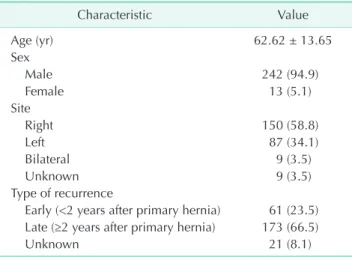
Among 4,604 patients who underwent hernia surgery, 255 patients (5.54%, 13 females and 242 males) were found to have recurrent hernia. Of them, 43 patients (16.9%) were under 50 years of age. Recurrent hernias were found predominantly between the ages of 61 to 70, comprising 28.2% of total recurrent hernia cases as shown in Fig. 1. Rightsided recurrent hernias (150, 58.8%) seemed to be more prevalent than left
sided ones (87, 34.1%). Bilateral recurrent inguinal hernias were reported in 9 patients (3.5%) (Table 1).
Indirect recurrent inguinal hernia occurred in 47.1% of the patients and direct hernia in 49.4%. Average time to recurrence was 9 years and 8 months. The incidence of early (<2 years after primary hernia) recurrence was 23.5%. The recurrence of hernias within 1 year of surgery was the highest at 17.3%, followed by those presenting 1 to 2 years after (7.5%), 2 to 3
12 20 0 0 0 0 0 0
Age (yr) 3 (1.2%) 4 (1.6%)
11 (4.3%) 25 (9.8%)
61 (23.9%) 72 (28.2%)
65 (25.5%)
14 (5.5%) Recurrent inguinal hernia
Fig. 1. Prevalence of recurrent inguinal hernias in patients of different age groups.
Table 1. Baseline characteristics of recurrent inguinal hernia
Characteristic Value
Age (yr) 62.62 ± 13.65
Sex
Male 242 (94.9)
Female 13 (5.1)
Site
Right 150 (58.8)
Left 87 (34.1)
Bilateral 9 (3.5)
Unknown 9 (3.5)
Type of recurrence
Early (<2 years after primary hernia) 61 (23.5) Late (≥2 years after primary hernia) 173 (66.5)
Unknown 21 (8.1)
Values are presented as mean ± standard deviation or number (%).
years after (7.1%), and 3 to 4 years after (7.1%) the operation.
After 4 years of the primary hernia operation, the recurrence rate decreased to less than 7% (Fig. 2).
Of the patients presenting with recurrent hernias, 81.6% had
undergone open methods at the time of initial surgery and 18.4% had undergone laparoscopic surgery. The initial surgery was performed at other hospitals for 61.2% of patients with
<1
No.ofpatients
Postoperative period (yr) 45
40 35 30 25 20 15 10 5 0
1 2 23
3 4 4 5
56 6 7
7 8 89
9 10 10
11 11
12 12
13 13
14 14
15 15
16 16
17 17
18 18
19 19
20 20
61
Fig. 2. Timing of hernia recurrence.
Table 2. Operation method and hospital of primary hernia repair
Primary hernia repair No. (%)
Operation method
Open 208 (81.6)
Laparoscopic 47 (18.4)
Total 255 (100)
Hospital
Participating institutesa) 99 (38.8)
Outside 156 (61.2)
Mesh
Yes 100 (39.2)
No 93 (36.5)
Unknown 62 (24.3)
a)St. Vincent’s Hospital, Uijeongbu St. Mary’s Hospital, Daejeon St. Mary’s Hospital, and Incheon St. Mary’s Hospital.
Table 3. Primary operation with and without mesh
Variable Mesh repair Tissue repair Pvalue
Male sex 94 (94.0) 75 (96.1) 0.515
Age >60 yr 64 (64.0) 44 (56.4) 0.354
Primary hernia type
Direct:indirect:femoral 50:46:1 (51.0:46.9:1.0) 40:36:0 (52.6:47.3:0) 0.844
Primary hernia location
Right:left:both 57:35:8 (57.0:35.0:8.0) 45:27:6 (57.7:34.6:7.7) 0.995
Recurrent hernia location
Right:left:both 59:36:4 (59.6:36.4:4.0) 46:28:2 (60.5:36.8:2.6) 0.879
Timing of hernia recurrence (mo) 44.2 ± 49.3 184.8 ± 171.7 <0.001
Values are presented as number (%) or mean ± standard deviation.
Table 4. Comparison of early and late recurrence of hernia
Variable Early
(<2 years after primary hernia) Late
(≥2 years after primary hernia) Pvalue
No. of patients 61 (23.5) 173 (66.5)
Male sex 57 (93.4) 166 (96.0) 0.426
Age >60 yr 35 (57.3) 69 (60.1) 0.708
Primary hernia type
Direct:indirect:femoral 22:34:1 (37.9:58.6:1.7) 96:75:0 (56.1:43.9:0) 0.068
Primary hernia location
Right:left:both 31:25:5 (50.8:41.0:8.2) 104:54:15 (60.1:31.2:8.7) 0.375
Recurrent hernia location
Right:left:both 33:25:2 (55:41.7:3.3) 105:57:5a) (62.9:34.1:3.0) 0.560
Primary repair
Mesh repair:tissue repair 47:9 (83.9:1.6) 53:69 (43.3:56.6) <0.001
Values are presented as number (%).
a)n = 167.
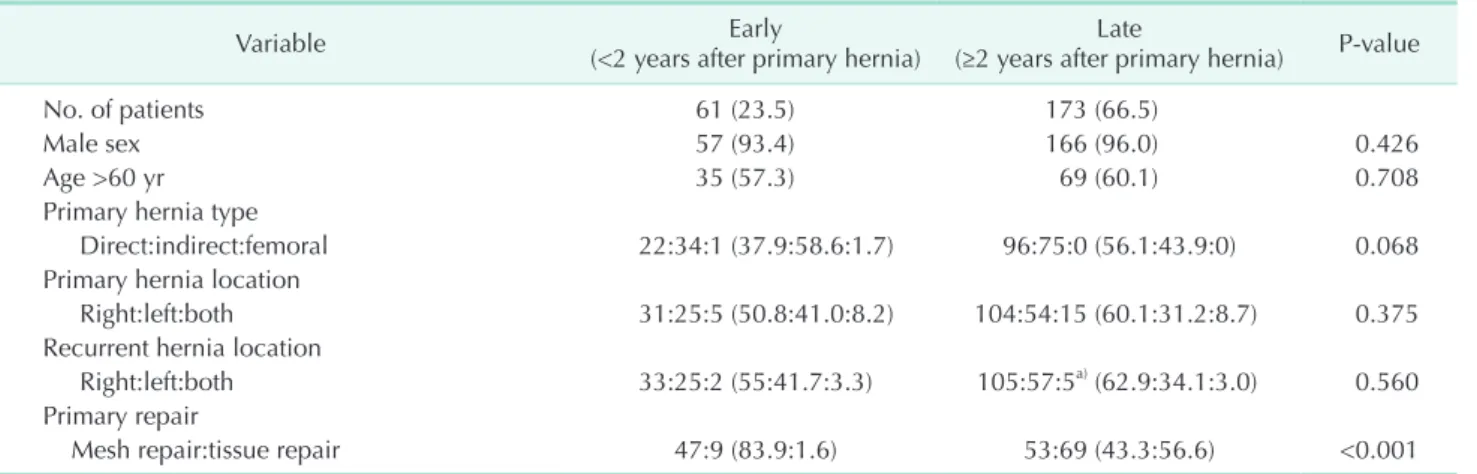
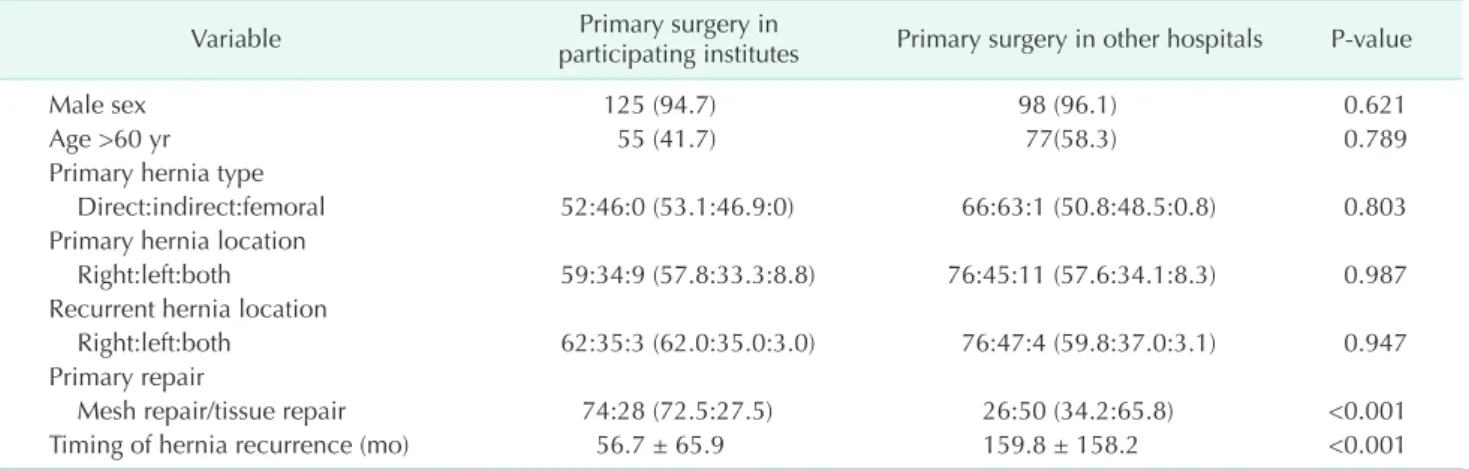
recurrent hernia, while 38.8% had undergone initial surgery at our institutions. In the primary repair, 39.2% of patients had undergone mesh repair and 36.5% of patients had undergone tissue repair (Table 2). Early recurrence rate was higher in the mesh repair group than in the tissue repair group (P < 0.001) (Tables 3 and 4). The frequency of mesh repair was higher in participating institutes than in the other hospitals, and the time to recurrence was shorter in participating institutes group than others (Table 5). Open surgery was most commonly performed for primary hernia while laparoscopic surgery was commonly performed for recurrent hernia (Table 6).
DISCUSSION
According to nationwide data on inguinal hernia surgery from 2007 to 2015, there was a dramatic increase in laparoscopic inguinal hernia repair procedures from less than 3% in 2007 to about 30% in 2015 [12]. Every year about 35,000 inguinal hernia repairs are performed in Korea and the incidence peak was found in adult patients aged 50 to 70 years [12]. Similarly, recurrent hernias were found most often between the ages of 61 and 70 years.
Nationwide data from 2007 to 2015 showed that, in Korea, every year approximately 2%–3% of repair operations are performed for recurrent hernia [12]. From 2007 to 2015, a total of 311,441 operations for inguinal hernia were performed in Korea, which comprised of 87% in male patients and 13% in
female patients [12]. Recurrent inguinal hernia was found in 94.9% of men and in 5.1% of women, indicating that there were more men with a recurrent hernia than those with a primary hernia. Our data show that recurrent inguinal hernia was found in 5.5% of hernia repair operations. The proportion of recurrent inguinal hernia in our study sample was higher than the nationwide proportion as local clinics refer their patients with recurrent inguinal hernia to our institute for assessment and treatment.
This study provided definite data on the surgical problem of hernia recurrence. The maximum number of patients presenting with recurrent hernias were middleaged men [13].
In this study, the incidence rate of right recurrent inguinal hernia was higher than that on the left side because the incidence inguinal hernia was higher on the right side than that on the left. A recent metaanalysis shows that direct inguinal hernia was a significant risk factor for recurrence after inguinal hernia surgery [14]. Our data showed that among patients with recurrent hernia, the ratio of patients with direct and indirect hernia was nearly the same (49.4% vs. 47.1%, respectively).
The high prevalence of early recurrence of hernia was predominantly due to technical failures, as opposed to late recurrences that were caused essentially by local tissue failure [13,15,16]. The recurrence rate of hernias was the highest within 1 year of surgery and the recurrence rate between 1 year and 2 years was the second highest. Moreover, we found that early recurrence was more likely in the mesh repair group compared Table 5. Comparison of primary surgery in participating institutes and in the other hospitals
Variable Primary surgery in
participating institutes Primary surgery in other hospitals Pvalue
Male sex 125 (94.7) 98 (96.1) 0.621
Age >60 yr 55 (41.7) 77(58.3) 0.789
Primary hernia type
Direct:indirect:femoral 52:46:0 (53.1:46.9:0) 66:63:1 (50.8:48.5:0.8) 0.803
Primary hernia location
Right:left:both 59:34:9 (57.8:33.3:8.8) 76:45:11 (57.6:34.1:8.3) 0.987
Recurrent hernia location
Right:left:both 62:35:3 (62.0:35.0:3.0) 76:47:4 (59.8:37.0:3.1) 0.947
Primary repair
Mesh repair/tissue repair 74:28 (72.5:27.5) 26:50 (34.2:65.8) <0.001
Timing of hernia recurrence (mo) 56.7 ± 65.9 159.8 ± 158.2 <0.001
Values are presented as number (%) or mean ± standard deviation.
Table 6. Operation methods for primary hernia and recurrent hernia
Operation methods for primary hernia and recurrent hernia No. of cases (%)
Open surgery for primary and recurrent hernia 47 (28.0)
Open surgery for primary hernia and laparoscopic surgery for recurrent hernia 75 (44.6) Laparoscopic surgery for primary hernia and open surgery for recurrent hernia 40 (23.8)
Laparoscopic surgery for primary and recurrent hernia 6 (3.6)
to the tissue repair group (Table 4). Early recurrence was noted if a technical problem occurred during mesh repair, while late recurrence was observed in patients who underwent tissue repair [6].
Laparoscopic repair was recommended for he patients who underwent open primary inguinal hernia surgery and experienced recurrence [17]. However, in this study, surgeons tend to perform open surgery for patients who underwent open primary inguinal hernia surgery. In fact, in 28% of cases, surgeons did not follow the recommendation for laparoscopic surgery for recurrent hernia.
The present study has some limitations. First, our data set is insufficient to draw conclusion regarding the causation of recurrent hernia, and the 4 participating institutions may not be representative of all centers treating hernias in Korea.
Second, we could not adjust for different operation methods
or other unknown factors. However, there have been no recent reports on hernia recurrence in Asia and this largescale multi
institutional study shows the epidemiological characteristics of recurrent inguinal hernia in Korea.
From our results, we found that the rate of recurrent hernia was highest in the first year following hernia repair, was higher in men. Further research is needed to identify the causes of early recurrence of hernias and prevent their occurrence. The higher proportion of early recurrences following hernia repair may be explained by the high proportion of technical failures [6].
CONFLICTS OF INTEREST
No potential conflict of interest relevant to this article was reported.
REFERENCES
1. EU Hernia Trialists Collaboration. Repair of groin hernia with synthetic mesh:
metaanalysis of randomized controlled trials. Ann Surg 2002;235:32232.
2. Bendavid R. Inguinal herniorrhaphy in women. Hernia 2006;10:1034.
3. EU Hernia Trialists Collaboration. Mesh com pared with nonmesh methods of open groin hernia repair: systematic re
view of randomized controlled trials. Br J Surg 2000;87:8549.
4. Scott NW, McCormack K, Graham P, Go PM, Ross SJ, Grant AM. Open mesh ver
sus nonmesh for repair of femoral and in gui nal hernia. Cochrane Database Syst Rev 2002;(4):CD002197.
5. Dahlstrand U, Wollert S, Nordin P, Sand
blom G, Gunnarsson U. Emergency femo
ral hernia repair: a study based on a natio
nal register. Ann Surg 2009;249:6726.
6. Magnusson N, Nordin P, Hedberg M, Gun
narsson U, Sandblom G. The time pro file of groin hernia recurrences. Hernia 2010;
14:3414.
7. BayNielsen M, Nordin P, Nilsson E, Kehlet H; Danish Hernia Data Base and the Swedish Hernia Data Base. Operative
fin dings in recurrent hernia after a Lich
ten stein procedure. Am J Surg 2001;182:
1346.
8. Sondenaa K, Nesvik I, Breivik K, Korner H.
Longterm followup of 1059 consecutive primary and recurrent inguinal hernias in a teaching hospital. Eur J Surg 2001;167:
1259.
9. Matthews RD, Anthony T, Kim LT, Wang J, Fitzgibbons RJ Jr, GiobbieHurder A, et al. Factors associated with postoperative com pli cations and hernia recurrence for patients undergoing inguinal hernia re
pair: a report from the VA Cooperative Her nia Study Group. Am J Surg 2007;194:
6117.
10. Heller CA, Marucci DD, Dunn T, Barr EM, Houang M, Dos Remedios C. Inguinal canal “lipoma”. Clin Anat 2002;15:2805.
11. Eklund AS, Montgomery AK, Rasmussen IC, Sandbue RP, Bergkvist LA, Rudberg CR. Low recurrence rate after laparoscopic (TEP) and open (Lichtenstein) inguinal hernia repair: a randomized, multicenter trial with 5year followup. Ann Surg 2009;249:338.
12. Han SR, Kim HJ, Kim NH, Shin S, Yoo RN,
Kim G, et al. Inguinal hernia surgery in Korea. Ann Surg Treat Res 2019;97:417.
13. Jansen PL, Klinge U, Jansen M, Junge K.
Risk factors for early recurrence after inguinal hernia repair. BMC Surg 2009;9:
18.
14. Burcharth J, Pommergaard HC, Bisgaard T, Rosenberg J. Patientrelated risk factors for recurrence after inguinal hernia repair:
a systematic review and metaanalysis of observational studies. Surg Innov 2015;22:
30317.
15. Phillips EH, Rosenthal R, Fallas M, Carroll B, Arregui M, Corbitt J, et al. Reasons for early recurrence following laparoscopic her nio plasty. Surg Endosc 1995;9:1404.
16. Lowham AS, Filipi CJ, Fitzgibbons RJ Jr, Stoppa R, Wantz GE, Felix EL, et al.
Mecha nisms of hernia recurrence after pre peritoneal mesh repair. Traditional and laparoscopic. Ann Surg 1997;225:422
31.
17. HerniaSurge Group. International guide
lines for groin hernia management. Her
nia 2018;22:1165.