Vol. 22, No. 2, 2010 199
Received July 21, 2009, Revised July 30, 2009, Accepted for publication August 3, 2009
Corresponding author: Bong Seok Shin, M.D., Department of Derma- tology, School of Medicine, Chosun University, 588 Seosuk-dong, Dong-gu, Gwangju 501-717, Korea. Tel: 82-62-220-3130, Fax: 82-62- 232-3215, E-mail: [email protected]
Ann Dermatol Vol. 22, No. 2, 2010 DOI: 10.5021/ad.2010.22.2.199
CASE REPORT
A Case of Human Immunodeficiency Virus Infection Initially Presented with Disseminated Herpes Zoster
Bong Seok Shin, M.D., Chan Ho Na, M.D., In Guk Song, M.D., Kyu Chul Choi, M.D.
Department of Dermatology, School of Medicine, Chosun University, Gwangju, Korea
Herpes zoster is characterized by unilateral grouped vesicles along the distribution of a single dermatome. Disseminated herpes zoster usually is defined as a generalized eruption of more than 20 extra-dermatomal vesicles occurring within a week of the onset of classic dermatomal herpes zoster. It oc- curs chiefly in old or debilitated individuals, and especially in patients with underlying malignancy, immunosuppres- sive therapy, or human immunodeficiency virus (HIV) infection. A 51-year-old man presented with segmental grouped vesicles on the left upper trunk and arm, and a vari- cella-like eruption over the entire body. Tzanck smear prepa- ration and punch biopsy done on the vesicles of the trunk in- dicated a herpetic infection. Later, he was found to be HIV-positive. We report a rare case of HIV infection initially presenting with disseminated herpes zoster. (Ann Dermatol 22(2) 199∼202, 2010)
-Keywords-
Disseminated herpes zoster, Extradermatomal, HIV in- fection
INTRODUCTION
Herpes zoster classically occurs unilaterally within the dis- tribution of a single cranial or spinal sensory nerve. It pres- ents with a unilateral radicular pain and a vesicular erup- tion which is limited to a dermatome innervated by that nerve. Depending on which dermatome is affected, many clinical variations are possible: (herpes) zoster oph-
thalmicus, zoster myelitis, disseminated zoster, zoster du- plex bilateralis or unilateralis, and zoster multiplex1,2. Disseminated herpes zoster, defined as at least 20 lesions in multiple dermatomes, occurs in 2∼10% of unselected patients with localized zoster, most of whom have im- munologic defects (underlying malignancy, immuno- suppressive therapy, or human immunodeficiency virus (HIV) infection)3. Also, systemic dissemination to the lung, brain, and liver, and subsequent death in disseminated herpes zoster have been documented4. Disseminated her- pes zoster in HIV-seropositive individuals is less com- monly reported and may be the initial manifestation of HIV infection5,6, as it was in the case we are about to pres- ent: disseminated herpes zoster with HIV infection, which has not yet been reported in the Korean literature.
CASE REPORT
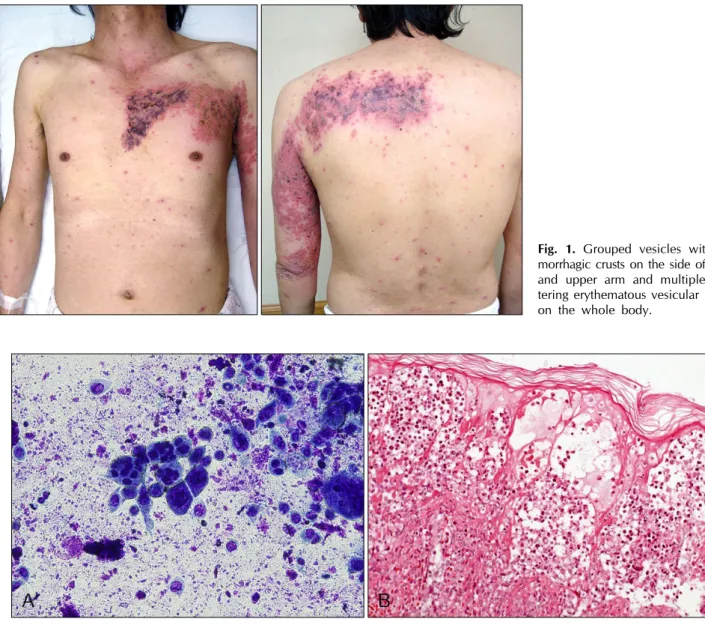
A 51-year-old homeless man presented with a 5-day his- tory of painful vesicles. Initially, 5 days before coming in, he recognized lesions on the left trunk and upper arm (T2 dermatome) as several grouped vesicles with a pricking pain. Four days later, he developed multiple scattering er- ythematous vesicular rashes with mild pruritus over the entire body, and more ulcerative wounds associated with sharp pain on the previous lesions (Fig. 1). His past medi- cal and family history was unremarkable. On the visit, lab- oratory examinations including complete blood cell counts, routine urinalysis, liver function test, and chest X-ray, which were all unremarkable or within normal limits. Tzanck smear test was done on the vesicles of the left trunk, which demonstrated multinucleated giant cells, characteristic of herpetic infection (Fig. 2A). Skin biopsy of a vesicular lesion on the abdomen revealed intra- epidermal vesicle with acantholysis and balloon cells (Fig.
2B). Serologically, VZV IgM antibody was reported as neg- ative and VZV IgG antibody was reported as positive by
BS Shin, et al
200 Ann Dermatol
Fig. 1. Grouped vesicles with he- morrhagic crusts on the side of trunk and upper arm and multiple scat- tering erythematous vesicular rashes on the whole body.
Fig. 2. (A) Tzanck smear preparation showing multinuclear giant cells (Giemsa stain, ×200). (B) Skin biopsy of a vesicular lesion on abdomen revealed intraepidermal vesicle with acantholysis and balloon cells (H&E stain, ×200).
enzyme immunoassay (EIA). In the hospital, the HIV ELISA test was noted to be positive. This was confirmed by a western blot analysis (Fig. 3). Based on the his statement, it was assumed that the patient had been infected by sex- ual intercourse with a prostitute, having denied any other possibility for HIV transmission, including operations, transfusion, drug abuse, and homosexuality. He was treat- ed with an IV antiviral agent and then referred to the Department of Internal Medicine for the further evaluation and status of HIV infection. He refused the further evalua- tion and then escaped from hospital.
DISCUSSION
Herpes zoster is caused by reactivation of latent varicella
zoster virus (VZV) which lies dormant in the ganglia.
Although the mechanisms of VZV reactivation from la- tency are unclear, its association with immunosuppression and age suggests that an effective immune system main- tains the viral genome in the latently infected cell and pre- vents viral replication4,7. Therefore, immunosuppression, especially organ transplantation, hematologic malignancy, and HIV infection, increase the rates of zoster occurrence.
While typical herpes zoster is characterized by unilateral, segmental painful vesicles over certain affected dermato- mal region, herpes zoster in the immunosuppressed may be ulcerative and necrotic and may scar more severely.
Also, multidermatomal involvement and disseminated in- fections are more common than they are in healthy in- dividuals1. Disseminated herpes zoster is defined as more
Disseminated Herpes Zoster in HIV Infection
Vol. 22, No. 2, 2010 201 Fig. 3. The HIV-seropositivity of our patient (# 17, arrow) was
confirmed by a western blot analysis.
than 20 small widespread vesicles resembling varicella outside the area of the primary and adjacent dermatomes, and may or may not involve visceral organs. It has been mainly described in the elderly or persons with im- munosuppression due to HIV infection, hematologic ma- lignancy, or chemotherapy; in otherwise healthy in- dividuals it is very rarely reported5,8,9. Therefore, a patient with disseminated herpes zoster, with no known co-fac- tors (as noted above) deserves a complete work-up to elu- cidate any underlying malignancy or immunodefici- ency3,4,10,11.
In this decade, HIV infection has been one of the most common causes of immunosuppression. Herpes zoster of- ten occurs as the first manifestation of the compromised immune function of progressive HIV infection and often indicates a HIV infection with an increased probability of the subsequent development of acquired immune defi- ciency syndrome (AIDS)12,13. Friedman-Kien et al.14 in 1986 described that the incidence of herpes zoster in HIV-positive individuals is seven times greater than that of the general population. Thus, HIV infection should be considered in individuals who develop herpes zoster, and especially in those who develop disseminated herpes zos- ter associated with immunosuppression.
Cohen and Grossman6 reported clinical features of HIV-as- sociated disseminated herpes zoster and compared it to those observed in HIV-seronegative immunosuppressed patients. They stated that systemic dissemination and sub- sequent death have been documented in 26% of HIV-se- ropositive patients. To compare with HIV-seronegative im- munosuppressed patients, in these people there was an in- creased severity of cutaneous lesions noted, and as well,
the course of disease could be prolonged or recurrent.
Although our patient was not evaluated for the immune status precisely, the lesions quickly became necrotic and were associated with severe pain, thereby suggesting a considerable HIV-seropositive immunosuppressed state in our patient.
Most disseminated herpes zoster in HIV-seropositive pa- tients have occurred in those who have had prior oppor- tunistic infections associated with AIDS6. But, dis- seminated herpes zoster may be the first manifestation of HIV infection. Therefore, it is important to recognize this disease as having a high predictive value for HIV in- fection, and therefore perform necessary lab work to as- certain HIV status5,6,12. In our case, HIV seropositivity was incidentally found in the process of laboratory evaluation for systemic factors associated with disseminated herpes zoster without other AIDS-related manifestations. Prompt treatment with systemic antiviral agents is warranted in HIV-associated herpes zoster, because of the increased se- verity of cutaneous lesions and poor prognosis6,13.
To our knowledge, disseminated herpes zoster in HIV-se- ropositive patients has not yet been described in the Korean literature because HIV infection is a relatively un- common entity in Korea, compared to some other region (i.e. Africa), where the prevalence of AIDS is high and the AIDS-related diseases have been frequently reported15. Thus we have reported a rare case of disseminated herpes zoster as being the first manifestation of HIV infection.
REFERENCES
1. Shin BS, Seo HD, Na CH, Choi KC. Case of herpes zoster duplex bilateralis. J Dermatol 2009;36:95-97.
2. Vu AQ, Radonich MA, Heald PW. Herpes zoster in seven disparate dermatomes (zoster multiplex): report of a case and review of the literature. J Am Acad Dermatol 1999;40:868- 869.
3. Straus SE, Oxman MN, Schmader KE. Varicella and herpes zoster. In: Wolff K, Goldsmith LA, Katz SI, Gilchrest BA, Paller AS, Leffell DJ, editors. Fitzpatrick's dermatology in general medicine. 7th ed. New York: McGraw-Hill, 2008:
1885-1898.
4. James WD, Berger TG, Elston DM. Andrews' diseases of the skin: clinical dermatology. 10th ed. Philadelphia: WB Saun- ders, 2006:379-384.
5. Cohen PR, Beltrani VP, Grossman ME. Disseminated herpes zoster in patients with human immunodeficiency virus infection. Am J Med 1988;84:1076-1080.
6. Cohen PR, Grossman ME. Clinical features of human immu- nodeficiency virus-associated disseminated herpes zoster virus infection--a review of the literature. Clin Exp Dermatol 1989;14:273-276.
7. Kennedy PG, Steiner I. A molecular and cellular model to
BS Shin, et al
202 Ann Dermatol
explain the differences in reactivation from latency by herpes simplex and varicella-zoster viruses. Neuropathol Appl Neurobiol 1994;20:368-374.
8. Gupta S, Jain A, Gardiner C, Tyring SK. A rare case of disseminated cutaneous zoster in an immunocompetent patient. BMC Fam Pract 2005;6:50.
9. Burdett C, Mendoza N, Arora A, Bartlett B, Gewirtzman A, Tremaine AM, et al. A rare case of disseminated shingles in an immunocompetent patient following a 7-day treatment with oral valacyclovir. J Clin Virol 2008;43:233-235.
10. Singal A, Mehta S, Pandhi D. Herpes zoster with dissemi- nation. Indian Pediatr 2006;43:353-356.
11. McCrary ML, Severson J, Tyring SK. Varicella zoster virus. J Am Acad Dermatol 1999;41:1-14.
12. Petrozza JC, Monga M, Oshiro BT, Graham JM, Blanco JD.
Disseminated herpes zoster in a pregnant woman positive for human immunodeficiency virus. Am J Perinatol 1993;10:
463-464.
13. Gulick RM, Heath-Chiozzi M, Crumpacker CS. Varicella- zoster virus disease in patients with human immunodefici- ency virus infection. Arch Dermatol 1990;126:1086-1088.
14. Friedman-Kien AE, Lafleur FL, Gendler E, Hennessey NP, Montagna R, Halbert S, et al. Herpes zoster: a possible early clinical sign for development of acquired immunodeficiency syndrome in high-risk individuals. J Am Acad Dermatol 1986;14:1023-1028.
15. Naburi AE, Leppard B. Herpes zoster and HIV infection in Tanzania. Int J STD AIDS 2000;11:254-256.