ISSN 2234-3806 • eISSN 2234-3814
194 www.annlabmed.org http://dx.doi.org/10.3343/alm.2016.36.2.194 Ann Lab Med 2016;36:194-196
http://dx.doi.org/10.3343/alm.2016.36.2.194
Letter to the Editor
Diagnostic Genetics
An 18.3-Mb Duplication on Chromosome 14q With Multiple Cardiac Anomalies and Clubfoot Was
Identified by Microarray Analysis
Jihoon G. Yoon, M.D.1, Saeam Shin, M.D.1, Jo Won Jung, M.D.2, Seung-Tae Lee, M.D.1, and Jong Rak Choi, M.D.1
Department of Laboratory Medicine1, Severance Hospital, Yonsei University College of Medicine; Division of Pediatric Cardiology2, Department of Pediatrics, Severance Cardiovascular Hospital, Yonsei University College of Medicine, Seoul, Korea
Dear Editor,
Abnormalities involving the proximal segment of the long arm of chromosome 14 (14q) are rare. Clinical phenotypes of duplica- tions on 14q vary, with autistic disorder, mental retardation, de- layed development, and dysmorphic features being the common phenotypes [1-3]. Several studies have attempted to elucidate the correlation between these clinical phenotypes and candidate genes. However, because of insufficient reports and genetic studies, establishing a correlation between genotype and the cor- responding phenotype has been difficult. In this study, we report a newborn with an 18.3 Mb large duplication in the 14q11.2q21.1 that was identified by a chromosomal microarray.
Our case was a 1-month-old newborn girl born at 41 weeks of gestation through vaginal delivery. She was the third child, and her parents were both 33 yr old. Her mother had an obstetric history of gravida 4, para 3, and abortus 1. The first and second children did not have developmental problems or intellectual disabilities, and there was no family history. The birth weight, height, and head circumference of the patient were within nor- mal ranges (2,940 g [3rd-10th percentile], 47.5 cm [10th-25th
percentile], and 32.5 cm [10th-25th percentile], respectively).
Cardiac murmur was detected, and hypoxemia (SpO2, 68-85%) was observed after birth. Echocardiography indicated a ventric- ular septal defect, pulmonary stenosis, and an overriding aorta, correlating to tetralogy of Fallot (TOF). The patient had bilateral clubfoot. However, other dysmorphic features in the extremities and face were unnoticeable.
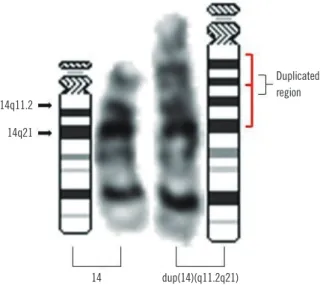
G-banding chromosome analysis of phytohemagglutinin (PHA) stimulation on cultured lymphocytes from peripheral blood showed an insertion in the proximal segment of 14q in all 25 metaphase cells (Fig. 1). At the level of 550-band resolution, the breakpoint and origin of the inserted fragment could not be clearly identified. We further investigated copy number altera- tions using Cytoscan 750K array (Affymetrix, Santa Clara, CA, USA). An approximately 18.3-Mb gain from 14q11.2 to 14q21.1 (chr14:20,516,277-38,826,881) was identified (Fig. 2). The karyotype was 46,XX,dup(14)(q11.2q21).arr 14q11.2q21.1 (20,516,277-38,826,881)x3 according to the International Sys- tem for Human Cytogenetic Nomenclature (2013). Chromosome analyses in both parents showed normal karyotypes, indicating a
Received: July 7, 2015 Revision received: July 28, 2015 Accepted: November 13, 2015 Corresponding author: Saeam Shin
Department of Laboratory Medicine, Yonsei University College of Medicine, 50-1 Yonsei-ro, Seodaemun-gu, Seoul 03722, Korea
Tel: +82-2-2228-2454, Fax: +82-2-364-1583, E-mail: [email protected] Co-corresponding author: Seung-Tae Lee
Department of Laboratory Medicine, Yonsei University College of Medicine, 50-1 Yonsei-ro, Seodaemun-gu, Seoul 03722, Korea
Tel: +82-2-2228-2450, Fax: +82-2-364-1583, E-mail: [email protected]
© The Korean Society for Laboratory Medicine.
This is an Open Access article distributed under the terms of the Creative Commons Attribution Non-Commercial License (http://creativecommons.org/licenses/by-nc/3.0) which permits unrestricted non-commercial use, distribution, and reproduction in any medium, provided the original work is properly cited.
Yoon J, et al.
14q duplication identified by microarray analysis
http://dx.doi.org/10.3343/alm.2016.36.2.194 www.annlabmed.org 195
de novo duplication mechanism.
Compared with other patients with 14q duplications, our pa- tient showed multiple cardiac anomalies. We found 47 duplica- tion cases in the 14q11.2q21.1 region from DECIPHER (Data- basE of Chromosomal Imbalance and Phenotype in Human us- ing Ensemble Resources, http://www.decipher.sanger.ac.uk).
The most frequent phenotypes were intellectual disability (34.0%) and autism (19.1%); only two patients showed cardiac anomalies. One patient (DECIPHER ID: 283016) with a 0.39-Mb duplication in 14q12 (chr14:29,829,325-30,220,298) had au- tistic spectrum disorder, malformation of the heart and great vessels, nystagmus, and TOF. The other patient (DECIPHER ID:
287854) with a 0.37-Mb duplication in 14q11.2 (chr14:20,424, 580-20,796,696) had a hypoplastic right heart and malforma- tion in the heart and great vessels.
The 18.3-Mb duplication observed in our patient was large enough to be detected by chromosomal analysis. This region contains 446 genes and is associated with 32 phenotypes (NCBI database: http://www.ncbi.nlm.nih.gov/mapview/maps.cgi?
[Build 35]). The only cardiac anomaly-associated gene in this region is myosin heavy chain 6 (MYH6) [4]. However, a mis- sense mutation in MYH6, not a duplication, is known to be asso- ciated with cardiac anomalies. Most congenital heart defects arise from abnormal heart development in embryogenesis. Dur- ing heart development, the dose of a gene product available at a specific time and location is important for normal cardiogenesis [5]. Hence, the cardiac anomalies observed in our patient may have resulted from dosage imbalances during cardiac develop- ment. Monfort et al. [2] reported that quantitative trait loci (QTLs) in 14q11.2 controlled stature. Similarly, we propose that the du- plication observed in our patient supported the presence of a putative QTL in 14q that controlled heart development. The cur- rent results indicated that a duplication in chromosome 14 could lead to congenital heart defects.
Clubfoot can be associated with chromosomal abnormalities [6, 7]. Six patients from DECIPHER (ID: 1366, 248559, 249644, 249887, 277167, and 279247) have anomalies of the extremi- ties and overlapping duplicated regions with our case. The criti- cal region for anomalies of extremities is still uncertain, because there was no common region among these cases.
Two patients (nssv578665, nssv578667) with 19-Mb duplica- tions overlapping with the 14q11.2q21.1 region have been re- ported in the International Standards for Cytogenomic Arrays database (http://www.ncbi.nlm.nih.gov/dbvar/). Both had facial dysmorphism, hypertonia, intellectual disability, and develop- mental delay. Because of the young age of our patient, intellec- tual disability and delayed development could not be evaluated.
Follow-up examinations for expected phenotypes are necessary.
Fig. 2. Microarray analysis of chromosome 14 showed an 18.3-Mb duplication in the 14q11.2q21.1 (20,516,277–38,826,881) region (in- dicated by the blue bar).
Fig. 1. G-banding chromosome analysis showed a duplication in the proximal segment of the long arm of chromosome 14 (indicated by red brackets).
14q11.2
Duplicated region 14q21
14 dup(14)(q11.2q21)
chr14
Yoon J, et al.
14q duplication identified by microarray analysis
196 www.annlabmed.org http://dx.doi.org/10.3343/alm.2016.36.2.194 Thus, we confirmed an insertion of unknown origin in a con-
genital heart defect case using chromosomal microarray analy- sis. Chromosomal microarray is useful for determining the size and precise breakpoints of abnormalities, regardless of whether they could be detected by G-banding analysis.
Authors’ Disclosures of Potential Conflicts of Interest
No potential conflicts of interest relevant to this article were re- ported.
Acknowledgments
This research was supported by the Basic Science Research Program through the National Research Foundation of Korea (NRF) funded by the Ministry of Education, Science and Tech- nology (NRF-2012R1A1A2043879).
REFERENCES
1. Brunetti-Pierri N, Paciorkowski AR, Ciccone R, Della Mina E, Bonaglia MC, Borgatti R, et al. Duplications of FOXG1 in 14q12 are associated with developmental epilepsy, mental retardation, and severe speech im- pairment. Eur J Hum Genet 2011;19:102-7.
2. Monfort S, Blesa D, Roselló M, Orellana C, Oltra S, Cigudosa JC, et al.
Duplication of 14q11.2 associates with short stature and mild mental re- tardation: a putative relation with quantitative trait loci. Am J Med Genet A 2007;143:382-4.
3. Yeung A, Bruno D, Scheffer IE, Carranza D, Burgess T, Slater HR, et al.
4.45 Mb microduplication in chromosome band 14q12 including FOXG1 in a girl with refractory epilepsy and intellectual impairment. Eur J Med Genet 2009;52:440-2.
4. Granados-Riveron JT, Ghosh TK, Pope M, Bu’Lock F, Thornborough C, Eason J, et al. Alpha-cardiac myosin heavy chain (MYH6) mutations af- fecting myofibril formation are associated with congenital heart defects.
Hum Mol Genet 2010;19:4007-16.
5. Bruneau BG. The developmental genetics of congenital heart disease.
Nature 2008;451:943-8.
6. Hagen A, Bigl A, Wand D, Klopocki E, Heller R, Siekmeyer M, et al.
Combined partial trisomy 11q and partial monosomy 10p in a 19-year- old female patient: phenotypic and genotypic findings. Am J Med Genet A 2011;155A:3075-81.
7. Dundar M, Kiraz A, Tasdemir S, Akalin H, Kurtoglu S, Hafo F, et al. Un- balanced 3;22 translocation with 22q11 and 3p deletion syndrome. Am J Med Genet A 2010;152A:2791-5.