Relationship Between Essential Tremor and Cerebellar Dysfunction According to Age
Eui-Seong Lim, M.D., Man-Wook Seo, M.D., Seong-Ryong Woo, M.D., Suk-Young Jeong, M.D., Seul-Ki Jeong, M.D.
Department of Neurology, Chonbuk National University College of Medicine, Jeonju, Korea
Background: The cerebellum and its neural circuitry have been assumed to play a major role in the pathophysiology of essential tremor (ET). In this study, we sought to find associations between ET and cerebellar dysfunction.
Methods: We performed tandem gait test in 41 ET patients and 44 age-matched controls. Investigators assessed tandem gait by counting the number of missteps during ten-step tandem walk and each subject repeated the trial three times.
Results: ET patients had a higher average and total numbers of missteps during tandem gait tests than control subjects (p<0.05). Sex-adjusted odds ratio of the association between tandem gait abnormality and ET was 3.40 (95% confidence intervals 1.06-10.85). According to age stratification, aged ET patients (age ≥70 years) showed significantly higher prevalence of tandem gait abnormality than young ones. Interaction terms determined by a likelihood ratio test was also statistically significant (p<0.05).
Conclusions: Dysfunction of cerebellar neural circuitry may be associated with the pathophysiological mechanism of ET. In addition, aging may be an important factor modifying the association.
J Clin Neurol 1(1):76-80, 2005
Key Words : Essential tremor, Tandem gait, Cerebellum, Age
Received : January 18, 2005 / Accepted : March 8, 2005 / Address for correspondence : Man-Wook Seo, M.D.
Department of Neurology, College of Medicine, Chonbuk National University. 634-18 Geumam 2-dong, Deokin-gu, Jeonju-si, 561-712, Korea Tel: 82-63-250-1895, Fax: 82-63-251-9363, E-mail: [email protected]
INTRODUCTION
Essential tremor (ET) is one of the most common movement disorders. Clinically, this is a slowly progressive, monosymptomatic disorder characterized by postural tremor and kinetic tremor; in advanced stages, intention tremor can severely handicap the affected patients.1,2 However, the pathophysiologic aspects of ET has not been elucidated and pathoanatomical investi- gations have not identified any morphological abnormalities until now.
The cerebellum and its neural circuitry have been
assumed to play a major role in the pathophysiology of ET.3 To date, a functional disturbance of olivocerebellar circuit is the most popular hypothesis for the etiology of ET.4 Positron emission tomography (PET) studies have suggested a central oscillation involving the cerebellum and the red nucleus.5 Low frequency repetitive trans- cranial magnetic stimulation of the cerebellum can induce a moderate, transient, significant reduction of tremor in ET patients.6 A recent study reported that tandem gait abnormality is found in ET patients who did not complain about walking disturbances.7,8
We have hypothesized that if ET is associated with abnormal cerebellar function, other cerebellar motor
functions could also be disturbed. Since tandem gait is one of the ways to measure the cerebellar function, we have examined the prevalence of tandem gait abnor- mality in ET patients.
MATERIALS AND METHODS
1. Subjects
We investigated tandem gait in 41 ET patients (15 male, 26 female) and 44 age-matched controls (14 male, 30 female). All patients fulfilled the diagnostic criteria of classic ET according to the consensus statement of the Movement Disorders Society.9 Inclusion criteria were: 1) bilateral, largely symmetric postural or kinetic tremor involving hands and forearms that is visible and persistent, 2) additional or isolated tremor of the head may occur but in the absence of abnormal posturing.
Exclusion criteria were: 1) other abnormal neurologic signs, especially dystonia, 2) the presence of known causes of enhanced physiologic tremor, including current or recent exposure to tremorogenic drugs or the presence of a drug withdrawal state, 3) historic or clinical evidence of psychogenic tremor, 4) convincing evidence of sudden onset or evidence of stepwise deterioration, 5) primary orthostatic tremor, 6) isolated voice tremor, 7) isolated position-specific or task-specific tremors, including occupational tremors and primary writing tremor, 8) isolated tongue or chin tremor, 9) isolated leg tremor.
All the patients were asked to walk 10 meters, turn around, and walk back. An examiner noted the speed of initiation of gait, the posture, stride length, heel strike, and extent and symmetry of arm swing. As the patient turned, the number of steps taken to turn and any evidence of slight overbalancing were carefully observed. ET patients who had parkinsonian signs or an abnormal thyroid function were excluded. All patients were physically active and completely independent.
Controls were recruited among the patients’ spouses or relatives, and the same exclusionary criteria were applied.
2. Analysis of tandem gait
Investigators assessed tandem gait by counting the number of missteps during a ten-step tandem walk. Each subject repeated the trial three times. A misstep was considered if the patient’s advancing foot failed to land immediately ahead of and in close contact with the toes of the nonadvancing foot, with the method described as previously.10 Both feet were expected to have their sagittal plane parallel to the forward direction of movement, so that lateral rotations of the front of the foot as it landed were not considered acceptable.
Subjects were graded as having a normal or abnormal tandem gait based on the findings that two or more missteps per trial occur and the findings had to be reproduced twice or more.
3. Statistical analysis
The demographic variables and missteps were analyzed by independent samples t-test or chi-square test as appropriate. Associations between tandem gait abnormality and ET were quantified using odds ratios (OR) and 95% confidence intervals (CI). Because aging (age ≥70 years) potentially modified the effects, chi-square test was repeated within strata of aging.
Interaction terms between aging and ET were assessed by likelihood ratio tests. All statistical analyses were conducted using Stata 8.0 for Windows package (Stata Corporation, College Station, Tex., USA).
RESULTS
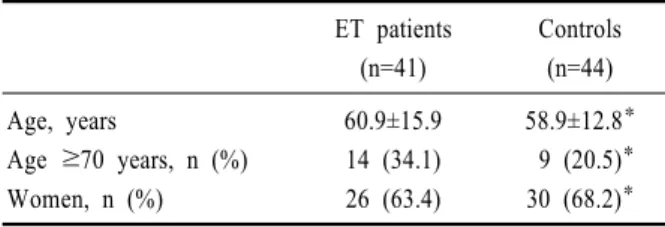
The demographic characteristics were summarized in Table 1. ET patients and controls did not differ in age and sex (mean±SD, 60.9±15.9 years and 58.9±12.8 years; 63.4 and 68.2% female, respectively). The proportion of the aged population (age ≥70 years) was not statistically different (34.1 and 20.5%, p>0.1).
Tandem gait abnormality was summarized in Table 2.
ET patients had the higher average number of missteps per trial (0.89±1.03 and 0.51±0.64, p<0.05) and higher average total missteps (2.66±3.08 and 1.52±1.91, p<
Age <70 Age ≥70*
Abnormal tandem Normal tandem Abnormal tandem Normal tandem ET patients
Control
2 (7.4) 3 (8.6)
25 (92.6) 32 (91.4)
10 (71.4) 2 (22.2)
4 (28.6) 7 (77.8) Values represent number and percentage in parentheses. *p<0.05 by chi-square test.
Table 4. Crosstabulation between ET and tandem gait abnormality according to age stratification 0.05) than the control. The results of logistic regression
analyses were summarized in Table 3. Unadjusted OR for the association between tandem gait abnormality and ET was 3.23 (95% CI 1.02~10.18). However, these associations fell into borderline significance with additive adjustments of sex and age.
ET patients (n=41)
Controls (n=44) Age, years
Age ≥70 years, n (%) Women, n (%)
60.9±15.9 14 (34.1) 26 (63.4)
58.9±12.8*
9 (20.5)*
30 (68.2)*
Values are mean±SD, unless noted otherwise, ET; essential tremor. *All p values >0.1 by Students t-test or chi-square test as appropriate.
Table 1. Demographic characteristics
Average number of missteps (per trial)*
Average missteps (total)*
ET patients Controls
0.89±1.03 0.51±0.64
2.66±3.08 1.52±1.91 Values are mean±SD, *p=0.047 by Independent-samples t-test Table 2. Finding of tandem gait in patients with ET compared with controls
OR (95% CI) p value Unadjusted
Sex adjusted Sex and age adjusted
3.23 (1.02-10.18) 3.40 (1.06-10.85) 3.79 (0.90-15.97)
0.046 0.039 0.069 OR; odds ratio, CI; confidence intervals
Table 3. Associations between ET and tandem gait abnormality
According to age stratification, crosstabulation between ET and tandem gait abnormality was expressed
in Table 4. In the aged ET patients (age ≥70 years), tandem gait abnormality was significantly higher than in the age-matched controls. These association, however, was not noted in the young (age <70 years) ET patients.
The age-adjusted interaction terms between age 70 (dichotomy) and ET was also statistically significant (p=
0.048).
DISCUSSION
The present study showed that ET patients had the higher prevalence of tandem gait abnormality than age-matched controls, and that the tandem gait abnormality was more evident in aged ET patients (age
≥70 years) than young ones (age <70 years). An abnormal tandem gait in a patient with ET may suggest that the pathophysiology of ET is associated with the cerebellum and its neural circuitry. Thus, our results were consistent with the previous findings.7,8 Increased tandem gait abnormality in aged ET patients indicates that a subtle pathologic transformation of a central oscillator in aged ET patients may finally affect the tandem gait.
Several studies have indicated that the cerebellum plays an important role in the generation of tremor in ET patients. Ataxic tandem gait of ET was indistinguish- able from gait abnormalities due to diseases in the cerebellum or the cerebellar outflow tracts.11 The clinical signs such as tandem gait abnormality and intention tremor, suggesting cerebellar dysfunction, were often present in advanced ET.11,12 In support of the notion of a possible cerebellar involvement in ET, regional cerebral blood flow studies using C15O2 and H215O PET revealed overactivity of the cerebellum and its projections in ET patients.5,13,14 Functional magnetic
resonance imaging investigations in ET patients found a significant activation in the cerebellar hemispheres and the red nucleus compared with mimicked tremor in the control group.15 On the other hand, clinical observations in patients with localized strokes in the cerebellum demonstrated a disappearance of essential tremor.16 An analysis of ballistic movements in ET patients demon- strated that the abnormalities resembled those described in human beings with cerebellar lesions.17 Moreover, the kinematic analysis of intention tremor in ET patients showed distinct abnormalities resembling tremor in cerebellar diseases.12
The present study showed an interactive effect of aging on the tandem gait abnormality in ET patients (interaction terms, p<0.05). As reported previously, biological aging could affect the progression of ET, resulting in a gradual reduction in tremor frequency, which secondarily increases the amplitude of tremor.18 Louis et al. reported that there was an association between the age of onset and the rate of ET progression;
patients with older age of onset (>60 years) showed rapid progression of ET.19 Aging has been shown to play a role in the clinical expression of subtle pathologic transformation of physiologic neuronal oscillators.18
The present study has several limitations. First, the majority of ET patients were on various antitremor medications with variable dosages. Although we included the ET patients with normal gait patterns only, we could not exclude the influence of antitremor drugs on the cerebellar function test. Second, the present study did not examine the family history and the charac- teristics of tremor including duration, severity and distribution. Therefore, we could not delineate the relationship between these characteristics and the occurrence of tandem gait abnormality.
In conclusion, tandem gait abnormality as a measure for cerebellar function test was significantly associated with ET and the association was evident especially in aged ET patients. Therefore, dysfunction of cerebellar neural circuitry may be associated with the basic pathophysiological mechanisms of ET.
REFERENCES
1. Deuschl G, Bergman H. Pathophysiology of nonparkin- sonian tremors. Mov Disord 2002;17:S41-48.
2. Deuschl G, Raethjen J, Lindemann M, Krack P. The pathophysiology of tremor. Muscle Nerve 2001;24:716- 735.
3. Britton TC. Essential tremor and its variants. Curr Opin Neurol 1995;8:314-319.
4. Deuschl G, Elble RJ. The pathophysiology of essential tremor. Neurology 2000;54:S14-20.
5. Jenkins IH, Bain PG, Colebatch JG, Thompson PD, Findley LJ, Frackowiak RS, et al. A positron emission tomography study of essential tremor: evidence for overactivity of cerebellar connections. Ann Neurol 1993;
34:82-90.
6. Gironell A, Kulisevsky J, Lorenzo J, Barbanoj M, Pascual-Sedano B, Otermin P. Transcranial magnetic stimulation of the cerebellum in essential tremor: a controlled study. Arch Neurol 2002;59:413-417.
7. Singer C, Sanchez-Ramos J, Weiner WJ. Gait abnormality in essential tremor. Mov Disord 1994;9:193-196.
8. Hubble JP, Busenbark KL, Pahwa R, Lyons K, Koller WC. Clinical expression of essential tremor: effects of gender and age. Mov Disord 1997;12:969-972.
9. Deuschl G, Bain P, Brin M. Consensus statement of the Movement Disorder Society on Tremor. Ad Hoc Scientific Committee. Mov Disord 1998;13:S2-23.
10. Singer C, Mantero-Atienza E, Weiner WJ. A novel rating scale for evaluation of tandem gait: a study of interrater reliability and comparison of normal subjects with parkinsonian and essential tremor patients. Mov Disord 1992;7:S104.
11. Stolze H, Petersen G, Raethjen J, Wenzelburger R, Deuschl G. The gait disorder of advanced essential tremor.
Brain 2001;124:2278-2286.
12. Deuschl G, Wenzelburger R, Loffler K, Raethjen J, Stolze H. Essential tremor and cerebellar dysfunction clinical and kinematic analysis of intention tremor. Brain 2000;123:
1568-1580.
13. Colebatch JG, Findley LJ, Frackowiak RS, Marsden CD, Brooks DJ. Preliminary report: activation of the cerebellum in essential tremor. Lancet 1990;336:1028- 1030.
14. Wills AJ, Jenkins IH, Thompson PD, Findley LJ, Brooks DJ. Red nuclear and cerebellar but no olivary activation associated with essential tremor: a positron emission tomographic study. Ann Neurol 1994;36:636-642.
15. Bucher SF, Seelos KC, Dodel RC, Reiser M, Oertel WH.
Activation mapping in essential tremor with functional magnetic resonance imaging. Ann Neurol 1997;41:32-40.
16. Dupuis MJ, Delwaide PJ, Boucquey D, Gonsette RE.
Homolateral disappearance of essential tremor after cerebellar stroke. Mov Disord 1989;4:183-187.
17. Koster B, Deuschl G, Lauk M, Timmer J, Guschlbauer B, Lucking CH. Essential tremor and cerebellar dysfunction:
abnormal ballistic movements. J Neurol Neurosurg Psychiatry 2002;73:400-405.
18. Elble RJ. The role of aging in the clinical expression of essential tremor. Exp Gerontol 1995;30:337-347.
19. Louis ED, Ford B, Barnes LF. Clinical subtypes of essential tremor. Arch Neurol 2000;57:1194-1198.