INTRODUCTION
Breast cancer is the second most common malignancy in women in the United States after skin cancer [1]. It is one of the primary causes of cancer-related death in women world- wide and the fifth leading cause in Korea [2,3]. Furthermore, the incidence of breast cancer is increasing with population ag- ing, changing reproductive patterns, and increasingly active screening [1,4]. Fortunately, the treatment outcomes of breast
cancer have shown considerable improvement in recent de- cades, primarily because of stage/subtype-specific multi- modality treatment [1,4].
Postoperative radiotherapy (PORT) is one of the essential breast cancer treatment modalities, and a positive effect of PORT after breast-conserving surgery (BCS) has clearly been demonstrated in a large long-term study [5]. Because of these proven benefits, PORT is recommended for all breast cancer patients who receive BCS [6,7]. However, some patients do not receive PORT for various reasons, such as a fear of radiation, difficulty in accessing a radiation facility, or short life expectan- cy. According to the Surveillance, Epidemiology, and End Re- sults (SEER) registry, approximately 10% to 20% of patients did not receive PORT after BCS [8], and those patients had lower cancer-specific survival than patients who did receive PORT [9]. On the other hand, studies have indicated that some patients can omit PORT without an increase in their recur- rence risk [10-14]. The clinical outcomes of PORT omission
Proportion and Clinical Outcomes of Postoperative Radiotherapy Omission after Breast-Conserving Surgery in Women with Breast Cancer
Jeong Il Yu, Doo Ho Choi, Seung Jae Huh, Won Park, Seok Jin Nam1, Seok Won Kim1, Jeong Eon Lee1, Won Ho Kil1, Young-Hyuck Im2, Jin Seok Ahn2, Yeon Hee Park2
Departments of Radiation Oncology, 1Surgery, and 2Medicine, Samsung Medical Center, Sungkyunkwan University School of Medicine, Seoul, Korea ORIGINAL ARTICLE
Purpose: The present study was conducted to investigate the proportion and clinical outcomes of breast cancer patients who did not receive postoperative radiotherapy (PORT) after breast- conserving surgery (BCS). Methods: This retrospective study in- cluded all breast cancer patients received curative BCS without PORT between 2003 and 2013. In the PORT omission group, characteristics and local recurrence differences were compared between the recommended group and the refused group. To compare the local recurrence-free survival (LRFS) of the PORT omission group and the control group who received PORT, sub- jects were selected by using the pooled data of patients treated between 1994 and 2007. Results: During the study period, 96 pa- tients did not receive PORT among a total of 6,680 patients who underwent BCS. Therefore, the overall rate of PORT omission was 1.4%. Among the 96 patients, 20 were recommended for PORT omission (recommended group) and 76 refused PORT (re- fused group). The median follow-up period of all study partici- pants was 19.3 months (range, 0.3–115.1 months). Patients in
the recommended group were older (p=0.004), were more likely to be postmenopausal (p=0.013), and had more number of posi- tive prognostic factors compared with the refused group. Overall, 12 cases of disease recurrence, including 11 cases of local recur- rence, developed in the PORT-refused group. The LRFS of the PORT-omission group was significantly inferior to that of patients who received PORT after BCS (p<0.001). In the PORT-omission group, significant favorable prognostic factors for LRFS were having histologic grade 1 or 2 disease (p=0.023), having no axil- lary lymph node metastasis (p=0.039), receiving adjuvant endo- crine therapy (p=0.046), and being in the recommended group (p=0.026). Conclusion: The rate of PORT omission in the present study is very low among women who underwent surgery com- pared to that of other studies worldwide. PORT omission is sig- nificantly related to a high local recurrence rate.
Key Words: Adjuvant radiotherapy, Breast neoplasms, Local neoplasm recurrence, Proportion, Segmental mastectomy
Correspondence to: Doo Ho Choi
Department of Radiation Oncology, Samsung Medical Center,
Sungkyunkwan University School of Medicine, 81 Irwon-ro, Gangnam-gu, Seoul 135-710, Korea
Tel: +82-2-3410-2616, Fax: +82-2-3410-2619 E-mail: [email protected]
This research was supported by the Samsung Medical Center grant (GF01130081).
Received: October 8, 2014 Accepted: January 16, 2015
Cancer
after BCS have not been studied in a Korean population.
The present study was designed to investigate the proportion and clinical outcomes of breast cancer patients who did not re- ceive PORT after BCS at Samsung Medical Center in Korea.
METHODS
The present retrospective study was conducted on all breast cancer patients who received curative BCS at Samsung Medi- cal Center between January 2003 and June 2013. Our Institu- tional Review Board approved this study and waived the re- quirement for consent (IRB number: 2014-07-020).
The inclusion criteria were as follows: female patients who were pathologically diagnosed with invasive breast cancer, no distant metastasis (DM) detected before surgery and for at least 6 months after surgery, and curative BCS performed without subsequent adjuvant radiotherapy (RT) within 1 year. The ineli- gibility criteria were as follows: presence of in situ lesion(s) only, ipsilateral tumor recurrence after curative local treatment, com- pletion of total mastectomy within 6 months after BCS, prior or simultaneous invasive malignancy except for papillary thyroid carcinoma, and/or minimum 2-year disease-free interval.
This study was based on all registered data coded as inva- sive breast cancer in the Samsung Medical Center Informa- tion System based on the above criteria. Initially, we searched for patients who were diagnosed with invasive breast cancer and who received resection surgery in our hospital without a record of RT in the following year. Patients who underwent a total mastectomy or completed mastectomy after BCS were excluded. For all remaining patients, we confirmed whether PORT was conducted in another institution through a careful review of medical records, and we excluded patients with con- firmed definite administration of PORT. The present study was conducted on the remaining eligible patients.
The clinical, pathologic, or immunohistochemical (IHC) data were collected. According to the IHC profile, molecular subtypes were classified as follows: luminal (positive for estro- gen receptor [ER] or progesterone receptor [PR], and negative for human epidermal growth factor receptor 2 [HER2]), lu- minal/HER2+ (positive for ER or PR and positive for HER2), HER2+/ER-PR- (negative for ER/PR and positive for HER2), and triple-negative (negative for all ER, PR, and HER2) [15].
Local recurrence (LR) was defined as tumor reappearance in the ipsilateral breast; regional recurrence (RR) as recur- rence in axilla, internal mammary area, infraclavicular or su- praclavicular regions; and locoregional recurrence (LRR) as either LR or RR. DM was defined as tumor recurrence outside the above locoregional areas. Biopsy or excision was per- formed if additional pathologic and/or IHC examination was
needed for optimal systemic management or if solitary LRR was suspected; however, either clinical or radiologic examina- tion alone was sufficient to diagnose recurrence in patients who had a poor performance status and/or multiple sites or multiple lesions.
The Fisher exact test and Mann-Whitney test were used to compare clinical, pathologic, or IHC variables between groups.
The date of operation was regarded as the start of follow-up for survival analysis. Local recurrence-free survival (LRFS) was measured from the date of the operation to the date when LR developed or the final follow-up visit if LR was not detect- ed during the follow-up period.
To compare the LRFS of the PORT-omission group and the control group who received PORT, subjects were selected from pooled data of 1,015 patients with invasive ductal carci- noma and 56 patients with invasive lobular carcinoma treated between 1994 and 2007 at our institution. Patients who re- ceived neoadjuvant chemotherapy before surgery were ex- cluded from the control group. The pathologic stage was I in 588 cases (54.9%), II in 433 (40.4%), and III in 50 (4.7%).
The Kaplan-Meier method and log-rank test were used to calculate survival curves and compare differences between the curves, respectively. All statistical analyses were performed using the Windows version of PASW software version 21.0 (SPSS Inc., Armonk, USA), and p<0.05 was considered sta- tistically significant.
RESULTS
Study population
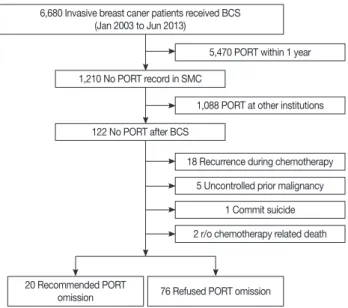
During the study period, a total of 6,680 patients received BCS with curative intent at Samsung Medical Center. Among them, BCS was conducted as a primary treatment without RT within 1 year at our institution for 1,210 female patients with invasive breast cancer. Of these, 1,088 patients received PORT at other institutions. Therefore, 122 patients who definitely did not receive PORT remained eligible for this study. Among these patients, an uncontrolled prior malignancy was present in five patients and one patient committed suicide after surgery.
During chemotherapy, recurrence was detected in 18 patients, and two patients died because of possible chemotherapy- related respiratory failure without evidence of tumor recurrence.
The present study was conducted with the remaining 96 patients (Figure 1). The median follow-up period of those patients was 17.2 months (range, 0.3–115.1 months).
Patients
Omission of PORT was recommended by the physician for patients with stage I disease and an age more than 70 years
(n=13), and it was optionally recommended for those with small tumors with a wide margin (stage T1mi, surgical mar- gin ≥5 mm, ductal carcinoma in situ smaller than 1 cm;
n=7). These 20 patients formed the recommended group.
Seventy-six patients refused PORT, even though their doctor advised PORT after BCS (refused group).
The comparison of patient characteristics between the two groups is shown in Table 1. As expected, the recommended group had an advanced age (p=0.004), a higher percentage of postmenopausal patients (p=0.013), no axillary lymph node (LN) metastasis (p<0.001), and a higher proportion of nucle- ar grade 3 disease (p=0.009). Additionally, in the molecular subtype classification, the recommended group showed a higher proportion of the luminal type, and lower proportions of luminal/HER2+ and triple-negative types than the refused group (p=0.041).
Because of the older age of the patients and the small tumor size, adjuvant chemotherapy was not used in the recommend- ed group, in contrast to the refused group (p=0.003). Endo- crine therapy, however, was more frequently used in the rec- ommended group than in the refused group (p=0.001), al- though the positivity status of hormone receptors was not sig- nificantly different between the groups.
Proportion of postoperative radiotherapy omission
The proportion of PORT omission after BCS from the rele- vant study period was calculated based on our institutional breast cancer database and was classified by surgery type. The overall rate of PORT omission between January 2003 and
June 2013 was 1.4% (96 of 6,680 BCS cases). The annual pro- portion of PORT omission for all patients and separately for the two groups is shown in Figure 2. The data showed a slight increase in the PORT omission rate to approximately 1.5% af- ter 2006, when physicians started to recommend PORT omis- sion in certain cases.
Table 1. Characteristics of patients according to type of postoperative radiotherapy omission
Variable Recommend (n=20) No. (%)
Refuse (n=76) No. (%) p-value
Age (yr)* 77 (27–88) 47 (26–88) 0.004
Menopausal status 0.013
Premenopausal 6 (30.0) 47 (61.8) Postmenopausal 14 (70.0) 29 (38.2)
T stage 0.064
T1 17 (85.0) 47 (61.8)
T2 3 (15.0) 29 (38.2)
ALN metastasis <0.001
Yes 0 32 (42.1)
No 20 (100.0) 44 (57.9)
Histologic grade 0.064
1–2 17 (85.0) 47 (61.8)
3 3 (15.0) 29 (38.2)
Nuclear grade 0.009
1–2 18 (90.0) 45 (59.2)
3 2 (10.0) 31 (40.8)
ER† 0.546
Positive 15 (83.3) 56 (73.7)
Negative 3 (16.7) 20 (26.3)
PR† 0.258
Positive 15 (83.3) 52 (68.4)
Negative 3 (16.7) 24 (31.6)
HER2† 0.451
Positive 1 (6.3) 12 (16.0)
Negative 15 (93.8) 63 (84.0)
Molecular subtype‡ 0.041
Luminal A like 12 (50.0) 33 (43.4) Luminal/HER2+ 3 (15.0) 23 (30.3)
HER2+/ER-PR- 1 (5.0) 2 (2.6)
Triple-negative 1 (5.0) 16 (21.1)
Not defined 3 (15.0) 2 (2.6)
Adjuvant chemotherapy 0.003
Yes 0 23 (30.3)
No 20 (100.0) 53 (69.7)
Endocrine therapy 0.001
Yes 15 (75.0) 25 (32.9)
No 5 (25.0) 51 (67.1)
ALN=axillary lymph node; ER=estrogen receptor; PR=progesterone recep- tor; HER2=human epidermal growth receptor 2.
*Median (range); †Analysis was performed in only accessible patients (ER/PR examinations were not possible due to no residual tumor after breast-con- serving surgery in referred patients or no additional fluorescence in situ hybrid- ization in HER2); ‡Luminal A like (positive for ER or PR, and negative for HER2); luminal/HER2+ (positive for ER or PR, and positive for HER2); HER2+/
ER-PR- (negative for ER/PR, and positive for HER2); triple-negative (negative for all ER, PR, and HER2).
6,680 Invasive breast caner patients received BCS (Jan 2003 to Jun 2013)
20 Recommended PORT
omission 76 Refused PORT omission
18 Recurrence during chemotherapy 1,088 PORT at other institutions
5,470 PORT within 1 year
5 Uncontrolled prior malignancy 1 Commit suicide 2 r/o chemotherapy related death
Figure 1. CONSORT diagram.
BCS=breast-conserving surgery; PORT=postoperative radiotherapy;
SMC=Samsung Medical Center; r/o=rule out.
1,210 No PORT record in SMC
122 No PORT after BCS
Patterns of recurrence and salvage treatment
LR with or without RR was the most frequent failure pat- tern in the study patients. Overall, 12 recurrences, developed during the follow-up period, and they were all in the refused group. Among the 12, five were solitary LR only and five were LRR. The other two patients showed DM, one of which was combined with LRR. The median time to recurrence was 9.8 months (range, 6.4–50.2 months).
Nine of the patients who showed LRR were recommended for salvage surgery with adjuvant RT and chemotherapy; the remaining patient showed recurrence on the breast, axilla, and internal mammary LN and underwent salvage RT followed by chemotherapy. Only four patients received the recom- mended treatment; three of these had no evidence of recur-
rence during the median follow-up of 18.9 months (range, 17.5–43.0 months), whereas the other patient showed DM af- ter 20 months. Two patients received surgical resection only and refused to undergo RT and chemotherapy; one showed recurrence after 8.9 months, and the other was lost to follow- up 1 month after surgery. The remaining four patients who showed LRR refused to get any treatment and were lost to fol- low-up.
Local recurrence-free survival
The overall LRFS rate of the PORT omission group was 80.0% at 3 years and 75.6% at 5 years; this result was signifi- cantly inferior to the result of a recent analysis of 1,071 pa- tients who received PORT after BCS at our institution (p<
0.001) (Figure 3).
Most cases of LR developed within 3 years after surgery.
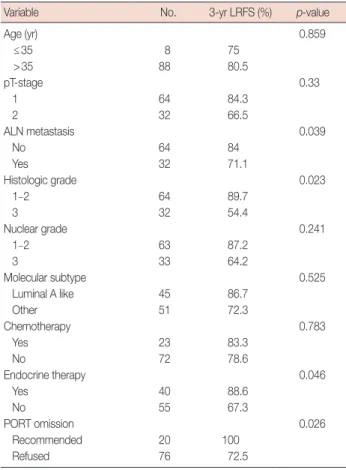
Possible prognostic factors related to LRFS are shown in Ta- ble 2. Significant favorable prognostic factors were histologic grade 1 or 2 (p=0.023), no axillary LN metastasis (p=0.039), adjuvant endocrine therapy (p=0.046), and the recommend-
2.5 2.0 1.5 1.0 0.5 0
No PORT Refused Recommended
Percentage (%)
Figure 2. Annual proportion of postoperative radiotherapy (PORT) omission after breast-conserving surgery (BCS). The rate increased slightly to approximately 1.5% after 2006, when physicians started to recommend PORT omission.
Year 2003 2004 2005 2006 2007 2008 2009 2010 2011 2012 2013.6
No PORT 2 2 2 7 7 15 7 18 16 15 6
Recommended 0 0 0 2 0 5 1 2 5 4 1
Refused 2 2 2 5 5 10 4 16 11 11 5
All BCS 270 268 300 331 444 843 877 941 1,018 848 540
100 80 60 40 20 0
97.6% at 5-years 75.6% at 5-years
LRFS (%)
BCS+PORT p<0.001
PORT omission
0 60 120 180
Time (mo)
Figure 3. Kaplan-Meyer curves of local recurrence-free survival (LRFS) according to the postoperative radiotherapy (PORT) or omission. When compared with patients who received PORT after breast-conserving surgery (BCS) in 1994 to 2007 at Samsung Medical Center, LRFS was clearly inferior in PORT omission group.
Table 2. Possible prognostic factors predicting local recurrence-free survival
Variable No. 3-yr LRFS (%) p-value
Age (yr) 0.859
≤35 8 75
>35 88 80.5
pT-stage 0.33
1 64 84.3
2 32 66.5
ALN metastasis 0.039
No 64 84
Yes 32 71.1
Histologic grade 0.023
1–2 64 89.7
3 32 54.4
Nuclear grade 0.241
1–2 63 87.2
3 33 64.2
Molecular subtype 0.525
Luminal A like 45 86.7
Other 51 72.3
Chemotherapy 0.783
Yes 23 83.3
No 72 78.6
Endocrine therapy 0.046
Yes 40 88.6
No 55 67.3
PORT omission 0.026
Recommended 20 100
Refused 76 72.5
LRFS =local recurrence-free survival; ALN =axillary lymph node; PORT = postoperative radiotherapy.
ed group (p=0.026). Figure 4 shows LRFS curves according to these significant factors.
DISCUSSION
A proportion of patients with breast cancer do not receive PORT after BCS [16], even though its benefit has been repeat- edly confirmed by multiple meta-analyses of large, well-de- signed, randomized, controlled trials [17,18]. PORT after BCS can reduce both LR and DM, thus improving overall survival [5]. Therefore, guidelines recommend PORT as an integral component of breast cancer management after BCS [5,6].
Nonetheless, 10% to 20% of breast cancer patients in the United States do not receive PORT after BCS [8,16].
Several studies have shown that the effect of PORT after BCS on disease recurrence and overall survival with endo- crine therapy is minimal in older patients (aged 70 or more) with stage I disease [13,19]. Based on these results, National Comprehensive Cancer Network guidelines now allow PORT omission after BCS in these patients [6].
Breast cancer is one of the most important health-related is- sues for Korean women [3,4]. Korea has the most rapidly in-
creasing incidence of breast cancer among the nations of the Organization for Economic Co-operation and Development.
There is a slight difference in the breast cancer distribution ac- cording to age, and patients aged 70 years or older account for only 5% to 6% of all cases of breast cancer in Korea according to data from 2006 to 2010 [4]. In contrast, more than 40% of breast cancer cases developed in women aged 65 years or old- er in the United States [1]. Because of these unique character- istics, it is necessary to investigate the proportion and clinical outcomes of PORT omission in Korean breast cancer patients.
Although a large number of patients did not receive PORT after BCS in our institution, more than 90% of these received PORT in regional hospitals. Overall, approximately 1.5% of all patients who received BCS did not receive PORT. This rate is extremely low compared with those reported in other coun- tries [8,9,16,20]. The support of the National Health Insurance Service might be an important reason for this high rate of op- timal management. Adequate evaluation of breast cancer by the Health Insurance Review and Assessment Service might be another reason for the high compliance with standard treatments.
The results of large randomized trials on PORT omission in Figure 4. Kaplan-Meyer curves of local recurrence-free survival (LRFS) according to prognostic factors. Significantly higher LRFS was detected for patients with histologic grade (HG) 1 or 2 (A), no axillary lymph node (LN) metastasis (B), endocrine therapy (Tx) (C), and the recommended group (D).
100 80 60 40 20 0
100 80 60 40 20 0
100 80 60 40 20 0
100 80 60 40 20 0
LRFS (%)LRFS (%) LRFS (%)LRFS (%)
HG 1 or 2
Endocrine Tx
LN negative
Recommended p=0.023
p=0.046
p=0.039
p=0.026 HG 3
No endocrine Tx
LN positive
Refused 0 24 48 72 96 120
0 24 48 72 96 120
0 24 48 72 96 120
0 24 48 72 96 120 Time (mo)
Time (mo)
Time (mo)
Time (mo) A
C
B
D
a low-risk older population [13,19] predict favorable clinical outcomes for the patients who were recommended PORT omission in the present study, although the small number of cases and short follow-up period preclude a concrete conclu- sion. Watchful waiting might be an option for these patients.
However, optimal indications based on molecular subtype and/or genomic analyses and careful follow-up are recom- mended [21-23], because, even in this subset of patients, the rate of LR is higher in the PORT omission group than in those that receive PORT in randomized trials [19].
As expected, LR was the most important failure pattern in our study population. Interestingly, recurrence developed only in the refused group, although it should be noted that the fol- low-up period was relatively short. The patients who were recommended for PORT omission did not receive chemo- therapy, but all hormone receptor-positive patients received endocrine therapy.
The recurrence rate in the refused group was higher than that reported in a previous prospective trial [24]. This discrep- ancy might be associated with differences in the use of opti- mal systemic management. Many patients enrolled in the present study did not follow the physician’s recommendation about either PORT or systemic management. Chemotherapy was used in less than one-third of patients in the refused group, and endocrine therapy was used in less than one-half of those who were hormone receptor positive. Moreover, some patients refuse salvage treatment or adjuvant treatment even after recurrence, despite their potential to be cured [25].
Noncompliance might be an important issue in these patients.
In the recent report of Badakhashi et al. [9], the compliance with PORT was closely related with usage of endocrine thera- py, and the 5-year LRFS in the noncompliance group was 75.4%. Although a direct comparison of this recurrence rate with that in our study is not possible because other important factors, such as stage or grade, were not matched, the absolute value was very similar to our 5-year LRFS of 75.5%.
To improve clinical outcomes, therefore, overcoming pa- tient noncompliance might be one of the most important is- sues. More detailed, accurate explanations of the effect and/or necessity of PORT, consequence of clinical outcomes, and rec- ommended alternatives should be provided to allow the pa- tient to contribute to decision making regarding the optimal management strategy.
This study has several limitations. First, selection bias is in- evitable because of the retrospective study design and involve- ment of a single institution. Second, clinical outcomes of some patients could not be assessed because of early follow-up loss, although the records of all patients who did not receive PORT were analyzed. Third, the assessment of survival outcomes, es-
pecially in patients with LR, was not conducted owing to the tendency of early follow-up loss of these patients.
To our knowledge, this is the first report describing the clinical outcomes of PORT omission after BCS in a Korean population. The rate of PORT omission was very low among women who underwent surgery in the present study com- pared with that of other studies worldwide. Our data indicate that PORT might be safely omitted in carefully selected pa- tients aged 70 years or older. However, the rate of LR was dra- matically elevated in the refused group, and solutions to en- hance compliance in these patients should be discussed.
CONFLICT OF INTEREST
The authors declare that they have no competing interests.
REFERENCES
1. DeSantis C, Siegel R, Bandi P, Jemal A. Breast cancer statistics, 2011. CA Cancer J Clin 2011;61:409-18.
2. Jemal A, Bray F, Center MM, Ferlay J, Ward E, Forman D. Global cancer statistics. CA Cancer J Clin 2011;61:69-90.
3. Jung KW, Won YJ, Kong HJ, Oh CM, Lee DH, Lee JS. Cancer statistics in Korea: incidence, mortality, survival, and prevalence in 2011. Cancer Res Treat 2014;46:109-23.
4. Korean Breast Cncer Society. Breast Cancer White Paper. Seoul: Korean Breast Cancer Society; 2013.
5. Early Breast Cancer Trialists’ Collaborative Group (EBCTCG), Darby S, McGale P, Correa C, Taylor C, Arriagada R, et al. Effect of radiotherapy after breast-conserving surgery on 10-year recurrence and 15-year breast cancer death: meta-analysis of individual patient data for 10,801 women in 17 randomised trials. Lancet 2011;378:1707-16.
6. Cinical practice guidelines in oncology: breast cancer. 2014. National Comprehensive Cancer Network. http://www.nccn.org/professionals/
physician_gls/f_guidelines.asp. Accessed October 1st, 2014.
7. National Institute for Health and Clinical Excellence; National Collabo- rating Centre for Cancer. Early and Locally Advanced Breast Cancer:
Diagnosis and Treatment. London: National Institute for Health and Clinical Excellence; 2009.
8. Nattinger AB, Hoffmann RG, Kneusel RT, Schapira MM. Relation be- tween appropriateness of primary therapy for early-stage breast carci- noma and increased use of breast-conserving surgery. Lancet 2000;356:
1148-53.
9. Badakhshi H, Gruen A, Sehouli J, Budach V, Boehmer D. The impact of patient compliance with adjuvant radiotherapy: a comprehensive co- hort study. Cancer Med 2013;2:712-7.
10. White J. Do we need to irradiate all small invasive breast cancers and DCIS? Am Soc Clin Oncol Educ Book 2013:40-4.
11. Colleoni M, Rotmensz N, Peruzzotti G, Maisonneuve P, Viale G, Renne G, et al. Minimal and small size invasive breast cancer with no axillary lymph node involvement: the need for tailored adjuvant therapies. Ann Oncol 2004;15:1633-9.
12. Kim H, Noh JM, Choi DH, Lee J, Nam SJ, Lee JE, et al. Excision alone for
small size ductal carcinoma in situ of the breast. Breast 2014;23:586-90.
13. Hughes KS, Schnaper LA, Berry D, Cirrincione C, McCormick B, Shank B, et al. Lumpectomy plus tamoxifen with or without irradiation in women 70 years of age or older with early breast cancer. N Engl J Med 2004;351:971-7.
14. Lim YJ, Kim K, Chie EK, Han W, Noh DY, Ha SW. Treatment outcome of ductal carcinoma in situ patients treated with postoperative radiation therapy. Radiat Oncol J 2014;32:1-6.
15. Cheang MC, Voduc D, Bajdik C, Leung S, McKinney S, Chia SK, et al.
Basal-like breast cancer defined by five biomarkers has superior prog- nostic value than triple-negative phenotype. Clin Cancer Res 2008;14:
1368-76.
16. Showalter SL, Grover S, Sharma S, Lin L, Czerniecki BJ. Factors influ- encing surgical and adjuvant therapy in stage I breast cancer: a SEER 18 database analysis. Ann Surg Oncol 2013;20:1287-94.
17. Fisher B, Bryant J, Dignam JJ, Wickerham DL, Mamounas EP, Fisher ER, et al. Tamoxifen, radiation therapy, or both for prevention of ipsilat- eral breast tumor recurrence after lumpectomy in women with invasive breast cancers of one centimeter or less. J Clin Oncol 2002;20:4141-9.
18. Fyles AW, McCready DR, Manchul LA, Trudeau ME, Merante P, Pintil- ie M, et al. Tamoxifen with or without breast irradiation in women 50 years of age or older with early breast cancer. N Engl J Med 2004;351:
963-70.
19. Hughes KS, Schnaper LA, Bellon JR, Cirrincione CT, Berry DA, Mc- Cormick B, et al. Lumpectomy plus tamoxifen with or without irradia- tion in women age 70 years or older with early breast cancer: long-term
follow-up of CALGB 9343. J Clin Oncol 2013;31:2382-7.
20. Tuttle TM, Jarosek S, Habermann EB, Yee D, Yuan J, Virnig BA. Omis- sion of radiation therapy after breast-conserving surgery in the United States: a population-based analysis of clinicopathologic factors. Cancer 2012;118:2004-13.
21. Bane AL, Whelan TJ, Pond GR, Parpia S, Gohla G, Fyles AW, et al. Tu- mor factors predictive of response to hypofractionated radiotherapy in a randomized trial following breast conserving therapy. Ann Oncol 2014;25:992-8.
22. Zhou W, Jirström K, Amini RM, Fjällskog ML, Sollie T, Lindman H, et al. Molecular subtypes in ductal carcinoma in situ of the breast and their relation to prognosis: a population-based cohort study. BMC Cancer 2013;13:512.
23. Caudle AS, Yu TK, Tucker SL, Bedrosian I, Litton JK, Gonzalez-Angulo AM, et al. Local-regional control according to surrogate markers of breast cancer subtypes and response to neoadjuvant chemotherapy in breast cancer patients undergoing breast conserving therapy. Breast Cancer Res 2012;14:R83.
24. Pötter R, Gnant M, Kwasny W, Tausch C, Handl-Zeller L, Pakisch B, et al. Lumpectomy plus tamoxifen or anastrozole with or without whole breast irradiation in women with favorable early breast cancer. Int J Ra- diat Oncol Biol Phys 2007;68:334-40.
25. Jeong Y, Kim SS, Gong G, Lee HJ, Ahn SH, Son BH, et al. Treatment re- sults of breast cancer patients with locoregional recurrence after mas- tectomy. Radiat Oncol J 2013;31:138-46.