Beauveria bassiana Bb08의 살충성 물질 생산을 위한 배양조건의 통계적 최적화
고은수1, 임영훈1, 정형철2, 최재필3, 박인서3, 김정준4, 이동진5, 김근1*
1수원대학교생명공학과
2수원대학교통계정보학과
3(주)고려바이오연구소
4농촌진흥청국립농업과학원
5단국대학교식량생명공학과
Received: September 27, 2013 / Revised: November 24, 2013 / Accepted: November 25, 2013
서 론
병원성곰팡이(entomopathogenic fungi)는미생물살충제 로사용되는데, 그장점으로사람에게무해하고, 다른천적 들과도같이사용할수있으며, 독성잔류물이없고, 미생물 증식에의해지속적인방제를할수있다는점을들수있다 [22]. 여러 병원성곰팡이들 중에서 Beauveria bassiana (Balsamo-Crivelli) Vuillemin은자연에서넓은지역에분포 하고 70종류의해충을방제할수있으며[21], 현재세계적으
로효과적인상업적인미생물살충제로판매되고있다. 진딧물은국내에서특히오이, 고추, 토마토를비롯한많
은작물에큰피해를주고있다[12]. 진딧물은식물영양분
을섭취하기때문에잎이말리고, 변형되며, 당분을분비하 기때문에식물병원균을성장시키고, 많은식물병원성바이 러스를전파한다[10].
곤충병원성곰팡이살충제는주로곰팡이포자(conidia)를 이용하는데, 이포자살충제는전체살충제시장에서차지하 는비중이작다[23]. 그이유로이곰팡이포자살충제의성 공적인상용화의걸림돌은포자에의한병발생의속도가느 리다는점과, 포자의살충력이온도, 습도등과같은경작지 환경에영향을받아그살충효과가변동이크다는점이다[4, 8].
이러한포자살충제의살충력을높여줄수있는가능성은 병원성곰팡이배양액에서찾아볼수있는데, 병원성곰팡이 Statistical Optimization of Culture Conditions for the Production of Aphicidal Metabolites of Beauveria bassiana Bb08. Go, Eunsu1, Younghoon Lim1, Hyeongchul Jeong2, Jaepil Choi3, Inseo Park3, Jeong Jun Kim4, Dong-Jin Lee5, and Keun Kim1*. 1Department of Bioscience and Biotechnology, 2Department of Applied Statistics, The University of Suwon, Gyeonggi-do 445-743, Korea, 3KoreaBio Co., Ltd., Gyeonggi-do 445-966, Korea, 4Agricultural Microbiology Division, National Academy of Agricultural Science, Gyeonggi-do 441-707, Korea, 5Department of Crop Science and Biotechnology, Dankook University, Chungnam 330-714, Korea
For the maximal production of aphicidal metabolites produced by the Beauveria bassiana Bb08, statistical methods such as the Box-Behnken experimental design and response surface methodology were used. The fungal culture filtrate was sprayed towards 3-star aphids and the mortality was examined. After the statistical analysis of the aphid mortality, the optimal culture conditions were found to be a culture temperature of 26.2oC, medium pH 5.9, flask shaking speed of 209.0 rpm, and culture time of 5.9 days. The expected mortality on days 4, 5, and 6 after spraying the filtrate on to the aphids were 76.8%, 84.9%, and 89.4%, respectively. All 4 factors of the culture conditions significantly affected the production of the aphicidal metabolites, and the order of significance was temperature, pH, culture time and shaking speed.
Keywords: Beauveria bassiana, statistical optimization, culture condition, aphicidal metabolites, culture filtrate
*Corresponding author
Tel: +82-31-220-2344, Fax: +82-31-220-2344 E-mail: [email protected]
© 2013, The Korean Society for Microbiology and Biotechnology
의배양액은곤충에살포후에바로포자의살충율을높여 줄수있다. 병원성곰팡이의배양액내의살충성물질로는 효소와독성대사산물을들수있다. 대사산물들중에서효소 들은 곤충에서의 발병에서 중요한 역할을 한다[5], 특히 chitinase, Pr1-protease, Pr2-protease들은 곤충의 cuticle 층을뚫는데결정적인역할을한다[13, 14]. 대사산물내의분 비된독성대사산물은대부분은저분자 cyclic peptide [18, 22]
이며, 고분자단백질성물질[16]도알려졌다.
발효공정의최적화는많은생물공정의생산수율을높이기 위해사용되어왔다. 하나의변수를고정하고다른변수를변 화시키는전형적방식의공정최적화는시간과노동을소모 하는단점이있는데, 특히변수가많을수록더욱그렇다. 그 런데, 보다더효율적인방법은통계적모형을활용한최적 화 방법이다. 반응표면분석(response surface methodology;
RSM)은최적발효조건을찾을때, 예상되는처리조합근처 에서 반응값들에 대한 함수식, 이른바 반응표면(response
surface)을구하고이를이용하여최적반응값을찾아처리
조합을분석하는통계적방법이다[3, 6]. 한편, 박스벤켄(Box- Behnken) 디자인은인자가계량인자이고 3 수준인경우에 2차회귀방정식도구하고최적조건을찾을수있는실험계 획법이다. 이계획법은인자의수가 k개경우에 3k요인배치 법보다는 실험점의 수가 많지 않으면서도 직교블록 (orthogonal blocking)을만들기용이하고, 2차회귀방정식 으로교호작용과이차효과를동시에탐색할수있기에반응 표면분석에서널리사용된다[7].
본연구에서는 Beauveria bassiana Bb08에서 분비하는 살충성대사산물을연구하기위해살충성대사산물을최대 로생산할수있는배양조건을 Box-Behnken 실험설계로설 계하였으며반응표면분석을사용하여최적화하였다.
재료 및 방법
균주
B. bassiana Bb08 균주를 20% glycerol 용액에혼합하여
−80oC에서 보관하였다. 균배양액의 접종균 준비를 위해 potato dextrose agar(PDA)에서 25oC, 7-10일간 배양 후 4oC에저장하여사용하였다.
목화진딧물(Aphis gossypii)
실험에사용된목화진딧물은농촌진흥청작물보호과에서 분양받아온도 25oC, 광조건 16 L : 8 D, 상대습도 70% 조건 으로사육하였다.
균 액체배양
액체 배양액을 준비하기 위해서는 potato dextrose
agar (PDA)에서 7일간배양한것을사용하였으며 mycelia plug를 1×1 cm 크기로 잘라 100 ml 액체배지를 담은 250 ml Erlenmyer flask에 접종하고 25oC에서 rotary shaking incubator에서 200 rpm의속도로 5일간배양하였 다. 여기에서사용된액체배지로는 potato dextrose broth (PDB); 3% corn meal, 2% corn steep powder, 2% rice bran(CCR); CCR + 0.2% chitin (Sigma, C7170); 3% starch, 1% soybean flour, 1% dextrose, 0.1% yeast extract, 0.2%
KH2PO4, 0.1% MgSO4·7H2O (CDS)의 4종류이었다. 진딧물 살충력 측정
균배양액내의살충물질의살충력을측정하기위해배양 액을원심분리하여그상등액을 0.2μm membrane filter로 여과하여균체와포자를제거한뒤살충력측정에사용하였 다. 살충력은 detached leaf assay로하였고, 이를위해배추 를구입하여잎을수돗물로 3분동안세척후 laminar flow hood에서건조시켰다. 직경 9 cm로절단한배추잎을, 뚜껑 에 4 cm의통기를위한나일론망을갖추고있고통내부바 닥에물로적신여과지를깔은곤충사육통(100 × 40 mm)의 바닥에넣었다. 3령의 30마리의진딧물을곤충사육통내의배 추잎위에올려놓고, 5 ml의균배양여과액을핸드-스프레 이하였다. 이처리된샘플은온도 25oC, 광조건 16 L : 8 D, 상대습도 70% 조건으로배양하였다. 사멸한진딧물을 6일 동안매일계수하여살충율(%)을계산하였다.
통계적 방법
본실험에서는 4가지요인에대해 3개의직교블록이존재 하는 Box-Behnken(B-B) 실험계획을사용하여실험을실시 하였다. 인자의수가 k = 4인경우 34요인배치법은 81회의 실험이요구되나, B-B 실험에서는 27회의실험이요구됨으 로실험점이적어서경제적이다. 또한, B-B 실험으로이차 회귀방정식을만들수있기때문에최적점탐사에매우용 이하다.
본연구에서사용한 2차다항식은다음과같다.
(1)
여기서, Y는예측된반응값, Xi및 Xj는부호화된인자(coded factor), β0는절편항(intercept), βi는 1차회귀계수, βii는 2차 회귀계수, βij는 Xi와 Xj의교호작용계수이다. 한편, 주의할 점은 Xi들에대해
의관계가성립하는데, Xi는부호화된값(coded value), xi는 Y β0 βiXi
∑i βiiXi2
∑i βijXiXj i j<
∑
+ + +
=
Xi xi–x0 xi ---Δ
=
실제값(actual value), x0는중심값, 그리고∆xi는증분값을 의미한다. 위의 (1)식은부호화된변수에대한회귀식으로 B-
B 실험에의하면, Xi는±1과 0으로 3개의값으로부호화된 다. Table 1은본연구에서사용한 4가지인자에대한실제 Table 1. Coded and actual levels of the factors for four factor Box-Behnken design.
Independent
variables Symbols Coded and actual levels
-1 0 +1
Temperature (oC) X1 20 25 30
pH X2 4 5.5 7
Shaking speed (rpm) X3 150 200 250
Culture time (day) X4 3 5 7
Table 2. Box-Benken experiment for the 4 variables and experimental results.
Run
Actual experimental point Aphid mortality (%) after
Block Temperature
(oC) pH Shaking (rpm)
Culture
time (day) 1 day 2 3 4 5 6 Predicted
1 20 4 200 5 3.3 13.3 16.6 26.6 36.6 40.0 36.51
1
2 20 7 200 5 6.6 10.0 26.6 36.6 43.3 46.6 47.01
3 30 4 200 5 6.6 16.6 23.3 43.3 53.3 53.3 50.94
4 30 7 200 5 13.3 23.3 36.6 56.6 63.3 66.6 68.14
5 25 5.5 150 3 10.0 26.6 40.0 46.6 60.0 63.3 64.28
6 25 5.5 150 7 10.0 33.3 53.3 63.3 76.6 80.0 77.63
7 25 5.5 250 3 13.3 33.3 46.6 63.3 70.0 70.0 70.43
8 25 5.5 250 7 13.3 43.3 56.6 73.3 80.0 83.3 80.38
9 25 5.5 200 5 13.3 40.0 56.6 76.6 83.3 86.6 85.94
10 20 5.5 200 3 6.6 13.3 26.6 36.6 43.3 46.6 45.08
2
11 20 5.5 200 7 6.6 16.6 33.3 46.6 53.3 56.6 53.43
12 30 5.5 200 3 13.3 26.6 43.3 53.3 60.0 60.0 59.57
13 30 5.5 200 7 13.3 26.6 40.0 60.0 73.3 76.6 74.52
14 25 4 150 5 6.6 30.0 33.3 53.3 60.0 60.0 57.35
15 25 4 250 5 10.0 26.6 33.3 46.6 56.6 60.0 60.15
16 25 7 150 5 13.3 36.6 50.0 66.6 73.3 73.3 69.55
17 25 7 250 5 16.6 40.0 53.3 60.0 73.3 76.6 75.65
18 25 5.5 200 5 16.6 43.3 60.0 73.3 80.0 86.6 85.94
19 20 5.5 150 5 3.3 16.6 30.0 36.6 43.3 43.3 48.31
3
20 20 5.5 250 5 6.6 16.6 30.0 40.0 46.6 50.0 52.76
21 30 5.5 150 5 10.0 16.6 40.0 56.6 63.3 63.3 66.09
22 30 5.5 250 5 16.7 33.3 46.3 63.3 70.0 70.0 70.54
23 25 4 200 3 6.6 26.6 36.6 43.3 50.0 50.0 51.68
24 25 4 200 7 6.6 30.0 36.6 46.6 53.3 56.6 63.28
25 25 7 200 3 16.6 33.3 46.6 53.3 63.3 66.6 65.48
26 25 7 200 7 16.6 30.0 43.3 53.3 66.6 73.3 77.18
27 25 5.5 200 5 13.3 36.6 50.0 73.3 83.3 86.6 85.94
28 25 5.5 200 5 16.6 36.6 53.3 73.3 80.0 83.3 85.94
29 25 5.5 200 5 16.6 36.6 53.3 76.6 83.3 86.6 85.94
값과부호화된값이다.
B-B 실험에서는모두 27개의실험(run)이존재하나, 본실 험은모두 29회로구성되었다. 그이유는네인자의중심점 (0)에서 2회의반복실험을실시했기때문이다(Table 2의 28, 29번실험). Table 2는 B-B 실험점에서 6일동안사멸되는 진딧물의비율(%)를보여준다.
결과 및 고찰
배지선정
여러배지에서배양한 B. bassiana Bb08의배양여과액의 진딧물에대한살충력을살포후 6일동안관찰하였고, 그 결과를 Fig. 1에나타내었다. PDB와 CDS의경우 CDS가 3, 4일째살충율이높았으나 5일째는 PDB가살충율이높았고, 6일째에는두배지모두 56.7%로살충율이같았다. CCR의
경우는 살충력에기여하는 chitinase의 증산 효과가있는
chitin [9, 20]을배지에첨가한경우가 3, 4일째살충율이조 금더높았으나, 5, 6일째에는살충율이같았다. Chitin의배 지로의첨가가살충력에크게영향을끼치지않는것으로보 아 B. bassiana Bb08배양액의주 살충물질은 chitinase가 아닌다른물질로사료되었다. 결국 6일째살충력이 80%로 가장높고, chitin을첨가하지않아도되는 CCR을배양조건 연구에사용할배지로선정하였다.
분산분석
진딧물사멸과관련되어 6일동안진딧물사멸에단위증 분량의변화의정도에따라영향력이큰변수를파악하고자 분산분석을실시하였다. 배양액살포후 6일째의진딧물사 멸의정도가최종적결과이므로 6일째의결과를제공하기로 하였다(Table 3). 한편, B-B 실험에의해각인자의수준이 3수준이므로선형효과(linear)와곡선효과(quadratic) 검정을 위해대비(contrast) 제곱합을계산하였다(Table 3).
Table 3에서네가지인자모두단위증분량의변화에따
라진딧물의사멸에유의한영향을미치고있음을볼수있 다. 특히, 단위증분량의변화의정도에민감한반응을보이 는인자는평방합의순서로보면, 온도, pH, 배양시간, 교반 의 순으로 나타나며, 이들 모두 통계적으로 유의하다 (p < 0.05). 이제, 각인자들이모두세수준인관계로대비제 곱합의크기를통해선형효과가존재하는지곡선효과가존 재하는지를살펴보기로한다. 네인자모두선형대비와곡선 대비가통계적으로유의하다(p < 0.05)(Table 3). 한편, 온도 와 pH의곡선대비효과가강하다. 이는온도와 pH가살충 력에영향을미치는최적점발견에크게기여한다는점을의 미한다. 한편, 교반속도(shaking speed)는단위증분간선형
Table 3. Analysis of variance and contrast for four factors on 6 day after spray of culture filtrate.
Parameter (Contrast) Degrees of freedom Sum of squares Mean square F value p-value
Temperature 2 3746.97 1873.48 173.99 <.0001
linear 1 948.74 948.74 88.11 <.0001
quadratic 1 2798.22 2798.22 259.88 <.0001
pH 2 1943.02 971.51 90.23 <.0001
linear 1 575.47 575.47 53.44 <.0001
quadratic 1 1367.55 1367.55 127.01 <.0001
Shaking speed 2 273.49 136.75 12.70 0.0003
linear 1 59.41 59.41 5.52 0.0292
quadratic 1 214.09 214.09 19.88 0.0002
Culture time 2 726.82 363.41 33.75 <.0001
linear 1 407.17 407.17 37.81 <.0001
quadratic 1 319.66 319.66 29.69 <.0001
Fig. 1. Effect of different culture media for B. bassiana Bb08 on the mortality of aphid.
효과보다는곡선효과가상대적으로크지만, 배양시간(culture
time)은선형효과가상대적으로곡선효과보다 커서시간에
서단위증분정도를조금확대하여살충력을관찰할필요 가약간 정도요구된다. 하지만, 분산분석결과 모든인자 가유의하며, 모든인자에서곡선효과가존재하였으므로네 인자별살충력을최대로하는최적점발견이가능하리라판 단된다.
반응표면분석에 의한 최적점 탐색
6일간진딧물살충력을관찰하였으므로, 전일에대한최적 점을반응표면분석하였다(Table 4). 그결과, 시간이흐를 수록진딧물살충력이증가하였으므로최종일 6일을중심으 로진딧물살충력을최대화하는분석을실시하였다.
6일째의진딧물살충력에대한 2차회귀방정식은다음과 같다(Table 4).
Y = 85.940 + 8.892X1+ 6.925X2+ 2.225X3+ 5.825X4 + 1.675X1X2+ 0.000X1X3+ 1.650X1X4+ 0.825X2X3 + 0.025X2X4−0.850X3X4−20.770X12−14.520X22
−5.745X32−7.020X42 (2)
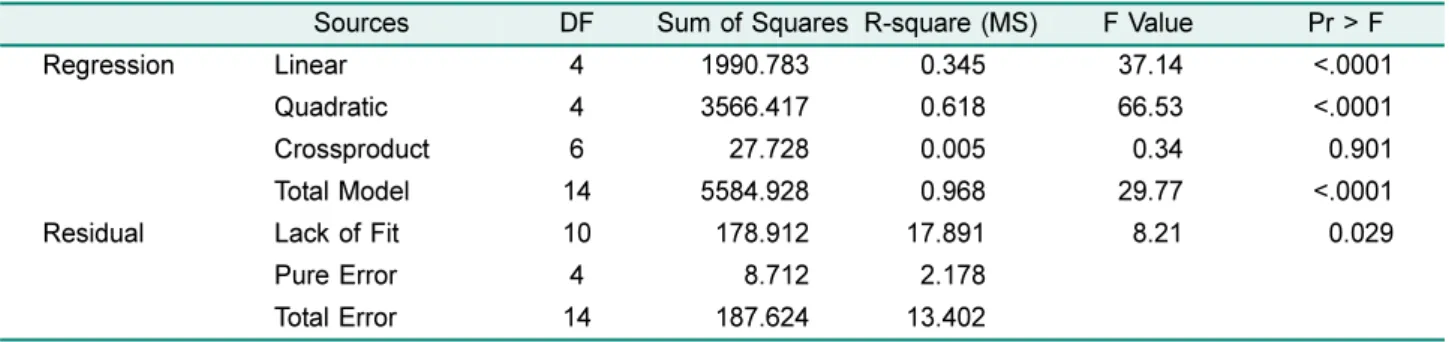
Table 5에 의하면, 선형효과와 곡선효과의 유의확률이
p < 0.0001로통계적으로매우유의하나, 교호효과는통계적 으로유의하지않는것으로나타난다. 한편, 모형의결정계 수(R2)는 0.968로적합력이매우높음을볼수있다. 이는모 형이실제자료와잘일치한다는것을나타낸다. 한편, 적합 결여(lack of fit)의유의확률이 0.029로추가적으로모형식 에포함될식이더필요하다는것을알려준다. 하지만, 최적 반응식을유도하기에는 2차회귀식이면충분하므로최종모 형에서는교호작용항을삭제하지않고 (2)의식으로부터최 적점을유도하기로하였다. Fig. 2는 6일째 2차회귀식에대 한삼차원그래프이다. 해당그림은모두 6개로주어지는데,
Table 4. Estimate of the response function to predict mortality(Y) from Eq. (2) by regression analysis on 6 day after spray of culture filtrate.
Parameter DF Estimate SE t Value Pr > |t|
Intercept 1 85.940 1.637 52.49 <.0001
X1 1 8.892 1.057 8.41 <.0001
X2 1 6.925 1.057 6.55 <.0001
X3 1 2.225 1.057 2.11 0.0538
X4 1 5.825 1.057 5.51 <.0001
X1*X1 1 -20.770 1.437 -14.45 <.0001
X2*X1 1 1.675 1.830 0.92 0.3756
X2*X2 1 -14.520 1.437 -10.10 <.0001
X3*X1 1 0.000 1.830 0.00 1.0000
X3*X2 1 0.825 1.830 0.45 0.6591
X3*X3 1 -5.745 1.437 -4.00 0.0013
X4*X1 1 1.650 1.830 0.90 0.3826
X4*X2 1 0.025 1.830 0.01 0.9893
X4*X3 1 -0.850 1.830 -0.46 0.6495
X4*X4 1 -7.020 1.437 -4.88 0.0002
Table 5. Analysis of variance for quadratic model on 6 day after spray of culture filtrate.
Sources DF Sum of Squares R-square (MS) F Value Pr > F
Regression Linear 4 1990.783 0.345 37.14 <.0001
Quadratic 4 3566.417 0.618 66.53 <.0001
Crossproduct 6 27.728 0.005 0.34 0.901
Total Model 14 5584.928 0.968 29.77 <.0001
Residual Lack of Fit 10 178.912 17.891 8.21 0.029
Pure Error 4 8.712 2.178
Total Error 14 187.624 13.402
(Temperature, pH), (Temperature, Shaking speed), (Temperature, Culture time), (pH, Shaking speed), (pH, Culture time), (Shaking speed, Culture time) 간의살충력 (response) 정도를나타내며, 그림에서보는바와같이각인 자의수준변화에대해 2차곡선효과가존재하여최적점을 유도할수있음을볼수있었다. 6일째살충력을최대화하기 위한 반응표면분석 모형식에 의하여 유도된 최적점은 temperature 26.208oC, pH 5.887, shaking speed 209.007 rpm, culture time 5.866 days이다. 한편, Table 2의실험자료에 (2) 식에의한 6일째살충력예측값을제시하였다. 본실험 결과는다른실험보고에서도유사하였는데, Pham 등[15]은 B. bassiana의액체배양에서포자를생산하기위한최적배 양온도는 25oC와 shaking speed는 200 rpm으로보고하였 다. B. bassiana와같이역시중온성(mesophilic) 사상균인 Aspergillus niger도최적발효온도가 25oC로보고되었다[1].
일별 최적점 변화
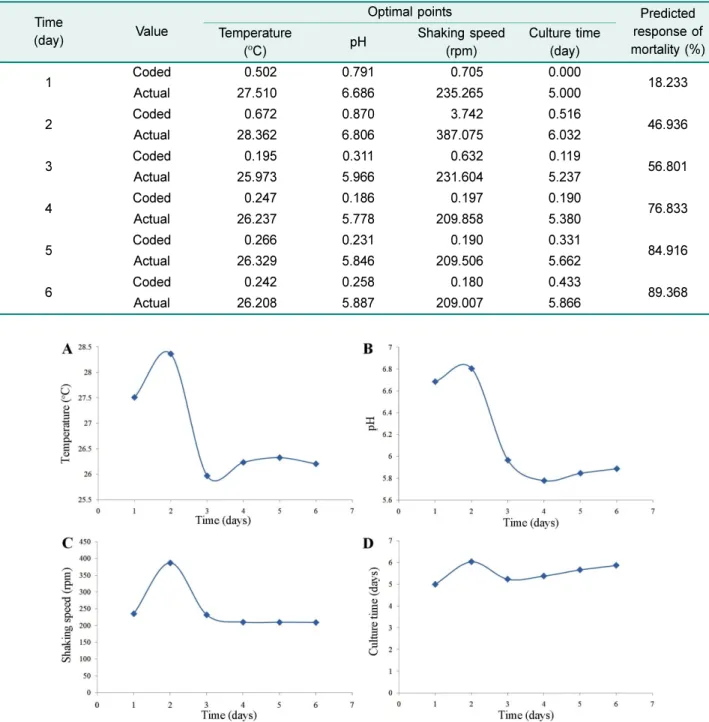
6일동안의진딧물살충력에대해최대로하는최적점이
일별로어떻게변화하는지살펴보았다. 이를위해 6일동안 의진딧물살충력을반응표면분석을실시하였다. 6일동안
유도된최적점은정준형분석(canonical analysis)을통해살 충력을최대로유도하는값으로판정되었다. Table 6과 Fig.
3은 6회의반응표면분석결과에따른최적점들의변화를보 여준다. 관찰일이길어질수록진딧물의살충력이상승하게 되는데, 4일이후로최적점에큰변화가없다는점을볼수 있다. 즉, 4일이후부터 temperature는 26.2-26.3oC, pH는 5.7-5.9, shaking speed는 209.0-209.8 rpm, culture time은 5.3-5.8 days 수준에서최적점이결정되며, 일별최적점의변 화가크지않았다.
일별 최적점의 살충력 예측값은 1일째 18.23%, 2일째 46.94%, 3일째 56.80%, 4일째 76.83%, 5일째 84.92%, 6일 째 89.37%로나타났다. 또한, 이들최적실험조건은 B-B 실 험에서실시한실험점내부에존재하는것으로나타나유의 한실험결과가유도된것으로판단되었으며끝으로본연 구에서는 6일째살충력의최대화수준을최적점으로제시하 였다.
살충력비교
본연구에사용된 B. bassiana Bb08 배양여과액의살충력 을다른논문과비교하고자하였다. 그러나대부분의다른 Fig. 2. Response surface plot and the corresponding contour plot for mortality(Y).
논문들은배양여과액을직접살충력측정에사용하지않고, 균배양액으로부터정제된대사산물을사용하였고, 대상곤 충이진딧물이아닌다른곤충들이었거나, 살충력을측정하 기위한생물검정방법이상이하여[2, 16, 18], 본연구의 B.
bassiana Bb08 배양여과액의살충력과비교할수없었다. 한
편배양여과액으로직접살충율을측정한다른논문들의경 우를보면, B. bassiana SF205균주의배양여과액을목화진 딧물을대상으로살충력을측정한결과, 배양여과액의희석 배수에따라 31.5-94.3%의살충율을보였다[11]. 그러나이 경우사용한살충력측정방법은본논문의경우와상이하였 Table 6. Optimal points for four factors and predicted response of second-order regression model on optimal points for 6 days after spray of culture filtrate.
Time
(day) Value
Optimal points Predicted
response of mortality (%) Temperature
(oC) pH Shaking speed
(rpm)
Culture time (day)
1 Coded 0.502 0.791 0.705 0.000
18.233
Actual 27.510 6.686 235.265 5.000
2 Coded 0.672 0.870 3.742 0.516
46.936
Actual 28.362 6.806 387.075 6.032
3 Coded 0.195 0.311 0.632 0.119
56.801
Actual 25.973 5.966 231.604 5.237
4 Coded 0.247 0.186 0.197 0.190
76.833
Actual 26.237 5.778 209.858 5.380
5 Coded 0.266 0.231 0.190 0.331
84.916
Actual 26.329 5.846 209.506 5.662
6 Coded 0.242 0.258 0.180 0.433
89.368
Actual 26.208 5.887 209.007 5.866
Fig. 3. Optimal points for four factors and predicted response of second-order regression model on optimal points for 6 days observation. (A) temperature, (B) pH, (C) shaking speed, (D) culture time.
고, B. bassiana SF205균주의주된살충물질은 chitinase이 었다. 또다른경우는 Lecanicillium lecanii의배양여과액으 로어린선충(Heterodera glycines Ichinohe의 second stage juvenile)으로살충력을측정한결과 L. lecanii 균주에따라 2.0-20.7%의살충력을보였다[17].
본논문의통계적최적화후 B. bassiana Bb08 배양여과 액은살충력 89.368%이었으며, 배양여과액내의살충물질은 chitinase가아니다른물질로사료되며, 그물질규명은앞 으로흥미로운연구가될것으로기대된다.
요 약
본연구에서는 B. bassiana Bb08가생산하는진딧물살충 대사산물의최대생산을위하여박스벤켄(Box-Behnken) 디 자인과표면반응분석을이용한통계적방법을사용하였다. 균 배양을위한배지는옥수수분말, 미강, 옥수수침지액분말로 구성되었다. 균배양액은원심분리후상등액을 0.45μm 막 여과지로여과한후 3령의목화진딧물에살포하였고, 6일동 안매일죽은진딧물수를계수하여살충율을계산하였다. 통 계분석한결과최적의배양조건은온도 26.2oC, 배지초기 pH 5.9, 플라스크진탕속도 209.0 rpm, 그리고균배양시간 은 5.9일로나타났다. 여과액살포후 4, 5, 그리고 6일째기 대살충율은각각 76.8, 84.9, 그리고 89.4%이었다, 배양조 건 4가지모두살충성대사산물생산에유의한영향을미쳤 고, 영향이큰요인순서는온도, pH, 배양시간, 진탕속도의 순서로분석되었다.
Acknowledgments
This work was carried out with the support of “Cooperative Research Program for Agriculture Science & Technology Develop- ment (Project No. PJ008980032013)”, Rural Development Admin- istration, Republic of Korea.
References
1. Amenaghawon NA, Nwaru KI, Aisien FA, Ogbeide SE, Okie- imen CO. 2013. Application of Box-Behnken design for the optimization of citric acid production from corn starch using Aspergillus niger. Br. Biotechnol. J. 3: 236-224.
2. Bandani AR, Khambay BPS, Faull JL, Newton R, Deadman M and Butt TM. 2000. Production of efrapeptins by Tolypocla- dium species and evaluation of their insecticidal and antimi- crobial properties. Mycol. Res. 104: 537-544.
3. Box GEP, Hunter JS. 1957 Multi-factorial designs for exploring response surfaces. Ann. Math. Stat. 28: 195-241.
4. Burges HD. 1998. Formulation of mycopesticides. pp. 131- 186. In: Burges, H. D. (ed.), Formulation of Microbial Biopesti-
cides: Beneficial Microorganisms, Nematodes and Seed Treatment. Kluwer Academic Publisher, Dordrecht, The Neth- erland.
5. Charnley AK. 2003. Fungal pathogens of insects: cuticle degrading enzymes and toxins. Adv. Bot. Res. 40: 241-321.
6. Farid MA, Ghoneimy EA, El-Khwwaga MA, Negm-Eldein A, Awad GEA. 2013. Statistical optimization of glucose oxidase production from Aspergillus niger NRC9 under submerged fermentation using response surface methodology. Ann.
Microbiol. 63: 523-531.
7. Ferreir SLC, Bruns RE, Ferreira HS, Matos GD, David JM, Brandao GC, daSilva EGP, Porugal LA, Reis PS, Souza AS, dos Santos WNL. 2007. Box-Behnken design: an alternative for the optimization of analytical methods. Anal. Chim. Acta.
597: 179-186.
8. Inglis GD, Johnson DL, Goettel MS. 1997. Effect of tempera- ture and sunlight on mycosis of Beauveria bassiana (Hypho- mycetes: Sympodulosporae) of grasshoppers under field conditions. Environ. Entomol. 26: 400-409.
9. Kao PM, Chen CI, Huang SC, Lin KM, Chang YC, Liu YC.
2009. Preparation of fermentation-processed chitin and its application in chitinase affinity adsorption. Process Biochem- istry 44: 343-348.
10. Kim HY, Lee HB, Kim YC, Kim IS. 2008. Laboratory and field evaluations of entomopahogenic Lecanicillium attenuatum CNU-23 for control of green peach aphid (Myzus persicae). J.
Microbiol. Biotechnol. 18: 1915-1918.
11. Kim JS, Je YH, Yu YM. 2011. Mass production of aphicidal Beauveria bassiana SFB-205 supernatant with the parameter of chitinase. J. Microbiol. Biotechnol. 21: 604-612.
12. Kim SH, Kim IS, Lee MH. 1986. Aphid species and their sea- sonal fluctuations in vegetable crops. Korean J. Plant Prot. 25:
129-131.
13. Khan S, Guo L, Maimalti Y, Mijit M, Qiu D. 2012. Ento- mopathogenic fungi as microbial control agent. Molecular Plant Breeding. 3: 63-79.
14. Moraes CK, Schrank A, Vainstein MH. 2003. Regulation of extracellular chitinase and proteases in the entomopathogen and acaricide Metarhizium anisopliae. Curr. Microbiol. 46:
205-210.
15. Pham TA, Kim JJ, Kim SG, Kim K. 2009. Production of blas- tospore of entomopathogenic Beauveria bassiana in a sub- merged batch culture. Mycobiology 37: 218-224.
16. Quesada-Moraga E, Vey A. 2004. Bassiacridin, a protein toxic for locusts secreted by the entomopathogenic fungus Beu- veria bassiana. Mycol. Res. 108: 441-452.
17. Shinya R, Aiuchi D, Kushida A, Tani M, Kuramochi K, Koike K.
2008. Effects of fungal culture filtrates of Verticillium lecanii (Lecanicillium spp.) hybrid strains on Heterodera glycines eggs and juveniles. J. Invertebr. Pathol. 97: 291-297.
18. Strasser H, Vey A, Butt T. 2000. Are there any risks in using entomopathogenic fungi for pest control, with particular refer- ence to bioactive metabolites of Metarhizium, Tolypocladium
and Beuveria species? Biocontrol Sci. Technol. 10: 717-735.
19. Srivastava CN, Maurya P, Sharma P, Mohan L. 2009. Pro- spective role of insecticides of fungal origin: Review. Entomol.
Res. 39: 341-355.
20. Suresh PV, Chandrasekaran M. 1999. Impact of process parameters on chitinase production by an alkalophilic marine Beauveria bassiana in solid state fermentation. Process Bio- chem. 34: 257-267.
21. Thomas KC, Khachatourians GG, Ingledew WM. 1987. Pro- duction and properties of Beauveria bassiana conidia culti-
vated in submegerd culture. Can. J. Microbiol. 33: 12-20.
22. Vey A, Hoagland R, Butt TM. 2001. Toxic metabolites of fun- gal biocontrol agents. pp. 311-346. In: Butt TM, Jackson CW, and Magan N (eds.), Fungi as Biocontrol Agents Progress:
Problems and Potential, CABI publishing, Wallingford, CT, U.S.A.
23. Yatin BT, Venkataraman NS, Parija TK, Panneerselvam D, Govindanayagi P, Geetha K. 2006. The new biopesticide mar- ket. Business Communications Research, Denver, CO, U.S.A.