Rapid Statistical Optimization of Cultural Conditions for Mass Production of Carboxymethylcellulase by a Newly Isolated Marine Bacterium, Bacillus velezensis A-68 from Rice Hulls
Bo-Kyung Kim
1, Hye-Jin Kim
2and Jin-Woo Lee
2*
1
Korea Bio-Solution Co., Busan 612-020, Korea
2
Department of Biotechnology, Dong-A University, Busan 604-714, Korea
Received March 15, 2013 /Revised May 25, 2013 /Accepted May 28, 2013
A microorganism producing carboxymethylcellulase (CMCase) was isolated from seawater, identified as Bacillus velezensis by analyses of 16S rDNA and partial sequences of the gyrA, and designated as B. velezensis A-68. The optimal conditions for production of CMCase by B. velezensis A-68 were estab- lished using response surface methodology (RSM). The optimal concentrations of rice hulls and yeast extract, and initial pH of the medium for cell growth were 60.2 g/l, 7.38 g/l, and 7.18, respectively, whereas those for production of CMCase were 50.0 g/l, 5.00 g/l, and 7.30. The analysis of variance (ANOVA) implied that the most significant factor for cell growth as well as production of CMCase was yeast extract. The optimal concentrations of K
2HPO
4, NaCl, MgSO
4∙7H
2O, and (NH
4)
2SO
4in the medium for cell growth were 7.50, 1.00, 0.10, and 0.80 g/l, respectively, which were the same as those for production of CMCase. The optimal temperatures for cell growth and production of CMCase were 30 and 35℃, respectively. The maximal production of CMCase under optimized conditions was 83.8 U/ml, which was 3.3 times higher than that before optimization. In this study, rice hulls, agro-by- product, were developed as a substrate for production of CMCase and time for production of CMCase was reduced to 3 days using a newly isolated marine bacterium.
Key words : Bacillus velezensis, carboxymethylcellulase, marine bacterium, response surface method- ology, rice hulls
*Corresponding author
*Tel:+82-51-200-7593, Fax:+82-51-200-7505
*E-mail : [email protected]
This is an Open-Access article distributed under the terms of the Creative Commons Attribution Non-Commercial License (http://creativecommons.org/licenses/by-nc/3.0) which permits unrestricted non-commercial use, distribution, and reproduction in any medium, provided the original work is properly cited.
Journal of Life Science 2013 Vol. 23. No. 6. 757~769 DOI : http://dx.doi.org/10.5352/JLS.2013.23.6.757
Introduction
Conversion of lignocellulosic biomass to fermentable sug- ars represents a major challenge in global efforts to utilize renewable resources [1]. The world rice production in 2010 reaches at 464 million tone (696 million tons paddy) [24].
The annual waste product from the rice milling industry in the Republic of Korea is about 900 thousand tons of rice hulls. Hydrolysates of rice hulls contain mainly glucose and xylose, which can be used as substrates for the production of ethanol [27, 33]. However, rice hulls are mostly disposed of in land-fill sites or burned in rice fields, and have become a significant problem to the ecology and environment due to constraints such as their low digestibility, peculiar size, low bulk density, high ash contents, and abrasive character-
istics [29].
Production of ethanol from lignocellulosic biomass by si- multaneous saccharification and fermentation (SSF) was first reported in 1977 [31]. Enzymatic saccharification of cellulosic materials could be accomplished through a complex reaction of three different types of cellulases; endoglucanase (carbox- ymethylcellulase), exocellobiohydrolase (avicelase), and β -glucosidase [4]. Rice hulls were hydrolyzed by commercial cellulases, in which the major cellulase was carbox- ymethylcellulase [33]. Higher exogenously added cellulases result in increased yield of SSF process [25]. A major con- strain in enzymatic saccharification of cellulosic materials is the cost of cellulases and low productivity [29].
Most commercial cellulases are produced by solid state fermentations of fungal species [7]. Productions of cellulases by bacterial systems of Acetivibrio, Bacillus, Bacteriodes, Cellomonas, Clostridium, Erwinia, Thermonospora, and Ruminococcus species have been reported [26]. Enzymes pro- duced by marine microorganisms can provide numerous ad- vantages over traditional enzymes due to their severe living condition and wide ranges of environment [14, 15].
Hyperthermophilic bacteria isolated from marine sediments
and seawater can utilize glucans as well as hemicellulose such as xylans and mannans [1]. Cold-adapted amylase and arginine kinase were produced by marine bacteria [23, 30].
In this study, a microorganism producing carbox- ymethylcellulase (CMCase) was isolated from seawater and identified as Bacillus velezensis. The optimal conditions for the production of CMCase by B. velezensis using rice hulls were established using response surface methodology (RSM) [17, 22].
Materials and Methods
Isolation of a marine microorganism producing carboxymethylcellulase
To isolate microorganism producing carboxymethylcellulase (CMCase), seawater from Kyungsang Province of Korea was diluted with 0.85% (w/v) NaCl. The suspension was then cultivated on the marine agar plate (Difco Marine Agar 2216, Difco Lab., Franklin, USA) at 30℃ for 3 days under aerobic conditions. Starter cultures of isolated microorganisms were prepared by transferring cells from the agar plate to 200 ml of the medium in 500 ml Erlenmeyer flasks. The medium used for production of CMCase contained the following components: 20.0 g/l carboxymethylcellulose (CMC), 2.5 g/l yeast extract, 5.0 g/l K
2HPO
4, 1.0 g/l NaCl, 0.2 g/l MgSO
4·7H
2O, and 0.6 g/l (NH
4)
2SO
4, which had been pre- viously optimized [15, 16]. The resulting cultures were in- cubated at 30℃ for 3 days under aerobic conditions. After the cultivation, cells were removed from the culture broth by centrifugation at 12,000× g for 20 min and the super- natants were dialyzed overnight against distilled water.
Based on productivity of CMCase, one microorganism was selected for production of CMCase and identified by se- quencing of 16S rDNA and gyres A gene (gyrA).
Analyses of 16S rDNA and gyrase A gene sequences For sequence analysis, bacterial genomic DNA was ex- tracted and purified using a Wizard Genomic DNA Prep.
Kit (Promega Co., Madison, USA). Two primers annealing at the 5’ and 3’ end of the 16S rDNA were 5’-AGGAGG AAAAGATCAGATATGAAACGGTCAATC-3’ and 5’-TCCA GTATTTCATCCACAACGACCTCC-3’, respectively. The gyrA region was amplified using two oligonucleotide pri- mers, 5’-CAGTCAGGAAATGCGTACGTCCTT-3’ and 5’- CAAGGTAATGCTCCAGGCATT GCT-3’ [3]. PCR amplifi-
cation was performed as described in the previous report [12]. The PCR was run for 35 cycles in a DNA thermal cycler (Model No. 9700, Perkin-Elmer Co. Wellesley, USA).
Amplified PCR products were then analyzed in a 1.0% (w/v) agarose gel, excised from the gel, and purified. Purified products were cloned into a pGEM-T Easy vector (Promega Co., Madison, USA) and subsequently sequenced using an ALF Red automated DNA sequencer (Pharmacia, Sweden).
The 16S rDNA sequence of the isolate was aligned with those in the GenBank database. Multiple alignments of se- quences and calculations of levels of sequence similarity were performed by using CLUSTAL W [32]. Neighbor-join- ing phylogenetic analysis was carried out with a MEGA pro- gram [18].
Production of carboxymethylcellulase by isolated microorganism
The main culture for production of CMCase was carried out in the medium containing 20.0 g/l CMC, 2.5 g/l yeast extract, 5.0 g/l K
2HPO
4, 1.0 g/l NaCl, 0.2 g/l MgSO
4·7H
2O, and 0.6 g/l (NH
4)
2SO
4for 3 days under aerobic conditions.
Batch fermentations for production of CMCase by an iso- lated microorganism were performed in a 100 l bioreactor (Ko-Biotech Co., Korea). Working volumes of 100 l bio- reactors were 70 l and inoculum sizes of batch were 5%
(v/v). Agitation was provided by three six-flat-blade impellers. Samples were periodically withdrawn from the cultures to examine cell growth and production of CMCase.
Experimental design using response surface methodology
The rice hulls (X
1), yeast extract (X
2), and initial pH of the medium (X
3) were chosen as the independent variables and cell growth (Y
1) and CMCase (Y
2) were used as a de- pendent output variable. The model constructed as a re- sponse function of the variables on cell growth and pro- duction of CMCase was a second-order polynomial as fol- lows (Eq. 1):
Y=ß
0+∑ß
iX
i+∑ß
iiX
i2+∑ß
ijX
iX
j(1)
Where, y is the measured response (cell growth as meas-
ured dry cells weight or production of CMCase), ß
0, ß
i, and
ß
ijare the regression coefficients, and X
iand X
jare the fac-
tors under study. For three variable systems, the model
equation is given below (Eq. 2). Regression analysis and esti-
Table 1. Similarity of the isolated microorganism with
Bacillus
species based on the 16S rDNA sequencesStrain Similarity (%) Nucleotide differences/compared
Bacillus velezensis
LMG 22478T 99.77 2/871Bacillus amyloliquefaciens
ATCC 23350T 99.65 3/865Bacillus atrophaeus
JCM 9070T 99.54 4/874Bacillus vallismortis
DSM 1103T 99.43 5/874Bacillus subtilis
subsp. subtilis
NCDO 1769T 99.31 6/870Bacillus majavensis
IFO 15718T 99.08 8/874Bacillus subtilis
subsp. subtilis
DSM 10T 99.08 8/873Bacillus licheniformis
DSM 13T 97.59 21/873Bacillus pumilus
NCDO 1766T 96.47 30/850Bacillus carboniphilus
JCM 973T 95.06 43/870Bacillus oleronius
DSM 9356T 94.68 46/865Bacillus sporothermodurans
DSM 10599T 94.59 47/868Bacillus indicus
Sd/3T 94.54 47/861Bacillus firmus
IAM 12464 94.23 50/866Bacillus methanolicus
NCIMB 13114T 94.15 51/872Bacillus azotoformans
ATCC 29788T 93.98 50/830mation of the coefficient were performed using the statistical software, Design-Expert (Version 7.1.6, Stat-Ease Inc., Minneapolis, USA). The contribution of individual parame- ters and their quadratic and interactive effects on cell growth and production of CMCase were determined.
Y=ß
0+ß
1X
1+ß
2X
2+ß
3X
3+ß
11X
12+ß
22X
22+ß
33X
32+ß
12X
1X
2+ß
13X
1X
3+ß
23X
2X
3(2)
The K
2HPO
4(X
1), NaCl (X
2), MgSO
4∙7H
2O (X
3), and (NH
4)
2SO
4(X
4) were also chosen as the independent varia- bles, and each variable was designated as -1, 0, and 1, respectively. Cell growth (Y
1’) and CMCase (Y
2’) were used as dependent output variables. For four variable systems, the model equation is given below (Eq. 3).
Y=ß
0+ß
1X
1+ß
2X
2+ß
3X
3+ß
4X
4+ß
11X
12+ß
22X
22+ß
33X
32+ß
44X
42+ß
12X
1X
2+ß
13X
1X
3+ß
14X
1X
4+ß
23X
2X
3+ß
24X
2X
4+ß
34X
3X
4(3)
Analytic Methods
Cell growth as the dry cells weight, was measured by directly weighing the biomass after drying to a constant weight at 100-105℃ after collection of cells by centrifugation at 12,000× g for 10 min. The activity of CMCase was meas- ured by the 3,5-dinitrosalicylic acid (DNS) method [9], through the determination of the amount of reducing sugars liberated from CMC solubilized in 50 mM Tris-HCl buffer, pH 8.0. The cellulase activity was determined by using a calibration curve for glucose (Sigma-Aldrich, UK). One unit of enzyme activity was defined as the amount of enzyme that released 1 μmol of glucose for 1 min.
Results and Discussion Identification of isolated microorganism
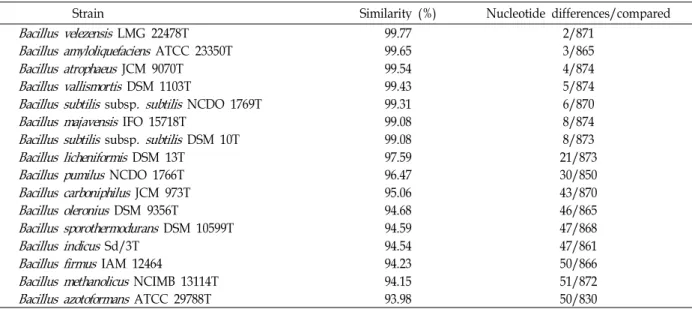
A microorganism producing CMCase isolated from sea- water from Kyungsang Province in Korea was designated as strain A-68. The phylogenetic analysis of the strain A-53 using its 16S rDNA nucleotide sequence data showed that this strain had the highest homology (99.77%) with Bacillus velezensis LMG 22478T, as shown in Table 1. The partial se- quences of the gyr A gene of strain A-53 also showed the highest homology (99.77%) with B. velezensis LMG 22478T.
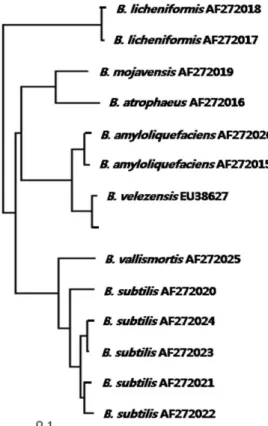
Based on the evolution distance and the phylogenetic tree resulting from partial sequencing of the gyr A gene and the neighbour-joining method [2, 3], this strain was identified as a Bacillus velezensis and designated as B. velezensis A-68, as shown in Fig. 1.
Effect of carbon and nitrogen sources on production of CMCase
The effect of carbon and nitrogen sources on cell growth and the production of CMCase by B. velezensis A-68 was investigated. Carbon sources used in this study were 20.0 g/l glucose, fructose, maltose, sucrose, rice bran, and rice hulls. Nitrogen sources were 2.5 g/l malt extract, peptone, tryptone, yeast extract, ammonium sulfate, and ammonium nitrate. Rice hulls used in this study consisted of 47.0% fiber, 0.2% crude lipid, 2.4% crude protein, 14.1% ash, and 7.1%
water [9]. Maltose and yeast extract were found to be the
best combination of carbon and nitrogen sources for cell
Fig. 1. Neighbour-joining tree based on
gyrase
A gene sequences ofBacillus subtilis
complex. Scale bar indicates 0.1 nucleo- tide substitution per nucleotide position.growth of B. velezensis A-68, whereas rice hulls and yeast extract were the best one for production of CMCase, as shown in Fig. 2. The best combination of carbon and nitro- gen sources for cell growth of B. velezensis A-68 was different from that for the production of CMCase. The highest pro- duction of CMCase by B. velezensis A-68 was 25.3 U/ml from 20.0 g/l rice hulls and 2.5 g/l yeast extract.
The best combination of carbon and nitrogen sources for the production of CMCase by B. amyloliquefaciens DL-3 was rice hulls and peptone and that by B. licheniformis LBH-52 was rice hulls and ammonium nitrate [9, 16], whereas that for the production of CMCase by a marine bacterium, B.
sutilis subsp. sutilis A-53 was rice bran and yeast extract [12, 19]. The best carbon and nitrogen source for the production of CMCase by a psychrophilic marine bacterium, Psychrobacter aquimaris LBH-10 were reported to be rice bran and peptone [15]. Wheat bran has been reported to be a ma- jor carbon source for the production of CMCases by Aspergillus and Trichoderma [11]. All strains investigated to date for the production of cellulases are inducible by cellu- lose, lactose or sophorose, and all are repressible by glucose,
A
B
Fig. 2. Effect of carbon and nitrogen sources on cell growth (A) and production of CMCase (B) by
B. velezensis
A-68.which are reasons why most carbon sources for the pro- duction of CMCase are rice hulls, rice bran or wheat bran [11]. Induction, synthesis, and secretion of the β-glucanase appear to be closely associated [4].
Optimization of rice hulls, yeast extract, and initial pH for production of CMCase
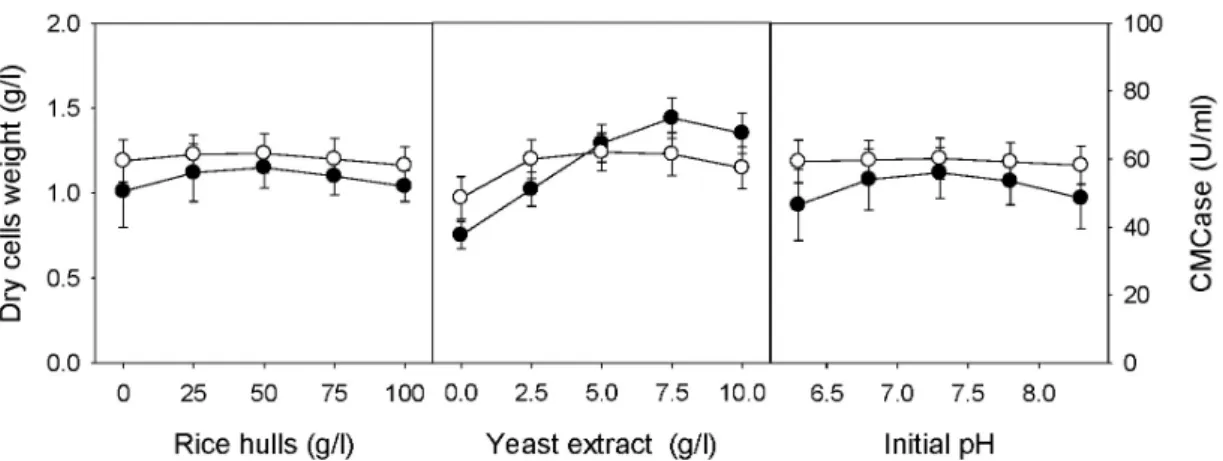
The optimal conditions of rice hulls, yeast extract, and initial pH of the medium for cell growth and the production of CMCase by B. velezensis A-68 were investigated using one-factor-at-a-time experiment. Composition of basic me- dium and culture conditions were 50.0 g/l rice hulls, 5.0 g/l yeast extract, and initial pH of 7.3, as shown in Fig. 3.
The optimal concentrations of rice hulls and initial pH of
the medium for cell growth as well as production of CMCase
by B. velezensis A-68 were 50.0 g/l and 7.3, respectively. The
optimal concentration of yeast extract for cell growth was
Fig. 3. Effect of rice hulls, yeast extract, and initial pH of medium cell growth and production of CMCase by
B. velezensis
A-68.●, DCW and ○, CMCase
Table 2. Central composite design (CCD) and determined response values for optimization of rice hulls, yeast extract, and initial pH of medium
Run X1 (g/l) X2 (g/l) X3 Y1 (g/l) Y2 (U/ml)
1 50 5.0 7.3 1.19 61.3
2 50 5.0 7.3 1.22 61.7
3 50 5.0 6.5 1.14 61.1
4 75 2.5 7.8 1.06 59.7
5 92 5.0 7.3 1.14 60.3
6 25 2.5 6.8 1.07 60.2
7 50 5.0 7.3 1.20 60.8
8 50 5.0 7.3 1.21 61.5
9 50 9.2 7.3 1.22 59.3
10 75 2.5 6.8 1.07 59.5
11 50 5.0 8.1 1.15 60.8
12 50 0.8 7.3 1.03 58.2
13 25 7.5 6.8 1.21 60.8
14 75 7.5 7.8 1.20 60.2
15 8 5.0 7.3 1.13 60.8
16 25 7.5 7.8 1.21 60.7
17 75 7.5 6.8 1.21 60.4
18 50 5.0 7.3 1.18 61.2
19 50 5.0 7.3 1.21 61.4
20 25 2.5 7.8 1.07 60.2
7.5 g/l, whereas that for production of CMCase was 5.0 g/l.
Based on results from one-factor-at-a-time experiment, the optimal conditions of rice bran, yeast extract, and initial pH of the medium on cell growth and production of CMCase was also investigated using response surface methodology.
The coded values of minimum and maximum ranges of rice hulls (X
1), yeast extract (X
2), and initial pH of the medium (X
3) were 25.0 and 75.0 g/l, 2.5 and 7.5 g/l, and 6.8 and 7.8, respectively. Cell mass, measured as dry cells weight (DCW), and production of CMCase from 20 different con- ditions ranged from 1.03 to 1.22 g/l and from 58.2 to 61.7
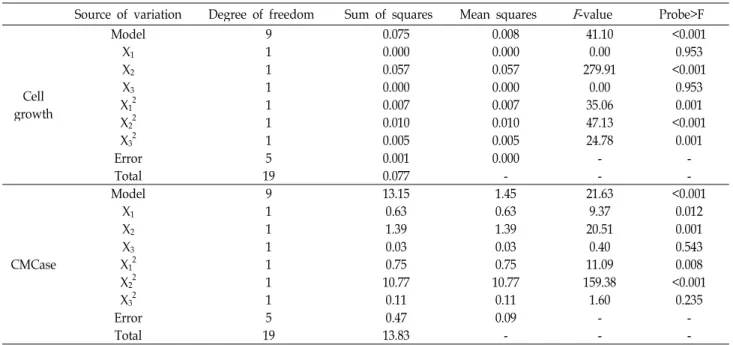
U/ml, as shown in Table 2. The model F-value of 41.10 from
the analysis of variance (ANOVA) of cell growth implied
that this model was significant, as shown in Table 3. The
P values were used as a tool to check the significance of
each of the coefficients, which, in turn were necessary to
understand the pattern of the mutual interactions between
the test variables. The smaller the magnitude of the P value,
the more significant is the corresponding coefficient. The
ANOVA indicated that this model and the model terms of
X
2and X
22(“probe > F” less 0.001) were highly significant
and those of X
12and X
32(“probe > F” less 0.050) were sig-
Table 3. Parameter estimates and analysis of variance (ANOVA) of the design for optimization of rice hulls, yeast extract, and initial pH for cell growth and production of CMCase by
B. velezensis
A-68Source of variation Degree of freedom Sum of squares Mean squares
F
-value Probe>FgrowthCell
Model 9 0.075 0.008 41.10 <0.001
X1 1 0.000 0.000 0.00 0.953
X2 1 0.057 0.057 279.91 <0.001
X3 1 0.000 0.000 0.00 0.953
X12
1 0.007 0.007 35.06 0.001
X22 1 0.010 0.010 47.13 <0.001
X32 1 0.005 0.005 24.78 0.001
Error 5 0.001 0.000 - -
Total 19 0.077 - - -
CMCase
Model 9 13.15 1.45 21.63 <0.001
X1 1 0.63 0.63 9.37 0.012
X2 1 1.39 1.39 20.51 0.001
X3 1 0.03 0.03 0.40 0.543
X12 1 0.75 0.75 11.09 0.008
X22 1 10.77 10.77 159.38 <0.001
X32 1 0.11 0.11 1.60 0.235
Error 5 0.47 0.09 - -
Total 19 13.83 - - -
nificant for cell growth of B. velezensis A-68. The regression equation obtained from ANOVA indicated that the multiple correlation coefficient of R
2was 0.974. The model can explain 97.4% variation in the response. The value of the adjusted determination coefficient (Adj. R
2=0.950) was very high to advocate for a high significance of this model [22]. The pre- dicted determination of coefficient of 0.887 was in reasonable agreement with the Adj. R
2of 0.950. From the statistical re- sults obtained, it was shown that the above models were adequate to predict the cell growth of B. velezensis A-68 with- in the range of variables studied. Multiple regression analy- sis of the experimental data gave the following second-order polynomial equation in terms of coded factors (Eq. 4). The optimal conditions of rice hulls, yeast extract, and initial pH of the medium for cell growth extracted by Design Expert Software were 60.2 g/l, 7.38 g/l, and 7.18, respectively. The maximum cell growth of 1.23 g/l was predicted by this model. The maximal actual value of cell growth was 1.22 g/l when concentrations of rice hulls and yeast extract and initial pH of medium were 50.0 g/l, 5.0 g/l, and 7.3.
Y
1=1.20+0.06X
2-0.02X
12+0.03X
22-0.03X
32(4) The model F-value of 21.63 from the ANOVA of pro- duction of CMCase implied that this model was also significant. The ANOVA indicated that this model and mod- el terms of X
22were highly significant and those of X
1,X
2, and X
22were significant for the production of CMCase by
B. velezensis A-68. The regression equation obtained from ANOVA indicated that the multiple correlation coefficient of R
2was 0.951. The value of the adjusted determination coefficient (Adj. R
2=0.907) was high to advocate for a high significance of this model. From the statistical results ob- tained, it was shown that the above models were adequate to predict the production of CMCase by B. velezensis A-68 within the range of variables studied. Multiple regression analysis of the experimental data gave the following sec- ond-order polynomial equation in terms of coded factors (Eq. 5). The optimal conditions of rice hulls, yeast extract, and initial pH of the medium for production of CMCase were 50.0 g/l, 5.00 g/l, and 7.30, respectively. The maximum production of CMCase of 61.3 U/ml was predicted by this model. The maximal actual value of CMCase production was 61.7 U/ml when concentrations of rice hulls and yeast ex- tract and initial pH of medium were 50.0 g/l, 5.0 g/l, and 7.3.
Y
2=61.31-0.22X
1+0.32X
2-0.04X
3+0.04X
1X
2+0.10X
1X
3-0.06X
2X
3-0.236X
12-0.86X
22+0.09X
32(5)
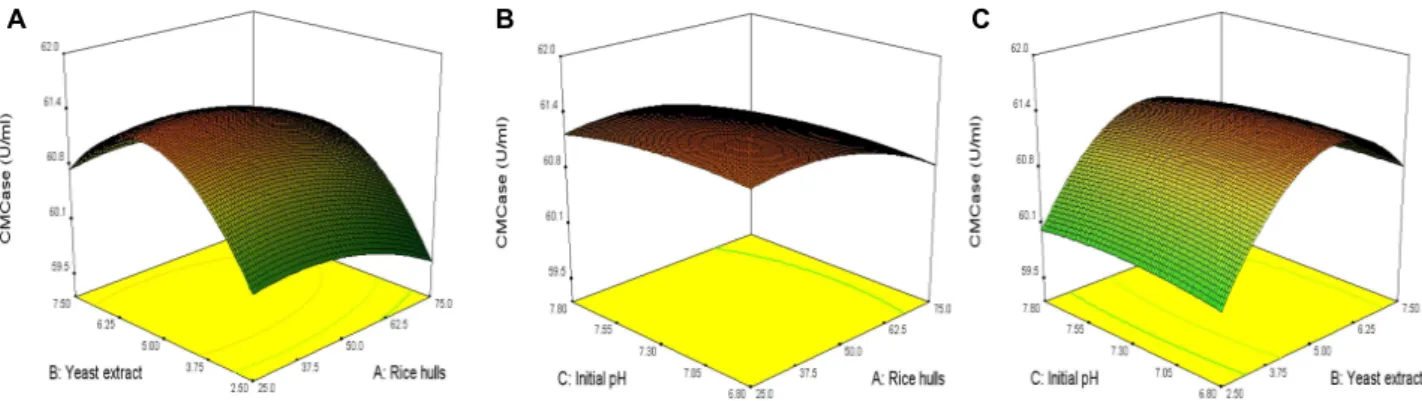
The three-dimensional response surface plots were gen-
erated to investigate their combined effects of rice hulls and
yeast extract, rice hulls and initial pH, and yeast extract and
initial pH on the response of cell growth and the production
of CMCase by B. velezensisA-68, as shown in Fig. 4. The
P-values of rice hulls and yeast extract, rice hulls and initial
A B C
Fig. 4. 3D response surface displaying relative combined effects of rice hulls and yeast extract (A), rice hulls and initial pH (B), and yeast extract and initial pH (C) on production of CMCase by
B. velezensis
A-68.pH, and yeast extract and initial pH were 0.6918, 0.8945, and 0.5116, respectively. Interactive effect of yeast extract and ini- tial pH of medium on the production of CMCase by B.
velezensisA-68 was relatively more significant than those of rice hulls and yeast extract as well as rice hulls and initial pH.
The optimal concentrations of rice bran and yeast extract for the production of CMCase by B. sutilis subsp. sutilis A-53 were 50.0 and 1.0 g/l, respectively. However, those for its cell growth were higher than those for production of CMCase [19]. The optimal concentrations of carbon and ni- trogen source for cell growth of B. velezensis A-68 were also different from those for production of CMCase. The optimal concentrations of rice hulls and yeast extract for the pro- duction of CMCase by B. amyloliquefaciens DL-3 were 50.0 and 2.0 g/l, respectively, whereas those for cell growth was 50.0 and 3.0 g/l [9].The optimal initial pH of the medium and temperature for cell growth of B. amyloliquefaciens DL-3 were 7.2 and 32℃, whereas those for the production of CMCase were 6.8 and 37℃ [9]. The production of CMCase by another marine microorganism, B. subtilis subsp. subtilis A-53 was 136.8 U/ml when initial pH of the medium and temperature were 6.8 and 30℃ [19]. The optimal initial pHs for the production of CMCases by bacterial and fungal mi- croorganisms ranged from 4.0 to 7.3 [14]. Generally speak- ing, optimal initial pHs for the production of CMCases by bacterial strains are higher than those by fungal strains.
Optimization of salts in medium for production of CMCase
The optimal concentrations of 4 salts in the medium, K
2HPO
4, NaCl, MgSO
4∙7H2O, and (NH
4)
2SO
4, for cell growth
and the production of CMCase by B. velezensis A-68 were investigated using one-factor-at-a-time experiment.
Concentrations of rice hulls and yeast extract and initial pH of the medium were 50.0 g/l, 5.0 g/l, and 7.3. Concentrations of K
2HPO
4, NaCl, MgSO
4∙7H
2O, and (NH
4)
2SO
4in the basic medium were 5.0, 2.0, 0.5, and 1.0 g/l. The optimal concen- trations of K
2HPO
4, NaCl, MgSO
4∙7H
2O, and (NH
4)
2SO
4for cell growth 7.5, 2.0, 0.25, and 1.0 g/l, respectively, which were the same as those for production of CMCase, as shown in Fig. 5.
Based on results from one-factor-at-a-time experiment, the optimal concentrations of 4 salts in the medium on cell growth and production of CMCase were also investigated using RSM. Levels of K
2HPO
4, NaCl, MgSO
4∙7H2O, and (NH
4)
2SO
4ranged from 2.5 to 7.5 g/l, from 1.0 to 3.0 g/l, from 0.25 to 0.75 g/l, and from 0.5 to 1.5 g/l, respectively.
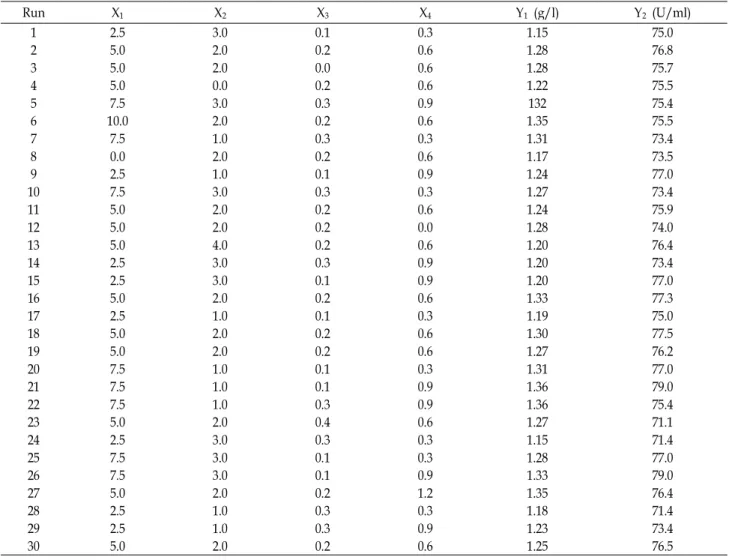
The results of central composite design (CCD) experiments
consisted of experimental data to investigate effects of four
independent variables, as shown in Table 4. Cell growth and
production of CMCase from 30 different conditions ranged
from 1.15 to 1.36 g/l and from 71.1 to 79.0 U/ml. The analy-
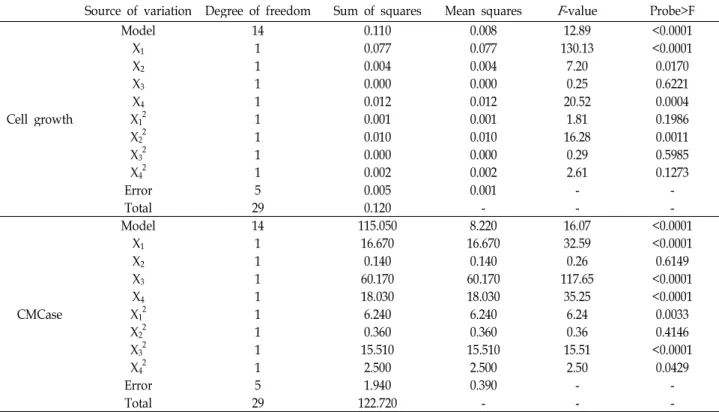
sis of variance (ANOVA) of cell growth of B. velezensis A-68
indicated that this model and the model term of X
1were
highly significant (“probe > F” less than 0.0001) and that
of X
22was significant (“probe > F” less than 0.0500) for cell
growth, as shown in Table 5. The model F-value of 12.89
implied that this model was significant. The regression equa-
tion obtained from the ANOVA indicated that the multiple
correlation coefficient of R
2was 0.9232. The predicted deter-
mination of coefficient of 0.7626 was in reasonable agree-
ment with the Adj. R
2of 0.8516. Multiple regression analysis
of the experimental data gave the following second-order
Fig. 5. Effect of salts in the medium on cell growth and production of CMCase by
B. velezenssis
A-68. ●, DCW and ○, CMCaseTable 4. Central composite design (CCD) for optimization of four salts in medium and determined response values
Run X1 X2 X3 X4 Y1 (g/l) Y2 (U/ml)
1 2.5 3.0 0.1 0.3 1.15 75.0
2 5.0 2.0 0.2 0.6 1.28 76.8
3 5.0 2.0 0.0 0.6 1.28 75.7
4 5.0 0.0 0.2 0.6 1.22 75.5
5 7.5 3.0 0.3 0.9 132 75.4
6 10.0 2.0 0.2 0.6 1.35 75.5
7 7.5 1.0 0.3 0.3 1.31 73.4
8 0.0 2.0 0.2 0.6 1.17 73.5
9 2.5 1.0 0.1 0.9 1.24 77.0
10 7.5 3.0 0.3 0.3 1.27 73.4
11 5.0 2.0 0.2 0.6 1.24 75.9
12 5.0 2.0 0.2 0.0 1.28 74.0
13 5.0 4.0 0.2 0.6 1.20 76.4
14 2.5 3.0 0.3 0.9 1.20 73.4
15 2.5 3.0 0.1 0.9 1.20 77.0
16 5.0 2.0 0.2 0.6 1.33 77.3
17 2.5 1.0 0.1 0.3 1.19 75.0
18 5.0 2.0 0.2 0.6 1.30 77.5
19 5.0 2.0 0.2 0.6 1.27 76.2
20 7.5 1.0 0.1 0.3 1.31 77.0
21 7.5 1.0 0.1 0.9 1.36 79.0
22 7.5 1.0 0.3 0.9 1.36 75.4
23 5.0 2.0 0.4 0.6 1.27 71.1
24 2.5 3.0 0.3 0.3 1.15 71.4
25 7.5 3.0 0.1 0.3 1.28 77.0
26 7.5 3.0 0.1 0.9 1.33 79.0
27 5.0 2.0 0.2 1.2 1.35 76.4
28 2.5 1.0 0.3 0.3 1.18 71.4
29 2.5 1.0 0.3 0.9 1.23 73.4
30 5.0 2.0 0.2 0.6 1.25 76.5
polynomial equation in terms of coded factors (Eq. 6) and the optimal concentrations of K
2HPO
4, NaCl, MgSO
4∙7H2O, and (NH
4)
2SO
4for cell growth were 7.50, 1.00, 0.10, and 0.80 g/l, respectively. The maximum cell growth of 1.35 g/l was predicted by the model. The maximal actual value of cell
growth was 1.36 g/l when concentrations of K
2HPO
4, NaCl, MgSO
4∙7H
2O, and (NH
4)
2SO
4were 7.5, 1.0, 0.1, and 0.9 g/l, respectively.
Y
1=5.33+0.03X
1+0.03X
3+0.04X
4+0.01X
1X
3+0.01X
2X
3-0.01X
2Table 5. Parameter estimates and analysis of variance (ANOVA) of the design for optimization of four salts in medium for cell growth and production of CMCase by
B. velezensis
A-68Source of variation Degree of freedom Sum of squares Mean squares
F
-value Probe>FCell growth
Model 14 0.110 0.008 12.89 <0.0001
X1 1 0.077 0.077 130.13 <0.0001
X2 1 0.004 0.004 7.20 0.0170
X3 1 0.000 0.000 0.25 0.6221
X4 1 0.012 0.012 20.52 0.0004
X12 1 0.001 0.001 1.81 0.1986
X22 1 0.010 0.010 16.28 0.0011
X32 1 0.000 0.000 0.29 0.5985
X42 1 0.002 0.002 2.61 0.1273
Error 5 0.005 0.001 - -
Total 29 0.120 - - -
CMCase
Model 14 115.050 8.220 16.07 <0.0001
X1 1 16.670 16.670 32.59 <0.0001
X2 1 0.140 0.140 0.26 0.6149
X3 1 60.170 60.170 117.65 <0.0001
X4 1 18.030 18.030 35.25 <0.0001
X12 1 6.240 6.240 6.24 0.0033
X22 1 0.360 0.360 0.36 0.4146
X32 1 15.510 15.510 15.51 <0.0001
X42 1 2.500 2.500 2.50 0.0429
Error 5 1.940 0.390 - -
Total 29 122.720 - - -
X
4+0.01X
3X
4+0.02X
12+0.01X
22+0.01X
32+0.01X
42(6) The ANOVA of the production of CMCase by B. velezensis A-68 indicated that this model and the model terms of X
1, X
3, X
4, and X
32were highly significant and that of X
32was significant for cell growth. The model F-value of 16.07 also implied that this model was significant. The regression equa- tion obtained from the ANOVA indicated that the multiple correlation coefficient of R
2was 0.9375. The value of the ad- justed determination coefficient (Adj. R
2=0.8792) was very high to advocate for a high significance of this model.
Multiple regression analysis of the experimental data gave the following second-order polynomial equation in terms of coded factors (Eq. 7) and the optimal concentrations of K
2HPO
4, NaCl, MgSO
4∙7H
2O, and (NH
4)
2SO
4for cell growth were 7.50, 1.00, 0.10, and 0.80 g/l, respectively. The maximum production of CMCase of 78.3 U/ml was pre- dicted by the model. The maximal actual value of CMCase production was 79.0 U/ml when concentrations of K
2HPO
4, NaCl, MgSO
4∙7H
2O, and (NH
4)
2SO
4were 7.5, 3.0, 0.1, and 0.9 g/l, respectively.
Y
2=76.70+0.83X
1+0.08X
2-1.58X
3+0.87X
4-0.48X
12-0.11X
22-0.75X
32-0.30X
42(7)
Many studies including types of strains, culture con- ditions, and substrates on production of cellulases have been reported [9, 13, 19]. However, there have been few reports on optimization of mineral salts in the medium on pro- duction of cellulases [15]. Results from RSM indicated that K
2HPO
4was significant for cell growth of B. velezenssis A-68, whereas K
2HPO
4, MgSO
4∙7H
2O, and (NH
4)
2SO
4were sig- nificant for production of CMCase. Potassium phosphate is one of the major salts in the medium for productions of mi- crobial polysaccharides and enzymes as well as a well-known ingredient in buffer solutions [8, 12, 21]. Sodium chloride was reported to be used as a physiological modu- lator of biosynthetic pathway of biopolymers [15].
Magnesium sulfate added to medium assist with spore ger- mination and initial growth of A. fisheri, which results in 1.9 fold increased production of xylanase [28].
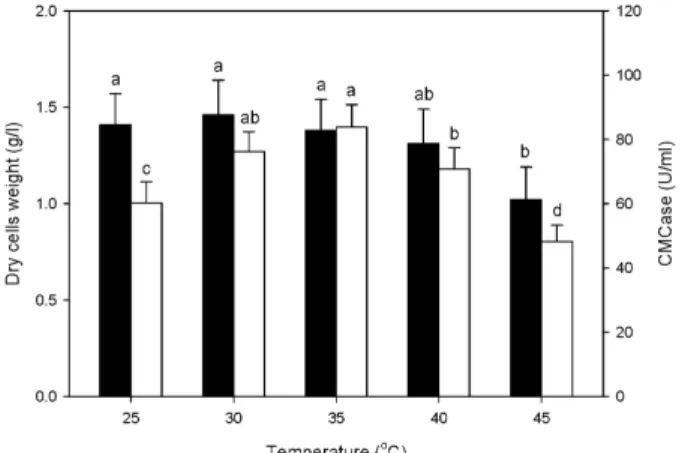
Effect of temperature on production of CMCase
The effect of temperature on cell growth and the pro- duction of CMCase by B. velezensis A-68 was investigated.
The temperature for cell growth and production of CMC
ranged from 25 to 45℃. The carbon and nitrogen source and
initial pH of the medium were 50.0 g/l rice hulls, 5.00 g/l
Fig. 6. Effect of temperature on cell growth and production of CMCase by
B. velezensis
A-68. █, DCW and □, CMCaseFig. 7. Pilot-scaled production of CMCase by
B. velezensis
A-68 in a 100 L bioreactor. ●, pH; ■, DO; ▲, DCW; and○, CMCase
yeast extract, and pH 7.30, respectively. The optimal temper-
atures for cell growth and the production of CMCase by B.
velezensis A-68 were found to be 30 and 35℃, respectively, as shown in Fig. 6. Cell growth and the production of CMCase by B. velezensis A-68 under optimized conditions were 1.38 g/l and 83.8 U/ml.
The optimal temperatures for cell growth and the pro- duction of CMCase by B. subtilis subsp. subtilis A-53 were 35 and 30℃, respectively [19]. The optimal temperatures for production of CMCases ranged from 25 to 37℃, except for thermophilic microorganisms such as Thermoascus aurantiacu, which optimal temperature for the production of CMCase is 50℃ [10]. The optimal temperature for cell growth of B.
amyloliquefaciens DL-3 was 32℃, whereas that for production of CMCase was 37℃ [9]. The optimal temperature for cell growth of B. velezensis A-68 was also different from that for production of CMCase as production of other CMCases.
Mass production of CMCase under optimized conditions in a 100 l bioreactor
Batch culture for the production of CMCase by B. vele- zensis A-68 was performed in a 100 l bioreactor under opti- mized conditions in this study. Carbon and nitrogen source was 50.0 g/l rice hulls and 5.0 g/l yeast extract. The initial pH and cultural temperature were 7.3 and 35℃. Agitation speed and aeration rate of a 100 l bioreactor were 200 rpm and 1.0 vvm. The pH in the medium dramatically decreased until 12 h of cultivation, and then gradually increased to approximately 7.5 thereafter, as shown in Fig. 7. Dissolved oxygen in the medium also dramatically decreased until 24 h and gradually increased after 36 h. Cell growth of B. vele-
zensis A-68 rapidly increased until 36 h. The production of CMCase by B. velezensis A-68 appeared to be paralleled with cell growth. Production of CMCase by B. amyloliquefacience DL-3 had been reported to be paralleled with cell growth [9]. Production of cellulases by a psychrophilic marine bacte- rium, Psychrobacter aquimaris LBH-10 was also paralleled with cell growth [13]. The cell growth and production of CMCase in a 100 l bioreactor was 1.46 g/l and 83.0 U/ml.
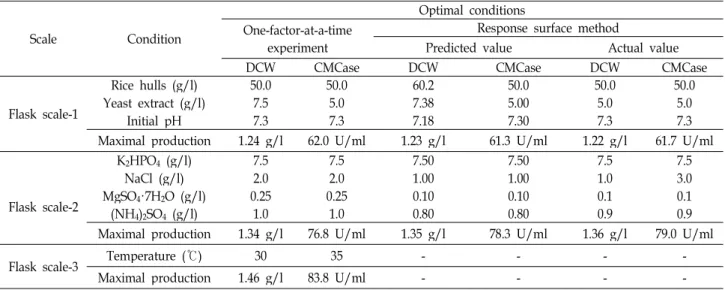
In this study, rice hulls were developed as a substrate
for the production of CMCase by a newly isolated marine
bacterium, B. velezensis A-68. The optimal conditions for
production of CMCase were established using response
surface method, as show in Table 6. The production of
CMCase by B. velezensis A-68 in a 100 l bioreactor under
optimized conditions established in the flask scale was al-
most the same as the maximal production of CMCase ob-
tained in the flask scale, which meant that the optimized
conditions in this study would be directly applied for mass
production of CMCase in an industrial scale [5, 20]. Time
for production of cellulases by fungal species in solid-state
fermentation normally takes 7 to 10 days [11]. However,
the time for production of CMCase by B. velezensis A-68 re-
duced to 3 days in suspension culture. The optimal con-
ditions for production of CMCase by bacterial and fungal
species were compared, as shown in Table 7. The pro-
ductivities of CMCase by recombinant strains were nor-
mally higher than those by wild types. Next study will be
focused on construction of recombinant strains and charac-
terization of their CMCases with an expectation of distinc-
tive features such as cold-adapted, halo-tolerant or acid-
ophilic CMCase due to its living in severe conditions and
Table 6. Optimal conditions for cell growth and production of CMCase by
B. velezensis
A-68Scale Condition
Optimal conditions One-factor-at-a-time
experiment
Response surface method
Predicted value Actual value
DCW CMCase DCW CMCase DCW CMCase
Flask scale-1
Rice hulls (g/l) 50.0 50.0 60.2 50.0 50.0 50.0
Yeast extract (g/l) 7.5 5.0 7.38 5.00 5.0 5.0
Initial pH 7.3 7.3 7.18 7.30 7.3 7.3
Maximal production 1.24 g/l 62.0 U/ml 1.23 g/l 61.3 U/ml 1.22 g/l 61.7 U/ml
Flask scale-2
K2HPO4(g/l) 7.5 7.5 7.50 7.50 7.5 7.5
NaCl (g/l) 2.0 2.0 1.00 1.00 1.0 3.0
MgSO4·7H2O (g/l) 0.25 0.25 0.10 0.10 0.1 0.1
(NH4)2SO4 (g/l) 1.0 1.0 0.80 0.80 0.9 0.9
Maximal production 1.34 g/l 76.8 U/ml 1.35 g/l 78.3 U/ml 1.36 g/l 79.0 U/ml
Flask scale-3 Temperature (℃) 30 35 - - - -
Maximal production 1.46 g/l 83.8 U/ml - - - -
Table 7. Comparison of optimal conditions for the production of various CMCases by bacterial and fungal microorganisms Strain Carbon source Nitrogen source Initial
pH Temperature
(℃) Productivity Reference
Bacillus amyloliquefaciens
DL-3 Rice hulls Peptone 6.8 37 367 U/ml [9]Bacillus atrophaeus
LBH-18 Rice bran peptone 7.0 30 128 U/ml [17]Bacillus licheniformis
LBH-52 Rice hulls Ammonium nitrate 7.0 36 75 U/ml [13]Bacillus subtilus
subsp.subtilis
A-53 Rice bran Yeast extract 6.8 30 137 U/ml [19]Bacillus velezensis
A-68 Rice hulls Yeast extract 7.3 35 84 U/ml This studyCellulophaga lytica
LBH-14 Rice bran Ammonium chloride 6.1 25 154 U/ml [5]Psychrobacter aquimaris
LBH-10 Rice bran peptone 8.0 30 339 U/ml [14]Escherichia coli
JM109/DL-3 Rice bran Peptone 7.2 37 871 U/ml [22]Escherichia coli
JM109/A-53 Rice bran Ammonium chloride 8.0 35 880 U/ml [20]Aspergillus niger
KK2 Rice straw Yeast extract 7.0 28 129 U/g CSa [11]a carbon source
wide ranges of environments [6].
Acknowledgement
This research was financially supported by the Ministry of Education, Science Technology (MEST) and National Research Foundation of Korea (NRF) through the Human Resource Training Project for Regional Innovation.
References
1. Blumer-Schuette, S. E., Kataeva, I., Westpheling, J., Adams, M. W. W. and Kelly, R. M. 2008. Extremely thermophilic microorganisms for biomass conversion: status and prospects.
Curr Opin Biotechnol
19, 210-217.2. Chun, J. 1995 Computer-assisted classification and identi- fication of actinomycestes. Ph D Thesis, University of Newcastle, Newcastle upon Tyne, UK.
3. Chun, J. and Bae, K. S. 2000. Phylogenetic analysis of
Bacillus subtilis
and related taxa based on partialgyrA
gene sequence.Antonie van Leeuwenhoek
78, 123-127.4. Gao, W., Lee, E. J., Lee, S. U., Li, J., Chung, C. H. and Lee, J. W. 2012. Enhanced carboxymethylcellulase production by a newly isolated marine bacterium,
Cellulophaga lytica
LBH-14, using rice bran.J Microbiol Biotechnol
22, 1415-1425.5. Gao, W., Lee, S. U., Li, J. and Lee, J. W. 2013. Enhanced production of carboxymethylcellulase by
Cellulophaga lytica
LBH-14 in pilot-scale bioreactor under optimized conditions involved in dissolved oxygen.Korean J Chem Eng
30, 1105-1110.6. Irwin, J. A., Alfredsson, G. A., Lanzetti, A. J., Gudmundsson, H. M. and Engel, P. C. 2001. Purification and characterization of a serine peptidase from the marine psychrophile strain PA-43.
FEMS Microbiol
201, 285-290.7. Jecu, L. 2000. Solid state fermentation of agricultural wastes for endogulcanse production.
Ind Crop Prod
11, 1-5.8. Jin, I. H., Jung, D. Y., Son, C. W., Kim, S. K., Gao, W., Chung, C. H. and Lee, J. W. 2011. Enhanced production of hetero-
polysaccharide-7 by
Beijerinkia indica
HS-2001 in repeated batch culture with optimized substitution of culture medium.Biotechnol Bioproces Eng
16, 245-255.9. Jo, K. I., Lee, Y. J., Kim, B. K., Lee, B. H., Chung, C. H., Nam, S. W., Kim, S. K. and Lee, J. W. 2008. Pilot-scale pro- duction of carboxymethylcellulase from rice hull by
Bacillus amyloliquefaciens
DL-3.Biotechnol Bioprocess Eng
13, 182-188.10. Kalogeris, E., Christakopoulos, P., Katapodis, P., Alexious, A., Vlachou, S., Kekos, D. and Macris, B. J. 2003. Production and characterization of cellulolytic enzymes from the ther- mophilic fungus
Thermoascus aurantiacus
under solid state cultivation of agricultural waste.Process Biochem
38, 1099-1104.11. Kang, S. W., Park, Y. S., Lee, J. S., Hong, S. I. and Kim, S. W. 2004. Production of cellulase and hemicellulases by
Aspergillus niger
KK2 from lignocellulosic biomass.Bioresour Technol
91, 153-156.12. Kim, B. K., Lee, B. H., Lee, Y. J., Jin, I. H., Chung, C. H.
and Lee, J. W. 2009. Purification and characterization of car- boxymethylcellulase isolated from a marine bacterium,
Bacillulus
subsp.subtilis
A-53.Enzyme Microb Technol
44, 411-416.13. Kim, H. J., Gao, W., Chung, C. H. and Lee, J. W. 2011.
Statistical optimization for production of carbox- ymethylcellulase from rice hulls by a new isolated marine microorganism
Bacillus licheniformis
LBH-52 using response surface method.J Life Sci
21, 1083-1093.14. Kim, H. J., Gao, W., Lee, Y. J., Chung, C. H. and Lee, J.
W. 2010. Characterization of acidic carboxymethylcellulase produced by a marine microorganism,
Psychrobacter aqui- maris
LBH-10.J Life Sci
20, 487-495.15. Kim, H. J., Lee, Y. J. Gao, W., Chung, C. H., and Lee, J.
W. 2012. Optimization of salts in medium for production of carboxymethylcellulase by a psychrophilic marine bacte- rium,
Psychrobacter aquimaris
LBH-10 using two statistical methods.Korean J Chem Eng
29, 384-391.16. Kim, H. J., Lee, Y. J., Gao, W., Chung, C. H., Son, C. W.
and Lee, J. W. 2011. Statistical optimization of fermentation conditions and comparison of their influences on pro- duction of cellulases by Psychrophilic marine bacterium,
Psychrobacter aquimaris
LBH-10 using orthogonal array method.Biotechnol Bioprocess Eng
16, 542-548.17. Kim, Y. J., Gao, W., Lee, S. U., and Lee, J. W. 2012. Enhanced production of carboxymethylcellulase by a newly isolated marine microorganism
Bacillus atrophaeus
LBH-18 using rice bran, a byproduct from the rice processing industry.J Life Sci
22, 1295-1306.18. Kumar, S., Tamura, K. and Nei, N. 1993. MEGA N.
Molecular evolutionary genetic analysis, version 1.01, The Pennsylvania State University, University Park. USA.
19. Lee, B. H., Kim, B. K., Lee, Y. J., Chung, C. H. and Lee, J. W. 2010. Industrial scale of optimization for the pro- duction of carboxymethylcellulase from rice bran by a ma- rine bacterium,
Bacillulus
subsp.subtilis
A-53.Enzyme Microb Technol
46, 38-42.20. Lee, E. J., Lee, B. H., Kim, B. K. and Lee, J. W. 2013.
Enhanced production of carboxymethylcellulase of a marine microorganism,
Bacillus subtilis
subsp.subtilis
A-53 in a pi- lot-scaled bioreactor by a recombinantEscherichia coli
JM109/A-53 from rice bran.Mol Biol Rep
40, 3609-3621.21. Lee, N. K., Jo, Y. B., Jin, I. H., Son, C. W. and Lee, J. W.
2009. The effect of potassium phosphate as a pH stabilizer on the production of gellan by
Sphingomonas paucibilis
Nk-2000.J Life Sci
19, 1033-1038.22. Lee, Y. J., Kim, H. J., Gao, W., Chung, C. H., and Lee, J.
W. 2012. Statistical optimimization for production of carbox- ymethylcellulase of
Bacillus amyloliquefaciens
DL-3 by a re- combinantEscherichia coli
JM109/DL-3 from rice bran using response surface method.Biotechnol Bioprocess Eng
17, 227-235.23. Liu, J., Zhang, Z., Liu, Z., Zhu, H., Dang, H., Lu, J. and Cui, Z. 2011. Production of cold-adapted amylase by marine bacterium
Wangia
sp. 53: optimization, modeling, and parti- al characterization.Mar Biotechnol
13, 837-844.24. MercoPress 2011. Global rice production reaches 476 million tons in 2011; strong Mercosur recovery.
South Atlantic News Agency
, June 27th, USA.25. Park, E. Y., Ikeda, Y. and Okuda, N. 2002. Empirical evalua- tion of cellulose on enzymatic hydrolysis of waste office paper.
Biotechnol Bioprocess Eng
7, 268-274.26. Roboson, L. M. and Chambliss, G. H. 1989. Cellulases of bacterial origin.
Enzyme Microb Technol
11, 626-644.27. Saha, B. C. and Cotta, M. A. 2008. Lime pretreatment, enzy- matic saccharification and fermentation of rice hulls to ethanol.
Biomass Bioenergy
32, 971-977.28. Senthikumar, S. R., Ashokkumar, A., Raj, K. C. and Cunasekraran, P. 2005. Optimization of medium composi- tion for alkali-stable xylanase production by
Aspergillus fi- scheri
Fxn 1 in solid-state fermentation using central compo- site rotary desing.Bioresour Technol
96, 1380-1386.29. Sukumaran, R. K., Singhania, R. R., Mathew, G. M. and Pandey, A. 2009. Cellulase production using biomass feed stock and its application in lignocellulose saccharification for bio-ethanol production.
Renew Energy
34, 421-424.30. Suzuki, T., Yamamoto, K., Tada, H. and Uda, K. 2012.
Cold-adapted features of arginine kinase from the deep-sea clam
Calyptogena kaikoi
.Mar Biotechnol
13, 294-303.31. Takagi, M., Abe, S., Suzuki, S., Emert, G. H. and Yata, N.
1977. A method for production of ethanol directly from cel- lulose using cellulase and yeast. Ghose, T. K. (ed),
Proceedings of Bioconversion Symposium
, Dheli, India.32. Thompson, J. D., Higgins, D. G. and Gibson, T. J. 1994.
CLUSTAL W. Improving the sensitivity of progressive mul- tiple sequence alignment through sequence weighting, posi- tions-specific gap penalties and weight matrix choice
Nucleic Acids Res
22, 4673-4680.33. Wei, G. Y., Lee, Y. J., Kim, Y. J., Jin, I. H., Lee, J. H., Chung, C. H. and Lee, J. W. 2010. Kinetic study on the pretreatment and enzymatic saccharification of rice hull for the pro- duction of fermentable sugars.