• 검색 결과가 없습니다.

Is Double J Stenting or Percutaneous Nephrostomy More Suitable for Maximizing the Clinical Effects of Temporary Urinary Diversion for Acute Pyelonephritis with a Complicated Ureteral Stone?

N/A
N/A
Protected

Academic year: 2021

Share "Is Double J Stenting or Percutaneous Nephrostomy More Suitable for Maximizing the Clinical Effects of Temporary Urinary Diversion for Acute Pyelonephritis with a Complicated Ureteral Stone?"

Copied!
6
0
0

로드 중.... (전체 텍스트 보기)

전체 글

(1)

Urogenit Tract Infect 2019;14(3):87-92

http://crossmark.crossref.org/dialog/?doi=10.14777/uti.2019.14.3.87&domain=pdf&date_stamp=2019-12-25

Is Double J Stenting or Percutaneous Nephrostomy More Suitable for Maximizing the Clinical Effects of Temporary Urinary Diversion for Acute Pyelonephritis with a Complicated Ureteral Stone?

Jeonghyouk Choi, Taesoo Choi, Dong-Gi Lee, Gyeong Eun Min, Hyung Lae Lee, Koo Han Yoo Department of Urology, School of Medicine, Kyung Hee University, Seoul, Korea

Purpose: This study compared the clinical benefits of double J (DJ) ureteral stenting with percutaneous nephrostomy (PCN) for the management of acute pyelone- phritis (APN) with complicated ureteral stones.

Materials and Methods: The records of 85 patients with complicated APN between December 2006 and July 2017 were reviewed retrospectively. Sixty one patients who underwent DJ or PCN for the management of acute urinary obstruction were enrolled in this study. Some of the participants were excluded for concurrent renal stones, multiple ureteral stones, ureteral stricture, malignancy, and anatomical anomalies. The patient and stone characteristics and peri-procedural laboratory test results of the groups were compared. The success rate, depending on the type of urinary diversion and the presence of immediate complications, were also anal- yzed.

Results: In this study, 19 patients underwent DJ stenting, and 42 patients underwent PCN as a transient urinary diversion. No failed procedures or immediate com- plications requiring subsequent intervention were encountered (Clavien–Dindo grade II-V). Urologists preferred PCN to DJ stenting in cases with an elevated serum creatinine level (p=0.001) and higher C-reactive protein (CRP) level (p<0.001).

The indicative parameters for renal injury and septic conditions (white blood cell count, segment neutrophil, and creatinine levels) tended to show immediate improvement, whereas CRP did not; however, the differences in markers were not significant (p=0.701, 0.962, 0.288, and 0.360, respectively).

Conclusions: Both DJ stenting and PCN were safe and feasible methods for the management of complicated APN. With experienced urologists or radiologists, there may be little danger of prolonged renal failure or other procedure-related complications.

Keywords: Nephrostomy, percutaneous; Urinary diversion; Pyelonephritis;

Ureterolithiasis; Ureteral obstruction

Copyright 2019, Korean Association of Urogenital Tract Infection and Inflammation. All rights reserved.

This is an open access article distributed under the terms of the Creative Commons Attribution Non-Commercial License (http://creativecommons.org/licenses/by-nc/4.0) which permits unrestricted non-commercial use, distribution, and reproduction in any medium, provided the original work is properly cited.

Received: 18 September, 2019 Revised: 25 October, 2019 Accepted: 14 November, 2019

Correspondence to: Koo Han Yoo https://orcid.org/0000-0001-7952-7902 Department of Urology, Kyung Hee University Hospital at Gangdong, School of Medicine, Kyung Hee University, 892 Dongnam-ro, Gangdong-gu, Seoul 05278, Korea

Tel: +82-2-440-6271, Fax: +82-2-440-7744 E-mail: [email protected]

Original Article

INTRODUCTION

Urinary tract infection (UTI) is a common urologic problem

that occurs frequently as a complication combined with

urolithiasis. The potential symptoms of complicated uroli-

thiasis include flank pain, hematuria, nausea, vomiting, and

(2)

systemic responses, such as fever or chills, which may be masked in some cases. The main pathophysiological features are induced by an obstruction of the urinary tract [1].

Acute pyelonephritis (APN) is a serious, life-threatening form of UTI with an annual incidence of 250,000 cases in the United States and 11.7 and 2.4 cases per 10,000 popu- lation among females and males, respectively, requiring hos- pitalization. In comparison, the incidence in Korea is 39.1 cases per 10,000 population [2]. The clinical manifestations include severe systemic symptoms, such as high fever, chills, nausea, and vomiting. Without the appropriate treatments, the renal pelvis and its parenchyma can be damaged, fol- lowed by sepsis that may lead to death. In cases with associated sepsis, the mortality reaches up to 10% to 20%.

In Korea, high mortality (2.1 cases per 1,000 persons among hospitalized patients) has been reported [3].

APN associated with ureteral stones is a potentially life- threatening condition without appropriate management.

This condition may require immediate intervention, such as urinary diversion for decompression of the collecting system, when the ureteral obstruction cannot be eliminated promptly.

Two common intervention procedures are used for de- compression of the urinary tract, namely, retrograde double J (DJ) stent insertion and percutaneous nephrostomy (PCN).

Both approaches drain standing urine and preserve the renal function. Retrograde DJ stenting is associated with septi- cemia, irritative bladder symptoms, forgotten stents, and high failure rates, which ultimately requires PCN tube insertion to drain the affected kidney [4]. In contrast, PCN is associated with complications, such as bleeding, sep- ticemia, tube blockage, and accidental tube dislodgement [5,6]. Moreover, PCN also requires extra care for the external urine-collecting bag.

This study evaluated the choice of procedure for urine diversion to take benefit of infection control for patients of urosepsis due to obstructive uropathy. No clear guidelines for the optimal methods of urinary decompression for the management of ureteral obstruction have been reported.

On the other hand, several researchers have examined the superiority between DJ ureteral stenting and PCN insertion.

The clinical benefit of DJ stenting and PCN in the manage- ment of APN with complicated ureteral stones were also compared in this study.

MATERIALS AND METHODS

This retrospective study was conducted in the Department of Urology of Kyung Hee University Hospital at Gangdong, Seoul, Korea, from December 2006 to July 2017. The records of patients diagnosed with complicated APN were reviewed.

Among the patients, those who underwent DJ stenting or PCN on an emergent basis were enrolled in this study. The institutional review board (IRB) of Kyung Hee University Hospital at Gangdong approved this study and confirmed the need for informed consent (IRB no. 2018-07-007-001).

Some patients were excluded for concurrent renal stones, multiple ureteral stones, ureteral stricture, malignancy, and anatomical anomalies. The patients were divided into the PCN or DJ stenting group, and a detailed history and the physical examination data were then retrieved. The patients’

clinical characteristics, stone characteristics, and peri- procedural laboratory test results in the groups were compared to identify the factors that determined the use of each urinary diversion. The data analyzed included age, sex, presence of underlying disease (diabetes mellitus, hypertension, ischemic heart disease, and cerebrovascular disease), history of previous stone or UTI, stone charac- teristics (size and location), positive urine/blood culture, serum laboratory tests (hemoglobin, hematocrit, platelet, blood urea nitrogen/creatinine [BUN/Cr], and erythrocyte sedimentation rate/C-reactive protein [ESR/CRP], albumin, aspartate transaminase/alanine transaminase [AST/ALT], Na/K), failure rate of each procedure, and sepsis-related mortality. The approximate clinical courses of the patients were also analyzed to determine the success rates depending on the type of urinary diversion and the presence of im- mediate complications.

The data were analyzed using PASW Statistics ver. 18.0 (SPSS Inc., Chicago, IL, USA). Proportion comparisons for the categorical variables were performed using 

2

tests. The p-values and relative ratios were calculated for the risk factors. p-values <0.05 were considered significant. In addi- tion, multivariate analysis was performed to determine the progression of complicated APN to sepsis and septic shock.

RESULTS

The medical records of 85 patients diagnosed with com-

plicated APN from December 2006 to July 2017 were reviewed

(3)

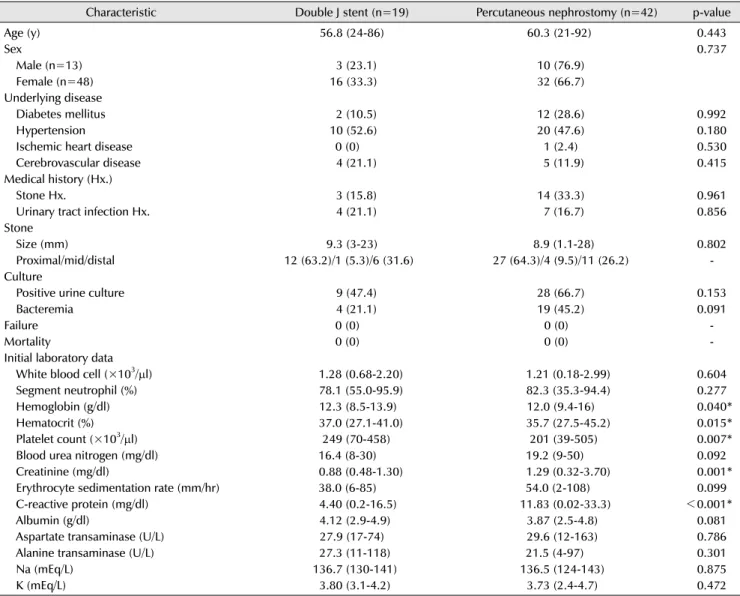
Table 1. Comparative characteristics of the patients according to the type of urinary diversion

Characteristic Double J stent (n=19) Percutaneous nephrostomy (n=42) p-value

Age (y) 56.8 (24-86) 60.3 (21-92) 0.443

Sex 0.737

Male (n=13) 3 (23.1) 10 (76.9)

Female (n=48) 16 (33.3) 32 (66.7)

Underlying disease

Diabetes mellitus 2 (10.5) 12 (28.6) 0.992

Hypertension 10 (52.6) 20 (47.6) 0.180

Ischemic heart disease 0 (0) 1 (2.4) 0.530

Cerebrovascular disease 4 (21.1) 5 (11.9) 0.415

Medical history (Hx.)

Stone Hx. 3 (15.8) 14 (33.3) 0.961

Urinary tract infection Hx. 4 (21.1) 7 (16.7) 0.856

Stone

Size (mm) 9.3 (3-23) 8.9 (1.1-28) 0.802

Proximal/mid/distal 12 (63.2)/1 (5.3)/6 (31.6) 27 (64.3)/4 (9.5)/11 (26.2) -

Culture

Positive urine culture 9 (47.4) 28 (66.7) 0.153

Bacteremia 4 (21.1) 19 (45.2) 0.091

Failure 0 (0) 0 (0) -

Mortality 0 (0) 0 (0) -

Initial laboratory data

White blood cell (×10

3

/ l) 1.28 (0.68-2.20) 1.21 (0.18-2.99) 0.604

Segment neutrophil (%) 78.1 (55.0-95.9) 82.3 (35.3-94.4) 0.277

Hemoglobin (g/dl) 12.3 (8.5-13.9) 12.0 (9.4-16) 0.040*

Hematocrit (%) 37.0 (27.1-41.0) 35.7 (27.5-45.2) 0.015*

Platelet count (×10

3

/ l) 249 (70-458) 201 (39-505) 0.007*

Blood urea nitrogen (mg/dl) 16.4 (8-30) 19.2 (9-50) 0.092

Creatinine (mg/dl) 0.88 (0.48-1.30) 1.29 (0.32-3.70) 0.001*

Erythrocyte sedimentation rate (mm/hr) 38.0 (6-85) 54.0 (2-108) 0.099

C-reactive protein (mg/dl) 4.40 (0.2-16.5) 11.83 (0.02-33.3) <0.001*

Albumin (g/dl) 4.12 (2.9-4.9) 3.87 (2.5-4.8) 0.081

Aspartate transaminase (U/L) 27.9 (17-74) 29.6 (12-163) 0.786

Alanine transaminase (U/L) 27.3 (11-118) 21.5 (4-97) 0.301

Na (mEq/L) 136.7 (130-141) 136.5 (124-143) 0.875

K (mEq/L) 3.80 (3.1-4.2) 3.73 (2.4-4.7) 0.472

Values are presented as mean (range) or number (%).

Hx.: history.

*p <0.05, statistically significant.

retrospectively. Among them, 61 patients who underwent DJ stenting or PCN for the management of ureteral ob- struction were enrolled in this study. Of these, 19 and 42 patients underwent DJ stenting and PCN, respectively, to manage complicated APN. Table 1 lists the stone-related and patient clinical characteristics. The mean ages in the DJ stenting and PCN groups were 56.8 (24-86) and 60.3 (21-92) years, respectively. PCN insertion was preferred in both genders. Males tend to have PCN inserted more than females. Several patients had a history of a previous stone or UTI and the urine or blood culture positivity was much more dominant in the PCN group. The most common stone location at the initial diagnosis was the proximal ureter.

In particular, there were no failed procedures or immediate

complications requiring subsequent intervention (Clavien–

Dindo grade II-V), and there were no sepsis-related deaths.

Urologists preferred PCN to DJ stenting for cases with

elevated serum Cr (p=0.001) and CRP (p <0.001) levels. Sex,

which may affect the technical difficulty due to anatomical

structures, was not a significant factor determining the type

of procedure. Neither the stone size nor location was crucial

in selecting the treatment method (p >0.05). The PCN group

showed lower serum hemoglobin and hematocrit levels and

a lower platelet count compared to those in the DJ stenting

group. The liver function (AST/ALT) and electrolyte values

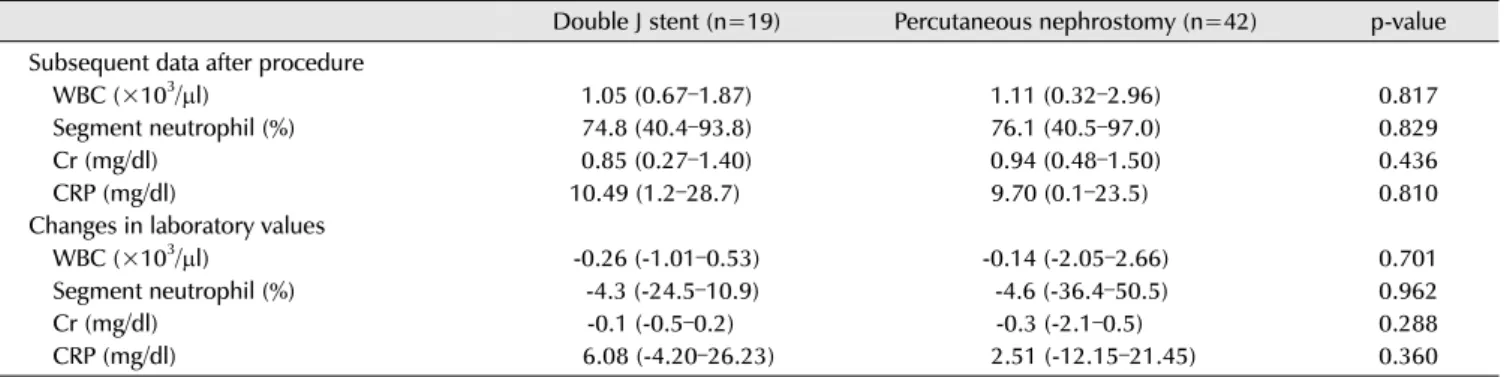
were similar in the two groups. The indicative parameters

for acute renal injury and septic conditions (white blood

cell count, segment neutrophil, and Cr) showed immediate

(4)

Table 2. Periprocedural laboratory parameters indicative of sepsis and septic shock

Double J stent (n=19) Percutaneous nephrostomy (n=42) p-value Subsequent data after procedure

WBC (×10

3

/ l) 1.05 (0.67 –1.87) 1.11 (0.32 –2.96) 0.817

Segment neutrophil (%) 74.8 (40.4 –93.8) 76.1 (40.5 –97.0) 0.829

Cr (mg/dl) 0.85 (0.27–1.40) 0.94 (0.48–1.50) 0.436

CRP (mg/dl) 10.49 (1.2 –28.7) 9.70 (0.1 –23.5) 0.810

Changes in laboratory values

WBC (×10

3

/l) -0.26 (-1.01–0.53) -0.14 (-2.05–2.66) 0.701

Segment neutrophil (%) -4.3 (-24.5–10.9) -4.6 (-36.4–50.5) 0.962

Cr (mg/dl) -0.1 (-0.5 –0.2) -0.3 (-2.1 –0.5) 0.288

CRP (mg/dl) 6.08 (-4.20 –26.23) 2.51 (-12.15 –21.45) 0.360

Values are presented as mean (range).

WBC: white blood cell, Cr: creatinine, CRP: C-reactive protein.

improvement, but CRP did not (Table 2). On the other hand, none of these differences in markers were statistically significant (p=0.701, 0.962, 0.288, and 0.360, respectively).

After ureteral stenting or PCN insertion, for ultimate treatment, the endoscopic removal of ureter stones under general anesthesia was performed on most of the patients, but a few patients required regular changes of the ureter stent or PCN without surgery, considering the Eastern Cooperative Oncology Group performance status and life expectancy.

DISCUSSION

APN complicated with ureteral stones is a potentially life-threatening condition for which the immediate relief of urinary obstruction, preceding infection control, and subsequent definitive treatment are recommended. The two main procedures to achieve urinary diversion are DJ stenting and PCN [7].

Goldsmith et al. [8] reported equivalent outcomes between DJ stenting and PCN based on previous research on 130 patients with complicated APN over a 15-year study period.

Mokhmalji et al. [9] did not identify any significant differ- ences between the two methods in a study of 40 patients with stone-related hydronephrosis. Pearle et al. [10] also reported no difference in the superiority or availability of either method. Similarly, other studies concluded that DJ stenting and PCN were both effective and feasible ways of managing complicated APN. The clinical preference and specific outcomes were examined through retrospective reviews, as well as the collection and analysis of medical records in the authors’ institution.

The history of stone or UTI, underlying disease, and stone characteristics (size, location) were similar in the two groups.

On the other hand, Goldsmith et al. [8] reported the stone size to be a significant factor in performing PCN instead of DJ stenting.

The complications associated with the use of ureteral stents or nephrostomy catheter are similar but do differ slightly. The main reason for complications after DJ stenting is mechanical irritation, resulting in lower urinary symptoms.

Diverse storage symptoms, such as the frequency, tenesmus, and urgency, occur in 9% to 27.27% of patients. The post-DJ stenting hematuria rates reported in previous studies ranged from 2% to 21%, with septicemia occurring in 5.2% to 19%

of cases. In contrast, the most common complication of PCN is bleeding, which occurred in 3.5% to 21.5% of cases. A PCN malfunction, including blockage or dislocation, may also be problematic in 4% to 37% of cases. Additional pro- cedures associated with temporary urinary diversions were not required in this study. Most patients with complicated APN underwent definitive treatment within one month; thus, the short duration of maintaining DJ stenting or PCN may have influenced this positive result.

The severity of sepsis was a significant factor in deciding

the type of urinary diversion. Subgroup analysis showed that

successful DJ stenting demands favorable conditions, in-

cluding the degree of bladder trabeculation, stone charac-

teristics (size, location, and the presence of impaction),

combined UTI, and patient compliance. High-grade hy-

dronephrosis with a ureteral stone may suggest a prolonged

obstruction and the possibility of stone impaction. Male

patients are more prone to severe pain or hematuria as-

sociated with a long and curved urethra, and prostate. This

(5)

may result in a higher rate of PCN insertion into males than females. Successful DJ stenting leads to easier ureteroscopic stone management, as indicated in previous studies.

In general, the success rate of PCN is superior to that of DJ stenting. Van Glabeke et al. [11] reported a DJ stenting failure rate of 20%, whereas Stables [12], Stanley et al. [13], and Mokhmalji et al. [9] reported PCN success rates ranging from 98% to 100%. The overall success rate of each procedure was excellent in the authors’ center, but this may reflect the relatively small number of cases and patient selection based on the clinical characteristics.

These study findings suggest that clinicians choose PCN for the initial management of emergent situations, such as septic conditions and positive urine/blood culture results and in cases with comorbid anemia, thrombocytopenia, higher Cr, or higher CRP. A similar preference for PCN vs.

ureteral stenting was noted in cases with higher ESR, higher AST, and electrolyte imbalance, but the difference was not significant.

Several studies have reported a clinician’s preference for PCN, particularly for cases with a large stone burden. Gold- smith et al. reported a preference for PCN for the manage- ment of larger ureteral stones to avoid the failure associated with a higher risk of stone impaction. On the other hand, the stone number or location were not significant factors related to determining the type of procedure [8]. This trend is based on the accumulated clinical experience regarding stent failure or procedure-related pain. Urologists perform DJ stenting using rigid cystoscopes that can cause intolerable pain associated with the anatomic structures, particularly in male patients. The alternative way to decrease pain is by flexible cystoscopy, but retrograde ureteral catheteri- zation requires a steep learning curve.

The post-procedural clinical prognoses for both DJ stent- ing and PCN were excellent in terms of infection control and preservation of the renal function. Moreover, the dif- ferences between groups were not statistically significant.

Some institutions perform DJ stenting under general anes- thesia and prefer PCN in severe cases [8]. The authors’

institution performs both urinary diversions under local anesthesia using intraurethral lidocaine gel; thus, this factor can be excluded when interpreting the results.

This study had several limitations. The retrospective design and relatively small sample of enrolled patients may weaken the evidence. Some patients were excluded owing to insuffi-

cient information in their medical records. In addition, several biases, such as selection bias, may have impacted the results due to our study design. Additional prospective, large-scale, and multi-center studies will be necessary to correct these shortcomings.

CONCLUSIONS

Clinicians tend to choose PCN insertion more than DJ stenting for obstructive uropathy patients with lower hemo- globin or platelet levels, and higher serum Cr or CRP. On the other hand, a comparison of the laboratory parameters of the post-procedural state of patients revealed significant differences in the environment with a low incidence of complications and high success rates. Therefore, both mo- dalities can preserve the renal function and relieve infec- tions.

CONFLICT OF INTEREST

No potential conflict of interest relevant to this article was reported.

AUTHOR CONTRIBUTIONS

J.C. and K.H.Y. designed the study. T.C. collected the data and performed analysis. J.C. wrote the manuscript with support from K.H.Y. and T.C.. D.G.L., G.E.M., and H.L.L.

provided critical feedback and contributed to the final version of the manuscript.

ORCID

Jeonghyouk Choi, https://orcid.org/0000-0003-0650-7569 Taesoo Choi, https://orcid.org/0000-0002-2800-5773 Dong-Gi Lee, https://orcid.org/0000-0001-7369-9252 Gyeong Eun Min, https://orcid.org/0000-0003-3881-7481 Hyung Lae Lee, https://orcid.org/0000-0002-4338-7423 Koo Han Yoo, https://orcid.org/0000-0001-7952-7902

REFERENCES

1. Hamasuna R, Takahashi S, Nagae H, Kubo T, Yamamoto S,

Arakawa S, et al. Obstructive pyelonephritis as a result of

urolithiasis in Japan: diagnosis, treatment and prognosis. Int J

(6)

Urol 2015;22:294-300.

2. Kim B, Myung R, Kim J, Lee MJ, Pai H. Descriptive epidemiology of acute pyelonephritis in Korea, 2010-2014: population-based study. J Korean Med Sci 2018;33:e310.

3. Lee DG, Jeon SH, Lee CH, Lee SJ, Kim JI, Chang SG. Acute pyelonephritis: clinical characteristics and the role of the surgical treatment. J Korean Med Sci 2009;24:296-301.

4. Richter S, Ringel A, Shalev M, Nissenkorn I. The indwelling ureteric stent: a 'friendly' procedure with unfriendly high mor- bidity. BJU Int 2000;85:408-11.

5. Ku JH, Lee SW, Jeon HG, Kim HH, Oh SJ. Percutaneous nephrostomy versus indwelling ureteral stents in the manage- ment of extrinsic ureteral obstruction in advanced malign- ancies: are there differences? Urology 2004;64:895-9.

6. Baishya RK, Dhawan DR, Jagtap J, Sabnis R, Desai MR. Per- cutaneous nephrostomy under ultrasound guidance. Indian J Nephrol 2011;21:67.

7. Preminger GM, Tiselius HG, Assimos DG, Alken P, Buck C, Gallucci M, et al.; EAU/AUA Nephrolithiasis Guideline Panel.

2007 guideline for the management of ureteral calculi. J Urol 2007;178:2418-34.

8. Goldsmith ZG, Oredein-McCoy O, Gerber L, Bañez LL, Sopko

DR, Miller MJ, et al. Emergent ureteric stent vs percutaneous nephrostomy for obstructive urolithiasis with sepsis: patterns of use and outcomes from a 15-year experience. BJU Int 2013;

112:E122-8.

9. Mokhmalji H, Braun PM, Martinez Portillo FJ, Siegsmund M, Alken P, Kohrmann KU. Percutaneous nephrostomy versus ureteral stents for diversion of hydronephrosis caused by stones:

a prospective, randomized clinical trial. J Urol 2001;165:1088- 92.

10. Pearle MS, Pierce HL, Miller GL, Summa JA, Mutz JM, Petty BA, et al. Optimal method of urgent decompression of the col- lecting system for obstruction and infection due to ureteral calculi. J Urol 1998;160:1260-4.

11. Van Glabeke E, Conort P, Chartier-Kastler E, Desrez G, Boyer C, Richard F. [Treatment of complicated renal colic in patients treated with indinavir: value of double J stents]. Prog Urol 1999;9:470-3. French.

12. Stables DP. Percutaneous nephrostomy: techniques, indications, and results. Urol Clin North Am 1982;9:15-29.

13. Stanley P, Bear JW, Reid BS. Percutaneous nephrostomy in

infants and children. AJR Am J Roentgenol 1983;141:473-7.

수치

Table 1. Comparative characteristics of the patients according to the type of urinary diversion
Table 2. Periprocedural laboratory parameters indicative of sepsis and septic shock

참조

관련 문서

For Kummell’s disease with persistent pain and without neurological symptoms, percutaneous vertebroplasty (VP) or balloon kyphoplasty (KP) has been known to

- Example) Suppose that a new product or facility is proposed and that the criterion for success is a 10 percent rate of return on the investment for a 5-year life of the

Yanga, “Mesoporous activated carbon fiber as electrode material for high-performance electrochemical double layer capacitors with ionic liquid electrolyte”, J...

• Useful if the forces or torques acting on the object or mechanical part are difficult to determine.. • Very useful for more complicated systems later (MDOF and

This article, in terms of retrospective evaluation, intended to present a suitable alternative for the present with the normative analysis, the comparative

3-43 The Fault Current and Voltage Curves of Fault Phase During the Double Line to Ground Fault(A Transformer for Voltage Drop or Modifier)..

(Note that when the number of scored questions for a given test is greater than the range of possible scaled scores, it is likely that two or more raw scores will convert to

The results showed that male bladder cancer patients with urinary diversion experienced various symptoms at the same time, and the identified symptom clusters affected