■
Sang-Jin Kim, PT, MS; Chun-Bae Jeon, PT, MS; Chung-Sun Kim, PT, PhD
■
Department of Physical Therapy, College of Rehabilitation Science, Daegu University
Purpose: The purpose of the present study was to examine, in stroke patients, differences between backward walking training applied on a treadmill and the same training applied on the ground.
Methods: Twenty seven stroke patients were divided into a treadmill backward walking group of 14 patients and a ground backward walking group of 13 subjects. Each group performed their respective training method for 8 weeks (15 min per day, 4 days a week). Walking ability was measured using a 10 m MWS (Maximal Walking Speed) test and the GAITRite system to examine changes in walking. Cadence, stridelength, step time, step length and symmetry index of the less affected side were measured to examine changes in stance phase of the lower extremity of the more affected side.
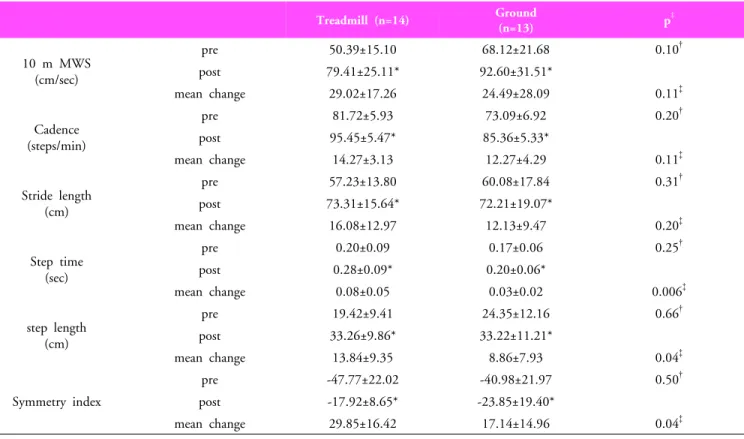
Results: 10 m MWS, cadence, stride length, step time and step length of the less affected side significantly increased and symmetry index significantly decreased after training in both groups. The treadmill backward walking group experienced a significantly greater increase in step time and step length and a significantly greater decrease in symmetry index than the ground backward walking group.
Conclusion: The two walking training methods were effective for improving stability in stance phase of the lower extremity of the more affected side, but the treadmill method was more effective. The present studyis meaningful in that it analyzed the effects of backward walking training methods on walking and the differences of the training methods to provide information necessary for effective treatmentof stroke patients.
Keywords: Backward walking, Treadmill walking, Ground walking, Stroke Received: April 29, 2011
Revised: May 08, 2011 Accepted: May 31, 2011
Corresponding author: Chun-Bae Jeon, [email protected]
Stroke Patients
The Journal of Korean Society of Physical Therapy
I. Introduction
Stroke is one of the top three causes of death along with cancer and heart disease, and its prevalence is gradually increasing.
Although survival rate is increasing due to developments in the medical sciences, stroke survivors have many dysfunctions, and social costs for their treatment are high.
1Stroke patients maintain abnormal postures and experience low efficiency when walking due to imbalances in the body, lack of a sense of balance, imbalances in muscle strength, inadequate weight bearing, co-contraction, and degradation of motor ability control.
2Furthermore, patients diagnosed with stroke experience degradation in quality of life together with decreased physical functions.
3In particular, the gait disturbance of hemiparesis
patients resulting from stroke causes difficulties in body movement and in daily life and has negative effects on prognosis.
Thus, most patients don't recover normal walking after the onset of a stroke.
4Characteristic walking patterns of stroke patients include a slow walking cycle, a short stance phase on the more affected side, and a relatively long swing phase.
5Stroke patients may partially recover their walking ability, but most patients live with a slow walking speed and low endurance, and their independent movement at home and in society are limited.
6The improvement and recovery of walking ability is closely related to the return of stroke patients to work and society.
7Accordingly, recovery of walking ability is a major goal in the functional recovery of stroke patients.
8Diverse approaches are used in order to enhance walking
ability
9-11and interest in backward walking that is easily accessible has recently increased. Studies on backward walking of healthy persons and stroke patients are increasing. It has been reported that, based on the results of studies on backward walking of healthy persons, lower extremity muscle strength increased
12. And it has been reported that as a result of stroke patients’ backward walking on a treadmill, walking speeds increased.
13It has also been reported that as a result of stroke patients’ backward walking on the ground, lower extremity muscle strength increased and consequently, balance ability and walking speeds increased.
14,15Although studies on backward walking training have been recently conducted in order to improve stroke patients’
functions, these studies have been conducted either on the ground or on a treadmill. There has been no study of effective methods for applying backward walking training. Therefore, the purpose of the present study was to examine differences in backward walking training – applied either on a treadmill or the same training applied on the ground.
II. Study Method
1. Subjects
The present study was done on 27 stroke patients who were under treatment after being hospitalized in OO Hospital in Deagu Republic of Korea between December 2008 and April 2009 and who were at least 6 months after stroke onset (to minimize the possibility of natural recovery).
The subjects were recruited among those who could walk with a walking aid or alone for at least 10 m, whose MAS (Modified Ashworth Scale), whichmeasures the stiffness of the lower extremities of the more affected side, was G2 or lower, who had no orthopedic diseases on either of their lower extremities, who had no limitations in range of motion, whose Korean mini-mental state examination (MMSE-K) score was at least 24, and who voluntarily agreed to participate in the study.
2. Experimental Method
The present study performed backward walking training in addition to balancing therapy for weight bearing or weight shifting and general exercise therapy for strengthening walking and muscle strength. The subjects were randomly assigned to a
ground backward walking group of 13 subjects or a treadmill backward walking group of 14 subjects. The two groups conducted their respective exercises for 15 minutes per session, 4 sessions a week, for a total of 8 weeks.
1) Treatment Method
The training method for the ground backward walking group is described below. The training program was based on the method presented by Davies.
16The details are as follows. At first, subjects trained inside the parallel bars and then outside them.
The training was divided into four levels. First, the subjects were asked to set foot backwards inside the parallel bars and when necessary, support themselves with the hand of the less affected side. The therapist helped the subjects so that they could move in the right pattern. Once the subjects were able to move their bodies in the right pattern, the therapist slowly decreased the amount of help. Second, as the subjects were trained inn elements of movement, they were able to actively perform the exercise with only a little help, and the therapist facilitated their backward walking inside the parallel bars. Third, the subjects were able to actively walk backwards? outside the parallel bars.
Fourth and last, the subjects gradually increased the distance and speed of backward walking.
The above-mentioned procedure was applied on a treadmill (Cima fitness, Korea) for the treadmill backward walking group.
Before the experiment, we explained about the treadmill for the
treadmill backward walking group so that they would become
familiar with the machine. The slope of the treadmill was set to
zero, and the patients were trained with a suspension device
(composed of hydraulic top and bottom electronic devices and a
harness) for safety. However, they were not allowed to partially
bear their weight on the suspension device. The treadmill
(minimum start speed 0.1 km/hr and adjustable in 0.1 km/hr
units) was started at a speed with which the patient felt
comfortable. The speed was gradually increased as patient
functions on the treadmill improved. During the training, two
therapists helped the subjects when it was necessary. One
therapist sat beside the paralyzed side of the subject and used
hands to correct the subject's walking pattern with the lower
extremities. The other therapist stood behind the subject and
provided guided weight support on the paralyzed side. During
every training session, the therapists gave appropriate feedback
to facilitate the backward walking pattern. The patients were
Treadmill (n=14)
Ground
(n=13) p-value*
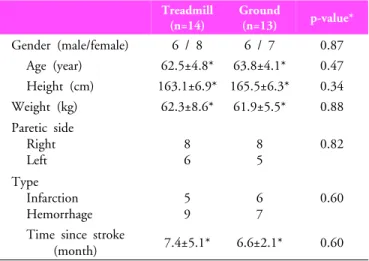
Gender (male/female) 6 / 8 6 / 7 0.87 Age (year) 62.5±4.8* 63.8±4.1* 0.47 Height (cm) 163.1±6.9* 165.5±6.3* 0.34 Weight (kg) 62.3±8.6* 61.9±5.5* 0.88 Paretic side
Right Left
8 6
8 5
0.82
Type Infarction Hemorrhage
5 9
6 7
0.60
Time since stroke
(month) 7.4±5.1* 6.6±2.1* 0.60
* The data reported as Mean±standard deviations
Table 1. General characteristics of subjects allowed to hold the treadmill with their less affected hand when
necessary or could choose to wear a walking aid.
132) Measurement Method
(1) 10 m MWS (maximal walking speed)
To evaluate walking performance, a 10 m MWS test was used that had been verified for its reliability and validity.
17The 10 m MWS consisted of a 14 m straight walking passage using tapes with a width of 10 cm between two points. Furthermore, mark lines were drawn at 2 m inward from both ends of the 14 m walking passage. The 2 m distances from the beginning and from the end were designated as the area for acceleration and deceleration. Walking times for 10 m in the middle of the walking area were measured with a stop watch. The walking test was performed three times and the average was determined.
(2) GAITRite system
To measure the elements of walking, we evaluated cadence, stride length, step time, step length, and symmetry index using the GAITRite system (CIR System Inc., USA). In particular, symmetry index was calculated using the formula:
SI = 2*[(single limb support phase of the more affected side - single limb support phase of the less affected side)/(single limbsupport phase of the more affected side + single limb support phase of the less affected side)]*100
A symmetry index of less than 10% was regarded as acceptable symmetry.
18The GAITRite system has been proven for its reliability and validity in analyzing the temporal and spatial elements of walking. It is an electronic walking plate with a length of 366 cm and a width of 61 cm and has attached 13,824 sensors. The system collects data at a sampling rate of 80 Hz per second and sends the data to a computer for analysis through a serial interface cable. To measure the actual leg length before measuring walking elements, the length from the anterior superior iliac spine to the medial malleolus of the ankle joint in the supine position was measured and inputted to the GAITRite system. The subjects were asked to walk on the walking plate starting from 2 m before the walking plate according to the oral instructions of the tester. The walking task was performed three times and averages were determined.
3. Data Analysis
Data were analyzed with SPSS for Windows version 17. To test the homogeneity between subjects in the two groups, qualitative data were analyzed using the Chi-square test. Among quan- titative data, age, height, weight, time since stroke and step time satisfied normality tests and thus were analyzed using two sample t-tests, which are parametric tests. The 10 m MWS, cadence, stride length, step length and symmetry indexes did not satisfy normality tests and thus were analyzed using the Wilcoxon rank sum test, which is a nonparametric test. To compare the changes between pre-test and post-test of training in each group, step time was analyzed using paired t-test as step time satisfied normality tests. Since 10 m MWS, cadence, stride length, step length and symmetry indexes did not satisfy normality tests, these were analyzed using Wilcoxon signed rank test which are nonparametric tests. To compare mean changes between the groups after the training, step time was analyzed using two sample t-tests. 10 m MWS, cadence, stride length, step length and symmetry indexes were analyzed using Wilcoxon rank sum tests. The statistical significance level αα was set to 0.05.
III. RESULTS
1. Group Homogeneity Test
gender, age, height, weight, paralyzed site, cause of disease, and
period of disease did not show significant differences between
the two groups (p>0.05) (Table 1).
Treadmill (n=14) Ground
(n=13) p
‡10 m MWS (cm/sec)
pre 50.39±15.10 68.12±21.68 0.10
†post 79.41±25.11* 92.60±31.51*
mean change 29.02±17.26 24.49±28.09 0.11
‡Cadence (steps/min)
pre 81.72±5.93 73.09±6.92 0.20
†post 95.45±5.47* 85.36±5.33*
mean change 14.27±3.13 12.27±4.29 0.11
‡Stride length (cm)
pre 57.23±13.80 60.08±17.84 0.31
†post 73.31±15.64* 72.21±19.07*
mean change 16.08±12.97 12.13±9.47 0.20
‡Step time (sec)
pre 0.20±0.09 0.17±0.06 0.25
†post 0.28±0.09* 0.20±0.06*
mean change 0.08±0.05 0.03±0.02 0.006
‡step length (cm)
pre 19.42±9.41 24.35±12.16 0.66
†post 33.26±9.86* 33.22±11.21*
mean change 13.84±9.35 8.86±7.93 0.04
‡Symmetry index
pre -47.77±22.02 -40.98±21.97 0.50
†post -17.92±8.65* -23.85±19.40*
mean change 29.85±16.42 17.14±14.96 0.04
‡* The comparison of gait variables between pre-test and post-testin each group.
†
The Comparison of gait variables at pre-test between treadmill and ground groups.
‡