• 검색 결과가 없습니다.

Comparison of Trunk Control on Gross Motor Function and Topography in Children with Spastic Cerebral Palsy

N/A
N/A
Protected

Academic year: 2021

Share "Comparison of Trunk Control on Gross Motor Function and Topography in Children with Spastic Cerebral Palsy"

Copied!
9
0
0

로드 중.... (전체 텍스트 보기)

전체 글

(1)


| Abstract |

1)

PURPOSE: This study examined the differences in the trunk impairment scores according to the levels of the gross motor classification system by evaluating trunk control in children with spastic cerebral palsy using the index of trunk impairment. In addition, the characteristics of trunk control disabilities were investigated according to the cerebral palsy type.

METHODS: The subjects were 49 children (mean age 8.57±1.83 years, 11 with hemiplegia, 26 with diplegia, and 12 with quadriplegia) with spastic cerebral palsy levels Ⅰ to Ⅳ under the gross motor function classification system (GMFCS). The coordination and balance of the children with cerebral palsy were evaluated using the index for trunk impairment. Statistical analyses were performed using a Kruskal-Wallis test, and Bonferroni analyses were used as a

†Corresponding Author : Ji-Hye Kim

[email protected], https://orcid.org/0000-0002-7647-0039 This is an Open Access article distributed under the terms of the Creative Commons Attribution Non-Commercial License (http://creativecommons.org/licenses/by-nc/3.0) which permits unrestricted non-commercial use, distribution, and reproduction in any medium, provided the original work is properly cited.

post-hoc comparison for any significant results.

RESULTS: The median of the total scores of trunk impairment was 13 (range, 9-17), which was 56% of the maximum score. The total score of trunk impairment and subscales differed significantly according to the disease severity and type of motor disability. The scores for children with quadriplegia were the lowest compared to children with hemiplegia and diplegia.

CONCLUSION: Trunk control function in children with spastic cerebral palsy was reduced, and varied according to the disease severity and types of motor disabilities. The degree of trunk impairment differed from the trunk control ability according to the degree of motor disability of children with cerebral palsy.

Key Words: Cerebral palsy, Trunk control, GMFCS

Ⅰ. Introduction

Cerebral palsy is defined as a permanent disability in the development of movement and posture caused by non-progressive brain impairment of infants after birth or a developing fetus. According to the definition, postural control impairment is one characteristic of children with

Research Article Open Access

Comparison of Trunk Control on Gross Motor Function and Topography in Children with Spastic Cerebral Palsy

Young-Eun Choi, PT, PhD⋅Hye-Rim Jung, OT, PhD 1 ⋅Ji-Hye Kim, PT, PhD 2†

Department of Physical Therapy, College of Health Medicine, Kaya University

1 Department of Occupational Therapy, College of Health Medicine, Kaya University

2 Department of Physical Therapy, Gangdong University

Received: October 14, 2019 / Revised: October 21, 2019 / Accepted: Nobvember 4, 2019

ⓒ 2019 J Korean Soc Phys Med

(2)

cerebral palsy [1]. Postural control is the ability to adjust the body and maintain stability when adapting to the surrounding environment [2]. Postural control systems are developed to maintain a stable head and trunk posture by resisting gravity to provide a foundation for sitting, reaching, standing, and walking. In addition, it affects hand- eye coordination, upper extremity functions, functional skills, self-management, recognition, and social interactions [3]. On the other hand, children with cerebral palsy lose their postural control ability because of spasticity, decrease in force production, unnatural timing, loss of senses, and secondary musculoskeletal impairment [4].

The trunk is a key body segment that plays an important role in postural control [5]. The trunk muscles stabilize the spine and trunk to provide a foundation for the free movement of the head and extremities [6]. Regardless of the severity of disability, children with mild and severe cerebral palsy show problems in posture control, and while performing daily tasks, many children with cerebral palsy sit instead of stand. Ultimately, they spend longer periods sitting compared to children without cerebral palsy [7,8].

Therefore, during an evaluation and treatment planning of children with cerebral palsy, it is important to check their trunk control while they are seated [9].

Although the measurement scales, such as force plate, kinematic analysis, and electromyography, are used to evaluate trunk control, such scales are expensive and complex, which have limited their use during clinical practice and studies [10-12]. In a systematic review of the tools to evaluate balance in children with cerebral palsy, four clinical balance tools could evaluate trunk control, one of which is the Trunk Impairment Scale (TIS) [13].

The TIS evaluates the trunk control of children with cerebral palsy during static and dynamic sitting positions and identifies the domain of the body structure and function from the International Classification of Functioning, Disability, and Health (ICF) standards [14]. Although the TIS was validated as a scale to evaluate the trunk control

of children with cerebral palsy, few studies have examined the trunk impairment scores related to the severity of motor disability and cerebral palsy type [15,16]. The Gross Motor Function Classification System (GMFCS) classifies the functional restriction level of children into five levels [17].

Children with cerebral palsy are classified as hemiplegia, diplegia, quadriplegia, ipsilateral, or bilateral cerebral palsy [18,19]. This study examined the characteristics of trunk control from a sitting posture in children with cerebral palsy.

The purpose of this study was to verify the differences in TIS according to the levels of the GMFCS by evaluating the trunk control of children with spastic cerebral palsy.

In addition, the characteristics of trunk control disabilities were examined according to the cerebral palsy type.

Ⅱ. Methods

1. Study subjects

The subjects of this study were 49 children with cerebral palsy of levels Ⅰ to Ⅳ according to the GMFCS. The purpose of the study and any risks that may arise during their participation was explained to the children’s guardians of the study, and written consent was obtained. The subjects were selected based on the following criteria: (1) children who were diagnosed with spastic cerebral palsy and aged between 6 and 12 years, (2) children who can follow the therapist’s instructions, and (3) children who have not had any procedures or surgery within the past six months.

Children with the following conditions were excluded: (1) children with innate musculoskeletal diseases, developing central nervous system diseases, and a history of orthopedic surgery, and (2) children with genetic disorders or other severe diseases other than cerebral palsy.

2. Measurement

1) Trunk Impairment

The Trunk Impairment Scale (TIS) was used to evaluate

(3)

the balance and coordination of children with cerebral palsy.

The TIS is an evaluation tool with verified reliability to assess the trunk movement, coordination, and balance of stroke patients while sitting [20]. The TIS has three subscales (static sitting balance, dynamic balance, and coordination), 17 items, with a total score range of zero to 23. The static sitting balance consists of three items:

the ability to maintain a sitting posture with the support of the feet, while passively crossing the legs, and while actively crossing the legs. The static sitting balance can have a score of zero to seven with scores of zero to two or zero to three for each item. The dynamic sitting balance consists of 10 items that evaluate the ability to bend the trunk sideways or lift one side of the hip and can have a total score of zero to 10 with scores of zero to one for each item. Coordination consists of four items: an evaluation of the ability to start the movement of the shoulder and the hip, and an evaluation of the ability to spin the upper and lower part of the trunk six times.

Coordination can have a total score of zero to six with scores of zero to one or zero to two for each item. This study used the Korean version of the TIS edited by Ko and You [21]. The reliability among the evaluators of the Korean version of the TIS was ICC3, 1=.920-.983 (r=.924-.984), and the test-retest reliability was ICC3, 1=.805-.901 (r=.806-.903).

2) Gross Motor Function Classification System (GMFCS) This study classified the gross motor functions of children with cerebral palsy using the GMFCS. The GMFCS is divided into five levels according to the age group and determines a child’s level based on their abilities and limitations in gross motor functions. Level Ⅰ is defined as the ability to walk without any restriction. Level Ⅱ is defined as the ability to walk with some restrictions.

Level Ⅲ is defined as the ability to walk without the support of the trunk but with canes, crutches, and walkers. Level

Ⅳ is defined as the ability to move by oneself with

restrictions using motor wheelchairs or other methods of movement. Level Ⅴ is defined as restricted movement, even with the use of assistance tools. The reliability among the test subjects was .97 to .99 [22].

3. Statistical analyses

The trunk impairment scores were analyzed according to the general characteristics, type of cerebral palsy, and motor impairment using descriptive statistics. After conducting the Kolmogorov-Smirnov test, no normal distribution was found for each item measured. The Kruskal-Wallis test was conducted to identify the difference in the trunk impairment scores according to the cerebral palsy type and the movement levels, and the post hoc test was conducted using a Mann-Whitney U test with the Bonferroni correction method. All statistical data were analyzed using Windows SPSS 18.0, and the significance level was set to p<.05.

Ⅲ. Results

1. General characteristics of the subjects The subjects were 49 children aged between six and 12 with spastic cerebral palsy (21 boys and 28 girls) and an average age of 8.57±1.83 years. The distribution of children with spastic cerebral palsy revealed 11 with hemiplegia, 26 with diplegia, and 12 with quadriplegia.

The distribution of the GMFCS showed that 11, 14, 15, and nine were classified as level Ⅰ, Ⅱ, Ⅲ, and Ⅳ, respectively (Table 1). The total TIS scores had a median of 13 out of 23 (range, 9-17), and was 56% of the maximum score. After analyzing the median of the subscales, the static sitting balance was six out of seven (range, 4-7);

the dynamic sitting balance was five out of 10 (range, 2-7), and coordination was two out of six (range, 1-4).

The median of each subscale was 85%, 40%, and 33%

of the maximum score, respectively.

(4)

2. Comparison of the trunk impairment level according to levels in the GMFCS

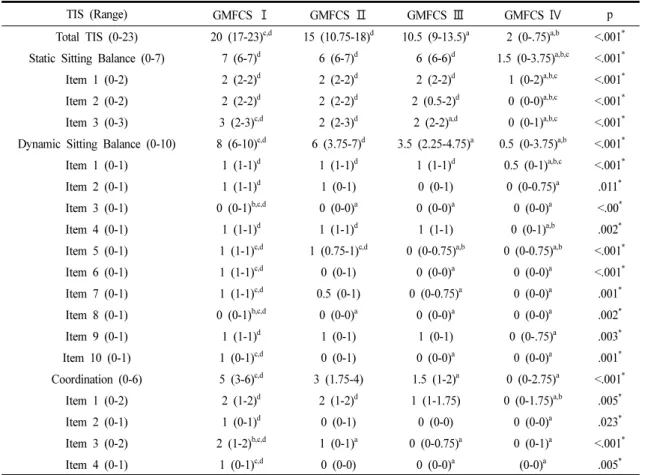
The median for the total score was 20.0, 15.0, 10.3, and 2.0 for level Ⅰ (range, 17-23), Ⅱ (range, 10.75-18),

Ⅲ (range, 9-13.5), and Ⅳ (range, 0-.75), respectively. The subscale and total TIS scores showed significant differences according to levels (p<.05); the scores decreased from level

Ⅰ to level Ⅳ. After posttest analysis, the total scores and the dynamic sitting balance showed significant differences between levels Ⅰ and Ⅲ and between levels Ⅱ and Ⅳ.

In the static sitting balance, significant differences were observed between levels Ⅰ and Ⅳ, levels Ⅱ and Ⅳ, and levels Ⅲ and Ⅳ. In coordination, a significant difference was noted between levels Ⅰ and Ⅲ. A comparison of the 17 items revealed significant differences among all levels. Posttest analysis revealed the following to have significantly higher scores in level Ⅰ than level Ⅲ: static sitting balance item 3; dynamic sitting balance items 3, 5, 6, 7, 8, and 10; and coordination items 3 and 4. In the static sitting balance, the following had significantly higher scores in level Ⅱ than level Ⅳ: items 1, 2, and 3; dynamic sitting balance items 4 and 5; and coordination item 1. A comparison of the scores per item for levels

I and Ⅳ revealed level Ⅰ to have significantly higher scores than level Ⅳ (Table 2).

3. Comparison of the trunk impairment level according to the types of cerebral palsy The median of the total score for children with hemiplegia was 14 (range, 10-15), children with diplegia was 15 range, 10.75-20), and children with quadriplegia was 2 (range, 0-9.75 There was a significant difference when comparing the total score and subscale scores of children with hemiplegia, diplegia, and quadriplegia. After the posttest, the scores of children with quadriplegia were significantly low, and children with hemiplegia and diplegia did not have significant differences (Table 3).

Ⅳ. Discussion

This study examined the differences in trunk impairment scores according to the GMFCS levels by evaluating the trunk control of children with spastic cerebral palsy using the trunk impairment index. In addition, the characteristics of the trunk control disabilities were investigated according

Type of Cerebral Palsy

Total Hemiplegic Diplegic Quadriplegic

Sample Size (n) 49 11 26 12

Age, Years (mean±SD) 8.57±1.83 8.27±1.84 8.50±1.86 9.00±1.85

Gender

Male (n) 21 8 9 4

Female (n) 28 3 17 8

GMFCS Level Ⅰ 11 3 8 -

Ⅱ 14 5 9 -

Ⅲ 15 3 9 3

Ⅳ 9 - - 9

n: number, SD: Standard deviation, GMFCS: Gross motor function classification system

Table 1. General Characteristics of the Subjects

(5)

TIS (Range) GMFCS Ⅰ GMFCS Ⅱ GMFCS Ⅲ GMFCS Ⅳ p Total TIS (0-23) 20 (17-23) c,d 15 (10.75-18) d 10.5 (9-13.5) a 2 (0-.75) a,b <.001 * Static Sitting Balance (0-7) 7 (6-7) d 6 (6-7) d 6 (6-6) d 1.5 (0-3.75) a,b,c <.001 *

Item 1 (0-2) 2 (2-2) d 2 (2-2) d 2 (2-2) d 1 (0-2) a,b,c <.001 *

Item 2 (0-2) 2 (2-2) d 2 (2-2) d 2 (0.5-2) d 0 (0-0) a,b,c <.001 *

Item 3 (0-3) 3 (2-3) c,d 2 (2-3) d 2 (2-2) a,d 0 (0-1) a,b,c <.001 * Dynamic Sitting Balance (0-10) 8 (6-10) c,d 6 (3.75-7) d 3.5 (2.25-4.75) a 0.5 (0-3.75) a,b <.001 *

Item 1 (0-1) 1 (1-1) d 1 (1-1) d 1 (1-1) d 0.5 (0-1) a,b,c <.001 *

Item 2 (0-1) 1 (1-1) d 1 (0-1) 0 (0-1) 0 (0-0.75) a .011 *

Item 3 (0-1) 0 (0-1) b,c,d 0 (0-0) a 0 (0-0) a 0 (0-0) a <.00 *

Item 4 (0-1) 1 (1-1) d 1 (1-1) d 1 (1-1) 0 (0-1) a,b .002 *

Item 5 (0-1) 1 (1-1) c,d 1 (0.75-1) c,d 0 (0-0.75) a,b 0 (0-0.75) a,b <.001 *

Item 6 (0-1) 1 (1-1) c,d 0 (0-1) 0 (0-0) a 0 (0-0) a <.001 *

Item 7 (0-1) 1 (1-1) c,d 0.5 (0-1) 0 (0-0.75) a 0 (0-0) a .001 *

Item 8 (0-1) 0 (0-1) b,c,d 0 (0-0) a 0 (0-0) a 0 (0-0) a .002 *

Item 9 (0-1) 1 (1-1) d 1 (0-1) 1 (0-1) 0 (0-.75) a .003 *

Item 10 (0-1) 1 (0-1) c,d 0 (0-1) 0 (0-0) a 0 (0-0) a .001 *

Coordination (0-6) 5 (3-6) c,d 3 (1.75-4) 1.5 (1-2) a 0 (0-2.75) a <.001 *

Item 1 (0-2) 2 (1-2) d 2 (1-2) d 1 (1-1.75) 0 (0-1.75) a,b .005 *

Item 2 (0-1) 1 (0-1) d 0 (0-1) 0 (0-0) 0 (0-0) a .023 *

Item 3 (0-2) 2 (1-2) b,c,d 1 (0-1) a 0 (0-0.75) a 0 (0-1) a <.001 *

Item 4 (0-1) 1 (0-1) c,d 0 (0-0) 0 (0-0) a (0-0) a .005 *

TIS: Trunk impairment scale, GMFCS: Gross motor function classification system The data are presented by median (interquartile range), *p<.05

a Significance difference compared to the GMFCS level Ⅰ

b Significance difference compared to the GMFCS level Ⅱ

c Significance difference compared to the GMFCS level Ⅲ

d Significance difference compared to the GMFCS level Ⅳ

Table 2. Differences in the Total TIS Score, Subscale Totals and Items Scores According to the GMFCS

TIS (Range) Hemiplegia Diplegia Quadriplegia All Types

Total TIS (0-23) 14 (10-15) c 15 (10.75-20) c 2 (0-9.75) a,b <.001 * Static Sitting Balance (0-7) 6 (6-6) c 6.5 (6-7) c 1.5 (0-3.75) a,b <.001 * Dynamic Sitting Balance (0-10) 6 (3-6) c 6 (3.75-8) c 0.5 (0-3.75) a,b <.001 *

Coordination (0-6) 2 (1-3) 3 (2-5) c 0 (0-2.75) b .005 *

TIS: Trunk impairment scale

The data are presented by median (interquartile range), * p<.05

a Significance difference compared to hemiplegia

b Significance difference compared to diplegia

c Significance difference compared to quadriplegia

Table 3. Differences in the Total TIS Score, Subscale Totals According to Type of Cerebral Palsy

(6)

to cerebral palsy type. In this study, the total TIS of children with cerebral palsy was 13, or 56% of the maximum score, which is significantly lower than that of normally developed children [23]. The GMFCS was developed to evaluate the degree of nervous motor disability in children with cerebral palsy by classifying the gross motor movement function without considering the quality of movement based on the sitting and walking movements. Levels Ⅰ and Ⅱ indicate mild movement impairment, whereas level Ⅲ denotes medium impairment, and levels Ⅳ and Ⅴ show severe impairment [24]. In using this classification system with other evaluation tools, it is possible to interpret the movement skills of children easily to confirm their levels of function comprehensively. This study revealed differences in the total score of the TIS and the dynamic sitting balance between levels Ⅰ and Ⅲ and levels Ⅱ and Ⅳ in the GMFCS, coordination between levels Ⅰ and Ⅲ, and static sitting balance between levels Ⅱ and

Ⅳ and levels Ⅲ and Ⅳ. In other words, children with cerebral palsy with medium to severe motor impairment had lower TIS scores than children with cerebral palsy with mild motor impairment.

Pavão et al. [25] compared comparing children with cerebral palsy with mild motor impairment with children with medium-to-severe motor impairment and reported that the total TIS score for medium motor impairment was lower than that of children with mild motor impairment. Children with medium to severe impairments in movement have weaknesses in the trunk muscles, an excessive increase in the simultaneous contraction of the trunk muscles to maintain stability, and poor coordination among the joints when reacting to unexpected posture instability [26,27].

This causes impairments in trunk control. All items in the static sitting balance showed differences in levels Ⅲ and

Ⅳ of the GMFCS. The static sitting balance items include maintaining a sitting posture (item 1), maintaining balance with crossed legs (item 2), and maintaining balance while crossing the legs (item 3). Jung et al. [28] reported that

the total scores for the TIS increased after conducting interventions to enhance the trunk control abilities for frail, elderly patients who had suffered from strokes. This is consistent with the results of this study, which showed that it is possible to detect a change in subjects exhibiting motor abilities with low trunk impairment scores. Children with cerebral palsy have difficulties in selective movements, such as sagittal plane, bending, reaching flexion, extension, frontal plane, lateral flexion, transverse plane, and rotation, due to a lack of experience and physical recognition of controlled movement of the upper and lower parts of the trunk [9].

Previous studies also reported that the severity of trunk impairment of children with cerebral palsy is dependent on the disease severity and types of motor impairment.

Bousquet et al. [29] reported that children with spastic ipsilateral cerebral palsy would have better sitting balance abilities than those with spastic bilateral cerebral palsy.

This is similar to the results reported by Mendoza et al.

[30]. This study examined the differences in trunk impairment according to the severity of the motor involvement based on the GMFCS level. Marked differences were found between level Ⅰ and Ⅲ, level Ⅱ and Ⅳ for total TIS and subscale totals and items score.

Pavão et al. [25] evaluated the discriminant ability of the TIS, GMFM in children with cerebral palsy. These instruments can be used as predictors of the motor function in children with cerebral palsy that are mildly or moderate to severely impaired.

In this study, children with quadriplegia had the lowest

scores in the total TIS scores and the subscale scores of

the static sitting balance and dynamic sitting balance

according to the types of cerebral palsy, which showed

the largest impairment in trunk control. Children with

hemiplegia and diplegia had less impairment in trunk

control than children with quadriplegia. This is consistent

with Heyrman et al. [9], who compared the trunk control

of children with hemiplegia, diplegia, and quadriplegia.

(7)

They reported that children with quadriplegia have more limitations in spinning in various directions and performing selective movements, as well as reduced support of the lower part of the body and a decrease in the activation of the abdomen and back muscles compared to those of children with diplegia or hemiplegia [31,32]. In particular, the static sitting balance requires a predictable and compensatory postural adjustment to maintain a stable posture during movements of the upper or lower parts of the body [11,33]. This study showed that children with quadriplegia have a more severe impairment in the static sitting balance. Within the static sitting balance area, which includes the items to cross the legs, either passively or actively, the static sitting balance scores appear to reflect the ability to control the upper part of the body and the trunk while attempting movements of the lower body part.

This means that children with quadriplegia cannot use the upper part of the body or the trunk to maintain a static sitting balance.

The coordination subscale challenge dynamic trunk control to actively move the trunk over the stability limits of the base of support, demanding trunk rotation. Previous study has evaluated the normal and abnormal components of movement control in children with spastic cerebral palsy and found them as having problems with either muscle coordination or sensory organization, or both. Children with hemiplegia largely have problems with muscle coordination [34]. In the present study, there was no difference between children with hemiplegia and diplegia. Performing trunk rotations makes more challenges on postural control and children with cerebral palsy develop strategies to cope with deficient postural control [35]. Children with hemiplegia might depend more on their non-hemiplegic side and use that as a planning strategy during states of postural instability. This study used the TIS by sampling randomly 49 children with spastic cerebral palsy. An additional limitation occurred when generalizing the selected methods and subjects of the study to all children with cerebral palsy.

A more systematic and specific posture control and balance abilities for the various spastic cerebral palsy types will be needed in future studies. Measuring the balance and coordination using the Korean version of the TIS within the clinical area will provide basic data to physiotherapists for the treatment of children who aim to improve their trunk control.

Ⅴ. Conclusion

The results of the study showed that the trunk control of children with spastic cerebral palsy was impaired and differed according to the severity of motor impairment and type. The trunk control ability could be differentiated according to the severity of motor impairment of children with cerebral palsy with the TIS. Furthermore, this study found that children with spastic quadriplegia have severe restrictions in dynamic and static trunk movement compared to children with spastic hemiplegia and diplegia.

Therefore, information on trunk control impairment can be used to evaluate the trunk control abilities using the TIS.

References

[1] Rosenbaum P, Paneth N, Leviton A, et al. A report:

The definition and classification of cerebral palsy April 2006. Dev Med Child Neurol Suppl. 2007;109:8-14.

[2] Rose J, Wolff DR, Jones VK, et al. Postural balance in children with cerebral palsy. Dev Med Child Neurol.

2002;44(1):58-63.

[3] Redstone F, West JF. The importance of postural control for feeding. Pediatr Nurs. 2004;30(2):97-100.

[4] Love SR, Johnston LM. Exercise interventions improve postural control in children with cerebral palsy: a systematic review. Dev Med Child Neurol. 2015;57(6):

504-20.

[5] Assaiante C, Malllau S, Viel S, et al. Development of

(8)

postural control in healthy children: A functional approach.

Neural Plast. 2005;12(2-3):109-18.

[6] Verheyden G, Vereeck L, Tuijen S, et al. Trunk performance after stroke and the relationship with balance, gait and functional ability. Clin Rehabil. 2006;20(5):

451-58.

[7] Carlberg EB, Hadders-Algra M. Postural dysfunction in children with cerebral palsy: Some implications for therapeutic guidance. Neural Plast. 2005;12(2-3):221-8.

[8] De Graaf-Peters VB, Blauw-Hospers CH, Dirks T, et al. Development of postural control in typically developing children and children with cerebral palsy: Possibilities for intervention? Neurosci Biobehav Rev. 2007;31(8):

1191-200.

[9] Heyrman L, Desloovere K, Molenaers G, et al. Clinical characteristics of impaired trunk control in children with spastic cerebral palsy. Res Dev Disabil. 2013;

34(1):327-34.

[10] Coluccini M, Maini ES, Martelloni C, et al. Kinematic characterization of functional reach to grasp in normal and in motor disabled children. Gait Posture. 2007;

25(4):493-501.

[11] Girolami GL, Shiratori T, Aruin AS. Anticipatory postural adjustments in children with hemiplegia and diplegia.

J Electr Kinesiol. 2011;21(6):988-97.

[12] Ju YH, Hwang, IS, Cherng RJ. Postural adjustment of children with spastic diplegic cerebral palsy during seated hand reaching in different directions. Arch Phys Med Rehabil. 2012;93(3):471-9.

[13] Saether R, Helbostad JL, Adde L, et al. Reliability and validity of the trunk impairment scale in children and adolescents with cerebral palsy. Res Dev Disabil.

2013;34(7):2075-84.

[14] Zadnikar M, Kastrin A. Effects of hippotherapy and therapeutic horseback riding on postural control or balance in children with cerebral palsy: A meta-analysis. Dev Med Child Neurol. 2011;53(8):684-91.

[15] Pham HP, Eidem A, Hansen G, et al. Validity and

responsiveness of the trunk impairment scale and trunk control measurement scale in young individuals with cerebral palsy. Phys Occup Ther Pediatr. 2016;36(4):

440-52.

[16] R, Jørgensen L. Intra- and inter-observer reliability of the trunk impairment scale for children with cerebral palsy. Res Dev Disabil. 2011;32(2):727-39.

[17] Palisano R, Rosenbaum P, Walter S, et al. Development and reliability of a system to classify gross motor function in children with cerebral palsy. Dev Med Child Neurol.

1997;39(4):214-23.

[18] Cans C, Guillem P, Arnaud C. Surveillance of cerebral palsy in Europe: a collaboration of cerebral palsy surveys and registers. Dev Med Child Neurol 2000;42(12):816-24.

[19] Mutch L, Alberman E, Hagberg B, et al. Cerebral palsy epidemiology: Where are we now and where are we going? Dev Med Child Neurol. 1992;34(6):547-51.

[20] Verheyden G, Mertin J, Preger R, et al. The trunk impairment scale: A new tool to measure motor impairment of the trunk after stroke. Clin Rehabil. 2004;18(3):326-34.

[21] Ko JY, You YY. Reliability and responsiveness of the Korean version of the trunk impairment scale for stroke patients. J Kor Phys Ther. 2015;27(4):175-82.

[22] Ko JY, Woo JH, Her JG. The Reliability and concurrent validity of the GMFCS for Children with cerebral palsy.

J Phys Ther Sci. 2011;23(2):255-8.

[23] Saether R, Helbostad JL, Riphagen II, et al. Clinical tools to assess balance in children and adults with cerebral palsy: A systematic review. Dev Med Child Neurol.

2013;55(11):988-99.

[24] Reid SM, Carlin JB, Reddihough DS. Classification of topographical pattern of spasticity in cerebral palsy:

A registry perspective. Res Dev Disabil. 2011;32(6):

2909-15.

[25] Pavão SL, Maeda DA, Corsi C, et al. Discriminant ability and criterion validity of the trunk impairment scale for cerebral palsy. Disabil Rehabil. 2019;41(18):2199-205.

[26] Pavão SL, Rocha NACF. Sensory processing disorders

(9)

in children with cerebral palsy. Infant. Behav Dev.

2017;46:1-6.

[27] Verschuren O, Ada L, Maltais DB, et al. Muscle strengthening in children and adolescents with spastic cerebral palsy: Considerations for future resistance training protocols. Phys Ther. 2011;91(7):1130-9.

[28] Jung K, Kim Y, Chung Y, et al. Weight-shift training improves trunk control, proprioception, and balance in patients with chronic hemiparetic stroke. Tohoku J Exp Med. 2014;232(3):195-9.

[29] Bousquet E, Hägglund G. Sitting and standing performance in a total population of children with cerebral palsy:

Across-sectional study. BMC Musculoskelet Disord.

2010;11:131.

[30] Mendoza SM, Gómez-Conesa A, Hidalgo Montesinos MD. Association between gross motor function and postural control in sitting in children with cerebral palsy:

a correlational study in Spain. BMC Pediatr. 2015;15:124.

[31] Brogren E, Forssberg H, Hadders-Algra M. Influence of two different sitting positions on postural adjustments in children with spastic diplegia. Dev Med Child Neurol.

2001;43(8):534-46.

[32] Hadders-Algra M, Brogren E, Forssberg H. Development of postural control—differences between ventral and dorsal muscles?. Neurosci Biobehav Rev. 1998;22(4):501-6.

[33] Bigongiari A, de Andrade e Souza F, Franciulli PM, et al. Anticipatory and compensatory postural adjustments in sitting in children with cerebral palsy. Hum Mov Sci.

2011;30(3):648-57.

[34] Nashner LM, Shumway-Cook A, Marin O. Stance posture control in select groups of children with cerebral palsy:

deficits in sensory organization and muscular coordination.

Exp Brain Res. 1983;49(3):393-409.

[35] Carlberg EB, Hadder-Algra M. Postural dysfunction in

children with cerebral palsy: some implications for

therapeutic guidance. Neural Plast. 2005;12(2-3):221-8.

수치

Table 2. Differences in the Total TIS Score, Subscale Totals and Items Scores According to the GMFCS

참조

관련 문서

Modern Physics for Scientists and Engineers International Edition,

Five days later, on 15 January 1975, the Portuguese government signed an agreement with the MPLA, FNLA and UNITA providing for Angola to receive its independence on 11

Since every classical or virtual knot is equivalent to the unknot via a sequence of the extended Reidmeister moves together with the forbidden moves, illustrated in Section 2,

웹 표준을 지원하는 플랫폼에서 큰 수정없이 실행 가능함 패키징을 통해 다양한 기기를 위한 앱을 작성할 수 있음 네이티브 앱과

_____ culture appears to be attractive (도시의) to the

When a child with severe brain damage is held like this, her legs may automatically stiffen and her feet point down-the so-called 'tiptoe reflex'.. Because the feet sometimes

The index is calculated with the latest 5-year auction data of 400 selected Classic, Modern, and Contemporary Chinese painting artists from major auction houses..

The key issue is whether HTS can be defined as the 6th generation of violent extremism. That is, whether it will first safely settle as a locally embedded group