• 검색 결과가 없습니다.

Surgical Management of Infective Endocarditis Complicated by Embolic Stroke: Early versus Delayed Surgery

N/A
N/A
Protected

Academic year: 2021

Share "Surgical Management of Infective Endocarditis Complicated by Embolic Stroke: Early versus Delayed Surgery"

Copied!
6
0
0

로드 중.... (전체 텍스트 보기)

전체 글

(1)

http://dx.doi.org/10.5090/kjtcs.2011.44.5.332 ISSN: 2233-601X (Print) ISSN: 2093-6516 (Online)

*Department of Thoracic and Cardiovascular Surgery, Asan Medical Center, University of Ulsan College of Medicine

†This paper has been presented as a poster at the 47th STS Annual Meeting in 2011.

Received: May 3, 2011, Revised: May 31, 2011, Accepted: June 3, 2011

Corresponding author: Jae Won Lee, Department of Thoracic and Cardiovascular Surgery, Asan Medical Center, University of Ulsan College of Medicine, 388-1, Pungnap-dong, Songpa-gu, Seoul 138-736, Korea

(Tel) 82-2-3010-3584 (Fax) 82-2-3010-6966 (E-mail) [email protected]

C

The Korean Society for Thoracic and Cardiovascular Surgery. 2011. All right reserved.

CC
This is an open access article distributed under the terms of the Creative Commons Attribution Non-Commercial License (http://creative- commons.org/licenses/by-nc/3.0) which permits unrestricted non-commercial use, distribution, and reproduction in any medium, provided the original work is properly cited.

Surgical Management of Infective Endocarditis Complicated by Embolic Stroke: Early versus Delayed Surgery

Gwan Sic Kim, M.D.*, Joon Bum Kim, M.D.*, Sung-Ho Jung, M.D.*, Tae-Jin Yun, M.D.*, Suk Jung Choo, M.D.*, Cheol Hyun Chung, M.D.*, Jae Won Lee, M.D.*

Background: The optimal timing of surgery for infective endocarditis complicated by embolic stroke is unclear. We compared early versus delayed surgery in these patients. Materials and Methods: Between 1992 and 2007, 56 consecutive patients underwent open cardiac surgery for the treatment of infective endocarditis complicated by acute septic embolic stroke, 34 within 2 weeks (early group) and 22 more than 2 weeks (delayed group) after the onset of stroke. Results: The mean age at time of surgery was 45.7±14.8 years. Stroke was ischemic in 42 patients and hemorrhagic in 14. Patients in the early group were more likely to have highly mobile, large (>1 cm in di- ameter) vegetation and less likely to have hemorrhagic infarction than those in the delayed group. There were two (3.7%) intraoperative deaths, both in the early group and attributed to neurologic aggravation. Among the 54 survi- vors, 4 (7.1%), that is, 2 in each group, showed neurologic aggravation. During a median follow-up of 61.7 mon- ths (range, 0.4∼170.4 months), there were 5 late deaths. Overall 5-year neurologic aggravation-free survival rates were 79.1±7.0% in the early group and 90.9±6.1% in the delayed group (p=0.113). Conclusion: Outcomes of early operation for infective endocarditis in stroke patients were similar to those of the conventional approach. Early sur- gical intervention may be preferable for patients at high risk of life-threatening septic embolism.

Key words: 1. Endocarditis 2. Embolism 3. Stroke

4. Neurologic manifestations 5. Cerebral complicaton

INTRODUCTION

Although optimal medical management consists of anti- microbial medications, about 20% to 40% of patients with in- fective endocarditis (IE) experience neurologic complications [1-4]. The most common of these complications, septic em- bolic stroke due to endocardial vegetation, is associated with a high mortality rate and poor prognosis [5]. Although early

surgery in patients with IE plus septic embolic stroke may re-

duce the risk of further embolic episodes by eliminating its

sources, cardiopulmonary bypass during the acute phase of

neurologic events may exacerbate neurologic symptoms in

these patients. It has been recommended that cardiac surgery

for these patients be deferred until after 2 to 4 weeks of opti-

mal medical treatment [6,7]. However, the proper timing of

cardiac surgery in this setting remains unclear. We therefore

(2)

evaluated patient outcomes relative to the timing of surgery for IE in patients with acute embolic stroke. We compared the composite endpoint of death and neurologic aggravation in patients who underwent early surgery (within 2 weeks of stroke onset) and delayed surgery (after 2 weeks).

MATERIALS AND METHODS

From January 1992 to December 2007, 317 consecutive pa- tients underwent open cardiac surgery for the treatment of IE in our institution. The diagnosis of IE was based on the modified Duke criteria [8]. Of these, 56 patients had IE com- plicated by acute septic embolic stroke at the time of presentation. Signs of acute embolic stroke included cerebral infarction and cerebral hemorrhage. Patients were evaluated neurologically or by brain imaging, including magnetic reso- nance imaging (MRI) in 51 patients (91.1%) and computed tomography (CT) in 5 (8.9%).

Of the 56 patients included, 34 underwent surgery within 2 weeks after the onset of stroke (early group), whereas surgery was deferred until after 2 weeks in the remaining 22 patients (delayed group). This study was approved by our institutional review board, which waived informed consent owing to the retrospective nature of this study.

1) Surgical techniques

A median sternotomy approach and conventional ascending aorta and bicaval cannulation were the usual strategy.

Myocardial protection was achieved with antegrade and retro- grade tepid blood cardioplegia. When infective endocarditis involved the aortic valve, the valve or root was replaced.

When the mitral valve was involved, the decision to repair or replace was determined according to the degree of mitral ap- paratus preservation after resection of the infected tissue; that is, mitral valve replacement was performed only when the mitral tissue remaining after resection did not allow for repair surgery.

2) Postoperative management

Intravenous antimicrobial medications were continued for at least 4 weeks after surgery. If blood culture after surgery was positive for bacterial growth, intravenous antimicrobial medi-

cations were continued for at least 4 weeks after culture negativity. Antimicrobial regimens were continued or adjusted according to the results of bacterial culture and drug suscepti- bility of operative specimens. If no microorganism was cul- tured from either the blood or surgical specimens, called

“culture-negative endocarditis”, then the patient was treated with consultation with an infectious diseases specialist and the total duration of therapy was 4 to 6 weeks or more.

Patients who underwent valve repair or bioprosthetic valve implantation were routinely administered warfarin for 3∼6 months postoperatively, with a target international normalized ratio (INR) of 1.5∼2.5. Further anticoagulation was based on the presence of thromboembolic risks and cardiac rhythm sta- tus in each patient. For patients with mechanical valve im- plantation, the target INR was 2.0∼3.0, regardless of cardiac rhythm status.

3) Definitions

The primary endpoint of this study was defined as the composite of death and neurological aggravation, as de- termined clinically by neurologists, after surgery. The secon- dary endpoint was defined as the worsening of brain injury on CT and/or MRI. Worsening of injury included hemor- rhagic conversion of ischemic infarction, increased size of in- farction or hemorrhage, and development of new lesions.

4) Statistical analysis

Categorical variables are presented as frequencies and per-

centages, and continuous variables are expressed as mean±SD

or medians and ranges. Differences in baseline characteristics

between the early and delayed groups were compared using

the t-test or the Mann-Whitney U test for continuous varia-

bles and the chi-square test or Fisher’s exact test for catego-

rical variables, as appropriate. Cumulative incidence rates of

the composite outcome were estimated using the Kaplan-Meier

method and compared using the log-rank test. All reported

p-values are two-sided, and p<0.05 was considered statisti-

cally significant. Data documentation and statistical analysis

were performed with SPSS 16.0 (SPSS Inc.).

(3)

Table 1. Baseline characteristics of all patients

Early surgery (<14 days) Delayed surgery (≥14 days) p-value Number of patients

Age (years) Male, n (%)

NYHA functional class, n (%) I

II III IV

Ejection fraction (%) Predisposing factors, n (%) Previous endocarditis Bicuspid aortic valve Prosthetic heart valve Underlying condition Diabetes mellitus, n (%) Hypertension, n (%) Infected valve, n (%) Aortic

Mitral

Aortic and mitral

Neurologic complication, n (%) Cerebral infarction

Cerebral hemorrhage Mobile large vegetation, n (%) Laboratory test

WBC CRP Creatinine

Elective operation, n (%)

34 43.5±13.9

23 (67.6)

25 (73.5) 6 (17.6) 2 (5.9) 1 (2.9) 58.7±8.0

3 (8.8) 0 1 (2.9)

3 (8.8) 8 (23.5)

12 (35.3) 18 (52.9) 4 (11.7)

29 (85.3) 5 (14.7) 34 (100)

11,867.1±8,124.2 8.0±6.9 1.2±0.7 26 (76.5)

22 49.0±15.9

14 (63.6)

13 (59.1) 4 (18.2) 5 (22.7)

0 55.8±1.6

1 (4.5) 3 (13.6) 6 (27.3)

3 (13.6) 5 (22.7)

6 (27.3) 12 (54.5) 4 (18.2)

13 (59.1) 9 (40.9) 11 (50)

8,820.9±3,664.3 9.3±8.3 1.0±0.4 19 (86.4)

0.17 0.76 0.22

0.26 0.001*

0.67 0.95 0.75

0.027*

<0.001*

0.11 0.51 0.31 0.079

*p<0.05.

RESULTS 1) Demographic and clinical features

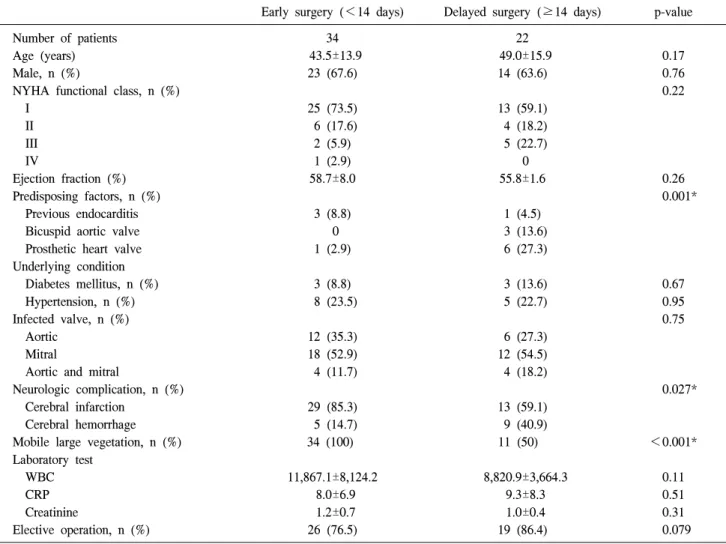
Of the 56 patients, 37 (66.1%) were male; mean age at surgery was 45.7±14.8 years. According to modified Duke criteria, 43 patients (76.8%) had definite and 13 (23.2%) had possible infective endocarditis, with the latter meeting 1 ma- jor and <3 minor criteria. Of these patients, 42 (75.0%) had ischemic and 14 (25.0%) had hemorrhagic events. The base- line characteristics of the patients are shown in Table 1.

Patients in the early group were more likely to have large (>1 cm) mobile vegetation, and were less likely to have un- dergone prosthetic valve implantation and have cerebral hem- orrhage, than those in the delayed group.

2) Preoperative neurological manifestations and mic- roorganisms

Acute embolic infarction was observed in 26 patients, pro- ducing neurologic symptoms of dysarthria (n=6), sensory or motor loss (n=5), drowsiness (n=5), aphasia (n=3), visual loss (n=2), disorientation (n=2), memory impairment (n=1), dizzi- ness (n=1), and syncope (n=1). Eleven patients had acute hemorrhage, presenting with symptoms of drowsiness (n=9), severe headache (n=1), and seizure (n=1). The remaining 19 patients had no symptoms of neurologic complications.

Multiple microemboli occurred in 12 (21.4%) patients, and

intracranial mycotic aneurysms in 3 (5.4%). One patient

(1.8%) had multiple brain abscesses caused by Staphylococ-

(4)

Table 2. Postoperative clinical and imaging evaluation of patient neurologic status

Early surgery

Delayed

surgery p-value Clinical evaluation, n (%)

Improved No change Aggravated

Imaging evaluation, n (%) Number of patients evaluated Better No change Worse

34 26 (76.5%) 4 (11.8%) 4 (11.8%)

18 (52.9%)

5 (27.8%) 7 (38.9%) 6 (33.3%)

22 18 (81.8%)

2 (9.1%) 2 (9.1%)

14 (63.6%)

6 (42.9%) 4 (28.6%) 4 (28.6%)

>0.99

0.742

Fig. 1. Neurologic aggravation-free survival rate.

cus aureus.

Microorganisms responsible for IE included Streptococcus in 20 patients (35.7%), Staphylococcus in 12 (21.4%), the HACEK group in 3 (5.4%, including Haemophilus in 1 and Cardiobacterium in 2), fungus in 1 (1.8%), and others in 5 (8.9%, including Enterococcus in 2, Klebsiella in 1, Brucella in 1, and Gamella in 1). The causative microorganisms could not be determined in 15 patients (26.8%).

3) Perioperative data and operative outcomes

The mean times from onset of acute septic embolic stroke to time of surgery were 3 days (range, 0∼12 days) in the early surgery group and 20 days (range, 14∼69 days) in the delayed surgery group. Aortic cross clamping time (88.2±59.4 min vs 80.0±37.8 min, p=0.568) and cardiopulmonary bypass time (124.6±83.4 min vs 121.8±51.6 min, p=0.891) were similar in the early and delayed groups. Surgical procedures included isolated mitral valve replacement in 22 patients, iso- lated mitral valve repair in 8, isolated aortic valve replace- ment in 15, combined aortic valve replacement and mitral valve replacement in 8, and Bentall operation in 3. There were two early deaths in the early surgery group (3.7%), with one patient dying 11 days after surgery due to a cerebral hemorrhage, and another dying 18 days after surgery due to a cerebral infarction.

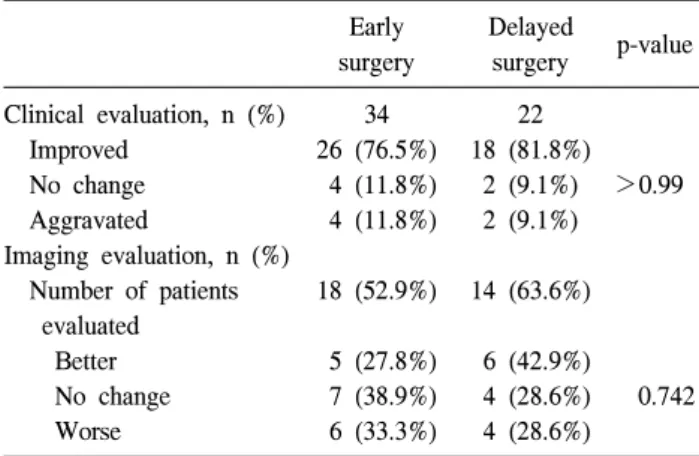
Among the 54 survivors, 4 (7.1%) showed neurologic ag- gravation on clinical evaluations, 2 each in the early and de- layed groups. Follow-up brain imaging was performed in 32

patients (57.1%). Changes in the postoperative neurologic sta- tus at discharge are summarized in Table 2. There were no significant differences in neurologic aggravation between the two groups, either clinically or radiologically.

During a median follow-up of 61.7 months (range, 0.4∼

170.4 months), there were five late deaths, all in the early surgery group. Causes of late deaths were cerebral hemor- rhage in one patient, unknown in one, and non-cardiac-related events in three (one each from a traffic accident, aplastic ane- mia, and common bile duct cancer).

The overall mean 5-year neurologic aggravation-free sur- vival rates were 79.1±7.0% in the early group and 90.9±6.1%

in the delayed group (p=0.113) (Fig. 1).

DISCUSSION

Our results indicated that early and delayed surgical inter- ventions for IE were associated with similar survival and neurologic function in patients with acute septic embolic stroke. Neurologic deterioration was not influenced by the time interval from onset of acute septic embolic stroke to time of surgery. Although two patients in the early operation group died soon after surgery, at 11 and 18 days, the differ- ence between the two groups was not statistically significant.

Most patients with acute embolic stroke completely recovered from their neurologic symptoms without aggravation of neu- rologic imaging status.

Heparin anticoagulation during cardiopulmonary bypass has

(5)

been regarded as at risk for secondary bleeding into ischemic regions, and low-pressure, non-pulsatile blood flow may ac- centuate the development of ischemic edema in the injured brain tissue [9]. After cerebral infarction, autoregulation of blood flow to the infarcted area is lost for 4∼5 weeks.

During this period, tissue perfusion is directly related to blood pressure and even a slight change of blood pressure can result in infarct extension and neurological deterioration [10]. These observations have led to suggestions that cardiac surgery be delayed until after the recovery of cerebral blood flow autoregulation, a period of 2 weeks after an ischemic stroke and 4 weeks after a hemorrhagic stroke [5,6]. Alth- ough there has been some evidence that supports this conven- tional management strategy [11,12], there have been no clin- ical studies to date in support of this delayed strategy for IE in patients with acute stroke [6]. We found that surgical in- tervention within 2 weeks is safe in IE patients with acute septic embolic stroke, and associated with outcomes similar to those of delayed surgery.

Despite advances in antibiotic treatment, this treatment alone cannot prevent the formation of mycotic aneurysms caused by septic emboli and does not decrease the incidence of neurologic complications in the overall IE patient pop- ulation [2,13,14]. Because vegetations of IE are friable, re- moval of a potential source of emboli can prevent embolic stroke [3]. Patients with a vegetation with a diameter greater than 1 cm and high mobility have a significantly higher in- cidence of embolization, so that removal of the septic vegeta- tion by early surgical intervention was effective in decreasing embolization in IE patients with large mobile vegetations [15-17]. However, the optimal timing of surgical intervention in IE patients with acute septic embolic stroke has remained unclear. Although early surgical intervention was previously shown to be safe in 15 IE patients with recent cardiogenic embolic stroke [10], that study population was limited to in- farcted patients and the sample size was small, thus prompt- ing our investigation.

1) Limitations of the study

This study is subject to the limitations inherent to a retro- spective non-randomized study using observational data. The small number of patients included did not allow for adjust-

ments for differences in baseline profiles between the two groups. Therefore, perioperative confounders, procedural bias, and detection bias may have affected our results. Another limitation was that only selected patients underwent follow-up MRI or CT. Prospective randomized studies including larger patient populations are therefore required.

CONCLUSION

Early and delayed surgeries for IE patients with acute em- bolic stroke were associated with similar clinical outcomes, as determined by mortality and neurologic function. Early surgi- cal intervention may be a valuable option for a subset of pa- tients at high risk of life-threatening septic embolism.

REFERENCES

1. Ziment I. Nervous system complications of bacterial endo- carditis. Am J Med 1969;47:593-607.

2. Schold C, Earnest MP. Cerebral hemorrhage from a mycotic aneurysm developing during appropriate antibiotic therapy.

Stroke 1978;9:267-8.

3. Lerner PI. Neurologic complications of infective endocarditis.

Med Clin North Am 1985;69:385-98.

4. Ruttmann E, Willeit J, Ulmer H, et al. Neurological outcome of septic cardioembolic stroke after infective endocarditis.

Stroke 2006;37:2094-9.

5. Matsushita K, Kuriyama Y, Sawada T, et al. Hemorrhagic and ischemic cerebrovascular complications of active infec- tive endocarditis of native valve. Eur Neurol 1993;33:267-74.

6. Eishi K, Kawazoe K, Kuriyama Y, Kitoh Y, Kawashima Y, Omae T. Surgical management of infective endocarditis as- sociated with cerebral complications. Multi-center retrospec- tive study in Japan. J Thorac Cardiovasc Surg 1995;110:

1745-55.

7. Gillinove AM, Shah RV, Curtis WE, et al. Valve replace- ment in patients with endocarditis and neurologic deficit.

Ann Thorac Surg 1996;61:1125-30.

8. David TE. Surgical treatment of aortic valve endocarditis.

In: Cohn LH. Cardiac surgey in the adult. 3rd ed. New York: McGraw-Hill companies, Inc. 2008;949- 55.

9. Kanter MC, Hart RG. Neurologic complications of infective endocarditis. Neurology 1991;41:1015-20.

10. Zisbrod Z, Rose DM, Jacobowitz IJ, Kramer M, Acinapura AJ, Cunningham JN Jr. Results of open heart surgery in pa- tients with recent cardiogenic embolic stroke and central nervous system dysfunction. Circulation 1987;76(suppl V):

S109-12.

(6)

11. Wood MW, Wakim KG, Sayre GP, Millikan CH, Whisnant JP. Relationship between anticoagulants and hemorrhagic cerebral infarctions in experimental animals. Arch Neurol Psychiatry 1958;79:390-6.

12. Giordano JM, Trout HH, Kozloff L, Depalma RG. Timing of carotid artery endarterectomy after stroke. J Vasc Surg 1985;2:250-5.

13. Bayer AS, Bolger AF, Taubert KA, et al. Diagnosis and management of infective endocarditis and its complications.

Circulation 1998;98:2936-48.

14. Molinari GF, Smith L, Goldstein MN, et al. Pathogenesis of

cerebral mycotic aneurysms. Neurology 1973;23:325-32.

15. Kim DH, Kang DH, Lee MZ, et al. Impact of early surgery on embolic events in patients with infective endocarditis.

Circulation 2010;122(suppl I):S17-22.

16. Thuny F, Di Salvo G, Belliard O, et al. Risk of embolism and death in infective endocarditis: prognostic valve of echo- cardiography: a prospective multicenter study. Circulation 2005;112:69-75.

17. Di Salvo G, Habib G, Pergola V, et al. Echocardiography

predicts embolic events in infective endocarditis. J Am Coll

Cardiol 2001;37:1069-76.

수치

Table 1. Baseline characteristics of all patients
Fig. 1. Neurologic aggravation-free survival rate.

참조

관련 문서

Prevention of coronary and stroke events with atorvastatin in hypertensive patients who have average or lower-than-average cholesterol concentrations, in

Comparison of clinical risk factors and distribution of age, sex of patients aged ≧80 years and <80 years... Comparison of the stroke subtype and thrombolysis of

Depending on Tennis Forehand Stroke with elbow pain and without elbow pain Kinematic Analysis of

With the increase of the dental implant procedure, there are many cases of Maxillary Sinus Floor Elevation Surgery(MSFES). Additionally, its side effect has

"Guidelines for the early management of adults with ischemic stroke: a guideline from the American Heart Association/American Stroke Association Stroke

This showed that the surgical outcome was successfulin 269 patients (98.89%),butthe revision surgery due to surgicalrelapse was performed in three patients.Of 152 patients

In addition, if the patients had a high MPV level (cut-off value of 7.95 fL) without low-dose aspirin therapy, they were at risk for ischemic stroke, especially in

The benefits and harms of intravenous thrombolysis with recombinant tissue plasminogen activator within 6 h of acute ischaemic stroke (the third