Journalof theKoreanChem”calSociety 2000,Vol.44,No.5
Pdntedin theRepublicof Kores
Kinetic StHdies on
Wyryldiphenylphosphine
of Hydrolysis of Oxide
Tae Mu Kim*, Gap CheoI Shin+, Sang Yong Pyun*++, and Seek Hee Lee$
Depa~nt oj Chemistry,Korea University,SeouJ 136-701, Korea
‘Department of Chemisby Gyeongsang National Univemiw,Chinju660-701, Ko~a
‘department of ChemisW, Pukyong National University,Pusan 60/-739 kbma
‘Depanwent of Cherkxd Engineering, Pukyong NationalUniversi~,Pusan 608-736, K2nva
@3%iVd h’by 16, 2000)
= Q1. Styryldiphenylphosphine oxide@DPO)Q]7~q *E%%- ~}q~ ~%~ %@w Q + pHoI]~~2 “1+ %+-+=~% +=}$jq. pH~] q=% +=$++ ~=)-, 7~~ @&&+ @?, ~~$j 7] ~ Z]137] ~~ ++~+j ~~~ 2*] & ‘~+ ~.~ ~]flq~ ~]”$=}%q. % pH 4.5 ‘]=~]~j%
phospbine oxide71QI4!!41 %&+7} %7EI c%- %% “W&#OIl W %?7}7}QJo-M 71%%W1- 5J%W
%, pH 4.5-8.0 +++1-+% %+~}~ +-~ +]= 37}7} %~j=)= ~++ %&”] ~?j~]%=, pH 8.0
*I &’w-1% w++= %+=7} +W+ +-W-+ *=I1 WJ~131#+ %2&}.
ABSTRACT. The rate constants for the hydrolysis of styrykiiphenylphosphine oxide(SDPO) were cleter- mined by ultraviolet visible spectrophotometric method and rate equation which can be applied over wide pH ranges was obtained. On the basis of pEMate profiie, hydrolysis product analysis, geneml base catalysis and substituent effec~ a plausible hydrolysis mechanism is proposed: Below pH4.5, thehydrolysis reaction is pro- ceeded by the attack of water to carbocdion after protonation at the oxygen of the phosphine oxide group, and in the pH range of 4.5-8.0,theaddition of water or hydroxide ion occurs competitively. Above pH 8.0, the rate constants are dependent only upon tie concentration of. hydroxide ion.
Journal of the Korean Chemical Socieiy
0.60 -
0.s8 -
a+ ~.= -
E \
k,
0s4 -
\ ●
0.52I !
o 2 4 6 6
Time(xl O’.ssc)
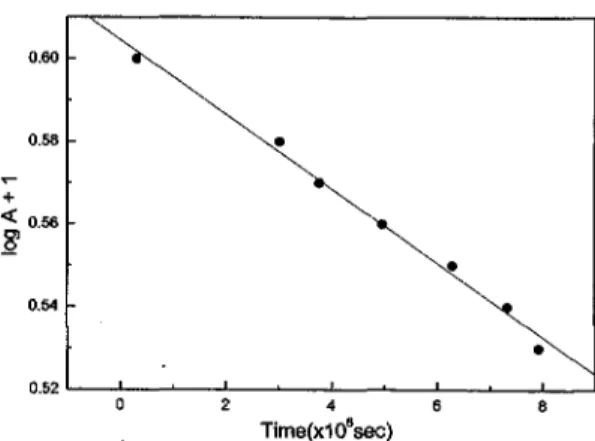
Fig. 1. Plot of log absorbruw vs. time for the hydrolysis of SDPO at pH 4.0 and 25 “C.
01 , t I I , I
o 2 4 6 8 10 12 14
r’l i
Fig. 2. pH-rate profiles for the hydrolysis of SDPO at 25 “C.
CirAes am experimental points and the solid line is drimk according to the eqnation (13).
432 f%$wi”wfw”l wti%”%%w
Zbbk 1. Rate constants for the hydrolysis of SDPO at various pHand25
k,(S&) 10’”
pH Buffer Solution
Observed Calculated 1.0
2.0 3.0 4.0 5.0 6.0 7.0 8.0 9.0 10.0 11.0 12.(I 13.0
,, HOAc+NaOAc
,, ,, KH2P0,+Na2HP0,
,, H,BO,+NaOH
,,
!,
NaOH ,,
3,960 389.3 48.20 10.15 5.613 4.574 4.796 4.533 10.46 57.15 563.1 4.862 42.360
3,576 361.6 40,28 8.145 4.931 4.614 4.621 5.004 8.873 47.56 463.5 4.303 42.990
ok 0.05 O.io O.is 0.20 0.;5 O.io
[Clcl+,coo]
Fig. 3.Et3xt of general base concentration on the rate of hydrolysis of SDFO at pH 2.85 and 25 “C.
J.
5- //
p = 5.24(r=WS9) k
, ,,/, PH = 12.1
4- ,,~ N
,>””
FCH, ,,.--”’
: 3- p+c~,.ti”’ P=4.2W=0.S+W _~DH=3.0
+
*$2- ,,”t i
, .../””’’”-””””,,/,-,,*..,/@i=,o
E ,- ~... ../--”
..,--”- ../’”
,,--i” /’” ~.4.03(raz.gga)
o- ,/””
,,Y ””
,8-1 .-’ , , ,
-0.3 42 -0.1 0.0 01 0.2 0.3
0
4
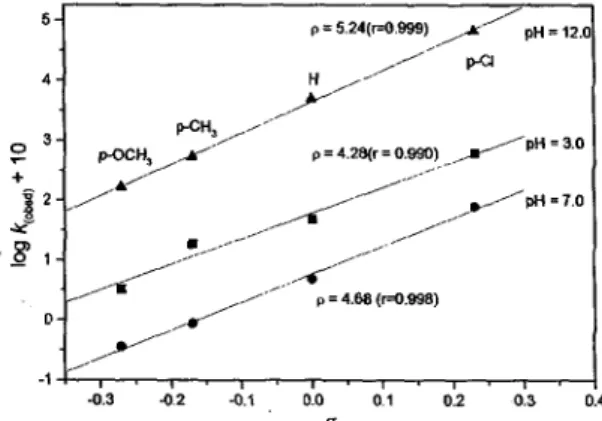
Fig.4.Hanunett plots for the hydrolysis of SDPO derivatives at pH 3.0, 7.0 and 12.0.
Journal
ofthe
Koreau Chemical SocietyScheme 3.
Rate = k[SDPOJ[H20]
= &[SDPO] (8)
kvbld=ko (9)
-FW$3”4%RIR
1. House, H. 0. Modem Synthetic Reactbn.s, 2nd Ed,;
Benjamin, W. A. hrc.: U.S. A,, 1972; p 595.
2. Koelsch. C. F.; Rolfwm, S. T. J. Am. Chenr. Sot. 1950, 72, 1871.
3. Patti, S.; RappeK E. J. Cherrr. Sot. 1%2, 377.
4. Oga@ Y.; Kishi, I. J. Chem. Sot. B1968,703.
5. Tsnru@ T.; F@jio,R. 1 C7reirr.Sot., 1966, 924.
6. (a) Crowell, T. I.; Francis, A. W. J. Am Chem. Sot.
1%1, 83, 591. (b) Cmwell, T. 1.; Kim, T. R. .J. Am.
Chern L!’’OC.1973,95,6781.
7. (a) Kim, T. R.; Huh, T. S. J. Korean Cbn. S’oc.1973, 17, 363. (b) & T. R.; Huh, T. S.; Han, 1. S. ~U~~
Korean Chent SOC.19S2, 3, 162. (c) Kim, T. R.; Choi, S. Y.; Choi, W. S. Bull Korwrr Chern, SOC.19S3Y4,92.
(d) Kim, T. R.; Chung, Y. S.; Chung, M. S. 1 Koran C}rerrr.Sot. 1991,35,268. ~
8. Bailey, W. J.; Buckler, S. A.;Marktscheffel,F. J. Org.
CXenk1960,25, 1996.
9, Colh.s, D. J.; MciIhird, S. A.; Rose, N.; Swan, J. M.
Aust. J. Chern. 1974,27,2365.
‘IO.Collins, D. J.; Rowley, L. E.; Swan, J. M: Ausf. J.
Chem. 1W4, 27,841.
11. Maerkl, G.; Merkl, B. Tetrahedrrm Mt. 1981, 22(45), 4459.
12. Maerkl, G.; Merkl, B. Tetruhxhn hf. 1981,22(45), 4463.
13. Pike, R. M.; Cohere, R. A. .i. Polymer Sci. 1960,.44, 531. (b) Jin, J. I.; Byun, H. S.; Park, Y, M. J. Korr?arr Chem Sot. 1977, 21(3), 219. (c) Jin, J. I.; Shim, H. K.;
be, S. M. J. Kowart Chern Sot. 1982, 26(6), 421. (d) Rabmowitz, R.; Marcus, R.; Pello~ J. J. Polymer Sc~
part A 1964,12, 1241. (e) Ranbinowi~ R. .l Oig.
Chem.1%1,26,5152.
14.Aguiar, A. M.; Daigle, D. J. Otg. Oern 1%5,30,2826.
15.Kim,T. R.; Lee, K, I. Ball. Koreon (%wr. Sot. 1991, 12,273.
16.Caldin,E. T. Fast Reactio~ John Wlely and Sons Inc.
1964; p. 263.
Journal of the Koran ChemicafSociety