© 2012 The Korean Academy of Medical Sciences.
This is an Open Access article distributed under the terms of the Creative Commons Attribution Non-Commercial License (http://creativecommons.org/licenses/by-nc/3.0) which permits unrestricted non-commercial use, distribution, and reproduction in any medium, provided the original work is properly cited.
pISSN 1011-8934 eISSN 1598-6357
Recalcitrant Cutaneous Ulcer of Comorbid Patient Treated with Platelet Rich Plasma: A Case Report
The platelet-rich plasma (PRP) has been advocated as a way to introduce increased concentrations of growth factors and other bioactive molecules to injured tissues in an attempt to optimize the local healing environment. A 94-yr-old woman with various comorbidities presented with a two-week history of severe cutaneous ulcer on the left dorsum of foot. It was caused by recurrent mechanical trauma and did not respond to several wound debridement and simple dressings. However, after she was completed on seven times of autologous PRP treatments, we observed complete healing of the skin lesion within 3 months. Herein, we report a case of recalcitrant cutaneous ulcer with various comorbidities and discuss about the promising possibility of autologous PRP as an effective alternative therapeutic modality.
Key Words: Platelet Rich Plasma (PRP); Refractory Ulcer; Aged; Diabetes Dai Hyun Kim, Jong Yeob Kim,
Soo Hong Seo, Hyo Hyun Ahn, Young Chul Kye, and Jae Eun Choi Department of Dermatology, Korea University College of Medicine, Seoul, Korea
Received: 10 June 2012 Accepted: 22 August 2012 Address for Correspondence:
Jae Eun Choi, MD
Department of Dermatology, Korea University College of Medicine, 73 Inchon-ro, Seongbuk-gu, Seoul 136-705, Korea Tel: +82.2-920-5470, Fax: +82.2-928-7540
E-mail: [email protected]
http://dx.doi.org/10.3346/jkms.2012.27.12.1604 • J Korean Med Sci 2012; 27: 1604-1606
CASE REPORT
Dermatology
INTRODUCTION
In recent years the problem of “cutaneous ulcers” (venous, ar- terial, diabetic, and pressure sores) has become increasingly important, in particular because of the progressive increase in the elderly population and, therefore, of chronic disorders (1).
Chronic cutaneous ulcers of the comorbid elderly patient tend to resist on standard therapy and therefore the management is difficult, time-consuming and expensive (2). Optimally, a short period of advanced therapy to stimulate healing can result in the transition of an intractable wound to a treatable one, which can then be treated with less expensive, standard care (3).
Platelet-rich plasma (PRP) is an autologous preparation of platelets in concentrated plasma and contains various growth factors. Due to the presence of high concentrations of these growth factors, PRP has been used in a wide variety of surgical procedures and clinical treatments (4).
We herein report a comorbid patient with refractory cutane- ous ulcer which did not respond to formal therapeutic methods.
The patient was treated with autologous PRP and could achieve complete response of the skin lesion within 3 months.
CASE DESCRIPTION
On November 25, 2011, a 94 yr-old woman was referred for the management of erythematous to violaceous patches with bul- lae on dorsum of left foot. She repeatedly hit her left foot in which
intravenous line was situated with the opposite side for days. She had a various underlying disease including Alzheimer’s demen- tia, angina pectoris, type 2 diabetes, hypertension, chronic kid- ney disease (stage IV) and was in a bed ridden state. Because of the poor oral intake and noncompliance to the Levin-tube, the percutaneous endoscopic gastrostomy tube had been inserted on her abdomen and only minimal amount of nutrition was maintained.
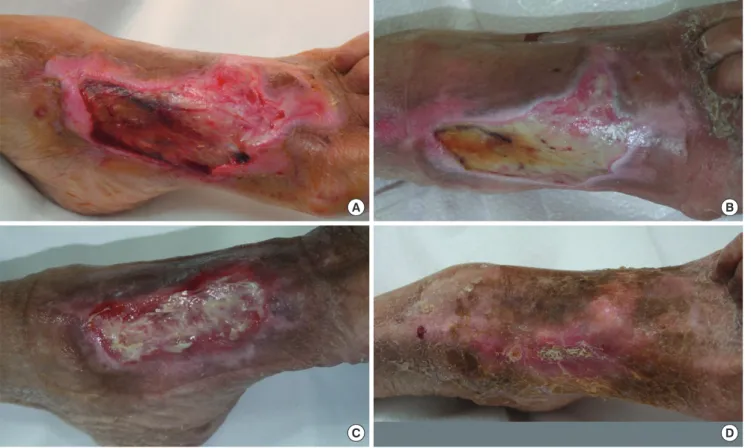
Despite of the daily simple dressing and intermittent debride- ment about 2 weeks, the status of the wound was deteriorated and advanced to painful ulcerative patches with eschar and granulation tissues (Fig. 1A). The results of the bacterial culture and gram stain were negative.
Autologous PRP were prepared for the alternative manage- ment of her worsening wound. 12 mL peripheral autologous blood was obtained and collected into tubes containing acid- citrate-dextrose solution formula (ACD-A) anticoagulant. The citrated blood was centrifuged for 7 min at 2,500 rpm. Subse- quently, the yellow plasma (containing buffy coat with plate- lets) was separated from other components. The upper 3 to 4 mL plasma called platelet poor plasma was removed by micro- pipette. The remnant PRP was extracted by sleeve filter and mixed with CaCl2. Finally, The CaCl2-activated PRP was topical- ly applied to the ulcerative wound.
The patient underwent a total of 7 PRP treatments over a span of 8 weeks (performed twice a week until 5th treatment and then weekly until 7th treatment). As described above, these
Kim DH, et al. • Recalcitrant Cutaneous Ulcer Treated with Platelet Rich Plasma
http://jkms.org 1605
http://dx.doi.org/10.3346/jkms.2012.27.12.1604
treatments involved topically application of activated PRP as well as packing of the wound with aseptic film for the sustained effect of growth factors. The film was removed on next day and the top layer was covered with hydrofoam dressing material until subsequent PRP treatment.
Over the course of the PRP treatment, the wound became noticeably vascularized and filled with granulation tissue. The results of the changes in wound surface area and depth are shown in Fig. 1B-D. The wound was essentially filled in with granulation tissue after seven PRP treatments with only subtle epithelialization of the new tissue remaining. There were nei- ther signs of infection and allergic reaction nor discomfort of the patient during the treatment. After 2 months from the last (7th) treatment, the complete epithelialization was seen and no further simple dressing was required for the wound.
DISCUSSION
The complete response of the recalcitrant cutaneous ulcer us- ing PRP therapies implies that this stimulation therapy could be an appropriate alternative modality when the degree of healing with conventional treatment appears to be unsatisfactory. The ulcer bed more rapidly demonstrated margin in-growth, granu- lation tissue development, vascularization and epithelialization
(5, 8). These regenerative actions of PRP are the result of three main components. First of all, the growth factors and cytokines released from PRP are able to stimulate the proliferation, migra- tion and differentiation of dermal fibroblasts and endothelial cells. PRP also increased type I collagen and MMPs gene expres- sion, suggesting that PRP also have the potential to promote the tissue remodeling of aged skin (4). The second component is the mesh of fibrin that constitutes the “structure” of the platelet gel: this mesh forms a biological scaffold that helps and guides the migration of the mesenchymal cells, derived from popula- tions of resident stem cells or circulating precursors, from the base and the margins of the wound. The third component is the antibacterial properties of the factors released by the platelets and, probably, by the leucocytes contained in the PRP (1).
On the basis of these molecular understandings, PRP therapy has been successfully used in the treatment of various derma- tological defect including pressure ulcer (1, 5), diabetic ulcer (1, 2, 6) vascular ulcers, post-traumatic ulcers (1) and lipoderma- tosclerosis (7). However, a few studies have reported in the treat- ment of severe cutaneous ulcers associated with old age, hypo- mobility and many underlying diseases (2, 9).
This report showed the favorable outcome of the refractory cutaneous ulcer using autologous PRP. Although further stud- ies are required for better understandings of the mechanism,
A B
C D
Fig. 1. Initial presentation and subsequent changes of cutaneous ulcer according to autologous PRP treatments. (A) Painful ulcerative patches with eschar and granulation tis- sues on left dorsum of foot before the 1st PRP treatment on 2011.12.09, (B) at 5th application of PRP on 2011.12.23, (C) at 7th application of PRP on 2012.02.07 and (D) 2 months after the last (7th) PRP on 2012.04.17.
Kim DH, et al. • Recalcitrant Cutaneous Ulcer Treated with Platelet Rich Plasma
1606 http://jkms.org http://dx.doi.org/10.3346/jkms.2012.27.12.1604 efficacy, and safety of autologous PRP therapy, it could be con-
sidered as an effective alternative option for the recalcitrant cu- taneous ulcer with various comorbidities.
REFERENCES
1. Bernuzzi G, Tardito S, Bussolati O, Adorni D, Cantarelli S, Fagnoni F, Rossetti A, Azzarone M, Ficarelli E, Caleffi E, et al. Platelet gel in the treat- ment of cutaneous ulcers: the experience of the immunohaematology and Transfusion Center of Parma. Blood Transfus 2010; 8: 237-47.
2. Orcajo B, Muruzabal F, Isasmendi MC, Gutierrez N, Sanchez M, Orive G, Anitua E. The use of plasma rich in growth factors in the treatment of a severe mal perforant ulcer in the foot of a person with diabetes. Diabetes Res Clin Pract 2011; 93: 65-7.
3. De Leon JM, Driver VR, Fylling CP, Carter MJ, Anderson C, Wilson J, Dougherty RM, Fuston D, Trigilla D, Valenski V, et al. The clinical rele- vance of treating chronic wounds with an enhanced near-physiological concentration of platelet-rich plasma gel. Adv Skin Wound Care 2011;
24: 357-68.
4. Kim DH, Je YJ, Kim CD, Lee YH, Seo YJ, Lee JH, Lee Y. Can platelet-rich plasma be used for skin rejuvenation? Evaluation of effects of platelet-rich plasma on human dermal fibroblast. Ann Dermatol 2011; 23: 424-31.
5. Sell SA, Ericksen JJ, Reis TW, Droste LR, Bhuiyan MB, Gater DR. A case report on the use of sustained release platelet-rich plasma for the treat- ment of chronic pressure ulcers. J Spinal Cord Med 2011; 34: 122-7.
6. Villela DL, Santos VL. Evidence on the use of platelet-rich plasma for di- abetic ulcer: a systemic review. Growth Factors 2010; 28: 111-6.
7. Jeong KH, Shin MK, Kim NI. Refractory lipodermatosclerosis treated with intralesional platelet-rich plasma. J Am Acad Dermatol 2011; 65:
157-8.
8. Pallua N, Wolter T, Markowicz M. Platelet-rich plasma in burns. Burns 2010; 36: 4-8.
9. Greppi N, Mazzucco L, Galetti G, Bona F, Petrillo E, Smacchia C, Ras- pollini E, Cossovich P, Caprioli R, Borzini P, et al. Treatment of recalci- trant ulcers with allogenic platelet gel from pooled platelets in aged hy- pomobile patients. Biologicals 2011; 39: 73-80.