Improving Survival Rate of Patients with In-Hospital Cardiac Arrest: Five Years of Experience in a Single Center in Korea
The aim of this study was to describe the cause of the recent improvement in the outcomes of patients who experienced in-hospital cardiac arrest. We retrospectively analyzed the in- hospital arrest registry of a tertiary care university hospital in Korea between 2005 and 2009. Major changes to the in-hospital resuscitation policies occurred during the study period, which included the requirement of extensive education of basic life support and advanced cardiac life support, the reformation of cardiopulmonary resuscitation (CPR) team with trained physicians, and the activation of a medical emergency team. A total of 958 patients with in-hospital cardiac arrest were enrolled. A significant annual trend in in- hospital survival improvement (odds ratio = 0.77, 95% confidence interval 0.65-0.90) was observed in a multivariate model. The adjusted trend analysis of the return of spontaneous circulation, six-month survival, and survival with minimal neurologic impairment upon discharge and six-months afterward revealed similar results to the original analysis. These trends in outcome improvement throughout the study were apparent in non-ICU (Intensive Care Unit) areas. We report that the in-hospital survival of cardiac arrest patients gradually improved. Multidisciplinary hospital-based efforts that reinforce the Chain of Survival concept may have contributed to this improvement.
Key Words: Cardiopulmonary Resuscitation; Cardiopulmonary Arrest; Advanced Cardiac Life Support
Tae Gun Shin1,2, Ik Joon Jo1, Hyoung Gon Song1, Min Seob Sim1, and Keun Jeong Song1
1Department of Emergency Medicine, Samsung Medical Center, Sungkyunkwan University School of Medicine, Seoul; 2Department of Medicine, Graduate School, Kyung Hee University, Seoul, Korea Received: 26 August 2011
Accepted: 15 November 2011 Address for Correspondence:
Ik Joon Jo, MD
Department of Emergency Medicine, Samsung Medical Center, Sungkyunkwan University School of Medicine, 81 Irwon-ro, Gangnam-gu, Seoul 135-710, Korea
Tel: +82.2-3410-2053, Fax: +82.2-3410-0012 E-mail: [email protected]
http://dx.doi.org/10.3346/jkms.2012.27.2.146 • J Korean Med Sci 2012; 27: 146-152 Cardiovascular Disorders
INTRODUCTION
In-hospital cardiac arrest is a leading cause of morbidity and mortality. Approximately one to five of every 1,000 patients that are admitted to a hospital undergo cardiac arrest, and this con- tributes to the approximate 80% in-hospital mortality rate (1, 2).
Despite this high mortality rate, there have been no significant changes in the in-hospital survival rate for the past several de- cades (3, 4).
Improving survival outcome following in-hospital cardiac arrest can be difficult due to the complexity of pre-arrest to post-resus- citation treatment. The Chain of Survival concept is useful for understanding these complexities (5, 6). The steps of the ‘in-hos- pital chain of survival’ are composed of prevention, calling for help, cardiopulmonary resuscitation (CPR), defibrillation, ad- vanced life support, and post-resuscitation care. Recent studies have reported that several interventions aimed at enhancing the quality of care at each of these steps may improve the outcome of in-hospital arrest (7-12).
To improve the outcome of in-hospital cardiac arrest, we have implemented several interventions such as CPR education, CPR team reformation, and the activation of a medical emergency team (MET). The aim of this study was to assess the changes in
outcome of adult patients who experienced in-hospital cardiac arrest over the past five years. We also attempted to show how the outcomes changed when multidisciplinary hospital-based approaches were implemented.
MATERIALS AND METHODS Patient enrollment criteria
This study was conducted at the Samsung Medical Center, a ter- tiary academic hospital in Seoul, Korea that has 1,951 beds. We retrospectively analyzed a historical data set that was drawn from the in-hospital CPR registry between January 2005 and Decem- ber 2009 according to Utstein-style guidelines (13). Cardiac arrest was defined as the cessation of cardiac mechanical activity as confirmed by lapse in circulation, which was determined by the absence of a palpable central pulse, unresponsiveness, and apnea according to the guidelines mentioned above. Exclusion criteria included patients younger than 15 yr of age and patients who had previously signed a “Do Not Resuscitate” order.
Historic changes in the hospital
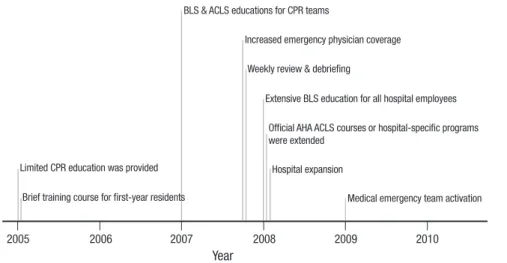
The major changes that occurred in the in-hospital resuscita- tion policies and CPR education programs are summarized in
Fig. 1. Limited CPR education programs were available prior to 2008. Basic life support (BLS) training classes were rarely offered and utilized only one or two manikins for a large number of em- ployees. For the first time in 2005, we began a brief training course for first-year residents that included airway management and CPR algorithms. In 2007, BLS and advanced cardiac life support (ACLS) education were selectively provided to physicians be- longing to CPR teams.
Extensive BLS and ACLS education programs have been of- fered at Samsung Medical Center since 2008. More than 5,000 hospital employees per year (more than 90% of all hospital em- ployees), regardless of job category, completed a 2-hr BLS train- ing course that was based on the 2005 international CPR guide- lines and used the practice-while-watching (PWW) method of instruction (14). The student-to-manikin ratio was between 1:1 and 1:4 in order to ensure that each trainee received an adequate amount of practice.
Simulation ACLS training and team approaches were selec- tively provided for doctors and nurses. Official American Heart Association (AHA) ACLS courses or hospital-specific programs were used for the ACLS education programs. First-year residents from all departments, senior residents, and fellows from the de- partments of Internal Medicine and Surgery, intensivists, cardiol- ogists, and emergency physicians all completed these courses.
ACLS-trained physician coverage was less than 20% prior to 2007. The coverage increased to 50% in 2007 and surpassed 80%
in 2008 and 2009. The CPR teams were reorganized in October of 2007 to increase the emergency physician coverage, especially in the general wards. The in-hospital CPR committee reviewed cases of cardiac arrest on a weekly basis and monitored the ad- equacies of the initial response and performance of the CPR team. Feedback was provided to the initial responders and CPR team members when necessary.
Another alteration in the program was the activation of an MET in 2009. The team consisted of specialists, senior internal medicine residents, and respiratory therapists. The members of
the MET also responded to cardiac arrests as members of the CPR team, especially in the intensive care unit (ICU).
One of the noticeable non-interventional changes was the expansion of the cancer center in January of 2008, in which 699 general ward beds and 21 ICU beds were added.
Outcome measurements
The primary endpoint was in-hospital survival. The secondary endpoints included the return of spontaneous circulation (ROSC), six-month survival, and neurologic status, which were assessed according to the Glasgow-Pittsburgh cerebral performance cat- egories (CPC) score upon discharge and again after six months (15). ROSC was defined as the onset of an organized rhythm with a palpable pulse and a measurable blood pressure for at least 20 min (10). Survival with minimal neurologic impairment was defined as a CPC score ≤ 2. Data was obtained from the reviews of medical records and telephone interviews conducted by re- search nurses.
Statistical analysis
Continuous variables were expressed as the mean ± standard deviation or the median (interquartile range). These variables were compared using the Kruskal-Wallis test, while categorical variables were compared with a chi-square test. Multiple logis- tic regression analysis was used to evaluate the adjusted trends in the outcome variables throughout the five-year study period.
Each year of the study period was converted to a continuous vari- able. In addition to the demographic factors and the CPR vari- ables, the maximal value of the Sequential Organ Failure Assess- ment (SOFA) score in the 24 hr prior to the arrest and the Deyo- Charlson score were used to reflect the burden of comorbidities and to adjust for pre-arrest conditions, respectively (3, 16-18).
Those variables were selected according to previous reports about in-hospital arrest (19, 20). Cox regression analysis was used to estimate the hazard ratio (HR) of the six-month mortality. All values of odds ratio (OR) or HR were shown using modeling mor- Year
Limited CPR education was provided
BLS & ACLS educations for CPR teams
Increased emergency physician coverage Weekly review & debriefing
Extensive BLS education for all hospital employees Official AHA ACLS courses or hospital-specific programs were extended
Hospital expansion
Medical emergency team activation Brief training course for first-year residents
2005 2006 2007 2008 2009 2010
Fig. 1. Major changes in the in-hospital resuscitation policies and CPR education programs. CPR, cardiopul- monary resuscitation; BLS, basic life support; ACLS, advanced cardiac life support; AHA, American Heart Association.
tality, significant neurologic deficit, or failure to achieve ROSC.
Version 11.0 of the Stata software was used to perform the statis- tical analyses, and two-tailed P values < 0.05 were considered to be significant.
Ethics statement
The study was approved by the institutional review board of Sam- sung Medical Center (IRB No. 2011-01-023). Informed consent was waived because of the retrospective nature of the study.
RESULTS
Characteristics of the study sample
A total of 1,185 in-hospital cardiac arrests occurred during the study period. Of these patients, 227 were excluded from the study because they were younger than 15 yr of age (n = 196), had signed a “Do Not Resuscitate” order (n = 27), or data on the patient was insufficient (n = 4). Ultimately, there were a total of 958 patients in the study population. The baseline characteristics and the
comparative results throughout the five year study period are shown in Table 1. There were no significant differences except for the location of arrest.
Annual changes
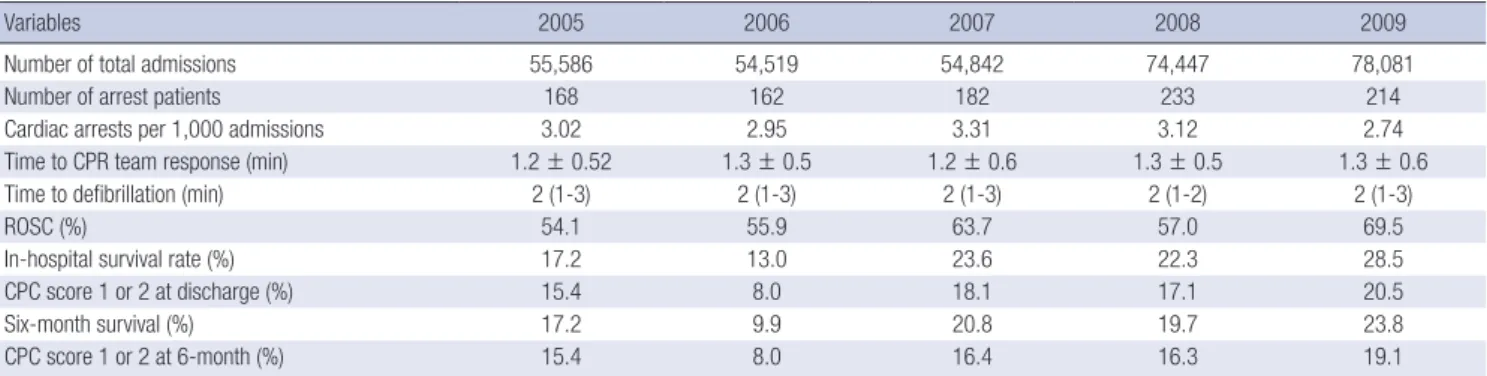
The total number of admissions had noticeably increased in 2008 (Table 2). On the other hand, the occurrence of cardiac arrests per 1,000 admissions slightly decreased beginning in 2007, al- though this decrease was not statistically significant. There was no significant difference in the time interval from the time of arrest or the time at which the CPR team responded and per- formed defibrillation.
In terms of the outcome variables, there was a gradual trend of improvement between the years of 2005 and 2009. The sur- vival rate was lowest in 2006 and highest in 2009. We also com- pared the survival rates according to the location of arrest, which revealed significant differences in the incidence (Fig. 2). The improvement in survival was prominent in the general ward, the outpatient department, radiologic examination rooms, and
Table 1. Baseline clinical characteristics and cardiopulmonary resuscitation variables throughout the five year study period
Variables 2005 (n = 168) 2006 (n = 161) 2007 (n = 182) 2008 (n = 233) 2009 (n = 213) P
Age (yr) 59.1 ± 17.3
63 (48-73)
58.8 ± 16.2 62 (50-70)
59.1 ± 15.9 61 (49-71)
59.6 ± 15.3 60 (49-71)
59.4 ± 15.7 62 (49-71)
0.98
Male gender 100 (59.5) 92 (57.1) 112 (61.5) 144 (61.8) 122 (57.2) 0.80
Comorbidity Diabetes Hypertension Cardiovascular disease Stroke
Chronic renal disease Pulmonary insufficiency Chronic hepatic disease Malignancy
43 (25.6) 58 (34.5) 61 (36.3) 13 (7.7) 14 (8.3) 10 (5.9) 29 (17.2) 59 (35.1)
44 (27.3) 54 (33.5) 56 (34.7) 19 (11.8) 15 (9.3) 16 (9.9) 28 (17.3) 57 (35.4)
37 (20.3) 48 (26.3) 71 (39.0) 8 (4.4) 14 (7.6) 14 (7.6) 38 (20.8) 72 (39.5)
62 (26.6) 69 (29.6) 71 (30.4) 20 (8.5) 33 (14.1) 26 (11.1) 35 (15.0) 89 (38.2)
43 (20.1) 61 (28.5) 72 (33.6) 14 (6.5) 21 (9.8) 23 (10.7) 29 (13.5) 85 (39.7)
0.26 0.41 0.45 0.12 0.19 0.36 0.35 0.82 Cause of arrest
Presumed cardiac Respiratory Hypovolemic Septic Others
83 (49.4) 30 (17.8) 18 (10.7) 31 (18.4) 6 (3.5)
81 (50.3) 27 (16.7) 17 (10.5) 28 (17.3) 8 (4.9)
87 (47.8) 46 (25.2) 15 (8.2) 26 (14.2)
8 (4.4)
122 (52.3) 32 (13.7) 18 (7.7) 45 (19.3)
16 (6.8)
96 (44.8) 42 (19.6) 22 (10.2) 43 (20.1) 11 (5.1)
0.49
Illness category Cardiac Surgical
Shockable initial rhythm
52 (30.9) 33 (19.6) 26 (15.4)
44 (27.3) 33 (20.5) 29 (18.0)
65 (35.7) 39 (21.4) 32 (17.5)
61 (26.1) 55 (23.6) 40 (17.1)
76 (35.5) 51 (23.8) 35 (16.3)
0.11 0.81 0.97 Location of arrest
Ward/other area Emergency department ICU/OR/Cath lab
57 (33.9) 51 (30.3) 60 (35.7)
57 (35.4) 51 (31.6) 53 (32.9)
58 (31.8) 51 (28.0) 73 (40.1)
93 (39.9) 38 (16.3) 102 (43.7)
79 (36.9) 31 (15.0) 104 (48.6)
< 0.001
Witnessed or monitored 161 (95.8) 156 (96.8) 180 (98.9) 226 (97.0) 205 (95.7) 0.42
Time period 11PM-7AM
Weekend 44 (26.1)
48 (28.5) 58 (36.0)
37 (22.9) 53 (29.1)
49 (26.9) 63 (27.0)
56 (24.0) 75 (35.0)
50 (23.3) 0.12
0.68
Use of PCPS 15 (8.9) 15 (9.3) 18 (9.8) 26 (11.1) 18 (8.4) 0.89
CPR duration (min) 26.6 ± 25.5
20 (8-37)
30.5 ± 30.6 21 (8-40)
27.4 ± 27.0 20 (7-40)
27.4 ± 29.4 20 (9-35)
22.4 ± 20.0 15 (8-35)
0.39
Pre-arrest SOFA score 7 (4-10) 7 (5-10) 8 (5-11) 7 (4-11) 7 (4-11) 0.58
Deyo - Charlson score 2 (1-5) 2 (1-4) 2 (1-4) 2 (1-5) 3 (1-5) 0.19
Data is shown as mean ± SD, median (interquartile range) or No. (%). ICU, intensive care unit; OR, operating room; Cath lab, catheterization laboratory; PCPS, percutaneous cardiopulmonary support; CPR, cardiopulmonary resuscitation; SOFA, Sequential Organ Failure Assessment.
public spaces throughout the hospital.
Multivariate analysis
The multivariate regression model that was used to evaluate the factors associated with in-hospital mortality is presented in Table 3. The model showed that the annual trend of improvement in in-hospital survival was significant (odds ratio of mortality = 0.77, 95% confidence interval 0.65-0.90). Other factors associat- ed with survival were shockable rhythm, surgical illness catego- ry, and the use of percutaneous cardiopulmonary support. Pre- dictors for mortality were age, CPR duration, cause of arrest (sep- tic cause), Deyo-Charlson score, and pre-arrest SOFA score.
Adjusted odds ratios or hazard ratios for the secondary end- points, which were derived from the additional multivariate mod- els using the same variables, are also shown in Table 4. The re- sults are similar to those obtained from the original analysis.
DISCUSSION
The survival rate of patients with in-hospital cardiac arrest has been unchanged for the past several decades (3, 4, 21). However, we have recently experienced a significant improvement in the
outcomes of in-hospital arrest victims between the years of 2005 and 2009. In this report, we attempted to identify the historical- ly implemented multidisciplinary efforts that resulted in these improvements. Major changes that occurred were the addition of extensive BLS and ACLS education programs, CPR team ref- ormation with trained physicians, and the activation of an MET.
Another non-interventional change was the expansion of the hospital.
Improving survival after in-hospital cardiac arrest requires an integrated set of coordinated actions that are described by the “Chain of Survival.” (22) Therefore, multifaceted efforts that reinforce the Chain of Survival could potentially show a syner- gistic effect compared to that of a single method of intervention.
Table 2. Annual changes in cardiac arrests per 1,000 admissions, response time, and outcome variables
Variables 2005 2006 2007 2008 2009
Number of total admissions 55,586 54,519 54,842 74,447 78,081
Number of arrest patients 168 162 182 233 214
Cardiac arrests per 1,000 admissions 3.02 2.95 3.31 3.12 2.74
Time to CPR team response (min) 1.2 ± 0.52 1.3 ± 0.5 1.2 ± 0.6 1.3 ± 0.5 1.3 ± 0.6
Time to defibrillation (min) 2 (1-3) 2 (1-3) 2 (1-3) 2 (1-2) 2 (1-3)
ROSC (%) 54.1 55.9 63.7 57.0 69.5
In-hospital survival rate (%) 17.2 13.0 23.6 22.3 28.5
CPC score 1 or 2 at discharge (%) 15.4 8.0 18.1 17.1 20.5
Six-month survival (%) 17.2 9.9 20.8 19.7 23.8
CPC score 1 or 2 at 6-month (%) 15.4 8.0 16.4 16.3 19.1
Data is shown as mean ± SD, median (interquartile range) or No. (%). CPR, cardiopulmonary resuscitation; ROSC, return of spontaneous circulation; CPC, cerebral-performance categories.
In-hospital survival (%)
General wards/others Emergency department ICU/OR/Cath lab 50
40
30
20
10
0
17.5 8.7
25.8 26.8 36.7
11.7 15.6 15.6
23.6
19.3 21.6
2005 2006 2007 2008 2009
15.0 27.4
17.6 25.0
Fig. 2. Annual changes in the in-hospital survival rate according to the location of arrest. ICU, intensive care unit; OR, operating room; Cath lab, catheterization labora- tory.
Table 3. Multivariate analysis of predictors of in-hospital survival
Variables Odds ratio* 95% CI P
Age 1.02 1.01-1.03 0.01
Sex (male) 0.84 0.54-1.32 0.45
Diabetes 0.87 0.49-1.54 0.63
Hypertension 1.05 0.64-1.73 0.84
Renal failure 0.63 0.28-1.42 0.26
Malignancy 1.04 0.51-2.14 0.91
Heart disease 0.84 0.39-1.82 0.65
Chronic hepatic disease 0.69 0.38-1.28 0.24
Lung insufficiency 2.14 0.95-4.78 0.06
Previous stroke 0.52 0.25-1.10 0.08
Deyo - Charlson score 1.20 1.03-1.39 0.02
Illness category (cardiac) 1.23 0.65-2.30 0.52
Illness category (surgical) 0.44 0.26-0.75 0.003
Time period (night) 1.11 0.68-1.82 0.67
Weekend 1.10 0.65-1.83 0.72
Witnessed or monitored 0.61 0.13-2.98 0.54
Cause of arrest (sepsis) 5.22 1.72-15.92 0.004
Location of arrest (ICU) 0.85 0.51-1.43 0.54
Shockable rhythm 0.40 0.23-0.68 0.001
CPR duration 1.14 1.11-1.17 < 0.001
Use of PCPS 0.11 0.05-0.27 < 0.001
Pre-arrest SOFA score 1.26 1.17-1.35 < 0.001
Time trend (yr) 0.77 0.66-0.90 0.001
*Modeled for mortality. CI, confidence interval; ICU, intensive care unit; CPR, cardio- pulmonary resuscitation; PCPS, percutaneous cardiopulmonary support; SOFA, Sequen- tial Organ Failure Assessment.
Strengthening these procedures to maximize survival outcome also requires effective resuscitation education and the imple- mentation of high quality treatment (22, 23).
The quality of the CPR procedure has been shown to affect post-cardiac arrest survival rates, and effective CPR training is particularly vital in maintaining that high quality (22-25). Our BLS education program emphasized chest compressions, mini- mal interruptions, and the importance of avoiding hyperventi- lation in order to enhance the quality of the CPR procedure. We hypothesize that these changes played key roles in improving the outcomes of cardiac arrests, although we were unable to di- rectly compare the quality of CPR among performers. Further studies are needed to examine the effects of these changes on implementation and skill retention.
Increases in the number of ACLS-trained team members pres- ent at in-hospital resuscitation training efforts might increase the survival rate following cardiac arrest (7, 26). ACLS training improves the resuscitation skills, knowledge, and performance of CPR teams. ACLS education is also thought to play a benefi- cial role in cardiac arrest prevention according to a study indi- cating that the introduction of a simple and widespread educa- tional program was associated with reductions in both the num- ber of in-hospital cardiac arrests and unsuccessful cardiopul- monary resuscitation attempts (8).
The MET, which is a well-known tool for cardiac arrest as the first link in the Chain of Survival, was introduced to our hospital in January 2009 (1, 5, 6, 12). It was shown to have a positive ef- fect in a previously published prospective, historically controlled study from our hospital. The presence of an MET decreased the incidence of cardiac arrest in the general wards and the ICU- dearranged time, which is the time interval between the initial physiologic derangement that meets the MET activation crite- ria and ICU admission (27). While we were unable to fully eval- uate the effects of MET activation, we hypothesize that the MET positively affected the trend of decreasing cardiac arrest events in 2009.
The locations of the general wards and the emergency depart- ment (ED) are known to be associated with the worst outcomes (19). In addition, overall ED overcrowding has been aggravated
even though the length of stay in the ED has decreased through hospital expansion. Therefore, we were encouraged by the im- provements in survival observed in both the general wards and the ED.
On the other hand, the increasing numbers of admissions into the ICU might affect the improvement in survival in our study because ICU admission is a known predictor for survival in in- hospital arrest patients. A possible explanation for these results is the more timely ICU admission of a patient from a non-ICU area prior to deterioration. Other important contributing factors might include early recognition and transfer of critically ill pa- tients to the ICU and the availability of ICU beds. The increased availability of ICU beds due to hospital expansion was thought be especially associated with the decreasing number of arrests in the emergency department.
The ROSC and survival rates in 2007 were the second highest among the years studied. This may indicate that other changes had taken place or a high natural yearly variability. For example, a previous report from a single center showed a very high vari- ability that ranged from 25% to 45% (28). In our study, we iden- tified relatively clear time trends using multivariate models. We also determined that the number of trained physicians and their coverage began to increase by selective education in 2007.
Therapeutic hypothermia, which has an important role in post-arrest care, is one of the principal treatment modalities in patients with cardiac arrest. However, it has not been accepted as a standard treatment for in-hospital arrest at our hospital and has been applied in only four cases since 2007. The potential syn- ergistic effect of hypothermia with our implementations requires further study.
Our study has several limitations due to the fact that it is a sin- gle-center, retrospective, nonrandomized, observational study.
First, we were unable to identify which interventions were di- rectly associated with improvements in survival. We did not com- pare prospective data or the objective measurements with the quality of CPR as measured by the chest compression rate, hy- perventilation, and the rate of the first responder CPR. The in- terventions were individually implemented. Second, we were unable to fully adjust for the effects of the changes in the overall Table 4. Multivariate analysis of predictors of secondary outcome variables
Variables Odds ratio or
hazard ratio* 95% CI P
Multivariate logistic regression model of predictors of ROSC†
Time trend (yr) 0.84 0.74-0.95 0.006
Multivariate logistic regression model of predictors of in-hospital survival with minimal neurologic impairment†
Time trend (yr) 0.84 0.72-1.00 0.05
Cox regression model of predictors of six-month survival†
Time trend (yr) 0.93 0.88-0.98 0.006
Cox regression model of predictors of six-month survival with minimal neurologic impairment†
Time trend (yr) 0.94 0.90-0.99 0.035
*Modeled for mortality, significant neurologic deficit or failure to achieve ROSC; †Adjusted with all covariates in the model for in-hospital survival. CI, confidence interval; ROSC, return of spontaneous circulation.
case mixture, staffing, or hospital environment. Hidden biases may remain, although our statistical approach should have re- duced these levels. Finally, there was great variability in the base- line hospital characteristics and survival within different areas (29, 30). The results of this study may not be applicable to other hospitals in other regions since our study was based on the data from a single tertiary teaching hospital in Korea. We believe that a locally implemented strong in-hospital chain of survival, which is customizable to specific requirements, is probably the best way to improve outcomes in individual hospitals (29).
We report that the in-hospital survival of cardiac arrest pa- tients gradually improved between the years of 2005 and 2009, especially in non-ICU areas of the hospital. Multidisciplinary hospital-based efforts that reinforce the concepts of Chain of Survival may have contributed to the improvement in survival of cardiac arrest patients.
ACKNOWLEDGMENTS
We thank In Jung Woo and Kyongnam Yoo, charge nurses from the Office of CPR Operations and Training, for managing the BLS and ACLS training programs. We also thank Hee Kyoung Choi, a research nurse working in the emergency department, for his assistance in data collection. We appreciate the excellent educational support of Aerin Yoon, a charge nurse at the Clini- cal Simulation Center.
REFERENCES
1. Sandroni C, Nolan J, Cavallaro F, Antonelli M. In-hospital cardiac arrest:
incidence, prognosis and possible measures to improve survival. Inten- sive Care Med 2007; 33: 237-45.
2. Thom T, Haase N, Rosamond W, Howard VJ, Rumsfeld J, Manolio T, Zheng ZJ, Flegal K, O’Donnell C, Kittner S, Lloyd-Jones D, Goff DC Jr, Hong Y, Adams R, Friday G, Furie K, Gorelick P, Kissela B, Marler J, Meigs J, Roger V, Sidney S, Sorlie P, Steinberger J, Wasserthiel-Smoller S, Wilson M, Wolf P; American Heart Association Statistics Committee and Stroke Statistics Subcommittee. Heart disease and stroke statistics:
2006 update: a report from the American Heart Association Statistics Committee and Stroke Statistics Subcommittee. Circulation 2006; 113:
e85-151.
3. Ehlenbach WJ, Barnato AE, Curtis JR, Kreuter W, Koepsell TD, Deyo RA, Stapleton RD. Epidemiologic study of in-hospital cardiopulmonary resuscitation in the elderly. N Engl J Med 2009; 361: 22-31.
4. Bloom HL, Shukrullah I, Cuellar JR, Lloyd MS, Dudley SC Jr, Zafari AM.
Long-term survival after successful inhospital cardiac arrest resuscita- tion. Am Heart J 2007; 153: 831-6.
5. Perkins GD, Soar J. In hospital cardiac arrest: missing links in the chain of survival. Resuscitation 2005; 66: 253-5.
6. Smith GB. In-hospital cardiac arrest: is it time for an in-hospital ‘chain of prevention’? Resuscitation 2010; 81: 1209-11.
7. Moretti MA, Cesar LA, Nusbacher A, Kern KB, Timerman S, Ramires JA. Advanced cardiac life support training improves long-term survival
from in-hospital cardiac arrest. Resuscitation 2007; 72: 458-65.
8. Spearpoint KG, Gruber PC, Brett SJ. Impact of the Immediate Life Sup- port course on the incidence and outcome of in-hospital cardiac arrest calls: an observational study over 6 years. Resuscitation 2009; 80: 638-43.
9. Thigpen K, Davis SP, Basol R, Lange P, Jain SS, Olsen JD, Erickson BR, Schuchard TN, Aufderheide TP. Implementing the 2005 American Heart Association guidelines, including use of the impedance threshold device, improves hospital discharge rate after in-hospital cardiac arrest. Respir Care 2010; 55: 1014-9.
10. Edelson DP, Litzinger B, Arora V, Walsh D, Kim S, Lauderdale DS, Van- den Hoek TL, Becker LB, Abella BS. Improving in-hospital cardiac arrest process and outcomes with performance debriefing. Arch Intern Med 2008; 168: 1063-9.
11. Sandroni C, Ferro G, Santangelo S, Tortora F, Mistura L, Cavallaro F, Car- icato A, Antonelli M. In-hospital cardiac arrest: survival depends mainly on the effectiveness of the emergency response. Resuscitation 2004; 62:
291-7.
12. Konrad D, Jäderling G, Bell M, Granath F, Ekbom A, Martling CR. Re- ducing in-hospital cardiac arrests and hospital mortality by introducing a medical emergency team. Intensive Care Med 2010; 36: 100-6.
13. Jacobs I, Nadkarni V, Bahr J, Berg RA, Billi JE, Bossaert L, Cassan P, Coovadia A, D’Este K, Finn J, Halperin H, Handley A, Herlitz J, Hickey R, Idris A, Kloeck W, Larkin GL, Mancini ME, Mason P, Mears G, Mon- sieurs K, Montgomery W, Morley P, Nichol G, Nolan J, Okada K, Perl- man J, Shuster M, Steen PA, Sterz F, Tibballs J, Timerman S, Truitt T, Zideman D; International Liaison Committee on Resuscitation; Ameri- can Heart Association; European Resuscitation Council; Australian Re- suscitation Council; New Zealand Resuscitation Council; Heart and Stroke Foundation of Canada; InterAmerican Heart Foundation; Re- suscitation Councils of Southern Africa; ILCOR Task Force on Cardiac Arrest and Cardiopulmonary Resuscitation Outcomes. Cardiac arrest and cardiopulmonary resuscitation outcome reports: update and sim- plification of the Utstein templates for resuscitation registries: a state- ment for healthcare professionals from a task force of the International Liaison Committee on Resuscitation (American Heart Association, Eu- ropean Resuscitation Council, Australian Resuscitation Council, New Zealand Resuscitation Council, Heart and Stroke Foundation of Cana- da, InterAmerican Heart Foundation, Resuscitation Councils of South- ern Africa). Circulation 2004; 110: 3385-97.
14. International Liaison Committee on Resuscitation. 2005 International Consensus on Cardiopulmonary Resuscitation and Emergency Cardio- vascular Care Science with Treatment Recommendations. Part 8: Inter- disciplinary topics. Resuscitation 2005; 67: 305-14.
15. Prohl J, Röther J, Kluge S, de Heer G, Liepert J, Bodenburg S, Pawlik K, Kreymann G. Prediction of short-term and long-term outcomes after cardiac arrest: a prospective multivariate approach combining biochem- ical, clinical, electrophysiological, and neuropsychological investigations.
Crit Care Med 2007; 35: 1230-7.
16. Deyo RA, Cherkin DC, Ciol MA. Adapting a clinical comorbidity index for use with ICD-9-CM administrative databases. J Clin Epidemiol 1992;
45: 613-9.
17. Ferreira FL, Bota DP, Bross A, Mélot C, Vincent JL. Serial evaluation of the SOFA score to predict outcome in critically ill patients. JAMA 2001;
286: 1754-8.
18. Vincent JL , de Mendonça A, Cantraine F, Moreno R, Takala J, Suter PM,
Sprung CL, Colardyn F, Blecher S. Use of the SOFA score to assess the in- cidence of organ dysfunction/failure in intensive care units: results of a multicenter, prospective study. Working group on “sepsis-related prob- lems” of the European Society of Intensive Care Medicine. Crit Care Med 1998; 26: 1793-800.
19. Larkin GL, Copes WS, Nathanson BH, Kaye W. Pre-resuscitation factors associated with mortality in 49,130 cases of in-hospital cardiac arrest: a report from the National Registry for Cardiopulmonary Resuscitation.
Resuscitation 2010; 81: 302-11.
20. Shin TG, Choi JH, Jo IJ, Sim MS, Song HG, Jeong YK, Song YB, Hahn JY, Choi SH, Gwon HC, Jeon ES, Sung K, Kim WS, Lee YT. Extracorporeal cardiopulmonary resuscitation in patients with inhospital cardiac arrest:
a comparison with conventional cardiopulmonary resuscitation. Crit Care Med 2011; 39: 1-7.
21. Tian J, Kaufman DA, Zarich S, Chan PS, Ong P, Amoateng-Adjepong Y, Manthous CA; American Heart Association National Registry for car- diopulmonary Resuscitation Investigators. Outcomes of critically ill pa- tients who received cardiopulmonary resuscitation. Am J Respir Crit Care Med 2010; 182: 501-6.
22. Bhanji F, Mancini ME, Sinz E, Rodgers DL, McNeil MA, Hoadley TA, Meeks RA, Hamilton MF, Meaney PA, Hunt EA, Nadkarni VM, Hazinski MF. Part 16: education, implementation, and teams: 2010 American Heart Association Guidelines for Cardiopulmonary Resuscitation and Emergency Cardiovascular Care. Circulation 2010; 122: S920-33.
23. Soar J, Monsieurs KG, Ballance JH, Barelli A, Biarent D, Greif R, Hand- ley AJ, Lockey AS, Richmond S, Ringsted C, Wyllie JP, Nolan JP, Perkins GD. European Resuscitation Council Guidelines for Resuscitation 2010
Section 9. Principles of education in resuscitation. Resuscitation 2010;
81: 1434-44.
24. Chamberlain DA, Hazinski MF; European Resuscitation Council; Amer- ican Heart Association; Heart and Stroke Foundation of Canada; Aus- tralia and New Zealand Resuscitation Council; Resuscitation Council of Southern Africa; Consejo Latino-Americano de Resuscitación. Edu- cation in resuscitation. Resuscitation 2003; 59: 11-43.
25. Abella BS, Alvarado JP, Myklebust H, Edelson DP, Barry A, O’Hearn N, Vanden Hoek TL, Becker LB. Quality of cardiopulmonary resuscitation during in-hospital cardiac arrest. JAMA 2005; 293: 305-10.
26. Dane FC, Russell-Lindgren KS, Parish DC, Durham MD, Brown TD. In- hospital resuscitation: association between ACLS training and survival to discharge. Resuscitation 2000; 47: 83-7.
27. Lim SY, Park SY, Park HK, Kim M, Park HY, Lee B, Lee JH, Jung EJ, Jeon K, Park CM, Ko MG, Park MR, Nam JM, Won SY, Jung JH, Cho SH, Suh GY.
Early impact of medical emergency team implementation in a country with limited medical resources: a before-and-after study. J Crit Care 2011;
26: 373-8.
28. Fredriksson M, Aune S, Thorén AB, Herlitz J. In-hospital cardiac arrest:
an Utstein style report of seven years experience from the Sahlgrenska University Hospital. Resuscitation 2006; 68: 351-8.
29. Skrifvars MB, Castrén M, Aune S, Thoren AB, Nurmi J, Herlitz J. Variabil- ity in survival after in-hospital cardiac arrest depending on the hospital level of care. Resuscitation 2007; 73: 73-81.
30. Carr BG, Kahn JM, Merchant RM, Kramer AA, Neumar RW. Inter-hos- pital variability in post-cardiac arrest mortality. Resuscitation 2009; 80:
30-4.