인공광 이용형 Common Ice Plant 식물공장의 실용적 설계
차미경1·김주성1,2,3·신종화4·손정익4·조영열2,3,5*
1제주대학교 식물자원환경전공, 2제주대학교 아열대농업생명과학연구소, 3제주대학교 친환경농업연구소, 4서울대학교 식물 생산과학부, 5제주대학교 원예환경전공
Practical Design of an Artificial Light-Used Plant Factory for Common Ice Plant ( Mesembryanthemum crystallinum L.)
Mi-Kyung Cha1, Ju-Sung Kim1,2,3, Jong Hwa Shin4, Jung Eek Son4, and Young Yeol Cho2,3,5*
1Major in Plant Resources and Environment, Jeju National Univ., Jeju 690-756, Korea
2Research Institute for Subtropical Agriculture and Animal Biotechnology, Jeju National Univ., Jeju 690-756, Korea
3Sustainable Agriculture Research Institute, Jeju National Univ., Jeju 690-756, Korea
4Dept. of Plant Science, Seoul National Univ., Seoul 151-921, Korea
5Major in Horticultural Science, Jeju National Univ., Jeju 690-756, Korea
Abstract. This study was carried out to get the basic data to practically design an artificial light-used plant factory system for common ice plant (Mesembryanthemum crystallinum L.) cultivation. The adequate range of light intensity was 120- 200µmol·m−2·s−1 and the carbon fixed rates was 0.84nmol CO2·cm−2·s−1. When the planting density, light intensity, and yield were 0.0225m2 (15×15cm), 200µmol·m−2·s−1, and 1,000 plants per day, the total number of the plants, cultivated area, and total light intensities were estimated as 25,000 plants, 563m2, and 140,625µmol·s−1, respectively. About 153.2kW with 2,785 fluorescent lights (FL) needed for the electric power and the electricity charges was 2.46 million won for one month. At a harvest rate of 1,000 plants per day in closed-type plant factory, the light installation cost, total installation cost, and total pro- duction cost were 27.85, 83.56, and 100.27 million won, respectively. The production cost per plant including labor cost was calculated as 370 won, providing that the cultivation period was 25 days and marketable ratio was 80%. Considering the annual total expenses, incomes, and depreciation cost, the sales cost per plant could be estimated around 970 won or higher.
Additional key words : electric charge, fluorescent lamp, installation expense, light intensity, production expense
서 론
식물공장에서는 최적의 환경조건으로 식물을 연중 계 획적인 생산이 가능하다. 식물공장은 인공광 이용형과 자연광 이용형으로 구분되며, 완전제어 형태인 인공광 이용형 식물공장은 자연광 이용형에 비하여 안정된 재배 환경을 유지할 수 있으며 생육 예측이 용이한 장점이 있 다(Cha 등, 2014). 그러나 인공광 이용형 식물공장은 설 비 비용과 전력비용이 많이 소요되어 채산성 확보가 가 장 중요하기 때문에, 고부가가치 작물, 저에너지 작물 및 기능성 작물 등과 같은 작물의 선발이 필요하다. 특히, common ice plant(Mesembryanthemum crystallinum L.)는 고부가가치와 기능성 작물로 알려지면서(Agarie 등, 2009), 최적의 환경조건을 갖춘 인공광 이용형 식물공장
에서 생산하기 위한 연구들이 일본 및 국내에서 많이 시도되고 있다.
국내에서 식물공장에 관한 연구들로는 자동화(Seo 등, 2011), 광(Cha 등, 2012; Kim과 You 2013; Kim 등, 2013; Um 등, 2010), 수경재배(Cha 등, 2012), 작물선발 (Um 등, 2010) 및 품질관리(Kim과 You, 2013; Kim 등, 2013) 기술 등이 있으며, 작물 재배를 위한 최적화된 연 구 결과를 바탕으로 인공광 이용형 식물공장을 설계하게 된다. 이 때 고려해야 할 중요한 항목으로는 경제성 분 석이 있다. 경제성 분석을 하기 위해 중요한 항목으로는 경제적인 작물 선발, 광원에 따른 광도 확보, 광원과 광 도에 따른 전력 비용, 상품화율을 고려한 생산량, 관리 비용 및 1주당 판매비용을 고려할 필요가 있다.
본 연구는 인공광 이용형 common ice plant 식물공장 의 실용적 설계를 위하여, 작물의 광합성 곡선을 추정하 고, 생육모델을 이용하여 수확시기를 예측하여, 수확일수 와 상품수량 및 관리 비용에 따른 경제성을 분석하였다.
*Corresponding author: [email protected]
*Received October 20, 2014; Revised November 19, 2014;
*Accepted December 9, 2014
재료 및 방법
1. 광합성 곡선과 생장 모델
광합성 곡선은 광합성 측정기(LI-6400, Li-cor, Lincoln, Nebraska, USA)를 이용하여 28개체를 측정하였다. 광합 성 곡선은 asymptotic exponential 등식(Goudriaan과 Van Laar, 1994)을 사용하여 구하였다.
Pn= Pmax×(1 − exp(−α × PAR/Pmax))−R (1) 여기서, Pn은 광합성량(µmol CO2·m−2·s−1), Pmax는 최대 광합성량(µmol CO2·m−2·s−1), α는 직선의 시작기울기, PAR는 광도(µmol·m−2·s−1), R은 광도 0일 때의 광합성량 (µmol CO2·m-2·s−1)이다. Common ice plant의 생육량 변 화는 Goudriaan과 Monteith(1990)가 제안한 선형 지수 함수식을 사용하였다.
W = Cm/Rm× ln (1 + exp(Rm× (t − tb))) (2)
여기서, W는 단위면적당 건물중(g·m−2), Cm는 작물생장 률(g·m−2·d−1), Rm는 상대생장률 (g·g−1·d−1), t는 정식 후 일수, tb는 잎이 포개지는 시점(lost time, day)이다. 식물 공장에서 전체 재식주수는 다음과 같이 계산된다.
m = n×t (3)
여기서, m은 전체 재식주수, n은 1일의 수확수주, t는 정식후 일수(수확일수)이다.
2. 광도와 전기 요금 추정
전체 광도 (F, µmol·m−2·s−1)는 다음과 같이 계산된다.
F = A× PAR/M/U (4)
여기서, A는 광원이 커버하는 면적(m2), PAR는 광도 (µmol·m−2·s−1), M은 보수율, U는 조명률이며, M·U = 0.8 로 가정한다. 백색 형광등 변환값은 1W = 4.59µmol·s−1 로 하였다.
형광등 전력량(FP)와 한달 전기사용량(E)는 다음과 같 이 계산된다.
FP = F/ω/ϕ (5)
E = FP× h × d (6)
여기서, ω는 환산계수(4.59), ϕ는 형광등 효율 (효율은 20% 가정), h는 조명시간(12시간), d는 일수(30일)이다.
전기 요금(P)는 농업용전력(을)을 사용하며, kWh당 39.2원인 요금으로 계산하였다.
PW = 39.2× E (7)
P = PW + (PW× 0.1) + (PW × 0.037) (8)
여기서, PW는 전력량 요금이다. 전기 요금은 전력량 요 금계+부가가치세+ 전력산업기반기금이 합쳐진 값으로, 부가가치세는 전력량 요금계의 10%로, 전력산업기반기 금은 전력량 요금계의 3.7%로 계산하였다.
3. 생산 비용 계산
형광등을 이용한 식물공장을 위한 전체 설비 비용(PF) 는 다음과 같이 계산된다.
PF =α × χ (9)
여기서, χ 조명 설비 비용, α는 형광등 식물공장인 경우 3배로 가정한다(Takatsuji, 2007). 감가상각 연수(T)를 10 년으로 하고 매년 감가 상각비를 생산비용(ρ)의 25%로 가정하면(Takatsuji, 2007), 다음과 같은 관계가 된다.
ρ = 4 × PF/T = 0.4 × PF (10)
1주 당 조명 설비 비용(y), 1주 당 생산비용(k) 및 연 간 판매수입(CP)는 다음과 같이 계산된다.
y =χ /m (11)
κ = y / 8.7 (12)
CP =τ × n × Ω × dy (13)
여기서, τ는 상품화율(0.8), n는 수확주수, Ω는 판매단 가, dy는 수확일수(325일)이다.
유통비와 관리비 포함 가격(M)은 단위 재배면적당 금 액을 활용하였다(Kim, 2009).
M = m× PD × 201,760원/m2 (14) 여기서, PD는 재식밀도(m2)이다.
결과 및 고찰
1. 적정 광도 수준 및 필요 전력 추정
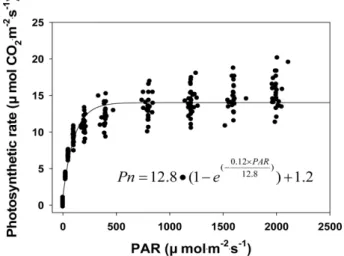
Common ice plant의 광합성을 조사한 결과, 이상적인 광합성량은 12.8µmol CO2·m−2·s−1 이었으며, 광포화점은 456µmol·m−2·s−1, 광보상점은 0µmol·m−2·s−1 이었다(Fig.
1). 광합성은 광도가 250µmol·m−2·s−1 전후에서 포화하는 경향을 보였다. 포화영역에 들어가면 광이용 효율이 떨 어지므로, 가능하면 광합성 곡선의 직선 부분에 해당되 는 광을 이용하는 것이 바람직하다. 따라서 작물 재배를 위한 적정 광도는 150~200µmol·m−2·s−1 수준이라고 판단 된다. 형광등의 경우 1µmol·m−2·s−1은 74lx에 해당하므로 (Lee와 Kim, 2012), 조도는 11,100~14,800lx 정도가 필요 하다. 1lx는 단위면적당 1lumen(lm)이며, 광속(luminous flux)으로 표기하면, 444~592lm이 된다. 형광등의 광속이 4,800lm이고 광도가 65µmol·m−2·s−1이면, 식물체 위로부터 0.2m에서 광도 150~200µmol·m−2·s−1수준일 경우, 형광등 은 2~3개가 필요하다. 정식 후 일수에 따른 단위면적당 건물중의 변화 곡선은 선형 지수적인 형태를 보였으며, 상대생장률은 0.24g·g−1·d−1이었다(Cha 등, 2014). Sestak 등(1971)이 제안한 CO2 전환 계수(1.54g CO2 fixed/g saccharide formed)에 따른 작물의 탄소 고정률은 다음 계 산과 같이 0.84nmol CO2·cm−2·s−1이 된다. 즉, (0.24g·g−1
·day− 1) × (1gDW) × (4.0·10− 3gDW/cm− 2) × (1.54)
× (2.27·107nmolCO2/g)× (1/4·10−4·s−1) = 0.84 nmolCO2·cm−2·s−1 상대생장률과 광합성 곡선식을 기반으로 한 0.84nmol CO2·cm−2·s−1 탄소 고정률에 해당되는 광도는 120µmol·
m−2·s−1 수준이었다. 따라서, 형광등을 이용하는 완전제어 형 식물공장에서 common ice plant 재배를 위한 최저 광 도는 120µmol·m−2·s−1(8,880lx)이상이 되어야 한다. 1주의 점유 면적을 0.0225m2(15× 15cm), 광도를 200µmol·m−2·s−1, 조명 보수율과 조명률 곱한 값을 0.8이라 가정하면, 하루 1,000주를 생산할 경우, 정식부터 수확(생체중 100g)까지 25일 정도 걸리기 때문에(파종 후부터 40일 소요) 식재주수 는 25,000주(25일 × 1,000주)가 된다. 재식면적 0.0225m2 (15× 15cm)으로 하면, 563m2 (25,000주 × 0.0225m2)의 재배
면적이 필요하다. 따라서, 재배면적과 광도, 조명 보수율 및 조명률값을 고려한 형광등 전체의 광도는 140,625µmol·s−1 (563m2×200µmol·m−2·s−1/0.8)이 된다. 형광등 전력밀도 (W)로의 환산계수인 4.59로 나누면, 30.7kW가 전력이 필요하다. 형광등의 효율을 20%로 가정하면, 전력은 약 153.2kW가 필요하며 55W 형광등이라면 약 2,785개가 필요하다.
2. 식물공장 경제성 분석
상기의 조건을 기준으로 경제성 분석한 결과는 Table 1과 같다. 55W 형광등의 가격을 개당 1만원이라 가정하면, 총 2,785만원이 된다. 농업용전력(을) kW당 39.2원을 기준으로 월 전기 요금(전력량요금계+부가가치세+전력산업기반기금) 은 2,457,930원 (55,147kWh × 39.2원 + 55,147kWh × 39.2원
× 0.1 + 55,147kWh × 39.2원 × 0.037) 이며, 연간 전기요금은 2,950 만원이 된다. 조명 설비 비용은 2,785만원, 전체 설비 비용(초기 도입 비용)은 조명 설비의 3배라 가정하면 8,356 만원이 된다. 감가상각 연수를 10년, 현재 생산 비용에서 차 지하는 감가상각비가 25%(생산 비용이 감가상각비의 4배) 라고 가정하면, 생산 비용은 전체 조명 설비 비용의 1.2배인 10,027만원이 된다. 하루 생산량 n은 전체 재식주수/재배기 간이므로, 재배기간이 25일(325일 생산)일 경우, 상품화율 80%에 따른 1주 당의 생산 비용은 0.8 × n × 325 = 260n으로 나누어 구할 수 있으며, 하루 생산량을 1,000주로 할 경우, 전체 재식주수는 25,000주가 된다. 또한, 1주 당 조명 설비 비용은 1,110원(2,785만원/25,000주)이 되며, 1주 당 생산 비
Fig. 1. Photosynthetic rate curve of common ice plant at 1,000µmol·mol−1 of CO2 concentration, 50-65% of relative humidity, and 25oC of leaf temperature.
Table 1. Economic analyses of fluorescent lamps-used plant fac- tories growing common ice plants at different light intensities.
Item Case 1 Case 2 Case 3 Case 4 Light intensity (µmol·m−2·s−1) 120 150 200 250
Yield (plants/day) 1,000 1,000 1,000 1,000
Harvesting time (day) 25 25 25 25
Planting density (m2/plant) 0.0225 0.0225 0.0225 0.0225 Total installation cost
(1,000 won) 50,134 62,667 83,556 104,445 Total production cost
(1,000 won) 60,160 75,201 100,267 125,334 Light installation cost
(1,000 won) 16,711 20,889 27,852 34,815 Electricity cost per year
(1,000 won) 17,697 22,121 29,495 36,869 Light cost per plant (won) 668 836 1,114 1,393 Production cost per plant (won) 77 96 128 160 Maintenance cost (1,000 won) 113,490 113,490 113,490 113,490 Sales cost per plant ( won) 760 840 970 1,110
용은 약 130원(1,114/8.7)이 된다. Takatsuji(2007)는 식물공장 에서 생산비용의 정밀한 계산은 매우 어려우며, 가능한 한 합리적인 설계를 한 후 실제 운영해 본 결과를 통해 추정하 는 것이 최선의 방법이라 하였다. 인건비는 1,000주 생산의 경우 시간제 직원 9명(시설상추 기준 1인 5,314원/시간)이 5 시간 근무할 경우, 인건비를 포함한 1주 당 생산 비용은 370원(130원+240원)이 된다. 연간 전기 요금과 운영비(감가 상각비+인건비+생산비)를 포함한다면 경비 총합은 13,820만 원이 소요된다. 연간 판매수입(1주당 생산 비용)은 9,547만 원(0.8 × 1,000주 × 370원 × 325일)이 된다. 유통비와 관리비를 18,158만원/900m2로 가정할 경우(Kim, 2009), 연간 전기 요 금, 운영비(감가 상각비+인건비+생산비), 유통비 및 관리비 를 포함한다면 경비 총합은 25,169만원이 소요된다. 따라서, 경비 총합과 연간 판매수입을 고려해 볼 때, 1주 당 판매 비용은 970원 이상으로 추정된다.
Common ice plant 재배를 위한 형광등을 이용한 식물 공장의 채산성을 추정한 결과, 1주 당 최저 판매 비용을 970원으로 책정할 경우, 연간 총수입(조수입)은 25,220만 원, 각종 비용 25,169만원을 제외할 경우의 순수익(소득) 은 51만원으로 추정된다. 조수입에 대한 수익률은 0.2%
이며, 초기 시설비용으로 투자된 8,356만원에 대한 연간 투자수익율을 계산하면 0.6%가 된다. 특히, 상품화율을 90%로 향상할 경우 28,373만원으로, 순수익과 연간 투 자수익율은 각각 3,203만원과 38%가 된다. 또한 상품화 율 90% 향상과 유통비와 경영비 10% 감소하게 되면, 4,338만원의 순수익과 52%의 연간 투자수익율이 기대된 다. 따라서 수익성 향상을 위해서는 재배 가능 주수를 증가시키고 재배일수를 감소시키는 기술 등과 시설 개선 을 통한 경영 효율성과 상품화율을 향상시키는 방안을 모색해야 할 필요가 있다.
초 록
본 연구는 인공광 이용형 common ice plant 식물공장 설계를 위한 기초자료를 확보하고자 수행되었다. 인공광 이용형 식물공장에서 작물의 광합성을 위해 필요한 광도는 120~200µmol·m−2·s−1, 탄소 고정률은 0.84nmolCO2·cm−2·s−1 이었다. 1주의 점유 면적 0.0225m2(15×15cm), 광도 200µmol·m−2·s−1, 하루 1,000주 생산을 가정할 경우, 식 재 주수는 25,000주, 563m2의 재배면적이 필요하며, 전 체 광도는 140,625µmol·s−1가 필요하게 된다. 하루 전력 약 153.2kW 기준으로 약 2,785개의 55W 형광등이 필 요하며, 1개월 전기요금은 246만원(농업용 전력(을))이 된 다. 또한 조명 설비 비용 2,785만원, 설비 비용 8,356만 원과 전체 생산 비용 10,027만원이 소요된다. 재배기간 25일(325일 생산), 상품화율 80%에 따른 1주 당 생산 비
용은 인건비 포함하여 약 370원이 된다. 경비 총합, 감가 상각비와 연간 판매수입을 고려해 볼 때, 1주당 판매 비 용은 970원 이상으로 판단되었다.
추가 주제어 : 광도, 생산 비용, 설비 비용, 전기요금, 형 광등
사 사
이 논문은 2014학년도 제주대학교 학술진흥연구비 지 원사업에 의하여 연구되었음.
Literature Cited
Agarie, S., A. kawaguchi, A. Kodera, H. Sunagawa, H.
Kojima, A. Nose, and T. Nakahara. 2009. Potential of the common ice plant, Mesembryanthemum crystallinum as a new high-functional food as evaluated by polyol accumula- tion. Plant Production Sci. 12:37-46.
Cha, M.K., J.S. Kim, and Y.Y. Cho. 2012. Growth response of lettuce to various levels of EC and light intensity in plant factory. J. Bio-Env. Con. 21:305-311 (in Korean).
Cha, M.K., J.S. Kim, and Y.Y. Cho. 2014. Growth model of common ice plant (Mesembryanthemum crystallinum L.) using expolinear functions in a closed-type plant production system. Kor. J. Hort. Sci. Technol. 32:493-498 (in Korean).
Goudriaan, J. and J.L. Monteith, 1990. A mathematical func- tion for crop growth based on light interception and leaf area expansion. Ann. Bot. 66:695-701.
Goudriaan, J. and H. H. Van Laar. 1994. Modelling potential crop growth processes: Textbook with exercises. Current issues in production ecology 2. Dordrecht: Kluwer Aca- demic Publishers.
Kim, D.E., H.J. Lee, D.H., D.H. Kang, G.I. Lee, and Y.H.
Kim. 2013. Effects of artificial light sources on the photo- synthesis, growth and phytochemical contents of butterhead lettuce (Lactuca sativa L.) in the plant factory. Protected Hort. Plant Fac. 22:392-399 (in Korean).
Kim, H.R. and Y.H. You. 2013. Effects of red, blue, white, and far-red LED source on growth response of Wasabia japon- ica seedlings in plant factory. Kor. J. Hort. Sci. Technol.
31:415-422 (in Korean).
Kim, J.H. 2009. Prospects and trends of plant factory. Korea Rural Economic Institute. Agri-Policy Focus 61:1-22 (in Korean).
Lee, W.S. and S.G. Kim. 2012. Development of rotational smart lighting control system for plant factory. World Acad- emy of Science, Engineering and Technology 62:741-744 (in Korean).
Seo, K.K. Y.S. Kim, and J.S. Park. 2011. Design of adaptive neuro-fuzzy inference system based automatic control sys-
tem for integrated environment management of ubiquitous plant factory. J. Bio-Env. Con. 20:169-175 (in Korean).
Sestak, Z., P.G. Jarvis, and J. Catsky. 1971. Plant photosyn- thetic production: Manual of methods. P.27. The Hague.
Takatsuji, M. 2007. Plant factory using artificial light. Ohm-
sha Ltd. Japan (in Japanese).
Um, Y.C., S.S. Oh, J.G. Lee, S.Y. Kim, and Y.A. Jang. 2010.
The development of container-type plant factory and growth of leafy vegetables as affected by different light sources. J.
Bio-Env. Con. 19:333-342 (in Korean).