DOI http://dx.doi.org/10.12791/KSBEC.2013.22.3.248 eISSN 2288-100X
Scheduling Non-drainage Irrigation in Coir Substrate Hydroponics with Different Percentages of Chips and Dust for Tomato Cultivation
using a Frequency Domain Reflectometry Sensor
Eun-Young Choi
1, Ki-Young Choi
2, and Yong-Beom Lee
2*
1
Department of Green Technology Convergence, KonKuk University, Chungju 380-701, Korea
2
Department of Environmental Horticulture, University of Seoul, Seoul 130-743, Korea
Abstract. This study examined an automated irrigation technique by a frequency domain reflectometry (FDR) sen- sor for scheduling irrigation for tomato (Solanum lycopersicum L. ‘Starbuck F1’) cultivation aimed at avoiding efflu- ent from an open hydroponic system with coir substrate containing different ratios of chip-to-dust (v/v) content.
Specifically, the objectives were to undertake preliminary measurements of irrigation volumes, leachate volume, vol- umetric water content and electrical conductivity (EC) in the substrate, plant growth, fruit yield, and water use effi- ciency resulting from variation in chip content as an initial experiment. Commercial coir substrates containing different percentages of chips and dust (0 and 100%, 30 and 70%, 50 and 50%, or 70 and 30%), two-story coir sub- strates with different percentages of chips in the lower layer and dust in the upper layer (15 and 85%, 25 and 75%, or 35 and 65%), or rockwool slabs were used. The results showed that a negligible or no leachate was found for all treatments when plants were grown under a technique for scheduling non-drainage irrigation using a frequency domain reflectometry (FDR) sensor. Daily irrigation volume was affected by chip content in both commercial and two-story slabs. The highest plant growth, marketable fruit weight, and water-use efficiency were observed in the plants grown in the commercial coir slab containing 0% chips and 100% dust, indicating that the FDR sensor-auto- mated irrigation may be more useful for tomato cultivation in coir substrate containing 0% chips and 100% dust using water efficiently and minimizing or avoiding leachate and thus increasing yield and reducing pollution.
Detailed experiment is necessary to closely focus on determining appropriate irrigation volume at each of irrigation as well as duration of each individual irrigation cycle depending on different physical properties of substrates using an automated irrigation system operated by the FDR sensor.
Additional key words : leachate volume, two-story slab, volumetric water content, water use efficiency
Introduction
Drainage produced by a hydroponic growing system causes environmental pollution with loss of water and nutrients (Choi et al., 2001). Environmental and economic concerns regarding nutrient contamination are growing (Giuffrida et al., 2003), and in the Netherlands, the leach- ing of drain water from greenhouses into the soil has been prohibited to protect the quality of groundwater (Runia and Amsing, 2001). As a result, there is a need for the develop- ment of a drainage-free open hydroponic system suitable for a particular substrate, for which irrigation volume and timing has to be managed depending on the water require- ments of the crop to avoid leaching of nutrient-rich solu-
tion. Efficient irrigation management can allow growers to reduce leaching and runoff and to improve plant growth.
Bilderback (2000) suggested that efficient irrigation is a straightforward and inexpensive way to reduce leaching and runoff from container production. Utilizing a soil- moisture sensor to monitor substrate water content was successful in both greenhouse and nursery cultivations (Burnett, 2008; van Iersel et al., 2010). Lin (2003) showed that frequency domain analysis increases the accuracy of the data by permitting increases in the bandwidth. For this reason, the FDR system has more potential than the travel time analysis methods with time domain reflectometry (TDR). Soil moisture sensor based on the FDR is capable of monitoring both electrical conductivity (EC) and soil water content. Hilhorst (2000) presented a linear relation- ship between bulk electrical conductivity and dielectric constant in moist soil, in which using this linear relation- ship, measurements of pore water electrical conductivity
*Corresponding author: [email protected]
*Received July 21, 2013; Revised August 14, 2013;
*Accepted August 28, 2013
can be made in a wide range of soil types without soil-spe- cific calibrations.
The popularity of coir is increasing worldwide for green- house crops (Noguera et al., 2000). It is an organic sub- strate obtained after the extraction of fiber from the husk of coconut (Cocos nucifera L.) fruit (Abad et al., 2002). As with most of the hydroponic substrates, coir has a larger particle size and releases more water at much lower pres- sure than most soil types. The bulk density of coir varies between 0.04 and 0.13 kg m
−3, depending on the ratio of chips to dust (Evans et al., 1996; Kang et al., 2004). The addition of coconut chips to coconut dust increases the air- space and reduces the easily available water content (Prasad, 1997). However, this information does not pro- vide irrigation strategy in moisture sensor controlled irriga- tion system for commercial production. Therefore, the purpose of this study was to examine a technique for scheduling irrigation using the FDR sensor aimed at avoid- ing effluent from an open hydroponic system with coir sub- strate containing different percentages of chips and dust, two-story coir substrates with different percentages of chips in the lower layer and dust in the upper layer, and commer- cial rockwool substrate. The key objectives were to undertake preliminary measurements of irrigation volumes, volumet- ric water content and electrical conductivity (EC) in the substrate, growth and fruit yield of tomato, and water use efficiency resulting from variation in chip content as an ini- tial experiment.
Materials and Methods
1. Plant growth and conditions
This experiment was undertaken in a heated polyethyl- ene film greenhouse at KonKuk University, Chungju, Chungcheongbuk-do, located at latitude 35
o49'N and longi- tude 127
o08'E. Tomato seed (‘Starbuck F1’, De Ruiter Seeds®.) was sown on February 1, 2012, and four tomato seedlings were transplanted on March 16, 2012, in each commercial coir slab (100 × 20 × 10 cm, chip : dust (v/v) = 0 : 100%, 30 : 70%, 50 : 50%, or 70 : 30%, Sivanthi Joe Coirs, Tamil Nadu, India), in each two-story coir slab with different percentages of chips in the lower layer and dust in the upper layer (chip : dust (v/v) = 15 : 85%, 25 : 75%, or 35 : 65%), or in each rockwool slab (UR Co. Ltd., Korea) as a control with 1.2 m between rows and 0.33 m between plants. Before the transplant, the coir slabs were washed
with tap water at approximately pH 6.2 and EC 0.15 dS m
−1until the EC value of the slabs reached 0.3 dS m
−1. Four coir slabs per treatment were placed in a heated polyethyl- ene film greenhouse at KonKuk University. A FDR sensor (WT1000N, Mirae-Sensor®, Korea) with a three-rod probe 65 mm long was placed vertically in the slabs per treat- ment. A nutrient solution at pH 5.8 and EC 2.0 dS m
−1was supplied using a drip irrigation system after transplant. The nutrient solution (Glasshouse Crops Research and Experi- ment Station at Naaldwijk, Netherlands) was supplied from a 125-L tank containing a water pump (55W, Hyupsin®, Korea). The composition of the nutrient solution was as follows: 13.75 me L
−1nitrate nitrogen (NO
3-N), 1.25 me L
−1ammonium nitrogen (NH
4-N), 3.75 me L
−1phosphorous (P), 8.75 me L
−1potassium (K), 8.5 me L
−1calcium (Ca), 4.0 me L
−1magnesium (Mg), 7.5 me L
−1sulfur (S), 0.84 ppm iron (Fe), 0.55 ppm manganese (Mn), 0.33 ppm zinc (Zn), 0.05 ppm copper (Cu), 0.33 ppm boron (B), and 0.05 ppm molybdenum (Mo). The amount of water irrigated and drained was measured daily until the July 12, 2012. Dur- ing the study, the temperature, relative humidity, carbon dioxide (CO
2) concentration, and photosynthetically active radiation (PAR) were recorded every 30 minutes using an ALMEMO® 2890-9 device (AHLBORN, Holzkirchen, Germany), which has both data processing and compiler systems. Some data gathered by the ALMEMO data com- piler were transferred to a computer using a Universal Serial Bus (USB).
2. Automated irrigation system using the FDR sensor The automated irrigation system using the FDR sensor was applied after transplanting. Calibration of the FDR sensor to measure water content was carried out using glass beads. The beads were gradually mixed until satura- tion with different pore water solutions ranging from dis- tilled water up to solutions with an EC of 3.0 dS m
−1. When the volumetric water content in the coir substrate reached experimental set trigger points, the irrigation was automatically initiated. Each irrigation amount was 60 mL per plant. The water sensor avoided irrigation when the stop set point of substrate moisture was already present.
The start and stop frequency values were manually input.
For example, irrigation was started from < 50% value, and
stopped at < 55% for the 50% treatment. Irrigation-on-
and-off hours were modified depending on daily times of
sunrise and sunset. Irrigation began 1 hour after sunrise,
and ended 3 hours before sunset, or at 9:00 a.m. and 3:00 p.m., respectively, between 0 and 52 days after transplant (DAT) (between the March 16 and May 7, 2012), and at 7:00 a.m. and 5:00 p.m. between 53 and 102 DAT (between the May 8 and June 26, 2012). The volumetric water content level was preset at 50% between 0 and 25 DAT, 53% between 26 and 52 DAT, 55% between 53 and 60 DAT, 57% between 61 and 62 DAT, 60% between 63 and 66 DAT, 67% between 67 and 90 DAT, and 65%
between 91 and 102 DAT (Table 1). The data of volumet- ric water content, EC, and temperature in the root zone of the substrate were saved every 10 minutes in a data log- ger (WT600, Mirae-Sensor®, Korea) connected to the sen- sors. The data were then downloaded and analyzed using an Excel spreadsheet. The water content of the substrate monitored by the FDR sensor was quantified as the inter- nal capacitance of the substrate using high-frequency pulses, while the EC value was quantified as both the internal capacitance and resistance value using low-fre- quency multiple pulses, which allows measurement of both the water content and ion concentration in the sub- strate at the same time. The voltage values for the water content and ion concentration were calculated by assess- ing different numbers of high-frequency pulses returned after converting the high-frequency pulse into direct cur- rent (DC) in a current-conversion circuit by a matching transmitter set between antennae and oscillators of a high- frequency pulse. In addition, the conductivity sensor was temperature corrected.
3. Water use efficiency
The water use efficiency (WUE) was calculated as a function of the applied irrigation water retained in the sub- strate [WUE = leaf, stem and fruit fresh weight at harvest ÷ (applied irrigation volume-leachate)].
4. Statistics
Data were subjected to analysis of variance (ANOVA) with SAS 9.2 (SAS Institute, Cary, North Carolina, USA).
The experiment was set up using a randomized complete block design for four replications. Mean separation of mea- surement variables used Duncan’s Multiple Range Test (DMRT) at the 5% level.
Results
1. Growth conditions
During the study, the average air temperature was 27
oC ranging from 17 to 37
oC, relative humidity from 30% to 99%, CO
2concentration from 200 to 700 ppm, and PAR from 0 to 1180 µm · m
−2· s
−1. During the night, from 22:00 to 6:00, the CO
2concentration inside the greenhouse was higher than 600 ppm, while the lowest concentration of CO
2was measured at 13:00, about 300 ppm. During the entire growth period, the lowest temperature was approxi- mately 17
oC and generally remained higher than the out- side temperature. Relative humidity during the night and early morning between 8:00 p.m. and 6:00 a.m. ranged from 80% to 99%, while it ranged from 50% to 70% dur- ing the day. The highest PAR level was at 13:00 in the 26
thof June at 1180 µm · m
−2· s
−1(data not shown).
2. Irrigation and leachate volumes
Significantly higher daily average irrigation amounts and total irrigation volume for 75 days were observed in the slabs including about 25 to 30% chips in both commercial and two-story slabs. The highest daily average irrigation amounts per plant, 2.422 L and 2.495 L, were found between 24 and 99 DAT when plants were grown in the commercial slab with 30% chips and 70% dust and grown in the two-story coir slab with 25% chips in the lower layer Table 1. Summary of periodically changes in daily duration of irrigation and targets of volumetric water content of coir substrate con-
trolled by the FDR after transplanting at 16
thof March 2012.
Days DAT
(days after transplant)
Daily duration of Irrigation
Targets of volumetric water content
16
thMarch~10th April 0~25 9:00~15:00 50%
11
thApril~7
thMay 26~520 9:00~15:00 53%
8
thMay~15
thMay 53~600 7:00~17:00 55%
16
thMay~17
thMay 61~620 7:00~17:00 57%
18
thMay~21
thMay 63~660 7:00~17:00 60%
22
thMay~14
thJune 67~900 7:00~17:00 67%
15
thMay~26
thJune 91~102 7:00~17:00 65%
and 75% dust in the upper layer, respectively (Table 2). In contrast, the lowest daily average irrigation amount and total irrigation volume for 75 days was 1.858 L and 139 L, respectively, when plants were grown in the commercial slab with 70% chips and 30% dust. The results of daily average irrigation volume and total irrigation volume for 75
days in the rockwool substrate are the same as those for the slabs including 0% chip in commercial slab and 15% chips in two-story slab. There was no leachate from either the commercial slab with 0% chips and 100% dust or the rock- wool slab during the growing period, and all treatments had a negligible amount of leachate volume.
Table 2. Daily average irrigation volume (mL plant
−1day
−1) (n = 75), total irrigation volume (n = 2), and total leachate volume (n = 2) measured from 24 to 99 days after transplant as affected by the percentage of chips and dust in coir substrate controlled by the fre- quency domain reflectometry (FDR).
Substrates Ratio
(chip : dust)
Daily-averaged Irrigation volume (mL plant
−1day
−1)
Total irrigation volume for 75 days (L plant
−1)
Total leachate volume for 75 days (L plant
−1)
Rockwool 2109 bc 153bc 0
Commercial slab
00 : 100 2129 bcd 160abc 0
30 : 700 2422 a 182ab 0.22 (± 0.25)
Z50 : 500 2279 abc 171ab 0.53 (± 0.29)
Z70 : 300 1858 c 139c 1.45 (± 0.68)
ZTwo-story slab
15 : 850 2079 bc 156bc 2.28 (± 0.88)
Z25 : 750 2495 a 187a 2.32 (± 0.96)
Z35 : 650 2396 ab 171ab 1.91 (± 0.72)
ZZ
: standard deviation for two replications.
Means within columns sharing the same letter are not significantly different by Duncan’s Multiple Range Test (DMRT) at P < 0.05.
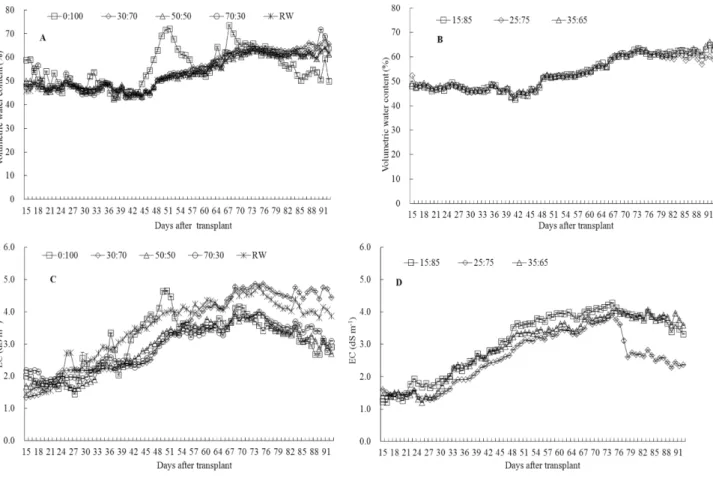
Fig. 1. Change of volumetric water content and electrical conductivity (EC) levels measured by the FDR sensor in the commercial coir
slab (A, C) and in the two-story substrate (B, D) when the water content of the substrate was controlled between 55% to 60% and the
EC of the nutrient solution was supplied at 2.0 dS m
−1. Thirty observations were made between 15 and 92 days after transplant (DAT).
3. Volumetric water content and EC level of substrate The volumetric water content reached between 50% and 70% for both commercial and two-story slabs. The volu- metric water content in the commercial slab with 0% chips and 100% dust showed more fluctuation during the obser- vation period compared to that in other slabs (Fig. 1A). The substrate EC concentration ranged between 1.5 and 4.8 dS m
−1that started increasing from 30 DAT and decreasing from 75 DAT. The commercial slab with 30% chips and 70% dust and the rockwool slab had slightly higher EC concentration (Fig. 1C, D).
4. Plant growth
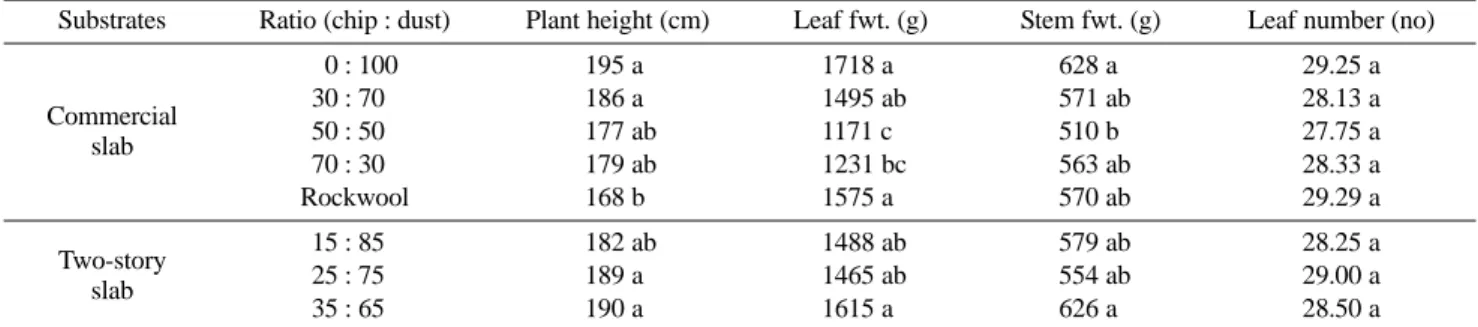
The fresh weights of leaf at 102 DAT showed a signifi- cant reduction in plants grown in the commercial slab with 50% chips and dust and with 70% chips and 30% dust (Table 3). Significantly higher fresh weights of leaf and stem and leaf number were found in the plants grown in the commercial slab with 0% chips and 100% dust as well as those grown on the two-story coir slab with 35% chips in the lower layer and 65% dust in the upper layer. There were no significant differences in photosynthetic rates and stomata conductance for all the treatments (data not shown).
5. Fruit yield and quality
The fruit weight and fruit numbers were significantly affected by the percentages of chips and dust in the slabs.
The weights of marketable fruits grown in the commercial slab with 50% chips and dust and 70% chips and 30% dust or on rockwool were significantly lower than those in other treatments, while the highest soluble solid content was observed in fruits from the slabs; on average they were 7.0 Brix (Table 4). The highest fruit weights and fruit numbers
were observed in the plants grown in the commercial slabs with 0% chips and 100% dust.
6. Water use efficiency
Water use efficiency (WUE) decreased as plants were grown in substrate with higher chip content (Fig. 2). The highest WUE was observed in the commercial slab at 0%
chips and 100% dust.
Discussion
A negligible or no leachate was found for all treatments when plants were grown under a technique for scheduling non-drainage irrigation using the FDR sensor (Table 2).
These results indicate that irrigation scheduling for the non- drainage hydroponic system using a FDR sensor is very precise and effective and increases sustainability. Our pre- vious study showed that scheduling irrigation using a fre- quency domain reflectometry (FDR) sensor at a volumetric Table 3. Plant height, fresh weight of leaf and stem, and leaf number per plant of tomatoes grown hydroponically for 70 days after trans-
plant as affected by the percentages of chips and dust in coir substrate controlled by the FDR.
Substrates Ratio (chip : dust) Plant height (cm) Leaf fwt. (g) Stem fwt. (g) Leaf number (no)
Commercial slab
00 : 100 195 a 1718 a 628 a 29.25 a
30 : 700 186 a 1495 ab 571 ab 28.13 a
50 : 500 177 ab 1171 c 510 b 27.75 a
70 : 300 179 ab 1231 bc 563 ab 28.33 a
Rockwool 168 b 1575 a 570 ab 29.29 a
Two-story slab
15 : 850 182 ab 1488 ab 579 ab 28.25 a
25 : 750 189 a 1465 ab 554 ab 29.00 a
35 : 650 190 a 1615 a 626 a 28.50 a
Means within columns sharing the same letter are not significantly different by Duncan’s Multiple Range Test (DMRT) at P < 0.05.
Fig. 2. Water use efficiency (WUE = leaf, stem, and fruit fresh
weight at harvest ÷ retained irrigation volume) of tomato grown
hydroponically as affected by the percentage of chips and dust
in coir substrate controlled by the FDR. Bars indicate standard
errors (±) of means for three replications per treatment.
water content between 50% and 60% produced no leach- ing of drain water from the coir substrate hydroponic sys- tem without water stress conditions over the entire investigation period during the autumn to winter season, and also suggested that efficient irrigation scheduling to obtain a drainage-free system during the late-spring to sum- mer season can be achieved by first controlling the volu- metric water content of the substrate to between 40% and 50% by the FDR, and then increasing it to between 60 and 70% with close observation of water content patterns and the electrical conductivity (EC) level of the substrate (Choi et al., 2013a, b). Commonly, irrigation schedules were based on monitoring soil-moisture status (Fares and Polya- kov, 2006; Papadopoulos et al., 2008; Thompson et al., 2007) and required irrigation timing (Warren and Bilder- back, 2004). The timing of irrigation, irrigation quantity per irrigation cycle, and the duration of each cycle for hydroponics have been determined using a variety of tech- niques, including a sensor of cumulative solar radiation and a time clock (Lizarraga et al., 2003; Lee et al., 2007).
Unlike the time-clock method, irrigation by solar radiation applies more water when the crop needs more (Lizarraga et al., 2003); however, the authors postulated that during the morning hours from 10 a.m. until 12 p.m., when solar radi- ation is low, it takes more than 1 hour to reach the required radiation level (225 W m
−2), but during the middle hours, the irrigation interval is shorter than 30 minutes. In con- trast, the automated FDR sensor appears to match the irri- gation in the morning to the amount of water lost since the end of irrigation the previous day (Choi et al., 2013a, b).
These results support that irrigation volume should be based on the amount of water lost since the last irrigation (Yeager et al., 1997).
In the present study, daily irrigation volume and water use efficiency (WUE) was affected by chip content in both commercial and two-story slabs (Table 2, Fig. 2). Conse- quently, the plant growth, fruit weight, and fruit numbers were significantly affected by the percentages of chip and dust in the slabs (Tables 3, 4). The highest plant growth, marketable fruit weights per plant, and WUE were observed in the commercial coir slab with 0% chips and 100% dust. In general, WUE varies with species and envi- ronmental factors (Burnett, 2008). The environmental fac- tor in the present study is the substrate’s physical property.
In a FDR sensor-dependent automated irrigation for non- drainage system, frequency of irrigations is determined by crop demand, and most of portion of applied nutrient solu- tion retains in substrate. At the beginning of cultivation, substrates have no soluble ions as washed off by water prior to transplanting, but with time, the substrate accumu- lates mineral nutrients. The accumulation processes occur depends on uptake rate by plant root, irrigation volume as well as the EC concentration in nutrient solution. In the present study, the substrate EC concentration ranged between 1.5 and 4.8 dS m
−1that started increasing from 30 DAT and decreasing from 75 DAT (Fig. 1C, D). The com- mercial slab with 30% chips and 70% dust and the rock- wool slab had slightly higher EC concentration. While the EC level in the slab with 30% chips and 70% dust started increasing from about 55 DAT, the rockwool slab EC started greatly increasing from 30 DAT. These results indi- cate that an increase in the EC level in the slab with 30%
chips and 70% dust may be related with the highest total irrigation volume (Table 2), which may have been demanded by their plant roots, producing relatively higher marketable fruits (Table 3). However, the long-term higher EC level in Table 4. Marketable fruit (> 150 g fruit
−1) weights per plant, marketable fruit numbers per fruit, and soluble solid contents of tomatoes harvested from the first to fifth cluster grown hydroponically as affected by the percentages of chips and dust in coir substrate con- trolled by the FDR.
Substrates Ratio
(chip : dust)
Marketable Fruit weights (g) (n = 8)
Marketable Fruit weight (g) (n = 180)
Soluble solid content (
oBrix)
Commercial slab
00 : 100 8251 a 285 a 5.63 b
30 : 700 4131 b 275 a 5.78 b
50 : 500 2905 de 200 c 7.05 a
70 : 300 3297 cd 214 bc 7.03 a
Rockwool 2407 e 209 bc 6.85 a
Two-story slab
15 : 850 3679 bc 272 a 6.92 a
25 : 750 3453 bcd 249 ab 6.69 a
35 : 650 3782 bc 271 a 6.34 ab
Means within columns sharing the same letter are not significantly different by Duncan’s Multiple Range Test (DMRT) at P < 0.05.
the rockwool slab may be associated with 100% retention of the applied nutrient solution without active root absorp- tion since the plants grown the rockwool slab produced lower marketable fruits. The EC of the retained nutrient solution in the rockwool slab may have been adversely influenced root uptake of water and nutrient solution. All the integrated data indicate that the FDR sensor-automated irrigation may be more useful for tomato cultivation in coir substrate containing 0% chips and 100% dust using water efficiently and minimizing or avoiding leachate and thus reducing pollution. Detailed experiment would be neces- sary to closely focus on determining appropriate irrigation volume at each of irrigation as well as duration of each individual irrigation cycle depending on different physical properties of substrates using an automated irrigation sys- tem operated by the FDR sensor.
Acknowledgement
This study was supported by the Korea Institute of Plan- ning and Evaluation for Technology in Food, Agriculture, Forestry and Fisheries (IPET).
Literature Cited
Abad, M., P. Noguera, R. Puchades, A. Maquieira and V.
Noguera 2002. Physico-chemical and chemical properties of some coconut dusts for use as a peat substitute for contai- nerised ornamental plants. Bioresource Tecnology 82: 241- 245.
Bilderback, T.E. 2002. Water management is key in reducing nutrient runoff from container nurseries. HortTechnology 12:541-544.
Burnett, S.E. 2008. Morphology and irrigation efficiency of Gaura lindheimeri growth with capacitance sensor-con- trolled irrigation. HortScience 43: 1555-1560.
Choi, E.Y., Y.B. Lee, and J.Y. Kim 2001. Nutrient uptake, growth and yield of cucumber cultivated with different growing substrates under a closed and an open system. Acta Horticulturae 548: 543-550.
Choi, E.Y., K.Y. Choi, and Y.B. Lee. 2013a. Non-drainage irri- gation scheduling in coir substrate hydroponic system for tomato cultivation by a frequency domain reflectometry sen- sor. European Journal of Horticultural Science 78: S. 132–
143.
Choi, E.Y., K.Y. Choi, and Y.B. Lee. 2013b. Development of a non-drainage hydroponic system with a coconut coir sub- strate by a Frequency Domain Refectometry for tomato cul- tivation. Journal of Plant Nutrition 36 (in Press).
Evans, M.R., S. Konduru, and R.H. Stamps. 1996. Source variation in physical and chemical properties of coconut coir dust. HortScience 31: 965-967.
Fares, A. and V. Polyakov. 2006. Advances in crop water management using capacitive water sensors. Advances in Agronomy 90 : 43-77.
Giuffrida, F., S. Argento, V. Lipari, and C. Leonardi. 2003.
Methods for controlling salt accumulation in substrate culti- vation. Acta Horticulturae 614: 799-803.
Hilhorst, M.A. 2000. A pore water conductivity sensor. Soil Science Society of America Journal 64: 1922–1925.
Kang, J.Y., H.H. Lee, and K.H. Kim. 2004. Physical and chemical properties of organic horticultural substrates used in Korea. Acta Horticulturae 644: 231-235.
Lee, J.H., Y.B. Lee, E.Y. Choi, and E.Y. Yang. 2007. A con- trolled irrigation method using integrated solar radiation has effect on both the production and quality of single-node cut- ting rose ‘versillia’ Acta Horticulturae 761: 379-385.
Lin, C.P. 2003. Frequency domain versus travel time analyses of TDR waveforms for soil moisture measurements. Soil Science Society of America Journal 67: 720–729.
Lizarraga, A., H. Boesveld, F. Huibers, and C. Robles. 2003.
Evaluating irrigation scheduling of hydroponic tomato in Navarra, Spain. Irrigation and Drainage 52: 177-188.
Noguera, P., M. Abad, V. Noguera, R. Puchades and A.
Maquieira 2000. Coconut coir waste, a new and viable eco- logically-friendly peat substitute. Acta Horticulturae 517:
279-286.
Papadopoulos, A.P., U. Saha, X. Hao, and S. Khosla. 2008.
Irrigation management in greenhouse tomato production in rockwool. Acta Horticulturae 799: 521-528.
Prasad, M. 1997. Physical, chemical and biological properties of coir dust. Acta Horticulturae 450:21-30.
Runia, W.T. and J.J. Amsing. 2001. Disinfection of recirculat- ing water from closed cultivation systems by heat treat- ment. Acta Horticulturae 548:215-222.
Thompson, R.B., M. Gallardo, L.C. Valdez, and M.D. Fernan- dez. 2007. Determination of lower limits for irrigation man- agement using in situ assessments of apparent crop water uptake made with volumetric soil water content sensors.
Agricultural Water Management 92:13-28.
van Iersel, M.W., S. Dove, J.G. Kang, and S.E. Burnett. 2010.
Growth and water use of petunia as affected by substrate water content and daily light integral. HortScience 45:277- 282.
Warren, S.L. and T.E. Bilderback. 2004. Irrigation timing:
Effect on plant growth, photosynthesis, water-use efficiency and substrate temperature. Acta Horticulturae 644:29-37.
Yeager, T.R., C.H. Gilliam, T.E. Bilderback, D.C. Fare, A.X.
Niemiera, and K.M. Tilt. 1997. Best management practice:
guide for producing container-grown plants. Southern Nurs-
ery Assoc., Marietta, GA.
토마토 수경재배에서 FDR(Frequency Domain Reflectometry) 센서를 활용한 무배액 시스템에 적합한 코이어 배지의 Chip과 Dust 비율 구명
최은영1·최기영2·이용범2
*
1