접수 16. 08. 05 / 심사종료 16. 09. 01 / 게재승인 16. 09. 13
Vol.32, No.3, pp345-352(2016)
DOI http://dx.doi.org/10.12654/JCS.2016.32.3.05 Printed in the Republic of Korea
pISSN: 1225-5459 eISSN: 2287-9781
오륜대 한국순교자박물관 소장
필첩 및 첩갑에 사용된 직물 및 염료분석
백영미1 | 하신혜* | 배선영* | 이정은** | 권영숙**
부산대학교 한국전통복식연구소, *오륜대 한국순교자박물관, **부산대학교 의류학과
Analysis on the Textile and Dye Used for the Book Cover and Slipcase Housed in the Oryundae Korean Martyrs Museum
Young Mee Baek1 | Shin Hye Ha* | Sun Young Bae* | Jung Eun Lee** | Young Suk Kwon**
Korean Traditional Costume Research Institute, Pusan National University, Busan, 46241, Korea
*Oryundae Korean Martyrs Museum, Busan, 46265, Korea
**Department of Clothing and Textiles, Pusan National University, Busan, 46241, Korea
1Corresponding Author: [email protected], +82-51-510-2850
초 록 본 연구는 부산 오륜대 한국순교자박물관에 소장되어있는 국긔복소션과 법복졀복의 직의(織衣) 즉, 표지직물 및 이를 보관하는 첩갑을 구성하고 있는 직물에 관한 분석적 연구이다. 본 유물은 조선 제24대 왕인 헌종(재 위 1834∼1849)의 후궁인 경빈 김씨(1831-1907)가 작성한 것으로 추정된다. 첩갑과 2권의 필첩의 표지는 모두 적외분광 분석 결과, 견직물에 의해 배첩이 되어있으며 첩갑의 표지는 화문직은단(花紋織銀緞)으로 되어있고 두 필첩의 겉표지 는 초록색과 적색의 수자편복문단(壽字蝙蝠紋緞)이다. 첩갑의 금속사 부분은 에너지분산형 분광분석으로 분석한 결 과 은이 산화한 것임을 확인할 수 있었다. 한편 염료분석 결과, 적색인 법복졀복의 표지직물에서는 berberine, brazilin, carthamin 등이 검출되어 황벽, 소목, 홍화 등에 의해 복합염색이 된 것으로 추정되며 첩갑의 색사들을 분석한 결과에서는 첩갑의 황색섬유에서 rutin이 검출되어 괴화에 의한 염색으로 추정된다.
중심어
:
필첩,
첩갑,
직의,
염료분석, 19
세기말ABSTRACT The purpose of this study is to analyze on the textile used for book covers of Gukgiboksiksoseon and
Boepboksajeolboksaek, and slipcase of these books kept in the Oryundae Korean Martyrs Museum in Busan. These records are estimated to be written by Gyeongbin Kim(1831-1907), who was a royal concubine of 24th King Heonjong (reign 1834∼1849) of the Joseon Dynasty. The cover textile of slipcase and two books are investigated to be silks by the FT-IR. The cover textile of slipcase is flower patterned satin with silver thread and the cover textile of two books are green and red with Su characters and bat patterned satin. The blackish part of pattern of slipcase is investigated by silver thread by FE-SEM-EDAX. Moreover, by the dye analysis, berberine, brazilin, and carthamin are detected from the cover textile of Boepboksajeolboksaek. It is indicated that it was dyed with an amur cork-tree, a sappanwood, and a safflower. And rutin which is the main dyestuff of the sophora flower of the pagoda tree was detected from the yellow thread of the cover textile of slipcase.
Key Words: Book, Slipcase, Textile book cover, Dye analysis, Late 19th century
Figure 1. Gukgiboksiksoseon, Boepboksajeolboksaek,
and slipcase kept in the Oryundae Korean Martyrs Museum.Table 1. Analytical condition for FE-SEM-EDAX.
Instruments EDAX Apollo X Genesis ver.6.45Ⅰ Carl Zeiss Field Emission Scanning Electron Microscope SUPRA40VP kV-nA 15 kV – 5 nA
Angle of election incidence 90°
Angle of X-ray extraction 35°
Detector Silicon Drift detector(SDD) Time 100 s
1. 서 론
부산 오륜대 한국순교자박물관에 소장되어있는 국긔 복소션과 법복졀복은 조선 제24대 왕인 헌종 (재위 1834∼1849)의 후궁인 경빈 김씨(1831-1907)가 작 성한 것으로 추정되는 기록으로 국긔복소션은 순조대 왕과 순원왕후, 익종대왕과 신정왕후, 헌종대왕과 첫 번째 왕후인 효현왕후 등 3대에 걸쳐 총 여섯 분의 기일복식에 관하여 기록되어 있으며, 법복졀복은 일 년 사절기 동안 궁중에서 왕실 여성이 탄일·정조를 비롯한 크고 작은 명절과 일상생활에 착용하는 의례복과 평상복을 기록한 것으로 19세기 말 궁중 왕실 여성의 옷차림을 알 수 있는 중요한 자료이다(Ha and Kwon, 2014; 2016). 이 두 권의 필첩은 책갑에 보관되어있으며 모두 겉면이 직물로 배접 되어 있는 상태이다(Figure 1). 전적류의 겉표지를 장황하 는데 있어서는 종이로 배접하는 지의(紙衣)와 단이나 주와 같은 견직물로 배접하는 직의(織衣)가 있는데 영조대의
「선원보략수정의궤」에 기록된 「선원보략」 수정시 장책 건 수와 책수를 살펴보면 진상, 진헌, 봉안건에 직의를 사용하 였고 반사(頒賜) 즉, 하사품에는 대부분 지의로 장황하였 으며 총 건수 중 직의에 의한 장황이 3% 정도 행해졌다 (Cho, 2005).
본 연구에서는 오륜대 한국순교자박물관에 소장되어있 는 이 두 권의 필첩과 첩갑에 사용된 직물에 관하여 조사하 고 최소량의 시편으로 HPLC-PDA를 사용하여 염료분석 을 실시하였다. 지금까지 국내에서는 섬유문화재에 대한 염료분석은 주로 출토복식에 대하여 이루어졌으며(Baek
et al., 2012; Chae and Ryu, 2015), 다양한 분석법을 사용
하여 변퇴색의 환경요인, 퇴색거동 및 퇴화물(Ahn andObendorf, 2004; Ahn, 2007; Ahn et al., 2014; 2015), 비 파괴분석법 연구(Lee et al., 2008; Yun and Kwon, 2013) 등 염료분석을 위한 기초자료 수집을 위한 기반 연구들을 시도하고 있다.
본 유물의 제작연대는 1890년대 이후로 보고 있으므로 조선 후기 직물연구의 자료가 될 수 있을 것이다. 또한 염 료연구에 있어서도 이 시기는 합성염료의 개발 이후의 시 기이며 고급견직물에 대한 수입이 많았던 것을 미루어볼 때 당시의 직물 교역 및 염색기술을 알 수 있는 기초자료가 될 것으로 생각된다.
2. 연구 방법 2.1. 직물조직 및 재질분석
직물조직의 특성은 휴대용 현미경(Dino-Lite pro, Taiwan) 을 사용하여 40배, 60배, 200배 등으로 관찰하였다. 직물 의 재질분석은 적외선분광분석기(FT-IR, Spectrometer GX, PerkinElmer, USA)를 사용하여 ATR법에 의해 분석하였 으며 금속사로 보이는 부분은 전계방출형 주사전자현미경 과 결합된 에너지분산형 분석기(FE-SEM-EDAX, SUPRA40 VP, Carl Zeiss, Germany)를 사용하여 분석하였으며 분석 조건은 Table 1과 같다.
2.2. 염료분석
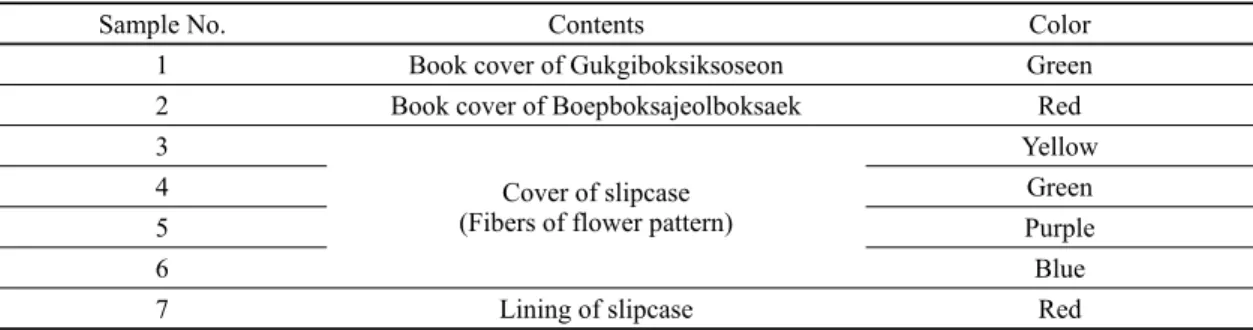
염료분석을 위해 시료편은 각 유물의 가장자리 헤어진 부분 실오라기를 채취하여 실험에 사용하였으며 필첩 두 권의 섬유 각 1종씩과 첩갑에 사용된 색사 5종 등 총 7종으 로 내역은 Table 2와 같다. 시료는 0.5 몰농도의 염산/메탄 올(0.5 M HCl/CH3OH(1:1))을 용매로 사용하여 추출하였 으며, 초록색과 파란색의 경우 DMF(HCON(CH3)2)에 추
Table 2. List of textile samples for dye analysis.
Sample No. Contents Color
1 Book cover of Gukgiboksiksoseon Green
2 Book cover of Boepboksajeolboksaek Red
3
Cover of slipcase (Fibers of flower pattern)
Yellow
4 Green
5 Purple
6 Blue
7 Lining of slipcase Red
Table 3. Condition for HPLC-PDA analysis.
Instrument Shimadzu HPLC LC-10A
Column STR ODS-II (4.6 mmΦ-150 mm) partical size : 5 μm, pore size : 12 nm
Elution profile
A : 10 mM(10 mol/L) aqueous sodium phosphate (pH 2.6) B : methanol
linear gradient 0 min. → 20 min → 30 min, A/B=60/40 → 5/95 → 5/95 Flow rate : 1.0 ml/min
Temperature : 40℃
Sample volume 5 μl~50 μl
Detector
Photodiode array (PDA) UV-VIS detector SPD-M10Avp
Wavelength : 190 ~ 700 nm Band width : 2 nm Time : 0.6 sec
Data process Shimadzu HPLC work station LC10-A UV-VIS Detecter SPD-M10AVP
Figure 2. Patterns of the fabric of Gukgiboksiksoseon.
출하였고, 0.1 μm의 Membrane filter(Advantec Toyo PTFE, T010A013A, 13 mm, PLAIN)로 여과하여 사용하였다. 분 석은 고속액체크로마토그래피 (HPLC, LC-10A, Shimadzu, Japan)를 사용하였고 분석결과는 시스템콘트롤(Shimadzu HPLC work station CLASS-LC 10, Japan)을 사용하여 데 이터를 처리하여 머무름 시간(이하 TR) 및 최대흡수파장 (이하 λmax)을 구하였다. HPLC-PDA의 분석조건은 Table 3과 같다.
3. 결과 및 고찰
3.1. 직물조직 및 재질 분석
본 유물과 같은 저자가 지은 첩초인 숙명여자대학교 소 장의 ≪순화궁첩초≫의 표지도 직물로 되어있으며 그 중
졀복장요람의 표지는 평지단층문직물인 남색의 쌍용문영초(雙龍紋英綃)로 꾸몄고 국긔복소션은 단 층문단인 녹색의 사합여의운보문단(四合如意雲寶文緞)으 로 되어있으며, 책갑은 색동단으로 되어있다(Sim, 2002).
본 유물의 두 권의 필첩은 같은 단층단직물이며 국긔 복소션은 초록색이고 법복졀복은 주홍색이다.
Figure 3. Fabric structures of Gukgiboksiksoseon and Boepboksajeolboksaek, (a)×60, (b)×200, (c)×200.
Figure 4. FT-IR spectrum of the samples. (a) Modern silk,
(b) No.1, (c) No.2, (d) No.3, (e) No.7.Figure 5. Fabric structure of Chaekgap(slipcase). (a)×40,
(b)×200.Figure 6. SEM image of the silver thread.
Figure 7. EDX result of the silver thread.
문양으로 원형의 수(壽)자 문양과 박쥐문양이 있는 수자편 복문단(壽字蝙蝠紋緞)이다(Figure 2). 이 직물은 동궁비 원삼으로 알려진 원삼의 안감과 동일한 것으로 원삼의 미 색의 안감과 파란색 선단에 사용되었는데 이 원삼은 1906년 순정효황후의 병오가례시에 사용된 것으로 기록되어 있다 (Cultural Heritage Administration, 2006). 바탕조직은 5매 3뜀 경주자직이다(Figure 3). 첩갑은 채화단인 화문직은단 (五色花紋織銀緞)이며, 초록바탕에 노랑, 보라, 파랑색의 화문이 있고 안감은 주홍색 명주이다. 직물 재질을 분석하
기 위해 시료에 대한 FT-IR분석 결과 Figure 4와 같이 현대 견과 동일한 피크를 나타내었다. 즉, 3275 cm-1부근에서 – OH와 =NH 그룹 사이의 H-bond의 피크, 1622 cm-1에서 amideI의 강한 피크, 1520 cm-1부근에서 amideII의 강한 피크, 1230 cm-1부근에서 amide III의 약한 피크를 나타내 었다. 또한 화문부분의 금속사(Figure 5)는 FE-SEM- EDAX에 의한 분석결과, 은(Ag)으로 나타났으며, 뿐만 아 니라 알루미늄(Al), 규소(Si), 철(Fe) 등의 성분들이 검출되 었다(Figure 6, 7). 이는 중국과 한국에서 편금사나 편은사
Table 4. Characteristics of textile covers.
Sample name
Density
(Threads/cm) Density ratio (Warp/Weft)
Thread thickness
(mm) Thickness ratio (Warp/Weft)
Twist
Warp Weft Warp Weft Warp Weft
Gukgiboksiksoseon 112 44 2.55 0.093 0.263 0.35 z non
Boepboksajeolboksaek 112 44 2.55 0.095 0.276 0.34 z non
Chaekgap(slipcase) 62 20 3.1 0.092 0.625 0.15 z non
Table 5. Detected colorants and dyes by HPLC.
Sample
No. Color of
fabric Extractant Peak
Detected colorant Dyestuff
T
R(min) λmax(nm)1 Green DMF 11.41 224, 356 unknown -
2 Red HCl/CH3OH
4.28 230, 264, 345, 426 berberine amur cork 5.92 213, 275, 445 brazilin sappan wood
7.05 258, 306, 338 unknown -
16.31 238, 372, 520 carthamin safflower
3 Yellow HCl/CH3OH 6.45 257, 354 rutin pagoda tree
11.63 209, 358 unknown -
4 Green HCl/CH3OH 11.39 215, 358 unknown -
5 Purple HCl/CH3OH 3.76 233, 279, 546 unknown -
7.06 210, 289, 548 unknown -
6 Blue HCl/CH3OH 11.57 211, 358 unknown -
12.20 201, 278, 316, 604 unknown -
7 Red HCl/CH3OH 16.41 213, 328, 505 unknown -
를 만들 때 접착제를 아교와 주토를 혼합한 접착제를 사용 하였다는 연구 결과(Kim et al., 2016)를 통해 본 직물의 편 은사 제작에도 접착제로 주토를 함유한 아교 접착제를 사 용했을 가능성도 있을 것으로 보이며 추후 심도있는 조사 가 필요할 것으로 생각된다.
한편 직물의 구조적 특징은 Table 4와 같다. 유물 3점 모 두 경사의 두께는 0.09 mm로 상당히 얇고 Z꼬임이 있으며 위사의 경우 필첩의 표지위사는 0.27 mm 내외이며 꼬임이 없다. 첩갑의 경우, 경사는 필첩의 표지경사와 같으며 위사의 경우 청색사, 자색사, 황색사의 두께는 0.57 mm, 0.86 mm, 0.54 mm 이며, 편은사의 두께는 0.53 mm이다.
3.2. 염료분석
본 첩초를 구성하는 각 섬유 7종의 시료에 대한 염료분
석을 수행한 결과를 Table 5에 나타내었다. 색소물질에 대 한 정성분석은 본 실험과 같은 조건에서 실험한 선행연구 들(Ishii et al., 2005, Komatsu et al., 2005; Ishii, 2006;
Ishii and Saito, 2007; Fukatsu et al., 2008; Baek et al., 2012)과 비교하였다. 7종의 시료 중 법복사절복식 겉표 지(시료 No.2)와 책갑의 노란색 부분(시료 No.3)에서만 기 존의 천연염료의 특성 피크와 일치하는 피크가 검출되었다.
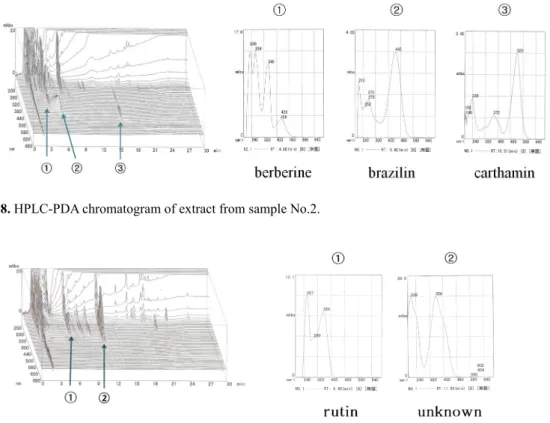
Figure 8은 법복졀복 표지(시료 No.2)에 대한 HPLC-PDA 분석결과이다. TR 4.28 분에서 황벽의 주요 색 소인 berberine이 검출되었으며, TR 5.92 분에서는 소목의 주요 색소인 brazilin이 검출되었고, TR 16.31 분에서는 홍 화의 주요 색소인 carthamin이 검출되었다. 한편 Figure 9 는 책갑의 꽃문양의 노란색 섬유에 대한 HPLC-PDA 분석 결과이며, TR 6.45 분에서 괴화의 주요 색소인 rutin이 검출 되었다.
Figure 8. HPLC-PDA chromatogram of extract from sample No.2.
Figure 9. HPLC-PDA chromatogram of extract from sample No.3.
일반적으로 녹색계와 청색계는 쪽을 사용한 복합염을 하는 것으로 알려져 있으나(Ishii et al., 2005; Cho, 2010) 본 시료 중 녹색과 청색인, 시료 No.1, No.5, No.7에서는 쪽의 주 색소성분인 indigo의 피크는 검출되지 않았고 TR
11.4~11.6 분대에서 노란색 계열의 색소피크가 초록색, 노 란색, 파랑색 섬유에서 나타났으나 기존의 데이터와는 일 치하지 않았다.
고문헌에 나타난 식물 염재는 50여종이며 염료식물은 문헌상 약 3,000종에 이른다(Kim and Lee, 2008). 한편 1856년 W.H.퍼킨에 의해 최초로 합성염료가 발명된 이후 천연재료들이 서서히 합성재료에 의해 대체되어갔다. 우 리나라 19세기말 탁지준절의 기록을 통해서 보면 개화 기 이후 서양에서 유입된 것으로 파악되는 양청, 양람, 양 적, 양홍, 양록, 양초록, 양옥색, 양보라, 양자적 등의 기록 이 발견되며 당시 프러시안 블루, 울트라마린 블루, 코발트 블루, 메틸렌 블루 등의 청색염료와 합성인디고 염료 등이 개발되었으며 카민안료, 합성알리자린의 홍색 염료, 말라 카이트 그린, 아이오딘 그린, 메틸 그린 등의 녹색계 염료, 모브, 바이올렛 등의 자색계 합성염료 등이 이미 개발되고
유통되고 있던 시기인 것으로 보아 당시 이 시기의 직물에 합성염료도 사용되었을 가능성도 있을 것으로 생각된다 (Kim, 2010).
4. 결 론
이상 오륜대 한국순교자박물관 소장의 국긔복소션
과 법복졀복, 첩갑의 표지직물에 대하여 조사하고 최소한의 시료로 HPLC-PDA에 의한 염료분석을 실시하였 다. 국긔복소션과 법복졀복의 표지직물은 수 자편복문단으로 이 중 적색의 법복졀복에서는 염 료분석 결과 berberine, brazilin, carthamin이 검출되어 황 벽, 소목, 홍화에 의한 복합염색에 의해 염색되었음을 알 수 있었다. 한편 첩갑의 표지직물은 화문직은단(花紋織銀 緞)으로 되어있으며 이에 사용된 편은사에 대한 EDX분석 결과 산화은과 알루미늄, 규소, 철 등이 검출되었다. 또한 책갑의 황색 섬유에서는 괴화의 주요성분인 rutin이 검출 되어 괴화에 의해 염색된 섬유를 사용했음을 알 수 있었다.
본 유물은 19세기 후반의 것으로 추정되며 19세기 말은 합
성염료가 도입되는 시기였으므로 이러한 점을 감안할 때 추후 초기합성염료와의 비교조사연구도 필요할 것으로 사 료된다.
사 사
이 논문은 2015년도 정부(교육부)의 재원으로 한국연구 재단의 지원을 받아 수행된 기초연구사업(NRF-2015R1D1A1A 02061580)이며 이에 감사드린다. 또한 본 연구의 염료분석 을 위해 도움을 주신 日本 共立女子大學 齊藤昌子 명예교 수님께 감사드린다.
REFERENCES
Ahn, C.S., 2007, Analysis of the degradation products of turmeric using GC-MS. Journal of the Korean Society of Clothing and Textiles, 31(6), 859-868. (in Korean with English abstract)
Ahn, C.S. and Obendorf, A.K., 2004, Dyes on archaeological textiles: Analyzing alizarin and its degradation products.
Textiles Research Journal, 74(11), 949-954.
Ahn, C.S., Zeng, X., Li, L. and Obendorf, S.K., 2014, Thermal degradation of natural dyes and their analysis using HPLC-DAD-MS. Fashion and Textiles, 1, 1-13.
Ahn, C.S., Zeng, X. and Obendorf, S.K., 2015, High- performance liquid chromatography-diode array detector- mass selective detector analysis of major natural dyes with the application of H2O2/ultraviolet treatment as a way to simulate burial degradation of textiles. Textiles Research Journal, 85(3), 238-250
Baek, Y.M., Kwon, Y.S., Goto-Doshida, S. and Saito, M., 2012, Analysis of dyes and mordants of 16~17th century textiles excavated from Daejeon. Journal of Conservation Science, 28(2), 119-129. (in Korean with English abstract) Chae, J.M. and Ryu, H.S, 2015, Identification of natural dyes used in 16th pink Dallryeong (Offical’s robe in Joseon Dynasty) excavated from Cheonan, Chungnam. Journal of Conservation Science, 31(3), 299-308. (in Korean with English abstract)
Cho, G.Y., 2005, A Study on the bookbinder and bookbinding in the late Joseon palace- The analysis of Seonwonboryak-
Sujeong-Uigue during King Yeongjo-. Bibliography Research, 31, 57-88. (in Korean with English abstract) Cho, K.R., 2010, Studies on the natural dyes. Hyungseul
Publishing, Seoul. (in Korean)
Cultural Heritage Administration, 2006, Important falk materials 2. (in Korean)
Fukatsu, Y., Kasasaku, N. and Saito, M., 2008, Scientific analysis of materials and techniques in purple woolen fabrics used for Japanese campaign coat from the Edo period. Journal of the Japan Society for the Conservation of Cultural Property, 53, 20-34. (in Japanese with English abstract)
Ha, S.H. and Kwon, Y.S., 2014, A study on the anniversary costumes for 19C royal women in Guk Gi Bok Sik So Seon. Journal of Korean Traditional Costume, 17(4), 71-86. (in Korean with English abstract)
Ha, S.H. and Kwon, Y.S., 2016, Royal female costumes of late 19th century in Sajeol Boksaek Sajang Yoram and
Beobbok Sajeol Bok Saek. Journal of Korean Traditional Costume, 19(2), 55-72. (in Korean with English abstract) Ishii, M., 2006, Scientific analysis of yellow dyes in historic
textiles and conservation research on fade prevention.
Ph.D. dissertation, Kyoritsu Women’s University, Tokyo.
(in Japanese with English abstract)
Ishii, M., Nagasaki, I., Ito, N. and Saito, M., 2005, HPLC analysis of natural yellow dyes and the identification of yellow and green dyes in Edo period kosode(kimono).
Journal of the Japan Society for the Conservation of Cultural Property, 49, 41-58. (in Japanese with English abstract)
Ishii, M. and Saito, M., 2007, HPLC analysis of natural yellow dyes in 18th century French silk textile. Journal of the Japan Society for the Conservation of Cultural Property, 52, 37-52. (in Japanese with English abstract) Kim, J.E., Yu, J.A., Han, Y.B. and Chung, Y.J., 2016, Study
of characteristics for red adhesive in traditional gold thread. Journal of Conservation Science, 32(1), 43-49. (in Korean with English abstract)
Kim, J.P. and Lee, J.J., 2008, Natural dyes in Korea- Traditional dyes and natural dyeing technology-. Seoul National University Press, Seoul. (in Korean with English abstract)
Kim, S.Y., 2010, Dyes and dyeing in Korea, from 1876 to 1910. Journal of the Korean Society of Costume, 60(9), 77-94. (in Korean with English abstract)
Komatsu, M., Nishioka, F. and Saito, M., 2005, Identification of red dyes and mordents used in 12th to 19th centuries Japanese armor. Journal of the Japan Society for the Conservation of Cultural Property, 49, 25-40. (in Japanese with English abstract)
Lee, Y.H., Lee, J.H., Kim, Y.S., Choi, S.C., Ham, S.W. and Kim, K.J., 2008, Investigation of natural dyes and ancient
textiles from Korea using TOF-SIMS. Applied Surface Science, 255(4), 1033-1036.
Sim, Y.O., 2002, 5000 years of Korean textiles. Institute for Studies of Ancient Textile, Seoul. (in Korean with English abstract)
Yun, E.Y. and Kwon, H.Y., 2013, Nondestructive analysis of textile dyed with traditional blue and green. Conservation Science in Museum, 14, 81-89. (in Korean with English abstract)