기후 환경 요인을 이용한 사과 ‘후지’의 과실 횡경 예측 모델 개발
한현희* · 한점화 · 정재훈 · 류수현 · 권용희 국립원예특작과학원 과수과
Development of Prediction Model on Fruit Width Using Climatic Environmental Factors in ‘Fuji’ Apple
Hyun Hee Han*, Jeom Hwa Han, Jae Hoon Jeong, Suhyun Ryu, and YongHee Kwon Fruit Research division, National Institute of Horticultural & Herbal Science, Wangju 55365, Korea
Abstract. In this study, we analyzed environmental factors including annual fruit growth and meteorological condi- tions in Suwon area from 2000 to 2014 to develop and verify a fruit width prediction model in ‘Fuji' apple. The 15-
year average of full bloom data was April 28 and that of fruit development period was 181 days. The fruit growth until 36 days after full bloom followed single sigmoid curve. The environmental factors affecting fruit width were BIO2, precipitation in September, the average of daily maximum and minimum temperature in April, minimum tem- perature in August, and growing degree days (GDD) in April. Among them, the model was constructed by combining BIO2 and precipitation in September, which are not cross-correlated with each other or, with other factors. And then, thefinal model was selected as 19.33095 + (5.76242 × BIO2) - (0.01891 × September precipitation) + (2.63046 × mini- mum temperature in April) which was the most suitable model with AICc of 92.61 and the adjusted R
2value of 0.53.
The model was compared with the observed values f rom 2000 to 2014. As a result, the mean difference between the measured and predicted values of ‘Fuji’ apple fruit width was ± 2.9 mm and the standard deviation was 3.54.
Additional key words : BIOCLIM, Meteorology, Akaike information criterion, Correlation analysis
서 론
과실의 품질 및 생산량을 결정하는 요인에는 과중, 횡 경, 종경, 당도 등을 들 수 있다. 특히, 과실의 크기는 시장에서의 가격수준을 결정하는 중요한 요인(Kim and Lee, 2005) 중의 하나이다. 따라서,
과실 크기 예측과 작 물 시뮬레이션 모델에서의 생산량 예측 등을 위해서는 과실의 생장 모니터링이 중요하다. 해마다 초기의 과실 생산량에 대한 예측은 사과 생산 가격, 유통 및 다른 특 성(품종, 판매 계획, 저장)과 같은 중요한 요인을 설정할 때 매우 유용하기 때문에 당해 년도의 시장 수급 계획 을 세우는데 필수적이다(Stajnko et al., 2009; Wulfsohn et al., 2012).
이러한 과실의 크기 및 품질에는 다양한 기상요인이 복합적으로 영향을 주는데(Kaack and Pedersen, 2010;
Park et al., 1995), 그 중에서 온도가 가장 큰 영향을 주 는 것으로 알려져 있다(Salisbury and Ross, 1991). 사과
의 과실 발달은 두 단계인 세포 분열과 세포 크기의 증 가(Austin et al., 1999)로 구분되는데, 생리학적으로 세 포 분열 속도는 최종 과실 크기를 결정한다(Goffinet et al., 1995). 따라서 세포분열시기의 기상 조건은 수확시기 의 사과의 중량에 크게 영향을 미친다(Austin et al., 1999)고 알려져 있다. 실제적으로, 이 시기에 기온이 높 을수록 세포분열이 왕성하여 과실크기가 커진다
(Calderón-Zavala et al., 2004; Warrington et al., 1999).Kim(2002)은 봄철 기온이 낮으면 과실나무의 그루당 착 과 수 및 과실의 무게에 부정적인 영향을 미치며, 과실 수확기의 많은 강수량은 감귤의 과실 비대에 긍정적인 영향을 준다고 분석하였고, Kim and Lee(2005)은 과실 비대기의 고온은 과실비대에 좋지 않은 영향을 줄 것으 로 추정하였고, 여름철 일조시간은 과실 비대에 좋은 영 향을 주며 품질을 결정하는 당도 또한 높아 질 것으로 예측했다. 한편, Endo(1975)는 수확기 과실 크기는 과실 비대 최성기인 3단계, 즉 7월 상순에서 9월 상순 사이의 과실 비대량의 영향을 크게 받는다고 하였다.
일반적으로 사과의 생산량 예측은 전년도의 격년결과 (Noguchiet et al., 2003) 유무와 당해년도의 기상과 관련
*Corresponding author: [email protected]
*Received July 07, 2017; Revised September 29, 2017;
*Accepted October 11, 2017
되어 있지만, 외국의 경우 대부분의 농가에서는 몇 나무 의 시각적 및 주관적인 관찰을 통해 사과 생산량을 예 측하는데 약 15-40%의 불확실성을 가진다고 알려져 있 다(Wulfsohn et al., 2012). 한국에서도 상황은 비슷하여 생산량 예측은 주산지별 표본 농가와 실측 조사 결과에 의존하고 있는 실정이다(Kim and Lee, 2005). 주요 선 진국들은 현장 조사 또는 확률 기반 샘플링 데이터를 생산량 예측에 활용하고 있고, 예측 모델은 착과량과 과 실 크기를 미리 계산된 생장곡선 및 과실 직경과 중량 간의 상관 관계와 결합시켜 사용하거나(Wulfsohn et al., 2012), 간단한 선형 또는 복잡한 곡선 투영법으로 과실 크기와 중량을 예측하는 방법(Austin et al., 1999;
Chakespari et al., 2010)을 이용하였다. 한편, 지난 수십 년간 Stajnko 등(2004, 2009)은 나무의 이미지를 캡처하 고 이미지를 자동으로 처리하는 시스템을 개발하여 과실 크기를 예측하였다.
생산량 예측을 위해서는 과중 예측 모델이 필요한데,
De Silva 등(1997)은 과실 직경으로 중량을 예측할 수 있 다고 연구한 것을 기초로 하여, 본 연구에서는 사과 ‘후지’의 생산량 예측의 과정으로 과실의 횡경을 예측할 수 있는 모델을 선발하고자 연차간 과실 생장과 기상을 포 함한 환경요인들을 이용하여 상관분석 및 모델 개발을 하여 검증을 실시하였다.
재료 및 방법
1. 만개기, 과실 생장 및 기상 자료 분석
사과(Malus domestica Borkh.) ‘후지'의 만개일과 만개 후 과실 생장은 수원의 국립원예특작과학원 과수원에서 2000년부터 2014년까지 조사된 자료를 이용하였다. 생물 계절 기준(Meier et al., 1994) 기준에 의하여, 만개기는
한 나무의 약 70~80% 개화 시 조사하였으며 수확기는 한 나무 내 70~80%의 과실이 성숙되는 시기로 과실 고 유의 색과 경도를 지니며 먹기 좋은 단계에 수확하였다.
2006년과 2010년은 만개일은 조사되었으나, 과실생장 조 사가 이루어지지 않아 과실생장 분석에서 제외하였고, 2014년에는 만개일이 조사되지 않았다. 연도별로 과실 크기를 조사한 날짜가 약간씩 달랐기 때문에 조사된 자 료를 조사 간격의 일수로 나누어 일 생장량으로 산출하 여 표기한 후 만개 후 10일 간격의 자료로 조정하여 분 석에 이용하였다. 과실 비대는 2차 적과가 완료된 만개 36일 후부터 자료 분석을 실시하였다. 생육기간 동안의 기상 자료는 2000년부터 2014년까지 기상청(KMA) 수 원기상대에서 측정된 기상 요인 중에서 평균기온, 최고 기온, 최저기온, 강우량, 일조시간 등의 일별 자료를 이 용하였다.
2. 생물기후변수(BIOCLIM)
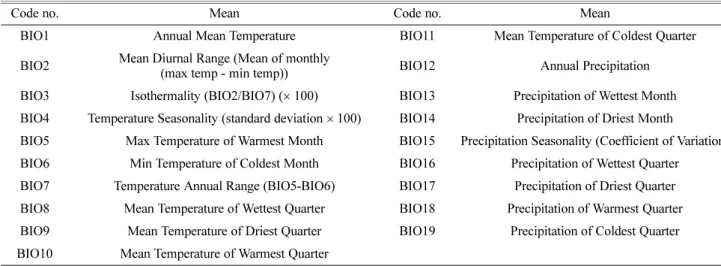
생물학적 의미를 가지는 기후변화 자료를 이용하여 19 개의 생물기후 변수들을 만들었다(Table 1). 생물기후변 수들은 수원의 월기상자료(최고온도, 최저온도, 강수량) 로부터 ArcGIS(ESRI, California, USA)와 Python (Python Software Foundation, Beaverton, USA) 프로그 램을 이용하여 자동화 스크립터를 제작하여 추출하였다.
생물기후 변수들은 연간 추세(연 평균기온, 연 강수량), 계절적 변동(기온, 강수량의 연간 범위), 그리고 극 또는 한계 환경변수(가장 춥거나 더운 달, 강수량이 많거나 건 조한 분기)들을 대표한다 (www.worldclim.org/bioclim).
3. 생육도일(Growing Degree Days, GDD)
Grossman 와 DeJong (1994)이 제안한 일 최고기온과 최저기온을 이용한 방적식으로 생육도일을 계산하였다.
Table 1. The code number and mean of BIOCLIM
Code no. Mean Code no. Mean
BIO1 Annual Mean Temperature BIO11 Mean Temperature of Coldest Quarter
BIO2 Mean Diurnal Range (Mean of monthly
(max temp - min temp)) BIO12 Annual Precipitation
BIO3 Isothermality (BIO2/BIO7) ( × 100) BIO13 Precipitation of Wettest Month BIO4 Temperature Seasonality (standard deviation × 100) BIO14 Precipitation of Driest Month
BIO5 Max Temperature of Warmest Month BIO15 Precipitation Seasonality (Coefficient of Variation)
BIO6 Min Temperature of Coldest Month BIO16 Precipitation of Wettest Quarter
BIO7 Temperature Annual Range (BIO5-BIO6) BIO17 Precipitation of Driest Quarter
BIO8 Mean Temperature of Wettest Quarter BIO18 Precipitation of Warmest Quarter
BIO9 Mean Temperature of Driest Quarter BIO19 Precipitation of Coldest Quarter
BIO10 Mean Temperature of Warmest Quarter
개화시작의 기본임계온도는 이전의 과수 연구에서와 같 이 7oC 기준으로 하였고(Zalom et al., 1983; DeJong and Goudriaan, 1989; Marra et al., 2002; Day et al., 2008), 월별로 4월부터 11월까지 나누어 각각 분석하였다.
*Σ : 1부터 n까지 합, tmax : 일 최고온도, tmin : 일 최저온도, b : 임계온도(7oC)
4. 통계분석 및 모델선택
사과 ‘후지’의 횡경과 환경요인의 상관분석(correlation analysis)을 기초로 상관계수를 이용하여 변수를 산정했 다. 2000년부터 2014년까지의 횡경과 1월부터 12월까지 의 월별 기상요인, BIOCLIM, 월별 GDD의 요인 중 어 떤 환경변수와 가장 관계를 나타내는지를 상관계수를 이 용하여 파악하였다. 모델의 적합도를 평가하는 지수는 매 우 다양하나 본 연구에서는 다중회귀모델을 평가하여 최 적의 모델을 선택하기 위하여 AIC(Akaike’s Information Criteria)와 정보이론접근법을 이용하였다(Gujarati and Porter, 2009). 이 모든 통계분석은 R프로그램을 이용하 였다.
AIC = n log(RSS/n) + 2K
*n: 표본수; RSS: 잔차 제곱합; RSS/n: MLE(최대가능추 정량); K: 추정가능 패러미터의 총수
결과 및 고찰
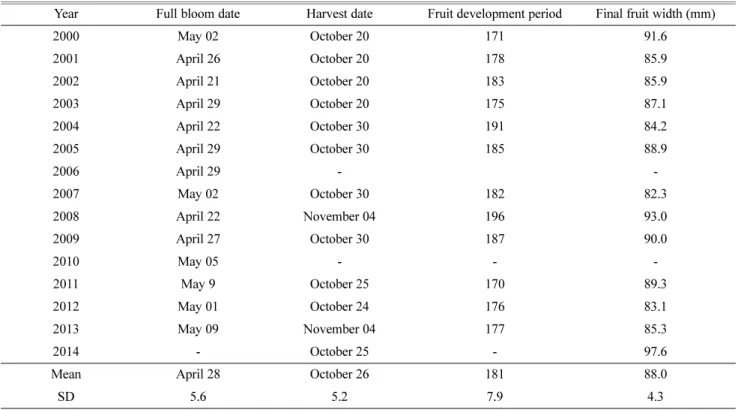
수원의 국립원예특작과학원 시험포장에서 재배되고 있 는 사과 ‘후지’ 품종을 2000년부터 2014년까지 15년간 만개일, 최종 수확일, 만개 후 생육일수 그리고 최종 수 확일의 과실 횡경을 조사하였다(Table 2). 만개일이 가장 빨랐던 해는 2002년으로 4월 21일이었으며, 가장 늦었 던 해는 2013년으로 5월 9일이었다. 2014년을 제외한 14년간의 평균 만개일은 4월 28일이었고 표준편차는 5.6 일이었다. 2006년과 2010년을 제외한 평균 수확일은 10 월 26일이었으며, 만개일과 수확일이 모두 조사된 해의 만개 후 수확일까지 성숙일수의 평균은 181일 이었다.
해당 연도의 기상에 따라 성숙일수의 차이가 많기는 하 지만 일반적으로 만생종인 ‘후지’의 이론적 수확 적기가 만개 후 180일이라는 기존의 연구(Hwang et al., 1998;
Song et al., 2003; Park et al., 2011)와 유사하였다.
만개 후 약 36일 이후부터 과실의 횡경을 10일간격으 로 조사하였으며, 그 생장 곡선은 Fig. 1과 같다. 일반적 으로 사과는 단일 S자 곡선의 생장을 하는 것으로 알려 져 있는데(Atkinson et al, 1995; Austin et al., 1999;
Warrington et al, 1999), 본 연구에서도 확인할 수 있었다.
GDD (tmax tmin+ ) ---2 –b
1 n
∑
=
Table 2. Full bloom date and mean final fruit width at harvest day after full bloom(DAFB) of ‘Fuji’ apple in Suwon for fifteen years.
Year Full bloom date Harvest date Fruit development period Final fruit width (mm)
2000 May 02 October 20 171 91.6
2001 April 26 October 20 178 85.9
2002 April 21 October 20 183 85.9
2003 April 29 October 20 175 87.1
2004 April 22 October 30 191 84.2
2005 April 29 October 30 185 88.9
2006 April 29 - -
2007 May 02 October 30 182 82.3
2008 April 22 November 04 196 93.0
2009 April 27 October 30 187 90.0
2010 May 05 - - -
2011 May 9 October 25 170 89.3
2012 May 01 October 24 176 83.1
2013 May 09 November 04 177 85.3
2014 - October 25 - 97.6
Mean April 28 October 26 181 88.0
SD 5.6 5.2 7.9 4.3
과실의 횡경에 영향을 미치는 최고·최저·평균온도, 강 수량, 일조량, BIOCLIM, GDD의 여러 환경요인 중에서 높은 상관 관계를 나타내는 요인들을 Table 3으로 나타 냈다. BIO2의 경우, 앞에서 설명한 바와 같이 평균일교 차를 의미하는데, ‘후지’품종의 경우 과실 횡경에 정의 영향을 미쳤으므로, 최고온도와 최저온도의 일교차가 심 할수록 횡경이 커진다는 것으로 해석할 수 있다. 사과 과 실은 주로 야간과 이른 아침에 생장하는데, 잎에서 과실 로의 가용물질 전이와 광합성을 촉진하는 주·야간의 온도 에 따라 달라진다(Jones, 1981). Bergh and Cloete(1992) 는 주간의 높은 온도보다 야간의 낮은 온도가 과실 횡경 생장에 더 영향을 미치는 인자이며, 야간 저온은 생장을 지연시킨다고 보고하였다. 본 연구에서는 모델 선발에 중점을 두었기 때문에 일교차에 관한 영향은 생리학적으 로 다시 접근할 필요성이 있을 것으로 생각된다.
9월의 강수량은 과실 횡경에 부의 상관관계를 나타내 었는데, 일반적으로 7월 상순에서 9월 상순의 과실비대 량이 수확시 과실 크기에 영향을 많이 미치는데(Endo, 1975), 일조시간(Kim and Lee, 2005)이 좋은 영향을 준 다고 하였다. 따라서, 일조와 부의 상관관계를 나타내는 9월의 많은 강수량은 과실 횡경 비대에 부정적인 영향을 미친 것으로 사료되었다. 단, 감귤에서는 과실 수확기의 많은 강수량이 과실 비대에 긍정적인 영향을 미친다는 연구(Kim, 2002)도 있었다.
4월의 평균기온, 최고기온, 최저기온 모두 과실 횡경과 정의 상관관계를 나타내었다. 과실의 크기는 개화부터
유과기까지의 기온이 높을수록 세포분열이 왕성하게 되 어 과실 크기가 커지는데(Calderón-Zavala et al., 2004;
Warrington et al., 1999), 최저기온이 높을수록 과실 횡 경이 증가되는 것은 아마도 만개기 등 빠른 생물계절로 인해 사과의 양·수분 이동이 먼저 이루어진 결과로 해석 되며, 평균기온의 상관은 최고기온과 최저기온의 차이로 서 최고기온과 최저기온이 모두 상관관계를 보인 결과로 생각되었다. 유사한 연구결과로 3월의 평균기온이 1oC증 가하면 단수가 평균적으로 120.95kg/10a 증가한다는 연 구도 있었다(Kim and Kim, 2014).
8월의 최저온도는 과실 횡경과 부의 상관관계를 나타 내었다. 최저 온도의 경우 일출직전에 가장 낮게 나타나 는데, 앞에서 언급한 바와 같이 낮은 온도는 과실 횡경 생장을 지체할 수 있다(Bergh and Cloete, 1992).
또한, 매월마다 기본임계온도 7oC의 누적시간을 계산 하여 상관관계를 분석하였는데, 4월의 생육도일이 과실 횡경과 정의 상관관계를 나타내었다. 이러한 결과는 앞 서 설명한 바와 같이 4월의 기온이 정의 상관관계를 나 타냈기 때문에 생육도일도 같은 경향을 보인 것으로 분 석되었다. 한편, 복숭아에서는 만개 후 30일까지의 생육 도일과 과실크기가 부의 상관관계를 나타내는 보고(Han, et al., 2016; Lopez and DeJong, 2007)도 있었다.
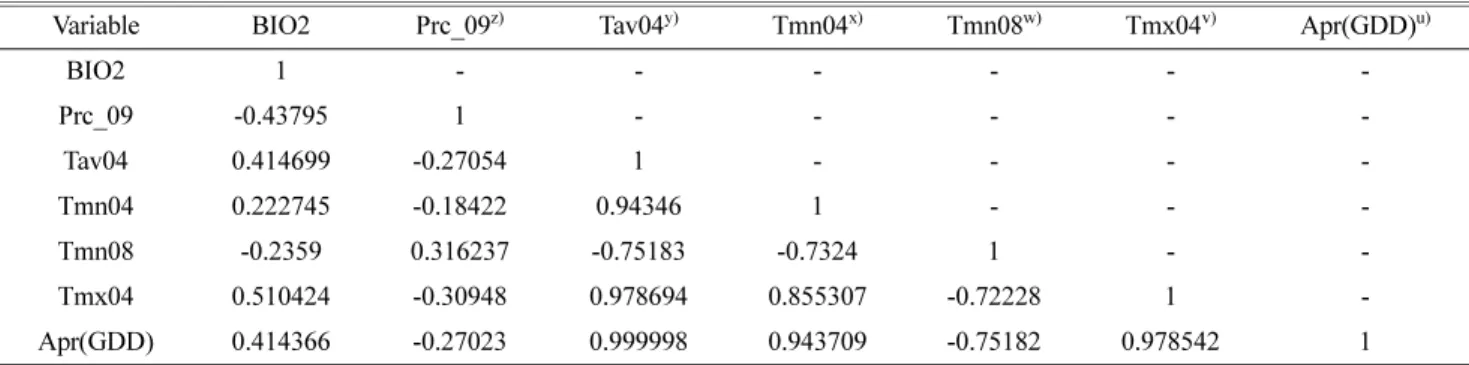
Table 3에서 제시한 환경요인들을 각 품종 간 서로 교 차상관 분석하였다(Table 4). Neter 등(1996)이 제안한 다중공선성(Multicollinearity) 교차상관계수의 ±0.75 이상 은 서로 간에 상관관계를 나타낸다고 분석하였다. 따라 서, BIO2와 9월의 강수량은 각각 다른 요인들과 상관관 계를 나태내지 않았는데, 이는 두 요인이 독립적으로 과 실 횡경에 영향을 미친다고 해석할 수 있었다. 반면, 4 월의 평균기온·최고기온·최저기온, 8월의 최저기온과 4월 의 생육도일은 서로 간에 높은 상관관계를 나타내었다.
따라서, 이들 요인 중에서 하나의 요인들만 선택하여 기 존에 독립적으로 영향을 미치는 BIO2와 9월의 강수량 요인들과 각각 조합하여 모델을 선발하였다(Table 5).
Table 5에서, 가장 좋은 모델은 BIO2, 9월 강수량, 4 월 최저기온 요인이 포함된 1번 모델(AICc=92.61)이며 보정된 결정계수(R2) 값은 0.53이었다. 이러한 결과는 배 의 연도별 과실 횡경과 누적 일조시수의 회귀분석 결과 R2값이 0.551 이었다는 보고(Han, et al., 2013)와 비슷한
Fig. 1. Annual diagram of fruit width in accordance with Julian
Day in ‘Fuji’ apple.
Table 3. Correlation coefficient between final width and environmental factors in ‘Fuji’ apple.
Cultivar BIO2 Prc_09
z)Tav04
y)Tmn04
x)Tmn08
w)Tmx04
v)Apr(GDD)
u)Fuji 0.58* -0.60* 0.64* 0.57* -0.56* 0.66* 0.64*
* Significant at P=0.05.
z
Prc_09 = September precipitation,
yTav04 = Average temperature in April,
xTmn04 = Minimum temperature in April,
wTmn08 = Mini-
mum temperature in August,
vTmx04 = Maximum temperature in April,
uApr(GDD) = Growing degree day accumulation in April.
수치를 나타내었다. 다른 모델들은 0.36-0.50의 보정된 R2 값을 나타내어 1번 모델보다 값이 낮았다. 따라서, 1번 모 델식을 선택하였으며 상수를 포함한 최종 모델식은 Table 6과 같다.
모델식의 BIO2, 9월 강수량, 4월의 최저온도 중에서도 BIO2의 상수(5.76242)가 다른 요인들(9월 강수량=0.02891;
4월 최저온도=2.63046)보다 커서 과실 횡경 크기에 가장 중요한 요인임을 확인 할 수 있었다. 또한 BIO2와 4월 최저온도는 정의 관계를 보였고, 9월 강수량은 부의 관 계를 보였다.
Table 6의 모델식을 2000년부터 2014년까지 2006년을 제외한 13년간의 BIO2, 9월 강수량, 4월 최저온도를 삽
입하여 예측치를 실측치와 비교하였다(Table 7). Table 7 에서 보는 바와 같이, 사과 ‘후지’ 과실 횡경의 실측치 와 예측치의 평균차이는 ±2.9mm, 표준편차는 3.54였다.
이 모델을 사용함에 있어 그 해의 과실 횡경을 예측하 려면 9월달의 강수량이 필요하므로 늦은 생육기에 예측 이 가능하다는 단점이 있다. 한편으로는, 횡경의 크기에 BIO2, 4월의 최저기온이 정의 영향을, 9월의 강수량이 부의 영향을 미치므로 신규 과원 재식시에 고려되어야 할 환경요인으로 이용될 수 있다. 추가적으로, 9월의 강 수량은 과실 횡경 평균인 87.64mm의 3.5%인 3.04mm 의 영향을 미쳐 다른 요인들보다 큰 변수로 작용하지 못했다(데이터 미제시).
Table 4. Cross-correlation (Pearson correlation coefficients, r) among selected variables on environmental factors in ‘Fuji’ apple.
Variable BIO2 Prc_09
z)Tav04
y)Tmn04
x)Tmn08
w)Tmx04
v)Apr(GDD)
u)BIO2 1 - - - - - -
Prc_09 -0.43795 1 - - - - -
Tav04 0.414699 -0.27054 1 - - - -
Tmn04 0.222745 -0.18422 0.94346 1 - - -
Tmn08 -0.2359 0.316237 -0.75183 -0.7324 1 - -
Tmx04 0.510424 -0.30948 0.978694 0.855307 -0.72228 1 -
Apr(GDD) 0.414366 -0.27023 0.999998 0.943709 -0.75182 0.978542 1
Note : Variable with r>±0.75 was in the same.
z
Prc_09 = September precipitation,
yTav04 = Average temperature in April,
xTmn04 = Minimum temperature in April,
wTmn08 = Mini- mum temperature in August,
vTmx04 = Maximum temperature in April,
uApr(GDD) = Growing degree day accumulation in April.
Table 5. Model evaluated for the fruit width in ‘Fuji’ apple.
Model no. Fruit width model AICc ΔAICc Adjusted R
2K
1 BIO2+Prc_09
z)+Tmn04
y)92.61 0.00 0.53 4
2 BIO2+Prc_09 93.31 0.70 0.36 3
3 BIO2+Prc_09+Tav04
x)93.55 0.94 0.50 4
4 BIO2+Prc_09+Apr(GDD)
w)93.56 0.95 0.50 4
5 BIO2+Prc_09+Tmx04
v)94.52 1.91 0.46 4
6 BIO2+Prc_09+Tmn08
u)95.09 2.48 0.44 4
Note : AICc is the Akaike’s Information Criterion corrected for small sample size; K is the number of estimable parameters in the model.
z
Prc_09 = September precipitation,
yTmn04 = Minimum temperature in April,
xTav04 = Average temperature in April,
wApr(GDD) = Growing degree day accumulation in April,
vTmx04 = Maximum temperature in April,
uTmn08 = Minimum temperature in August.
Table 6. Best model for the fruit width in ‘Fuji’ apple.
Predictor Parameter estimate Multiple R2 Adjusted R2 F P
(intercept) 19.331 0.64 0.53 5.93 0.01
BIO2 5.762
Prc_09
z)-0.019
Tmn_04
y)2.630
z
Prc_09 = September precipitation,
yTmn04 = Minimum temperature in April.
과실의 횡경(또는 직경)은 과중을 예측(Han et al., 2016; Hüsnü and Leylas, 2007; Ortega et al., 1998)할 수 있으며, 과중은 생산량을 예측할 수 있다(Kaack and Pedersen, 2010). 사과 ‘후지’의 횡경에 영향을 미치는 환경요인들의 분석은 최종적으로 생산량을 결정하는데 중요한 역할을 한다. 따라서, 과실의 횡경 예측 모델의 정확성은 정책적으로나 생산 및 유통의 측면에서 필수적 이므로 좀 더 정확하고 이른 생육 시기의 예측 모델을 위해 지속적인 개선이 필요하다.
적 요
본 연구는 사과 ‘후지’의 과실 횡경 예측 모델을 개발 하고 검증하고자, 수원지역에서 2000년부터 2014년까지 의 연차간 과실 생장과 기상을 포함한 환경요인들을 분 석하였다. 2000년부터 2014년까지의 평균 만개일은 4월 28일이었고, 만개 후 수확일까지의 성숙일수는 평균 181 일이었다. 만개 후 약 36일 이후부터의 과실 생장은 단 일 S자 곡선이었으며, 과실 횡경에 영향을 미치는 환경 요인들은 BIO2, 9월강수량, 4월 최고·최저·평균기온, 8월 최저기온, 그리고 4월의 생육도일이었다. 그 중에서, 서 로 간의 요인이 교차 상관관계를 나태내지 않는 BIO2와 9월 강수량을 각각 다른 요인들과 조합하여 모델을 만들 었다. 선발된 모델 중에서 AICc가 92.61이며 보정된 R2 값이 0.53으로 가장 적합도가 높았던 모델을 선택하였으 며 그 최종 모델식은 19.33095+(5.76242×BIO2)-(0.01891×9
월강수량)+(2.63046×4월최저온도)이었다. 이 모델을 2000 년부터 2014년까지의 실측치와 비교하였는데, 사과 ‘후 지’과실 횡경의 실측치와 예측치의 평균차이는 ±2.9mm, 표준편차는 3.54였다.
추가 주제어 : 생물기후변수, 기상학, Akaike 정보량기준, 상관분석
사 사
본 논문은 농촌진흥청 연구사업(세부과제번호: PJ0101 022017)의 지원에 의해 이루어진 것임
Literature Cited
Atkinson, C.J., L.Taylor, and J.M. Taylor. 1995. The influence of temperature and water supply on apple fruit growth and the development of orchard-grown trees. J. Hort. Sci.
70:691-703.
Austin, P.T., A.J. Hall, P.W.Gandar, I.J. Warrington, T.A. Ful- ton, and E.A. Halligan. 1999. A compartment model of the effect of early-season temperatures on potential size and growth of ‘Delicious’ apple fruits. Ann. Bot. 83:129-143.
Bergh, O. and V. De Cloete. 1992. Effect of different day and night temperature on the diurnal growth rate of terminal and lateral fruits in Golden Delicious apple. S. Afr. J. Plant Soil.
9:68-72.
Calderón-Zavala, G., N. Lakso, and R.M. Piccioni. 2004. Tem- perature effects on fruit and shoot growth in the apple (Malus domestica) early in the season. Acta Hort. 636:447- 453.
Chakespari, A.G., A. Rajabipour, and H. Mobli. 2010. Mass modeling of two apple varieties by geometrical attributes.
Aust. J. Agric. Eng. 1:112-118.
Day K, G. Lopez, and T.M. DeJong. 2008. Using growing degree hours accumulated thirty days after bloom to predict peach and nectarine harvest date. VIIIth ISHS on Model- ling in Fruit Research. Acta Hort. 80:163-166.
DeJong, T.M. and J. Goudriaan. 1989. Modeling peach fruit growth and carbohydrate requirements: reevaluation of the double-sigmoid growth pattern. J. Am. Soc. Hort. Sci.
114:800-804.
De Silva, H.N., D.S. Tustin, W.M. Cashmore, C.J. Stanley, G.
Lupton, and S.J. McArtney. 1997. Fruit fresh mass diameter relationship for ‘Royal Gala’ apple across seasons and among fruit production regions of New Zealand. Hort- Science. 32:1169-1173.
Endo, M. 1975. Studies on the daily change in fruit size of the Japanese pear. IV. Influence of shading on diurnal fluctua- tion of fruit. J. Japan. Soc. Hort. Sci. 43:347-358.
Goffinet, M.C., T.L. Robinson, and A.N. Lakso. 1995. A com-
Table 7. Modelled fruit width using selected model from 2000 to
2014 in ‘Fuji’ apple.
Year Observed Predicted Difference
2000 91.6 85.1 6.5
2001 85.9 89.1 -3.2
2002 85.9 90.6 -4.7
2003 87.1 85.7 1.4
2004 84.2 88.3 -4.1
2005 88.9 84.2 4.7
2007 82.3 82.4 -0.1
2008 93.0 92.6 0.4
2009 90.0 90.5 -0.5
2011 89.3 85.3 4.0
2012 83.1 86.6 -3.5
2013 85.3 83.2 2.1
2014 97.6 95.7 1.9
Mean ±2.9
SD 3.54
parison of Empire apple fruit size and anatomy in unthinned and had-thinned tress. J. Hort. Sci. 70:375-387.
Gujarati, D.N. and D.C. Porter. 2008. Basic Econometrics, McGraw-Hill.
Han, H.H., J.H. Han, J.H. Jeong, S.H. Ryu and Y.H. Kwan.
2016. Analysis of environmental factors for full bloom stage and fruit growth in peach. J. Climate Change Research.
7:493-498 (in Korean).
Han, J.W., I.C. Son, I.M. Choi, S.H. Kim, J.G. Cho, S.K. Yun, H.C. Kim, and T.C. Kim. 2013. Relationship between yearly fruit growth and climate factors in ‘Niitaka’ pear. Kor. J.
Hort. Sci. Technol. 31:8-13 (in Korean).
Hüsnü, D. and D. Leyla. 2007. Prediction model for estimat- ing peach fruit weight and volume on basis of fruit linear measurements during growth. J. Fruit Ornam. Plant Res.
15:65-69.
Hwang, Y.S., I. Kim and J.C. Lee, 1998. Influence of harvest date and postharvest treatments on fruit quality during stor- age and simulated marketing in ‘Fuji’ apples. Hortic., Envi- ron. Biotechnol. 39:574-578 (in Korean).
Jones, H.G. 1981. Carbon dioxide exchange of developing apple (Malus pumila Mill.) Fruits. J. Expt. Bot. 32:95-98.
Kaack, K. and H.L. Pedersen. 2010. Prediction of diameter, weight and quality of apple fruit(Malus domestica Borkh) cv. ‘Elsta’ using climatic variable and their interaction.
Europ. Hort. Sci. 75:60-70.
Kim, C.M. 2002. Effects of climatic parameters on flowering, fruiting and fruit quality of Satsuma Mandarin (Citrus unshiu Marc.) in Jeju island, Department of Horticulture, Jeju University (in Korean).
Kim, K.P. and W.J. Lee. 2005. A study on improvement in forecasting production of apple. Korea Rural Economic Institute (in Korean).
Kim, M.R. and S.G. Kim. 2014. Examining impact of weather factors on apple yield. Kor. J. Agr. For. Met. 16:274-284 (in Korean).
Lopez, G. and T.M. DeJong. 2007. Spring temperatures have a major effect on early stages of peach fruit growth. J. Hortic.
Sci. Biotechnol. 82:507-512.
Marra, F.P., P. Inglese, T.M. DeJong, and R.S. Jhonson. 2002.
Thermal time requirement and harvest time forecast for peach cultivars with different fruit development periods.
Proc. 5th IS on Peach. Acta Hort. 592:523-529.
Meier, U., H. Graf, H. Hack, M. Hess, W. Kennel, R. Klose, D. Mapples, D. Seipp, R. Stauss, J. Streif, and T. Van den boom. 1994. Phanologische entwick-lungsstadien des ker- nobstes (Malus domestica Borkh. und Pyrus commuis L.), des steinobstes (Prunus-Arten), der Johannisbeere(Ribes- Arten) und Erdbeere(Fragaria x ananassa Duch.). Nach-
richtenbl. Deut. Pflanzenschutzd. 46:141-153.
Neter, J., M.H. Kutner, C.J. Nachtsheim, and W. Wasserman.
1996. Applied linear statistical models: regression, analysis of variance, and experimental designs. Fourth edition. Irwin, Chicago, Illinois, USA.
Noguchi, Y., K. Sakai., S. Asada, L. Garciano, and A. Sasao.
2003. Modeling of alternate bearing in Satsuma Mandarin- linear dynamic model based on ensemble set for harvested fruits number. Japan J. Agric. Eng. 65:55-61.
Ortega, S., S. Fuentes, and J.B. Retamales. 1998. Models for predicting fruit diameter of Packham’s Triumph Pears. Acta Hort. 475:295-302.
Park, M.S., Y.J. Kim, H.K. Park, Y.S. Chang, and J.H. Lee.
1995. Using air temperature and sunshine duration data to select seed production site for Eleutherococcus senticosus Max. Kor. J. Crop. Sci. 40:444-450 (in Korean).
Park, Y.M., H.G. Park and B.S. Lim. 2011. Analysis of post- harvest 1-MCP treatment and CA storage effects on quality changes of ‘Fuji’ apples during export simulation. Kor. J.
Hort. Sci. Technol. 29:224-231 (in Korean).
Salisbury, F.B. and C.W. Ross. 1992. Plant physiology. 4th ed.
Wadsworth, Belmont, California, p. 329-355, 551-574, 585.
Song, K.J., J.H. Hwang and H.K. Yun. 2003. Changes of sol- uble sugar and starch concentration in fruits of apple culti- vars differing in maturity. Hortic., Environ. Biotechnol.
44:207-210 (in Korean).
Stajnko, D., M. Lakota, and M. Hocevar. 2004. Estimation of number and diameter of apple fruits in the orchard during the growing season by thermal imaging. Comput. Electron.
Agric. 42:31-42.
Stajnko, D., J. Rakun, and M. Blanke. 2009. Modeling apple fruit yield using image analysis for fruit colour, shape and texture. Eur. J. Hort. Sci. 74:260-267.
Warrington, I.J., T.A. Fulton, E.A. Halligan, and H.N. De Silva. 1999. Apple fruit growth and maturity are affected by early season temperatures. J. Am. Soc. Hort. Sci. 124:468- 477.
Wulfsohn, D., F. Aravena Zamora, C. Potin Téllez, I. Zamora Lagos, and M. García-Finana. 2012. Multilevel systematic sampling to estimate total fruit number for yield forecasts.
Prec. Agric. 13:256-275.
Zadraver, P., R. Veberic, F. Stampar, V. Schmitzer and K. Eler.
2014. Fruit growth patterns of four apple cultivars using nonlinear growth models. Europ. J. Hort. Sci. 79:52-59.
Zalom F.G., P.B. Goodell, L.T. Wilson, W.W. Barnett, and W.J.
Bentley. 1983. Degree-days: the calculation and use of heat units in pest management. In: Leaflet 21373. Division of Agriculture and Natural Resources, University of Califor- nia, Berkeley.