Vol.31(2): 77~86 (2004)
고분자 키토산 처리가 딸기 과실의 품질과 부패에 미치는 영향
황용수*ㆍ구자형
Effect of High Molecular Weight Chitosan on the Quality and Decay of Strawberry Fruits
Hwang, Yong-SooㆍKu, Ja-Hyeong
ABSTRACT
This study was aimed to determine the effect of high molecular weight chitosan treatment on the decay incidence and fruit quality in strawberries. Preharvest spray of chitosan (0.2%) effectively reduced the incidence of grey mould and increased fruit firmness. Chitosan application was also effective on remaining of surface gloss. This is probably due to coating effect.
Physiological disorders were not found in treatment of 4 sprays. Internal quality such as soluble solid content and acidity seemed not to be affected by chitosan application. The effect of chitosan on keeping freshness was clear in fruit without physical damage at harvest, but much less effective in injured fruit. Postharvest application of chitosan did not affect fruit quality. Above results indicated that chitosan is an alternative to keep strawberry quality through delaying decay and keeping firmness.
Keywords : firmness, acidity, soluble solids, marketability, injury
1
충남대학교 농업생명과학대학 식물자원학부 (Div. of Plant Science and Resources, College of Agriculture and Life Sciences, Chungnam National University, Daejeon 305-764, Korea)
*교신저자 : 황용수(E-mail : [email protected], Tel : 042-821-5738)
서 론
딸기는 부패성이 매우 강한 작물로 수확 또는 수확 후 관리 과정에서 받는 물리적 손상, 건조, 생리적 장해 및 부패에 취약하다. 잿빛곰팡이병 과 무름병은 딸기의 부패를 일으키는 중요한 병 으로 이들 병의 관행적인 방제수단은 재배기간 중 살균제를 간헐적으로 처리하는 것이다. 수확 한 과실에서 병의 발생을 억제하기 위해서는 신 속한 냉각과 고농도의 이산화탄소 처리로 부패균 의 생장을 지연시킬 수 있으나(Mass, 1981) 장시 간 고이산화탄소에 노출시키는 것은 과실의 장해 를 일으킬 우려가 있으며 저온관리 만으로는 이 들 병해를 완전히 억제하기 어렵다.
딸기는 일시에 수확하는 작물이 아니므로 수확 기에 접어들어서도 지속적으로 재배관리를 해야 하며 병의 발생을 억제하기 위해서 화학적 방제 를 실시하는 것이 일반적이다. 그러나 최근 잔류 농약에 대한 소비자의 우려를 불식시키기 어려워 새로운 대안을 모색할 필요성이 제시되고 있다 (Tripathi와 Dubey, 2004). 대체수단으로 다양한 천연물질 또는 식물추출물 등이 제시되고 있는데 이들 중에는 acetic acid, jasmonate, propilis, essential oil 및 키토산 등이 포함된다.
키토산은 고분자화합물로 기본 분자는 β-(1,4) -glucosamine polymer이며 일부 식물병원균의 세 포벽 기본 골격을 이루기도 하고 또한 갑각류 외피 를 구성하는 성분으로 키틴의 deacetylation 반응에 의하여 생산된다(Rege와 Block, 1999; Shahidi 등, 1999). 제조방법에 따른 키토산의 차이는 크지 않지만 반응온도가 분자량과 deacetylation 정도 에 영향을 미친다.
키토산의 항균작용은 널리 알려져 있어 식품과 관련하여 식품첨가제, 식용필름제조, 식이섬유 또
는 음용수 정화 등의 다양한 용도로 활용되고 있 다(Shahidi 등, 1999). 청과물에 대한 키토산 처리 효과를 검토한 연구에서 키토산 처리는 수확한 작물의 갈변을 억제하고 안토시아닌 감소를 억제 시켜 외관품질을 유지시키며 당 및 산의 감소를 억제하는 효과가 롱간(Jiang과 Li, 2001), 리치 (Zhang과 Quantick, 1997; Jiang 등, 2004), 자두 (Ruoyi 등, 2004), 딸기(Bhaskara-Reddy 등, 2000;
Devlieghere 등, 2004) 및 오렌지(El-Ghaouth 등, 2000; Galed 등, 2004)에서 보고되었다. 또한 키 토산 첨가 필름을 이용할 경우 여러 채소작물의 저장성을 증진시킨다고 하였다(Makino와 Hirata, 1997). 키토산의 항균작용은 숙주식물의 salicylic acid 수준을 증가시켜 항균기작을 높이거나 (Sathiyabama와 Balasubramanian. 1998; Molloy 등, 2004) 또는 병원균의 polygalacturonase 활성 을 억제시켜 균사의 침입을 제어하기 때문인 것 으로 보고되었다(Ghaouth 등, 1997). 한편 딸기에 대한 수확전후 키토산 처리효과를 검토한 연구에 서 Bhaskara-Reddy 등(2000)은 6gㆍL-1 농도에 서도 작물에 피해를 일으키지 않으며, 키토산 처 리농도가 높을수록 또는 누적적으로 처리할 때, 부패억제에 효과적이고 키토산 처리는 과실의 경 도를 증진시키지만 성숙을 다소 지연시키는 것으 로 밝혔다. 수확한 딸기에 대한 처리에서 Devlieghere 등(2004)은 최대 12일 저장기간 중 항균작용을 유지하며 특히 gram-negative 균에 대한 항균효과가 우수하다고 하였다. Han 등 (2004)은 키토산 코팅은 신선딸기 뿐아니라 냉동 딸기의 품질을 증진시킨다고 하였는데 키토산을 처리할 때 칼슘 또는 DL-
-tocopheryl acetate 등을 첨가하여 딸기의 식품 기능성을 향상시킬 수 있는 가능성도 제시하였다. 또한 사과 등에서 도 키토산 처리에 의한 왁스대체 효과가 검토된바 있다(Hwang 등, 1998).
본 연구에서는 국내 딸기 생산에서 많은 문제 가 되고 있는 병해를 억제하기 위하여 수확 전후 키토산 살포를 통한 딸기 과실의 품질과 부패 억 제의 가능성을 살피고자 하였으며 누적 처리의 효과도 아울러 검토하였다.
Ⅰ. 재료 및 방법
논산지역의 하우스 재배 딸기 농가의 하우스 1 동을 선정하여 두 골은 처리구로 다른 두 골은 대조구로 양분하였다. 딸기 품종은 ‘토치히토메’
이었으며 약제 처리는 고분자 키토산[2%, 평균 분자량 1000KDa, (주) 금호화성]을 10배로 희석 (키토산 약 0.2%)하여 3월 23일, 3월 31일, 4월 6일, 4월 13일 각각 4회 살포하였다. 대조구에는 아무런 처리를 실시하지 않았다. 1차 처리 8일 후 과실을 최소 8kg들이 3상자씩 무작위로 수확 하여 처리별 부패과 발생율을 조사하였다. 수확 한 과실은 관행적인 스티로폼 포장용기(8kg)에 담아 실험실로 수송한 다음 물리적 손상의 발생 정도를 살펴 상품성을 상실한 과실은 제거하고 건전과와 물리적 손상이 있으나 상품성이 있는 과실을 손상과로 구분하여 실험에 이용하였다.
수확 후 처리에서는 동일한 농도의 키토산 용 액을 과실에 살포한 다음 표면을 건조시켜 스티 로폼 접시에 담아 PVC 랩으로 포장하여 0℃에 저장하였다. 저장을 마친 과실의 반은 저장직후 즉시 조사하였고 나머지 반은 상온에 3일간 노출 시킨 다음 조사하였다.
수확 전후 처리의 효과를 검토하기 위하여 4회 누적 처리한 다음 10일 후(4월 23일) 무작위로 수확하여 스티로폼 상자(8kg 들이)에 담아 실험
실로 수송한 다음 물리적 손상을 받은 과실의 비 율을 조사하였으며 기타의 실험은 전술한 바와 같다. 외관품질은 육안으로 외형을 살펴 조사하 였는데 외적 품질의 등급에 따라 5(매우 우수)에 서 1(매우 나쁨)으로 구분하였으며 2점 이하는 상품성을 상실한 것으로 간주하였다. 특히 상품 성을 상실한 과실 중 육안으로 관찰하였을 때 균 사가 관찰된 것을 부패과로 간주하였다.
과실 품질요소인 경도, 당, 산함량을 조사하였 는데 경도는 과실을 종방향으로 길게 절반으로 잘라 과실 중앙부위, 과피 방향에서 경도를 측정 하였다. 경도는 rheometer (Compac 100, Sun Scientific Co., Japan)을 이용하여 10mm plunger 를 장착하여 조사하였다. 경도는 처리별로 유사 한 크기의 과실을 반복당 20개씩 선별하여 3반복 으로 조사하였다. 과피색은 색도차계(Minolta CR- 200, Japan)를 이용하여 L, a, b값을 결정한 다음 이를 hue angle로 환산하여 표시하였다. 표피색 은 경도와 동일한 반복으로 수행하였다. 과피색 을 조사한 다음 동일한 과실의 절반을 이용하여 8겹의 cheese cloth로 감싸 과즙을 채취한 다음 굴절당도계(Atago, Japan)로 가용성고형물함량 을 조사하였고 산함량은 과즙을 10배로 희석하여 0.1N NaOH로 적정하여 사과산 함량으로 환산하 였다. 고형물과 산함량은 각각 3반복으로 조사하 였다. 부패율은 육안으로 과실을 살펴 작은 부패 반점 혹은 무름증상이 관찰되며 모두 부패한 것 으로 판단하였으며 부패율은 반복없이 pooled sample에 대하여 조사하였다.
Ⅱ. 결과 및 고찰
키토산 용액을 1차 살포한 8일 후 무작위로 과
Table 1. Effect of preharvest chitosan spray on the percentage of marketable fruit and quality in strawberries
Treatment Marketable
fruit(%)
Firmness (kg)
Soluble Solids (oBrix)
Acidity (%)
Untreated 62.9z 0.66±0.08y 12.3±0.53 0.49±0.02
Chitosan 0.2% 74.9 0.81±0.17 13.5±0.61 0.55±0.02
zPooled data of 3 boxes(8kg/box).
yData were collected at 8 days after chitosan spray and the average of 3 replications±SD.
Table 2. Effect of preharvest spray of chitosan on the marketability in strawberry fruits
Treatment Physical injury
Marketable fruit(%)
Unmarketable fruits(%) Untreated None 77.6 20.7( 3.5)z Injured 23.4 76.6(21.3) Chitosan
0.2%
None 80.0 20.0(13.3)
Injured 62.5 37.5(27.1)
zData were collected from pooled sample and exposed to ambient temperature for 3 days before examination.
Numbers in parenthsis indicated the percentage of decayed fruit due to grey mould.
실을 수확하여 판매 가능한 과실비율을 비교하였 다(표 1). 상품과 비율은 키토산 처리구에서 무 처리에 비하여 12% 높게 조사되었다. 수확한 딸 기가 상품성을 상실한 원인은 주로 잿빛곰팡이병 과 무름병에 의한 것이었는데 처리구에서 상품과 율이 높았던 원인은 키토산 처리에 의하여 재배 지의 병 발생이 억제되었기 때문으로 판단된다.
과실품질에서도 다소간 차이를 보였는데 경도, 가용성 고형물, 및 산함량이 모두 높게 측정되었 다. 이러한 결과가 키토산 처리의 직접적인 영향 인지는 명확하지 않으나 Bhashara-Reddy 등 (2000)은 수확전 키토산 살포가 딸기 과실의 경 도를 증진시키며 반면에 성숙을 지연시킨다고 하
였다. 비록 통계적 유의차는 없었으나 산과 가용 성 고형물 수준이 처리구에서 높았던 것은 과실 의 편차에 기인하였을 가능성도 있다.
수확한 과실 중 상품성이 없는 과실을 제거하 고 육안으로 살펴 물리적 손상이 있으나 상품성 을 유지하고 있는 과실과 외적 손상이 없는 과실 을 구분하여 PVC 랩으로 소포장한 다음 상온에 3일간 노출시키고 품질을 비교하였을 때(표 2), 건전한 과실에 대하여 처리하였을 때에는 상품성 을 지니고 있는 과실의 비율에서 처리간 차이가 크지 않았으나 물리적 손상을 받은 과실에 처리 하였을 때에는 많은 차이를 나타내어 수확전 키 토산 처리 효과가 현저히 우수한 것을 알 수 있 었다. 그러나 비상품과 중 잿빛곰팡이에 감염된 과실의 비율은 건전한 과실에서보다 손상을 받은 과실에서 심하였고 처리간 차이도 뚜렷하지 않았 다. 이러한 결과는 손상을 받은 과실의 경우 수확 과정 또는 그 이후의 처리과정에서 병원성 미생물 과 접촉할 기회가 많기 때문에 수확전 키토산 처 리 효과가 감소하기 때문인 것으로 추정된다.
동일한 포장에서 1차 처리 8일 및 15일 후에 각각 키토산을 처리하고 식물 생육을 관찰하였을 때 키토산 처리에 따른 생리적 장해는 관찰되지 않았다. 키토산 처리기간 중 건조한 날씨가 계속 되어 잿빛곰팡이 발생이 대조구에서도 현저히 감
소하였는데 처리에 관계없이 감염된 화총과 과실 이 말라버리는 현상이 관찰되었으나 처리간 차이 는 확인되지 않았다.
키토산 누적처리 효과를 비교하기 위하여 2회 처리한 4월 6일과 3회 처리한 4월 10일 각각 수 확한 과실을 대상으로 부패율을 조사한 결과(표 3) 키토산 처리에서 21.4%, 무처리는 30.9%로 처리구의 부패율이 다소 낮았다. 그러나 4월 10 일 수확한 과실에서는 처리간 차이가 다소 감소 하였으나(표 3) 4월 6일 조사하였을 때보다 차이 가 적어진 결과를 보였다. 이러한 결과는 실험이 진행되는 기간 중 건조한 날씨가 계속되어 무처 리에서도 잿빛곰팡이 발생이 현저히 감소하였기 때문으로 추정된다.
Table 3. Effect of cummulative application of chitosan on marketability and decay in strawberries.
Date of harvest
Application
timesz Treatment Decay (%)
Marketable fruit(%)
April 6 0 Untreated 30.9 69.1
2 Chitosan
0.2% 21.4 78.6
April 10 0 Untreated 42.1 57.9
3 Chitosan
0.2% 37.9 62.1
zChitosan was sprayed on Mar. 23, Mar. 31 and April 6, respectively.
Table 4. Effect of cummulative application of chitosan on the quality of strawberries Date of
harvest
Application
timesz Treatment Firmness
(Kg)
Soluble Solids (oBrix)
Acidity (%)
April 6 0 Untreated 0.69±0.09y 13.5±0.7 0.73±0.01
2 Chitosan 0.2% 0.96±0.15 10.3±1.5 0.85±0.06
April 10 0 Untreated 0.63±0.11 11.4±0.1 0.77±0.0
3 Chitosan 0.2% 0.67±0.13 11.6±0.0 0.82±0.0
zChitosan was sprayed on Mar. 23, Mar. 31 and April 6, respectively.
yData were the average of 3 replications±SD
처리구별로 과실의 일반적 품질을 비교하였을 때 특징적인 차이는 관찰되지 않았으며 개체간에 편차가 비교적 심하여 일정한 경향을 찾을 수 없 었으며(표 4) 수확시기에 따른 차이도 관찰되지 않았다. 반면에 키토산 처리구의 과실은 무처리 구에 비하여 경도가 지속적으로 높은 경향을 보 여주었다.
4월 6일 수확한 과실 중 외형이 손상되지 않은 과실을 선별하여 PVC랩으로 포장한 다음 3일간 상온에 방치하며 부패율을 살피고 상품화에 적합 한 품질을 지닌 비율을 조사한 결과 부패율은 무 처리에서 66.7%로 매우 높았고 키토산 처리에는 34.2%에 불과하였다. 따라서 판매 가능한 개체의 비율이 무처리의 경우 33.3%, 처리구는 65.8%로 현저한 차이를 보였다(표 5). 품질 비교에서 키 토산 처리 과실의 경도가 다른 처리에 비하여 상 대적으로 높게 유지되었으며 당, 산의 함량은 특 징적인 차이를 나타내지 않았다.
4월 6일에 수확한 과실(2회 처리) 중 약간의 물리적 손상을 받은 과실을 대상으로 반복없이 0℃에 3일간 저장한 다음 부패율을 조사하였을 때 무처리구의 과실은 90.0%가 부패한 반면 키 토산 처리구의 과실은 41.7%가 부패하여 저온에 서 키토산 처리효과가 유지되는 것으로 나타났 다. 따라서 무처리의 경우를 살펴볼 때 저온만으
Table 5. Effect of preharvest spray of chitosan on the marketability and quality in strawberries exposed to ambient temperature for 3 days.
Treatment Marketable fruit
(%)
Firmness (kg)
Soluble solids (oBrix)
Acidity (%)
Untreated 33.3z 0.67±0.13y 9.9±0.62 0.90±0.13
Chitosan 0.2% (2 sprays) 65.8 0.82±0.13 11.0±0.01 0.87±0.04
zFruit were harvested on April 6 and data were collected from pooled sample.
yData were the average of 3 replications±SD.
Table 6. Strawberry fruit quality as influenced by 4 applications of chitosan.
Treatmentz Marketable
fruit (%) Hue value Firmness
(kg) Solids (oBrix) Acidity (%)
Untreated 62.4y 30.9±3.8x 0.43±0.09 9.0±0.13 0.71±0.01
Chitosan 0.2% 73.5 27.6±2.6 0.47±0.04 8.4±0.26 0.70±0.07
zChitosan (0.2%) was sprayed 4 times. yData from pooled sample.
xAverage of 3 replications±SD.
로 잿빛곰팡이병을 방제하기는 어려울 것으로 판 단되었다.
4월 10일 수확한 과실(3회 처리)를 대상으로 유사한 실험을 수행하였을 때 키토산 처리의 효 과는 명확하였으나 누적 처리효과는 현저하지 않 은 것으로 나타났다(미발표자료).
4월 13일까지 4회 누적 처리한 다음 4월 23일 과실을 무작위로 실험실로 수송한 다음 처리간 품질을 비교하였다(표 6). 실험실로 수송한 과실 을 대상으로 상품과율을 비교하였을 때 키토산 처리구의 비율이 다소 높아 키토산 처리효과가 10일 후까지 지속되는 것으로 판단되었다. 과피 색은 통계적 유의차는 없었지만 키토산 처리구에 서 hue 값이 27.6으로 다소 짙은 적색을 나타내 어 기존의 보고와 상이한 결과(Bhraska-Reddy 등, 2000)를 보였다. 그러나 수확한 시기가 4월 하순으로 기온이 매우 더운 시기이므로 과실생장
이 빨라 개체간 편차에 의한 결과일 가능성도 있 다. 경도는 과피색이 더욱 짙은 과실이었음에도 불구하고 처리구 과실의 경도가 다소 높았는데 이러한 결과는 키토산의 효과에 의한 것으로 판 단된다. 그러나 가용성고형물 및 산함량은 큰 차 이를 나타내지 않았다.
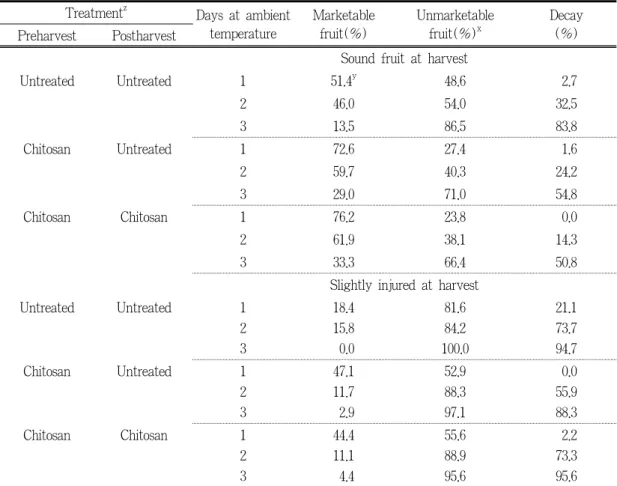
전술한 실험과 마찬가지로 선별한 과실 중 육 안 관찰로 물리적 손상이 없는 과실과 다소 손상 을 받았으나 상품성을 상실하지 않은 과실을 구 분하여 키토산을 살포한 다음 상온에 3일간 노출 시키며 부패율을 조사하였다(표 7).
처리 전 물리적 손상을 받지 않은 과실을 대상 으로 조사한 결과에서 무처리 과실의 경우, 상온 노출 3일에 부패율이 83.8%에 달하였고 대부분 의 과실이 잿빛곰팡이에 감염된 것으로 관찰되었 다. 반면에 키토산의 경우에는 54.8%로 낮았다.
그러나 수확 후 키토산을 재처리한 경우에도 부
패율은 50.8%로 수확전 처리와 큰 차이를 나타 내지 않았다.
상품성을 지니고 있는 과실의 비율을 비교하였 을 때에도 처리간 차이가 확인되었는데 무처리의 경우 판매 가능한 과실 비율이 13.5%에 불과하 였으나 수확전후 처리에 관계없이 키토산 처리구 의 판매 가능한 과실 비율은 29-33.3%로 높았다.
그러나 수확 후에 키토산을 재처리한 경우에도 그 효과가 뚜렷이 증진되지 않았다.
Table 7. Marketability of strawberry fruit as influenced by pre- and post-harvest application of chitosan.
Treatmentz Days at ambient temperature
Marketable fruit(%)
Unmarketable fruit(%)x
Decay Preharvest Postharvest (%)
Sound fruit at harvest
Untreated Untreated 1 51.4y 48.6 2.7
2 46.0 54.0 32.5
3 13.5 86.5 83.8
Chitosan Untreated 1 72.6 27.4 1.6
2 59.7 40.3 24.2
3 29.0 71.0 54.8
Chitosan Chitosan 1 76.2 23.8 0.0
2 61.9 38.1 14.3
3 33.3 66.4 50.8
Slightly injured at harvest
Untreated Untreated 1 18.4 81.6 21.1
2 15.8 84.2 73.7
3 0.0 100.0 94.7
Chitosan Untreated 1 47.1 52.9 0.0
2 11.7 88.3 55.9
3 2.9 97.1 88.3
Chitosan Chitosan 1 44.4 55.6 2.2
2 11.1 88.9 73.3
3 4.4 95.6 95.6
zChitosan (0.2%) was sprayed 4 times before harvest and reapplied after harvest as postharvest treatment.
yData were collected from pooled sample without replication.
xUnmarketable fruit were defined by appearance quality loss due to dessication and decay.
외적 품질을 관능적으로 비교하였을 때, 키토 산을 처리한 과실은 과피의 광택이 유지되고 있 었으나 무처리에서는 과피가 다소 건조한 느낌을 주어 외적 품질이 키토산 처리에 비하여 낮았다.
또한 이러한 현상 때문에 비록 곰팡이가 증식되 지 않았을지라도 판매 가치를 상실하는 것으로 나타났다. 물리적 손상을 받지 않은 과실과 달리, 손상을 받은 과실에 대한 처리 효과는 훨씬 떨어 졌는데 상온 노출 1일까지는 처리간 차이가 명확
Table 8. Strawberry fruit quality as influenced by pre- and post-harvest application of chitosan.
Treatment
Hue value Firmness (kg)
Soluble solids (oBrix)
Acidity Preharvest Postharvest (%)
Sound fruit at harvest
Untreated Untreated 26.6±2.4z 0.37±0.05 8.12±0.09 0.84±0.02
Chitosan Untreated 26.1±1.9 0.39±0.05 8.29±0.31 0.92±0.01
Chitosan Chitosan 26.6±2.6 0.45±0.01 7.98±0.08 0.90±0.01
Slightly injured fruit at harvest
Untreated Untreated 26.8±3.3 0.34±0.06 8.67±0.22 0.80±0.06
Chitosan Untreated 28.5±4.2 0.34±0.04 8.27±0.24 0.78±0.01
Chitosan Chitosan 29.4±2.4 0.39±0.05 7.60±0.40 0.81±0.01
zData were collected 3 days after exposure to ambient temperature and the average of 3 replications±SD.
Others are same in table 7.
하였으나 3일 후에는 키토산의 효과가 인정되지 않았다.
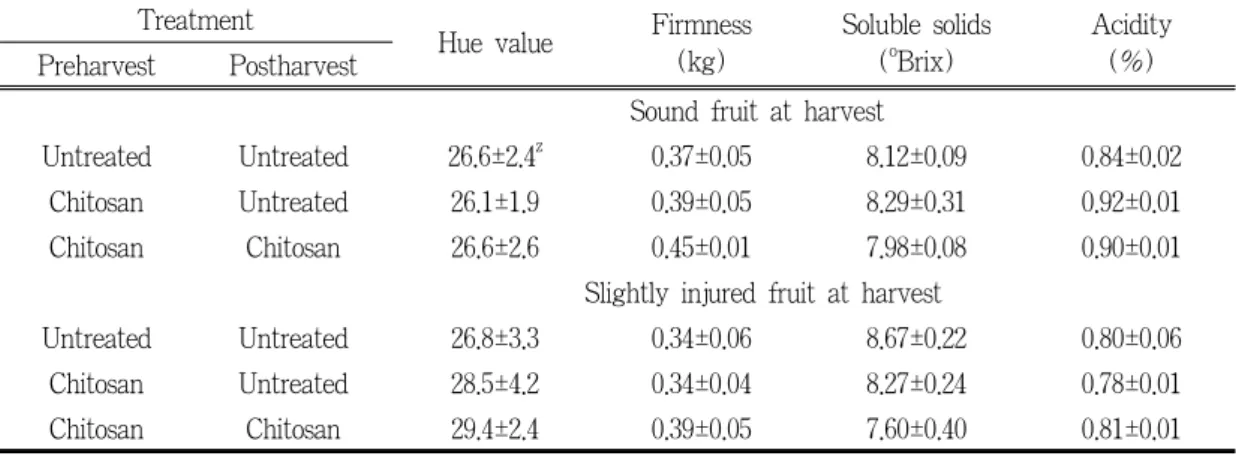
과실의 품질은 대체적으로 경도가 낮아진 결과 를 보였는데(표 8) 키토산 처리과실의 경도가 정 상과에서는 지속적으로 높았으나 손상과에서는 이러한 차이가 명확하지 않았다. 과색이 유통조건 이후 짙은 적색으로 변하는 경향이 모든 처리에 서 관찰되었는데 처리간 차이는 명확하지 않았다.
이상의 결과에서 살펴본 것과 같이 키토산 처 리는 딸기 과실의 품질 향상에 긍정적인 효과를 보였다. 이러한 원인은 키토산의 항균작용과 과 실의 경도를 증진시킴으로 얻어지는 것으로 확인 되었다. 또한 키토산은 고분자로 처리할 때 코팅 효과를 나타내므로 과실의 건조를 방지하여 외관 품질을 증진시키는 부가적인 효과도 인정되었다.
Ⅲ. 적 요
본 연구에서는 딸기에 대한 고분자 키토산의
수확 전후 처리가 과실의 품질과 부패에 미치는 영향을 조사하였다. 키토산 처리는 수확한 딸기 의 잿빛곰팡이병 억제, 과실의 경도 증진 및 표 피의 광택을 유지시키는 효과가 명확하였다. 그 러나 0.2% 농도 키토산 4회 누적적인 처리도 식 물 자체에 생리적 장해를 일으키지 않으며 내적 품질에 현저한 영향을 미치지 않았다. 키토산 처 리의 효과는 물리적 손상이 없을 경우 우수하였 으며 손상을 받은 과실에서는 명확한 선도유지 효과를 나타내지 않았다. 수확 후 처리의 효과는 명확하지 않았으며 수확 전 처리 효과를 증대시 키지 않았다. 이상의 결과로 볼 때 키토산은 화 학적 방제를 배제할 수 있는 수단으로 과실의 경 도 증진, 부패 억제를 통한 품질 향상의 대안이 될 수 있는 것으로 판단된다.
인용문헌
1. Bhaskara-Reddy, M.V., K. Belkacemi, R. Corcuff,
F. Castaigne, and J. Arul. 2000. Effect of pre-harvest chitosan sprays on post-harvest infection by Botrytis cinerea and quality of strawberry fruit. Postharvest Biol. Technol.
20:39-51.
2. Devlieghere, F., A. Vermeulen and J. Debevere.
2004. Chitosan: antimicrobial activity, interactions with food components and applicability as a coating on fruit and vegetables. Food Microbiol.
21:703-714.
3. El-Ghaouth, A., J.L. Smilanick and C.L. Wilson.
2000. Enhancement of the performance of Candida saitoana by the addition of glycolchitosan for the control of postharvest decay of apple and citrus fruit. Postharvest Biol.
Technol. 19:103-110.
4. Galed, G., M.E. Fernández-Valle, A. Martínez and A. Heras. 2004. Application of MRI to monitor the process of ripening and decay in citrus treated with chitosan solutions. Magnetic Resonance Imaging 22:127-137.
5. Ghaouth, A.E., J. Arul, C. Wilson, and N.
Benhamous. 1997. Biochemical and cytochemical aspects of the interactions of chitosan and Botrytis cinerea in bell pepper fruit. Postharvest Biol. Technol. 12:183-194.
6. Han, C., Y. Zhao, S.W. Leonard and M.G.
Traber. 2004. Edible coatings to improve storability and enhance nutritional value of fresh and frozen strawberries (Fragaria×ananassa) and raspberries (Rubus ideaus). Postharvest Biol.Technol. 33:67-78.
7. Hwang, Y.S., Y.A. Kim, and J.C. Lee. 1998.
Effect of postharvest application of chitosan and wax, and ethylene scrubbing on the quality changes in stored 'Tsugaru' apples. J. Kor. Soc.
Hort. Sci. 39:579-582.
8. Jiang, Y. and Y. Li. 2001. Effects of chitosan coating on postharvest life and quality of longan
fruit. Food Chem. 73:139-143.
9. Jiang, Y., J. Li, and W. Jiang. 2004. Effects of chitosan coating on shelf life of cold-stored litchi fruit at ambient temperature. Lebensmittel Wissenschaft und Technologie(In Press).
10. Makino, Y. and T. Hirata. 1997. Modified atmosphere packaging of fresh produce with a biodegradable laminate of chitosan-cellulose and polycarprolactone. Postharvest Biol. Technol.
10:247-254.
11. Mass, L.L. 1981. Postharvest disease of strawberry.
In: N.F. Chiders (ed.)., The strawberry cultivars to marketing. Horticultural publications, Univ. of Florida, Gainsville, FL, p.329-353.
12. Molloy, C., L.H. Cheah and J.P. Koolaard. 2004.
Induced resistance against Sclerotinia sclerotiorum in carrots treated with enzymatically hydrolysed chitosan. Postharvest Biol. Technol. 33:61-65.
13. Rege, P.R. and L.H. Block. 1999. Chitosan processing: influence of process parameters during acidic and alkaline hydrolysis and effect of the processing sequence on the resultant chitosan's properties. Carbohydrate Res. 321:
235-245.
14. Ruoyi, K., Y. Zhifang and L. Zhaoxin. 2004.
Effect of coating and intermittent warming on enzymes, soluble pectin substances and ascorbic acid of Prunus persica (Cv. Zhonghuashoutao) during refrigerated storage. Food Res. Intern.
(In Press).
15. Sathiyabama M. and R. Balasubramanian. 1998.
Xhitosan induces resistance components in Arachis hypogaea against leaf rust caused by Puccinia arachidis Speg. Crop Protection 17:
307-313.
16. Shahidi, F., J.K. Vidana-Arachchi, and Y. Jeon.
1999. Food applications of chitin and chitosan (review). Trends in Food Sci. Technol. 10:37- 51.
17. Tripathi, P. and N.K. Dubey. 2004. Exploitation of natural products as an alternative strategy to control postharvest fungal rotting of fruit and vegetables (Review). Postharvest Biol. Technol.
32:235-245.
18. Zhang, D. and P.C. Quantick. 1997. Effects of chitosan coating on enzymatic browning and decay during postharvest storage of lichi (Litchi chinensis Sonn.) fruit. Postharvest Biol. Technol.
12:195-202.