장류로부터 분리한 Bacillus tequilensis JBC17126의 프로바이오틱스 특성
박홍진1․오현화1․정도연2․김영수1
1전북대학교 식품공학과
2(재)발효미생물산업진흥원
Probiotic Characteristics of Bacillus tequilensis JBC17126 Isolated from Korean Traditional Soybean Paste
Hong-Jin Park1, Hyeon Hwa Oh1, Do Youn Jeong2, and Young-Soo Kim1
1Department of Food Science and Technology, Chonbuk National University
2Microbial Institute for Fermentation Industry (MIFI)
ABSTRACT This study examined the probiotic characteristics (acid tolerance, bile tolerance, antibacterial activity, and adhesive property) of Bacillus strains isolated from Korean traditional soybean pastes. The results of the acid and bile tolerance tests showed that the JBC17126 strain had high viability with 4.32 log CFU/mL of 7.58 log CFU/mL (57.04%) under acid conditions (pH 2.5) and 4.41 log CFU/mL of 7.43 log CFU/mL (59.34%) under bile condition (bile 0.3%). The adhesion assessment for mucin (intestinal mucus) showed that the JBC17126 strain was adhesive to mucin with 5.87 log CFU/mL of 7.49 log CFU/mL (78.37%). The JBC17126 strain, which showed acid tolerance, bile tolerance, and adhesive property, also inhibited Bacillus cereus and Staphylococcus aureus. This strain was con- firmed to be Bacillus tequilensis by 16S rRNA gene sequencing, and was named B. tequilensis JBC17126. Based on these results, B. tequilensis JBC17126 is expected to be a useful probiotic with excellent survival and adherence in the intestinal environment.
Key words: acid tolerance, bile tolerance, antibacterial activity, adhesive property, Bacillus strains
Received 9 April 2019; Accepted 18 June 2019
Corresponding author: Young-Soo Kim, Department of Food Sci- ence and Technology, Chonbuk National University, Jeonju, Jeonbuk 54896, Korea
E-mail: [email protected], Phone: +82-63-270-2569
Author information: Hong-Jin Park (Student), Hyeon Hwa Oh (Researcher), Young-Soo Kim (Professor)
서 론
프로바이오틱스는 ‘적정량 섭취했을 때 숙주에게 도움을 줄 수 있는 살아있는 미생물’로 정의되며(FAO/WHO, 2002), 이들이 체내에 유입된 후 장내 유익균총의 정상화를 돕고 생리활성 기능 향상에 도움을 주는 것으로 보고되어(Guo 등, 2006) 그 중요도가 증가하고 있다.
프로바이오틱스로 이용되는 미생물에는 Lactobacillus, Bifidobacterium, Enterococcus, Bacillus 속 균주가 있으 며, 현재 시판되는 프로바이오틱스 제품 대부분이 유산균 복 합제제에 집중되어 있다(Yoon 등, 2013). 유산균은 증식 중 에 유기산과 항균물질을 분비하여 장내 유해균의 증식을 억 제하고 장내 균총의 정상화에 도움을 주기 때문에 프로바이 오틱스로 유용하다고 알려져 있다(Lim 등, 2016). 그러나 일부 유산균은 체내 유입 시 생존율이 낮아 프로바이오틱스
로서 충분한 기능을 발휘하지 못한다는 보고가 있어 일부 업계에서는 유산균을 캡슐화하여 체내 생존율을 높인 제품 을 판매하기도 한다(Lee 등, 2007; Ding과 Shah, 2007).
섭취된 미생물이 프로바이오틱스로 작용하기 위해서는 위장을 통과하는 과정에서 위산과 담즙에 대하여 높은 비율 로 생존해야 한다. 또한 대장 상피세포에 부착력이 우수해야 하며 다른 미생물과 경쟁하며 생존하기 위해 항균력을 보유 해야 한다(Bengoa 등, 2018; Gueimonde와 Salminen, 2006; Ryu 등, 2017; Seo 등, 2011). 따라서 미생물이 프로 바이오틱스로 작용하기 위해서는 대사산물의 기능성뿐만 아니라 장내환경에서의 생존율 또한 중요한 요인으로 작용 한다(Lee 등, 2007).
이러한 요인에 유리하게 작용할 수 있는 미생물에는 Bacillus가 있다. 프로바이오틱스에 속하는 미생물 중 하나 인 Bacillus는 내성포자를 형성하는 특징이 있어 열과 pH 변화에 대한 내성을 가지고 있다. 따라서 위와 소장을 통과 하는 동안 높은 생존율을 유지할 수 있다는 이점이 있으며 (Barbosa 등, 2005; Spinosa 등, 2000), bacteriocin 등의 항균물질을 생산할 수 있어 프로바이오틱스로서 적합한 특 성을 갖는다(Jack 등, 1995; Hong 등, 2005). 뿐만 아니라 Bacillus 속은 amylase, protease, cellulase 등의 효소활성
을 보유하고 있어 식품에 적용 시 소화와 흡수를 돕고 프리 바이오틱스 이용성을 증대시킬 수 있다. 이와 같은 특성에 의해 국외에서는 Bacillus clausii, Bacillus subtilis, Bacillus coagulans, Bacillus licheniformis 등을 치료 목적의 보충 제, 식품 및 사료의 첨가제 등으로 이용하고 있다(Cutting, 2011; Hong 등, 2005). 그러나 국내에서는 프로바이오틱스 특성을 보유한 Bacillus 대부분을 가축이나 어류용 사료에 첨가하는 용도로 이용하고 있으며 생균제로서 사람이 이용 하기 위한 연구나 제품은 부족한 실정이다(Seong, 2008).
따라서 본 연구에서는 프로바이오틱스 생균제로 이용 가 능한 Bacillus 균주를 분리할 목적으로 전통장류(고추장, 된 장, 청국장, 간장)로부터 Bacillus 균주를 분리하여 이들의 프로바이오틱스 특성(내산성, 내담즙성, 장 부착능, 항균활 성)을 평가하였고, 가장 우수한 프로바이오틱스 특성을 나 타내는 균주를 선발하여 이 균주의 16S rRNA 유전자 염기 서열과 생화학적 특성을 분석하였다.
재료 및 방법
실험 재료 및 기기
균주 분리를 위해 사용된 장류 시료(고추장, 된장, 청국장, 간장)는 충청북도, 충청남도 및 전라북도 지역에서 시판되 는 제품을 수집하여 사용하였다. Nutrient agar(NA)와 nu- trient broth(NB)는 Becton, Dickinson & Co.(Franklin Lakes, NJ, USA) 제품을 사용하였고, BrillianceTM Bacillus cereus agar(BCA)는 Oxoid Ltd.(Basingstoke, UK) 제품 을 사용하였다. Biogenic amine(BA) 생성 확인을 위해 첨가 된 아미노산인 L-histidine, L-tyrosine과 내담즙성 및 장 부착능에 사용된 bile bovine, mucin 및 TritonTM X-100은 Sigma-Aldrich Co.(St. Louis, MO, USA) 제품을 사용하였 다. 항균활성 측정에 사용된 4종의 식품유해균(Bacillus cereus KACC 13064, Listeria monocytogenes KACC 10764, Staphylococcus aureus KACC 1927 및 Esche- richia coli KACC 10115)은 한국농업미생물자원센터(Ko- rean Agricultural Culture Collection, KACC, Wanju, Ko- rea)에서 분양받아 실험에 사용하였다. 미생물의 배양과 보 관을 위하여 원심분리기(CT15RE, Hitachi Koki Co., Ltd., Hitachinaka, Japan), 정치배양기(HB-101M, Hanbaek Scientific Co., Ltd., Bucheon, Korea), 진탕배양기(SI-2S, Universal Scientific Industrial Co., Ltd., Shanghai, Chi- na) 및 Deep freezer(DF8517, Ilshin Lab Co., Ltd., Dong- ducheon, Korea)를 사용하였다. 미생물 동정 장비인 VITEK2 (BioMérieux Vitek Inc., Durham, NC, USA)와 Bacillus identification card(BCL, BioMérieux Vitek Inc., Durham, NC, USA)에 함유된 46개의 기질에 대한 생화학적 특성을 분석하였다.
균주 분리
수집된 시료 0.1 g을 취해 NB로 연속 희석하여 NA에 도말한 후 37°C에서 18시간 배양하였다. 생성된 단일콜로 니를 수차례 획선 도말하여 분리과정을 반복하였다. 분리된 균주로부터 BCA 배지상에서 푸른색 콜로니를 생성하거나 L-histidine과 L-tyrosine이 각각 0.05% 첨가된 BA 배지 상에서 보라색 콜로니를 생성하는 균주를 제거하였다(Sim, 2017). B. cereus 제거및 biogenic amine 비생성 균주는 NA에 배양 후 NB에 접종하여 37°C, 180 rpm에서 18시간 배양하였고, 배양액과 50% glycerol을 동량(v/v) 혼합하여 최종 glycerol 농도가 25%가 되도록 하였다. 분리 선발된 균주는 다음 실험 때까지 -70°C에 보관하면서 사용하였다.
균주의 배양
Deep freezer(-70°C)에 보관되어 있는 선발균주는 NA 에 활성화한 후 NB에 단일콜로니를 접종하여 37°C, 180 rpm에서 18시간 배양하였고, 균배양액은 원심분리(4°C, 10,000×g, 5분) 하여 상층액과 pellet을 분리하였다. 배양 상층액은 항균활성 측정용 시료로 사용하였고, pellet은 NB 를 이용하여 회수한 후 재현탁시켰다. 접종 초기균수를 일정 하게 조정하기 위하여 균 현탁액의 흡광도(660 nm)와 생균 수를 비교했으며, OD=0.5일 때 생균수가 6~8 log CFU/
mL였다. 그러나 실험균주마다 동일한 OD에도 생균수의 차 이를 보였기 때문에 생존율 실험(내산성, 내담즙성 및 장 부착능)을 위하여 OD=0.5로 조정한 후 처리 전후의 생균수 (log CFU/mL)를 측정하여 비교하였다.
항균활성에 사용된 식품유해균(B. cereus KACC 13064, L. monocytogenes KACC 10764, S. aureus KACC 1927 및 E. coli KACC 10115)을 NA에 활성화한 후 NB에 단일 콜로니를 접종하여 진탕 배양(37°C, 200 rpm, 18시간)한 다음 사용하였다.
내산성 및 내담즙성 측정
내산성 및 내담즙성 측정은 Seo 등(2011)의 방법을 일부 변형하여 실시하였다. 내산성 측정은 1 N HCl을 이용하여 pH 2.5로 조정한 NB에 균주 배양액을 10%(7~8 log CFU/
mL) 접종하고 37°C, 180 rpm에서 2시간 배양하였다. 배양 물은 0.1 M sodium phosphate buffer(pH 6.2)를 이용하여 연속 희석하고 NA에 도말한 후 37°C에서 18시간 배양하여 생균수 변화를 측정하였다. 내담즙성 측정은 bile bovine이 0.3%(w/v) 첨가된 NB 배지에 균주 배양액을 10% 접종하여 37°C에서 24시간 배양하였다. 배양물은 0.1 M sodium phosphate buffer(pH 6.2)를 이용하여 연속 희석하고 NA 에 도말한 후 37°C에서 18시간 배양하여 생균수 변화를 측 정하였다. 내산성 및 내담즙성을 비교하고자 처리 전 생균수 (log CFU/mL)에 대한 처리 후 생균수(log CFU/mL)의 백분 율을 생존율로 평가하였다.
Mucin을 이용한 장내 부착능 측정
Mucin을 이용한 장내 부착능 측정은 Bengoa 등(2018) 의 방법을 변형하여 실시하였다. Mucin을 phosphate buf- fered saline(PBS, pH 7.4; Gibco, Grand Island, NY, USA) 에 용해시켜 3 mg/mL 농도로 제조한 후 96-well plate (Corning Inc., Corning, NY, USA)에 100 μL씩 분주하여 4°C에서 overnight incubation 하였다. Plate 바닥에 빈공 간이 없이 부착됨을 확인한 후 PBS 200 μL로 2회 세척하였 다. 균주 현탁액의 농도는 OD=0.5(6~8 log CFU/mL)로 하 여 각 well에 100 μL씩 분주하였고, mucin과 결합하도록 37°C에서 2시간 동안 incubation 하였다. 그 후 PBS로 6회 세척하고 0.05% Triton X-100 200 μL로 처리하여 37°C에 서 30분 동안 mucin에 부착된 균주를 탈착시킨 다음 회수하 였다. 회수된 액을 PBS로 연속 희석한 후 NA에 도말하여 37°C에서 18시간 배양한 다음 생균수를 측정하였다. 장 부 착능은 처리 전 측정된 생균수(log CFU/mL)에 대한 처리 후 회수된 생균수(log CFU/mL)의 백분율로 나타내었다.
항균활성 측정
Paper disc diffusion assay를 이용하여 선발 균주의 항균 활성을 측정하였으며 4종의 식품 유해균(B. cereus KACC 13064, L. monocytogenes KACC 10764, S. aureus KACC 1927 및 E. coli KACC 10115)에 대하여 항균활성을 평가 하였다. 멸균 면봉을 사용하여 NA에 유해균을 도말하고 6 mm paper disc를 부착시킨 후, 선발 균주 배양액의 원심분 리 상층액을 20 μL 분주하고 흡수시켜 37°C에서 18시간 정치 배양하였다. 배양 후 paper disc 주변으로 형성된 투명 환의 지름을 측정하고 균 집락의 지름에 대한 투명환의 지름 을 상대활성도로 하였다.
균주의 동정
분리된 균주는 16S rRNA 유전자 염기서열을 이용하여 동정하였다. Universal primer 27F(5’-AGAGTTTGATC MTGGCTCAG-3’)와 1492R(5’-TACGGYTACCTTGTT ACGACTT-3’)을 사용하여 유전자를 증폭한 후 PCR 산물 을 정제하여 염기서열을 해독하였다. BLASTN search (Zhang 등, 2000)와 Ribosomal Database Project(RDP, ver.11)의 SeqMatch program을 사용하여 해독된 균주의 염기서열과 서열 일치도가 높은 표준균주의 16S rRNA 유전 자 염기서열을 얻었으며, CLUSTAL W 프로그램(Thomp- son 등, 1994)을 사용하여 염기서열을 비교하였다. 계통도 는 균주들의 16S rRNA 유전자 염기서열을 정렬한 후 수작 업으로 gap이 최소화되도록 보정하여 Kimura 2-parame- ter model에 기초한 Maximum Likelihood 방법(Tamura와 Nei, 1993)을 사용하여 분석하였다. 각각의 계통수에서 각 분자에 대한 통계적 신뢰의 산출은 bootstrap을 1,000회 설정하고 MEGA program(Tamura 등, 2011)을 사용하여 계통분석 tree를 산출하였다.
생화학적 특성 비교
생화학적 특성을 분석하기 위하여 균주를 NA에 획선 도 말한 후 37°C에서 18시간 배양하여 준비하였다. 0.45%
NaCl 수용액에 균주를 현탁시켜 McFarland standard가 2.0(6.0×10⁸/mL)이 되도록 탁도(OD=0.5, Abs. 550 nm) 를 조정하였다(Zapata와 Ramirez-Arcos, 2015). 현탁액 을 VITEK2 장비의 사용법에 따라 BCL card에 자동 주입하 고 35.5°C에서 14시간 동안 incubation 하면서 자동 측정된 자료를 VITEK2 Compact Software database(version 7.01)를 이용하여 46가지 항목에 대해 분석하였다.
통계분석
각 실험에서 얻은 결과는 평균과 표준편차로 나타내었다.
SPSS package program(Ver.12.0K, SPSS Inc., Chicago, IL, USA)을 사용하여 각 시료 간의 유의성 검사를 실시하였 으며 P<0.05 수준에서 one-way ANOVA로 분산분석한 후 에 Duncan’s multiple range test로 비교하였다.
결과 및 고찰
내산성 및 내담즙성
프로바이오틱스는 위장관을 통과하여 대장에 이르기까지 위산과 담즙 등의 소화액에 사멸되지 않아야 하며, 이는 내 산성 및 내담즙성 균주를 선발하는 이유가 된다(Lim 등, 2016). 본 연구에서는 내산성 평가를 위하여 위액 환경(pH 2.5)에 균주를 첨가한 후 2시간 incubation 하여 생존율을 조사하였다(Fig. 1A). 내산성 평가 결과 JBS17136 균주는 7.09 log CFU/mL로 처리된 후 5.13 log CFU/mL가 생존하 여 가장 높은 생존율(72.34%)을 나타내었고, JBS17143 균 주는 7.71 log CFU/mL로 처리된 후 2.74 log CFU/mL가 생존하여 가장 낮은 생존율(35.53%)을 보였다. Ding과 Shah(2007)의 보고에 의하면 Lactobacillus 속(Lactoba- cillus rhamnosus외 4종)의 생존율(pH 2.0, 2시간)이 35%
이상이었다. 이에 비해 Bacillus 속은 65% 이상의 생존율 (pH 2.0, 3시간)이 보고된 바 있으며(Ryu 등, 2017), B. subtilis의 생존율(pH 3.0, 2시간)은 45%로 보고된 바 있다 (EI-Naggar, 2004). 본 연구에 사용된 실험균주들은 35.53
~72.34%의 생존율을 보여 유산균보다 내산성이 더 우수한 것으로 나타났고, 이와 같은 결과는 Bacillus 균주가 내성포 자를 형성하는 특성 때문에 포자를 형성하지 않는 유산균보 다 내산성이 높은 것으로 판단된다(Barbosa 등, 2005; Spi- nosa 등, 2000).
내담즙성의 평가는 0.3%의 담즙산 농도에서 평가하였으 며, 평가 결과 실험균주의 평균 생존율은 52.86%로 나타났 다(Fig. 1B). 그중 JBS17141 균주는 7.37 log CFU/mL로 첨가되었을 때 처리 후 6.42 log CFU/mL가 생존하여 87.13
%의 가장 높은 생존율을 나타냈지만, JBG17003과 JBD 17085 균주는 각각 7.51 log CFU/mL와 7.84 log CFU/mL
0 1 2 3 4 5 6 7 8 9
JBG17003 JBG17030 JBD17069 JBD17085 JBS17126 JBS17136 JBS17141 JBS17143 JBS17163 JBS17170 Viable cell count (log CFU/mL) . C
b CD
e A
de B
d CD
de B
f DE
ab CDE
a E
de CD
c
A
JBC17126
0 1 2 3 4 5 6 7 8 9
JBG17003 JBG17030 JBD17069 JBD17085 JBS17126 JBS17136 JBS17141 JBS17143 JBS17163 JBS17170 Viable cell count (log CFU/mL) . E
a C
h A
b G
a DE
e B
g D
i F
d B
c F
f
B
JBC17126
Fig. 1. Acid and bile tolerance of selected Bacillus spp. isolated from Korean tradition- al soybean products before (□) and after (■) passage. log CFU/mL: log colony forming units per milliliter. (A) Acid tolerance of se- lected strains. (B) Bile tolerance of selected strains. Means with different letters (A-F, a- i) above the bars are significantly different (P<0.05).
0 1 2 3 4 5 6 7 8 9
JBG17003 JBG17030 JBD17069 JBD17085 JBC17126 JBS17136 JBS17141 JBS17143 JBS17163 JBS17170
Viable cell count (log CFU/mL) .
e A
b CD
c CD
f D
d D
c
CD CD
g e
BC
d B
a D
Fig. 2. Adhesion to porcine gastric mucin of Bacillus strains before (□) and after (■) passage. log CFU/mL: log colony forming units per milliliter. Means with different let- ters (A-D, a-g) above the bars are signifi- cantly different (P<0.05).
로 첨가되었음에도 처리 후 모두 사멸하여 0%의 생존율을 나타내었다. 담즙은 미생물의 세포막에 영향을 주어 생육저 해 작용을 하지만 담즙산염 가수분해효소를 보유한 미생물 은 이에 저항하며 생존할 수 있는 것으로 알려져 있다(Seo 와 Lee, 2007). 본 연구에서 평가된 실험균주에 대한 내담즙 성은 JBS17141(87.13%), JBG17030(74.05%), JBS17136 (71.39%), JBS17170(62.89%), JBC17126(59.34%) 순으 로 나타났다. 따라서 내산성과 내담즙성 측정 결과 모두 우수 한 생존율을 보인 Bacillus 균주는 JBG17030, JBC17126, JBS17136으로 확인되었다.
장 부착능
미생물이 프로바이오틱스로 작용하기 위해서는 위와 소 장을 거쳐 대장에 도달하였을 때 체외로 배출되지 않고 부착 된 상태로 존재하여야 한다. 따라서 프로바이오틱스 균주 선별을 위해서는 장 부착능을 평가하는 것이 필요하다. 장
부착능이 우수한 Bacillus 균주를 선별하기 위하여 mucin 결 합능을 측정한 결과는 Fig. 2와 같다. Mucin에 결합 후 회수 된 생균수는 JBS17143(6.16 log CFU/mL), JBC17126 (5.87 log CFU/mL), JBG17030(5.64 log CFU/mL), JBS 17163(5.48 log CFU/mL) 순으로 유지되는 것으로 나타났 다. 특히 본 연구에서 분리 선발된 실험균주 중 JBG17030 (72.31%), JBC17126(78.37%), JBS17143(81.48%), JBS 17163(71.17%)은 70% 이상의 mucin 결합능을 보였다. 이 들 균주는 Kirjavainen 등(1998)의 연구에서 L. rhamno- sus, Bifidobacterium lactis, Lactobacillus johnsonii 중 결합능이 가장 우수하다고 보고한 L. rhamnosus의 결합능 (44.1~46.0%)보다 높은 결합능을 보유한 것으로 평가되었 다.
결과적으로 mucin 결합능을 통한 장 부착능 평가에서 실 험균주의 장 부착능은 47.32~81.48%로 나타났으며, JBC 17126 균주는 내산성(57.04%) 및 내담즙성(59.34%)뿐만
Table 1. Anti-microbial activity of selected Bacillus spp. isolated from Korean traditional soybean products Strain
Anti-microbial activity Bacillus cereus
KACC 13064 Listeria monocytogenes
KACC 10764 Staphylococcus aureus
KACC 1927 Escherichia coli KACC 10115 JBG17003
JBG17030 JBD17069 JBD17085 JBC17126 JBS17136 JBS17141 JBS17143 JBS17163 JBS17170
1.00a1)2) 1.00a 1.00a 1.00a 1.40±0.06b
1.00a 1.00a 1.00a 1.00a 1.00a
1.00a 1.00a 1.00a 1.00a 1.00a 1.06±0.02b
1.00a 1.00a 1.00a 1.00a
1.00a 1.49±0.05e3) 1.14±0.02bc
1.00a 1.09±0.03ab 1.17±0.06c 1.55±0.03e
1.00a 1.33±0.05d
1.00a
1.00a 1.10±0.02b
1.00a 1.00a 1.00a 1.00a 1.00a 1.00a 1.00a 1.00a The experiments were carried out in triplicate.
1)1.00, no activity.
2)Each column followed by the same letter are not significantly different according to Duncan’s multiple range test (P<0.05).
3)Mean±SD.
아니라 장 부착능(78.37%) 등의 프로바이오틱스 특성을 보 유하는 것으로 확인되었다.
항균활성
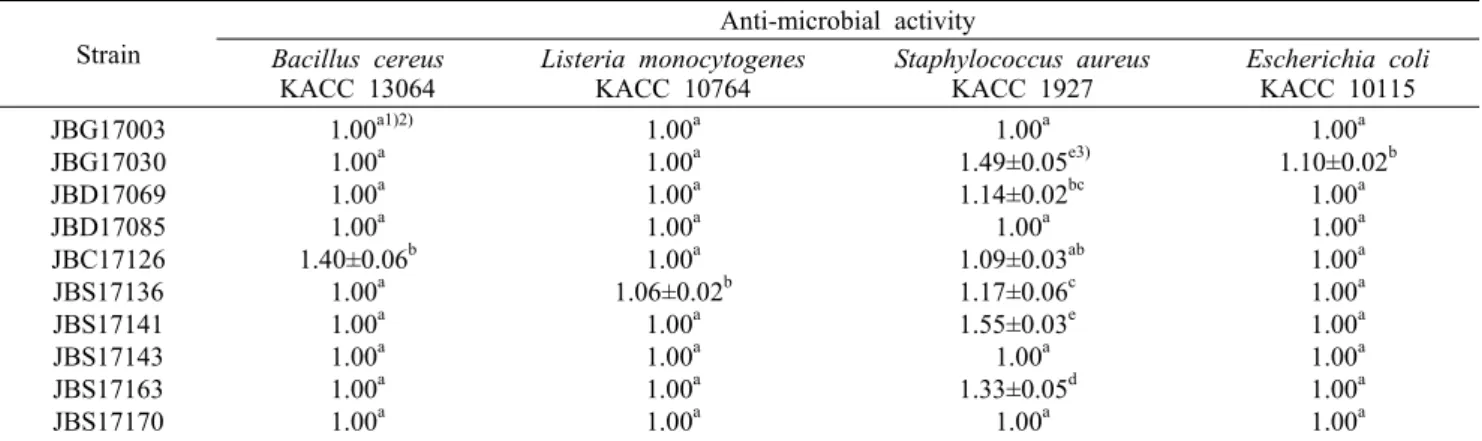
프로바이오틱스는 식품에 적용될 때 유해균에 의한 오염 을 방지하며 다른 균주와 경쟁 속에서 살아남아 대사하고 증식할 수 있어야 한다(Hong 등, 2005). 따라서 대표적으로 알려진 식품 유해균(B. cereus KACC 13064, L. mono- cytogenes KACC 10764, S. aureus KACC 1927 및 E. coli KACC 10115)에 대하여 선발된 균주의 항균활성을 측 정하였으며, 그 결과는 Table 1과 같다. JBC17126 균주를 제외한 다른 균주들은 B. cereus KACC 13064에 대한 항균 활성을 보유하고 있지 않은 것으로 확인되었으며, L. mo- nocytogenes KACC 10764에 대해서는 JBS17136 균주 만, 그리고 E. coli에 대해서는 JBG17030 균주만 생장을 억제하는 것으로 확인되었다. 또한 B. cereus KACC 13064, L. monocytogenes KACC 10764, E. coli에 대하여 항균활 성을 보유하였던 균주(JBC17126, JBS17136, JBG17030) 는 모두 S. aureus KACC 1927에 대해서도 항균활성을 보 유하고 있는 것이 확인되었다. 이처럼 항균력을 보유하는 Bacillus 속은 bacteriocin과 subtilin 같은 항균물질을 생산 하는 능력(Hong 등, 2005)에 의한 것으로 예상된다.
식품 유해미생물 중에서도 B. cereus는 자연계에서 흔히 발견되는 균주이며 포자를 형성하여 열에서도 잘 견디기 때 문에 전통적인 방법으로 장류를 제조할 때 가장 문제가 될 수 있는 유해균으로 꼽을 수 있다(Kim 등, 2010). 특히 앞서 진행하였던 내산성, 내담즙성, 장 부착능 실험에서 우수한 활성을 보유하였던 균주 중 JBC17126 균주는 B. cereus에 대하여 항균활성을 가지고 있기 때문에 다른 균주보다 프로 바이오틱스 특성이 더욱 우수한 것으로 판단된다. 따라서 본 연구에서 확인된 내산성과 내담즙성이 우수하며 mucin 부착능이 우수한 JBC17126 균주는 사람의 위장을 통과하
여 장내에 높은 비율로 점착할 수 있고 다른 균총과 경쟁에 서 우점하여 생존할 것으로 판단된다.
16S rRNA 유전자 염기서열을 이용한 동정
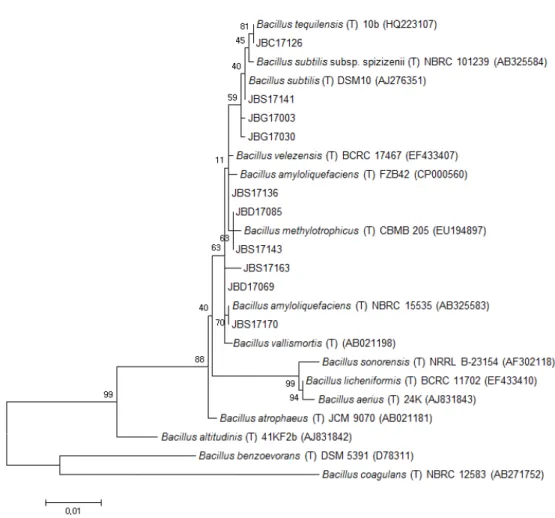
RDP의 SeqMatch program을 이용하여 Bacillus 속에 속 하는 균주의 16S rRNA 유전자 염기서열과 일치율이 높은 표준균주를 선정하고 MEGA program을 이용하여 계통도 를 분석한 결과, JBC17126균주는 표준균주인 Bacillus te- quilensis 10b와 가장 가까운 근연관계로 16S rRNA와 유 전자 서열은 98.8%의 상동성을 보였다. B. tequilensis 10b 는 B. subtilis의 subspecies로 알려져 있다(Fan 등, 2017;
Gatson 등, 2006). JBS17141, JBG17003과 JBG17030 균 주들은 B. subtilis로 분류되었으며, JBD17085와 JBS17143 균주들은 Bacillus methylotrophicus로, JBS17136, JBS 17163, JBD17069 및 JBS17170 균주들은 B. amylolique- faciens로 분류되었다(Fig. 3).
생화학적 특성 및 유용성
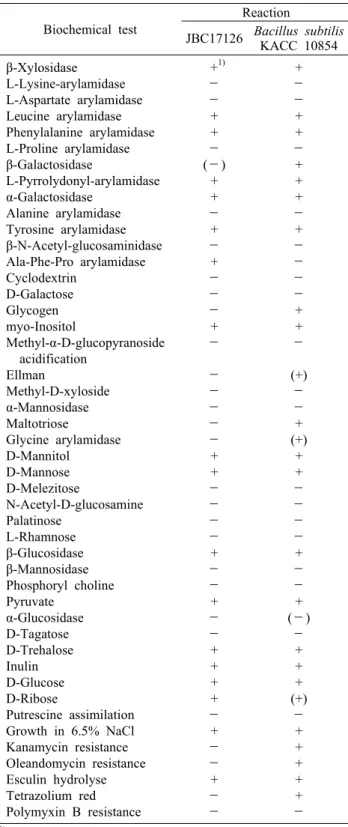
16S rRNA 유전자 염기서열을 이용한 균주 동정 결과 JBC17126 균주는 B. subtilis의 subspecies로 분류되었으 며, Vitek2 Compact Software를 이용하여 B. subtilis의 표준균주(B. subtilis KACC 10854)와 생화학적 특성 일치 도를 비교 분석한 결과는 Table 2와 같다. JBC17126 균주 는 D-mannose, D-trehalose, inulin, D-glucose, D-ri- bose 등을 탄소원으로 이용할 수 있었으나 D-galactose, glycogen, maltotriose, D-melezitose, palatinose, L- rhamnose, D-tagatose 등은 이용하지 못하였다. 특히 JBC 17126 균주는 kanamycin, oleandomycin과 같은 항생제에 대하여내성이 없는 것으로 나타났다. 항생제 내성 유전자는 플라스미드에 존재하여 다른 균들과 conjugation으로 교환 이 가능하다고 알려져 있다(Cebeci와 Gurakan, 2003). 따 라서 항생제에 대한 내성이 없는 JBC17126 균주는 순수한
Fig. 3. Phylogenetic tree based on 16S rRNA gene sequence of selected strains. All sequences used here were from Bacillus type strains. GenBank accession numbers are given in parentheses. The branching pattern was generated by maximum likelihood method.
Bar, 0.01 substitutions per nucleotide position. Bootstrap values are expressed as percentages of 1,000 replicates.
고유형질을 보유하는 균주인 것으로 판단된다.
결과적으로 JBC17126 균주는 생존율을 기준으로 하였 을 때 내산성(57.04%), 내담즙성(59.34%), 장 부착능(78.37
%) 등에서 우수한 균주로 평가되었고, 특이적으로 B. cer- eus KACC 13064 균주에 대한항균작용이 확인되어 프로 바이오틱스 후보균으로 선발되었다. 또한 유전적 계통도 비 교 결과 B. subtilis의 subspecies로 확인되었고, 표준균주 인 B. subtilis KACC 10854와 유사한 생화학적 특성을 보유 함에도 항생제 내성이 없는 균주로 분석되었다. 따라서 JBC 17126 균주는 프로바이오틱스로서 이용가치가 기대된다.
요 약
한국 전통장류로부터 Bacillus 속 미생물을 분리하고 실험 균주의 안전성을 확보하고자 B. cereus 독소와 biogenic amine을 생성하는 균주를 제거하고 나머지를 실험균주로 하였다. 체내 유입 시 생존 가능성을 평가하기 위하여 내산 성과 내담즙성을 측정한 결과, B. tequilensis JBC17126 균주는 두 조건에서 우수한 생존율을 보유하는 것으로 확인 되었다. Mucin을 이용하여 장 부착능을 평가한 결과에서도
B. tequilensis JBC17126 균주가 높은 비율로 부착되는 것 이 확인되었다. 또한 B. tequilensis JBC17126 균주는 B. cereus의 생장을 억제하는 활성을 보유하고 있어 장류 제조 시 문제가 될 수 있는 B. cereus의 오염을 막을 수 있고, 같은 종에 속하는 유해균주의 생장을 억제함으로써 우점화가 가 능할 것으로 예상된다. 따라서 B. tequilensis JBC17126 균주는 내산성과 내담즙성 및 장 부착능이 우수하고 식품 유해미생물에 대한 항균활성을 보유하고 있어 잠재적인 프 로바이오틱스 균주로 선발하였다.
감사의 글
본 연구는 2018년 산업통상자원부 산업기술거점기관지원 (한국형 유용균주, 과제번호: R0004073) 사업의 지원에 의 해 수행되었습니다.
REFERENCES
Barbosa TM, Serra CR, La Ragione RM, Woodward MJ, Henri- ques AO. Screening for Bacillus isolates in the broiler gastro- intestinal tract. Appl Environ Microbiol. 2005. 71:968-978.
Table 2. Biochemical characterization for the identification of the isolated JBC17126 strain by VITEK 2
Biochemical test
Reaction
JBC17126 Bacillus subtilisKACC 10854 β-Xylosidase
L-Lysine-arylamidase L-Aspartate arylamidase Leucine arylamidase Phenylalanine arylamidase L-Proline arylamidase β-Galactosidase
L-Pyrrolydonyl-arylamidase α-Galactosidase
Alanine arylamidase Tyrosine arylamidase β-N-Acetyl-glucosaminidase Ala-Phe-Pro arylamidase Cyclodextrin
D-Galactose Glycogen myo-Inositol
Methyl-α-D-glucopyranoside acidification
Ellman
Methyl-D-xyloside α-Mannosidase Maltotriose
Glycine arylamidase D-Mannitol
D-Mannose D-Melezitose
N-Acetyl-D-glucosamine Palatinose
L-Rhamnose β-Glucosidase β-Mannosidase Phosphoryl choline Pyruvate
α-Glucosidase D-Tagatose D-Trehalose Inulin D-Glucose D-Ribose
Putrescine assimilation Growth in 6.5% NaCl Kanamycin resistance Oleandomycin resistance Esculin hydrolyse Tetrazolium red Polymyxin B resistance
+1)
-
- + +
- (-)
+ +
- +
- +
-
-
- +
-
-
-
-
-
- + +
-
-
-
- +
-
- +
-
- + + + +
- +
-
- +
-
-
+
-
- + +
- + + +
- +
-
-
-
- + +
- (+)
-
- + (+)
+ +
-
-
-
- +
-
- + (-)
- + + + (+)
- + + + + +
-
1)+, positive reaction; -, negative reaction.
Bengoa AA, Zavala L, Carasi P, Trejo SA, Bronsoms S, Serra- dell MA, et al. Simulated gastrointestinal conditions increase adhesion ability of Lactobacillus paracasei strains isolated from kefir to Caco-2 cells and mucin. Food Res Int. 2018. 103:
462-467.
Cebeci A, Gurakan C. Properties of potential probiotic Lactoba-
cillus plantarum strains. Food Microbiol. 2003. 20:511-518.
Cutting SM. Bacillus probiotics. Food Microbiol. 2011. 28:214- 220.
Ding WK, Shah NP. Acid, bile, and heat tolerance of free and microencapsulated probiotic bacteria. J Food Sci. 2007. 72:
M446-M450.
EI-Naggar MYM. Comparative study of probiotic cultures to control the growth of Escherichia coli O157:H7 and Salmo- nella typhimurium. Biotechnol. 2004. 3:173-180.
Fan B, Blom J, Klenk HP, Borriss R. Bacillus amyloliquefaciens, Bacillus velezensis, and Bacillus siamensis form an “operational group B. amyloliquefaciens” within the B. subtilis species com- plex. Front Microbiol. 2017. 8:22.
FAO/WHO. Report of joint FAO/WHO working group on draft- ing guidelines for the evaluation of probiotics in food. Food and Agriculture Organization/World Health Organization, Lon- don, Canada. 2002.
Gatson JW, Benz BF, Chandrasekaran C, Satomi M, Venkates- waran K, Hart ME. Bacillus tequilensis sp. nov., isolated from a 2000-year-old Mexican shaft-tomb, is closely related to Bacil- lus subtilis. Int J Syst Evol Microbiol. 2006. 56:1475-1484.
Gueimonde M, Salminen S. New methods for selecting and eval- uating probiotics. Dig Liver Dis. 2006. 38:S242-S247.
Guo X, Li D, Lu W, Piao X, Chen X. Screening of Bacillus strains as potential probiotics and subsequent confirmation of the in vivo effectiveness of Bacillus subtilis MA139 in pigs. Antonie van Leeuwenhoek. 2006. 90:139-146.
Hong HA, Duc le H, Cutting SM. The use of bacterial spore formers as probiotics. FEMS Microbiol Rev. 2005. 29:813- 835.
Jack RW, Tagg JR, Ray B. Bacteriocins of gram-positive bac- teria. Microbiol Rev. 1995. 59:171-200.
Kim YS, Yun SH, Jeong DY, Hahn KS, Uhm TB. Isolation of Bacillus licheniformis producing antimicrobial agents against Bacillus cereus and its properties. Kor J Microbiol. 2010. 46:
270-277.
Kirjavainen PV, Ouwehand AC, Isolauri E, Salminen SJ. The ability of probiotic bacteria to bind to human intestinal mucus.
FEMS Microbiol Lett. 1998. 167:185-189.
Lee KW, Jang KI, Lee YB, Sohn HS, Kim KY. Development of probiotic microcapsules for the preservation of cell via- bility. Korean J Food Sci Technol. 2007. 39:66-70.
Lim ES, Kim YM, Lee EW. Probiotic properties and safety as- sessment of lactic acid bacteria isolated from salt-fermented anchovy. Korean J Food Sci Technol. 2016. 48:306-316.
Ryu MS, Yang HJ, Kim JW, Jeong SJ, Jeong SY, Jeong SE, et al. Potential probiotics activity of Bacillus spp. from tradi- tional soybean pastes and fermentation characteristics of Cheonggukjang. Korean J Food Preserv. 2017. 24:1168-1179.
Seo JH, Lee H. Characteristics and immunomodulating activity of lactic acid bacteria for the potential probiotics. Korean J Food Sci Technol. 2007. 39:681-687.
Seo WT, Nam SH, Lee CK, Cho KM. Identification of potential Bacillus subtilis probiotics from Korean soybean paste and their antimicrobial and immune activities. J Food Sci Nutr.
2011. 16:37-44.
Sim SH, Park HJ, Oh HH, Jeong DY, Song GS, Kim YS. Isola- tion and characterization of Bacillus spp. with high-level pro- ductivity of poly-γ-glutamic acid. J Korean Soc Food Sci Nutr.
2017. 46:1114-1121.
Soeng GC. Biotechnological applications of Bacillus sp. PS352 isolated from Korean traditional soybean paste. Dissertation.
Gyeongsang National University, Gyeongnam, Korea. 2008.
Spinosa MR, Braccini T, Ricca E, De Felice M, Morelli L, Pozzi
G, et al. On the fate of ingested Bacillus spores. Res Micro- biol. 2000. 151:361-368.
Tamura K, Nei M. Estimation of the number of nucleotide sub- stitutions in the control region of mitochondrial DNA in hu- mans and chimpanzees. Mol Biol Evol. 1993. 10:512-526.
Tamura K, Peterson D, Peterson N, Stecher G, Nei M, Kumar S. MEGA5: molecular evolutionary genetics analysis using maximum likelihood, evolutionary distance, and maximum parsimony methods. Mol Biol Evol. 2011. 28:2731-2739.
Thompson JD, Higgins DG, Gibson TJ. CLUSTAL W: improv- ing the sensitivity of progressive multiple sequence alignment through sequence weighting, position-specific gap penalties
and weight matrix choice. Nucleic Acids Res. 1994. 22:4673- 4680.
Yoon SS, Park YS, Choi HJ. Genetics and research revolutions in the lactic acid bacteria: focused on probiotics and immuno- modulation. Curr Top LAB Probiotics. 2013. 1:9-19.
Zapata A, Ramirez-Arcos S. A comparative study of McFarland turbidity standards and the Densimat photometer to determine bacterial cell density. Curr Microbiol. 2015. 70:907-909.
Zhang Z, Schwartz S, Wagner L, Miller W. A greedy algorithm for aligning DNA sequences. J Comput Biol. 2000. 7:203- 214.