DOI http://dx.doi.org/10.14770/jgsk.2014.50.6.811
‡Corresponding author: +82-51-510-2249, E-mail: [email protected]
<Short Note>
백두산 화산가스 및 온천수에 대한 지화학적 연구
이상철1․윤성효2․정훈영1,‡
1부산대학교 지질환경과학과
2부산대학교 지구과학교육과
요 약
본 연구는 백두산 Julong 온천 지역에서 2회에 걸친 화산가스 측정과 1회의 온천수 분석을 통해 이와 관련된
지화학적 의미와 향후 연구 방향을 고찰하였다. Julong 온천 지역의 화산가스는 대부분 CO2 성분인 것으로 측
정되었으며 CH4 가스가 그 다음으로 가장 많은 성분으로 측정되었다. 확산계수가 큰 H2와 He 농도는 시간에
따른 변화가 크게 나타났으나, 확산계수가 작은 CO2, C2H6, CH4 농도는 상대적으로 농도 변화가 작은 것으로 나타나 확산계수의 차이로 인한 화산 가스 성분들의 농도변화가 기체에 따라 큰 차이를 보이는 것으로 나타났 다. Julong 온천수의 온도는 남한 온천수에 비해 높았으나, pH는 다소 낮은 것으로 조사되었다. Ca 및 Mg 이온 의 경우, Julong 온천수는 남한 및 다른 화산활동 지역의 온천수와 비교하여 현저히 낮은 농도 분포를 보이는 것으로 나타났으며, 이는 Julong 지역 온천수의 물-암석 반응 시간이 비교적 짧기 때문인 것으로 추정된다. 주 요 양이온 및 음이온 분석 결과를 바탕으로 한 Julong 온천수의 지화학적 유형 분석결과 대부분 Na+-Cl- 유형인 것으로 나타났다.
주요어: 온천, 백두산, 화산가스, 화산활동
Sangchul Lee, Sung-Hyo Yun and Hoon Young Jeong, 2014, A geochemical study of volcanic gases and hot spring water at Mt. Baekdu. Journal of the Geological Society of Korea. v. 50, no. 6, p. 811-820
ABSTRACT: This study performed geochemical analyses on the volcanic gases and hot spring waters from the
Julong hot spring at Mt. Baekdu, and it also proposed several future works to better predict its volcanic activities.The volcanic gases examined were measured to consist mostly of CO2, with CH4 being the second most abundant component. H2 and He, the volcanic gases with high diffusion coefficients, showed larger temporal changes in their concentrations. In contrast, CO2, C2H6, and CH4, those with lower diffusion coefficients, exhibited smaller temporal changes. This indicates that the temporal changes of volcanic gases are largely dependent on the diffusion coefficients. The temperature of the Julong hot spring was higher compared to those present in South korea, and its pH was slightly lower. The concentrations of Ca and Mg in the Julong hot spring were much lower than those in hot springs from South korea and other oversea volcanoes. This would result from weaker water-rock interactions near the Julong hot spring due to the short residence time of the hot spring water. Based on the geochemical analysis of the major cations and anions, the Julong hot spring water was found to be generally classified into a Na+-Cl- type in the Piper diagram.
Key words: hot spring, Mt. Baekdu, volcanic gases, volcanic activity
(Sangchul Lee and Hoon Young Jeong, Department of Geological Sciences, Pusan National University, Busan 609-735, Republic of Korea; Sung-Hyo Yun, Department of Earth Science Education, Pusan National University, Busan 609-735, Republic of Korea)
1. 서 언
백두산은 2002년부터 2006년에 백두산 주변 지진
의 규모와 빈도가 증가하고, 온천수의 수온이 증가 해 많은 이목을 끌었다(Yun and Lee, 2012). 하지만 국내 연구자들의 백두산에 대한 접근성 한계로 이곳
에 대한 연구는 주로 중국 연구자에 의해 수행되었 다(Zhang et al., 2002; Song et al., 2007; Zhao and Liu, 2010; Zou et al., 2010). 최근 들어 GRACE 인 공위성을 이용한 Geoid 관측이 가능해지기 전까지 (Lee et al., 2013; Oh et al., 2013), 국내 연구의 대부 분은 국외 관측 자료를 인용해 해석하거나, 역사시대 분화기록을 연구하는 것으로 한정되었다(Yun and Lee, 2012; Jiang et al., 2013; Yun, 2013a, 2013b).
백두산과 같은 활화산들의 화산활동을 평가하기 위 해 지진관측(Ratdomopurbo and Poupinet, 2000;
Matthews et al., 2009; Budi-Santoso et al., 2013; Inza et al., 2014), 지표변위 및 거리변화(electronic distance measuring)의 측정(Pingue et al., 1998; Young et al., 2000; Ramirez-Ruiz et al., 2002; Saepuloh et al., 2013), 자기장 및 전기장의 변화관측(magnetic and electric field observation)(Sasai et al., 2002;
Zlotnicki et al., 2003; Lillis et al., 2008; Zlotnicki et al., 2009), 화산체 주변의 온도 변화 관측(Yamashina and Matsushima, 1999; Cigolini et al., 2009; Feseker et al., 2009), 화산가스의 관측(Giggenbach et al., 2001;
Aiuppa et al., 2007; Ohba et al., 2008) 등의 다양한 방법이 사용된다.
위에 열거된 여러 방법 중 화산가스에 대한 지화 학적 모니터링은 그 조성 변화가 화산활동과 강한 상관관계를 보이기 때문에 화산분화의 예측에 유용 하게 활용될 수 있다. 화산 하부에 위치한 마그마는 원래 맨틀 또는 지각하부에서 부분용융에 의해 생성 되어 주변과의 밀도차에 의해 지표 근처까지 상승하게 된다. 화산 하부에 위치한 마그마방(magma cham- ber)까지 상승한 마그마는 압력이 감소함에 따라 휘 발성분들은 용해도가 줄어들어 마그마로부터 분리 되어 마그마방 상부에 축적되고, 그 일부는 화산가 스의 형태로 지표 밖으로 나오게 된다(Proussevitch and Sahagian, 2005). 화산가스의 성분으로 H2O가 함량이 가장 크고, 그 다음 성분은 대체로 마그마에 대한 용해도가 낮은 CO2 함량이 크게 나타나게 된다 (Bruno et al., 2001). 그 밖의 화산가스의 성분에는 SO2, H2S, HCl, HF 등의 산성기체와 H2, He, N2, Ar, CH4, CO 등의 비용존 기체, 그리고 미량원소 (trace elements)와 유기물질 등이 검출되게 된다 (Cadle, 1980; Symonds et al., 1988; Chin and Davis, 1993). 이들 성분 중 CO2, SO2, H2S등의 농
도와 S/Cl, CO2/SO2 등의 비율은 화산분화 및 화산 활동의 지시자로 널리 사용되고 있다. 마그마의 상 승으로 화산분화가 임박하면 마그마로부터 탈가스 화가 활발히 일어나 CO2, SO2, H2S 등의 배출양이 증가한다. 또한 개별 화산가스의 마그마에 대한 용 해도 차이로 인하여 분출단계별 화산가스의 상대적 조성이 다르게 나타난다. 용해도가 특히 낮은 CO2
는 그 상대적인 함량이 초기부터 증가하나, 다른 성 분들에 비해 용해도가 높은 HCl, HF 등의 할로겐가 스들은 분출 마지막 단계까지 마그마에 많이 남아있 게 된다. 한편, 상승하는 화산가스는 상부의 지하수 계를 만나면 가스 성분의 일부가 지하수에 용해되 고, 이에 따라 지하수의 지화학적 특성을 변화시킨 다. 마그마 기원의 가스의 영향을 많이 받아 pH가 낮아진 지하수는 주변 암석과의 상호작용이 증가하 게 되고, 이로 인해 지하수에 용해된 총 염의 농도 (total dissolved salts)가 높아진다. 실제로 Federico et al. (2010)은 이탈리아의 Vulcano 화산에서 마그 마 통로에 가까운 지하수에서 온도와 염도(salinity) 가 가장 높게 나타났다고 보고했다.
한편, 본 논문의 연구 지역인 백두산은 화산가스 분석에 있어서 매우 제한 적이다. 그 이유는 백두산 이 지표수, 지하수 및 온천수 등의 주변 수계가 잘 발 달되어 있어 화산가스가 많이 용해되어 그 농도가 매우 낮기 때문이다(Xu et al., 2012). 특히 물에 의해 쉽게 용해되는 HCl, HF 및 SO2 등의 산성기체는 대 부분 온천수 및 지표수와의 반응이 빠르기 때문에 가스 상태의 성분 분석이 쉽지 않은 것으로 알려져 있지만(Symonds et al., 2001), 비교적 물에 잘 녹지 않는 CO2, H2 및 CH4 성분은 온천에서 분출되는 가 스로부터 측정할 수 있다. 화산가스뿐만 아니라 화 산가스 영향을 받은 온천수의 분석을 통해서도 화산 활동에 대한 유용한 정보를 얻을 수 있다. 본 논문은 백두산 화산가스 및 온천수에 대한 채취 및 분석 자 료를 보고하고, 이와 관련된 지화학적 의미와 향후 연구방향을 고찰한다.
2. 화산가스 및 온천수 채취
본 연구에서 분석한 화산가스 및 온천수의 채취 장소는 백두산 북쪽에 위치하고 있으며, 장백폭포 (Changbaishan waterfall) 부근의 Julong 온천이다
Fig. 1. Location of the Changbaishan waterfall. This is reprinted after Hahm et al. (2008).
(그림 1). 화산가스는 2회에 걸쳐(2014년 9월 6일~9 월 7일) Julong 온천의 서로 다른 네 지역에서 진행 하였다(site 1: 42"2'26.64"N, 128"3'30.12"E; site 2:
42"2'27.50"N, 128"3'30.40"E; site 3: 42"2'28.01"N, 128"3'30.54"E; site 4: 42"2'27.61"N, 128"3'31.28"E).
온천수는 2104년 9월 7일에 화산가스 채취가 이루어 진 곳과 동일한 장소에서 가스 채취 직후 수집했다.
화산가스 및 온천수의 채취는 모두 오전 6시부터 8 시 사이에 이루어졌다.
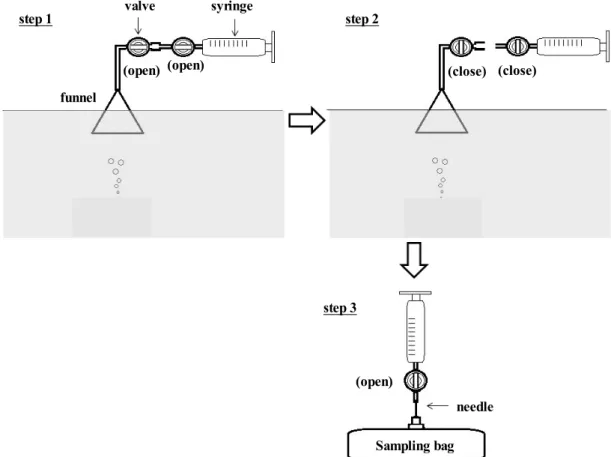
화산가스는 진공병법(evacuated bottle method)의 하나인 Giggenbach bottle법이 가장 널리 사용되고 있지만(Sortino et al., 2006), 백두산은 토양층에 발 달된 분기공이 없어 온천을 통해 배출되는 화산가스 를 채취해야만 한다. 이런 경우 온천수를 통과해 나오 는 소량의 화산가스만을 공기와 섞이지 않게 선택적 으로 받아내기가 어렵기 때문에, Giggenbach bottle 법을 이용한 화산가스의 채취가 불가능하다. 이런 문 제점을 해결하기 위해 온천수에서 나오는 화산가스 를 깔때기에 모은 후, 이를 주사기로 포집백(sampling
bag)에 옮기는 방식을 이용하였다. 그림 2는 본 연구 에 사용된 화산가스의 채취 방법을 도식화하고 있 다. 우선 상단부에 밸브가 연결된 깔때기를 화산가 스를 배출하는 온천수에 담근 뒤, 밸브에 연결된 주 사기를 이용해 깔때기 내부의 공기를 밖으로 뽑아낸 다. 이후 상승하는 화산가스가 깔때기 내부에 모이 면 주사기로 추출하여 포집백으로 옮긴다. 이와 함 께 온천수 또한 주사기를 사용했으며, 120 mL 용량 의 시료병(serum vial)에 온천수를 채취한 후 공기 가 통하지 않도록 밀봉시킨다.
채취한 화산가스는 그 손실을 최소화하기 위해 중국의 지진 연구소(China Earthquake Administration) 지구 화학실험실의 가스 크로마토그래프(gas chromato- graph)를 사용해 분석했다. 가스 크로마토그래프는 thermal conductivity detector가 부착된 SP-3420 모델로 아르곤 가스를 운반가스로 사용해 분석했다.
화산가스의 정량화를 위해 94.898% CO2, 0.503%
C2H6, 0.0296% H2, 0.0295% He, 1.01% CH4, 1.5%
O2, 2.02% N2로 이루어진 혼합기체를 초순도 아르곤
Vent
Needle Sampling bag
(open) (open) (close) (close)
(open)
①
③
step 1 step 2
step 3
valve syringe
funnel
needle
Fig. 2. Schematic diagram of sampling apparatus and procedures for volcanic gases: step 1: the evacuation of a
funnel after submerged under water, step 2: the collection of volcanic gases into the funnel, and step 3: the transfer of volcanic gases into a sampling bag.가스로 희석해 5개의 농도로 표준시료를 만들었고, 이로부터 검정곡선을 얻었다. 한편, 채취한 온천수 시 료는 국내에서 pH, 전기전도도(electrical conductivity, EC), 용존 CO2, 음이온 및 양이온 등을 분석했다. 온천 수 시료는 분석 전에 nylon membrane filter (pore size
= 0.20 µm)를 사용하여 부유물을 제거했다. pH는 520A pH meter (Thermo scientific Orion inc.)를 사용해 측정했고, 전기전도도는 Versa star pH/ISE Multiparameter (Orion Inc.)를 사용해 측정했다.
용존 CO2 농도는 다음과 같은 방법으로 분석했다.
우선 20 mL 시약병에 15 mL의 온천수를 넣은 후 고 무격막과 알루미늄 씰(aluminium seal)을 사용해 밀봉한다. 이 후 주사기를 사용해 1 mL 36% HCl 수 용액을 온천수에 주입해 시료의 pH를 낮춘다. pH 가 낮아지면 용해된 CO2가 시료병 상부의 빈 공간 에 모이게 되고, 이를 TCD가 장착된 가스 크로마토
그래프인 Clarus 600 GC (Perkin Elmer Inc.)를 사 용해 분석한다. 온천수 내의 음이온 및 양이온의 분 석은 이온 크로마토그래프의 하나인 883 Basic IC plus (Metromhm Inc.)를 사용했다. 음이온의 분석 에는 Metrosep A sup 5 칼럼과 3.2 mM Na2CO3/ NaHCO3 버퍼 수용액을 용리액으로 사용했고, 양 이온의 분석에는 Metrosep C4-150/4.0 칼럼과 1.7 mM 질산 수용액을 용리액으로 사용했다. 한편 온 천수에 용해되어 있는 다양한 미량 금속원소는 부산 대학교 공동실험실습관의 ICP-MS(모델명: ELAN DRC-e, Perkin Elmer Inc.)를 사용해 측정했다.
3. 토의 및 결론
표 1은 Julong 온천수의 온도, pH, 전기전도도, 음이온의 지화학적 자료를 보여주고 있다. Julong
Temp.
(℃) pH EC
(mS/cm) F-
(mg/L) Cl-
(mg/L) SO42-
(mg/L) HCO3-
(mg/L) Site1 68.1 7.88 1542 6.85 108.10 2.49 64.14
Site2 74.9 7.79 1752 6.63 99.74 2.37 86.38
Site3 71.3 7.75 1639 6.74 115.88 2.63 127.69 Site4 74.9 7.90 1721 12.60 96.08 2.72 100.88
Table 1. Temperature, pH, electric conductivity, and anion concentrations of hot spring water in the Julong hot spring.
(mg/L)Na K
(mg/L) Ca
(mg/L) Mg
(mg/L) As
(ug/L) Pb
(ug/L) Cd
(ug/L) Tl
(ug/L) U
(ug/L) Re (ug/L) Site1 184.05 24.22 18.60 1.10 31.25 7.12 0.12 2.50 0.61 N.D Site2 214.06 22.57 19.82 1.00 38.76 0.81 0.02 0.21 0.05 N.D Site3 201.53 21.53 19.10 0.97 34.82 0.51 0.02 0.09 0.02 N.D Site4 211.36 22.68 18.69 0.97 33.47 0.38 0.01 0.07 0.09 N.D
Table 2. Geochemical compositions of the major cations and trace metals collected from the Julong hot spring.
온천수의 온도는 68.1-74.9℃인데, 이는 우리나라의 다른 온천수(25-73.6℃)와 비교할 때 높은 편에 속하 는 것으로 나타난다(Kim and Choi, 1998). Julong 온천수의 pH는 우리나라 온천수의 평균 pH (8.1)에 비해 조금 낮게 측정되었다. 음이온의 경우, Julong 온천의 HCO3- 농도는 우리나라 온천의 농도 범위 (24.0-215.5 mg/L)의 평균 정도에 속했으나(Kim and Choi, 1998), F-와 SO42- 농도는 우리나라 온천수의 범위(F-=0.5-29.2 mg/L, SO42-
=6.2-45.6 mg/L)와 비교해 낮았다. 주목할 점은 Julong 온천수의 Cl- 농 도는 우리나라 온천수의 농도 범위인 1.6-28.1 mg/L 에 비해 훨씬 높았다(Kim and Choi, 1998).
표 2는 Julong 온천수에 대한 양이온의 분석 결과 를 나타낸 것이다. 양이온 중 Re는 본 연구에서 사용 한 분석법에 의해 검출되지 않았다(분석한계치:
<0.01 ug/L). Mackenzie and Canil (2008)에 의하 면 마그마에서 가스로 분리되는 정도가 금속 이온마 다 다르고, 특히 Cd와 Re간 차이가 크게 나타난다고 보고하였다. 따라서 Re 농도를 정량화할 수 있게 된 다면, Cd/Re의 비를 이용해 화산분화 시기의 예측 에 활용할 수 있다. 실제로 하와이 Kilauea 화산의 분출 때 Cd/Re의 비가 분출 전후로 크게 증가한 것 으로 보고되었다(Crowe et al., 1987). 표 2에서 보고 된 As 농도도 화산활동을 평가하는 지시자로 활용 될 수 있다(Mambo and Yoshida, 1993). As는 화산 가스의 온도가 100℃ 이하로 떨어지면 대부분 물에
녹거나 황과 반응해 변질되어 화산가스에 잘 남아있 지 않지만, 300℃ 이상인 경우 As가 거의 변질되지 않고 화산가스 내에 존재하게 된다. 일본 Tokachi 화산의 분화에서 이 결과와 부합되는 양상이 관찰되 었다(Hirabayashi et al., 1990). 표 2에 보고된 Ca과 Mg의 농도는 물과 주변 암석 사이 화학반응의 정도 를 지시한다. Julong 온천수의 Ca과 Mg의 농도는 다른 화산성 온천에서 보고된 농도와 비교해 매우 낮은 값을 보이고 있다. 예를 들면 미국 Arenal 화산 의 온천에서 2004년 11월 Ca과 Mg 농도는 각각 68.37 mg/L, 45.6 mg/L로 Julong 온천의 평균농도 인 19.0 mg/L, 1.0 mg/L에 비해 월등히 높았다 (Lopez et al., 2006). 또한 중국 Yunnan 지역의 Jifei 온천의 분석결과와 비교해도 Julong 온천의 Ca과 Mg 농도는 상대적으로 매우 낮은 것으로 나타났다 (Liu et al., 2015). 이는 Julong 온천수는 천지연 등 의 주변 지표수로부터 재충전이 빠르게 일어나면서 정체시간(residence time)이 짧아 물과 암석간 반응 이 적었기 때문으로 추정된다. 한편 표 1과 표 2에 제 시된 온천수의 화학적 조성은 화산가스에 비해 측정 지점에 따른 차이가 상대적으로 적었는데, 이는 Julong 온천수의 순환이 빠르게 일어나고 있기 때문 인 것으로 추정된다. 향후, 이러한 원인에 대한 추가 적인 정밀 조사 연구가 필요한 것으로 판단된다.
그림 3은 앞서 언급한 Julong 온천의 음이온 분석 및 양이온 분석 결과를 토대로 나타낸 Piper dia-
Date CO2 (%) C2H6 (ppmv) H2 (ppmv) He (ppmv) CH4 (ppmv)
Sep. 6 site1 97.232 31.7 10.4 178.7 4638.5
site2 97.347 N.D N.D 14.5 148.3
site3 97.572 N.D 0.2 4.1 1454.3
site4 97.052 N.D 9.1 7.4 3149.3
Sep. 7 site1 97.807 11.9 13.0 155.6 4775.9
site2 97.572 N.D N.D 206.0 148.7
site3 97.937 N.D 1.5 6.4 1351.0
site4 98.297 N.D 11.1 13.9 3093.8
Table 3. Analytical results of volcanic gases in the Julong hot spring.
Fig. 3. Piper diagram for chemical compositions of the
Julong geothermal waters.gram이다. Piper diagram은 물의 유형을 주요 양이 온과 음이온의 당량(equilvalent weight) 비율로 나 타냄으로써 구분한 것이다. 양이온은 Na+와 K+의 당량농도의 합과 Ca2+와 Mg2+의 당량농도의 합을 비교해 Na+ 유형과 Ca2+ 유형으로 구분한다. 또한 음이온은 SO42-
와 Cl-의 당량 농도 합과 HCO3-와 CO32-의 당량농도의 합을 비교해 Cl- 유형과 HCO3-
유형으로 나눈다. Julong 온천수는 4개의 측정지점 모두에서 양이온은 Na+ 형으로 나타났고, 음이온은 한 곳(site 3)의 시료를 제외하고 Cl- 형으로 나타났다.
또한 site 3에서 조차도 SO42-과 Cl-의 당량 농도 합 과 HCO3-
와 CO32-의 당량농도의 합의 차이가 크지 않았다. 일반적으로 지표수는 SO42- > Cl-, Na+ > K+ 및 Ca2+ > Mg2+의 경향을 나타낸다(Faure, 1991).
주목할 점은 Julong 온천수에서 Na+와 Cl-의 양이
눈에 띄게 높게 나타난다. Na+는 사장석의 풍화, 해 수의 침투 및 증발한 해수의 강수에 의해 유입될 수 있다(Lee et al., 1997). Cl- 농도는 Na+와 마찬가지로 해수의 직간접적인 영향에 의해 증가한다(Lee et al., 1997). 하지만 다른 온천수에 비해 월등히 높은 Julong 온천수 Cl- 농도는 백두산과 동해의 거리 및 편서풍 의 방향을 고려할 때 위에 열거된 해수에 의한 영향 에 의해 설명되지 않는다. 다른 원인으로는 백두산 하부에 있는 마그마가 해수에 포화된 섭입환경의 해 양지각판이 용융되어 생성되었거나, 인위적 요인에 의한 Julong 온천의 환경오염 등이 있을 수 있다. 그 원인 규명을 위해서는 Julong 온천을 포함한 백두산 부근의 다른 온천수에 대한 지속적인 지화학적 모니 터링이 필요하다.
표 3은 백두산 화산가스의 분석 결과를 나타낸 것 으로, 화산가스 중 산성기체인 CO2와 비용존 기체 인 C2H6, H2, He, CH4를 측정하였다. Julong 온천 의 네 지역에서 채취한 화산가스는 H2O를 제외하면 97% 이상이 CO2로 이루어져있고, 미량의 H2, He, CH4가 측정되었다. 채취한 가스 시료 중 특정 지역 (site1)에서만 C2H6가 검출되었고, 다른 세 곳에서는 C2H6가 측정되지 않았다. 이는 화산가스가 배출되 는 분기공이나 그 위치에 따라 화산가스의 농도가 현저히 달라질 수 있다는 기존의 사실과 그 맥락을 같이한다(Naboko, 1959; Stoiber and Rose, 1971).
따라서 백두산 화산가스에 대한 모니터링은 동일한 장소에서 지속적으로 실시해야 위치에 따른 가스 조 성 변화에 대한 영향을 배제시킬 수 있다.
본 연구에서 측정된 화산가스 중 CO2 농도는 90 년에서 99년까지 측정된 일본 Unzen hot spring에
서의 평균농도인 89.35%에 비해 현저히 높았고(Notsu et al., 2001), 백두산에서 2002년부터 2006년 사이 지 진 등의 활동이 활발하던 시기의 평균 농도인 96.1%
와 비슷했다(Xu et al., 2012). 이와는 달리 본 연구에 서 측정한 H2와 He 농도는 백두산의 화산활동이 활 발했던 2002년부터 2006년 사이에 측정된 H2와 He 농도에 크게 못 미쳤다(H2 농도: 2,750 ppmv, He 농 도: 700 ppmv by Xu et al. (2012)). 이틀 동안의 화 산가스 조성을 살펴보면, CO2, C2H6, CH4는 그 농 도에 큰 변화가 없었지만, H2와 He는 각각 약 7.5배, 14배까지의 큰 폭의 변화를 보이는 것으로 나타났 다. 이처럼 기체에 따라 시간별 농도 변화가 현저히 다른 이유의 하나로 확산계수(diffusion coefficient) 의 차이를 들 수 있다. 상온에서 CO2, H2, He 및 CH4의 확산계수는 각각 0.160 cm2/s, 1.604 cm2/s, 1.386 cm2/s, 0.188 cm2/s이고(Hirschfelder et al., 1954), C2H6의 확산계수는 0.1453 cm2/s이다(Elliott and Watts, 1971). 일일 농도 변화가 많았던 H2와 He 가스의 확산계수는 변화 적었던 기체들에 비해 약 10 배 정도 더 크다. 이것은 H2와 He는 확산속도 가 높아 화산체 하부 가스의 조성변화가 빠르게 상 부 가스의 조성변화로 이어졌기 때문으로 추정된다.
비록 본 논문에서 제시된 자료는 양(quantity)에 있어서 매우 제한적이지만, 향후 백두산 화산가스 및 온천수의 연구에 중요한 비교자료로 활용될 수 있을 것으로 기대한다. 화산가스 및 온천수의 지화 하적 지표를 활용해 백두산 화산활동의 예측 및 평 가를 위해 지속적인 자료의 확보가 필요하다. 또한 본 연구에서 제시된 자료이외에 다음과 같은 지화학 적 인자에 대한 모니터링이 추가적으로 필요하다.
첫째, 화산가스의 SO2/H2S의 비는 화산분화를 예측 하는 중요한 지시자로 알려져 있다(Ossaka et al., 1980; Ohwada et al., 2003). 이를 위해 SO2와 H2S의 분리 측정이 필요한데, Cd2+이 들어있는 NaOH 포 집용액이나 KI-KIO3 용액을 사용하면 이들을 각각 정량화할 수 있다(Lee et al., 2008; Ohba et al., 2008;
Shinohara et al., 2008; Lopez et al., 2013). 둘째, 온천 수에 대한 산소 및 수소에 대한 동위원소 분석을 한 다면 화산가스에서 기인한 H2O를 분리해 분석할 수 있다. 화산가스 내 H2O는 다른 가스성분과 마찬 가지로 화산활동과 깊은 관련이 있어 화산분화의 지 시자로 사용할 수 있다. 예를 들면 화산가스의 CO2/
H2O 비는 화산활동의 지시자로 활용되고 있다(Ohba et al., 2008, 2010). 이 비율은 마그마에서 분리된 가스 (magma vapor)와 기상수의 상호작용에 의해서 다 양한 값을 갖는데, 마그마로부터 탈가스화 정도를 판단하는데도 유용하다. 기상수에서 CO2/H2O 값 이 마그마에서 유래된 화산가스의 CO2/H2O 값보 다 작기 때문에 마그마에서 분리된 가스의 영향을 많이 받을수록 분기공에서 측정되는 화산가스에서 CO2/H2O 비는 높아진다(Ohba, 2007). 이런 관점에 서 화산분화가 임박할수록 화산가스 내 CO2/H2O 비가 증가한다(Ohba et al., 2008, 2010). 셋째, Julong 온천수를 포함해 백두산 인근의 Hubian 온천수 등 과 천지연 호수 등에 대한 지속적인 지화학적 모니 터링을 통해 온천수 및 지표수의 성분에 대한 성인 을 규명해야 한다.
사 사
본 논문은 이상철의 2014년도 석사 학위논문의 내용을 발췌 정리하였습니다. 이 연구는 기상청 지 진기술개발사업(CATER 2012-5072)의 지원으로 수 행되었습니다. 백두산 화산 가스 및 온천수 연구가 가능하도록 많은 도움을 주신 Jiandong Xu 박사님 (Institute of Geology, China Earthquake Administration, Beijing)께 깊은 감사의 마음을 전합니다. 또한 본 논 문을 심사해주시고 값진 조언을 해주신 양재하 박사 님과 익명의 심사위원께 깊이 감사드립니다.
REFERENCES
Aiuppa, A., Moretti, R., Federico, C., Giudice, G., Gurrieri, S., Liuzzo, M., Papale, P., Shinohara, H. and Valenza, M., 2007, Forecasting Etna eruptions by real-time observation of volcanic gas composition.
Geology, 35, 1115-1118.
Bruno, N., Caltabiano, T., Giammanco, S. and Romano, R., 2001, Degassing of SO2 and CO2 at Mount Etna (Sicily) as an indicator of pre-eruptive ascent and shallow emplacement of magma. Volcanology and Geothermal Research, 110, 137-153.
Budi-Santoso, A., Lesage, P., Dwiyono, S., Sumarti, S., Subandriyo, Surono, Jousset, P. and Metaxian, J.P., 2013, Analysis of the seismic activity associated with the 2010 eruption of Merapi Volcano, Java. Volcanology and Geothermal Research, 261, 153-170.
Cadle, R.D., 1980, A comparison of volcanic with other fluxes of atmospheric trace gas constituents. Reviews of Geophysics and Space Physics, 18, 746-752.
Chin, M. and Davis, D.D., 1993, Global sources and sinks of OCS and CS2 and their distribution. Global Biogeo- chemical Cycle, 7, 321-337.
Cigolini, C., Poggi, P., Ripepe, M., Laiolo, M., Ciamberlini, C., Donne, D.D., Ulivieri, G., Coppola, D., Lacanna, G., Marchetti, E., Piscopo, D. and Genco, R., 2009, Radon surveys and real-time monitoring at Stromboli volcano:
influence of soil temperature, atmospheric pressure and tidal forces on 222Rn degassing. Volcanology and Geothermal Research, 184, 381-388.
Crowe, B.M., Finnegan, D.L., Zoller, W.H. and Boynton, W.V., 1987, Trace element geochemistry of volcanic gases and particles from 1983-1984 eruptive episodes of Kilauea volcano. Geophysical Research, 92, 13708-13714.
Elliott, R.W. and Watts, H., 1971, Diffusion of some hydro- carbons in air: a regularity in the diffusion coefficients of a homologous series. Canadian Journal of Chemistry, 50, 31-34.
Faure, G., 1991, Principles and application of inorganic geochemistry. MacMillan Publishing Company, New York, 626.
Federico, C., Capasso, G., Paonita, A. and Favara, R., 2010, Effects of steam-heating processes on a stratified volcanic aquifer: stable isotopes and dissolved gases in thermal waters of Vulcano Island (Aeolian archipela- go). Volcanology and Geothermal Research, 192, 178-190.
Feseker, T., Dahlmann, A., Foucher, J.P. and Harmegnies, F., 2009, In-situ sediment temperature measurements and geochemical porewater data suggest highly dynam- ic fluid flow at Isis mud volcano, eastern Mediterranean Sea. Marine Geology, 261, 128-137.
Giggenbach, W.F., Tedesco, D., Sulistiyo, Y., Caprai, A., Cioni, R., Favara, R., Fischer, T.P., Hirabayashi, J.I., Korzhinsky, M., Martini, M., Menyailov, I. and Shinohara, H., 2001, Evaluation of results from the fourth and fifth IAVCEI field workshop on volcanic gases, Vulcano island, Italy and Java, Indonesia.
Volcanology and Geothermal Research, 108, 157-172.
Hahm, D., Hilton, D.R., Cho, M., Wei, H. and Kim, K.R., 2008, Geothermal He and CO2 variations at Changbaishan intra-plate volcano (NE China) and the nature of the sub-continental lithospheric mantle. Geophysical Research Letters 35, L22304.
Hirabayashi, J., Yoshida, M. and Ossaka, J., 1990, Chemistry of volcanic gases from the 62-1 Crater of Mt.
Tokachi, Hokkaido, Japan. Bulletin of Volcanological
Society of Japan, 35, 205-215.
Hirschfelder, J.O., Curtiss, C.F. and Bird, R.B., 1954, Molecular Theory of Gases and Liquids, Wiley, New York. DOI: 10.1126/science.120.3131.1097.
Inza, L.A., Metaxian, J.P., Mars, J.I., Bean, C.J., O’Brien, G.S., Macedo, O. and Zandomeneghi, D., 2014, Analysis of dynamics of vulcanian activity of Ubinas volcano using multicomponent seismic antennas.
Volcanology and Geothermal Research, 270, 35-52.
Jiang, Z., Yu, S., Yoon, S.M. and Choi, K.H., 2013, Damage and socio-economic impact of volcanic ash. Korean Earth Science Society, 34, 536-549 (in Korean with English abstract).
Kim, K.H. and Choi, H.J., 1998, A geochemical study on the thermal water and groundwater in hot spring area, South Korea. Korean Earth Science Society, 19, 22-34 (in Korean with English abstract).
Lee, D.S., Choi, S.C., Oh, C.W., Seo, M.H. and Ryu, I.C., 2013, The study on the possibility of using satellite in monitoring precursor of magma activity in the Baegdusan Volcano. The Petrological Society of Korea, 22, 35-47 (in Korean with English abstract).
Lee, H.F., Yang, T.F., Lan, T.F., Chen, C.H., Song, S.R., Tsao, S., 2008, Temporal variations of gas compositions of fumaroles in the Tatun Volcano group, northern Taiwan. Volcanology and Geothermal Research, 178, 624-635.
Lee, J.U., Chon, H.T. and John, Y.W., 1997, Geochemical characteristics of deep granitic groundwater in Korea.
Journal of Korean Society of Groundwater Environment, 4, 199-211 (in Korean with English abstract).
Lillis, R.J., Frey, H.V., Manga, M., Mitchell, D.L., Lin, R.P., Acuna, M.H. and Bougher, S.W., 2008, An im- proved crustal magnetic field map of Mars from elec- tron reflectometry: hghland volcano magmatic history and the end of the martian dynamo. Icarus, 194, 575-596.
Liu, Y., Zhou, X., Deng, Z., Fang, B., Tsutomu, Y., Zhao, J. and Wang, X., 2015, Hydrochemical characteristics and genesis analysis of the Jifei hot spring in Yunnan, southwestern China. Geothermics, 53, 38-45.
Lopez, D.L., Bundschuh, J., Soto, G.J., Fernandez, J.F. and Alvarado, G.E., 2006, Chemical evolution of thermal spring at Arenal Volcano, Costa Rica: effect of volcanic activity, precipitation, seismic activity, and Earth tides.
Volcanology and Geothermal Research, 157, 166-181.
Lopez, T., Ushakov, S., Izbekov, P., Tassi, F., Cahill, C., Neill, O. and Werner, C., 2013, Constraints on magma processes, subsurface conditions, and total volatile flux at Bezymianny Volcano in 2007-2010 from direct and remote volcanic gas measurements. Volcanology and
Geothermal Research, 263, 92-107.
Mackenzie, J.M. and Canil, D., 2008, Volatile heavy metal mobility in silicate liquids: implications for volcanic degassing and eruption prediction. Earth and Planetary Science Letters, 269, 488-496.
Mambo, V.S. and Yoshida, M., 1993, Behavior of arsenic in volcanic gases. Geochemical Journal, 27, 351-359.
Matthews, A.J., Barclay, J. and Johnstone, J.E., 2009, The fast response of volcano-seismic activity to intense precipitation: triggering of primary volcanic activity by rainfall at Soufriere Hills Volcano, Montserrat.
Volcanology and Geothermal Research, 184, 405-415.
Naboko, S.I., 1959, Volcanic exhalations and products of their reactions. Academy of Sciences of the USSR, 302 (in Russian).
Notsu, K., Nakai, S., Igarashi, G., Ishibashi, J., Mori, T., Suzuki, M. and Wakita, H., 2001, Spatial distribution and temporal variation of 3He/4He in hot spring gas re- leased from Unzen volcanic area, Japan. Volcanology and Geothermal Research, 111, 89-98.
Ohba, T., 2007, Formation process of recent fumarolic gas- es at the Mt. Mihara summit peak of the Izu-Oshima vol- cano, Japan. Earth Planets Space, 59, 1127-1133.
Ohba, T., Hirabayashi, J.I., Nogami, K., Kusakabe, M. and Yoshida, M., 2008, Magma degassing process during the eruption of Mt. Unzen, Japan in 1991 to 1995 Mmodeling with the chemical composition of volcanic gas. Volcanology and Geothermal Research, 175, 120-132.
Ohba, T., Sawa, T., Taira, N., Yang, T.F., Lee, H.F., Lan, T.F., Ohwada, M., Morikawa, N. and Kazahaya, K., 2010, Magmatic fluids of Tatun volcanic group, Taiwan. Applied Geochemistry, 25, 513-523.
Oh, C.W., Choi, S.C., Lee, D.S., Kim, M.D., Park, J.H. and Seo, M.H., 2013, A preliminary study on the correlation between GRACE satellite Geoid data variation and vol- canic magma activity. Korean Earth Science Society, 34, 550-560 (in Korean with English abstract).
Ohwada, M., Ohba, T., Hirabayashi, J., Nogami, K., Nakamura, K. and Nagao, K., 2003, Interaction be- tween magmatic fluid and metoric water, inferred from
18O/16O and 36Ar/H2O ratios of fumarolic gases at the Kusatsu Shirane volcano, Japan. Earth Planets Space, 55, 105-110.
Ossaka, J., Ozawa, T., Nomura, T., Ossaka, T., Hirabayashi, J., Takaesu, A. and Hayashi, T., 1980, Variation of chemical compositions in volcanic gases and waters at Kusatsu-Shirane Volcano and its activity in 1976.
Bulletin of Volcanology, 43, 207-216.
Pingue F., Troise, C., De Luca, G., Grassi, V. and Scarpa, R., 1998, Geodetic monitoring of Mt. Vesuvius
Volcano, Italy based on EDM and GPS surveys.
Volcanology and Geothermal Research, 82, 151-160.
Proussevitch, A. and Sahagian, D., 2005, Bubbledrive-1:
A numerical model of volcanic eruption mechanisms driven by disequilibrium magma degassing. Journal of Volcanology and Geothermal Research, 143, 89-111.
Ratdomopurbo, A. and Poupinet, G., 2000, An overview of the seismicity of Merapi volcano (Java, Indonesia), 1983-1994. Volcanology and Geothermal Research, 100, 193-214.
Ramirez-Ruiz, J.J., Santiago-Jimenez, H., Alatorre-Chavez, E. and Breton-Gonzalez, M., 2002, EDM deformation monitoring of the 1997-2000 activity at volcan de Colima. Volcanology and Geothermal Research, 117, 61-67.
Saepuloh, A., Urai, M., Aisyah, N., Sunarta, Widiwijayanti, C., Subandriyo and Jousset. P., 2013, Interpretation of ground surface changes prior to the 2010 large eruption of Merapi volcano using ALOS/PALSAR, ASTER TIR and gas emission data. Volcanology and Geothermal Research, 261, 130-143.
Sasai, Y., Uyeshima, M., Zlotnicki, J., Utada, H., Kagiyama, T., Hashimoto, T. and Takahashi, Y., 2002, Magnetic and electric field observations during the 2000 activity of Miyake-jima volcano, Central Japan.
Earth and Planetary Science Letters, 203, 769-777.
Shinohara, H., Ohba, T., Kazahaya, K. and Takahashi, H., 2008, Origin of volcanic gases discharging from a cool- ing lava dome of Unzen volcano, Japan. Volcanology and Geothermal Research, 175, 133-140.
Song, J., Hetland, E.A., Wu, F.T., Zhang, X., Liu, G. and Yang, Z., 2007, P-wave velocity structure under the Changbaishan volcanic region, NE China from wide- angle reflection and refraction data. Tectonophysics, 433, 127-139.
Sortino, F., Nonell, A., Toutain, J.P., Munoz, M., Valladon, M. and Volpicelli, G., 2006, A new method for sampling fumarolic gases: analysis of major, minor, and metallic trace elements with ammonia solutions. Volcanology and Geothermal Research, 158, 244-256.
Stoiber, R.E. and Rose, W.I., 1971, The geochemistry of Central American volcanic gas condensates. Geological Society of America Bulletin, 81, 2891-2912.
Symonds, R.B., Gerlach, T.M. and Reed, M.H., 2001, Magmatic gas scrubbing: implications for volcano monitoring. Volcanology and Geothermal Research, 108, 303-341.
Symonds, R.B., Rose, W.I. and Reed, M.H., 1988, Contribution of Cl- and F- bearing gases to the atmos- phere by volcanoes. Nature, 334, 415-418.
Xu, J., Liu, G., Wu, J., Ming, Y., Wang, Q., Cui, D.,
Shangguan, Z., Pan, Bo., Lin, X. and Liu, J., 2012, Recent unrest of Changbaishan volcano, northest China: a precursor of a future eruption? Geophysical Research Letters, 39, L16305.
Yamashina, K. and Matsushima, T., 1999, Ground temper- ature change observed at Unzen Volcano associated with the 1990-1995 eruption. Volcanology and Geo- thermal Research, 89, 65-71.
Young, K.D., Voight, B., Subandriyo, Sajiman, Miswanto and Casadevall, T.J., 2000, Ground deformation at Merapi Volcano, Java, Indonesia: distance changes, June 1988-October 1995. Volcanology and Geothermal Research, 100, 233-259.
Yun, S.H., 2013a, A study on the change of magma activity from 2002 to 2009 at Mt. Baekdusan using surface displacement. Korean Earth Science Society, 34, 470-478 (in Korean with English abstract).
Yun, S.H., 2013b, Volcanological interpretation of histor- ical eruptions of Mt. Baekdusan volcano. Korean Earth Science Society, 34, 456-469 (in Korean with English abstract).
Yun, S.H. and Lee, J.H., 2012, Analysis of unrest sign of activity at the Baegdusan Volcano. The Petrological Society of Korea, 21, 1-12 (in Korean with English ab- stract).
Zhang, X.K., Zhang, C.K., Zhao, J.R., Yang, Z.X., Li, S.L., Zhang, J.S., Liu, B.F., Cheng, S.X., Sun, G.W. and Pan, S.Z., 2002, Deep seismic sounding investigation
into the deep structure of the magma system in Changbaishan-Tianchi volcanic region. Acta Seismologica Sinica, 15, 143-151.
Zhao, D. and Liu, L., 2010, Deep structure and origin of active volcanoes in China. Geoscience Frontiers, 1, 31-44.
Zlotnicki, J., Sasai, Y., Toutain, J.P., Villacorte, E., Harada, M., Yvetot, P., Fauquet, F., Bernard, A. and Nagao, T., 2009, Electromagnetic and geochemical methods ap- plied to investigations of hydrothermal/volcanic un- rests: examples of Taal (Philippines) and Miyake-jima (Japan) volcanoes. Physics and Chemistry of the Earth, 34, 394-408.
Zlotnicki, J., Sasai, Y., Yvetot, P., Nishida, Y., Uyeshima, M., Fauquet, F., Utada, H., Takahashi, Y. and Donnadieu, G., 2003, Resistivity and self-potential changes asso- ciated with volcanic activity: the July 8, 2000 Miyake- jima eruption (Japan). Earth and Planetary Science Letters, 205, 139-154.
Zou, H.B., Fan, Q.C. and Zhang, H.F., 2010, Rapid development of the great Millennium eruption of Changbaishan (Tianchi) Volcano, China/North Korea: evidence from U-Th zircon dating. Lithos, 119, 289-296.
━━━━━━━━━━━━━━━━━━━━━━━━
투 고 일 : 2014년 12월 5일 심 사 일 : 2014년 12월 7일 심사완료일 : 2014년 12월 15일