www.earticle.net
건식 , 습식 및 건습식 사료급이가 육성돈의 성장, 소화율 및 도체 특성에 미치는 영향
김진수1 · Abdolreza Hosseindoust2 · 이수협2 · 최요한2 · 노현석2 · 채병조2*
미국 미네소타주립대학교1, 강원대학교 동물생명과학대학2
Effect of Dry, Wet and Liquid Feeding on the Performance, Digestibility and Carcass Characteristics of Growing Pigs
Jin Soo, Kim1, Abdolreza Hosseindoust2, Su Hyup Lee2, Yo Han Choi2, Hyun Suk Noh2 and Byung Jo Chae2*
1Southern Research and Outreach Center, University of Minnesota, Waseca, MN, USA,
2College of Animal Life Sciences, Kangwon National University, Chuncheon 24341, Korea
ABSTRACT1)
A total of 240 growing pigs were distributed in three treatment groups to investigate the influence of fermentation in different feeder type on the growing finishing pigs. The treatments were dry feeding (DF), wet feeding (WF) with dry-wet feeders and liquid feeding (LF) with freshly prepared 3:1 water to feed ratio fed three times a day throughout the experiment. The average daily gain (ADG) and body weight were consistently greater (p<0.05) in LF than the others. When the entire experimental period was taken under consideration the ADG and body weight was also found to be increased (p<0.05) in WF in comparison to DF. The average daily feed intake (ADFI) and growth to feed ratio (G/F) was not affected however the average daily water intake (ADWI) and water to feed ratio (W/F) were significantly reduced (p<0.01) in WF in comparison to DF and LF. The ATTD of DM, GE and CP was increased (p<0.05) in WF and LF in comparison to DF at both phase I and II (4th and 8th wk) of the experiment. Carcass characteristics and blood parameters were not affected (p>0.05) in any of the feeding type in growing finishing pigs. It can be concluded that wet feeding with dry-wet feeders is good for enhancing the growth performance in the later stages while fresh liquid feeding in ratio 3:1 is beneficial for the growing finishing pigs throughout the experiment.
(Key words: Liquid feeding, Performance, Digestibility, Growing-finishing pigs)
Ⅰ. INTRODUCTION
Feeding is the most important aspect of swine production that contributes for their performance and health status (Thacker, 1999) and pigs feed intake depends
on many factors such as feed processing (pellet, mash), feed type (solid, liquid), feeders type, feeding time, water availability etc that may influences the feeding and thus performance in pigs (Lawlor et al., 2002;
Hurst et al., 2008; Li et al., 2005). In the normal course,
* Corresponding author: Byung Jo Chae, Dep. of Animal Resources Science, College of Animal Life Sciences, Kangwon National University, Chuncheon 24341, Korea. Tel: +82-33-250-8616, E-mail: [email protected]
This is an Open Access journal distributed under the teams of the Creative Commons Attribution Non-Commercial License (http://creativecommons.org/licenses(by-nc/3.0) which permits unrestricted non-commercial use, and reproduction in any medium, provided the original work is properly cited.
[Provider:earticle] Download by IP 118.70.52.165 at Monday, December 20, 2021 7:56 PM
www.earticle.net
pigs receive dry feed and water separately. Previous studies reported that wet–dry feeder can increase the ADG and ADFI of finishing pigs compared with a conventional dry feeder (Brumm et al., 2000; Gonyou and Lou, 2000). Only a few researchers surveyed liquid feeding and reported improvement in the intestinal health (Deprez et al., 1987), increase in growth rate (Brooks et al., 1996; Jensen and Mikkelsen, 1998) and overall performance of pigs (Hurst et al., 2008) compared with pigs fed dry diets. In contrast, decreasing effect of liquid feeding on growth performance has also been reported by researchers (Lawlor et al., (2002) that are also accompanied by a few disadvantages such as the feed homogeneity (Braun and de Lange, 2004).
Commercial swine operations mostly utilize ad libitum feeding method to feed pigs. Programmed, time-feeding systems could be beneficial for promoting growth rate (Pomar et al., 2009). Fermented feed has also shown some potential and found to be advantageous to pig performance by eliminating the deleterious microbes such as Escherichia coli from the digestive tract (Jensen and Mikkelsen, 1998) and may promote protein digestion in the stomach (Longland, 1991) due to its pH range of 4.0 to 4.5. The present experiment was designed to study the effect of wet feeding ad libitum and liquid feeding in restricted form on the performance and digestibility in pigs. The main objective of the present research was to investigate the influence of feed type, feeder type, fermentation type and feeding time on the growing finishing pigs
Ⅱ. MATERIALS AND METHODS
The present experiment was approved by the Institutional Animal Care and Use Committee of Kangwon National University (KNU), Republic of Korea. This experiment was conducted at the facility of KNU farm and growing pigs (Landrace × Yorkshire × Duroc) were housed in partially slatted and concrete floor pens with a pen size of 2.8 x 5.0 m.
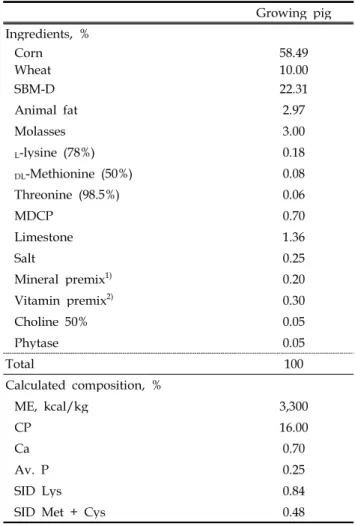
Table 1. Formula and chemical compositions of experimental diets
Growing pig Ingredients, %
Corn 58.49
Wheat 10.00
SBM-D 22.31
Animal fat 2.97
Molasses 3.00
L-lysine (78%) 0.18
DL-Methionine (50%) 0.08
Threonine (98.5%) 0.06
MDCP 0.70
Limestone 1.36
Salt 0.25
Mineral premix1) 0.20
Vitamin premix2) 0.30
Choline 50% 0.05
Phytase 0.05
Total 100
Calculated composition, %
ME, kcal/kg 3,300
CP 16.00
Ca 0.70
Av. P 0.25
SID Lys 0.84
SID Met + Cys 0.48
1) Supplied per kilogram of diet: 45 mg Fe, 0.25 mg Co, 50 mg Cu, 15 mg Mn, 25 mg Zn, 0.35 mg I, 0.13 mg Se.2) Supplied per kilogram of diet: 16,000 IU vitamin A, 3,000 IU vitamin D3, 40 IU vitamin E, 5.0 mg vitamin K3, 5.0 mg vitamin B1, 20 mg vitamin B2, 4 mg vitamin B6, 0.08 mg vitamin B12, 40 mg pantothenic acid, 75 mg niacin, 0.15 mg biotin, 0.65 mg folic acid, 12 mg antioxidant.
1. Animals, diets and management
A total of 240 growing pigs (initial body weight 61.47±0.61 kg) were randomly allotted to 4 treatments on the basis of initial body weight (BW). There were 4 replicates in each treatment with 15 pigs in each pen.
The dietary treatments included basal diet fed in dry form (DF). Diets were formulated to contain 3300 kcal/kg of metabolizable energy (Table 1) and fed in meal form for 56 d. All the diets met or exceeded
[Provider:earticle] Download by IP 118.70.52.165 at Monday, December 20, 2021 7:56 PM
www.earticle.net
current nutrient requirements for grower pigs (NRC, 2012).
In the first treatment, dry feed (DF) was provided ad libitum and water was provided in separate drinkers. Similarly, in the second treatment feed was provided ad libitum, but by dry and wet feeding system (WF) keeping the feed wet. In the third treatment feed:water ratio of 1:3 was prepared freshly and was provided to pigs in a liquid form (LF) three times a day (restricted form).
2. Experimental procedure and sampling
Pigs were individually weighed at the beginning, d 28 (end of phase I) and d 56 (end of phase II) of the experiment while feed consumption was recorded at the end of each phase so as to calculate average daily gain (ADG), average daily feed intake (ADFI), and gain to feed ratio (G:F).
3. Average daily water intake (ADWI) and water to feed ratio (W/F)
Water disappearance was recorded by an electronic water flow-meter connected to a process computer. The apparent total tract digestibility (ATTD) of energy and nutrients were evaluated to study the effect of different feeding methods by including 2.5 g/kg chromic oxide to each diet as an inert, indigestible indicator during last 7 d of each phase. The fecal grab samples were collected from the floor of each pen during the last 4 d of each phase. The samples were then pooled within pen and dried in a forced air drying oven at 60℃ for 72 h, and ground in Wiley mill (Thomas Model 4 Wiley Mill, Thomas Scientific, Swedesboro, NJ) using a 1-mm screen and used for chemical analysis.
On the starting day and at the last day of each phase (day 28 vs day 56), 10 mL blood samples were aseptically collected by jugular venipuncture. The heparinized vacuum tubes (Becton Dickinson, Franklin, USA) and tubes without anticoagulant were used to collect blood for measuring blood cell counts and
biochemical parameters respectively. Blood tubes were stored on ice for no more than 2 h at the time of collection before sample preparation and analysis. The above samples were centrifuged (3,000 × g for 15 min at 4℃) to collect plasma and serum which were then stored at -20℃ for further analysis. Blood serum was harvested by centrifugation. Conditions were 3,000 × g at 4℃ for 15 min. Blood plasma was used to quantify WBCs and lymphocytes while serum samples were used to measure glucose and cortisol.
To analysis the carcass characteristics, 4 pigs per treatment with average body weight were sacrificed by electrocution on d 56 of experiment. Carcass weight (%
of total weight) and dressing percentage was recorded at time of slaughter. Backfat thickness (mm) at 10th rib (6.5 cm from one side of the backbone) and lean meat percentage were measured 24 hours post-slaughter by using an ei-medical imaging ultrasound (Loveland, CO).
4. Chemical analysis
Experimental diets and excreta samples were analyzed in triplicate for DM (Method 930.15), CP (Method 990.03), according to AOAC (2007) methods.
Gross energy of diets and feces were measured by a bomb calorimeter (Model 1261, Parr Instrument, Molin, IL), and chromium concentrations was determined with an automated spectrophotometer (Jasco V-650, Jasco, Tokyo, Japan) according to the procedure of Fenton and Fenton (1979). The ATTD (g kg-1)of nutrients was calculated by using following formula:
ATTD (g kg-1)=[1-(Nf× Cd)/(Nd× Cf)]× 1000
Where, Nf=nutrient concentration in feces (g kg-1 DM);
Nd=nutrient concentration in diet (g kg-1 DM);
Cf=chromium concentration in feces (g kg-1DM) and Cd=chromium concentration in diet (g kg-1 DM).
Commercial kits (Fujifilm, Saitama, Japan) were used for the analysis of serum metabolites using an
[Provider:earticle] Download by IP 118.70.52.165 at Monday, December 20, 2021 7:56 PM
www.earticle.net
automated chemistry analyzer (Fuji Dri-chem 3500i, Fujifilm). White blood cells (WBC) and lymphocytes were measured immediately on a HemaVet 850 (CDC Technologies, Oxford, UK) analyzer according to the manufacturer’s procedures.
5. Statistical Analysis
Data generated in the present study was subjected to statistical analysis using the GLM procedure of SAS package 2012 (SAS Inst. Inc., Cary, NC) in a randomized complete block design. When significant difference were identified among treatment means, they were separated using Tukey,s honestly significant difference test. The pen was used as the experimental unit for the analysis of all the parameters. Probability values of less than 0.05 (p<0.05) were considered
significant.
Ⅲ. RESULTS
1. Growth performance
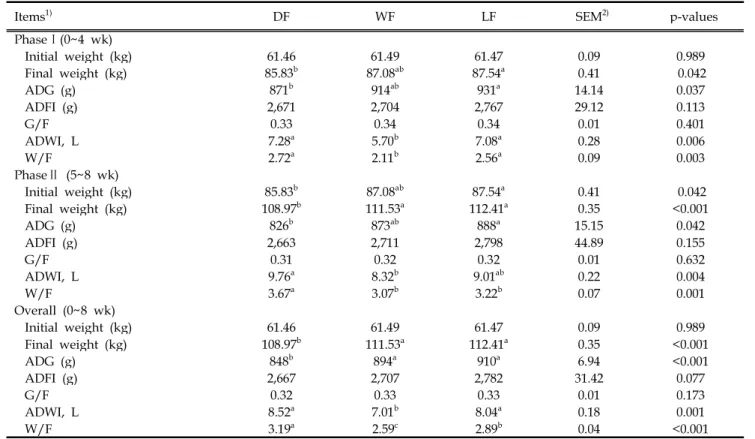
Growth performance of growing finishing pigs after feeding of dry, wet or liquid diets has been presented in Table 2. Piglets with similar weight in all the groups were taken at the start of the experiment;
however in Phases I and Ⅱthe ADG were increased (p<0.05) in LF treatment and thus resulted in higher 4th wk final body weight in comparison to DF. There was no variation (p>0.05) in the ADFI and G/F in the treatment groups however the ADWI and W/F was reduced (p<0.01) in WF in comparison to treatment DF
Table 2. Effect of dry feeding, wet feeding or liquid diets on the growth performance of growing finishing pigs
Items1) DF WF LF SEM2) p-values
PhaseⅠ(0~4 wk)
Initial weight (kg) 61.46 61.49 61.47 0.09 0.989
Final weight (kg) 85.83b 87.08ab 87.54a 0.41 0.042
ADG (g) 871b 914ab 931a 14.14 0.037
ADFI (g) 2,671 2,704 2,767 29.12 0.113
G/F 0.33 0.34 0.34 0.01 0.401
ADWI, L 7.28a 5.70b 7.08a 0.28 0.006
W/F 2.72a 2.11b 2.56a 0.09 0.003
PhaseⅡ (5~8 wk)
Initial weight (kg) 85.83b 87.08ab 87.54a 0.41 0.042
Final weight (kg) 108.97b 111.53a 112.41a 0.35 <0.001
ADG (g) 826b 873ab 888a 15.15 0.042
ADFI (g) 2,663 2,711 2,798 44.89 0.155
G/F 0.31 0.32 0.32 0.01 0.632
ADWI, L 9.76a 8.32b 9.01ab 0.22 0.004
W/F 3.67a 3.07b 3.22b 0.07 0.001
Overall (0~8 wk)
Initial weight (kg) 61.46 61.49 61.47 0.09 0.989
Final weight (kg) 108.97b 111.53a 112.41a 0.35 <0.001
ADG (g) 848b 894a 910a 6.94 <0.001
ADFI (g) 2,667 2,707 2,782 31.42 0.077
G/F 0.32 0.33 0.33 0.01 0.173
ADWI, L 8.52a 7.01b 8.04a 0.18 0.001
W/F 3.19a 2.59c 2.89b 0.04 <0.001
1) DF, Dry feeding; WF, Wet feeding; LF, Liquid feeding.
2) Standard error of mean.
a,b,c Values with different superscripts of the same row are significantly differ (p<0.05).
[Provider:earticle] Download by IP 118.70.52.165 at Monday, December 20, 2021 7:56 PM
www.earticle.net
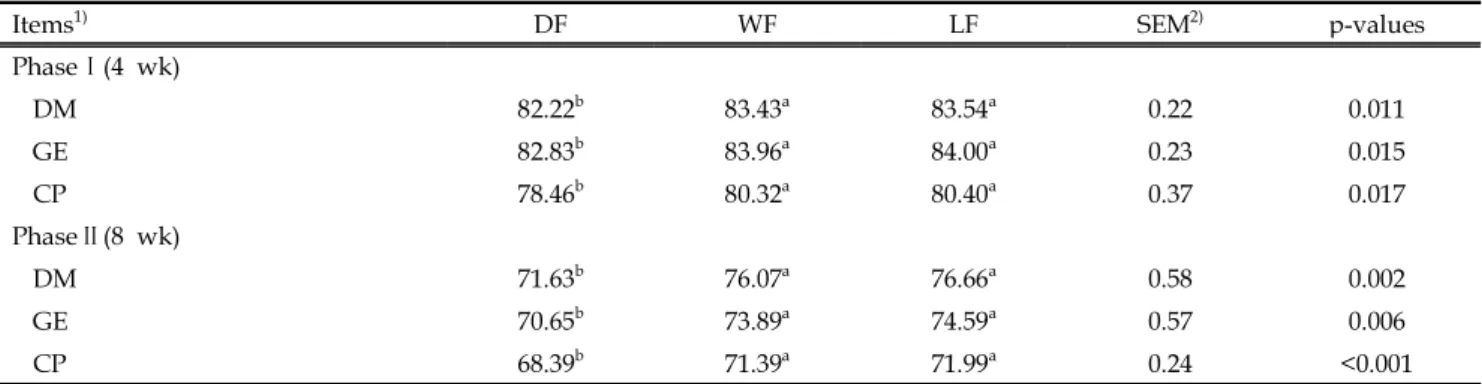
Table 3. Effect of dry feeding, wet feeding or liquid diets on nutrient digestibility of growing finishing pigs
Items1) DF WF LF SEM2) p-values
PhaseⅠ(4 wk)
DM 82.22b 83.43a 83.54a 0.22 0.011
GE 82.83b 83.96a 84.00a 0.23 0.015
CP 78.46b 80.32a 80.40a 0.37 0.017
PhaseⅡ(8 wk)
DM 71.63b 76.07a 76.66a 0.58 0.002
GE 70.65b 73.89a 74.59a 0.57 0.006
CP 68.39b 71.39a 71.99a 0.24 <0.001
1) DF, Dry feeding; WF, Wet feeding; LF, Liquid feeding.
2) Standard error of mean.
a,b Values with different superscripts of the same row are significantly differ (p<0.05).
and LF treatment. During the phase II, the ADG wasincreased (p<0.05) in LF while final weight was increased (p<0.01) in both WF and LF in comparison to DF. ADWI was decreased in WF while W/F ratio was (p<0.01) decreased in both WF and LF in comparison to DF.
While observing the overall performance during the whole experiment it was found that ADG and final body weight were significantly greater in WF and LF (p<0.01) compared with DF. ADWI was decreased (p<0.01) in WF while W/F was decreased (p<0.01) in both WF and LF but was found to be lowest in WF compared to DF.
2. Apparent total tract digestibility
The nutrient digestibility of growing finishing pigs has been presented in Table 3. The ATTD of DM, GE and CP was increased (p<0.05) in WF and LF in comparison to DF at both phase I and II (4th and 8th wk) of the experiment.
3. Blood characteristics
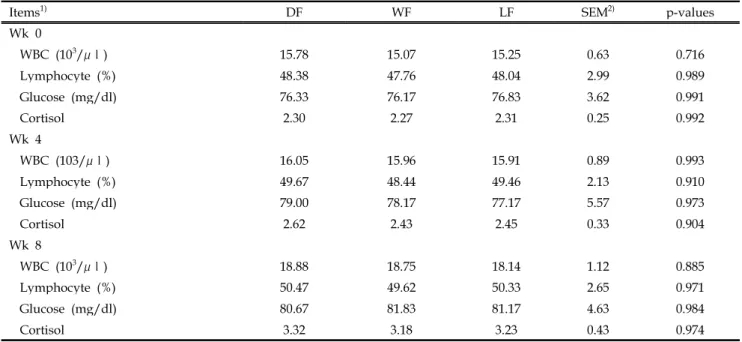
The blood parameter in pigs has been presented in Table 4. There was no variation in the WBCs, lymphocytes, glucose and cortisol levels in any of the treatment and control group.
4. Carcass characteristics and organ weight
Carcass characteristics of growing finishing pigs have been presented in Table 5. No variation was seen in the carcass characteristics including dressing percentage, backfat thickness, and lean meat percentage.
Ⅳ. DICUSSION
In Phase I the ADG was increased in LF treatment.
Similar increase in the ADG and final body weight was also observed in LF treatment at phase II and at the overall experimental period. This is in correlation with the earlier studies where liquid feeding had increased the ADG and body weight either in a 3-wk trial or 6-wk period (Partridge et al., 1992; Jensen and Mikkelsen, 1998). In contrary, in another experiment, dry feeding was found to increase ADG in comparison to liquid feeding (Kornegay and Thomas, 1981) while in the other experiment no difference in ADG was observed when dry pelleted feed and fresh liquid feed was offered to pigs (Lawlor et al., 2002). This could be due to the fact that, in the present experiment, the ratio for water:feed was taken 3:1 and the restricted feeding pattern was followed as the feed was provided three times a day in LF treatment throughout the experiment. Hurst et al., (2008) also reported heavier pigs with greater ADG, when offered the 1:3 feed and water ratio under restricted feeding conditions.
[Provider:earticle] Download by IP 118.70.52.165 at Monday, December 20, 2021 7:56 PM
www.earticle.net
Table 5. Effect of dry feeding, wet feeding or liquid diets on carcass characteristics of pigs
Items1) DF WF LF SEM2) p-values
Dressing (%) 85.82 85.91 86.07 0.23 0.755
Backfat thickness (mm) 25.67 25.94 25.42 0.94 0.927
Lean meat (%) 55.92 56.24 56.45 0.25 0.368
1) DF, Dry feeding; WF, Wet feeding; LF, Liquid feeding
2) Standard error of mean.
Table 4. Effect of dry feeding, wet feeding or liquid diets on blood and stress hormone parameters in pigs
Items1) DF WF LF SEM2) p-values
Wk 0
WBC (103/µℓ) 15.78 15.07 15.25 0.63 0.716
Lymphocyte (%) 48.38 47.76 48.04 2.99 0.989
Glucose (mg/dl) 76.33 76.17 76.83 3.62 0.991
Cortisol 2.30 2.27 2.31 0.25 0.992
Wk 4
WBC (103/µℓ) 16.05 15.96 15.91 0.89 0.993
Lymphocyte (%) 49.67 48.44 49.46 2.13 0.910
Glucose (mg/dl) 79.00 78.17 77.17 5.57 0.973
Cortisol 2.62 2.43 2.45 0.33 0.904
Wk 8
WBC (103/µℓ) 18.88 18.75 18.14 1.12 0.885
Lymphocyte (%) 50.47 49.62 50.33 2.65 0.971
Glucose (mg/dl) 80.67 81.83 81.17 4.63 0.984
Cortisol 3.32 3.18 3.23 0.43 0.974
1) DF, Dry feeding; WF, Wet feeding; LF, Liquid feeding
2) Standard error of mean.
Wet environment provides favorable conditions for the multiplication of microbes and there is a possibility that fermentation will begin as soon as the feed and water are mixed (Canibe and Jensen, 2003). The final weight was increased in WF in comparison to DF, however, the ADFI was not affected throughout the experiment. This is in line with the earlier reports of Hurst et al., (2008) where daily feed intake was similar between dry un-restricted and 1:3 un-restricted liquid fed groups. Restricted liquid diet improved FCR by 7%
to 10% but ad libitum diet could not put forward any difference (Hurst et al., 2008; Jensen and Mikkelsen, 1998). In the present study no variation was observed in the G:F ratio in either restricted LF treatment or in ad libitum DF or LF treatment.
The ADWI was consistently decreased in WF it
comparison to DF. It has been previously reported that different environmental and physiological factors influences the water utilization (Patience et al., 2005;
Mroz et al., 1995) but the effect of the type of diet is not yet clear. However less utilization of water may reduce the manure storage problem that is due to excessive water intake (Shaw et al., 2006). No variation in the ADWI in LF treatment of the present experiment might be due to hunger-induced polydipsia which can stimulate pigs to consume excessive quantities of water when their feed intake is limited (Yang et al., 1981). This problem can be solved by supplementing ad libitum feeding (Shaw et al., 2006).
Water to feed ratio was consistently decreased in WF throughout the experiment. Similar decrease was also seen in LF at the phase II. This is in line with the
[Provider:earticle] Download by IP 118.70.52.165 at Monday, December 20, 2021 7:56 PM
www.earticle.net
earlier studies of Li et al. (2005) who reported a decrease in W:F ration in nipple type drinkers. Shaw et al. 2006 reported lower water:feed ratio in ad libitum feeding in comparison to restricted feeding. Similarly, in our study ad libitum feeding (WF) had lower water:feed ratio compared to restricted feeding LF but DF treatment with ad libitum had higher G:F ratio and suggested that feeder type for water is much more important aspect than the type or time of feeding.
The ATTD of DM, GE and CP was increased in both WF and LF. This could be due to the presence of greater water content available to pigs and previous reports suggested that higher water ratios increase the digestibility in pigs (Barber et al., 1991). In contrast, Pedersen and Stein (2010) reported no significant effect on ATTD of DM, GE, and CP by the addition of water to the dry feed regardless of the dry feed to water ratio. The ATTD of DM, CP and organic matter was increased in pigs fed higher fermented diets than in lower fermented diets, however, ATTD of GE were not affected by fermentation (Pedersen and Stein, 2010;
Lyberg et al., 2006). This might be caused by the increase in the microbial activity due to the fermentation process that would have enhanced the fiber solubility (Pedersen and Lindberg, 2003).
There was no difference in WBC, lymphocyte, glucose and cortisol level in any of the treatment group. Similar to the previous studies reported by other researchers, liquid feeding had no effect on the WBC in comparison to dry feeding (Funderburke and Seerley, 1990; Choct et al., 2004).
No variation was seen in the carcass characteristics including dressing percentage, backfat thickness, and lean meat percentage of the pigs in any of the treatment group. This is in relation with the earlier reports of Hurst et al. (2008) where they reported no variation in backfat and long-term rate of growth in pigs fed diets either on liquid or ad libitum basis.
Magowan et al. (2008) also reported no effect of different feeder’s type on the back fat thickness in pigs.
Regarding the result of current experiment, it could
be concluded that the wet and liquid feeding are beneficial to improve the performance in growing pigs.
Dry-wet feeders are useful in promoting growth performance of the pig and reduce the water intake.
Similarly, fresh liquid feeding is useful for the development of pigs from the initial phase without effecting the blood biochemical parameters and carcass characteristics.
ACKNOWLEDGEMENT
This work was carried out with the support of Cooperative Research Program for Agriculture Science and Technology Development (Project No. 01160302), Rural Development Administration, Republic of Korea.
The authors are thankful to the Institute of Animal Resources, Kangwon National University, Chuncheon, Republic of Korea for providing the technical facilities to conduct this experiment.
Ⅴ. REFERENCES
1. AOAC, 2007. Official Methods of Analysis of the Association of Official Analytical Chemists International, 18th ed. Gaithersburg, MD, USA.
2. Barber, J., Brooks, P. H. and Carpenter, J. L. 1991.
The effects of water to food ratio on the digestibility, digestible energy and nitrogen retention of a grower ration. Anim. Prod. 52, 601.
3. Braun, K. and de Lange, K. 2004. Liquid swine feed ingredients: Nutritional quality and contaminants.
Proc. ANAC Eastern Nutrition Conference, May 11-12, 2004, Ottawa, Ontario, Canada. pp. 17
4. Brooks, P. H., Geary, T. M., Morgan, D. T. and Campbell, A. 1996. New developments in liquid feeding. J. Pig. 36:43-64.
5. Brumm, M. C., Dahlquist, J. M. and Heemstra, J. M.
2000. Impact of feeders and drinker devices on pig performance, water use, and manure volume. Swine Health Prod. 8:51–57.
[Provider:earticle] Download by IP 118.70.52.165 at Monday, December 20, 2021 7:56 PM
www.earticle.net
6. Canibe, J. and Jensen, B. B. 2003. Fermented and nonfermented liquid feed to growing pigs: effects on aspects of gastrointestinal ecology and growth performance. J. Anim. Sci. 81:2019-2031.
7. Choct, M., Selby, E. A. D., Cadogan, D. J. and Campbell, R. G. 2004. Effect of particle size, processing and dry or liquid feeding on performance of piglets. Crop Pasture Sci. 55:237-245.
8. Deprez, P., Deroose, P., van den Hende, C., Muylle, E. and Oyaert, W. 1987. Liquid versus dry feeding in weaned piglets: the influence on small intestinal morphology. J. Vet. Med. B34:254–259.
9. Funderburke, D. W. and Seerley, R. W. 1990. The effects of postweaning streassors on pig weight change, blood, liver and digestive tract characteristics. J. Anim Sci. 68:155-162.
10. Fenton, T. W. and Fenton, M. 1979. An improved procedure for the determination of chromic oxide in feed and feces. Can. J. Anim. Sci. 59:631-63.
11. Gonyou, H. W. and Lou, Z. 2000. Effects of eating space and availability of water in feeders on productivity and eating behavior of grower/fi nisher pigs. J. Anim. Sci. 78:865–870.
12. Hurst, D., Clarke, L. and Lean, I. J. 2008. Effect of liquid feeding at different water-to-feed ratios on the growth performance of growing–finishing pigs.
Animal. 2:1297–1302.
13. Jensen, B. B. and Mikkelsen, L. L. 1998. Feeding Liquid Diets to Pigs. In: (Ed. P. C. Garnsworthy and J. Wiseman) Recent Advances in Animal Nutrition. p. 107-126. Nottingham University Press, Notingham, UK.
14. Kornegay, E. T., Thomas, H. R., Handlin, D. L., Noland, P. R. and Burbank, D. K. 1981. Wet versus dry diets for weaned pigs. J. Anim. Sci. 52:14-17.
15. Lawlor, P. G., Lynch, P. B., Gardiner, G. E., Caffrey, P. J. and O’Doherty, J. V. 2002. Effect of liquid feeding weaned pigs on growth performance to harvest. J. Anim. Sci. 80:1725-1735.
16. Li, Y. Z., Che´nard, L., Lemay, S. P. and Gonyou, H. W. 2005. Water intake and wastage at nipple drinkers by growing-finishing pigs. J. Anim. Sci.
83:1413–1422.
17. Longland, A. C. 1991. Digestive enzyme activities in pigs and poultry. In vitro digestion for pigs and poultry (ed. MF Fuller), p. 3. CAB International, Wallingford, Oxon, UK.
18. Lyberg, K., Lundh, T., Pedersen, C. and Lindberg, J. E. 2006. Influence of soaking, fermentation and phytase supplementation on nutrient digestibility in pigs offered a grower diet based on wheat and barley. Anim. Sci. 82:853–858.
19. Magowan, E., McCanna, M. E. E. and Connell, N.
E. O. 2008. The effect of feeder type and change of feeder type on growing and finishing pig performance and behavior. Anim. Feed Sci. Tech.
142:133–143.
20. Mroz, Z., Jongbloed, A. W., Lenis, N. P. and Verman, K. 1995. Water in pig nutrition:
Physiology, allowances and environmental implications. Nutr. Res. Rev. 8:137–164.
21. NRC. 2012. Nutrient Requirements of Swine. 11th ed. National. Academic. Press, Washington, DC.
22. Partridge, G. G., Fisher, J., Gregory, H. and Prior, S. G. 1992. Automated wet feeding of weaner pigs versus conventional dry diet feeding: effects on growth rate and food consumption. Anim. Prod.
54:484 (Abstr.).
23. Patience, J. F., Umboh, J. F., Chaplin, R. K. and Nyachoti, C. M. 2005. Nutritional and physiological responses of growing pigs exposed to a diurnal pattern of heat stress. Livest. Prod. Sci. 96:205–214.
24. Pedersen, C. and Lindberg, J. E. 2003. Effect of fermentation in a liquid diet on nitrogen metabolism in growing pigs: Progress in Research on Energy and Protein Metabolism, International Symposium, Rostock-Warnemunde, Germany, 13–18 Sept. 2003, pp. 641–644.
25. Pedersen, C. and Stein, H. H. 2010. Effects of liquid and fermented liquid feeding on energy, dry matter, protein and phosphorus digestibility by growing pigs. Livst. Sci. 134:59–61.
26. Pomar, C., Hauschild, L., Zhang, G. H., Pomar, J.
and Lovatto, P. A. 2009. Applying precision feeding
[Provider:earticle] Download by IP 118.70.52.165 at Monday, December 20, 2021 7:56 PM
www.earticle.net
techniques in growing-finishing pig operations. R.
Bras. Zootec. 38:226-237.
27. SAS. 2012, SAS Software for PC. Release 9.3, SAS Institute. Ins, Cart, NC, USA.
28. Shaw, M. I., Beaulieu, A. D. and Patience, J. F.
2006. Effect of diet composition on water consumption in growing pigs. J. Anim. Sci.
84:3123-3132.
29. Thacker, P. A. 1999. Nutritional requirements of
early weaned pigs: A review. Asian Australas. J.
Anim. Sci. 12:976-987.
30. Yang, T. S., Howard, B. and MacFarlane, W. V.
1981. Effects of food on drinking behaviour of growing pigs. Appl. Anim. Ethol. 7:259–270.
(Received 23 October 2015, Revised 21 December 2015, Accepted 22 December 2015)
[Provider:earticle] Download by IP 118.70.52.165 at Monday, December 20, 2021 7:56 PM