• 검색 결과가 없습니다.

Tumor lysis syndrome following sorafenib treatment in hepatocellular carcinoma

N/A
N/A
Protected

Academic year: 2021

Share "Tumor lysis syndrome following sorafenib treatment in hepatocellular carcinoma"

Copied!
3
0
0

로드 중.... (전체 텍스트 보기)

전체 글

(1)

CASE REPORT eISSN 2384-0293 http://dx.doi.org/10.12701/yujm.2015.32.1.47

Yeungnam Univ J Med 2015;32(1):47-49

YUJM VOLUME 32, NUMBER 1, JUNE 2015 47

Tumor lysis syndrome following sorafenib treatment in hepatocellular carcinoma

Shin Young Kim, Hee Yeon Kim, Yu Seung Kim, Sang Min Lee, Chang Wook Kim

Division of Hepatology, Department of Internal Medicine, The Catholic University of Korea College of Medicine, Seoul, Korea Sorafenib is indicated for the treatment of advanced hepatocellular carcinoma (HCC), but although rare, tumor lysis syndrome (TLS) can be fatal in HCC patients with a large tumor burden. The authors describe the case of a 55-year-old hepatitis B carrier who visited our clinic with progressive dyspnea for 3 weeks.

Chest and abdominal computed tomography revealed a huge HCC in the left lobe of the liver with invasion of the inferior vena cava, right atrium, and pulmonary arteries. After 8 days of sorafenib administration, TLS was diagnosed based on the characteristic findings of hyperuricemia, hyperkalemia, and acute kidney injury with massive tumor necrosis by follow-up imaging. Despite discontinuation of sorafenib and supportive care, the patient’s clinical course rapidly deteriorated. The authors describe a rare but fatal complication that occurred soon after sorafenib initiation for HCC. Careful follow-up is required after commencing sor- afenib therapy for the early diagnosis and management of TLS.

Keywords: Hepatocellular carcinoma; Sorafenib; Tumor lysis syndrome

Received: May 25, 2014, Revised: June 25, 2014, Accepted: June 26, 2014

Corresponding Author: Chang Wook Kim, Division of Hepa- tology, Department of Internal Medicine, College of Medi- cine, The Catholic University of Korea, Uijeongbu St. Mary’s Hospital, 271 Cheonbo-ro, Uijeongbu 480-717, Korea Tel: +82-31-820-3997, Fax: +82-31-847-2719 E-mail: [email protected]

INTRODUCTION

Tumor lysis syndrome (TLS) is a commonly encountered emergency in patients with a hematologic cancer, but is rare in patients with a solid tumor [1]. This syndrome is caused by release of the contents of malignant cells to blood, either spontaneously or in response to effective therapy [2]. Sora- fenib, an oral multi-kinase inhibitor, blocks angiogenesis and tumor cell growth and provides proven survival benefits in advanced unresectable hepatocellular carcinoma (HCC) [3].

TLS has been reported in several cases of HCC after trans- arterial chemoembolization or radiofrequency ablation [4,5], but few reports of TLS following sorafenib treatment for HCC have been issued [6-8]. Here, we report a case of TLS that occurred 8 days after the administration of sorafenib in a patient with advanced HCC.

CASE

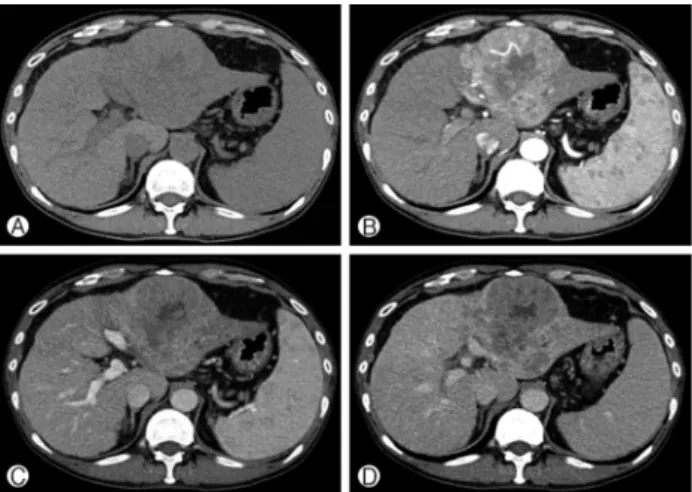
A 55-year-old male visited our clinic complaining of short- ness of breath that had persisted for 3 weeks. Thirty years previously he had been diagnosed with hepatitis B, but had not been followed regularly. Chest X-ray showed multiple small nodular opacities in both lung fields, and chest computed tomography (CT) displayed numerous small nodules, sugges- ting hematogenous metastasis, pulmonary tumor embolism involving the right main pulmonary, right upper lobar, and both lower lobar pulmonary arteries, and tumor thrombosis invasion of the left hepatic vein, inferior vena cava, and right atrium. Dynamic liver CT revealed a 7.5-cm sized hypervas- cular mass with washout occupying the left lobe (Fig. 1). We diagnosed HCC invading vessels with multiple lung metastases.

Laboratory data were as follows; hepatitis B e antigen (HBeAg)

negative, hepatitis B e antibody (HBeAb) positive, hepatitis

B virus DNA (LG Life Sciences, Korea) 21,129 copies/mL,

white blood cell count 4,480/mm

3

, hemoglobin 13.6 g/dL,

platelet count 96,000/mm

3

, aspartate aminotransferase (AST)

96 U/L (reference range, 0-40 U/L), alanine aminotransferase

(ALT) 42 U/L (reference range, 0-46 U/L), lactate dehydro-

(2)

Shin Young Kim et al.

48 YUJM VOLUME 32, NUMBER 1, JUNE 2015

Fig. 1. Liver dynamic computed tomography images before treat- ment with sorafenib showing a 7.5-cm hypervascular mass with delayed washout in the left lobe. (A) Pre-enhanced phase, (B) arte- rial phase, (C) portal phase, and (D) delayed phase.

Fig. 2. Chest computed tomography images taken 8 days after sorafenib commencement showed a large region of tumor necrosis and thrombus within the intrahepatic inferior vena cava. (A) Pre- enhanced phase, (B) post-enhanced phase.

genase (LDH) 1,308 U/L (reference range, 218-472 U/L), total bilirubin (TB) 1.38 mg/dL (reference range, 0.2-1.2 mg/dL), albumin 4 g/L (reference range, 3.8-5.3 g/L), prothrombin time 13.6 s (control 10.9 s), creatinine 0.96 mg/dL (reference range, 0.5-1.3 mg/dL), uric acid 5.4 mg/dL (reference range, 2.8-8.3 mg/dL), sodium 135 mEq/L (reference range, 135-150 mEq/L), potassium 4.1 mEq/L (reference range, 3.5-5.1 mEq/L), calcium 8.6 mg/dL (reference range, 8.2-10.2 mg/dL), phosphorus 2.0 mg/dL (reference range, 2.5-4.5 mg/dL), α-fetoprotein 1,795 μg/L (reference range, 0-20 μg/L), and prothrombin induced by vitamin K absence (PIVKA) II 19,717 mAU/mL. The pati- ent was given oral sorafenib 400 mg b.i.d. and oral tenofovir 300 mg once daily, and was discharged 4 days after introdu- cing sorafenib without adverse effect.

Eight days after sorafenib commencement, the patient com- plained of progressive dyspnea and generalized weakness.

Chest CT showed progression of the pulmonary thromboem- bolism and tumor thrombosis in the right atrium. In addition,

a large region of necrosis was observed in the location of the previously enhancing mass in the left liver (Fig. 2).

Laboratory data revealed an AST level of 5,729 U/L, ALT 2,370 U/L, LDH 17,971 U/L, TB 4.1 mg/dL, creatinine 0.85 mg/dL, uric acid 9.5 mg/dL, and potassium 5.3 mEq/L. Sora- fenib was discontinued due to concerns of TLS development.

However, on the following day, creatinine, uric acid, and pota- ssium levels rose to 1.45 mg/dL, 11.5 mg/dL, and 5.8 mEq/L, respectively. The patient was diagnosed with TLS, and intra- venous fluid replacement, diuretics, oral kalimate, bicarbonate, and allopurinol were administered. Although elevated AST and LDH levels began to decrease 2 days after discontinuing sora- fenib, creatinine increased to 2.55 mg/dL and urine output decreased. Emergent hemodialysis was considered, but the family decided on transfer to a nursing home.

DISCUSSION

TLS is a potentially life-threatening oncological emergency that is caused by the rapid breakdown of malignant cells and the release of their intracellular contents to blood [2]. The diagnosis of laboratory TLS is based on the presence of two or more of the following laboratory abnormalities: hyperuri- cemia, hyperkalemia, hyperphosphatemia, and hypocalcemia.

Laboratory TLS accompanied by an elevated creatinine level, cardiac dysrhythmia, seizure, or death satisfies the criteria for clinical TLS [9]. Our patient presented with hyperuricemia, hyperkalemia, and an elevated creatinine level, and thus, met the diagnostic criteria for clinical TLS.

TLS typically develops in cases of hematological malignancy

within a week after initiating an effective chemotherapy. On

the other hand, TLS in HCC is expected to develop later and

less frequently, because solid tumors grow at lower rates than

hematologic malignancies and are more resistant to cytotoxic

therapies [2]. However, the introduction of multi-targeted

kinase inhibitors increased the risk of the early development

of TLS in patients with solid tumors [10]. To date, the shortest

time reported to the development of TLS after sorafenib

commencement in a patient with HCC was 10 days [8], and

in the present case, TLS and massive tumor necrosis developed

only 8 days after starting sorafenib. TLS is more likely to

develop in patients with hematological malignancies, highly

proliferative tumors, a heavy tumor burden, or pre-existing

renal impairment or after the initiation of a highly effective

(3)

Sorafenib-induced tumor lysis syndrome

YUJM VOLUME 32, NUMBER 1, JUNE 2015 49

treatment [2]. In our patient, the presence of a rapid growing large HCC nodule and the therapeutic efficacy of sorafenib may have led to massive tumor necrosis and early TLS develop- ment.

Sorafenib is administered orally, and can be prescribed in an outpatient department. Subsequently, patients are moni- tored for common adverse events, such as, hand-foot skin reactions, constitutional symptoms, and diarrhea [3]. How- ever, although TLS following treatment with sorafenib is rare, it can be fatal as demonstrated by the present case. Patients with the manifestations of TLS should receive supportive care, including intravenous hydration, control of electrolyte disturbances, urine alkalinization, and hemodialysis when needed, in order to minimize oliguria and acidosis [2]. In the presented case, sorafenib was terminated after 8 days of treat- ment, but clinical TLS progressed despite supportive care.

Recently, a case of grade I TLS and of impending TLS were reported in whom early suspicion and prompt management prevented further progression [7,8]. To avoid potentially fatal complications after sorafenib commencement, careful follow up for TLS is required in HCC patients with a large tumor burden or an aggressive tumor type.

In conclusion, clinicians should remember that although rare, TLS can occur soon after instituting sorafenib in cases of HCC with a large tumor burden. Close monitoring for the development of TLS is needed after starting sorafenib in advanced HCC with a heavy tumor burden. Furthermore, a high index of suspicion for TLS, immediate discontinuation of the drug, and supportive management can improve prognosis.

REFERENCES

1. Cairo MS, Coiffier B, Reiter A, Younes A; TLS Expert Panel.

Recommendations for the evaluation of risk and prophylaxis of tumour lysis syndrome (TLS) in adults and children with malignant diseases: an expert TLS panel consensus. Br J Haematol 2010;149:578-86.

2. Howard SC, Jones DP, Pui CH. The tumor lysis syndrome.

N Engl J Med 2011;364:1844-54.

3. Llovet JM, Ricci S, Mazzaferro V, Hilgard P, Gane E, Blanc JF, et al. Sorafenib in advanced hepatocellular carcinoma. N Engl J Med 2008;359:378-90.

4. Hsieh PM, Hung KC, Chen YS. Tumor lysis syndrome after transarterial chemoembolization of hepatocellular carcinoma:

case reports and literature review. World J Gastroenterol 2009;15:4726-8.

5. Lehner SG, Gould JE, Saad WE, Brown DB. Tumor lysis syn- drome after radiofrequency ablation of hepatocellular carci- noma. AJR Am J Roentgenol 2005;185:1307-9.

6. Huang WS, Yang CH. Sorafenib induced tumor lysis syn- drome in an advanced hepatocellular carcinoma patient. World J Gastroenterol 2009;15:4464-6.

7. Joshita S, Yoshizawa K, Sano K, Kobayashi S, Sekiguchi T, Morita S, et al. A patient with advanced hepatocellular carci- noma treated with sorafenib tosylate showed massive tumor lysis with avoidance of tumor lysis syndrome. Intern Med 2010;49:991-4.

8. Shiozawa K, Watanabe M, Takenaka H, Nagai H, Ishii K, Sakai K, et al. Tumor lysis syndrome after sorafenib for hep- atocellular carcinoma: a case report. Hepatogastroenterology 2010;57:688-90.

9. Cairo MS, Bishop M. Tumour lysis syndrome: new ther- apeutic strategies and classification. Br J Haematol 2004;127:

3-11.

10. Nicholaou T, Wong R, Davis ID. Tumour lysis syndrome

in a patient with renal-cell carcinoma treated with sunitinib

malate. Lancet 2007;369:1923-4.

수치

Fig. 1. Liver dynamic computed tomography images before treat- treat-ment with sorafenib showing a 7.5-cm hypervascular mass with  delayed washout in the left lobe

참조

관련 문서

• 이명의 치료에 대한 매커니즘과 디지털 음향 기술에 대한 상업적으로의 급속한 발전으로 인해 치료 옵션은 증가했 지만, 선택 가이드 라인은 거의 없음.. •

The proposal of the cell theory as the birth of contemporary cell biology Microscopic studies of plant tissues by Schleiden and of animal tissues by Microscopic studies of

1 가톨릭대학교 서울성모병원 The Catholic University of Korea,.

In a statement to Kuwait News Agency (KUNA) on the sidelines of a meeting of the Arab Parliament's Foreign Affairs Political and National Security

The meeting was attended by Assistant Foreign Minister for GCC Affairs, Ambassador, Nasser Al-Muzayyen, and Deputy Assistant Foreign Minister for the Office of the

“ Sheikh Nasser has a written message from HH the Amir, Sheikh Sabah Al-Ahmad Al-Jaber Al-Sabah to the Chinese President, Chi Gen Beng related to enhancing mutual

On his part, CEO of Express Roads Authority, Saud Al-Naqqi said that the heavy rains of the previous day led to clogging parts of the express

Kuwait will celebrate on Sunday the fourth anniversary of the UN honoring and proclamation of His Highness the Amir, Sheikh Sabah Al-Ahmad Al-Jaber Al-Sabah as