Antecedents of Health-Promoting Behavior Among Female University Students in Korea
Shin, Hye Sook1 ․ Shin, Hyunsook1
1Professor, College of Nursing Science, Kyung Hee University; East-West Nursing Institute
여대생의 건강증진 행위에 영향을 미치는 요인
신 혜 숙1 ․ 신 현 숙1
1경희대학교 간호과학대학 교수, 동서간호학연구소 상임연구원
본 연구는 여대생의 건강증진행위를 설명하기 위하여, 문헌고찰을 통해 가설적 모형을 도출하고, 여대생을 대상으로 건강증진행 위를 횡단적으로 조사하여 모형의 적합성과 모형에서 제시된 가설을 검증하는 서술적 상관관계 연구이다. 연구에 사용된 변수는 건 강증진행위와 관련된 선행 문헌의 고찰을 근거로 선정되었으며, 총 280명의 자료가 최종 분석에 이용되었다.
설문지는 Pender의 건강증진모형을 기초로 하여 개발하였으며, 조정요인 5문항, 건강상태 지각 3문항, 건강 통제위 4문항, 자 아 존중감 5문항, 건강증진 행위 24문항의 총 41문항으로 구성하여 사용하였다. 개발된 항목에 대하여 간호대학생들을 대상으로 사 전 조사를 실시하여 최종적인 설문지를 완성하였다. 본 연구모형에 대한 구성개념의 파악을 위해서 탐색적 요인분석을 실시하였고, 측정항목에 대한 요인별 단일 차원성 확인 및 통계적 검정을 위해 확인적 요인분석을 실시하였다. 연구의 가설검증을 위해 공변량 구조분석을 실시하였다.
모형의 적합도는 카이제곱은 244.04(자유도=121, p<0.001), GFI=0.91, CFI=0.97, NNFI=0.96, RMSR= 0.022으로 나타났다. 분 석결과 여대생의 자아존중감과 내적통제위는 건강상태지각 및 건강증진행위에 유의한 영향을 미치는 요인으로 확인되었으며, 여대 생의 건강상태지각은 건강증진행위에 유의한 영향을 미치는 것으로 나타났다.
주요어 : 건강증진행위, 여대생, 공변량 구조분석
Key words : Health-promotion, Korea, Female university students Address reprint requests to : Shin, Hyunsook(Corresponding Author)
College of Nursing Science, Kyung Hee University, 1st Hoegi-dong, Dongdaemoon-gu, Seoul, Korea Tel: 82-2-961-9141 Fax: 82-2-961-9398 E-mail: [email protected]
투고일: 2008년 5월 16일 심사완료일: 2008년 5월 28일 게재확정일: 2008년 6월 3일
INTRODUCTION
Developments in science and medicine have significantly affected our lives. The improvements in standards of living due to socioeconomic development have increased the interest in maintaining healthy lifestyles. The lengthening of human life expectancies and improvements in
health levels has resulted in the gradual change of the focus ofmanagement from preventionman agement of diseases to a more effective and efficient health-care management system that aims at health promotion.
Total health expenditure accounted for 5.6% of GDP in Korea in 2004. Health spending as a share of GDP in Korea is the lowest among OECD
countries, more than three percentage points lower than the OECD average of 8.9%. Health spending tends to rise with income, and it is predicted that with higher GDP per capita tend to spend more on health(OECD, 2006). The potential long-term benefits expected from health promotion include extension of life expectancy and improvement of quality of life. This is now associated with an increased societal interest in reducing the cost of health management (Park et al., 1998).
The WHO has stated that health promotion is the process of enabling people to increase control over, and to improve, their health. To reach a state of complete physical mental and social wellbeing, an individual or group must be able to identify and to realize aspirations, to satisfy needs, and to change or cope with the environment. Health promotion focuseson the potential development of the individual, as well as that of his/her family, the community, the society,and the environment (WHO,1986).
The health promotion model represents a theoretical perspective that explores the factors and relationships contributing to health- promoting behavior and therefore to the enhancement of health and quality of life. The health promotion model originally developed in the early 1980s by Pender, defines health- promoting behavior as a multidimensional pattern of self-initiated actions and perceptions that serve to maintain or enhance the level of wellness, self-actualization, and fulfillment of the individual (Pender, 1996). Rozmus (2005) considered that autonomy and independence in decision- making - that is, a sense of self-efficacy - are major determinants that promote healthy lifestyles among freshman college students. Pullen, Walker, and Fiandt (2001) determined the extents to which
personal influences (demographics, definition of health, and perceived health status) and contextual influences (source of health information and provider counseling) explain health-promoting lifestyle behaviors in rural older women.
In this study, among the cognitive-perceptual variables of Pender's model, internal health locus of control, self-esteem, and perceived health status were considered to be suitable variables for evaluating the health- promoting behaviors of female university students.
Self-esteem refers to the degree to which one considers oneself as worthy and capable (Rosenberg, 1979). It can be defined as the affective component of the self (Seigley, 1999). Health- related research has focused on self-esteem as one variable influencing health-promoting behavior. Previous studies have emphasized the positive correlation between self-esteem and health (Mkikangas, Kinnunen, & Feldt, 2004 Mckinzie, Altamura, Burgoon, & Bishop, 2006).
Duffy (1988) investigated the effect of the health locus of control, self-esteem, health concern, and health status on health behavior. The health locus of control originated from social learning theory (Rotter, 1954), and was identified as one of the most important constructs related to the prediction of health-promoting behavior (Wallston and Wallston, 1978). It originated from Rotter's social learning theory, which states that behavior is a function of the individual's belief that the behavior will lead to a particular reinforcement and the value attached to the reinforcement (Norman, Bennett, Smith, & Murphy, 1997). Several previous studies have investigated the relationship between the health locus of control and health- promoting behavior (Paul, Marilyn, & Joel, 1998;
Rogers et al., 2004).
Health-promoting behavior has been studied in
various populations, includingpatients(Lee, Ko, &
Lee, 2006; Nothwehr & Stump, 2000), adolescent (Murphey, Lamonda, Carney, & Duncan, 2004), and women (Wang, 2001 Hui, 2002). Women are considered to greatly influence the health and lifestyles of families, since their role involves more than the caring and socialization of children, management of health care, and nutrition of family members. Rather, the health of women is thought to contribute to the overall wellness and happiness of humans because it directly affects the health of families, and thereby the health of a nation.
The life of a university student falls into the period of adolescence. Therefore, the health patterns of a university student influence health management into adulthood. Accordingly, desirable practices in health- care management during this period may lead to health-promoting behavior and become an important basis of a healthy adult life (Han, 2005).
Previous studies have largely focused on health- promotion issues in the general population, and there have been few studies of female university students who potentially affect the overall health of human beings.
To define the most important determinants affecting the health promotion behavior of female university students, a conceptual model was developed based on previous studies. The purpose of this study was to elucidate the relationships among self-esteem, perception of health, locus of control, and health promotion behavior of female university students in Korea. The findings from this study will help to guide the development of health-promoting programs for female university students and ultimately promote the quality of life of humans.
METHOD
1. Research Design
Variables were selected for inclusion in the explanatory model based on their theoretical relevance to health promotion behavior from previous studies. Self-esteem, internal health locus of control, perceived health status, and health-promoting behavior were conceptualized in a theoretical model. A structural equation model was used to evaluate the predictive model and identify the variables that affect health promotion behavior.
2. Data Collection
We collected data from a women's university located in Seoul. Participants were advised of the purpose of the study, and their informed consent was obtained. A structured self-administered questionnaire was used. A total of 284 responses were collected, of which 280 questionnaires were finally included in analysis after excluding4 incomplete responses.
3. Instruments
The instruments used in the study were based on those used in previous relevant literature suitably modified for female university students.
All instruments were comprehensively reviewed by two nursing professors, and a pilot test was conducted to test their validity and reliability.
Based on an analysis of the pilot test results, the instruments were further refined to fit the specific cultural context of female university students in Korea.
Self-esteem was measured using a modified
Self-esteem
Internal Health locus of control
Perceived health status Health-promoting behavior
Figure 1. Conceptual model instrument based on the scale of Rosenberg
(1965). This scale is a measure of acceptance of oneself as worthy and capable. The five-item scale asks respondents about their agreement with a set of statements, with each item rated from 1 ("strongly disagree") to 4 ("strongly agree").
Internal health locus of control was measured using a modified instrument based on the Multidimensional Health Locus of Control scale reported by Wallston et al. (1978). This study assessed only the internal health locus of control of the three dimensions of the original scale. The four-item scale was rated from 1 ("strongly disagree") to 4 ("strongly agree").
Perceived health status has been defined as a person's perception of his/herpresent health status. In the present study, this was measured by instruments developed by researchers. The three-item scale was rated from 1 ("strongly disagree") to 4 ("strongly agree").
Health-promoting behavior was measured using modified instruments based on the Health- Promoting Lifestyle Profile 2 scale (Walker et al., 1987). This scale asks respondents to rate how frequently they engage in 24 activities in the domains of responsibility to health, exercise, diet, spiritual growth, interpersonal relationships, and
stress management. The items are rated on a scale from 1 ("never") to 4 ("routinely").
4. Hypotheses
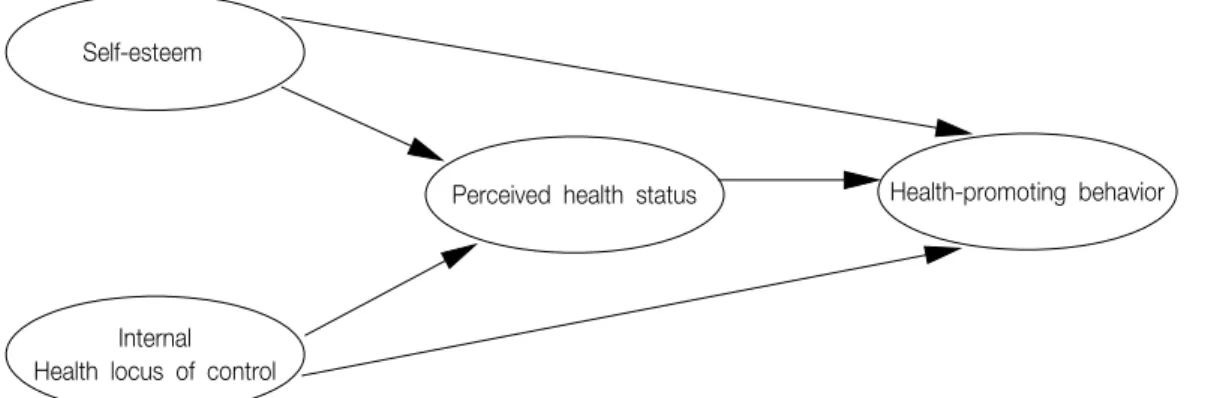
Self-esteem and internal health locus of control were identified as independent variables and perceived health status as mediating variable, and health-promoting behavior as dependent variable.
It was hypothesized that self-esteem and internal health locus of control impact positively on perceived health status, and that perceived health status impacts on health-promoting behavior. It was also hypothesized that self-esteem and health locus of control impact directly on health- promoting behavior (Fig. 1).
RESULTS
1. General Characteristics of Participants
The participants comprised mainly third-year university students (n=189, 67%). Half of them majored in liberal arts (n=140), 171 (61.4%) practiced a religion, 249 (88.9%) were in nuclear families, and 191 (68.2%) had experience of disease (Table 1).
Table 2. Reliability of Variables
Variable Construct Number of
proposed items
Number of deleted items
Cronbach's alpha
Perceived health status Health perception 3 - 0.802
Internal health locus of control Internal health locus of control 4 - 0.604
Self-esteem Self-esteem 8 3 0.842
Health-promoting behavior
Spiritual growth 4 - 0.818
Responsibility to health 6 1 0.742
Diet 4 - 0.627
Exercise 4 - 0.710
Interpersonal relationships 4 - 0.691
Stress management 4 1 0.626
Table 3. Correlation between Variables
Health-promoting
behavior Self-esteem Internal Health locus of control
Perceived health status Health-promoting behavior
Self-esteem
Internal Health locus of control Perceived health status
1.000
0.653 1.000
0.382 0.351 1.000
0.383 0.274 0.274 1.000
Table 1. General Characteristics of Participants (N=280)
Variable Frequency %
Grade
1 2 0.7
2 10 3.6
3 189 67.5
4 79 28.2
Major Liberal arts 140 50
Science or engineering 140 50 Religion
practiced
Yes 172 61.4
No 108 38.6
Family Extended family 31 11.1
Nuclear family 249 88.9
Disease experience
Yes 191 68.2
No 89 31.8
2. Data Analysis
Exploratory factor analysis with varimax rotation was performed to examine the inter- relationships within a set of variables. All factor loadings exceeded 0.3, and they explained more than 50% of the extracted variance. The properties of the variables studied in this study were assessed for reliability based on Cronbach's
alpha coefficient and the items-to-total correlation.
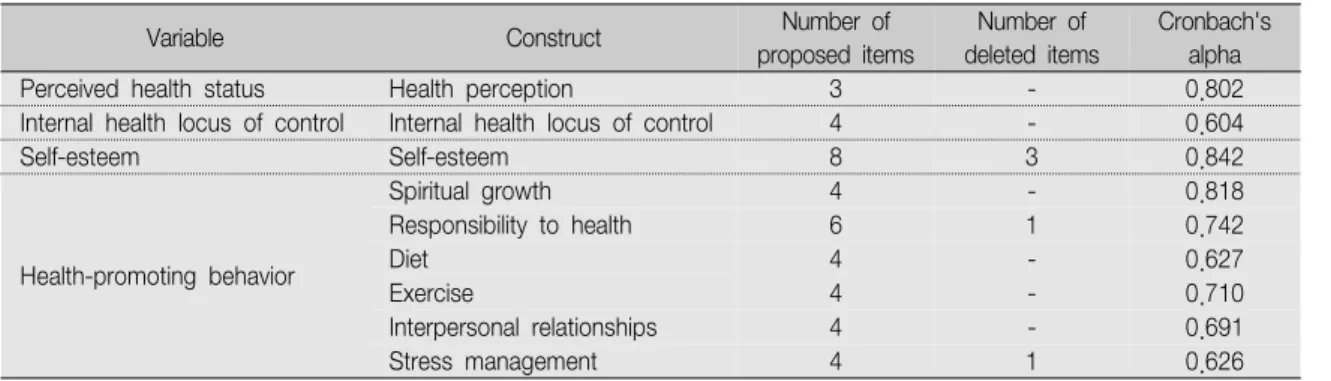
Four items were eliminated based on Cronbach's alpha and the items-to-total correlation: two from self-esteem and two from health-promoting behavior. (Table 2) indicates that all scales had reliability coefficients ranging from 0.604 to 0.842, which indicates satisfactory internal consistency given that they exceed the usual cutoff of 0.60 (Nunnally, 1978).
The hypothesized relationships between the study variables were tested using Pearson's correlation coefficient. (Table 3) indicates that the set of hypotheses - that self-esteem and internal health locus of control would be positively associated with perceived health and health- promoting behavior - was supported by the positive correlation between these variables.
3. Model Test
Based on the results of the correlation analysis, the proposed model was assessed using structural
Table 4. Confirmatory Factor Analysis
Variable Construct GFI AGFI RMSR NNFI χ2 d.f. p
Perceived health status Perceived health status 1 1 0 0 0
Internal health locus of control Internal health locus of control 0.94 0.71 0.05 0.69 34.57 2 0
Self-esteem Self-esteem 0.93 0.84 0.019 0.94 62.18 9 0
Health-promoting behavior
Spiritual growth 0.96 0.80 0.019 0.95 20.41 2 0.00
Responsibility to health 1 1 0 0 0
Diet 0.99 0.95 0.018 0.97 4.42 2 0.11
Exercise 0.95 0.73 0.048 0.90 27.44 2 0
Interpersonal relationships 1 1 0 0 0
Stress management 1 1 0 0 0
0.58(5.85)**
Self-esteem
0.2(2.12)* 0.11(2.05)*
0.35(3.33)**
0.28(3.38)**
Perceived health status
Internal Health locus of control
Health-promoting behavior
*P<.05 **P<.001
Figure 2. Final model
equation modeling with LISREL 8.1. Maximum likelihood estimation was used to estimate the parameters of the model (Joreskog and Sorbom, 1996).
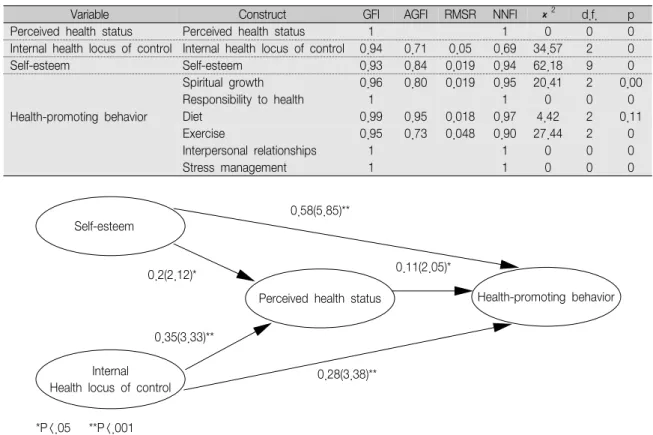
Confirmatory factor analysis was conducted to assess the correspondence between observed and latent variables. (Table 4) presents the results of the confirmatory procedure, which reveals the acceptable indicators.
The chi-square value was 244.04, with 121 degrees of freedom (p<0.001). The chi-square of the final trimmed model was not considered to be a good approximation (p<0.001), but the relative likelihood ratio - which is the ratio of the chi-square to the number of degrees of freedom (2.02) - was considered indicative of an acceptable fit.
The goodness-of-fit index (GFI), the comparative fit index (CFI), the non-normed fit index (NNFI), and the root-mean-square residual (RMSR) were used to assess the fit of the model. The recommended cutoffs close to 0.9 for GFI, CFI, and NNFI and to 0.05 for RMSR were used to assess the fit of the model to the data (Joreskog
& Sorborm, 1996). The values of these indices in this study - GFI=0.91, CFI=0.97, NNFI=0.96, and RMSR=0.022 - indicate the acceptable fit of the model. (Fig. 2) presents the final trimmed model.
Path coefficient estimates were estimated for testing the hypothesized relationships among the variables of the model. (Table 5) indicates that all of the path coefficients were statistically significant, with t values from 2.12 to 5.84.
Self-esteem had a positive effect on perceived
Table 5. Standardized Structural Coefficients of Final Model
Criterion variable Predictor variable Relationship Standardized coefficient
t
[standard error] R2
Perceived health status Self-esteem Positive 0.2* 2.12 [0.092]
Internal health locus of control Positive 0.35** 3.33 [0.11 ] 0.23
Health-promoting behavior
Perceived health status Positive 0.11* 2.05 [0.054]
0.84
Self-esteem Positive 0.58** 5.84 [0.099]
Internal health locus of control Positive 0.28** 3.38 [0.081]
*, p<0.05 **, p<0.001
health (β=0.2, p<0.05), but the effect of internal health locus of control was greater (β=0.35, p<0.001). Perceived health has a significant effect on health-promoting behavior (β=0.11, p<0.05).
Two independent variables - self-esteem (β
=0.58, p<0.001) and internal health locus of control (β=0.28, p<0.001) -directly and positively influenced health-promoting behavior. Overall, self-esteem was the most significant variable affecting the health-promoting behavior of female university students in Korea.
DISCUSSION
The purpose of this study was to determine the antecedents affecting the health-promoting behavior of female university students, and thereby help to guide the development of health education programs.
We found that self-esteem, internal health locus of control, and perceived health affect the health-promoting behavior of female university students.
Previous studies have shown that antecedents are important variables affecting health- promoting behavior, and these were also included and examined in this study. However, it is essential that important variables affecting the health of female university students be differentiated from those affecting other populations, since the health-promoting behavior of this group has the potentiality to affect the health of the
individual, and also that of their families and the community, society, and nation.
Consistent with previous studies demonstrating relationships between self-esteem and health- promoting behavior (McGee and Williams, 2000;
Thogersen- Ntoumani, & Ntoumanis, 2006), self-esteem was found to be the most important variable influencing the health promoting behavior of female university students. Moreover, the study findings clearly imply that students with a higher self-esteem are more likely both to have an interest in and to adopt desirable health- promoting practices. This finding has important implications for health management and the development of health-care programs, since it suggests that methods of improving both student self-esteem as well as physical and/or psychological wellness should be employed.
The positive influence of internal health locus of control on health-promoting behaviorin this study is consistent with many previous studies (Waller and Bates, 1992 Bellg, 2003). Health locus of control refers to enduring beliefs that health outcomes are controllable (Rotter, 1954). This study also indicated that internal health locus of control uses the perceived health status to engage in health-promoting behavior.
Internal health locus of control influenced perceived health status more than self-esteem.
We hypothesized that perceived health status influences health-promoting behavior when
cognitive antecedents are presented as motivators.
This hypothesis was supported by this study. The indirect effects of self-esteem and internal health locus of control on health-promoting behavior mediated by perceived health status were greater than the direct effects of perceived health status alone on health-promoting behavior.
In the present study, the overall variables, self-esteem, perceived health status, and internal health locus of control together explained 84% of the health-promoting behavior. The results support the presence of relationships between cognitive-perceptual variables and health-promoting behavior, but indicate the need for additional variables to be identified. Therefore, future research should consider a greater variety of characteristics of female university students and incorporate these characteristics into theory development and testing.
In conclusion, a strategy for enhancing the self- esteem of female university students and also a nursing intervention for stimulating and motivating their internal health locus of control should be developed. In addition, environments that provide optimal health education for female students should be established.
REFERENCES
Bellg, A. (2003). Maintenance of health behavior change in preventive cardiology. Internalization and self-regulation of new behaviors. Behavior Modification, 27(1), 103-131.
Duffy M. (1988). Determinants of health promoting lifestyle in midlife women. Nursing Research, 37(6), 358-362.
Han, K. (2005). Self efficacy, health promoting behaviors, and symptoms of stress among university students. Journal of Korean Academy of Nursing, 35(3), 585-592.
Hui, W. (2002). The health-promoting lifestyles of undergraduate nurses in Hong Kong. Journal of Professional Nursing, 18(2), 101-111.
Joreskog, K., & Sorbom, D. (1996). LISREL 8 User’s reference Guide, Scientific Software International Inc., Chicago.
Lee, T., Ko, I., & Lee, K. (2006). Health promotion behaviors and quality of life among community- dwelling elderly in Korea: A cross-sectional survey.
International Journal of Nursing Studies, 43, 293-300.
Mäkikangas, A., Kinnunen, U., & Feldt, T. (2004).
Self-esteem, dispositional optimism, and health:
Evidence from cross-lagged data on employees.
Journal of research in personality, 38(6), 556-575.
McGee, R., & Williams, S. (2000). Does low self-esteem predict health compromising behaviours among adolescents. Journal of Adolescent, 23(5), 569-582.
Mckinzie, C., Altamura, V., Burgoon, E., & Bishop, C.
(2006). Exploring the effect of stress on mood, self-esteem, and daily habits with psychology graduate students. Psychological Reports, 99(2), 439-448.
Murphey, D., Lamonda, K., Carney, J., & Duncan, P.
(2004). Relationships of a brief measure of youth assets to health-promoting and risk behaviors.
Journal of Adolescent Health, 34(3), 184-191.
Norman, P., Bennett, P., Smith, C., & Murphy, S.
(1997). Health locus of control and leisure-time exercise. Personality and individual differences, 23(5), 769-774.
Nothwehr, F., & Stump, T. (2000). Health-promoting behaviors among adults with type 2 diabetes:
Findings from the health and retirement study.
Preventive Medicine, 30(5), 407-414.
Nunnally, J. (1978). Psychometric theory(2nd ed.).
McGrawHill, New York.
OECD (Organization for Economic Co-operation and Development), (2006). Health data 2006. Retrieved May 1, 2008 from http://www/oecd.org/health/
healthdata.
Park, E. S., Kim, S. J., Kim, S. I., Chun, Y. J., Lee, P. S., & Kim, H. J., et al. (1998). A study of factors influencing health promoting behavior and
quality of life in the elderly. Journal of Korean Academy of Nursing, 28(3), 638-649.
Pau,l T., Marilyn, L., & Joel, W. (1998). Clinical applications of self-esteem and locus of control to adolescent health. Journal of Adolescent Health Care, 9(1), 1-14.
Pender, N. J. (1996). Health promotion nursing practice (3rd ed.). Stanford, CT: Appleton & Lange.
Pullen, C., Walker, S., & Fiandt, K. (2001).
Determinants of health-promoting lifestyle behaviors in rural older women. Fam Community Health, 24(2), 49-72.
Rogers L., Matevey, C., Hopkins-Price, P., Shah, P., Dunnington, G., & Courneya, K. (2004). Exploring social cognitive theory constructs for promoting exercise among breast cancer patients. Cancer Nursing, 27(6), 462-73.
Rosenberg, M. (1965). Society and the adolescent self-image.
Princeton: Princeton University Press.
Rosenberg, M. (1979). Conceiving the self. Basic Books, New York.
Rotter, J. (1954). Social learning and clinical psychology.
Englewood Cliffs, N.J.:Prentice-Hall.
Rozmus, C., Evans, R., Wysochansky, M., & Mixon, D.
(2005). An analysis of health promotion and risk behaviors of freshman college students in a rural southern setting. Journal of Pediatric Nursing, 20(1),
25-33.
Seigley, L. (1999). Self-esteem and health behavior:
Theoretic and empirical links. Nursing Outlook, 47(2), 74-77.
Thogersen-Ntoumani, C., & Ntoumanis, N. (2006). The role of self-determined motivation in the understanding of exercise-related behaviours, cognitions and physical self-evaluations. Journal of Sports Sciences, 24(4), 393-404.
Waller, K., & Bates, R. (1992). Health locus of control and self-efficacy beliefs in a healthy elderly sample.
American Journal of Health Promotion, 6(4), 302-309.
Wallston, B., & Wallston, K. (1978). Locus of control and health: a review of the literature. Health Education Monographs, 6, 107-117.
Walker, S., Sechrist, K., & Pender, N. (1987). The health-promoting lifestyle profile: Development and psychometric characteristics. Nursing Reseach, 36, 76-81.
Wang, H. (2001). A comparison of two models of health-promoting lifestyle in rural elderly taiwanese women. Public Health Nursing, 18(3), 204-211.
WHO (World Health Organization) (1986). Ottawa charter for health promotion. Retrieved May 1, 2008 from http://www.euro.who.int/AboutWHO/
Policy/20010827_2.