http://www.medicinalcrop.org
http://dx.doi.org/10.7783/KJMCS.2018.26.3.205
수확시기에 따른 새싹삼의 부위별 생육 및 Ginsenoside 함량 변화
장인배†· 유 진 · 서수정 · 장인복 · 권기범 농촌진흥청 국립원예특작과학원 인삼특작부
Growth and Ginsenoside Content in Different Parts of Ginseng Sprouts Depending on Harvest Time
In Bae Jang†, Jin Yu, Su Jeoung Suh, In Bok Jang and Ki Beam Kwon Department of Herbal Crop Research, NIHHS, RDA, Eumseong 27709, Korea.
ABSTRACT
Background: Since the revised Ginseng Industrial Act was passed, ginseng sprouts have become a new medicinal vegetable for which there is high consumer demand. However, the existing amount of research and data on ginseng production has not kept pace with this changed reality.
Methods and Results: In this study we analyzed the changes in the amounts of ginsenosides in different parts of growing ginseng sprouts during the period from when organic seedlings were planted in nursery soil until 8 weeks of cultivation had elapsed, which was when the leaves hardened. In the leaves, ginsenoside content increased 1.62 times with the panaxadiol (PD) system and 1.31 - 1.56 times with the panaxatriol (PT) system from 7 to 56 days after transplantation. During the same period, the total ginsenoside content of the stems decreased by 0.66 - 0.91 times, and those of the roots increased until the 21
stday, and then underwent steep declines. The effect of fermented press cake extract (FPCE) and tap water (TP) on the total amount of ginsenoside per plant were similar, and could be represented with the equations y = 1.4330 + 0.2262x - 0.0008x
2and y = 0.9555 + 0.2997x - 0.0031x
2in which y = ginsenoside content x = amount of and on the total amounts of FPCE or TP, respectively after 26.4 days, however, the difference between ginsenoside content with FPCE and TP widened.
Conclusions: These results suggested that the amounts of ginsenosides in different parts of ginseng varied with the cultivation period and nutrient supply. These findings also provide fundamental data on the distribution of ginsenosides among plant parts for 2- year-old ginseng plants in the early- growth stage.
Key Words: Panax Ginseng C. A. Meyer, Ginseng Sprouts, Ginsenoside, Panaxadiol, Panaxatriol
INTRODUCTION
Ginseng (Panax Ginseng C. A. Meyer) is a perennial herbaceous plant belonging to the genus of Araliaceae that has been widely used for medicinal purposes in East Asia since 2,000 years ago.
Since a unique ingredient ginsenoside, plays a positive role, ginseng is known to have anticancer (Suh et al., 2007), anti-stress (Kim et al., 2003), neuro-protective (Lopez
et al., 2007), and antidiabetic (Vuksan et al., 2008) effect.
As recent studies (Kim et al., 2010; Park, 2012) have found that the amount of ginsenosides is higher in leaves than roots, consumers and producers are interested in leaves of ginseng. As new farming method for ginseng growing sprouts, specifically, produces ginseng with the following procedure: seedlings that have passed organic or residual pesticide tests are harvested and stored frozen at
−4℃.
†
Corresponding author: (Phone) +82-43-871-5610 (E-mail) [email protected]
Received 2018 May 14 / 1st Revised 2018 June 4 / 2nd Revised 2018 June 18 / 3rd Revised 2018 June 21 / Accepted 2018 June 22
This is an open access article distributed under the terms of the Creative Commons Attribution Non-Commercial License (http://creativecommons.
Then, when there is a buying demand, the ginseng seedling is planted to grow sprouts for 2 to 8 weeks.
Until 2014, hydroponic ginseng producers maintained pH and EC of the nursery soil at 6.0 ± 0.5 and 1.0 ± 0.2 dS/m for 3 to 4 months after transplanting the seedlings (RDA, 2014).
This common method had limitations in using leaves and stems as thatched vegetables. As the revised regulations of 2016 specified in the Ginseng Industrial Act (MAFRA, 2016) relaxed restrictions on nurturing ginsengs only with particular nutrient solutions except for the specified cultivation period, ginseng producers are able to use either nutrient solutions or clean water. As a result, ginseng leaves are now produced with a softer texture, and sales of domestically produced ginseng leaves in the vegetable market grew from KRW 600 million in 2014 to KRW 18.3 billion in 2016. This is an increase in market demand of approximately 30 times within two years and this continuous rapid growth seems to be positive.
With the revised Ginseng Industrial Act, ginseng sprouts have become a new medicinal vegetable with high consumer demand in the market. However, the existing research data on ginseng production does not reflect the changed reality; there are insufficient studies on ginseng sprouts, as the general study focus has been on hydroponics ginseng cultivated by the previous method that applied nutrient solutions to nursery soil or water for 3 to 4 months. In the case of 4-months-old hydroponics ginseng, the total amount of ginsenosides in stems and roots is 1.1 - 1.5%, while the leaves have 13.3 - 16.1%, which is 12 times greater than the amount in stems and roots (Kim et al., 2010). However, during the different stages of cultivation, the proportion of ginsenosides in ginseng changes (Shi et al., 2007).
Therefore, this study analyzed the changing amounts of ginsenosides in growing ginseng sprouts by parts during the period after organic seedlings are planted in nursery soil until eight weeks of cultivation, when the leaves harden.
This ginseng is either irrigated by fermented press cake extract (FPCE) or tap water (TW) during the 8-weeks of cultivation. This research analysis meets the current demand of the ginseng production market in addition to providing fundamental data on the distribution of ginsenosides by
type for 2-years-old ginseng in the early-growth stage.
MATERIALS AND METHODS
1. Growth conditions of ginseng sprouts
For the analysis, this study sowed ginseng (Panax ginseng C. A. Meyer) purchased from a farmhouse in March 2014 in nursery soil specifically mixed for ginseng production and these organic seeds were cultivated to organic seedlings of 0.8 g in a greenhouse protecting them from rain without agricultural pesticides and chemical fertilizers (Jang et al., 2015).
For long-term preservation, the seedlings were kept frozen at −4℃ after being harvested in the middle of November, and then in May of the following year the frozen seedlings were stored at 2 - 4 ℃ for five days and then replanted in 35-plug seedling trays.
The ginseng seedlings were moved to a closed cultivation system that maintained the temperature at 20 ± 1 ℃, relative humidity at 40 ± 10%, and CO
2level at 400 ± 50 µM (similar to natural atmosphere concentration).
A consistent optical distance environment was set with 8 hours of LED lighting per day with a blending ratio of blue light and red light of 7 : 3 and photosynthetic photon flux of 50 ± 2 umol/m
2/s with an LI-250A quantum sensor (LI-COR Co., Lincoln, NE, USA) on the leaf surfaces of 2-years-old ginseng at a distance of 20 ㎝ above them.
After setting up the environment, the soil moisture level was maintained at 15 - 18% by automatically controlling the space in groups with 500-times diluted FPCE and TW without any additional chemical nutrients. The fermented press cake in the FPCE composition was purchased from the market and the percentages of T-N, P
2O
5, K
2O, CaO, MgO, and water content prior to dilution were 3.89, 2.21, 1.35, 0.89, 1.01 and 11%, respectively.
2. Nursery soil chemical analysis
This study analyzed chemical changes in soil composition after automatic applications of FPCE and TW every 4 weeks.
The assessments consisted of measuring changes in the
pH and EC of the filtrate solution after drying the soil
with wind and diluting it at 1 : 5 with distilled water and
v/v (NIAST, 2012).
ACN analyzer (Vario Max CN, Hanau, Germany) was used to measure the total amounts of carbon and nitrogen and other organic matters were calculated based on the total carbon measurements.
An ICP-OES (GBC Scientific Equipment, Braeside, Australia) was used to measure the amount of P
2O
5with the Lancaster method (Eo et al., 2011) and the amount of the exchangeable cation after being filtered with Toyo No.
5B.
3. Measurements of growth including chlorophyll content and dry weight
After replanting the ginseng seedlings, the chlorophyll content, leaf areas, and partial dry weights of 20 plants per treatment were measured every seven days.
The chlorophyll contents were measured by averaging the contents after using a portable chlorophyll meter (Konica Minolta, Tokyo, Japan) three times per ginseng and the leaf areas were measured with the WindDIAS image analysis system (ADC, London, England) to minimize the overlapping of the leaves.
The dry weights of ginseng parts were measured with an electronic scale (CAS, Seoul, Korea) after being parted into leaves, stem, and roots and dried in the same condition for five days at –80 ℃.
4. Analysis of partial ginsenosides
This study analyzed the amounts of 10 types of ginsenosides in the cultivated ginseng sprouts after categorizing them into leaves, stems, and roots.
First, 70% MeOH 2 ㎖ was added and mixed well with 0.2 g of the ginseng powder samples dried in the same
condition and assessed with ultrasonic waves for 30 minutes at 50 ℃. Then the supernatant obtained by 15min centrifugation at 13,000 rpm was processed by Sep-Pak.
In other words, a Sep-Pak Plus C
18cartridge was first conditioned by 3 ㎖ MeOH and then conditioned by 3 ㎖ dd-H
2O as the second step. The ginsenoside component was extracted gradually by 2 ㎖ MeOH while the saccharide of the 1 ㎖ sample liquid was eliminated by 10 ㎖ dd-H
2O loaded in a cartridge. The purified extract was filtered through a 0.45 ㎛ membrane filter and then used as an HPLC analysis sample (Jang et al., 2016).
The contents of ginsenosides were measured with the Nexera X2 UPLC system (Shimadzu, Kyoto, Japan) and 10 types of Rb
1, Rb
2, Rb
3, Rc, Rd, Re, Rf, Rg
1, Rg
2, and Rh
1(ChromaDex, Irvine, CA, USA) were used as standard reagents.
The flow rate of the mobile phase (0 -1 min, 27% B;
1 - 6 min, 28% B; 6 - 10 min, 28% B; 10 - 30 min, 34%
B; 30 - 33 min, 80% B and 33 - 35 min, 27% B) was 0.5 - 0.8 ㎖/min, the column temperature was 40℃, the wavelength of the UV detector was 203 ㎚, and the column was Halo RP-amide (4.6 × 150 ㎜, 2.7 ㎛, Advanced Analytical Technologies Inc., Wilmington, DE, USA).
5. Statistical analysis
The results obtained from this experiment on FPCE and TW treatment plot were analyzed with student’s t-test using the SAS software package (SAS v9.4, SAS Institute Inc., Cary, NC, USA), and the difference was proven to be statistically significant when the p = value was under 0.05.
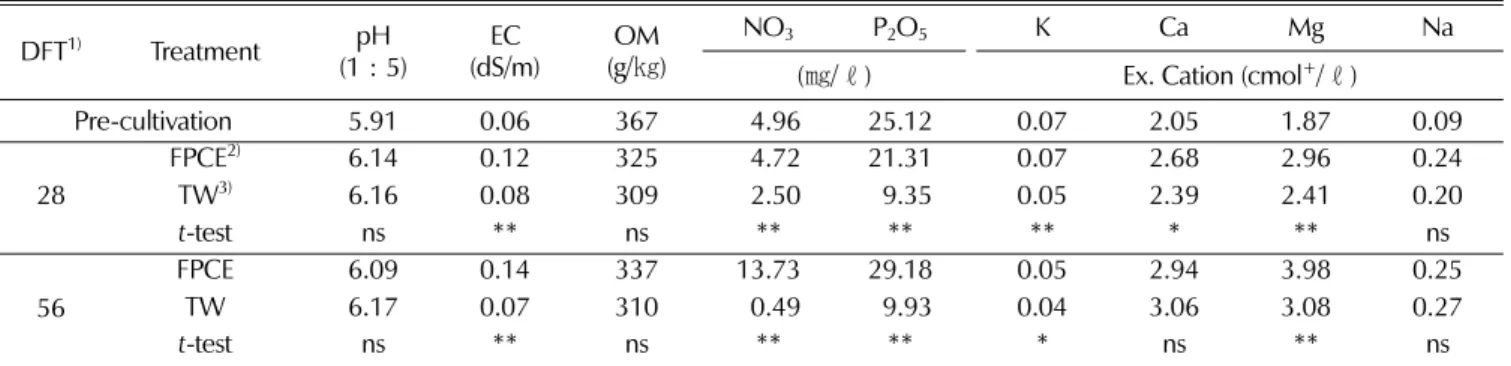
Table 1. Changes of nursery soil chemical properties by auto-irrigation of fermented press cake extract and tap water during cultivation period.
DFT1) Treatment pH
(1 : 5)
EC (dS/m)
(g/㎏)OM
NO3 P2O5 K Ca Mg Na
(㎎/ ℓ ) Ex. Cation (cmol+/ℓ )
Pre-cultivation 5.91 0.06 367
04.96
25.12 0.07 2.05 1.87 0.0928
FPCE2) 6.14 0.12 325
04.72
21.31 0.07 2.68 2.96 0.24TW3) 6.16 0.08 309
02.50 09.35
0.05 2.39 2.41 0.20t-test ns ** ns ** ** ** * ** ns
56
FPCE 6.09 0.14 337 13.73 29.18 0.05 2.94 3.98 0.25
TW 6.17 0.07 310
00.49 09.93
0.04 3.06 3.08 0.27t-test ns ** ns ** ** * ns ** ns
Values are presented as means of triplicate determinations from separate experiments. Significantly different at *p < 0.05 and **p < 0.01
RESULTS AND DISCUSSION
1. Changes in nursery soil chemical properties
Table 1 shows the changes in nursery soil chemical properties when the FPCE and TW were automatically
adjusted to 15 - 18% moisture content during the cultivation of ginseng (Panax Ginseng C. A. Meyer) sprouts.
There was no statistical difference between FPCE and TW in pH, OM, and Na regardless of the treatment days and in Ca after 56 days of treatment. However, EC, NO
3, P
2O
5, K, and Mg were measured higher in FPCE than in TW and when FPCE was used, the amounts of these components were in an increasing trend prior to cultivation to 56 days of cultivation. When TW was used, EC, NO
3, P
2O
5, K, and Mg tended to decrease or stay the same except Ca. This seems to be the case because the components were filtered as extracts by the water without any nutrition added. (Jang et al., 2013).
The continuous watering maintained the moisture level
Fig. 1. Partial dry weight of ginseng sprouts applied fermented press cake extract (FPCE) and tap water (TW) after transplanting seedling. A; leaf, B; stem, C; root. The vertical error bars represent the standard errors (n = 20). *p < 0.05 and **p
< 0.01 compared to FPCE and TW. NS; Not significant.
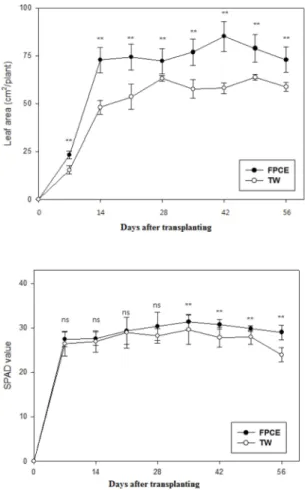
Fig. 2. Leaf area and SPAD value of ginseng sprouts applied fermented press cake extract (FPCE) and tap water (TW) after transplanting seedling. The vertical error bars represent the standard errors (n = 20). *p < 0.05 and **p <
0.01 compared to FPCE and TW. NS; Not significant.
and increased the pH compared to the level prior to cultivation, but the pH ranged around at 5.4 - 6.2, the appropriate level for non-soil cultivation. When the level of pH increases beyond the appropriate level in non-soil cultivation based on peat- moss rather than nursery soil with minerals, the soil strongly adheres with inorganic substance (Lucas and Davis, 1961; Park et al., 2014).
This prevents crops from absorbing necessary nutrients so that non-soil cultivation prompts various considerations for growing ginseng sprouts.
2. Effect of FPCE and TW on growth by harvest time Differences in nutrient compositions significantly influence the parts of ginseng sprouts.
Seven days after replanting seedlings, the root growth of ginseng sprouts produced by FPCE decreased, while the stems increased and leaves had no difference. In terms of the total dry weights of ginseng sprouts, the average weights were not significantly different between TW (148.8 ㎎/g) and FPCE (148.3 ㎎/g).
This means that the distribution of matter production started from the rhizome of the ginseng as the emergence of the ground part is done first with the stem rather than with the leaves (Lee et al., 1996; Proctor, 2008).
Nonetheless, but total amount did not change during cultivation. This growth pattern continued until the 14
thday of cultivation when the weight of leaves became greater, and the weight difference between the stem and leaves widened until the 28
thday. From the 35
thto the 42
ndday, the difference narrowed but was greater than the error range. Then, after the 42
ndday, it was clear that ginseng sprouts grown with FPCE were greater in dry weight than the ones cultivated with TW.
Regardless of the nutrient supply, the growth of the top shoots rapidly increased until the 35
thday, similar to the weight of the roots. Then after the 35
thday, root enlargement became more apparent. The deficiency of N, K, and Mg hinders the growth of ginseng leaves.
In particular the deficiency of N, as the plant cell components of amino acids, protein, and nucleic acids directly inhibit the growth of plant leaves. If the deficiency persists, most plant species exhibit yellow leaves, especially old leaves close to the base (Kwon et al., 1999; Lee et al., 2013; Kim et al., 2015).
chlorophyll-producing ability of the seedling germ, damage to the leaves occurs when the inorganic element supply is not smooth from the 35
thday.
Plants that have the N deficiency often have stems with a woody texture. This lignification is due to the accumulation of carbohydrates that are not used in the synthesis of amino acids or other N-containing compounds (Bloom et al., 1993; Aber et al., 2003) K, present in the plant in the form of cation, plays an important role in regulating the osmotic potential of plant cells. The stem of a K-deficient plant is thin and weak (Navetiyal et al., 1989). In this experiment to produce ginseng sprouts, it is considered that N and K deficits influenced the dry weights of the stems at the same time from an early stage.
In plant cells, Mg also plays a specific role in the activation of enzymes involved in respiration, photosynthesis, DNA and RNA synthesis. In the experiment, since Mg is also part of the chlorophyll ring structure (Wahome et al., 2001), it would have been deficient with N, which would have inhibited the expansion of ginseng leaves and maintenance of chlorophyll content. However, on the 21
stday, while the ginseng sprouts with TW applied showed such deficient conditions that nutrient production was not active at full capacity, they had a 4.4% greater mass in average total weight than the ones with FPCE with 19.6%
lower mass for the upper parts and 30.7% greater root weights.
This is because the distribution of matter production originating from the root can consume more inherent stored matter for producing leaves or stems. This suggests that in terms of per plant weight, it is more beneficial for farms with difficulties in applying additional nutrients to harvest ginseng sprouts only on water on the 21
stday after planting ginseng seedlings.
3. Analysis of partial ginsenoside during cultivation period
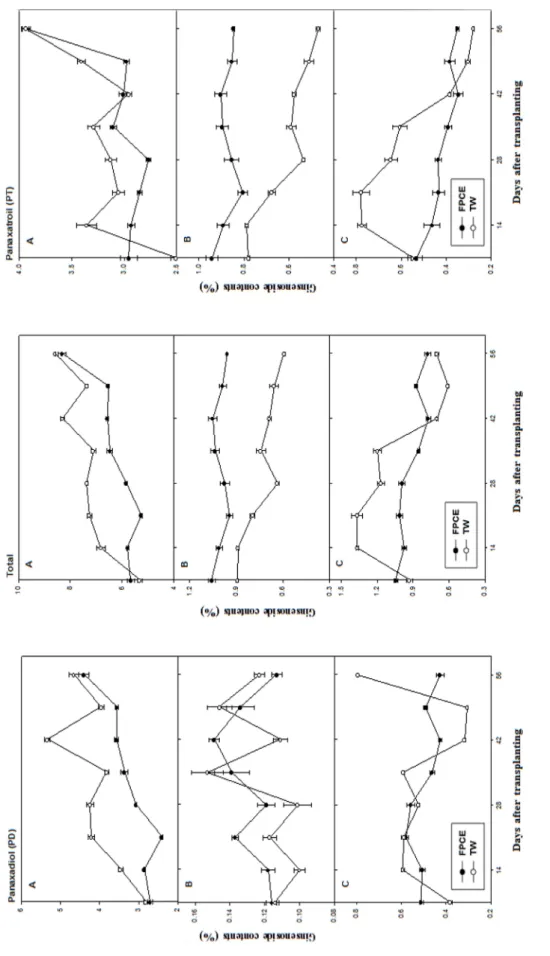
Changes in the ginsenoside contents of ginseng sprouts during automatic applications of FPCE and TW are shown in Fig. 3. As existing studies found, leaves have 6 - 8 times greater total ginsenoside contents than ones in roots or stems (Kim et al., 2010).
The ginsenoside contents of roots and stems were
Fi g. 3. Chang es in p artial gins enosid e c o ntents of gi ns eng s p rou ts ap plied fe rm ented pres s c ak e ext ract (F PCE) and t ap wate r (TW ) after t ransplanting se edling . A; leaf , B ; stem, C ; ro o t. P ana xa dio l (P D) = R b
1+R b
2+R b
3+R c+ R d , p an ax at ri o l ( P T )=R e + R f+R g
1+R g
2+R h
1. Da ta r epresent t h e mean s ± SD (n = 3 ).
the panaxadiol (PD) system (Rb
1, Rb
2, Rb
3, Rc and Rd) and panaxatriol (PT) system (Re, Rf, Rg
1, Rg
2and Rh
1) were large. In the case of roots, the ratio of PD and PT is about 1 : 1, but stems is about 1 : 8.
While most of the ginsenosides were composed of PT, P6H and chtochrome P450 genes are activated more in roots than other parts. This seems to be the case because protopanaxadiol can easily be converted to protopanaxatriol (Huang and Zhong, 2013).
Although the total ginsenoside content of ginseng is important, the PD/PT ratio is a more important factor in terms of its efficacy to consumers (Jin et al., 1999). PD- based ginsenoside is effective for central nervous system sedation and anti-inflammation, and PT ginsenoside is effective for fatigue recovery, strength improvement, and cholesterol reduction (Kim et al., 2008).
Thus, the optimal ratio seems to be approximately 1.0.
According to Kim et al. (2010) the ratio of PD/PT in hydroponic ginseng roots is 0.5 - 0.6, but in this study, in the case of ginseng sprouts, they have a PD/PT ratio of approximately 0.8 - 1.0, which is a level similar to 4-years- old ginseng (Han et al., 2013).
The composition of ginsenoside contents in ginseng sprouts showed various patterns by part with varying cultivation periods. In the case of leaves, ginsenoside contents increased 1.62 times in the PD system and 1.31 - 1.56 times in the PT system from 7 days to 56 days after transplantation. In the case of stems, the ginsenoside contents decreased by 0.6 - 0.89 times in the PT system, while the PT system contained the majority of the ginsenosides, and the total similarly decreased by 0.66 - 0.91 times.
The ginsenoside contents in roots increased until the 21
stday; and then showed a steep decline, which seems to be related to the distribution of the matter substances in the roots. This assumption is based on the observation that as the root dry weight decreased, the intrinsic ginsenoside contents increased and then decreased again from the 21
stday, while the dry weight increased.
Similarly, ginsenoside contents in leaves tended to increase gradually after the 28
thday, when the dry weight of leaves started to be maintained.
Many studies comparing ginsenoside contents by ginseng age have shown that the ginsenoside concentrations of 4- years-old ginseng was higher than that of 6-years-old ginseng (Court et al., 1996; Li and Wardle, 2002).
This indicates that there is a significant relationship between ginsenoside contents and ginseng growth. In particular, the difference is more apparent among short- term lived ginseng sprouts.
This study consistently found that ginsenoside contents was higher with TW-applied ginseng sprouts which had less leaf growth. However, as there was no significant growth difference in stems or roots by FPCE and TW, the more apparent difference came from the number of FPCE applications.
Ginsenoside is a glycoside conjugated with aglycone, the chemical structure of which is a dammarane triterpene, and is largely influenced by the accumulation of photosynthetic products. Excessive light uptake and accumulation of Na contents cause stress in plants, thus
Fig. 4. Changes in partial total ginsenoside per plant ofginseng sprouts applied fermented press cake extract (FPCE) and tap water (TW) after transplanting seedling. A; leaf, B; stem, C; root.
accumulation of carbohydrates (Ashraf and Orooj, 2006;
Jang et al., 2016). Ginseng, which has fewer accumulated saccharides, is forced to increase its ginsenoside content naturally. The ginsenoside changes per plant in leaf + stem + root were FPCE (y = 1.4330 + 0.2262x - 0.0008x
2) and TW (y = 0.9555 + 0.2997x - 0.0031x
2), where the x-axis is the period and the y-axis is the amount of ginsenosides.
Analysis based on day 26.4, when the two lines intersect, showed that the effects of FPCE and TW on the amounts of ginsenosides were similar, and then after day 26.4, the difference widened.
As ginsenosides are more abundant and the rate of ginsenoside accumulation is faster on leaves than on roots or stems, the study results show that the effects of FPCE and TW on ginseng ginsenosides are similar in leaves.
ACKNOWLEDGMENTS
This work was supported by Korea Institute of Planning and Evaluation for Technology in Food, Agriculture, Forestry and Fisheries(IPET) through Advanced Production Technology Development Program(315095-04-HD030), funded by Ministry of Agriculture, Food and Rural Affairs(MAFRA).
REFERENCES
Aber JD, Goodale CL, Ollinger SV, Smith ML, Magill AH, Martin ME, Hallett RA and Stoddard JL. (2003). Is nitrogen deposition altering the nitrogen status of northeastern forests?
Bioscience. 53:375-389.
Ashraf M and Orooj A. (2006). Salt stress effects on growth, ion accumulation and seed oil concentration in an arid zone traditional medicinal plant ajwain(Trachyspermum ammi [L].
Sprague). Journal of Arid Environments. 64:209-220.
Bloom AJ, Jackson LE and Smart DR. (1993). Root growth as a function of ammonium and nitrate in the root zone. Plant, Cell and Environment. 16:199-206.
Court WA, Reynolds LB and Hendel JG. (1996). Influence of root age on the concentration of ginsenosides of American ginseng(Panax quinquefolium). Canadian Journal of Plant Science. 76:853-855.
Eo J, Park KC and Yeon BR. (2011). Changes in soil biota affected by the application of organic materials in reclaimed upland and paddy-converted soils cultivated with Korea ginseng. Korean Journal of Soil Science and Fertilizer. 44:872- 877.
Han JS, Tak HS, Lee GS, Kim JS, Woo RJ and Choi JE.
(2013). Comparison of ginsenoside content and ratio of root tissue according to root age and diameter in Panax ginseng C.
A. Meyer. Korean Journal of Medicinal Crop Science. 21:342-
347.
Huang C and Zhong JJ. (2013). Elicitation of ginsenoside biosynthesis in cell cultures of Panax ginseng by vanadate.
Process Biochemistry. 48:1227-1234.
Jang IB, Hyun DY, Lee SW, Kim YC, Kim JU, Park GC, Bang KH and Kim GH. (2013). Analysis of growth characteristics and physiological disorder of Korean ginseng affected by application of manure in paddy-converted field.
Korean Journal of Medicinal Crop Science. 21:380-387.
Jang IB, Lee DY, Yu J, Park HW, Mo HS, Park KC, Hyun DY, Lee EH, Kim KH and Oh CS. (2015). Photosynthesis rates, growth, and ginsenoside contents of 2-yr-old Panax ginseng grown at different light transmission rates in a greenhouse. Journal of Ginseng Research. 39:345-353.
Jang IB, Yu J, Kweon KB and Suh SJ. (2016). Effect of controlled light environment on the growth and ginsenoside content of panax ginseng C. A. Meyer. Korean Journal of Medicinal Crop Science. 24:277-283.
Jin SH, Park JK, Nam KY, Park SN and Jung NP. (1999).
Korean red ginseng saponins with low ratios of protopanaxadiol and protopanaxatriol saponin improve scopolamine-induced learning disability and spatial working memory in mice. Journal of Ethnopharmacology. 66:123-129.
Kim DH, Moon YS, Lee TH, Jung JS, Suh HW and Song DK.
(2003). The inhibitory effect of ginseng saponins on the stress- induced plasma interleukin-6 level in mice. Neuroscience Letters. 353:13-16.
Kim GS, Jyun DY, Kim YO, Lee SW, Kim YC, Lee SE, Son YD, Lee MJ, Park CB, Park HK, Cha SW and Song KS.
(2008). Extraction and preprocessing methods for ginsenosides analysis of Panax ginseng C. A. Meyer. Korean Journal of Medicinal Crop Science. 16:446-454.
Kim GS, Hyun DY, Kim YO, Lee SE, Kwon H, Cha SW, Park CB and Kim YB. (2010). Investigation of ginsenosides in different parts of Panax ginseng cultured by hydroponics.
Korean Journal of Horticultural Science and Technology.
28:216-226.
Kim JU, Hyun DY, Kim YC, Lee JW, Jo IC, Kim DH, Kim KH and Shon JK. (2015). Effects of salt in soil condition on chlorophyll fluorescence and physiological disorder in Panax ginseng C. A. Meyer. Korean Journal of Medicinal Crop Science. 23:446-453.
Kwon TR, Harris PJC and Bourne WF. (1999). Partitioning of Na+, K+, proline, and total soluble sugar in relation to the salinity tolerance of Brassica juncea and Brassica rapa. Journal of the Korean Society for Horticultural Science. 40:425-430.
Lee JH, Lee MG, Chio KT and Lee SS. (1996). Identification of age of cultivated ginseng(Panax ginseng C. A. Meyer) based on stem vestige of rhizome. Korean Journal of Ginseng Science. 20:72-77.
Lee SW, Park KC, Lee SH, Park JM, Jang IB and Kim KH.
(2013). Soil chemical property and leaf mineral nutrient of ginseng cultivated in paddy field occurring leaf discoloration.
Korean Journal of Medicinal Crop Science. 21:289-295.
Li TSC and Wardle D. (2002). Seasonal fluctuations of leaf and root weight and ginsenoside contents of 2-, 3-, and 4-year-old American ginseng plants. HortTechnology. 12:229-232.
López MVN, Cuadrado PGS, Ruiz-Poveda OMP, Fresno AMVD and Accame EC. (2007). Neuroprotective effect of individual ginsenosides on astrocytes primary culture. Biochimica et Biophysica Acta. 1770:1308-1316.
Lucas RE and Davis JF. (1961). Relationships between pH values of organic soils and availabilities of 12 plant nutrients. Soil Science. 92:177-182.
Ministry of Agriculture, Food and Rural Affairs(MAFRA).
(2016). Enforcement regulation of Korean ginseng industry act.
Article 8(Tillage method and guidance). Ministry of Agriculture, Food and Rural Affairs. Sejong, Korea. p.169-175.
National Institute of Agricultural Sciences and Technology (NIAST). (2012). Methods of soil chemical analysis. National Institute of Agricultural Sciences and Technology. Rural Development Adminstration. Suwon, Korea. p.16-770.
Navetiyal RC, Ravindra V and Joshi YC. (1989). Germination and early seedling growth of some groundnut(Arachis hypogaea L.) cultivars under salt stress. Journal of Plant Physiology.
32:251-253.
Park HW, Jang IB, Kim YC, Mo HS, Park KC, Yu J, Kim JU, Lee EH, Kim KH and Hyun DY. (2014). Growth characteristics of ginseng seedlings as affected by mixed nursery soil under polyethylene film covered greenhouse.
Korean Journal of Medicinal Crop Science. 22:363-368.
Park JH. (2012). Antioxidant activities in shoots and roots of
hydroponic cultured ginseng. Journal of Applied Oriental Medicine. 16:21-26.
Proctor JTA. (2008). Source-sink relations in North American ginseng seedlings as influenced by leaflet removal. Journal of Ginseng Research. 32:337-340.
Rural Development Adminstration(RDA). (2014). Ginseng.
Rural Development Adminstration. Eumseong, Korea. p.90-246.
Shi W, Wang Y, Li J, Zhang H and Ding L. (2007).
Investigation of ginsenosides in different part and ages of Panax ginseng. Food Chemistry. 102:664-668.
Suh SO, Boo YJ, Park JM and Kim J. (2007). Prospective study for Korean red ginseng extract as an immune modulator following a curative surgery in patients with advanced colon cancer. Journal of Ginseng Research. 31:54-59.
Vuksan V, Sung MK, Sievenpiper JL, Stavro PM, Jenkins AL, Buono MD, Lee KS, Leiter LA, Nam KY, Arnason JT, Choi M and Naeem A. (2008). Korean red ginseng(Panax ginseng) improves glucose and insulin regulation in well- controlled, type 2 diabetes: Results of a randomized, double- blind, placebo-controlled study of efficacy and safety. Nutrition, Metabolism and Cardiovascular Diseases. 18:46-56.
Wahome PK, Jesch HH and Pinker I. (2001). Effect of sodium chloride on Rosa plants growing in vitro. Scientia Horticultrurae.
90:187-191.